As yesterday, travelling demands make it impossible to find creative time for the Blog. Thus a repeat of one of the most popular Posts from the last year.
Incredible outcomes from the dig in 2008
Stonehenge is one of Britain’s most famous historical sites, deservedly so because Stonehenge was one of the most important places in ancient Europe.
StonehengeProfessors Tim Darvill and Geoff Wainwright are the world-renowned archaeologists who believe they have cracked the conundrum of Stonehenge's original purpose.
But evidence from a dig that was authorised in 2008 has shown that not only is Stonehenge a much older site of human habitation but that it’s purpose is altogether different to what has been assumed. It was, indeed, a healing place, possibly the most important in Europe.
Those living in the UK can watch the Timewatch programme on the BBC iPlayer. But for those living outside the UK then the following web site has reams of wonderfully fascinating information. That site is here.
Apologies for the repeat but unable to write a fresh post for the next few days. This post about Kevin has been one of the most popular on Learning from Dogs.
Trust is both taught and learnt!
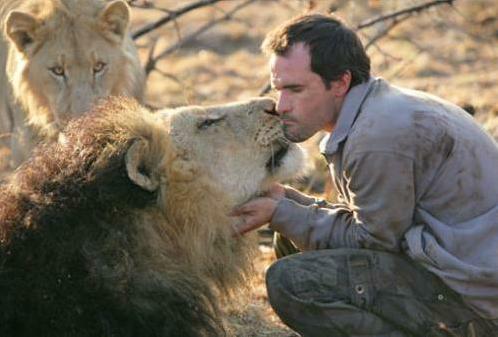
Thanks to Naked Capitalism, we posted an item on the 19th December about an unknown wild-life ranger working in the wildlife refuge area of Lanseria, South Africa. Here was one of the pictures included in that Post:
The Post finished with an appeal to anyone that knew the name of this Ranger. Many of you did and responded; thank you!
His name is Kevin Richardson and there is an interesting account of how he works and some of his ‘experiences’ in Revolution Magazine, luckily with online content. That article is here. It starts thus:
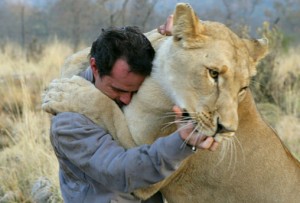
To do this he does not use the common methods of breaking the animal’s spirit with sticks and chains, instead he uses love, understanding and trust. With this unusual method of training he has developed some exceptionally personal bonds with his students. He sleeps with lions, cuddles newborn hyenas, swims with lionesses. Kevin can confidently look into their eyes, crouch to the their level and even lie down with them – all taboos in the normal world of wild animal handling – yet he doesn’t get mauled or attacked.
The article goes on to say that Kevin often works with the animals when they are very young. Thus he is demonstrating very powerfully that how we behave, especially with our children when they are young, creates the environment for building trust out of consistency of deed and thought. (By the way, do read some of the comments posted at the end of that Magazine article – some of them make for powerful reading.)
Kevin Richardson at 'work'.
Luckily, thanks to this wired world we now live in, there is also video of Kevin available on YouTube. A quick search under Kevin Richardson on YouTube will quickly find a number of videos but here are two that I wanted to share with you.
The first will leave you speechless and possibly wet-eyed!
The second is a promotional video by Kevin encouraging us to buy his recent book – and why not!
This is a very remarkable person and it’s an honour to share this with you. We have so much to learn from all animals.
Demonstrating the joy of being really good at what you do!
Before I get to the subject matter, just another word from me about the Posts being published on Learning from Dogs just now. As I mentioned earlier, I’m presently away from home and back in England for as long as it takes to complete all the necessary procedures at the US Embassy in London. All part of me being allowed to become a resident of Payson, Arizona and the husband to my lovely Jeannie.
Anyway, I’m posting items that catch my eye and don’t require the normal amount of time to prepare and write, simply because to have a new Post every day means keeping the pipeline going to cover the times when I shall be in darkest Devon and away from internet coverage! Trust I have your support during this period – I just love seeing so many readers of the Blog!
OK, to the article.
Bob Hoover
Bob Hoover is well known to many besides pilots because for years he has demonstrated the huge skill in managing the energy of a flying aircraft – with both engines stopped.
Thanks to Peter Kelsey, a Facebook contact, who recently posted a YouTube video of Bob flying his famous display. But more about the man. Here’s an extract from Wikipedia:
Robert A. “Bob” Hoover (born January 24, 1922) is a former air show pilot andUnited States Air Forcetest pilot, known for his wide-brimmed straw hat and wide smile. In aviation circles, he is often referred to as “The pilots’ pilot.”
Bob Hoover learned to fly at Nashville‘s Berry Field while working at a local grocery store to pay for the flight training.[1] He enlisted in the Tennessee National Guard and was sent for pilot training with the Army.[2] He was sent to Casablanca where his first major assignment of the war was test flying the assembled aircraft ready for service.[3] He was later assigned to the Spitfire-equipped 52nd Fighter Group in Sicily.[4] In 1944, on his 59th mission, his malfunctioning Mark V Spitfire was shot down by a Focke-Wulf Fw 190 off the coast of Southern France and he was taken prisoner.[5] He spent 16 months at the German prison campStalag Luft 1 in Barth,Germany.[6]
He managed to escape from the prison camp, stole an Fw 190, and flew to safety in the Netherlands.[7] After the war, he was assigned to flight-test duty at Wright Field. There he impressed and befriended Chuck Yeager.[8] Later when Yeager was asked who he wanted for flight crew for the supersonicBell X-1 flight, he named Bob Hoover. Hoover was Yeager’s backup pilot in the Bell X-1 program and flew chase for Yeager in a LockheedP-80 Shooting Star during the Mach 1 flight.[9] He also flew chase for the 50th anniversary in an F-16 Fighting Falcon.[10]
What Bob shows is that true professionalism, in whatever one does, work or play, always comes over as an underplayed, understated skill. Just look at this video for proof of that:
Well over 1,700,000 viewings at the time of writing this Post!
Remember Gordo Cooper in the film “The Right Stuff” poses the question, “Who’s the greatest pilot you ever saw?” Most pilots of all sorts would elect Bob Hoover for that honorable position.
The Smithsonian seem to agree as well. If you can, settle back and watch Bob Hoover’s talk at the 2010 Smithsonian Charles A Lindberg lecture. The video at that link is a long one and Bob doesn’t come on stage until minute 20.
But the flying scenes in the introduction include some historic footage and the talk by Bob Hoover, now nearly 90, is just wonderful. That link also includes the following summary of Bob Hoover:
Robert A. “Bob” Hoover is a fighter, military, and civilian test and air show pilot of legendary proportions. Using his superb piloting skills to fly aircraft to the edge of their performance capabilities, Hoover has left an indelible mark in aviation history. During his Air Force and North American Aviation careers, he flew 58 combat missions (and as a WWII POW flew himself to freedom), served as back-up pilot on the Bell X-1 and tested a wide array of fighter aircraft. As an ambassador of aviation, Hoover flew aerobatic routines in a North American P-51 Mustang, the T-39, and the Aero Commander fleet, culminating in the Shrike Commander 500S, at more than 2,500 civilian and military air shows. Bob Hoover will discuss his career in aviation and some of the pilots he has known including Orville Wright, Eddie Rickenbacker, Charles Lindbergh, Jacqueline Cochran, Neil Armstrong, and Yuri Gagarin.
The BBC reported last Wednesday (1st) the fact that NASA are now advising the Chilean authorities with regard to the trapped miners.
At first, I did a double-take. NASA? Why?
But, of course, it make complete sense. Astronauts clearly have had to face the most extreme form of loneliness – that of being alone in outer space.
Here’s an extract from that BBC piece, which has been widely reported elsewhere:
A team of Nasa experts advised officials to be honest with the miners and not to give them “false hopes”.
The miners, who are 700m (2,300ft) underground, have been told it could take a long time to get them out of the San Jose mine, but have not been given dates.
The Nasa team, which includes a doctor, nutritionist, and engineer and a psychologist, arrived in Santiago after a request by the Chilean authorities. They are due to travel to the mine site on Wednesday.
All we can do is to keep these miners in our minds and hearts.
I make no apology for this being the third day on the theme of the wonderful, loyal Akita dog, Hachikō. On the 31st I wrote about the American film that in modern style echoed the beautiful, original Japanese film of over 80 years ago.
Anyway, Daniela Caride, of the blog The Daily Tail, added a lovely comment to that first post and it deserved being published in full. Here it is:
I sobbed for two hours straight watching “Hachi, a dog’s tale” (I still have a headache) — a movie inspired by the real story of Hachiko, an Akita dog who achieved international fame for his loyalty. The dog waited for his deceased owner for nine years at the train station.
I realized that Hachi became a symbol of loyalty not because he was better than any other dog. Dogs are exceptionally loyal if treated with love and respect. But nobody offered Hachi a loving home during the long years he waited for Professor Ueno. It broke my heart. So I wrote the poem below.
Hachiko the dog
I humbly ask you to send this post to every person you know who may be able to find a home to a pet in need. Together we may be able to ease the pain of homeless animals like Hachi, who ask for so little and give back so much.
Hachi waits
By Daniela Caride
Hachi waits at the train station
The dog waits for nine minutes
It’s after five
It’s time
And the professor doesn’t arrive
Hachi waits for nine hours
Nine days
The professor is late
But the dog doesn’t mind
At the train station he stays
Hachi waits for nine months
Nine years straight
He’s convinced the professor is really late
But the dog doesn’t mind
At the train station he stays
Tired of old age, not tired of his long wait
Hachi finally closes his eyes
And finds his friend
In his deepest dreams inside
At the end
But Hachi still waits
Even after he died
He waits on the streets of every town
At all the neighborhood pounds
Under the skin of every dog around
For someone to rescue him
To give him
A name
Water
Food
And a home
Where love abounds
The lesson from dogs is so obvious but, in a sense, so out of reach to us.
The story published yesterday about the Japanese Akita dog, Hachikō, reverberated around my mind for some days afterwards. (It was written on the 27th.)
It wasn’t only about the incredible loyalty shown by the dog towards its master – refusing to accept that its master was never coming home, year after year. To be honest, humans also show great loyalty to their families and dear friends.
No, there was something else that I couldn’t put my finger on until this morning. It was a dog’s ability to make the best of every moment, to fully experience what is happening now. It’s not the first time I have reflected on this aspect of the dog.
We humans have a similar capability but our intellect, our capacity to reflect on the past and ponder (worry?) about the future frequently means that the value of the moment, the preciousness of now, is lost. I could go on about this – perhaps in another Post.
But I was reminded of when I published a short piece over a year ago, from an unknown author, that was a wonderful attempt to let us humans see into the mind of a dog. Here it is again.
A love song
Pharaoh
I am your dog and have something I would love to whisper in your ear. I know that you humans lead very busy lives. Some have to work, some have children to raise, some have to do this alone. It always seems like you are running here and there, often too fast, never noticing the truly grand things in life.
Look down at me now. While you sit at your computer. See the way my dark, brown eyes look at yours.
You smile at me. I see love in your eyes. What do you see in mine? Do you see a spirit? A soul inside who loves you as no other could in the world? A spirit that would forgive all trespasses of prior wrong doing for just a single moment of your time? That is all I ask. To slow down, if even for a few minutes, to be with me.
So many times you are saddened by others of my kind passing on. Sometimes we die young and oh so quickly, so suddenly that it wrenches your heart out of your throat. Sometimes, we age slowly before your eyes that you may not even seem to know until the very end, when we look at you with grizzled muzzles and cataract-clouded eyes. Still the love is always there even when we must take that last, long sleep dreaming of running free in a distant, open land.
I may not be here tomorrow. I may not be here next week. Someday you will shed the water from your eyes, that humans have when grief fills their souls, and you will mourn the loss of just ‘one more day’ with me. Because I love you so, this future sorrow even now touches my spirit and grieves me. I read you in so many ways that you cannot even start to contemplate.
We have now together. So come and sit next to me here on the floor and look deep into my eyes. What do you see? Do you see how if you look deeply at me we can talk, you and I, heart to heart. Come not to me as my owner but as a living soul. Stroke my fur and let us look deep into the other’s eyes and talk with our hearts.
I may tell you something about the fun of working the scents in the woods where you and I go. Or I may tell you something profound about myself or how we dogs see life in general. I know you decided to have me in your life because you wanted a soul to share things with. I know how much you have cared for me and always stood up for me even when others have been against me. I know how hard you have worked to help me be the teacher dog that I was born to be. That gift from you has been very precious to me. I know too that you have been through troubled times and I have been there to guard you, to protect you and to be there always for you. I am very different to you but here I am. I am a dog but just as alive as you.
I feel emotion. I feel physical senses. I can revel in the differences of our spirits and souls. I do not think of you as a dog on two feet; I know what you are. You are human, in all your quirkiness, and I love you still.
So, come and sit with me. Enter my world and let time slow down if only for a few minutes. Look deep into my eyes and whisper in my ears. Speak with your heart and I will know your true self. We may not have tomorrow but we do have now.
We may not have tomorrow, but we do have now! Cherish the moment.
We recently watched a film about an Akita dog called Hachi, Hachikō in Japanese, that demonstrates the loyalty that dogs can have for their human owners.
Here’s the official movie trailer. [UPDATE – for copyright reasons that movie trailer has been removed from YouTube.]
It’s a very moving film – seriously so! Expect to shed many tears. Even more so when one reflects that the Hollywood film is based, reasonably accurately, on a true story. The details of this story are in Wikipedia from which is quoted:
In 1924, Hidesaburō Ueno, a professor in the agriculture department at the University of Tokyo took in Hachikō as a pet. During his owner’s life Hachikō saw him out from the front door and greeted him at the end of the day at the nearby Shibuya Station. The pair continued their daily routine until May 1925, when Professor Ueno did not return on the usual train one evening. The professor had suffered from a cerebral hemorrhage at the university that day. He died and never returned to the train station where his friend was waiting. Hachikō was loyal and every day for the next nine years he waited sitting there amongst the town’s folk.
Hachikō was given away after his master’s death, but he routinely escaped, showing up again and again at his old home. Eventually, Hachikō apparently realized that Professor Ueno no longer lived at the house. So he went to look for his master at the train station where he had accompanied him so many times before. Each day, Hachikō waited for Professor Ueno to return. And each day he did not see his friend among the commuters at the station.
The permanent fixture at the train station that was Hachikō attracted the attention of other commuters. Many of the people who frequented the Shibuya train station had seen Hachikō and Professor Ueno together each day. They brought Hachikō treats and food to nourish him during his wait.
This continued for nine years with Hachikō appearing precisely when the train was due at the station
This hasn’t been the only film about this dog. See below:
Back to the Wikipedia entry:
That same year, another of Ueno’s faithful students (who had become something of an expert on the Akita breed) saw the dog at the station and followed him to the Kobayashi home (the home of the former gardener of Professor Ueno — Kikuzaboro Kobayashi) where he learned the history of Hachikō’s life. Shortly after this meeting, the former student published a documented census of Akitas in Japan. His research found only 30 purebred Akitas remaining, including Hachikō from Shibuya Station.
Professor Ueno’s former student returned frequently to visit the dog and over the years published several articles about Hachikō’s remarkable loyalty. In 1932 one of these articles, published in Tokyo’s largest newspaper, threw the dog into the national spotlight. Hachikō became a national sensation. His faithfulness to his master’s memory impressed the people of Japan as a spirit of family loyalty all should strive to achieve. Teachers and parents used Hachikō’s vigil as an example for children to follow. A well-known Japanese artist rendered a sculpture of the dog, and throughout the country a new awareness of the Akita breed grew.
Eventually, Hachiko’s legendary faithfulness became a national symbol of loyalty.
Hachikō died on March 8, 1935. He was found on a street in Shibuya. His heart was infected with filarial worms and 3-4 yakitori sticks were found in his stomach. His stuffed and mounted remains are kept at the National Science Museum of Japan in Ueno, Tokyo.
Hachiko
The Akita breed has a great reputation for loyalty. But knowing that doesn’t in any way weaken the power of the message for the present times.
A dog offers loyalty, trust and love in exchange for being treated, in turn, with integrity and compassion.
From the Hubble website. Here’s the description of the image:
“Starry Night”, Vincent van Gogh‘s famous painting, is renowned for its bold whorls of light sweeping across a raging night sky. Although this image of the heavens came only from the artist’s restless imagination, a new picture from the NASA/ESA Hubble Space Telescope bears remarkable similarities to the van Gogh work, complete with never-before-seen spirals of dust swirling across trillions of kilometres of interstellar space.
This image, obtained with the Advanced Camera for Surveys on February 8, 2004, is Hubble’s latest view of an expanding halo of light around a distant star, named V838 Monocerotis (V838 Mon).
The illumination of interstellar dust comes from the red supergiant star at the middle of the image, which gave off a flashbulb-like pulse of light two years ago. V838 Mon is located about 20,000 light-years away from Earth in the direction of the constellation Monoceros, placing the star at the outer edge of our Milky Way galaxy.
A single light-year is approximately 6 trillion miles, or 9,460,730,472,580.8 kms for the metric brigade! Thus 20,000 light-years is 120,000 trillion miles, or 120,000,000,000,000,000 miles.
It is beyond imagination – yet it is real!
It humbles one beyond measure that in this short lifetime on mine, science has reached out so far. And then one looks more closely to home and remains appalled that we have learnt so little about living in peace and with integrity on this funny third rock from the Sun.
Let’s all pray to keep the flame of hope burning brightly for these guys.
On the 24th August, Learning from Dogs published a piece about 33 Chilean miners trapped underground. I’m sure many read that.
Well the BBC are still covering the event and their news web site has an informative update on what is happening.
The plan to rescue the 33 men trapped 700m (2,300ft) underground in the San Jose copper mine in Chile is a complex undertaking that could take engineers until the end of the year to achieve.
In a similar operation in 2002, American rescuers spent two days drilling a hole just wide enough to fit a man to rescue nine miners trapped underground.
The Americans had to drill down just 74m. By comparison, the plan to rescue the 33 men in Chile nearly three quarters of a kilometre underground is a much greater challenge. But, says John Urosek, who took part in the 2002 Quecreek mine rescue in Pennsylvania, it is not “mission impossible.”
“I would put this at the tough end of things. It’s not mission impossible but it’s a difficult mission,” says Mr Urosek who is now chief of mine emergency operations for the US Mine Safety and Health Administration.
The key to the operation is the use of a specialist drilling machine, designed to bore deep narrow holes through any rock to a depth of just over a kilometre.