More from Unsplash.

oooo

oooo

oooo

oooo

oooo

oooo

oooo

They are all beyond beautiful. They are the reason we love dogs so much!
Dogs are animals of integrity. We have much to learn from them.
Author: Paul Handover
More from Unsplash.
oooo
oooo
oooo
oooo
oooo
oooo
oooo
They are all beyond beautiful. They are the reason we love dogs so much!
This beautiful topic just runs and runs; and so it should!
I saw a post on Newsweek published a couple of weeks ago and saved the link. It opens:
It’s probably impossible to know exactly what your dog is thinking. But a few years ago, Gregory Berns, a neuroscientist at Emory University, decided he wanted to try and find out anyway.
Newsweek
But then I realised that over the years I had published numerous posts on the topic. So I thought it was best to republish one of them, and I chose this one.
ooOOoo
The love of dogs
Pure and simple!
Thank you, M.K.
I promise you that you won’t be able to resist a tear or two.
It’s simply wonderful; the unconditional love of our dogs!
ooOOoo
Beautiful!
About keeping oneself mentally healthy.
I follow the website The Conversation and read most of their posts on a very regular basis. Back in May they published the following. It caught my eye because my own mental health is drifting downwards, or so it seems, due to age, I shall be 80 in November, 2024, plus a couple of brain bleedings that occurred in 2017 that were attended to by the Regional Trauma Center in Eugene.
I then had two sub-durnal (sp?) operations overnight before being put onto the ICU ward. The lead surgeon explained that I was within 24 hours of dying! As in if I had not gone back to hospital.
I find that difficult to realise that it was 6 years ago! Anyway, to the post published by The Conversation.
ooOOoo
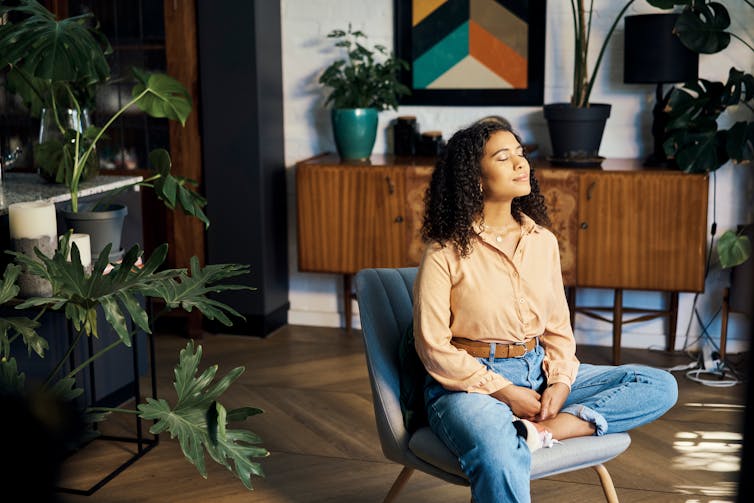
Rachel Goldsmith Turow, Seattle University
Mindfulness and self-compassion are now buzzwords for self-improvement. But in fact, a growing body of research shows these practices can lead to real mental health benefits. This research – ongoing, voluminous and worldwide – clearly shows how and why these two practices work.
One effective way to cultivate mindfulness and self-compassion is through meditation.
For more than 20 years, as a clinical psychologist, research scientist and educator, I taught meditation to students and clinical patients and took a deep dive into the research literature. My recent book, “The Self-Talk Workout: Six Science-Backed Strategies to Dissolve Self-Criticism and Transform the Voice in Your Head,” highlights much of that research.
I learned even more when I evaluated mental health programs and psychology classes that train participants in mindfulness and compassion-based techniques.
Mindfulness means purposefully paying attention to the present moment with an attitude of interest or curiosity rather than judgment.
Self-compassion involves being kind and understanding toward yourself, even during moments of suffering or failure.
Both are associated with greater well-being.
But don’t confuse self-compassion with self-esteem or self-centeredness, or assume that it somehow lowers your standards, motivation or productivity. Instead, research shows that self-compassion is linked with greater motivation, less procrastination and better relationships.
Could mindfulness meditation be the next public health revolution?
I didn’t like meditation – the specific practice sessions that train mindfulness and self-compassion – the first time I tried it as a college student in the late ‘90s. I felt like a failure when my mind wandered, and I interpreted that as a sign that I couldn’t do it.
In both my own and others’ meditation practices, I’ve noticed that the beginning is often rocky and full of doubt, resistance and distraction.
But what seem like impediments can actually enhance meditation practice, because the mental work of handling them builds strength.
For the first six months I meditated, my body and mind were restless. I wanted to get up and do other tasks. But I didn’t. Eventually it became easier to notice my urges and thoughts without acting upon them. I didn’t get as upset with myself.
After about a year of consistent meditation, my mind seemed more organized and controllable; it no longer got stuck in self-critical loops. I felt a sense of kindness or friendliness toward myself in everyday moments, as well as during joyful or difficult experiences. I enjoyed ordinary activities more, such as walking or cleaning.
It took a while to understand that anytime you sit down and try to meditate, that’s meditation. It is a mental process, rather than a destination.
Just having a general intention to be more mindful or self-compassionate is unlikely to work.
Most programs shown to make meaningful differences involve at least seven sessions. Studies show these repeated workouts improve attention skills and decrease rumination, or repeated negative thinking.
They also lessen self-criticism, which is linked to numerous mental health difficulties, including depression, anxiety, eating disorders, self-harm and post-traumatic stress disorder.
Meditation is not just about sustaining your attention – it’s also about shifting and returning your focus after the distraction. The act of shifting and refocusing cultivates attention skills and decreases rumination.
Trying repeatedly to refrain from self-judgment during the session will train your mind to be less self-critical.
An interconnected group of brain regions called the default mode network is strikingly affected by meditation. Much of this network’s activity reflects repetitive thinking, such as a rehash of a decadeslong tension with your sister. It’s most prominent when you’re not doing much of anything. Activity of the default mode network is related to rumination, unhappiness and depression.
Research shows that just one month of meditation reduces the noise of the default mode network. The type of meditation practice doesn’t seem to matter.
Don’t be discouraged if your mind wanders as you meditate.
A common misconception about mindfulness is that it’s simply a way to relax or clear the mind. Rather, it means intentionally paying attention to your experiences in a nonjudgmental way.
Consider meditation the formal part of your practice – that is, setting aside a time to work on specific mindfulness and self-compassion techniques.
Cultivating mindfulness with meditation often involves focusing on paying attention to the breath. A common way to start practice is to sit in a comfortable place and bring attention to your breathing, wherever you feel it most strongly.
At some point, probably after a breath or two, your mind will wander to another thought or feeling. As soon as you notice that, you can bring your attention back to the breath and try not to judge yourself for losing focus for five to 10 minutes.
When I was just getting started meditating, I would have to redirect my attention dozens or hundreds of times in a 20-to-30-minute session. Counting 10 breaths, and then another 10, and so on, helped me link my mind to the task of paying attention to my breathing.
The most well-established technique for cultivating self-compassion is called loving-kindness meditation. To practice, you can find a comfortable position, and for at least five minutes, internally repeat phrases such as, “May I be safe. May I be happy. May I be healthy. May I live with ease.”
When your attention wanders, you can bring it back with as little self-judgment as possible and continue repeating the phrases. Then, if you like, offer the same well wishes to other people or to all beings.
Every time you return your focus to your practice without judging, you’re flexing your mental awareness, because you noticed your mind wandered. You also improve your capacity to shift attention, a valuable anti-rumination skill, and your nonjudgment, an antidote to self-criticism.
These practices work. Studies show that brain activity during meditation results in less self-judgment, depression and anxiety and results in less rumination.
Mindfulness also occurs when you tune into present-moment sensations, such as tasting your food or washing the dishes.
An ongoing routine of formal and informal practice can transform your thinking. And again, doing it once in a while won’t help as much. It’s like situps: A single situp isn’t likely to strengthen your abdominal muscles, but doing several sets each day will.
When thoughts pop up during meditation, no worries. Just start again … and again … and again.
Studies show that mindfulness meditation and loving-kindness meditation reduce self-criticism, which leads to better mental health, including lower levels of depression, anxiety and PTSD. After an eight-week mindfulness program, participants experienced less self-judgment. These changes were linked with decreases in depression and anxiety.
One final point: Beginning meditators may find that self-criticism gets worse before it gets better.
After years or decades of habitual self-judgment, people often judge themselves harshly about losing focus during meditation. But once students get through the first few weeks of practice, the self-judgment begins to abate, both about meditation and about oneself in general.
As one of my students recently said after several weeks of mindfulness meditation: “I am more stable, more able to detach from unhelpful thoughts and can do all of this while being a little more compassionate and loving toward myself.”
Rachel Goldsmith Turow, Adjunct Assistant Professor in Population Health Science and Policy, Seattle University
This article is republished from The Conversation under a Creative Commons license. Read the original article.
ooOOoo
I do not meditate; have never done so.
In reading this article I think I should try and find a way to start the process. There are a great number of articles and websites. I will share my journey with you.
Time will tell!
Yet more dogs from Unsplash.
My son is unable to provide his fabulous photographs of birds every other week. More from him on an ‘as and when‘ basis.

oooo

oooo

oooo

oooo

oooo

oooo

oooo
There we go! More photographs in a week’s time.
A delightful story that one hopes will be allowed to share.
One is constantly looking for lovely dog stories and recently I came across this story from The Dodo.
ooOOoo
Woman Stops In Her Tracks When She Sees Brown Legs Poking Out Of Trash
Published on the 20th April, 2023
The other day, members of the neighborhood watch in Richards Bay, South Africa, received a shocking phone call. A woman said she’d been walking through an undeveloped area of wilderness nearby and stumbled on something heartbreaking.
Two watch captains rushed to the scene. When they arrived, they found a discarded pile of rubble and plastic — not necessarily a surprise, given that trash is occasionally dumped in the area. What was upsetting, though, were the pair of long brown legs and pleading black eyes barely visible under the debris.
A little dog was trapped, and he needed help.

With caution, the team began to cut the dog loose from the plastic bag where he’d been tied up. After freeing the pup, they carried him out of the trash and gently placed him in the grass nearby.

The dog, later named Rocky, was so happy to be able to move around, though he was very weak from his ordeal. Neighborhood watch personnel gave the pup some ice cubes to suck on while they waited for SPCA Richards Bay staff to arrive.

Safe at the SPCA, a veterinary team examined Rocky and treated him for a small wound on his head. The malnourished pup was given plenty of food and water, and, in no time, Rocky’s slim figure began to improve and his personality began to shine.
“Rocky is now the sweetest, most outgoing puppy,” a representative from SPCA Richards Bay told The Dodo.
SPCA staff were inspired by Rocky — who spread so much love and who didn’t seem jaded by his harrowing ordeal.
“We were amazed at how a puppy who had been discarded like trash could love and trust again,” the representative said.

Rocky has since been adopted into a loving family and taken to live with them on their farm. The grateful pup, who once spent hours trapped under garbage, unable to move, will spend the rest of his days running through the ample fields of his new home, loving every minute.
ooOOoo
All of the above photographs are taken by FACEBOOK/SPCA RICHARDS BAY
No matter where in the world one is there is a love for dogs and this account shows it to be so!
It is one of many things that deteriorate with age!
Jeannie and I go to the Club Northwest locally in Grants Pass twice a week. It is a local gym. Jean goes to her Rock Steady class and I see a coach. Both of us spend time ensuring our balance is as good as it can be. For me that consists primarily of spending a minute standing on each leg on a vibrating platform; it is not easy.
So for all the more elderly people out there, here is an article that was recently published on The Conversation.
ooOOoo
Published: May 19, 2023

My wife and I were in the grocery store recently when we noticed an older woman reaching above her head for some produce. As she stretched out her hand, she lost her balance and began falling forward. Fortunately, she leaned into her grocery cart, which prevented her from falling to the ground.
Each year, about 1 in every 4 older adults experience a fall. In fact, falls are the leading cause of injuries in adults ages 65 and older. Falls are the most common cause of hip fractures and traumatic brain injuries.
Injuries like those are also risk factors for placement in a nursing home, where the fall risk is nearly three times higher than for people living in the community.
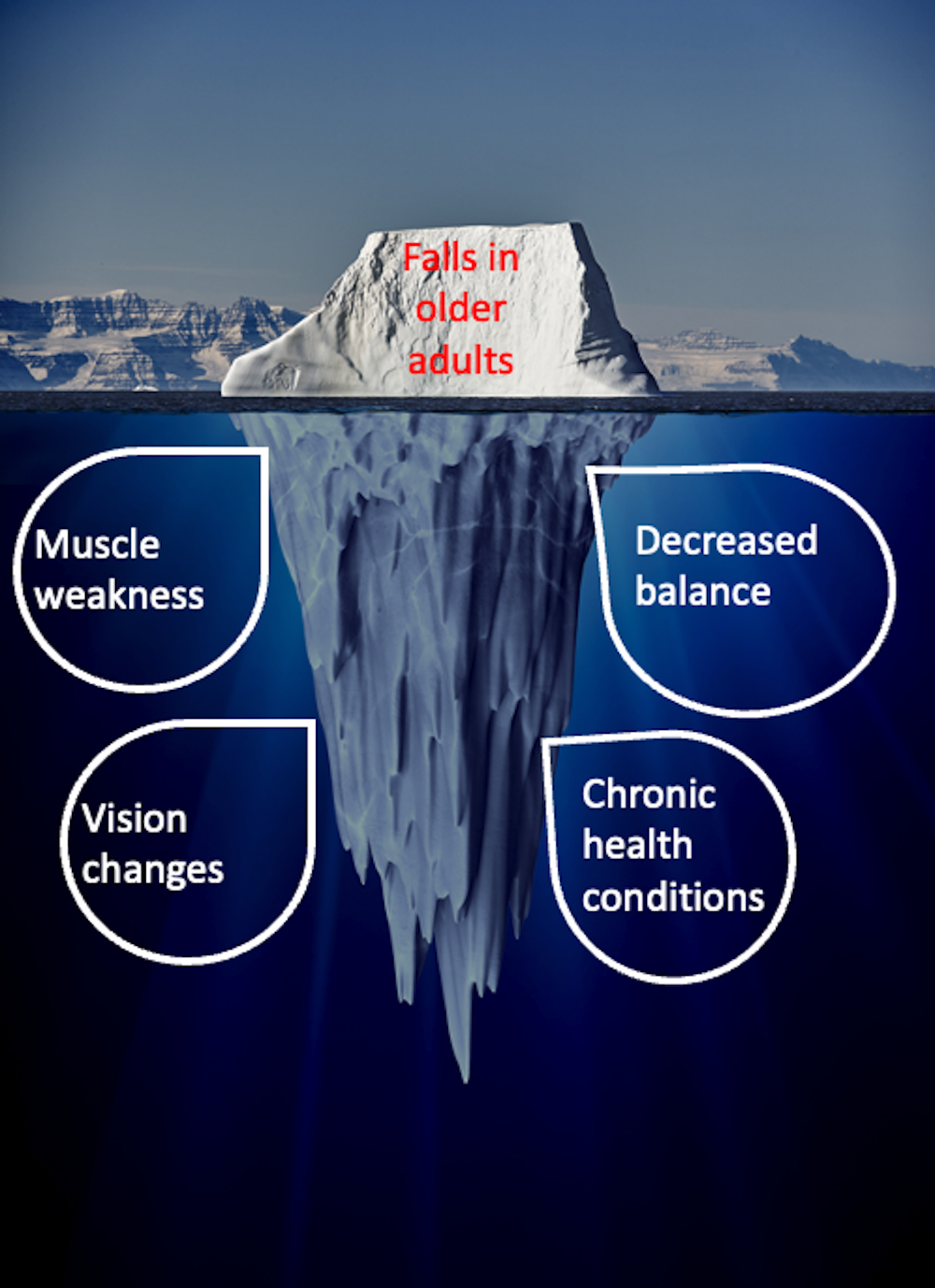
A number of physical changes with aging often go unseen preceding falls, including muscle weakness, decreased balance and changes in vision.
I am a physical therapist and clinical scientist focused on fall prevention in older adults, commonly ages 65 and older. I’ve spent most of my career investigating why older adults fall and working with patients and their families to prevent falls.
Aging is a process that affects the systems and tissues of every person. The rate and magnitude of aging may be different for each person, but overall physical decline is an inevitable part of life. Most people think aging starts in their 60s, but in fact we spend most of our life span undergoing the process of decline, typically beginning in our 30s.
Older adults are more prone to falling for various reasons, including age-related changes in their bodies and vision changes that leave them vulnerable to environmental factors such as curbs, stairs and carpet folds.
Some straightforward measures to improve the safety of the home environment for older adults can significantly lower the risk of falls.
Based on my experience, here are some common reasons older adults may experience falls:
First, aging leads to a natural loss of muscle strength and flexibility, making it more challenging to maintain balance and stability. The loss of strength and poor balance are two of the most common causes of falls.
Second, older adults often have chronic conditions such as arthritis, Parkinson’s disease or diabetes that can affect their mobility, coordination and overall stability.
In addition, certain medications commonly taken by older adults, such as sedatives or blood pressure drugs, can cause dizziness, drowsiness or a drop in blood pressure, leading to an increased risk of falls.
Age-related vision changes, such as reduced depth perception and peripheral vision and difficulty in differentiating colors or contrasts, can make it harder to navigate and identify potential hazards. Hazards in the environment, such as uneven surfaces, slippery floors, inadequate lighting, loose rugs or carpets or cluttered pathways, can significantly contribute to falls among older adults.
Older adults who lead a sedentary lifestyle or have limited physical activity may also experience reduced strength, flexibility and balance.
And finally, such conditions as dementia or Alzheimer’s disease can affect judgment, attention and spatial awareness, leading to increased fall risk.
There are numerous theories about why we age but there is no one unifying notion that explains all the changes in our bodies. A large portion of aging-related decline is caused by our genes, which determine the structure and function of bones, muscle growth and repair and visual depth perception, among other things. But there are also numerous lifestyle-related factors that influence our rate of aging including diet, exercise, stress and exposure to environmental toxins.
A recent advance in scientific understanding of aging is that there is a difference between your chronological age and your biological age. Chronological age is simply the number of years you’ve been on the Earth. Biological age, however, refers to how old your cells and tissues are. It is based on physiological evidence from a blood test and is related to your physical and functional ability. Thus, if you’re healthy and fit, your biological age may be lower than your chronological age. However, the reverse can also be true.
I encourage patients to focus on their biological age because it empowers them to take control over the aging process. We obviously have no control over when we are born. By focusing on the age of our cells, we can avoid long-held beliefs that our bodies are destined to develop cancer, diabetes or other conditions that have historically been tied to how long we live.
And by taking control of diet, exercise, sleep and other lifestyle factors you can actually decrease your biological age and improve your quality of life. As one example, our team’s research has shown that moderate amounts of aerobic exercise can slow down motor decline even when a person begins exercise in the latter half of the life span.
Adopting lifestyle changes such as regular, long-term exercise can reduce the consequences of aging, including falls and injuries. Following a healthy diet, managing chronic conditions, reviewing medications with health care professionals, maintaining a safe home environment and getting regular vision checkups can also help reduce the risk of falls in older adults.
There are several exercises that physical therapists use to improve balance for patients. It is important to note however, that before starting any exercise program, everyone should consult with a health care professional or a qualified physical therapist to determine the most appropriate exercises for their specific needs. Here are five forms of exercise I commonly recommend to my patients to improve balance:
When I think back about the woman who nearly fell in the grocery store, I wish I could share everything we have learned about healthy aging with her. There’s no way to know if she was already putting these tips into practice, but I’m comforted by the thought that she may have avoided the fall by being in the right place at the right time. After all, she was standing in the produce aisle.
Evan Papa, Associate Professor of Physical Therapy and Rehabilitation Science, Tufts University
This article is republished from The Conversation under a Creative Commons license. Read the original article.
ooOOoo
Reading this article reminds me that Bruce, my coach at the Club Northwest, also has me walking toe-to-heel; with my eyes fully open, then blinking rapidly and then with my eyes closed. Plus I go bike riding as often as I can.
This getting old lark really sucks!
More dogs from Unsplash!
Alex has been in the Isle of Mull this past week taking the most amazing photographs of birds and I hope that in time some of Alex’s photographs will be shared with you on Learning from Dogs.

oooo

oooo

oooo

oooo

oooo

oooo

This week I went for Poodles and selected the above photographs.
See you all next Tuesday.
Sorry about there being no post today.
We had a dental appointment yesterday that went on much later than was anticipated. We didn’t arrive home until 4pm.
So I am very sorry.
An interesting film.
On Sunday evening Jean and I watched a documentary on touch. It was most interesting and included the obvious thought (that I needed reminding of) that babies when they are born cannot see more than 30 centimetres and cannot hear at first. So touch is vital for the health and early bonding of the babe and its parents with the mother being the dominant parent and the provider of breast milk.
Then yesterday I poked around online and found that the benefits of touch not only were for the very young but also for all ages and also were more broadly available across many animals, especially dogs.
But here’s the first film:
Touch shapes us as humans. Indeed, touch is fundamental to what makes us social beings. Touch influences how we perceive stress and pain, who we trust and who we fear. How does this work? And what happens to us in the absence of touch? Gentle touch is vital for us humans. It creates the first contact with the world for newborns, giving us a sense of security and belonging. Touch influences our immune system, and on our feelings for our fellow human beings. Especially strong feelings, such as love or compassion, can be better conveyed through touch than through words, facial expressions or gestures. Given how important touch is, it’s no surprise that humans have a highly specialized system devoted exclusively to perceiving gentle touch stimuli. Why does the touch of a stranger feel so different to that of someone we are emotionally close to? What is happening in our brain – and what role does the brain play in all this? In an era of social distancing, touch research is becoming increasingly relevant. How does it affect us, and our relationships, when we are required to keep our distance? Researchers explore what role touch plays in our physical and emotional well-being, and what the consequences are when touch is missing.
Then moving on I found an article on the Johns Hopkins Medicine website called The Friend Who Keeps You Young.
It opens:
Adopting a pet may seem like a selfless act, but there are plenty of selfish reasons to embrace pet ownership. Research has shown that owning a pet provides an amazing array of health benefits, says Jeremy Barron, M.D., medical director of the Beacham Center for Geriatric Medicine at Johns Hopkins.
Not ready for a full-time furry friend in your home? Offer to walk a neighbor’s dog, cat-sit for a friend, or donate time at a local animal shelter—even short interactions provide enough pet exposure to reap some of these rewards.

And that wasn’t the end, far from it!
HelpGuide.org had a powerful article The Health and Mood-Boosting Benefits of Pets. Here’s how it starts:
Most pet owners are clear about the immediate joys that come with sharing their lives with companion animals. However, many of us remain unaware of the physical and mental health benefits that can also accompany the pleasure of snuggling up to a furry friend. It’s only recently that studies have begun to scientifically explore the benefits of the human-animal bond.
Pets have evolved to become acutely attuned to humans and our behavior and emotions. Dogs, for example, are able to understand many of the words we use, but they’re even better at interpreting our tone of voice, body language, and gestures. And like any good human friend, a loyal dog will look into your eyes to gauge your emotional state and try to understand what you’re thinking and feeling (and to work out when the next walk or treat might be coming, of course).
Pets, especially dogs and cats, can reduce stress, anxiety, and depression, ease loneliness, encourage exercise and playfulness, and even improve your cardiovascular health. Caring for an animal can help children grow up more secure and active. Pets also provide valuable companionship for older adults. Perhaps most importantly, though, a pet can add real joy and unconditional love to your life.

Dogs are the perfect companions to us!
More German Shepherds from Unsplash.

oooo

oooo

oooo

oooo

oooo

oooo

oooo

oooo

Quite a few puppies, as you can see!
 Learning from Dogs