Five days of writing about love and none the clearer!
So here I am penning Friday’s post about love. You will recall that on Monday I wrote:
In last week’s telephone conversation MaryAnne spoke so easily about love that I promised her that I would dedicate a post on Learning from Dogs to her.
In fact, rather than one post, I’m setting myself the challenge of writing about love for the entire week, i.e. Monday to Friday. I will readily admit that over and beyond today’s post, I don’t have more than the vaguest inkling of how the week will pan out. You have been warned!
Ironically, up until yesterday things fell into place pretty easily. But I must confess that today’s post has been a struggle. I read the love quotes over on the Brainy Quote website to find some inspiration. None found. Not that there weren’t many, many beautiful sayings but the incredible spread of quotations just magnified the difficulty of pinning down something to write about.
Then I did a web search for ‘love stories’. Came across the story of The Lost Wallet. It was moving but seemed too perfect a love story – try it yourself if you want.
Then back to the Brainy Quote website and once more meandered through the love quotes. Saw this one.
For small creatures such as we the vastness is bearable only through love.Carl Sagan
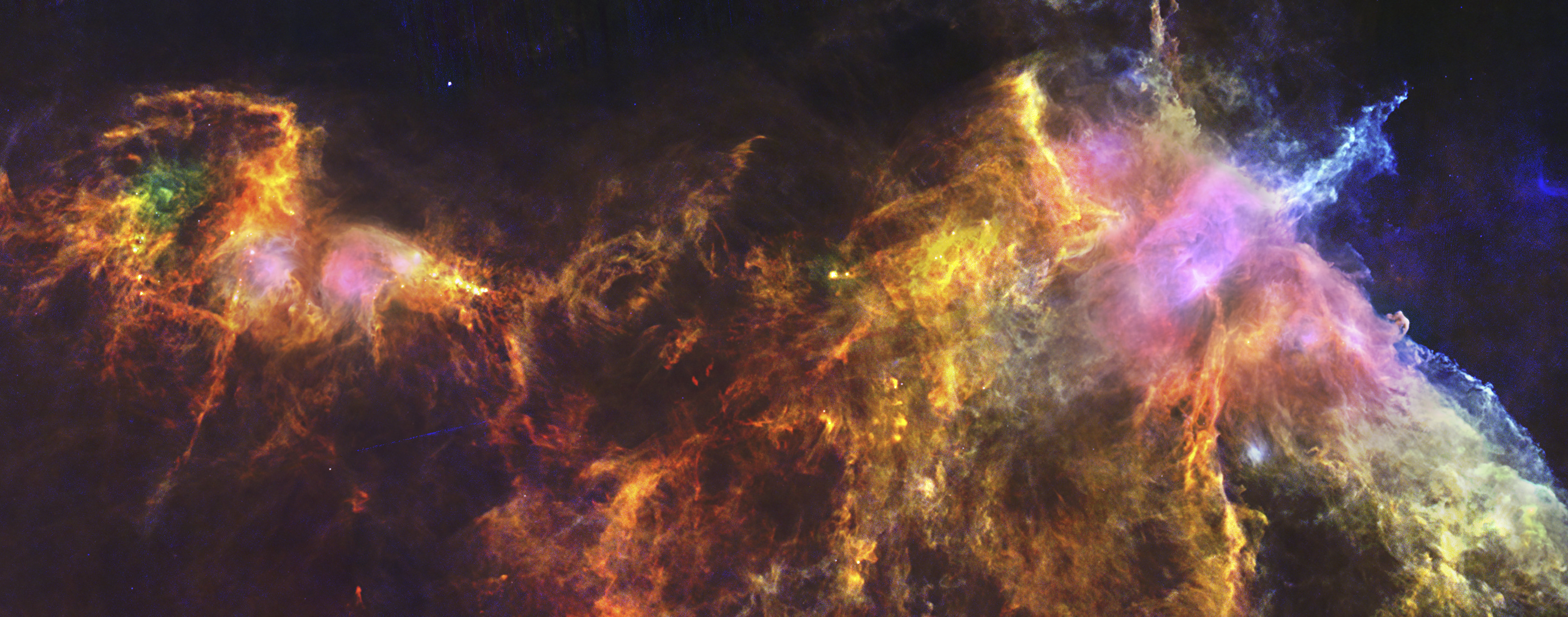
That struck a chord. A few hours earlier I had been sorting out my photographs and came across this one.
The Herschel Horsehead Nebula.
I had grabbed this image a month ago from the announcement on ESA’s website:
19 April 2013 New views of the Horsehead Nebula and its turbulent environment have been unveiled by ESA’s Herschel space observatory and the NASA/ESA Hubble space telescope.
The Horsehead Nebula lies in the constellation Orion, about 1300 light-years away, and is a popular target for amateur and professional astronomers alike. It sits just to the south of star Alnitak, the easternmost of Orion’s famous three-star belt, and is part of the vast Orion Molecular Cloud complex.
The new far-infrared Herschel view shows in spectacular detail the scene playing out around the Horsehead Nebula at the right-hand side of the image, where it seems to surf like a ‘white horse’ in the waves of turbulent star-forming clouds.
It appears to be riding towards another favourite stopping point for astrophotographers: NGC 2024, also known as the Flame Nebula. This star-forming region appears obscured by dark dust lanes in visible light images, but blazes in full glory in the far-infrared Herschel view.
The image is staggeringly beautiful yet a potent reminder that man, even the totality of our planet, is such an irrelevance in the scheme of things. We are surrounded by beauty both within and without, yet the fragility of our existance is a ‘vastness’, both literally and psychologically.
Guess what! Writing that last sentence brought to mind a photograph that I took Wednesday afternoon. As part of the Land Stewardship course Jean and I are taking, the class had gone to the Limpy Creek Botanical area in the Rogue River-Siskiyou National Forest not far from Grants Pass, Oregon. Here’s that photograph.
Reflect on the delicate beauty and vulnerability of that small wild flower. A perfect metaphor for the entire natural world.
So I am going to close this week’s perambulation through love with the thought that if we don’t love our planet with all the ardour and passion of a teenager’s first romance, all those other loves in our lives will ultimately become irrelevant.
Many of you will be aware that I follow Tom Engelhardt over at TomDispatch. Tom has been very generous in granting Learning from Dogs blanket permission to republish essays that appear on TomDispatch. From time to time I do just that; the last one being TomGram: William deBuys, Exodus from Phoenix just a couple of months ago.
Today is another republication of an incredibly powerful essay by Rebecca Solnit, with the usual introduction from Tom. When you read it you will easily see why it was a must for this week’s focus on love.
To offer a small inducement to read Rebecca’s essay, here is a taste of her words:
If you take the long view, you’ll see how startlingly, how unexpectedly but regularly things change. Not by magic, but by the incremental effect of countless acts of courage, love, and commitment, the small drops that wear away stones and carve new landscapes, and sometimes by torrents of popular will that change the world suddenly. To say that is not to say that it will all come out fine in the end regardless. I’m just telling you that everything is in motion, and sometimes we are ourselves that movement.
Wow!
“… the incremental effect of countless acts of courage, love, and commitment, the small drops
that wear away stones and carve new landscapes …“
Read and be moved by the words that people write.
oooOOOooo
Rebecca Solnit, What Comes After Hope
I worked for years as an editor at Pantheon Books. Its publisher, maybe the most adventurous in the business, was André Schiffrin. Among his many accomplishments, he “discovered” Studs Terkel (already a well-known Chicago radio personality), published his first oral history (Division Street: America), and made him a bestseller. Sometime after I arrived at Pantheon in the mid-1970s, he asked me to take a last look at a new manuscript by Studs. It was the equivalent of sending the second team onto the field, but it began my own long relationship with the famed oral historian. He was an experience — a small man who, when he wasn’t listening professionally in a fashion beyond compare, never stopped talking. In doing so, he had an almost magical way of making those around him feel larger than life. Later, I would be the editor for two of his oral histories, one on death and the other on hope (in that splendid order and the second with the Studs-appropriate title Hope Dies Last).
Last October, Bill Moyers interviewed me about the dismal state of American politics. As our conversation was ending, he suddenly asked: “What keeps you going against all the evidence?” At that moment, Studs came to mind. I mentioned editing “one of the greats of our world” and responded this way: “It turned out that when he wrote his book about hope, it was all about activists and the basic point he made was: in good times you could just be hopeful about your life. You didn’t have to be an activist. You didn’t have to be an anything. In bad times, if you want to be hopeful, you have to take a step. You’ve got to take some step to do something in the world. And in that sense, TomDispatch is my medicine against despair. So what makes me hopeful is doing TomDispatch.”
All true. But I realize now that it wasn’t quite a full response. I had left out one crucial figure in my life: Rebecca Solnit, who taught me how to hope in a world that seemed dismal indeed. She was the one who — I’ve written about it before — slipped through the barely ajar door of my life in May 2003, at a moment as grim and dreary as any in my political experience. The largest antiwar movement ever to protest a war that had yet to happen had just packed its tents and gone home in despair, while Baghdad was occupied by American troops and George W. Bush and his top officials were in their “mission accomplished” triumphalist mode. Many activists then feared that they would remain so forever and would have dismissed out of hand someone who suggested that their Pax Americana dreams of domination would begin unraveling in mere weeks (as happened), not decades or centuries.
Ten years ago, exactly to the day, I published Rebecca’s miraculous piece “Acts of Hope,” which she would later expand into her book Hope in the Dark. It was written to welcome that “darkness” which seemed already to be enveloping us. It was written with a sense of how the expectable unravels, of how the future surprises us, often enough with offerings not of horror but of hope.
With few people can you ever say, she (or he) changed my life, changed the very way I understand our world. For me, she’s one of the few — and she’s still doing it with her miraculous new book (out in June), The Faraway Nearby. She taught me how to look into that future darkness with hope. Like Studs, she taught me that acting, even while not knowing, is a powerful antidote to despair. So it means the world to me that she’s returned to the subject of hope to celebrate the tenth anniversary of her arrival in my life and at TomDispatch. Tom
Too Soon to Tell The Case for Hope, Continued
By Rebecca Solnit
Ten years ago, my part of the world was full of valiant opposition to the new wars being launched far away and at home — and of despair. And like despairing people everywhere, whether in a personal depression or a political tailspin, these activists believed the future would look more or less like the present. If there was nothing else they were confident about, at least they were confident about that. Ten years ago, as a contrarian and a person who prefers not to see others suffer, I tried to undermine despair with the case for hope.
A decade later, the present is still contaminated by the crimes of that era, but so much has changed. Not necessarily for the better — a decade ago, most spoke of climate change as a distant problem, and then it caught up with us in 10,000 ways. But not entirely for the worse either — the vigorous climate movement we needed arose in that decade and is growing now. If there is one thing we can draw from where we are now and where we were then, it’s that the unimaginable is ordinary, and the way forward is almost never a straight path you can glance down, but a labyrinth of surprises, gifts, and afflictions you prepare for by accepting your blind spots as well as your intuitions.
The despairing of May 2003 were convinced of one true thing, that we had not stopped the invasion of Iraq, but they extrapolated from that a series of false assumptions about our failures and our powerlessness across time and space. They assumed — like the neoconservatives themselves — that those neocons would be atop the world for a long time to come. Instead, the neocon and neoliberal ideologies have been widely reviled and renounced around the world; the Republicans’ demographic hemorrhage has weakened them in this country; the failures of their wars are evident to everyone; and though they still grasp fearsome power, everything has indeed changed. Everything changes: there lies most of our hope and some of our fear.
I’ve seen extraordinary change in my lifetime, some of it in the last decade. I was born in a country that had been galvanized and unsettled by the civil rights movement, but still lacked a meaningful environmental movement, women’s movement, or queer rights movement (beyond a couple of small organizations founded in California in the 1950s). Half a century ago, to be gay or lesbian was to live in hiding or be treated as mentally ill or criminal. That 12 states and several countries would legalize same-sex marriage was beyond imaginable then. It wasn’t even on the table in 2003. San Francisco’s spring run of same-sex weddings in 2004 flung open the doors through which so many have passed since.
If you take the long view, you’ll see how startlingly, how unexpectedly but regularly things change. Not by magic, but by the incremental effect of countless acts of courage, love, and commitment, the small drops that wear away stones and carve new landscapes, and sometimes by torrents of popular will that change the world suddenly. To say that is not to say that it will all come out fine in the end regardless. I’m just telling you that everything is in motion, and sometimes we are ourselves that movement.
Unstoppabilities
Hope and history are sisters: one looks forward and one looks back, and they make the world spacious enough to move through freely. Obliviousness to the past and to the mutability of all things imprisons you in a shrunken present. Hopelessness often comes out of that amnesia, out of forgetting that everything is in motion, everything changes. We have a great deal of history of defeat, suffering, cruelty, and loss, and everyone should know it. But that’s not all we have.
There’s the people’s history, the counterhistory that you didn’t necessarily get in school and don’t usually get on the news: the history of the battles we’ve won, of the rights we’ve gained, of the differences between then and now that those who live in forgetfulness lack. This is often the history of how individuals came together to produce that behemoth civil society, which stands astride nations and topples regimes — and mostly does it without weapons or armies. It’s a history that undermines most of what you’ve been told about authority and violence and your own powerlessness.
Civil society is our power, our joy, and our possibility, and it has written a lot of the history in the last few years, as well as the last half century. If you doubt our power, see how it terrifies those at the top, and remember that they fight it best by convincing us it doesn’t exist. It does exist, though, like lava beneath the earth, and when it erupts, the surface of the earth is remade.
Things change. And people sometimes have the power to make that happen, if and when they come together and act (and occasionally act alone, as did writers Rachel Carson and Harriet Beecher Stowe — or Mohammed Bouazizi, the young man whose suicide triggered the Arab Spring).
If you fix your eye on where we started out, you’ll see that we’ve come a long way by those means. If you look forward, you’ll see that we have a long way to go — and that sometimes we go backward when we forget that we fought for the eight-hour workday or workplace safety or women’s rights or voting rights or affordable education, forget that we won them, that they’re precious, and that we can lose them again. There’s much to be proud of, there’s much to mourn, there’s much yet to do, and the job of doing it is ours, a heavy gift to carry. And it’s made to be carried, by people who are unstoppable, who are movements, who are change itself.
Too Soon to Tell
Ten years ago I began writing about hope and speaking about it. My online essay “Acts of Hope,” posted on May 19, 2003, was my first encounter with Tomdispatch.com, which would change my work and my life. It gave me room for another kind of voice and another kind of writing. It showed me how the Internet could give wings to words. What I wrote then and subsequently for the site spread around the world in remarkable ways, putting me in touch with people and movements, and deeper into conversations about the possible and the impossible (and into a cherished friendship with the site’s founder and editor, Tom Engelhardt).
For a few years, I spoke about hope around this country and in Europe. I repeatedly ran into comfortably situated people who were hostile to the idea of hope: they thought that hope somehow betrayed the desperate and downtrodden, as if the desperate wanted the solidarity of misery from the privileged, rather than action. Hopelessness for people in extreme situations means resignation to one’s own deprivation or destruction. Hope can be a survival strategy. For comfortably situated people, hopelessness means cynicism and letting oneself off the hook. If everything is doomed, then nothing is required (and vice versa).
Despair is often premature: it’s a form of impatience as well as certainty. My favorite comment about political change comes from Zhou En-Lai, the premier of the People’s Republic of China under Chairman Mao. Asked in the early 1970s about his opinion of the French Revolution, he reportedly answered, “Too soon to tell.” Some say that he was talking about the revolutions of 1968, not 1789, but even then it provides a generous and expansive perspective. To hold onto uncertainty and possibility and a sense that even four years later, no less nearly two centuries after the fact, the verdict still isn’t in is more than most people I know are prepared to offer. A lot of them will hardly give an event a month to complete its effects, and many movements and endeavors are ruled failures well before they’re over.
Not long ago, I ran into a guy who’d been involved in the Occupy Wall Street movement, that great upwelling in southern Manhattan in the fall of 2011 that catalyzed a global conversation and a series of actions and occupations nationwide and globally. He offered a tailspin of a description of how Occupy was over and had failed.
But I wonder: How could he possibly know? It really is too soon to tell. First of all, maybe the kid who will lead the movement that will save the world was catalyzed by what she lived through or stumbled upon in Occupy Fresno or Occupy Memphis, and we won’t reap what she sows until 2023 or 2043. Maybe the seeds of something more were sown, as they were in Czechoslovakia during the Prague Spring of 1968 and Charter 77, for the great and unforeseen harvest that was the Velvet Revolution of 1989, the nonviolent overthrow of the Soviet totalitarian state in that country.
Second, Occupy began to say what needed to be said about greed and capitalism, exposing a brutality that had long been hushed up, revealing both the victims of debt and the rigged economy that created it. This country changed because those things were said out loud. I can’t say exactly how, but I know it mattered. So much that matters is immeasurable, unquantifiable, and beyond price. Laws around banking, foreclosure, and student loans are changing — not enough, not everywhere, but some people will benefit, and they matter. Occupy didn’t cause those changes directly, but it did much to make the voice of the people audible and the sheer wrongness of our debt system visible — and gave momentum to the ongoing endeavors to overturn Citizens United and abolish corporate personhood.
Third, I only know a little of what the thousands of local gatherings and networks we mean by “Occupy” are now doing, but I know that Occupy Sandy is still doing vital work in the destruction zone of that hurricane and was about the best grassroots disaster relief endeavor this nation has ever seen. I know that Strike Debt, a direct offshoot of Occupy Wall Street, has relieved millions of dollars in medical debt, not with the sense that we can fix all debt this way, but that we can demonstrate the malleability, the artifice, and the immorality of the student, medical, and housing debt that is destroying so many lives. I know that the Occupy Homes foreclosure defenders have been doing amazing things, often one home at a time, from Atlanta to Minneapolis. (Last Friday, Occupy Our Homes organized a “showdown at the Department of Justice” in Washington, D.C.; that Saturday, Strike Debt Bay Area held their second Debtors’ Assembly: undead from coast to coast.)
Fourth, I know people personally whose lives were changed, and who are doing work they never imagined they would be involved in, and I’m friends with remarkable people who, but for Occupy, I would not know existed. People connected across class, racial, and cultural lines in the flowering of that movement. Like Freedom Summer, whose consequences were to be felt so far beyond Mississippi in 1964, this will have reach beyond the moment in which I write and you read.
Finally, there was great joy at the time, the joy of liberation and of solidarity, and joy is worth something in itself. In a sense, it’s worth everything, even if it’s always fleeting, though not always as scarce as we imagine.
Climates of Hope and Fear
I had lunch with Middle East and nonviolence scholar Stephen Zunes the other day and asked him what he would say about the Arab Spring now. He had, he told me, been in Egypt several months ago watching television with an activist. Formerly, the news was always about what the leaders did, decided, ordained, inflicted. But the news they were watching was surprisingly focused on civil society, on what ordinary people initiated or resisted, on how they responded, what they thought. He spoke of how so many in the Middle East had lost their fatalism and sense of powerlessness and awoken to their own collective power.
This civil society remains awake in Egypt and the other countries. What will it achieve? Maybe it’s too soon to tell. Syria is a turbulent version of hell now, but it could be leaving the dynasty of the Assads in the past; its future remains to be written. Perhaps its people will indeed write the next chapter in its story, and not only with explosives.
You can tell the arc of the past few years as, first, the Arab Spring, then extraordinary civil society actions in Chile, Quebec, Spain, and elsewhere, followed by Occupy. But don’t stop there.
After Occupy came Idle No More, the Canada-based explosion of indigenous power and resistance (to a Canadian government that has gone over to the far right and to environmental destruction on a grand scale). It was founded by four women in November of 2012 and it’s spread across North America, sparking new environmental actions and new coalitions around environmental and climate issues, with flash-mob-style powwows in shopping malls and other places, with a thousand-mile walk (and snowshoe) by seven Cree youth this winter. (There were 400 people with them by the time they arrived at Canada’s Parliament in Ottawa.)
Idle No More activists have vowed to block the construction of any pipeline that tries to transport the particularly dirty crude oil from the Alberta tar sands, whether it heads north, east, or west from northern Alberta. Each of those directions takes it over native land. This is part of the reason why tar sands supporters are pushing so hard to build the Keystone XL pipeline from Alberta to the U.S. Gulf Coast.
Thankfully, the push back is also strong. Our fate may depend on it. As climate scientist James Hansen wrote a year ago, “Canada’s tar sands, deposits of sand saturated with bitumen, contain twice the amount of carbon dioxide emitted by global oil use in our entire history. If we were to fully exploit this new oil source, and continue to burn our conventional oil, gas, and coal supplies, concentrations of carbon dioxide in the atmosphere eventually would reach levels higher than in the Pliocene era, more than 2.5 million years ago, when sea level was at least 50 feet higher than it is now.”
The news just came in that we reached 400 parts per million of carbon dioxide in our atmosphere, the highest level in more than five million years. This is terrible news on a scale that eclipses everything else, because it encompasses everything else. We are wrecking our world, for everyone for all time, or at least the next several thousand years. But “we” is a tricky word here. Some of the people I most love and admire are doing extraordinary things to save the world, for you, for us, for generations unborn, for species yet to be named, for the oceans and sub-Saharan Africans and Arctic dwellers and everyone in-between, for the whole unbearably beautiful symphony of life on Earth that is imperiled.
Part of what sustains me in the face of this potential cataclysm is remembering that, in 2003, there hardly was a climate movement. It was small, polite, mostly believed the troubles were decades away, and was populated with people who thought that lifestyle changes could save the planet — rather than that you have to get out there and fight the power. And they were the good ones. Too many of us didn’t think about it at all.
Only a few years later, things have changed. There’s a vibrant climate movement in North America. If you haven’t quite taken that in, it might be because it’s working on so many disparate fronts that are often treated separately: mountaintop coal removal, coal-fired power plants (closing 145 existing ones to date and preventing more than 150 planned ones from opening), fracking, oil exploration in the Arctic, the Tar Sands pipeline, and 350.org’s juggernaut of a campus campaign to promote disinvestment from oil, gas, and coal companies. Only started in November 2012, there are already divestment movements underway on more than 380 college and university campuses, and now cities are getting on board. It has significant victories; it will have more.
Some countries — notably Germany, with Denmark not far behind — have done remarkable things when it comes to promoting non-fossil-fuel renewable energy. Copenhagen, for example, in the cold gray north, is on track to become a carbon-neutral city by 2025 (and in the meantime reduced its carbon emissions 25% between 2005 and 2011). The United States has a host of promising smaller projects. To offer just two examples, Los Angeles has committed to being coal-free by 2025, while San Francisco will offer its citizens electricity from 100% renewable and carbon-neutral sources and its supervisors just voted to divest the city’s fossil-fuel stocks.
There are so many pieces of the potential solution to this puzzle, and some of them are for you to put together. Whether they will multiply or ever add up to enough we don’t yet know. We need more: more people, more transformations, more ways to conquer and dismantle the oil companies, more of a vision of what is at stake, more of the great force that is civil society. Will we get it? I don’t know. Neither do you. Anything could happen.
But here’s what I’m saying: you should wake up amazed every day of your life, because if I had told you in 1988 that, within three years, the Soviet satellite states would liberate themselves nonviolently and the Soviet Union would cease to exist, you would have thought I was crazy. If I had told you in 1990 that South America was on its way to liberating itself and becoming a continent of progressive and democratic experiments, you would have considered me delusional. If, in November 2010, I had told you that, within months, the autocrat Hosni Mubarak, who had dominated Egypt since 1981, would be overthrown by 18 days of popular uprisings, or that the dictators of Tunisia and Libya would be ousted, all in the same year, you would have institutionalized me. If I told you on September 16, 2011, that a bunch of kids sitting in a park in lower Manhattan would rock the country, you’d say I was beyond delusional. You would have, if you believed as the despairing do, that the future is invariably going to look like the present, only more so. It won’t.
I still value hope, but I see it as only part of what’s required, a starting point. Think of it as the match but not the tinder or the blaze. To matter, to change the world, you also need devotion and will and you need to act. Hope is only where it begins, though I’ve also seen people toil on without regard to hope, to what they believe is possible. They live on principle and they gamble, and sometimes they even win, or sometimes the goal they were aiming for is reached long after their deaths. Still, it’s action that gets you there. When what was once hoped for is realized, it falls into the background, becomes the new normal; and we hope for or carp about something else.
The future is bigger than our imaginations. It’s unimaginable, and then it comes anyway. To meet it we need to keep going, to walk past what we can imagine. We need to be unstoppable. And here’s what it takes: you don’t stop walking to congratulate yourself; you don’t stop walking to wallow in despair; you don’t stop because your own life got too comfortable or too rough; you don’t stop because you won; you don’t stop because you lost. There’s more to win, more to lose, others who need you.
You don’t stop walking because there is no way forward. Of course there is no way. You walk the path into being, you make the way, and if you do it well, others can follow the route. You look backward to grasp the long history you’re moving forward from, the paths others have made, the road you came in on. You look forward to possibility. That’s what we mean by hope, and you look past it into the impossible and that doesn’t stop you either. But mostly you just walk, right foot, left foot, right foot, left foot. That’s what makes you unstoppable.
Rebecca Solnit’s first essay for Tomdispatch.com turned into the book Hope in the Dark: Untold Histories, Wild Possibilities, since translated into eight languages. Portions of this essay began life as the keynote speech at the National Lawyers’ Guild gala in honor of attorney and human rights activist Walter Riley, whose own life is a beautiful example of unstoppability. Solnit’s latest book, The Faraway Nearby, will be published in June.
Love as seen through the Celtic spiritual belief of bonding souls.
Who hasn’t lifted their eyes to the skies above and become lost in themselves? Whether the drama of a turbulent daytime sky or the deep mystery of an endless, clear night, sky? Doesn’t matter who we are or where we have or haven’t been in our lives, experiencing that shift from ‘reality’ to a place of souls is familiar to all.
Right at the front of Richard Bach’s lovestory book The Bridge Across Forever, there’s this quotation from E.E. Cummings:
– how fortunate are you and I, whose home
is timelessness: we who have wandered down
from fragrant mountains of eternal now
to frolic in such mysteries as birth
and death a day (or maybe even less)
Then on page 9, Richard Bach writes as part of his introduction:
We think, sometimes, there’s not a dragon left. Not one brave knight, not a single princess gliding through secret forests, enchanting deer and butterflies with her smile.
We think sometimes that ours is an age past frontiers, past adventures. Destiny, it’s way over the horizon; glowing shadows galloped past long ago, and gone.
What a pleasure to be wrong. Princesses, knights, enchantments and dragons, mystery and adventure …. not only are they here-and-now, they’re all that ever lived on earth!
Our century, they’ve changed clothes, of course. Dragons wear government-costumes, today, and failure-suits and disaster-outfits. Society’s demons screech, whirl down on us should we lift our eyes from the ground, dare we turn right at corners we’ve been told to turn left. So crafty have appearances become that princesses and knights can be hidden from each other, can be hidden from themselves.
Yet masters of reality still meet us in dreams to tell us that we’ve never lost the shield we need against dragons, that blue fire voltage arcs through us now to change our world as we wish. Intuition whispers true: We’re not dust, we’re magic!
Copyright (1984) Richard Bach.
Richard Bach’s hugely popular lovestory is widely summarised, thus:
‘Did you ever feel that you were missing someone you had never met?’.
Haunted by the ghost of the wise, mystical, lovely lady who lives just around the corner in time, Richard Bach begins his quest to find her, to learn of love and immortality not in the here-after, but in the here and now. Yet caught in storms of wealth and success, disaster and betrayal, he abandons the search, and the walls he builds for protection become his prison. Then he meets the one brilliant and beautiful woman who can set him free, and with her begins a transforming journey, a magical discovery of love and joy.
Just pause and listen. Hear your intuition whispering to you: You are not dust, you are magic!
oooOOOooo
Now let’s turn to another author: John O’Donohue. WikiPedia has an entry that starts:
John O’Donohue (1 January 1956 – 4 January 2008) was an Irish poet, author, priest, and Hegelian philosopher. He was a native Irish speaker, and as an author is best known for popularizing Celtic spirituality.
His death in January 2008 just a few days past his 52nd birthday was a huge and tragic loss. Not just to his family and all who knew him, but to all those in the world who dream the spiritual bonding with another person.
John O’Donohue’s book is no better appreciated than by hugging the meaning of that Celtic phrase anam cara, assuming you aren’t a Celtic speaker! A quick web search finds an explanation typically like this:
In the Celtic Spiritual tradition, it is believed that the soul radiates all about the physical body. What some refer to as an aura. When you connect and become completely open and trusting with another person, your two souls begin to flow together. The forming of that deep bond is described as having found your anam cara or soul friend.
Your anam cara always accepts you as you truly are, holding you in beauty and light. Inevitably, to appreciate this relationship, you must first recognize your own inner light and beauty. This is not always easy to do! The Celts believed that forming an anam cara friendship would help you awaken to your own inner light and beauty, as a pathway to experiencing the joys of others.
According to John O’Donahue, an accomplished Irish poet, philosopher and Catholic priest, “…You are joined in an ancient and eternal union with humanity that cuts across all barriers of time, convention, philosophy and definition. When you are blessed with an anam cara, the Irish believe, you have arrived at that most sacred place: home.“
Do you sense how the writings of Richard Bach and John O’Donohue are two hues from the same rainbow?
Take a few minutes and explore the John O’Donohue website that has much to remember about this wonderful man. Embrace such profound insights on the universal themes of friendship, solitude, love, and death as:
Light is generous
The human heart is never completely born
Love as ancient recognition
The body is the angel of the soul
Solitude is luminous
Beauty likes neglected places
The passionate heart never ages
To be natural is to be holy
Silence is the sister of the divine
Death as an invitation to freedom
I’m going to offer two videos. They are both of John O’Donohue. One is 51 minutes and one is 5 minutes. Do watch them both but if for whatever reason you cannot do that, then please watch the shorter one.
Your beloved and your friends were once strangers. Somehow at a particular time, they came from the distance toward your life. Their arrival seemed so accidental and contingent. Now your life is unimaginable without them. Similarly, your identity and vision are composed of a certain constellation of ideas and feelings that surfaced from the depths of the distance within you. To lose these now would be to lose yourself.
and recognising this post is day three of writing about love, here’s another quotation:
If you send out goodness from yourself, or if you share that which is happy or good within you, it will all come back to you multiplied ten thousand times. In the kingdom of love there is no competition; there is no possessiveness or control. The more love you give away, the more love you will have.
oooOOOooo
Are Jean and I touched by the spirit of anam cara? Leave you, dear reader, to judge that. In fact, leave you with the sign that is on our front gate!
Yesterday, I explored love across the species; back to that first encounter between wolf and early man.
Today, I want to revisit what we mean when we use the word ‘love‘ and feel the emotion. I say revisit because it’s not the first time I have dipped my toes into this particular pool. Last August, I wrote a piece What is love? It opened thus:
How the relationship that we have with domesticated animals taught us the meaning of love.
This exploration into the most fundamental emotion of all, love, was stimulated by me just finishing Pat Shipman’s book The Animal Connection. Sturdy followers of Learning from Dogs (what a hardy lot you are!) will recall that about 5 weeks ago I wrote a post entitled The Woof at the Door which included an essay from Pat, republished with her permission, that set out how “Dogs may have been man’s best friend for thousands of years longer than we realized“.
The following day, I wrote a further piece introducing the book and then commenced reading it myself. Please go there and read about the praise that the book has received.
What I want to do is to take a personal journey through love. I should add immediately that I have no specialist or professional background with regard to ‘love’ just, like millions of others, a collection of experiences that have tapped me on the shoulder these last 67 years.
The challenge for us humans is that while we instinctively understand what emotions represent: love, fear, anger, joy, grief, sadness, happiness, et al, we really have no way of knowing precisely what another person is feeling and how that feeling compares to our own awareness and experience of that emotion.
Stay with me as I explore how others offer a meaning of love.
As it happens, this week’s Sabbath Moment from Terry Hershey was much about love.
If you judge people you have not time to love them. Mother Teresa
Where there is great love there are always miracles. Willa Cather
Someday, after we have mastered the winds, the waves, the tides, and gravity, we shall harness… the energies of love. Then for the second time in the history of the world man will have discovered fire. Pierre Teilhard de Chardin
Then some further reflections:
Here’s my take: Life is complicated and at times, very, very challenging. And sometimes, overwhelming. Bad things can happen to good people. Decisions can be thorny and disconcerting. However. Even in the midst … where there is great love, there are always miracles.
and
Here’s the deal:
Love is not always where I predict it will be.
Love can grow and blossom even in the face of striving and anguish.
If we judge we cannot love. Just because I see something one way, doesn’t mean that I am right and you are wrong.
When we do love, we are present. When we are present, there is always a thread. The good news is that we are in this together. One day you may be that thread for me. And one day, I may be that thread for you.
Powerful words! Words that will have many nodding. Yet still nothing absolute that offers a definition of love that would be universally understood. Because there can be no universal definition. That is the magic of all emotions – they defy the ‘science of life’. So let’s just treasure that magic.
Last night I wrote this poem, its been a while since I posted one, so as my pen flew across the page I was inspired with these words.. Maybe due to the recent Solar flares, but my ears have been ringing ever louder as the energies have intensified.. The Silence space within is a place to reflect and absorb the peacefulness of Oneness with the Universe…. A place I often go, where we can just close our eyes to the constant noise as the Planet cries with yet more pain… Meditation helps centre our minds. If you would like to follow a meditation I often do… You can find it Here on a post I did back in 2008 .
Silence booms in an explosion of sound
Splintering static high pitched and loud
Morse Coded downloads in intermittent bursts
The Cosmos is talking-Do you hear its verse?
~~
I escape to the mountains and I run to the sea
But its chatter surrounds me as I long to be free
I hear cries of children, laments from the old
Each on a journey their stories to be told
~~
The Elephants and Dolphin their cries go unheard
Yet I hear their low rumbles and clicks how absurd
Each voice in the matrix – every thought in the mix
A Planet in Crisis – will it ever be fixed?
~~
So I turn down the volume as I shut the outer door
As I meditate inward finding higher-self law
Here I seek Peace in the stillness I find
The Key to the Cosmos we turn in the mind
~~
All things are great and all things are small
The Mind gives them power and shall overcome all
The Universal Plan- I am part and unique
Each one is searching to fit the pieces they seek
~~
And the answer is simple- but we make is so hard
With the choices we choose as we shuffle life’s cards
How to close it for today? Frankly, I’m not sure. So I’m going to ‘cheat’. By which I mean republish something else from last August. A guest essay about the loss of love. Because it seems to me that one way (the only way?) to experience what love truly means is when we lose it. As Eleanore MacDonald describes below in the most heart-rending and beautiful fashion.
oooOOOooo
one of the seven great dogs
“Until one has loved an animal, a part of one’s soul remains unawakened.” Anatole France
Djuna Cupcake, my heart of hearts, photo by Breelyn MacDonald
A great squall came upon us here on our farmlet a week ago. I saw it first from a distance, in that dawning of the morning when Djuna usually announced the coming day with his gentle, breathy ‘woooof’, his polite plea to join us on the bed. Mysteriously disturbing, it surely was a sign of things to come, but we didn’t know how dangerous it really was until it was upon us.
And when it was suddenly there, a Great Joy was sucked from our world and an overwhelming sadness took its place … a raging stillness, hot and stifling, no breath, no heartbeat.
My springs of Joy are dry … (a sentiment stolen in part from that great old song, Long Time Traveler)
Djuna Cupcake was one of the Seven Great Dogs. If you’ve seen the film ‘Dean Spanley’, you will know what I mean. If you have loved and been loved by a dog of pure heart … one who was a great teacher of presence, of patience, one who was the dispenser of unconditional love and the blessings of an incomparable joy … one who was a great listener, guardian, and the embodiment of Buddha, Coyote, the Goddesses Eleos and Kuan Yin all in one soft coated body … one who was your loving shadow because he or she felt that it was their job to see you safe at all times … you will know what I mean.
He died quite suddenly. Like that squall, his death came with no warning and for days after Paul and I were sucked deep into that great black hole of grief. The dread attacked us at every turn, where we would always see him but now only a glaring emptiness stood. I felt as though my heart and soul had a raw, oozing, gaping, searingly painful wound where he had been torn away from me. Stolen. We cried a lot.
Some people will never understand. I try to feel compassion for them, rather than issuing the big ‘EFF YOU”, but I am only human. What is this BS about a ‘three day’ rule? What? Because he was ‘just a dog’ we should be over it all in 3 days? Djuna was surely a better person than most Humans and I will never stop missing him. I feel so deeply sorry for those people who have overlooked having such grace and beauty bless their lives –– the companionship of a great dog (or cat or horse, or human person) –– so that, when the monumental end comes and they’ve come through the great fires of sorrow, and have been washed by the flush of a million tears, they come through to the other side where they are able to see the remarkable love, joys and lessons they’d been gifted by that companionship. I can only hope now to ‘be’ the person Djuna thought me to be.
3 days and 3 more and 3 million more and even then more just won’t do it.
Paul and I were with Djuna on our bedroom floor when he died. I lay with him next to my heart, whispering love, my arm draped over his neck … and as he was leaving us, I saw him standing just beyond Paul. Alert, ears akimbo, head cocked, eyes bright, a wad of socks in mouth, standing in his particularly great exuberance, as he did each morning when the time for chores presented itself – “Come on! It’s time to go! Get with it you silly humans! There’s work to be done, there’s a barn to clean and a day to sniff, there’s delight to be found!” And then he left.
My ‘joyometer’, my daily dispenser of mirth, and my constant reminder of the importance of presence, has gone missing – his lessons of ‘Be Here Now’ measured in doses of ’Oh, sense the beauty in the music of the wind!’, ‘Let’s just run in circles and laugh’, ‘I love, love, love you!’ … gone. It is wholly up to me now to remember to stay in each moment, to just be a nice person, cry whenever I must, to laugh as much as possible and dance for the sheer joy of it. And when the cacophony of the deafening silence has quieted and the colors of sorrow have muted and gone transparent and I’ve had some time to let the Aegean clean up those bloodied wounds in my heart and soul, there will be room again here for another one of the Seven Great Dogs. And the cycles will continue on.
Almost every evening Djuna and I took an evening stroll down our quiet lane. I loved watching him dance his great joy, nose to the ground scenting all of the news of the day or nose to the sky, sensing what was coming on the breeze. On our walks I watched the seasons change, the rising of the full moon, the greening of the new spring and the evening skies, like snowflakes, no one ever alike … I watched the Canadian geese come and go, the Red Tail hawks courting in the air above me, and let the build up of my day fall away as I tread softly with my gentle friend. It took me several days after Djuna’s death for me to realize that here was yet again another gift he had left for me in his wake, and one I should continue to enjoy. The sky was black to the West, we’d had heavy winds and rain all day, but when there was a break I set off on ‘our’ walk. Wrapped tightly in sadness and hardly breathing with the missing of him, I shuffled along about a 1/2 mile and turned for home before the rains started up and the chill wind began to blow, fierce again, from the south. That wind battered and bashed me until it freed the tears from my eyes, and the freezing rain lashed my face until I grew numb. As though suddenly realizing I was about to drown, I surfaced, taking in great gulps of air as though I’d not been breathing for several days, and began to climb free of the suffocating bonds of my sadness.
Part of our family
My Djuna, my Cupcake … My Heart of Hearts who knew my soul, my every thought; great lover of Paul and I, and of Breelyn; great lover of his mare and his pony, of socks and his furry toys and his GWBush chew doll; great lover of his evening walkies and of riding in the car, and feeding the birds; great lover of sofa naps and sleeping in late with us on the bed and chasing BALL and rolling on the grass and of eating horse poop; bountiful bestower of stealthy kisses; joyful jokester, Greek scholar (he knew about 15 words and understood several phrases spoken to him in Greek; something we did only after he’d begun to understand words and phrases *spelled out* in English! ‘Car’, ‘dinner?’, ‘play with the ball?’, ‘feed the birds’, water, pony, get the goat, etc!); Djuna, beloved Honorary Cat, our timekeeper, our guardian angel, our boss, our playfully dignified friend (thanks for that Marija) and family member, and one of the Seven Great Dogs – we will love and miss you forever.
But now – there’s work to be done, there’s a barn to clean and a new day to sniff, there’s delight to be found!
A week ago I started the first of what became four day’s writings about passing the 400ppm CO2 level in the planet’s atmosphere. As I said in the penultimate post, “In nearly four years of writing for Learning from Dogs, I can’t recall devoting three days of posts to a single subject.”
Later that week, I had a wonderful telephone conversation with MaryAnne back in Payson. MaryAnne and husband Ed were among a group of people who did so much to ease our transition into our new home in Arizona. As part of the process of obtaining my fiancee visa, I was to and fro between Payson and London which meant having to leave Jeannie alone for a number of weeks at a time. So for Jean having to get used to a change of country as well as home and for me wondering if I would ever get the magic piece of paper allowing me and Jean to be married and settle down, having so many loving friends around us was invaluable.
In last week’s telephone conversation MaryAnne spoke so easily about love that I promised her that I would dedicate a post on Learning from Dogs to her.
In fact, rather than one post, I’m setting myself the challenge of writing about love for the entire week, i.e. Monday to Friday. I will readily admit that over and beyond today’s post, I don’t have more than the vaguest inkling of how the week will pan out. You have been warned!
But how much better that ‘devoting three days to a single subject‘ should be about love rather than climate change.
oooOOOooo
Love across the species.
A week ago, we had friend Richard and his partner Julie from England staying with us. Richard and I go back 40 years and have been wonderful buddies all that time. Last Monday, I took Richard and Julie across to Wildlife Images just a few miles from the house here in Merlin, Oregon. As their website explains,
Wildlife Images Rehabilitation and Education Center was founded as a non-profit corporation in 1981 by renowned wildlife rehabilitator J. David Siddon. The facility was created in order to provide for the care and treatment of sick, injured and orphaned wildlife.
and a little later,
The organization’s clinic, animal sanctuary, and education center are located on 24 acres of land adjacent to the wild and scenic section of Oregon’s famous Rogue River. Animals treated at Wildlife Images have included everything from baby squirrels and badgers to American bald eagles.
Wildlife Images release rate of intakes is near 50 percent each year – far above the national average of 33 percent. Animals with permanently disabling injuries that make them unable to live in the wild are integrated into one of Wildlife Images educational programs, either as educational ambassadors, or as permanent residents of the facility.
While we were looking at the animals, along the pathway came a couple of the volunteer staff walking a Grey Wolf (Canis Lupus).
An afternoon walk for Tundra.
I was utterly captivated by this beautiful animal. Her story was that she was born in captivity and owned by an individual who soon decided he didn’t want her! Not long thereafter Tundra, as she became named, was brought to the Sarvey Wildlife Center in Washington and thence to Wildlife Images when she was just 8 weeks old.
Tundra turned to look at me. I stood perfectly still and quiet. Tundra seemed to want to come closer. As one would with a strange dog, I got down on my knees and turned my eyes away from Tundra’s. I sensed she was coming towards me so quickly held up my camera and took the picture below.
Wolf greets man.
I kept my gaze averted as I felt the warm breath of this magnificent animal inches from my face. Then the magic of love across the species! Tundra licked my face! The tears came to my eyes and were licked away. I stroked her and became lost in thought.
Was this an echo of how thousands and thousands of years ago, a wolf and an early man came together out of trust and love and started the journey of the longest animal-human relationship, by far?
Dogs are part of the Canidae, a family including wolves, coyotes and foxes, thought to have evolved 60 million years ago. There is no hard evidence about when dogs and man came together but dogs were certainly around when man developed speech and set out from Africa, about 50,000 years ago.
Let me close the first day of these musings by coming forward all those thousands of years to the year 2012. To the 6th April, 2012. To the day that we brought puppy Cleo back home. That sweet little creature of less than ten weeks of age starting her own journey of love across the species.
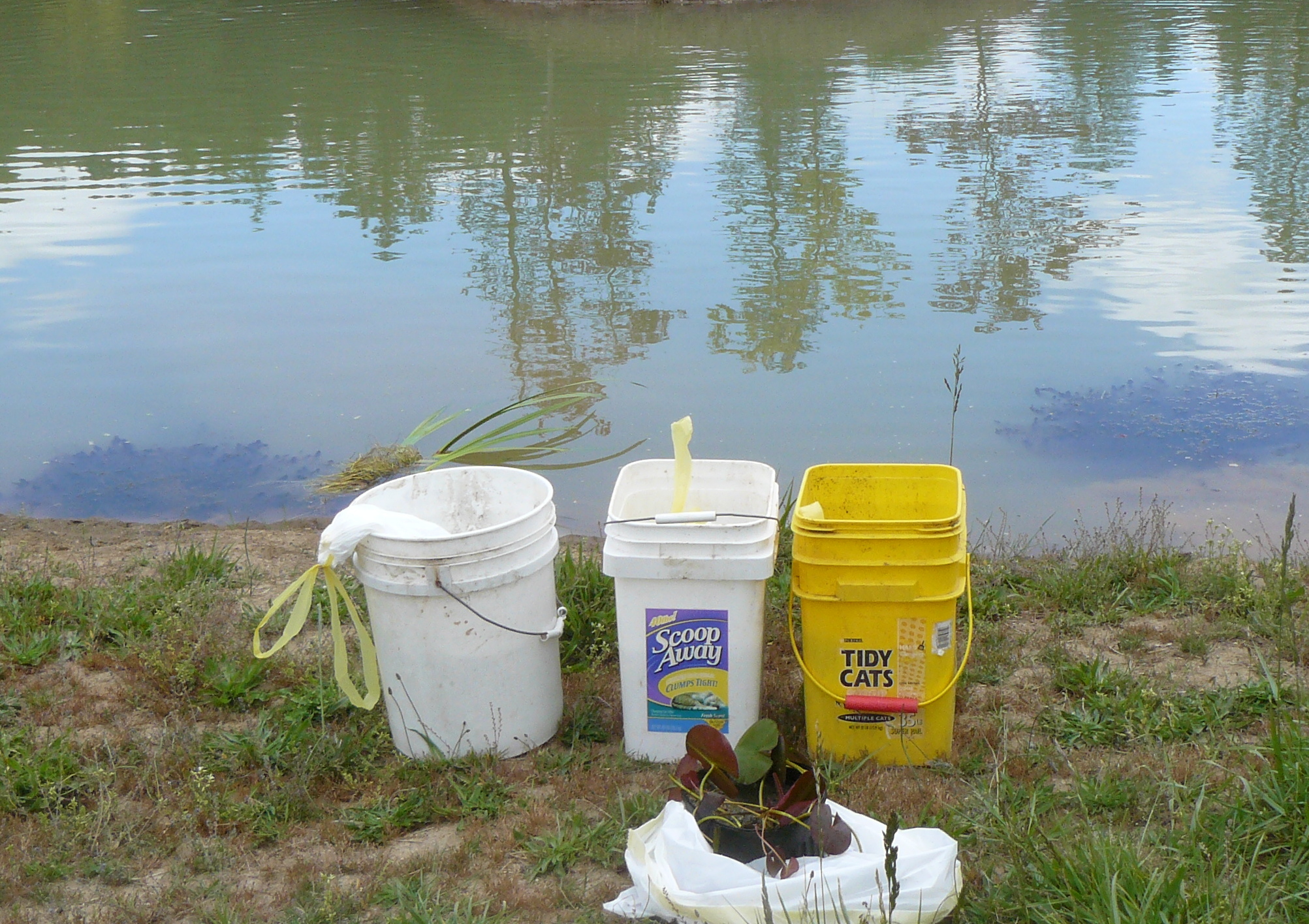
Our pond has settled to the point where Jean thought it would be good to get some fish. So off to a pond and fish supplies store in Grants Pass to seek advice. We settled on some Koi and a water lily plant.
Koi and water lily ready for the launch.
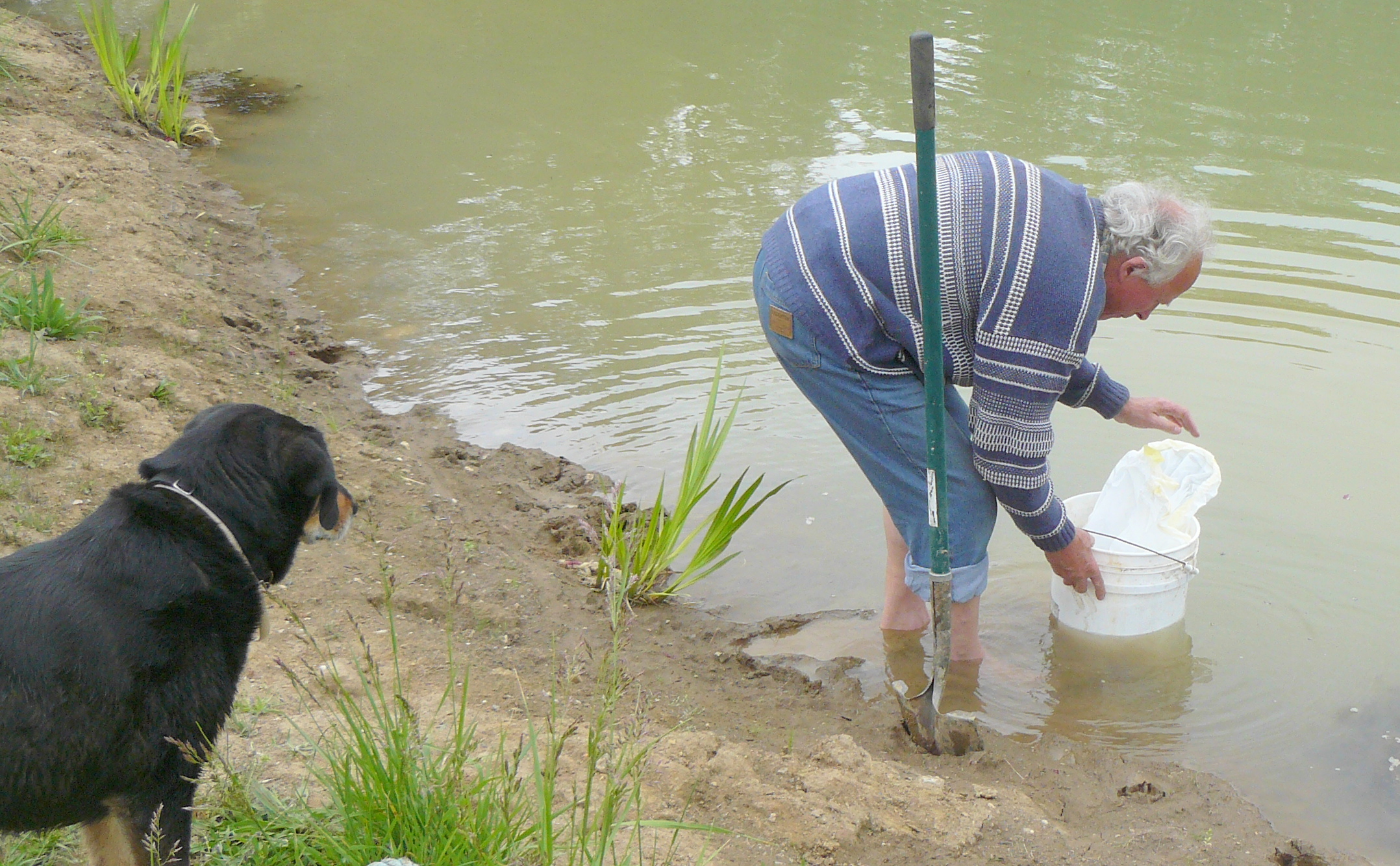
We were advised to acclimatise the fish in terms of water temperature by slowly mixing pond water into the bags containing each fish.
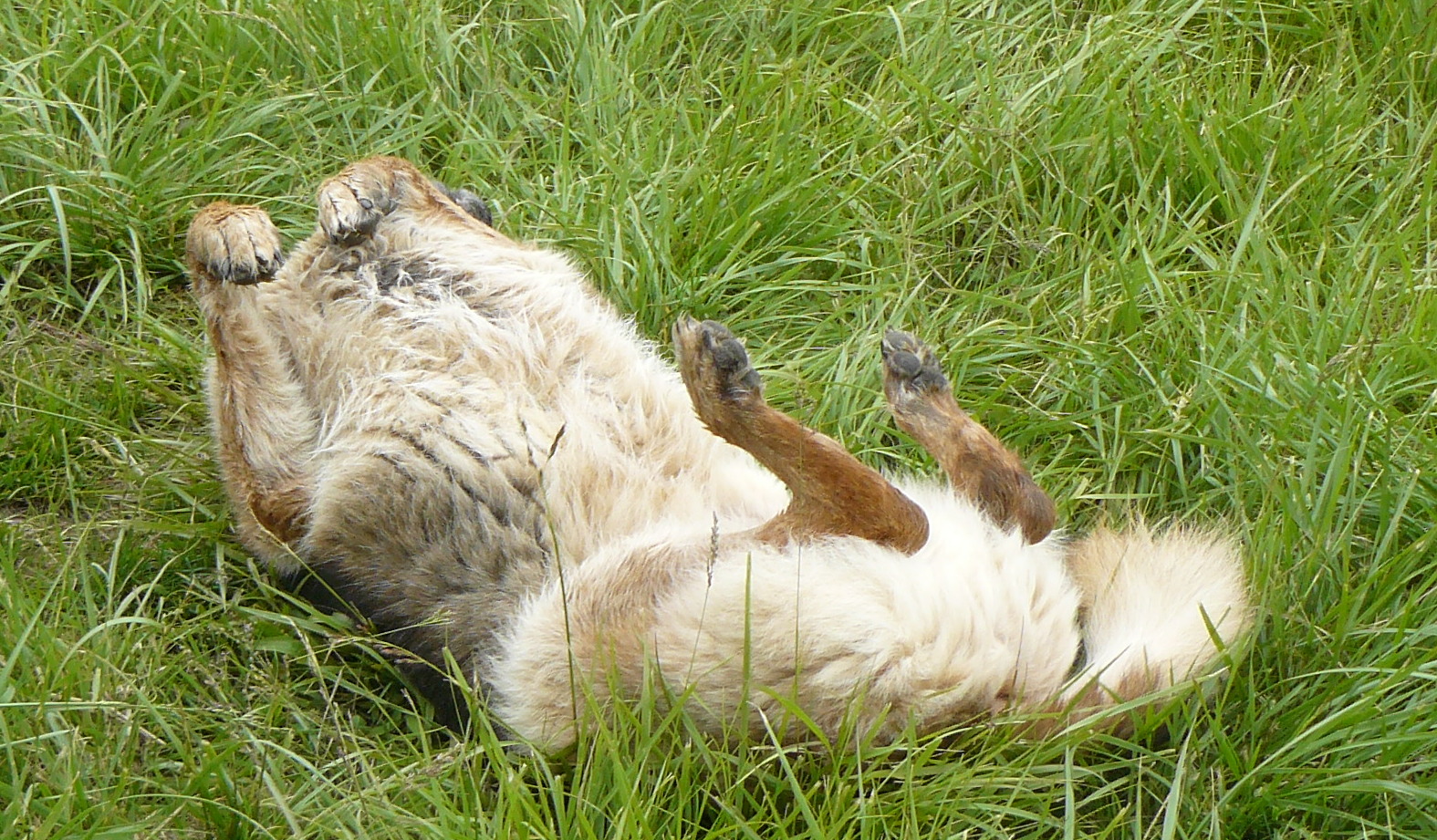
Meanwhile, Pharaoh took advantage of clean, green grass to give his back a bit of a rubdown.
Ah, that feels so much better!
And Hazel pondered what ‘Dad’ was up to.
Not seen this happen before?
But eventually it was time for the three Koi to slip away into the depths of their new home.
Wonder if I’ll ever find my two mates?
The twenty-three?
Nine dogs, five cats, four chickens, two miniature horses and three Koi!
This saying was offered in a creative writing class that Jean and I attended when we were living in Payson, Arizona. It came to me spontaneously as I started today’s post. Because feeling what is going on around us is the only way to write it, to share it, to bring it to the attention of all.
These are tough times for so many that love the world around us and having the odd weep is a perfectly rational, and healthy, thing to happen.
So as you listen to the following just feel it. And if a tear comes to your eye … embrace it.
Hopefully, you listened to the full seven minutes before reading on! Because to end the post at this point would be to leave out some great connections.
Put this on in the background and let it creep up on you.
Elizabeth Shepherd performs Live-to-Air with Michael Occipinti’s Shine On: The Universe of John Lennon
Toronto, June 1, 2012 CBC Radio
UPDATE: by popular demand, the original below.
Secondly, a quick dip into WikiPedia reveals that the song was recorded by the Beatles in February 1968 at the famous Abbey Road studios and released on the 12th December, 1969. It was written by John Lennon, and credited to Lennon–McCartney.
Abbey Road Studios, 3 Abbey Road, St. John’s Wood, London
Thirdly, that Wikipedia reference includes the background to the composition of the song, some of which I will share here:
One night in 1967, the phrase “words are flowing out like endless rain into a paper cup” came to Lennon after hearing his ex-wife Cynthia, according to Lennon, “going on and on about something.” Later, after “she’d gone to sleep—and I kept hearing these words over and over, flowing like an endless stream,” Lennon went downstairs and turned it into a song. He began to write the rest of the lyrics and when he was done, he went to bed and forgot about them.
“
I was lying next to my first wife in bed, you know, and I was irritated, and I was thinking. She must have been going on and on about something and she’d gone to sleep and I kept hearing these words over and over, flowing like an endless stream. I went downstairs and it turned into a sort of cosmic song rather than an irritated song, rather than a “Why are you always mouthing off at me?”[1]… [The words] were purely inspirational and were given to me as boom!. I don’t own it you know; it came through like that.[2]
”
The flavour of the song was heavily influenced by Lennon’s and the Beatles’ interest in Transcendental Meditation in late 1967 – early 1968, when the song was composed. Based on this he added the mantra “Jai gurudevaom” (Sanskrit: जय गुरुदेव ॐ) to the piece, which became the link to the chorus. The Sanskrit phrase is a sentence fragment whose words could have many meanings. Literally it approximates as “glory to the shining remover of darkness,”[3] and can be paraphrased as “Victory to God divine”, “Hail to the divine guru”, or the phrase commonly invoked by the late Maharishi Mahesh Yogi in referring to his spiritual teacher “All Glory to Guru Dev.”[4]
Finally the lyrics.
“Across The Universe”
Words are flowing out like endless rain into a paper cup
They slither wildly as they slip away across the universe
Pools of sorrow, waves of joy are drifting through my open mind
Possessing and caressing me
Jai Guru Deva OM
Nothing’s gonna change my world
Nothing’s gonna change my world
Nothing’s gonna change my world
Nothing’s gonna change my world
Images of broken light which dance before me like a million eyes
They call me on and on across the universe
Thoughts meander like a restless wind inside a letter box
They tumble blindly as they make their way across the universe
Jai Guru Deva OM
Nothing’s gonna change my world
Nothing’s gonna change my world
Nothing’s gonna change my world
Nothing’s gonna change my world
Sounds of laughter shades of live are ringing through my open ears
Inciting and inviting me
Limitless undying love which shines around me like a million suns
It calls me on and on, across the universe
Jai Guru Deva OM
Nothing’s gonna change my world
Nothing’s gonna change my world
Nothing’s gonna change my world
Nothing’s gonna change my world
Jai Guru Deva
Jai Guru Deva
Jai Guru Deva
Jai Guru Deva
Jai Guru Deva [fade out]
Footnote
The title of the song was given a new dimension when NASA beamed the song into space.
“On 4 February 2008, at 00:00 UTC, NASA transmitted the Interstellar Message “Across the Universe” in the direction of the star Polaris, 431 light years from Earth. The transmission was made using a 70m antenna in the Deep Space Network’s Madrid Deep Space Communication Complex, located outside of Madrid, Spain. It was done with an “X band” transmitter, radiating into the antenna at 18 kW. This was done to celebrate the 40th anniversary of the song’s recording, the 45th anniversary of the Deep Space Network (DSN), and the 50th anniversary of NASA. The idea was hatched by Beatles historian Martin Lewis, who encouraged all Beatles fans to play the track as it was beamed to the distant star. The event marked the first time a song had ever been intentionally transmitted into deep space, and was approved by McCartney, Yoko Ono, and Apple Corps.”
Thus those feelings so beautifully expressed in the song will be echoing around the universe for time immemorial. Now that is a legacy!
Whatever one’s view is about the significance of CO2 levels in the Earth’s atmosphere, this blog is about integrity. As the byline states, “Dogs are integrous animals. We have much to learn from them.” Regular readers (and thank you for being one) know that this blog ranges far and wide in pursuit of stories, essays and examples of integrity, all the more better when they involve a dog!
All dog owners know that one of the prime things we can learn from our dogs is the ability to remain in the present. No, more than that! To value and cherish the present. Dogs manage this in an effortless manner, in a way that humans can only dream of achieving.
This came to me as a result of a recent post on Damn the Matrix, Mike Stasse’s fascinating blog. The post was about what we humans regret at the end of our days, which I will come to in a moment.
Mike had taken the theme from a recent book by Australian author Bronnie Ware. Her website is here from where one learns:
Picture from The Sunday Mail (Qld)
Bronnie Ware is an inspiring and creative soul from Australia.
Through her work Bronnie weaves delightful tales of real life observations and experience. Using gentleness, honesty, and humour, Bronnie celebrates both the strength and vulnerability of human nature. Her message is a positive and inspiring one.
Bronnie is the author of the full-length memoir, The Top Five Regrets of the Dying– A Life Transformed by the Dearly Departing, released worldwide, with translations in 27 languages. She also runs an online personal growth and songwriting course, has released two albums of original songs, and writes a well-loved blog called Inspiration and Chai.
Every challenge brings its own gifts. Sometimes though it is not always easy to see those gifts at first. Suffering and wounds can blind us. We have all been there. It is at times like these that Inspiration and Chai is needed. Inspiration to soothe the heart. Chai to soothe the body.
Even during happier cruising chapters, being inspired is still a beautiful thing. It keeps us going. It reminds us of what we already know.
Inspiration and Chai is an ongoing journey. The aim of this site is to share inspirational stories and motivational thoughts and for it to reach more and more people in need, seekers on their path. It is a positive environment to revisit whenever you feel it calling. It is also somewhere for me to share my love of story telling and to share memories of life.
Jean is no stranger to the death of a dog. Over her many years of rescuing dogs Jean has seen far too many deaths. I have been living with Jean since 2008. In that short time five of our dogs have died.
Of course, we have no idea of what goes through a dog’s mind in those last stages of life. Dogs appear to embrace death in an uncomplicated way but we will never know for sure.
What about humans? On Bronnie’s blogsite there is a post under the title of Regrets of the dying. Whatever age you are, read what Bonnie wrote and ponder:
REGRETS OF THE DYING
For many years I worked in palliative care. My patients were those who had gone home to die. Some incredibly special times were shared. I was with them for the last three to twelve weeks of their lives.
People grow a lot when they are faced with their own mortality. I learnt never to underestimate someone’s capacity for growth. Some changes were phenomenal. Each experienced a variety of emotions, as expected, denial, fear, anger, remorse, more denial and eventually acceptance. Every single patient found their peace before they departed though, every one of them.
When questioned about any regrets they had or anything they would do differently, common themes surfaced again and again. Here are the most common five:
1. I wish I’d had the courage to live a life true to myself, not the life others expected of me.
This was the most common regret of all. When people realise that their life is almost over and look back clearly on it, it is easy to see how many dreams have gone unfulfilled. Most people had not honoured even a half of their dreams and had to die knowing that it was due to choices they had made, or not made.
It is very important to try and honour at least some of your dreams along the way. From the moment that you lose your health, it is too late. Health brings a freedom very few realise, until they no longer have it.
2. I wish I didn’t work so hard.
This came from every male patient that I nursed. They missed their children’s youth and their partner’s companionship. Women also spoke of this regret. But as most were from an older generation, many of the female patients had not been breadwinners. All of the men I nursed deeply regretted spending so much of their lives on the treadmill of a work existence.
By simplifying your lifestyle and making conscious choices along the way, it is possible to not need the income that you think you do. And by creating more space in your life, you become happier and more open to new opportunities, ones more suited to your new lifestyle.
3. I wish I’d had the courage to express my feelings.
Many people suppressed their feelings in order to keep peace with others. As a result, they settled for a mediocre existence and never became who they were truly capable of becoming. Many developed illnesses relating to the bitterness and resentment they carried as a result.
We cannot control the reactions of others. However, although people may initially react when you change the way you are by speaking honestly, in the end it raises the relationship to a whole new and healthier level. Either that or it releases the unhealthy relationship from your life. Either way, you win.
4. I wish I had stayed in touch with my friends.
Often they would not truly realise the full benefits of old friends until their dying weeks and it was not always possible to track them down. Many had become so caught up in their own lives that they had let golden friendships slip by over the years. There were many deep regrets about not giving friendships the time and effort that they deserved. Everyone misses their friends when they are dying.
It is common for anyone in a busy lifestyle to let friendships slip. But when you are faced with your approaching death, the physical details of life fall away. People do want to get their financial affairs in order if possible. But it is not money or status that holds the true importance for them. They want to get things in order more for the benefit of those they love. Usually though, they are too ill and weary to ever manage this task. It is all comes down to love and relationships in the end. That is all that remains in the final weeks, love and relationships.
5. I wish that I had let myself be happier.
This is a surprisingly common one. Many did not realise until the end that happiness is a choice. They had stayed stuck in old patterns and habits. The so-called ‘comfort’ of familiarity overflowed into their emotions, as well as their physical lives. Fear of change had them pretending to others, and to their selves, that they were content. When deep within, they longed to laugh properly and have silliness in their life again.
When you are on your deathbed, what others think of you is a long way from your mind. How wonderful to be able to let go and smile again, long before you are dying.
Life is a choice. It is YOUR life. Choose consciously, choose wisely, choose honestly. Choose happiness.
I hesitated to write anything more because that last sentence should be the one that continues to resonate.
So just a reflection on how easy it is for a dog to wag its tail – dogs so easily choose happiness.
The trouble with today’s post title is that while the analogy with the loss of the Titanic is accurate, indeed too bloody accurate, the phrase has dissolved into the depths of the barrel of smart, clever-dick sayings. The brutal consequence of ‘fiddling while Rome burns‘, to use another ‘smart’ saying, is obscured.
So before you read this guest post from regular contributor, John Hurlburt, let me plead for something?
That is that you don’t treat this as just another anecdote in the affairs of man, but a symptom of the blindness of societies right across the world. As my guest essay tomorrow reveals, waiting for leadership on this planet is a wait that you and I and millions of others just can’t afford. Each and every one of us has to do something, however minute, to make a difference. Even just sharing John’s words.
oooOOOooo
It seems that there’s no escaping politics in daily life.
I recently got together one evening with two friends at our local Elks Club.
They are a couple. Two old friends of about ten years who live across the street and around the corner from me during the summer season. They’ve been together for more than half their lifetimes and spend the fall, winter and early spring in Yuma.
He is a frequent fishing buddy. Sometimes wears a side arm when we fish the beautiful mountain lakes above Payson. Mountain lakes and related campgrounds that are maintained and supervised by the U.S. Forest Service. Rather cheekily, I once asked if the plan was to hook trout or shoot them!
Anyhow, this was our first get together of the season. It was noted that attendance and participation is down in Arizona for such fraternal organizations as the Elks and the Moose. We had a discussion with club management about the nature of the problem.
Fraternal club management tends to be cautious and well paid. However, it seems that placing discomforting restrictions on people is not popular. The case in point was a recent club smoking ban. The logic seemed reasonable enough. Unfortunately, no realistic accommodation was made for the members who chose to smoke. The reaction was emotional.
For many, it was apparently the last straw. There were perhaps four other people at the Payson Elks club at 5:30 p.m. that Friday evening. An evening with a moderately priced dinner buffet on hand that had been advertised online, in a newsletter and by word of mouth.
There was a point when a comment seemed appropriate. I offered the observation that the source of the problem might be political. No one seemed to register the observation.
We talked a bit about aches and pains; the usual organ recital. We spoke about what we’ve been doing. I told them about church and transition town activities. The conversation turned to our illusion of a stable economy. An observation was made that the USA was leveraged over twenty-two times above any material foundation. There was no disagreement.
Despite the clear New York Times warning that morning, climate change never entered the conversation. A remedy was to note that so far Katrina has cost U.S. taxpayers over sixteen Billion dollars and climbing. Sandy is expected to cost American taxpayers as much as sixty Billion dollars.
It was a pleasant evening and we plan to get together again soon.

Despair is often premature: it’s a form of impatience as well as certainty. My favorite comment about political change comes from Zhou En-Lai, the premier of the People’s Republic of China under Chairman Mao. Asked in the early 1970s about his opinion of the French Revolution, he reportedly answered, “Too soon to tell.” Some say that he was talking about the revolutions of 1968, not 1789, but even then it provides a generous and expansive perspective. To hold onto uncertainty and possibility and a sense that even four years later, no less nearly two centuries after the fact, the verdict still isn’t in is more than most people I know are prepared to offer. A lot of them will hardly give an event a month to complete its effects, and many movements and endeavors are ruled failures well before they’re over.