There were a total of twenty-four of these wonderful photographs sent to me by Su. Thus I am inclined to present them to you, dear reader, in a further two batches of eight over the next two weekends.
I can’t recall why it was many months ago that I came across the website of Frontiers in Science. But I did and, in particular, I came across a fundamental difference between the two species. In an article entitled: A simple reason for a big difference: wolves do not look back at humans, but dogs do.I’m going to take a chance, as in not having formal permission to republish it, in reposting it in full here. Because it means so much to me and other dog lovers!
ooOOoo
A simple reason for a big difference: wolves do not look back at humans, but dogs do.
Adám Miklósi, Enikö Kubinyi, József Topál, Márta Gácsi, Zsófia Virányi and Vilmos Csányi
Department of Ethology, Eötvös University, Budapest, Pázmány P. 1c, 1117, Hungary. miklosa@ludens.elte.hu
The present investigations were undertaken to compare interspecific communicative abilities of dogs and wolves, which were socialized to humans at comparable levels. The first study demonstrated that socialized wolves were able to locate the place of hidden food indicated by the touching and, to some extent, pointing cues provided by the familiar human experimenter, but their performance remained inferior to that of dogs. In the second study, we have found that, after undergoing training to solve a simple manipulation task, dogs that are faced with an insoluble version of the same problem look/gaze at the human, while socialized wolves do not. Based on these observations, we suggest that the key difference between dog and wolf behavior is the dogs’ ability to look at the human’s face. Since looking behavior has an important function in initializing and maintaining communicative interaction in human communication systems, we suppose that by positive feedback processes (both evolutionary and ontogenetically) the readiness of dogs to look at the human face has lead to complex forms of dog-human communication that cannot be achieved in wolves even after extended socialization.
ooOOoo
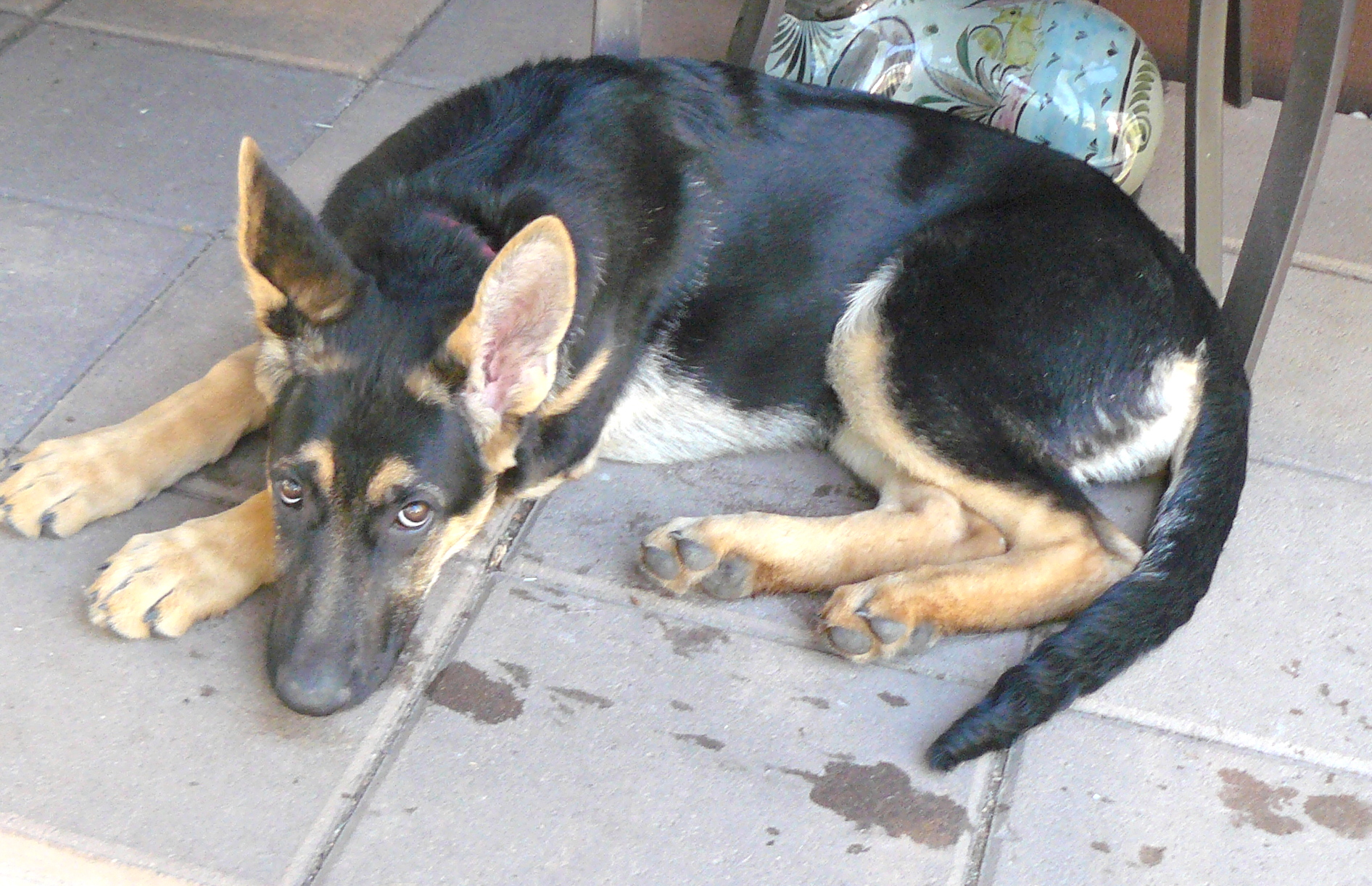
Actually, that article from the Department of Ethology at Eötvös University in Budapest is just an excuse for me to post three photographs confirming the good scientists results!
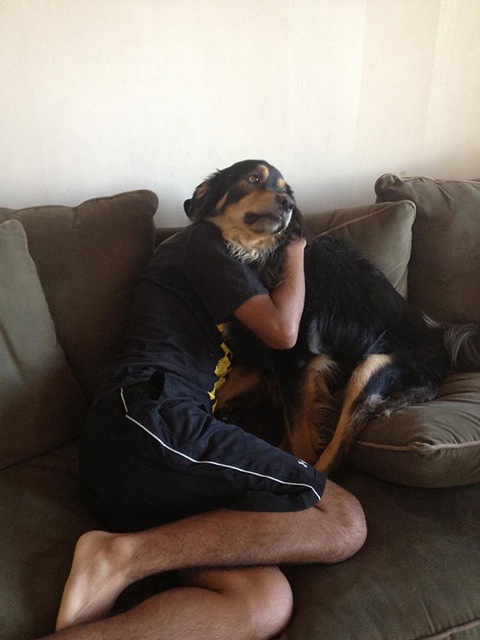
Young Cleo, May 12th, 2012.
oooo
Mr Pharaoh’s look from June, 2007.
oooo
The second Cleo look from May, 2012.
oooo
There’s no question in my mind that millions of dog lovers across the world know the intimacy that is conveyed in a dog’s eyes!
If you do a search on Learning from Dogs for Terry Hershey you will find that his name comes up from time to time. Way back in March, 2011, I published a post announcing a visit by Terry to Payson, AZ where Jean and I were then living. Having had the opportunity to listen to Terry speaking and to meet him in person, I have maintained a subscription to his weekly Sabbath Moment ever since.
Thus it was that last Sunday in came the regular missive from Terry. They are always good but last Sunday’s was spectacularly good. In response to my request to publish the full Sabbath Moment here on Learning from Dogs, there was a prompt reply to the affirmative.
Thus with no further ado, here is Terry’s Sabbath Moment for May 5th, 2014, in full.
ooOOoo
Artists
May 5, 2014
It seems that in the spiritual world, we do not really find something until we first lose it, ignore it, miss it, long for it, choose, it, and personally find it again–but now on a new level.Richard Rohr
Mystery is at the heart of creativity. That, and surprise. Julia Cameron
I was born fragile, farther said. I was just born that way. He said I was a nervous baby. Just born like that.David Helfgott
I saw the angel in the marble and carved until I set him free.Michelangelo
oooo
Lorraine Hunt Lieberson began her career as an accomplished viola player. While on tour in Europe (in the late 1980s), her viola was stolen. She could have replaced it. As would be imagined, the theft threw her into a state of feeling lost and uncertain. She stopped playing. After awhile, Lorraine began to work with only instrument she had, her voice.
When asked, Lorraine stresses that her decision to go into singing happened quite naturally. “There were a lot of encouragements along the way, but no individual, earth-shaking event that made me change,” she says. “But, back in 1988, when my viola was stolen, I took that as a sort of omen.” (And although she hasn’t yet replaced her stolen viola, she avows that “the viola is always with me in spirit when I sing.”)
Interestingly, Lorraine is shy about being interviewed; she has no press agent. But when she sings she is known for an ever-widening swath of ardor and awe that she leaves in her wake. An intensity. Her voice–her singing–touches hearts and lives. The irony is that the gift–the artistry–she has given us all, began when life turned left.
Ask any class of kindergarten students, “How many of you are artists?”
How many raise their hands? Every single one of them.
Ask fourth graders. Maybe half.
Seventh graders. A handful.
Seniors in high school. Maybe one.
It’s quite the educational system we have created. We begin with artists, and we slowly wean it out of them.
I do know this: it is easy to lose sight of that artist that resides inside of each one of us. Whether lost or buried or stuck or forgotten or dismissed or ignored… or “stolen.” (Whenever I lead a retreat, Crayolas are mandatory–because it is an unwritten spiritual principle that you cannot learn about life unless you color. It is curious then, how many–otherwise secure adults–will say, “I’m not very good at coloring.” I will say, “Who said anything about being ‘good’ at it?” Our mind has already morphed from play and wonder to mastery and proficiency.)
When we tag or label or describe ourselves, “artist” is seldom used. Where I was raised, artist was a phase you went through (a dream), you know, to grow out of, to, move on to something more useful and sensible–in order to get a real job.
Yes, of course we are all inner artists, but the cynical part of me tells me that it all sounds too much like a mantra meant to be chanted standing in a circle at a “be all you can be” conference. Sure, it all sounds good.
But I’m not sure what it really means.
In the opening scenes of Shine, we first meet the middle-aged David Helfgott (played by acclaimed Australian stage actor Geoffrey Rush), babbling to himself incessantly and wandering in the rain, in a state of transition. Behind him is the isolated existence as a child piano prodigy whose emotional turmoil led to a nervous breakdown, and a series of stays in various mental institutions. Ahead of him is his eventual reconnection with the world around him, guided by both love and his virtuoso talent that has been long abandoned. We witness the awakening of the artist. In the movie (and in real life), David eventually moves toward that which gives life.
So, what is this artist? It is the place in our spirit that births…
creativity, enchantment, imagination, play, risk and wonder.
There is no doubt that we hide it. We don’t believe it. Or we judge it as inadequate.
But here’s the deal: The artist in David did not reside only in the talent or prodigy or genius, but in the spontaneity, vitality, innocence, passion and delight. And the artist in Lorraine wasn’t detoured by life’s unkindness.
For me, the tragedy is that (in the name of love) David’s father (Peter) squeezes the artist out of the prodigy. But in truth, it doesn’t always require a pathological “love” to hide or extinguish the light.
In the movie rendition, there is a scene that stops my heart. David and his father are walking home after a competition. David has placed second.
(In his father’s eyes, anything other that first is a failure.) The father is seething, and there is no hiding his disgust. David has lived his entire life absorbing his father’s pathology, doing his very best to make his Daddy happy. The father walks ahead, hurried, his spirit heavy. David follows. On the sidewalk, in chalk, there is a hopscotch pattern.The camera follows from behind, and we see young David unconsciously, intuitively, childlike, hopping and skipping and jumping — the joy and the light (and the artistry) of his childhood still alive.
I don’t want to lose sight of that childlike artistry inside of me. I’m home for a week or so, and the garden is abounding and teeming with life and color and enchantment. The peony buds profligate, the bearded iris blooms beguiling, the columbine exquisite. The branches of the Japanese Maple, heavy with spring rain, deferentially bow. I once asked my analyst why I was in therapy. He told me it would make me a better gardener. Gardening can be strong medicine–an elixir that nurtures and shapes the soul. For that reason, it is a tonic seldom taken straight with no ice. Gardening has way of seeping into your soul, and one day you find yourself, in the words of poet May Sarton, spending the first half hour of the morning “enjoying the air and watching for miracles,” the joy and the light still alive.
oooo
I dip my pen in the blackest ink, because I’m not afraid of falling into my inkpot.Ralph Waldo Emerson
ooOOoo
Hope you all enjoyed this just as much as I did!
But I can’t close without mentioning something that struck me the very first time I read the essay. It is this.
That list that describes artistry: creativity, enchantment, imagination, play, risk and wonder. It’s not a million miles from describing the way our younger dogs behave when we take them for a walk around the property most days after lunch.
There was a recent TED Talk that really made me sit up and think. Before I introduce the talk, let me offer a personal view. I’m speaking about the changing nature of the Earth’s climate.
On balance I believe that the climate of our planet is changing and, again on balance, I believe that mankind’s activities especially with regard to CO2 emissions are the primary cause.
But here’s the rub! I’m not a scientist.
So when scientist Gavin Schmidt, a climate scientist no less, recently gave a twelve-minute TED Talk about the complexity of Planet Earth’s climate I found it compelling.
Here is is.
Published on May 1, 2014
You can’t understand climate change in pieces, says climate scientist Gavin Schmidt. It’s the whole, or it’s nothing. In this illuminating talk, he explains how he studies the big picture of climate change with mesmerizing models that illustrate the endlessly complex interactions of small-scale environmental events.
Then just two days later, on May 3rd, Alex Jones, he of the blog The Liberated Way, posted Unpredictable nature, that I have the pleasure in republishing in full. Read it and then reflect on Alex’s post and the talk given by Gavin Schmidt.
ooOOoo
Unpredictable nature
Posted on May 3, 2014 Nature is always full of surprises.
Amber the fox reflects the unpredictable face of nature showing up in my garden by surprise on random days.
I went camping and woke to frost on the ground. I wrote yesterday that summer had arrived in Britain. A pool of water from recent rains had frozen over.
One thing you quickly learn about nature is its unpredictability. Everything in nature has its own free will, and will determine its own unpredictable path regardless of what humanity thinks. Those that are able to let go of control enjoy a nature full of surprises.
ooOOoo
Thanks to the modern-day internet, it takes only a moment to find a relevant quotation to close today’s post.
“It is always wise to look ahead, but difficult to look further than you can see.” Sir Winston Churchill.
Last Friday I part-used a recent chilling essay on TomDispatch by Peter Van Buren to illustrate the madness and the associated dangers of how we humans are behaving at present. Here’s the balance of that essay.
ooOOoo
This Land Isn’t Your Land, This Land Is Their Land
An Empire in Decline (City by City, Town by Town)
By Peter Van Buren
The Most Exclusive Gated Community: U.S. Marine Corps Base, Camp Lejeune, North Carolina
I grew up in a fairly small Ohio town that, in the 1970s, was just crossing the sociological divide between a traditional kind of place and a proper bedroom suburb. Not everyone knew each other, but certain principles were agreed upon. A steak should be one inch thick or more. A good potluck solved most problems. Vegetables were boiled, faith rewarded. Things looked better in the morning. Kids drank chocolate milk instead of Coke. We had parades every Memorial Day and every Fourth of July, but Labor Day was just for barbecues because school began the next day and dad had to get up for work. In fact, that line — “I’ve got to get up for work” — was the way most social events broke up. This isn’t nostalgia, it’s history.
In 2014, you could travel significant parts of the decaying Midwest and not imagine that such a place had ever existed. But turn south on Interstate 95 and look for the signs that say “Welcome to U.S. Marine Corps Base Camp Lejeune,” in Jacksonville, North Carolina. Actually, welcome to almost any U.S. military base outside of actual war zones, where a homogeneous military population and generous government spending (re)creates the America of the glory days as accurately as a Hollywood movie. For a first-time visitor, a military base can feel like its own living museum, the modern equivalent of Colonial Williamsburg.
Streets are well maintained, shaded by tall trees planted there (and regularly pruned) for just that purpose. Road, water, and sewer crews are always working. There are no potholes. There is a single school with a prominent football field, and a single shopping area. The restaurants are long-time Department of Defense franchise partners and there’s always a pizza place with a fake-sounding Italian name. Those creature comforts on such bases in the U.S. and around the world come at a cost to taxpayers of billions of dollars a year.
Some of the places employ locals, some military spouses, some high school kids earning pocket money after school. The kids bag groceries. Everybody tips them; they’re neighbors.
The centerpieces of any base like Camp Lejeune are the Base Exchange and the Commissary. The former is a mini-Walmart; the latter, a large grocery store. Both are required by law not to make a profit and so sell products at near wholesale prices. Because everyone operates on federal property, no sales tax is charged. When a member of a Pentagon advisory board proposed shutting down some of the commissaries across the U.S., a step that would have saved taxpayers about $1.4 billion a year, World War III erupted in Congress and halted the idea.
Over in officers’ housing areas, everyone cuts their lawns, has a garage full of sports equipment and a backyard with a grill. Don’t keep up your assigned housing unit and you’ll hear from a senior officer. People get along — they’re ordered to do so.
The base is the whole point of Jacksonville, the town that surrounds it. The usual bars and strip clubs service the Marines, and Camp Lejeune is close to being the town’s sole employer like that old steel mill in Weirton or the gambling palaces in Atlantic City. The base shares another connection to places like Weirton: as men lost their health in the mills thanks to asbestos and other poisons, so Camp Lejeune’s drinking water was contaminated with trichloroethylene, a known carcinogen, between 1953 and 1987.
There, however, the similarities end.
Unlike the archipelago of American towns and cities abandoned to shrivel and die, the “city” inside Camp Lejeune continues to thrive, since its good times are fully covered by taxpayer money. The 23% of the national budget spent on defense assures places like Camp Lejeune of their prosperity.
The Department of Defense, with 3.2 million employees (albeit not all in uniform) is the world’s largest employer. It makes up more than two percent of the American labor force.
And the military pays well; no scrambling for a minimum wage at Camp LeJeune. With combat pay more or less standard since 9/11 (the whole world being a battlefield, of course), the Congressional Budget Office estimates that the average active duty service member receives a benefits and pay compensation package worth $99,000. This includes a livable pension after 20 years of service, free medical and dental care, free housing, a clothing allowance, and more. In most cases, dependents of service members continue to live on a base in the United States while their husbands or wives, fathers or mothers serve abroad. Unlike in the minimum-wage jobs many other Americans now depend on, service members can expect regular training and skills enhancement and a clear path to promotion. Nearly every year, Congress votes for pay increases. The arguments for military benefits may be clear — many service members lead difficult and dangerous lives. The point is, however, that the benefits exist, unlike in so many corporate workplaces today. The government pays for all of them, while Atlantic City and Weirton struggle to stay above water.
Small Town America in the Big Apple: Spanish Harlem
The number of Americans who have visited Harlem, even for a quick stop at a now-trendy restaurant or music club, is unknown but has to be relatively small. Even many lifetime New Yorkers riding the uptown subway under the wealthy upper east side are careful to hop off before reaching the 116th Street stop. Still, get off there, walk a few blocks, and you find yourself in a micro-economy that, in its own way, has more in common with America of the 1950s than 2014.
There are, of course, no shaded areas along the block I was visiting in what has traditionally been known as Spanish Harlem, no boyish Little League games. But what you do find are locally owned stores with hardly a franchised or corporately owned place in sight. The stores are stocked with a wondrous hodge-podge of what people in the area need, including South American root vegetables, pay-as-you-go cell phones, and cheap school supplies.
These stores could not exist in many other places. They are perfectly adapted to the neighborhood they are in. While the quality of goods varies, prices are wondrously below what similar things cost a half-dozen subway stops away in midtown Manhattan. In the stores, the employees of these family businesses speak the same languages as their mostly Dominican immigrant customers, and those who work there are eager to make suggestions and help you find things.
People actually chat with each other. Customer loyalty is important, so prices are often negotiable. When he discovered that his customer was also his neighbor, one shop owner helped carry purchases upstairs. Another store informally accepted and held package deliveries for neighbors.
The guy selling frozen ices on the sidewalk nearby did not work for a conglomerate and doled out healthy-sized servings to his regulars. He told me that he bought his raw materials in the very grocery store we were camped in front of.
Even at night, the sidewalks here are full of people. I never felt unsafe, even though I obviously wasn’t from the neighborhood. People seemed eternally ready to give me directions or suggest a local eatery I shouldn’t miss. The one established mega-corporate store in the area, a Rent-a-Center charging usurious prices for junk, had no customers inside on the day I visited. The shop next to it, with an impressive array of used TVs and small appliances from unknown Chinese manufacturers, seemed to be doing gangbuster business. The owner shifted among English, Spanish, and some sort of Dominican creole based on the needs of his customers.
Few things here are shiny or new. There are vacant lots, an uncomfortable sight at night. Homeless people, some near naked despite the weather and muttering to themselves, are more prevalent than in Midtown. The streets have more trash. I saw drug deals going on against graffiti-scarred walls. There is a busy methadone clinic on a busy street. Not everyone is the salt of the earth, but local businesses do cater to the community and keep prices in line with what people could pay. Money spent in the neighborhood mostly seems to stay there and, if not, is likely sent home to the Dominican Republic to pay for the next family member’s arrival in town — what economist John Maynard Keynes called the “local multiplier effect.” One study found that each $100 spent at local independents generated $45 of secondary local spending, compared to $14 at a big-box chain. Business decisions — whether to open or close, staff up or lay off — were made by people in the area face-to-face with those they affected. The businesses were accountable, the owners at the cash registers.
The stretch of Spanish Harlem I passed through is a galaxy away from perfect, but unlike Weirton, which had long ago given up, Atlantic City, which was in the process of doing so, or Camp Lejeune, which had opted out of the system entirely, people are still trying. It shows that an accountable micro-economy with ties to the community can still work in this country — at least in the short run. But don’t hold your breath. Target recently opened its first superstore not far away and may ultimately do to this neighborhood what cheap foreign steel imports did to Weirton.
Looking Ahead
I grew up in the Midwest at a time when the country still prided itself on having something of a conscience, when it was a place still built on hope and a widespread belief that a better future was anybody’s potential birthright. Inequity was always there, and there were always rich people and poor people, but not in the ratios we see now in America. What I found in my travels was place after place being hollowed out as wealth went elsewhere and people came to realize that, odds on, life was likely to get worse, not better. For most people, what passed for hope for the future meant clinging to the same flat-lined life they now had.
What’s happening is both easy enough for a traveler to see and for an economist to measure. Median household income in 2012 was no higher than it had been a quarter-century earlier. Meanwhile, expenses had outpaced inflation. U.S. Census Bureau figures show that the income gap between rich and poor had widened to a more than four-decade record since the 1970s. The 46.2 million people in poverty remained the highest number since the Census Bureau began collecting that data 53 years ago. The gap between how much total wealth America’s 1% of earners control and what the rest of us have is even wider than even in the years preceding the Great Depression of 1929. Argue over numbers, debate which statistics are most accurate, or just drive around America: the trend lines and broad patterns, the shadows of our world of regime change, are sharply, sadly clear.
After John Steinbeck wrote The Grapes of Wrath, he said he was filled with “certain angers at people who were doing injustices to other people.” I, too, felt anger, though it’s an emotion that I’m unsure how to turn against the problems we face.
As I drove away from Atlantic City, I passed Lucy the Elephant still at her post, unblinking and silent. She looks out over the Boardwalk, maybe America itself, and if she could, she undoubtedly would wonder where the road ahead will take us.
Let me pick up a sentence that Peter wrote in his penultimate paragraph. This one; “I, too, felt anger, though it’s an emotion that I’m unsure how to turn against the problems we face.“
Those feelings of anger are easy to feel and, of course, anger is a legitimate response to the terrible levels of inequity in many societies. But the answer is clear. We need to promote the role of integrity, honesty, love and trust in our affairs, from the top to the bottom of the peoples who make up a nation. As is explained in my sidebar Dogs and integrity,
In a post published last Monday under the title of Having yourself as your best friend, I presented a poem from Kimberly that was published on her blog: Words4jp’s Blog. As regular readers will recall that poem was an expression of personal sadness.
Then two days later, there was a further poem from Kimberly that just bowled me over with its beauty. Kimberly generously allowed me to share it with you.
Probably just now the most important lesson to be learnt from dogs! (read to the end!)
I have frequently written about the many growing stresses in societies so, in a sense, today’s post is nothing new. But the power of a recent essay over on TomDispatch was such that I couldn’t ignore it. Especially as Tom Engelhardt has given me permission to republish it. I’m referring to the essay by Peter Van Buren under the title of Regime Change in America.
However, while that essay is published wholly as one by Tom, I’m going to break it down into two posts; today and next Monday. Simply because it resonates so strongly with other items that I want to refer to.
But let me get started by offering you Tom’s introduction to Peter Van Buren’s essay.
The old words are on the rebound, the ones that went out in the last century when the very idea of a Gilded Age, and the plutocrats and oligarchy of wealth that went with it, left the scene in the Great Depression. Now, those three classic terms that were never to return (or so it once seemed) are back in our vocabularies. They’ve been green-lighted by society. (If they’re not on SAT tests in the coming years, I’ll eat my top hat.)
Of course, an inequality gap has been widening into an abyss for decades now, but when it comes to the present boom in old-fashioned words that once went with being really, really, obscenely wealthy and powerful, give the Occupy movement of 2011 credit. After all, they were the ones who took what should already have been on everyone’s lips — the raging inequality in American society — out of the closet and made it part of the national conversation. 1%! 99%!
Now, the stats on national and global inequality are everyday fare (and looking worse all the time). Meanwhile, the book of a French (French!) economist about how the U.S. is leading the way when it comes to inequality and possibly creating the basis for a future… yes!… oligarchy of inherited wealth is on the bestseller list and the talk of the town. And if that weren’t enough, a new study out of Princeton University suggests that, as Talking Points Memo put it, “Over the past few decades America’s political system has slowly transformed from a democracy into an oligarchy, where wealthy elites wield most power.” As the two authors of the study write, “The central point that emerges from our research is that economic elites and organized groups representing business interests have substantial independent impacts on U.S. government policy, while mass-based interest groups and average citizens have little or no independent influence.”
In an America where, when it comes to the political system, the Supreme Court has now granted the dollar the full right to speak its mind, and ever more of those dollars can be found in the pockets of… well, not to put a fine point on it, plutocrats, we need a new (that is, old) vocabulary to fit our changing circumstances.
In all of this, one thing missing has been the classic American observer, the keen reporter setting out on the road to catch the new look of a land in pain and misery. Today, TomDispatch aims to remedy that. Peter Van Buren, former State Department whistleblower and author of a new book on American inequality, Ghosts of Tom Joad: A Story of the #99Percent, has been traveling the ever-expanding, ever-rustier Rust Belt taking the temperature of a land with a significant fever. Here’s his account. Tom
But if you think this is an American problem, let me take you back a couple of days to my post that reflected the feeling that it was all getting too much: I just want to throw up! Reason? Because in that post I referred to a recent essay by George Monbiot called The Shooting Party. Here are the opening chapters (and you will have to go here to read the numbered references):
As the food queues lengthen, the government is giving our money to the super-rich.
By George Monbiot, published in the Guardian 29th April 2014
So now you might have to buy your own crutches, but you’ll get your shotgun subsidised by the state. A few days after False Economy revealed that an NHS group is considering charging patients for the crutches, walking sticks and neck braces it issues (1), we discovered that David Cameron has intervened to keep the cost of gun licences frozen at £50: a price which hasn’t changed since 2001 (2).
The police are furious: it costs them £196 to conduct the background checks required to ensure that shotguns are issued only to the kind of dangerous lunatics who use them for mowing down pheasants, rather than to the common or garden variety. As a result they – sorry we – lose £17m a year, by subsidizing the pursuits of the exceedingly rich (3). The Country Land and Business Association – the armed wing of the Conservative party – complains that it’s simply not fair to pass on the full cost of the licence to the owners of shotguns (4); unlike, say, the owners of passports or driving licences, who are charged on the basis of full cost recovery.
Three days later – on Friday – the government announced that it will raise the subsidy it provides for grouse moors from £30 per hectare to £56 (5). Yes, you read that right: the British government subsidises grouse moors, which are owned by 1% of the 1% and used by people who are scarcely less rich. While the poor are being forced out of their homes through government cuts, it is raising the payments – across hundreds of thousands of hectares – that some owners use to burn and cut the land (helping to cause floods downstream), shoot or poison hen harriers and other predators, and scar the hills with roads and shooting butts (6). While the rest of us can go to the devil, the interests of the very rich are ringfenced.
So with no further ado, back to the first half of Peter Van Buren’s essay.
ooOOoo
This Land Isn’t Your Land, This Land Is Their Land
An Empire in Decline (City by City, Town by Town)
By Peter Van Buren
As America’s new economy starts to look more like the old economy of the Great Depression, the divide between rich and poor, those who have made it and those who never will, seems to grow ever starker. I know. I’ve seen it firsthand.
Once upon a time, I worked as a State Department officer, helping to carry out the occupation of Iraq, where Washington’s goal was regime change. It was there that, in a way, I had my first taste of the life of the 1%. Unlike most Iraqis, I had more food and amenities than I could squander, nearly unlimited funds to spend as I wished (as long as the spending supported us one-percenters), and plenty of U.S. Army muscle around to keep the other 99% at bay. However, my subsequent whistleblowing about State Department waste and mismanagement in Iraq ended my 24-year career abroad and, after a two-decade absence, deposited me back in “the homeland.”
I returned to America to find another sort of regime change underway, only I wasn’t among the 1% for this one. Instead, I ended up working in the new minimum-wage economy and saw firsthand what a life of lousy pay and barely adequate food benefits adds up to. For the version of regime change that found me working in a big box store, no cruise missiles had been deployed and there had been no shock-and-awe demonstrations. Nonetheless, the cumulative effects of years of deindustrialization, declining salaries, absent benefits, and weakened unions, along with a rise in meth and alcohol abuse, a broad-based loss of good jobs, and soaring inequality seemed similar enough to me. The destruction of a way of life in the service of the goals of the 1%, whether in Iraq or at home, was hard to miss. Still, I had the urge to see more. Unlike in Iraq, where my movements were limited, here at home I could hit the road, so I set off for a look at some of America’s iconic places as part of the research for my book, Ghosts of Tom Joad.
Here, then, are snapshots of four of the spots I visited in an empire in decline, places you might pass through if you wanted to know where we’ve been, where we are now, and (heaven help us) where we’re going.
On the Boardwalk: Atlantic City, New Jersey
Drive in to Atlantic City on the old roads, and you’re sure to pass Lucy the Elephant. She’s not a real elephant, of course, but a wood and tin six-story hollow statue. First built in 1881 to add value to some Jersey swampland, Lucy has been reincarnated several times after suffering fire, neglect, and storm damage. Along the way, she was a tavern, a hotel, and — for most of her life — simply an “attraction.” As owning a car and family driving vacations became egalitarian rights in the booming postwar economy of the 1950s and 1960s, all manner of tacky attractions popped up along America’s roads: cement dinosaurs, teepee-shaped motels, museums of oddities, and spectacles like the world’s largest ball of twine. Their growth paralleled 20 to 30 years of the greatest boom times any consumer society has ever known.
Between 1947 and 1973, actual incomes in the United States rose remarkably evenly across society. Certainly, there was always inequality, but never as sharp and predatory as it is today. As Scott Martelle’s Detroit: A Biography chronicles, in 1932, Detroit produced 1.4 million cars; in 1950, that number was eight million; in 1973, it peaked at 12 million. America was still a developing nation — in the best sense of that word.
Yet as the U.S. economy changed, money began to flow out of the working class pockets that fed Lucy and her roadside attraction pals. By one count, from 1979 to 2007, the top 1% of Americans saw their income grow by 281%. They came to control 43% of U.S. wealth.
You could see it all in Atlantic City, New Jersey. For most of its early life, it had been a workingman’s playground and vacation spot, centered around its famous boardwalk. Remember Monopoly? The street names are all from Atlantic City. However, in the economic hard times of the 1970s, as money was sucked upward from working people, Boardwalk and Park Place became a crime scene, too dangerous for most visitors. Illegal drug sales all but overtook tourism as the city’s most profitable business.
Yet the first time I visited Atlantic City in the mid-1980s, it looked like the place was starting to rebound in the midst of a national economy going into overdrive. With gambling legalized, money poured in. The Boardwalk sprouted casinos and restaurants. Local business owners scrambled to find workers. Everyone and everything felt alive. Billboards boasted of “rebirth.”
Visit Atlantic City in 2014 and it’s again a hollowed-out place. The once swanky mall built on one of the old amusement piers has more stores shuttered than open. Meanwhile, the “We Buy Gold” stores and pawnshops have multiplied and are open 24/7 to rip off the easy marks who need cash bad enough to be out at 4 A.M. pulling off their wedding rings. On a 20-story hotel tower, you can still read the word “Hilton” in dirt shadow where its name had once been, before the place was shuttered.
Trump Plaza, a monument to excess and hubris created by a man once admired as a business magician and talked about as a possible presidential candidate, is now a catalog of decay. The pillows in the rooms smell of sweat, the corners of doors are chipped, many areas need a new coat of paint, and most of the bars and restaurants resemble the former Greyhound bus terminal a few blocks away. People covered with the street gravy that marks the homeless wander the casino, itself tawdry and too dimly lit to inspire fun. There were just too many people who were clearly carrying everything they owned around in a backpack.
Outside, along the Boardwalk, there are still the famous rolling chairs. They are comfortable, bound in wicker, and have been a fixture of Atlantic City for decades. They were once pushed by strong young men, maybe college students earning a few bucks over the summer break. You can still ride the chairs to see and be seen, but now they’re pushed by recent immigrants and not-so-clean older denizens of the city. Lots of tourists still take rides, but there’s something cheap and sad about paying workers close to my own age to wheel you around, just a step above pushing dollars into the G-strings of the strippers in clubs just off the Boardwalk.
One of the things I did while in Atlantic City was look for the family restaurant I had worked in 30 years earlier. It’s now a dollar store run by an angry man. “You buy or you leave,” he said. Those were the last words I heard in Atlantic City. I left.
Dark Side of the Moon: Weirton, West Virginia
The drive into Weirton from the east takes you through some of the prettiest countryside in Maryland and Western Pennsylvania. You cross rivers and pass through the Cumberland Gap along the way and it’s easy going into the town, because the roads are mostly empty during typical business hours. There’s nothing much going on. The surrounding beauty just makes the scarred remains of Weirton that much more shocking when you first come upon them. Take the last turn and suddenly the abandoned steel mills appear like a vision of an industrial apocalypse, nestled by the Ohio River.
In 1909, Ernest T. Weir built his first steel mill next to that river and founded what later became the Weirton Steel Corporation. In the decades to come, the town around it and the mill itself were basically synonymous, both fueled by the industrial needs of two world wars and the consumer economy created following the defeat of Germany and Japan. The Weirton mill directly contributed to wartime triumphs, producing artillery shells and raw steel to support the effort, while Weirton’s sons died on battlefields using the company’s products. (A war memorial across the street from the mill sanctifies the dead, the newest names being from the battlefields of Iraq and Afghanistan.)
At its peak, the Weirton Steel Corporation employed more than 12,000 people, and was the largest single private employer and taxpayer in West Virginia. The owners of the mill paid for and built the Weirton Community Center, the Weirton General Hospital, and the Mary H. Weir Library in those glory days. For years the mill also paid directly for the city’s sewers, water service, and even curbside garbage pickup. Taxes were low and life was good.
In the 1970s and early 1980s, however, costs rose, Asian steel gained traction and American manufacturing started to move offshore. For the first time since the nineteenth century, the country became a net importer of goods. Some scholars consider the mid-1970s a tipping point, when Congress changed the bankruptcy laws to allow troubled companies an easier path to dumping existing union contracts and employee agreements. It was then that Congress also invented individual retirement accounts, or IRAs, which were supposed to allow workers to save money tax-free to supplement their retirements. Most corporations saw instead an opportunity to get rid of expensive pensions. It was around then that some unknown steelworker was first laid off in Weirton, a candidate for Patient Zero of the new economy.
The mill, which had once employed nearly one out of every two people in town, was sold to its employees in 1984 in a final, failed attempt at resuscitation. In the end, the factory closed, but the people remained. Today, the carcass of the huge steel complex sits at one end of Main Street, rusting and overgrown with weeds because it wasn’t even cost-effective to tear it down. Dinosaur-sized pieces of machinery litter the grounds, not worth selling off, too heavy to move, too bulky to bury, like so many artifacts from a lost civilization. A few people do still work nearby, making a small amount of some specialty metal, but the place seems more like a living museum than a business.
Most of the retail shops on Main Street are now abandoned, though I counted seven bars and two strip clubs. There’s the Mountaineer Food Bank that looks like it used to be a hardware store or maybe a dress shop. The only still-thriving industry is, it seems, gambling. West Virginia legalized “gaming” in 1992 and it’s now big business statewide. (Nationally, legal gambling revenues now top $92.27 billion a year.)
Gambling in Weirton is, however, a far cry even from the decaying Trump Hotel in Atlantic City. There are no Vegas-style casinos in town, just what are called “cafes” strung along Main Street. None were built to be gambling havens. In fact, their prior history is apparent in their architecture: this one a former Pizza Hut, that one an old retail store with now-blacked out windows, another visibly a former diner.
One sunny Tuesday, I rolled into a cafe at 7 A.M., mostly because I couldn’t believe it was open. It took my eyes a minute to adjust to the darkness before I could make out three older women feeding nickels into slot machines, while another stood behind a cheap padded bar, a cigarette tucked behind her ear, another stuck to her dry lips. She offered me a drink, gesturing to rows of Everclear pure grain, nearly 99% pure alcohol, and no-name vodka behind her. I declined, and she said, “Well, if you can’t drink all day, best anyway that you not start so early.”
Liquor is everywhere in Weirton. I talked to a group of men drinking out of paper bags on a street corner at 8 A.M. They hadn’t, in fact, been there all night. They were just starting early like the cafe lady said. Even the gas stations were stocked with the ubiquitous Everclear, all octane with no taste or flavor added because someone knew that you didn’t care anymore. And as the state collects tax on it, everyone but you wins.
Booze is an older person’s formula for destruction. For the younger set, it’s meth that’s really destroying Weirton and towns like it across the Midwest. Ten minutes in a bar, a nod at the guy over there, and you find yourself holding a night’s worth of the drug. Small sizes, low cost, adapted to the market. In Weirton, no need even to go shopping, the meth comes to you.
Meth and the Rust Belt were just waiting for each other. After all, it’s a drug designed for unemployed people with poor self-images and no confidence. Unlike booze or weed, it makes you feel smart, sexy, confident, self-assured — before the later stages of addiction set in. For a while, it seems like the antidote to everything real life in the New Economy won’t ever provide. The meth crisis, in the words of author Nick Reding in Methland: The Death and Life of an American Small Town, is “as much about the death of a way of life as the birth of a drug.”
The effects of a lifetime working in the mill — or for the young, of a lifetime not working in the mill — were easy enough to spot around town. The library advertised free diabetes screening and the one grocery store had signs explaining what you could and could not buy with SNAP (food stamps, which have been called the Supplemental Nutrition Assistance Program since 2008). The local TV channels were chock-a-block full of lawyers’ ads urging you to call in if you have an asbestos-related illness. A lot of health was left behind in those mills.
There are some nice people in Weirton (and Cleveland, Detroit, or any of the other industrial ghost towns once inhabited by what Bruce Springsteen calls “steel and stories”). I’m sure there were even nicer parts of Weirton further away from the Main Street area where I was hanging out, but if you’re a stranger, it’s sure damn hard to find them. Not too far from the old mill, land was being cleared to make way for a new Walmart, a company which already holds the distinction of being West Virginia’s largest private employer.
In 1982 at the Weirton mill, a union journeyman might have earned $25 an hour, or so people told me. Walmart pays seven bucks for the same hour and fights like a junkyard dog against either an increase in the minimum wage or unionization.
Copyright 2014 Peter Van Buren
ooOOoo
OK, I opened today’s post with the sub-heading “Probably just now the most important lesson to be learnt from dogs!” Let me expand on that.
Dogs, like many other ‘pack’ animals, have a relatively flat hierarchy across their group. Typically, a wild dog pack numbered upwards of 30 animals although in modern times we have only the African Wild dog left to study. Nevertheless, the African Wild dog offers mankind the key lesson about cooperation and social equality. Here’s an extract from a National Geographic article [my emphasis]:
African Wild Dog Lycaon pictus
Known as African wild, painted, or Cape hunting dogs, these endangered canines closely resemble wolves in their pack-oriented social structure. Photograph by Chris Johns
The African wild dog, also called Cape hunting dog or painted dog, typically roams the open plains and sparse woodlands of sub-Saharan Africa.
These long-legged canines have only four toes per foot, unlike other dogs, which have five toes on their forefeet. The dog’s Latin name means “painted wolf,” referring to the animal’s irregular, mottled coat, which features patches of red, black, brown, white, and yellow fur. Each animal has its own unique coat pattern, and all have big, rounded ears.
African wild dogs live in packs that are usually dominated by a monogamous breeding pair. The female has a litter of 2 to 20 pups, which are cared for by the entire pack. These dogs are very social, and packs have been known to share food and to assist weak or ill members. Social interactions are common, and the dogs communicate by touch, actions, and vocalizations.
African wild dogs hunt in formidable, cooperative packs of 6 to 20 (or more) animals. Larger packs were more common before the dogs became endangered.
So back to the domesticated dog. There are just three ‘roles’ to be found: the female alpha dog, the male beta dog and the omega dog that can be of either gender. Even though in a group of dogs (we have eight here at home) the alpha and beta dogs are dominant and will eat first, there is no question of denying the other dogs in the group access to food, water and love from us humans.
The lesson we must learn from dogs is obvious and there’s no need for me to spell it out!
The second half of Peter Van Buren’s essay will be published here on Monday.
Regular visitors to this blog probably now don’t notice my home page where I state, in part:
Dogs live in the present – they just are! Dogs make the best of each moment uncluttered by the sorts of complex fears and feelings that we humans have. They don’t judge, they simply take the world around them at face value. Yet they have been part of man’s world for an unimaginable time, at least 30,000 years.
Just as likely, I expect, readers do not go across to my sideline Dogs and integrity that includes, in part:
Dogs are part of the Canidae, a family including wolves, coyotes and foxes, thought to have evolved 60 million years ago. There is no hard evidence about when dogs and man came together but dogs were certainly around when man developed speech and set out from Africa, about 50,000 years ago. See an interesting article by Dr. George Johnson.
Recently Patrice Ayme published a post under the title of Neanderthal Superiority. In that post he set out very convincing arguments about the origins of the Neanderthals and I do recommend you read it in full.
However, what I would like to republish is the part of Patrice’s essay that explains the origins of the domesticated dog, as it is very different to what I have been presenting on Learning from Dogs. Here it is:
Previously unknown Neanderthal technologies are found every year. Neanderthals invented needle and thread, way back (80,000 years ago, at least; probably much older). Necessity was the mother of invention: Europeans (aka Neanderthals) needed clothing more than Africans did, as the latter wore none. Moreover, appropriate fibers are more easily found in the temperate zone (everything rots quickly in the very warm, wet tropics, including DNA).
NEANDERTHALS INVENTED DOGS, COAL BURNING, SHELL FISH DINING:
Some of the arguments against Neanderthals have been outright ridiculous: not only we were told, without any evidence, that they could not talk, but that the superiority of Africans came from eating shell fish, about 70,000 years ago (along the East Coast of Africa).
Neanderthals also used coal, as long ago as 73,000 years. Once again, making a fire in present day France, then suffering from a pretty bad glaciation, made more sense than trying to stay warm in the Congo.
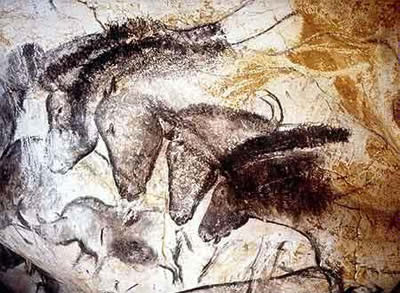
Earlier and earlier prehistoric art has been found. It’s getting ever harder to claim that Neanderthals had nothing to do with it. This is from the enormous Chauvet cave in France, at least 32,000 years old:
If Not Neanderthal, Probably Mostly Neanderthal
(42,000 year old art was also found in Spain.)
Neanderthals also domesticated, and genetically engineered dogs, from European wolves. That’s very clear.
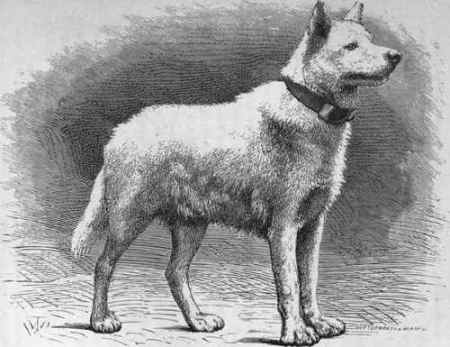
How do I know this? Simple. The Goyet dog, pictured below was dated around 32,000 years. In 2010, an even older dog was found in the Altai mountains. Both dogs were derived from Canis Lupus Familiaris, the European wolf, but were quite distant from it, genetically, they had been evolved probably on a time scale of more than 10,000 years, thus well before any arrival of Sapiens Sapiens from Africa.
Those dogs were completely compatible with people, just as contemporary dogs are. Proof? Ancient, 26,000-year-old footprints made by a child and a dog deep in the Chauvet Cave, France. (OK, by then Neanderthals had been deemed “extinct” by some… However, these are still the same dogs Neanderthals invented.)
It Took Many Thousands Years To Breed Such Large Dogs From European Wolves.
It is perplexing that other human groups did not domesticate the local canids. There are (still!) wolves in Africa and India. And also Lycaons (“African Wild Dogs”). Those are supremely intelligent, and sort of domesticate readily in the wild (I tried this myself as a child).
The argument that Africans would have moved to Europe to domesticate European wolves, when they had a similar fauna, including wolves, to domesticate in Africa, is simply extravagant.
In the next few days I will amend those static pages to incorporate this fascinating update to my knowledge. I shall also seek permission to republish the articles linked to by Patrice as they are full of detailed knowledge about the oldest man-animal relationship; by far!


















 Learning from Dogs