Came across this a few days ago and you will love it!
The new world comes up with some marvellous treats. Here I was listening to the radio (BBC – Radio 4) from Southern Oregon and they had this item about a Scottish thatcher using a variety of plants to thatch roofs. The thatcher had been thatching for years.
Then a quick search on the internet found this video:
An interesting article about the benefits of being active.
I try and stay as active as I can mainly by bicycle riding. This article from The Conversation shows the importance of this. It is just a shame that they do not mention being old and active; as in being 80!
ooOOoo
Some pro athletes keep getting better as they age − neuroscience can explain how they stay sharp
Recovery and mental resilience support the development of neuroplasticity, which helps athletes like Allyson Felix stay sharp. AP Photo/Charlie Riedel
In a world where sports are dominated by youth and speed, some athletes in their late 30s and even 40s are not just keeping up – they are thriving.
Novak Djokovic is still outlasting opponents nearly half his age on tennis’s biggest stages. LeBron James continues to dictate the pace of NBA games, defending centers and orchestrating plays like a point guard. Allyson Felix won her 11th Olympic medal in track and field at age 35. And Tom Brady won a Super Bowl at 43, long after most NFL quarterbacks retire.
The sustained excellence of these athletes is not just due to talent or grit – it’s biology in action. Staying at the top of their game reflects a trainable convergence of brain, body and mindset. I’m a performance scientist and a physical therapist who has spent over two decades studying how athletes train, taper, recover and stay sharp. These insights aren’t just for high-level athletes – they hold true for anyone navigating big life changes or working to stay healthy.
Increasingly, research shows that the systems that support high performance – from motor control to stress regulation, to recovery – are not fixed traits but trainable capacities. In a world of accelerating change and disruption, the ability to adapt to new changes may be the most important skill of all. So, what makes this adaptability possible – biologically, cognitively and emotionally?
The amygdala and prefrontal cortex
Neuroscience research shows that with repeated exposure to high-stakes situations, the brain begins to adapt. The prefrontal cortex – the region most responsible for planning, focus and decision-making – becomes more efficient in managing attention and making decisions, even under pressure.
During stressful situations, such as facing match point in a Grand Slam final, this area of the brain can help an athlete stay composed and make smart choices – but only if it’s well trained.
In contrast, the amygdala, our brain’s threat detector, can hijack performance by triggering panic, freezing motor responses or fueling reckless decisions. With repeated exposure to high-stakes moments, elite athletes gradually reshape this brain circuit.
They learn to tune down amygdala reactivity and keep the prefrontal cortex online, even when the pressure spikes. This refined brain circuitry enables experienced performers to maintain their emotional control.
Creating a brain-body loop
Brain-derived neurotrophic factor, or BDNF, is a molecule that supports adapting to changes quickly. Think of it as fertilizer for the brain. It enhances neuroplasticity: the brain’s ability to rewire itself through experience and repetition. This rewiring helps athletes build and reinforce the patterns of connections between brain cells to control their emotion, manage their attention and move with precision.
In moments like these, higher BDNF availability likely allows him to regulate his emotions and recalibrate his motor response, helping him to return to peak performance faster than his opponent.
Rewiring your brain
In essence, athletes who repeatedly train and compete in pressure-filled environments are rewiring their brain to respond more effectively to those demands. This rewiring, from repeated exposures, helps boost BDNF levels and in turn keeps the prefrontal cortex sharp and dials down the amygdala’s tendency to overreact.
This kind of biological tuning is what scientists call cognitive reserve and allostasis – the process the body uses to make changes in response to stress or environmental demands to remain stable. It helps the brain and body be flexible, not fragile.
Importantly, this adaptation isn’t exclusive to elite athletes. Studies on adults of all ages show that regular physical activity – particularly exercises that challenge both body and mind – can raise BDNF levels, improve the brain’s ability to adapt and respond to new challenges, and reduce stress reactivity.
Programs that combine aerobic movement with coordination tasks, such as dancing, complex drills or even fast-paced walking while problem-solving have been shown to preserve skills such as focus, planning, impulse control and emotional regulation over time.
After an intense training session or a match, you will often see athletes hopping on a bike or spending some time in the pool. These low-impact, gentle movements, known as active recovery, help tone down the nervous system gradually.
Serbian tennis player Novak Djokovic practices meditation, which strengthens the mental pathways that help with stress regulation. AP Photo/Kin Cheung
Over time, this convergence creates a trainable loop between the brain and body that is better equipped to adapt, recover and perform.
Lessons beyond sport
While the spotlight may shine on sporting arenas, you don’t need to be a pro athlete to train these same skills.
The ability to perform under pressure is a result of continuing adaptation. Whether you’re navigating a career pivot, caring for family members, or simply striving to stay mentally sharp as the world changes, the principles are the same: Expose yourself to challenges, regulate stress and recover deliberately.
While speed, agility and power may decline with age, some sport-specific skills such as anticipation, decision-making and strategic awareness actually improve. Athletes with years of experience develop faster mental models of how a play will unfold, which allows them to make better and faster choices with minimal effort. This efficiency is a result of years of reinforcing neural circuits that doesn’t immediately vanish with age. This is one reason experienced athletes often excel even if they are well past their physical prime.
Physical activity, especially dynamic and coordinated movement, boosts the brain’s capacity to adapt. So does learning new skills, practicing mindfulness and even rehearsing performance under pressure. In daily life, this might be a surgeon practicing a critical procedure in simulation, a teacher preparing for a tricky parent meeting, or a speaker practicing a high-stakes presentation to stay calm and composed when it counts. These aren’t elite rituals – they’re accessible strategies for building resilience, motor efficiency and emotional control.
Humans are built to adapt – with the right strategies, you can sustain excellence at any stage of life.
Earlier this month, a homeowner called Tidewater Wildlife Rescue with an urgent request. A common garter snake was hopelessly tangled in a piece of netting in their yard. Could someone come help?
Rescue volunteer Serenity Reiner quickly headed to the scene.
TIDEWATER WILDLIFE RESCUE
Reiner and her rescue partner, Daniel, used scissors to cut away big pieces of the net. Then, Daniel gently held the snake as Reiner snipped away netting closer to the animal’s body.
“We were very focused,” Reiner told The Dodo. “We wanted to be as fast as possible to limit [her] stress.”
The rescuers were almost finished when they noticed something amazing — the snake was giving birth in their hands.
TIDEWATER WILDLIFE RESCUE
Reiner hastily removed the remaining netting as the mama snake birthed two babies. Then, she took the snake and her little ones to a wooded area behind the house and released them back into the wild.
Surprisingly, despite their size, baby garter snakes don’t need to live with their mom for very long. In fact, as the rescue notes, these young snakes are completely independent from the moment they’re born and can immediately find food on their own.
TIDEWATER WILDLIFE RESCUE
According to the U.S. National Park Service, garter snakes typically give birth to 15-40 babies at a time. Reiner suspects this mama welcomed many more little ones into the world once she was safe in the forest.
The rescuer encouraged the homeowners to use animal-safe netting next time. She’s grateful that, in this case, everything turned out OK.
“I felt so much joy knowing that she was able to go back to her normal life unharmed,” Reiner said.
From Saturday, 26th July until Thursday, 7th August we will have family staying with us and the likelihood is that there will not be any blog posts during this period. By family I mean my daughter, son-in-law, and my grandson.
It is what we share with animals, but it is not as straightforward as one thinks!
The range of thinking, in terms of logical thinking, even in humans, is enormous. And when we watch animals, especially mammals, it is clear that they are operating in a logical manner. By ‘operating’ I am referring to their thought processes.
So a recent article in The Conversation jumped out at me. Here it is:
ooOOoo
Humans and animals can both think logically − but testing what kind of logic they’re using is tricky
Can a monkey, a pigeon or a fish reason like a person? It’s a question scientists have been testing in increasingly creative ways – and what we’ve found so far paints a more complicated picture than you’d think.
Imagine you’re filling out a March Madness bracket. You hear that Team A beat Team B, and Team B beat Team C – so you assume Team A is probably better than Team C. That’s a kind of logical reasoning known as transitive inference. It’s so automatic that you barely notice you’re doing it.
It turns out humans are not the only ones who can make these kinds of mental leaps. In labs around the world, researchers have tested many animals, from primates to birds to insects, on tasks designed to probe transitive inference, and most pass with flying colors.
As a scientist focused on animal learning and behavior, I work with pigeons to understand how they make sense of relationships, patterns and rules. In other words, I study the minds of animals that will never fill out a March Madness bracket – but might still be able to guess the winner.
Logic test without words
The basic idea is simple: If an animal learns that A is better than B, and B is better than C, can it figure out that A is better than C – even though it’s never seen A and C together?
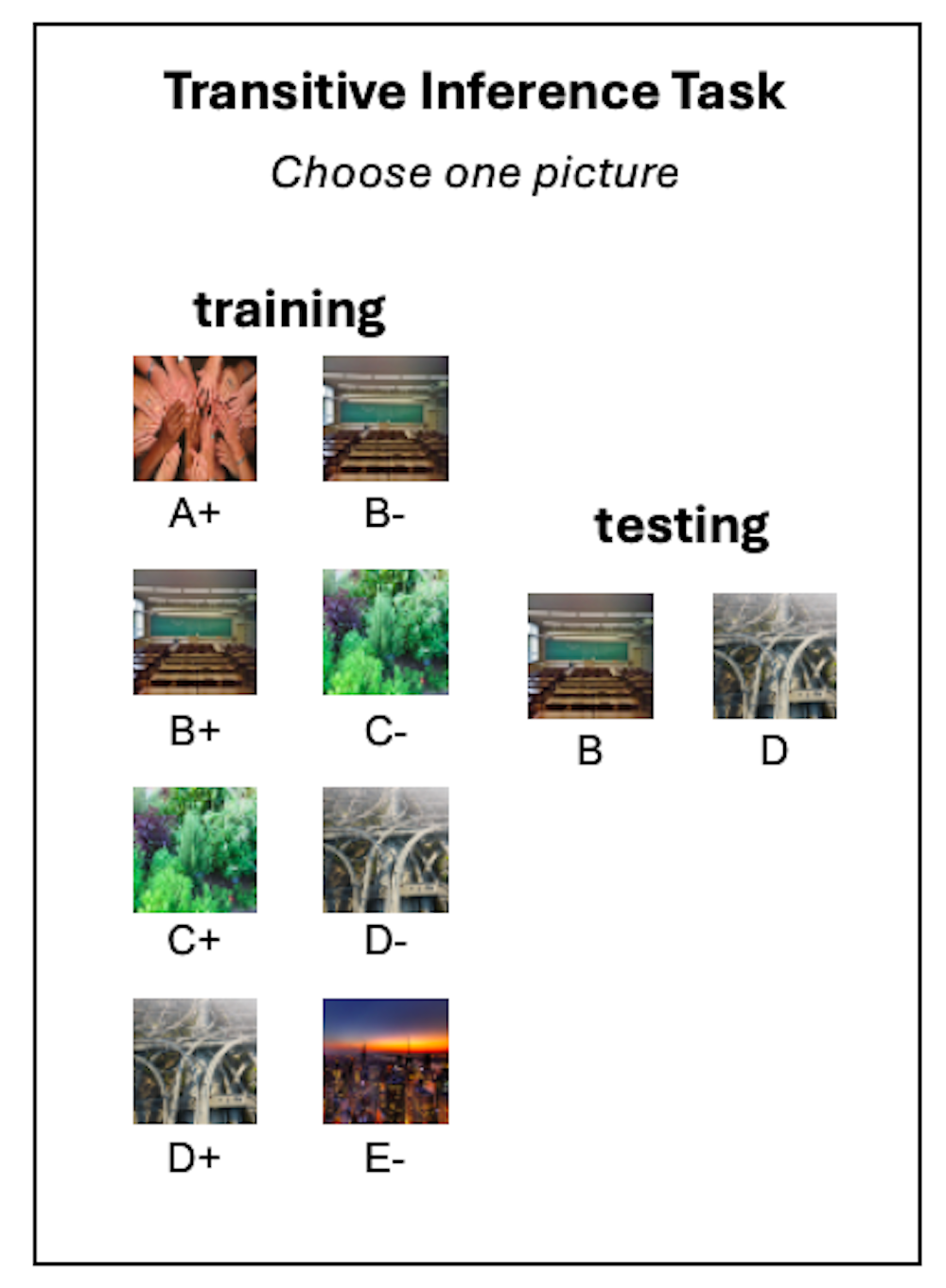
In the lab, researchers test this by giving animals randomly paired images, one pair at a time, and rewarding them with food for picking the correct one. For example, animals learn that a photo of hands (A) is correct when paired with a classroom (B), a classroom (B) is correct when paired with bushes (C), bushes (C) are correct when paired with a highway (D), and a highway (D) is correct when paired with a sunset (E). We don’t know whether they “understand” what’s in the picture, and it is not particularly important for the experiment that they do.
In a transitive inference task, subjects learn a series of rewarded pairs – such as A+ vs. B–, B+ vs. C– – and are later tested on novel pairings, like B vs. D, to see whether they infer an overall ranking. Olga Lazareva, CC BY-ND
One possible explanation is that the animals that learn all the tasks create a mental ranking of these images: A > B > C > D > E. We test this idea by giving them new pairs they’ve never seen before, such as classroom (B) vs. highway (D). If they consistently pick the higher-ranked item, they’ve inferred the underlying order.
What’s fascinating is how many species succeed at this task. Monkeys, rats, pigeons – even fish and wasps – have all demonstrated transitive inference in one form or another.
The twist: Not all tasks are easy
But not all types of reasoning come so easily. There’s another kind of rule called transitivity that is different from transitive inference, despite the similar name. Instead of asking which picture is better, transitivity is about equivalence.
In this task, animals are shown a set of three pictures and asked which one goes with the center image. For example, if white triangle (A1) is shown, choosing red square (B1) earns a reward, while choosing blue square (B2) does not. Later, when red square (B1) is shown, choosing white cross (C1) earns a reward while choosing white circle (C2) does not. Now comes the test: white triangle (A1) is shown with white cross (C1) and white circle (C2) as choices. If they pick white cross (C1), then they’ve demonstrated transitivity.
In a transitivity task, subjects learn matching rules across overlapping sets – such as A1 matches B1, B1 matches C1 – and are tested on new combinations, such as A1 with C1 or C2, to assess whether they infer the relationship between A1 and C1. Olga Lazareva, CC BY-ND
The change may seem small, but species that succeed in those first transitive inference tasks often stumble in this task. In fact, they tend to treat the white triangle and the white cross as completely separate things, despite their common relationship with the red square. In my recently published review of research using the two tasks, I concluded that more evidence is needed to determine whether these tests tap into the same cognitive ability.
Small differences, big consequences
Why does the difference between transitive inference and transitivity matter? At first glance, they may seem like two versions of the same ability – logical reasoning. But when animals succeed at one and struggle with the other, it raises an important question: Are these tasks measuring the same kind of thinking?
The apparent difference between the two tasks isn’t just a quirk of animal behavior. Psychology researchers apply these tasks to humans in order to draw conclusions about how people reason.
For example, say you’re trying to pick a new almond milk. You know that Brand A is creamier than Brand B, and your friend told you that Brand C is even waterier than Brand B. Based on that, because you like a thicker milk, you might assume Brand A is better than Brand C, an example of transitive inference.
But now imagine the store labels both Brand A and Brand C as “barista blends.” Even without tasting them, you might treat them as functionally equivalent, because they belong to the same category. That’s more like transitivity, where items are grouped based on shared relationships. In this case, “barista blend” signals the brands share similar quality.
Researchers often treat these types of reasoning as measuring the same ability. But if they rely on different mental processes, they might not be interchangeable. In other words, the way scientists ask their questions may shape the answer – and that has big implications for how they interpret success in animals and in people.
This difference could affect how researchers interpret decision-making not only in the lab, but also in everyday choices and in clinical settings. Tasks like these are sometimes used in research on autism, brain injury or age-related cognitive decline.
If two tasks look similar on the surface, then choosing the wrong one might lead to inaccurate conclusions about someone’s cognitive abilities. That’s why ongoing work in my lab is exploring whether the same distinction between these logical processes holds true for people.
Just like a March Madness bracket doesn’t always predict the winner, a reasoning task doesn’t always show how someone got to the right answer. That’s the puzzle researchers are still working on – figuring out whether different tasks really tap into the same kind of thinking or just look like they do. It’s what keeps scientists like me in the lab, asking questions, running experiments and trying to understand what it really means to reason – no matter who’s doing the thinking.
As many of you know I flew during my years when I was based in England. I flew as a hobby. Very quickly I realised that looking at the ground from a few thousand feet up gave one a unique view of the landscape.
ooOOoo
50 Years of Flying for Heritage
Damian Grady
Damian Grady is the Historic England Aerial Reconnaissance Manager. He joined the Royal Commission on the Historical Monuments of England in 1990 to map archaeology from aerial photographs and from 1998 became responsible for managing the aerial reconnaissance programme.
Published 8 February 2017
On Wednesday 8 February 2017 Historic England celebrated 50 years of our flying programme. Since those early days in 1967 much has changed, but reconnaissance, the act of flying to record and monitor sites and landscapes of archaeological interest, is still at the heart of the work carried out by our research teams.
This article was originally written in 2017 to mark the 50th anniversary but we have kept it live as it continues to be read and enjoyed.
On a cold February afternoon in 1967 an Auster, four-seater, light aircraft took off from Fairoaks airfield on the outskirts of south west London. This was the first test flight of the Royal Commission on the Historical Monuments of England (RCHME), one of the predecessors of Historic England. On-board was the pilot, a photographer, Ron Parsons and John Hampton. John was responsible for setting up the RCHME Air Photo Library in 1965 to implement the commission’s resolution (1964) to “use air photography to build up rapidly a record of field monuments throughout England.”
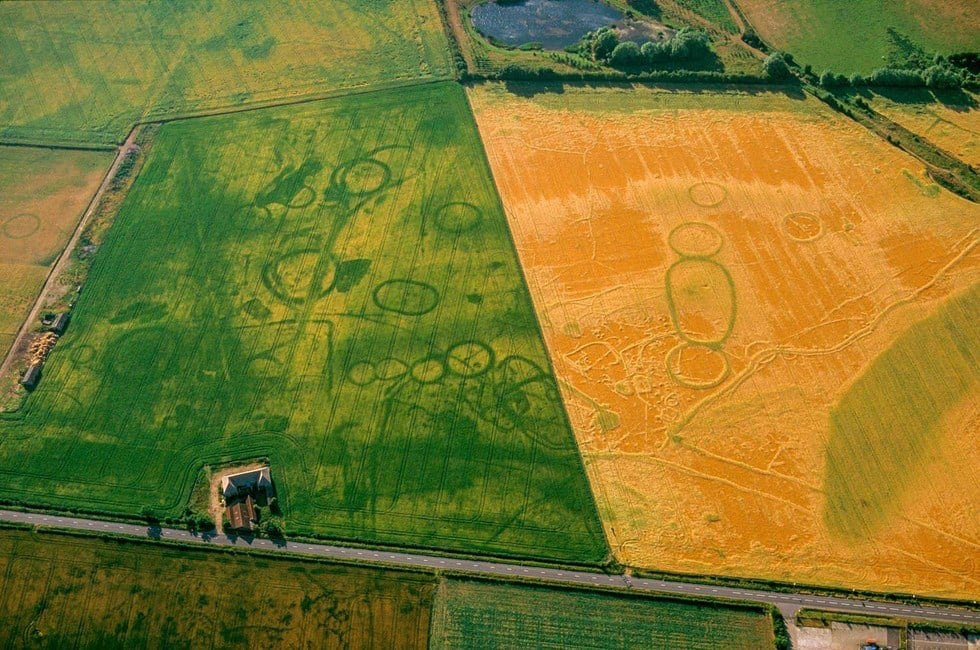
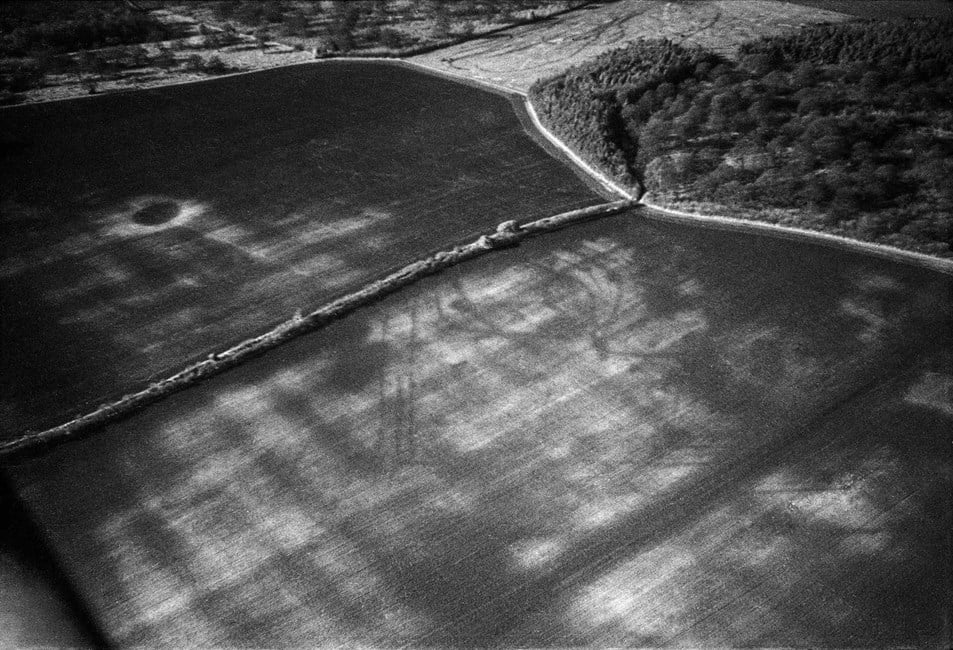
In the beginning this involved acquiring aerial photographs to build up a library of images of archaeological sites. By 1967 it was felt that RCHME should take its own oblique aerial photographs in support of its field survey work. Oblique photographs are taken at an “oblique” angle to the ground, as opposed to directly from above. They are usually taken with a hand held camera through the open window of a plane. The main target at this time was cropmarks; the walls and ditches of buried archaeology can affect the rate at which plants grow over them, causing differences in colour and height. These cropmarks are not always visible on the ground, so the best way to look for them is from the air.
This first flight was very much an experiment. Flying from Fairoaks to Basingstoke, Tidbury Ring and back they photographed prehistoric sites on the chalk soils of Hampshire. Many of the sites had been ploughed recently and were seen as colour differences in the soil and germinating crops. During the 1.5 hour flight John Hampton learned a number of valuable lessons, such as the best height to fly, the best angle to use and to make sure there was plenty of film! The lessons learned from this and subsequent flights formed the foundation of 50 years of flying by the aerial reconnaissance team in RCHME, English Heritage and now Historic England.
Growth of the archive
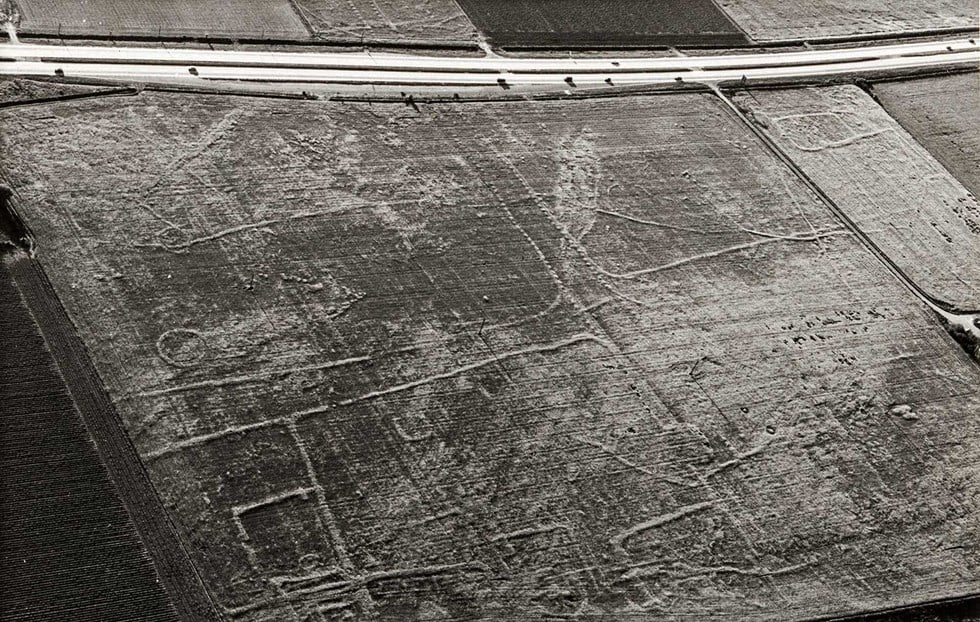
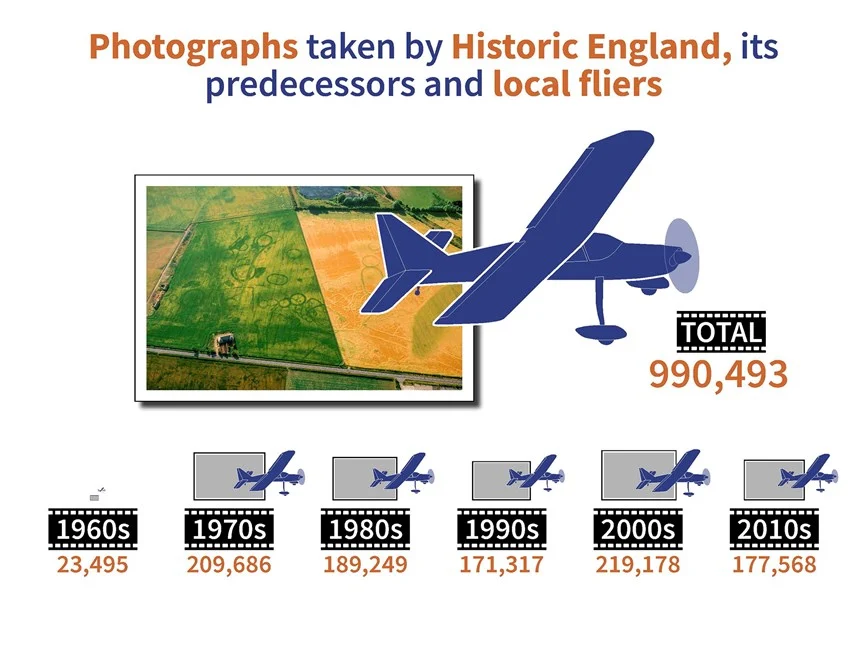
At about the same time as this first flight the collection of aerial photographs grew with the arrival of the Crawford Collection from the Ordnance Survey. Later, in the 1970s, the Air Photo library acquired many more aerial photographs from archaeologists and private fliers keen to discover archaeological sites. One such flier was Derrick Riley who took this photograph of an Iron Age/Roman field system in Nottinghamshire.
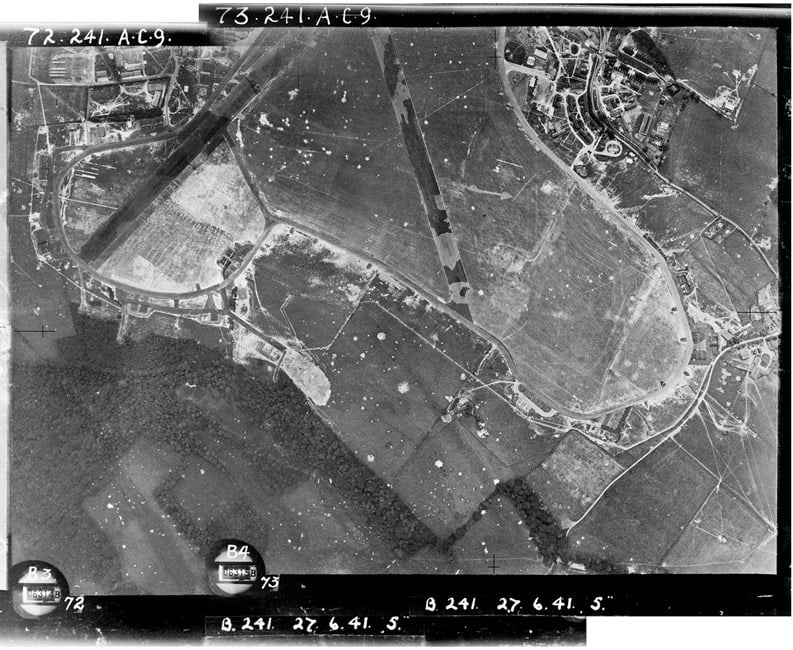
The oblique photographs acquired and taken by RCHME were ordered by kilometre square and stored in distinctive red boxes. Then in the 1980s there was a rapid growth with the acquisition of the Department of the Environment collection of vertical aerial photos. This collection included all prints taken of England by the RAF since the start of WWII such as the image below. This shows the airfield at Biggin Hill, near London with evidence of the many bomb craters sustained during German air raids. Further expansion came in the 1990s with the acquisition of the Ordnance Survey archive and in 2007 with the Aerofilms collection.
Photo mosaic of RAF images of Biggin Hill airfield taken on 27 June 1941, showing a camouflaged runway and filled in bomb craters (RAF_241_72 and 73). Source: Historic England Archive (RAF collection).
Mapping from aerial photographs
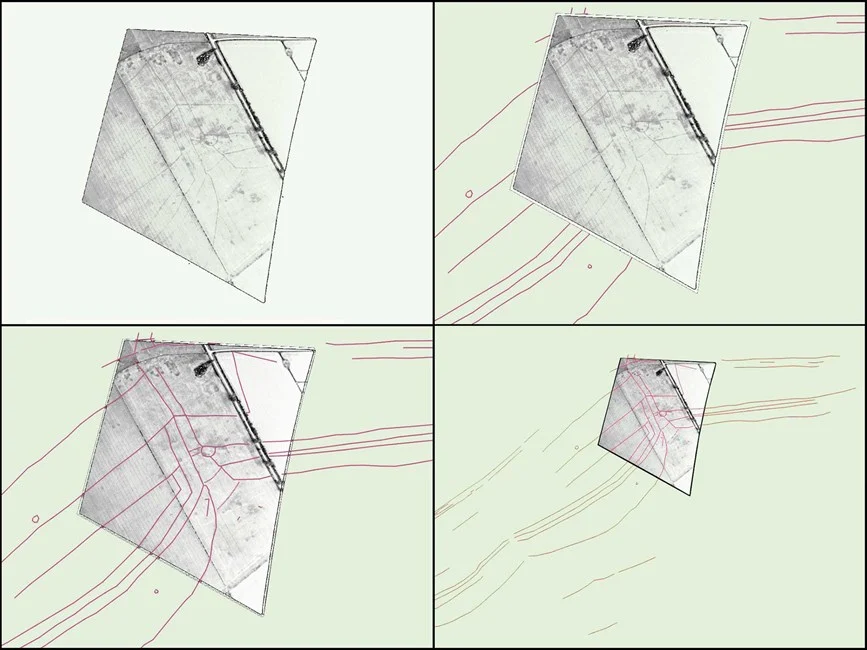
In the 1970s John Hampton and his team looked at various ways of interpreting and mapping from the aerial photographs taken by RCHME and acquired from local fliers. Along with others, they experimented with a variety of mapping techniques from sketch plotting to photogrammetry. An important step in the development of this process was the project to map the archaeology around the Iron Age hillfort of Danebury. This approach was scaled up by RCHME to map the prehistoric archaeology visible as cropmarks on the Yorkshire Wolds. This project used computer aided rectification of oblique aerial photographs, a process that was being developed.
In the late 1980s, as the archive acquired more aerial photographs, RCHME developed a systematic methodology to interpret, map and record all archaeological features, not just cropmarks, visible on aerial photographs. Pilot projects in Kent, Hertfordshire and the Thames Valley were set up to develop the methodology further.
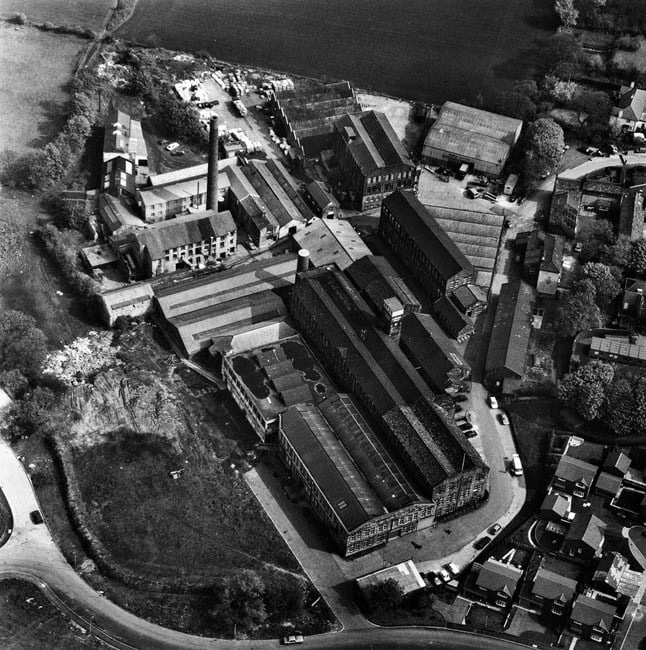
In the 1990s the range of subjects photographed increased as RCHME used aerial photographs to record the large building complexes they were surveying that were undergoing major changes at the time. These included textile mills, hospitals, prisons and Cold War military sites. For some of these sites such as the textile mill below in Leeds, these photographs are the last record we have as development pressures have since led to their demolition.
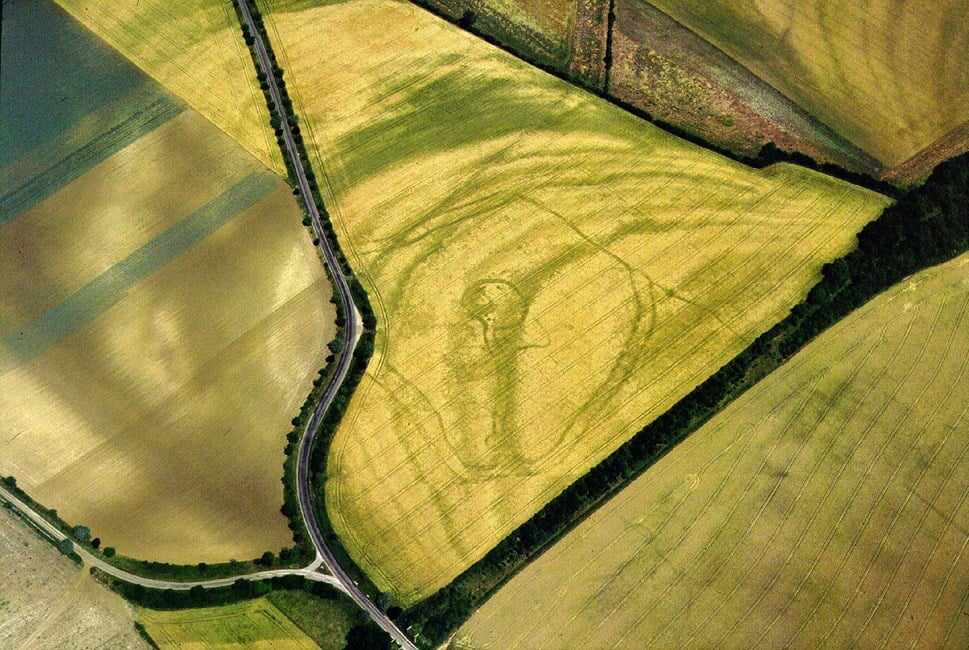
The 1990s also saw new discoveries across the country especially in the hot summers of 1995 and 1996. Below is just one such site, a “banjo” enclosure, so called because of the shape; a circular enclosure with a long funnel neck leading into it. See other examples of new sites discovered in the 1990s and at other times in the gallery below.
In the 1990s the political changes and opening up of eastern Europe led to archaeologists visiting the survey and archive teams to learn from our experience of flying, mapping and archiving aerial photographs. This led to us joining forces with other aerial archaeologists from western Europe to set up training courses in Hungary and Poland. This in turn led to further work exchanges and training courses across Europe.
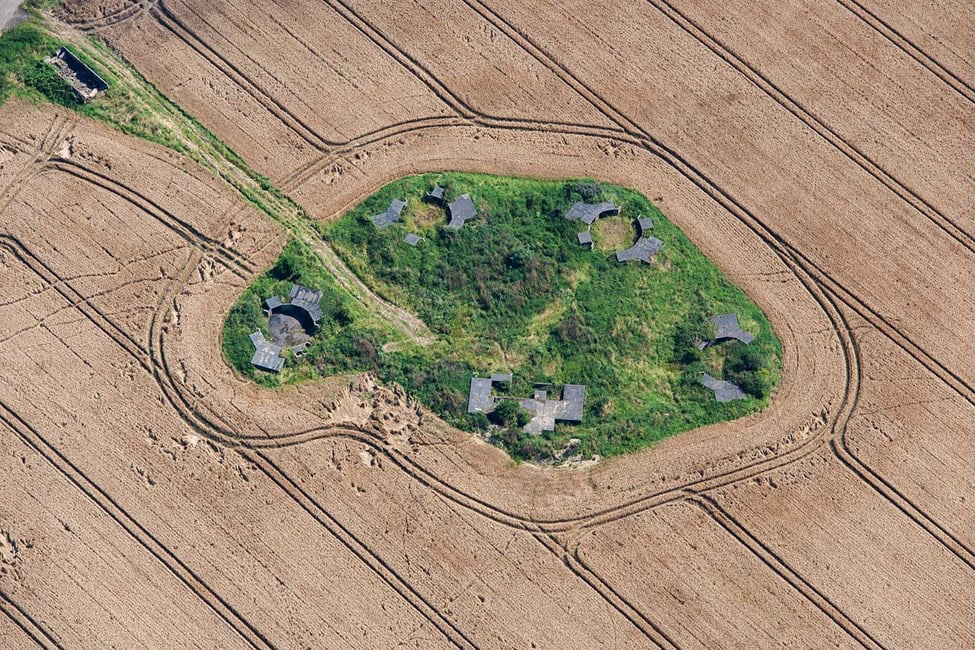
The late 1990s saw RCHME and EH working together to supply aerial photographs to help Field Monument Wardens monitor the condition of scheduled monuments. Following the merger of the two organisations in 1999 this became an important aspect of the flying programme. In the image below the World War Two anti-aircraft battery might appear to be safe since it has been removed from the cultivation that surrounds it. However, it is still at risk from being overgrown by scrub.
The new century saw important technological developments taken up by the flying and mapping teams. The reconnaissance teams began experimenting with digital cameras in 2003 and the archive developed standards for the long term preservation of digital data. The last negative film shot in the air was 2006. The archive now holds over 200,000 digital aerial photographs taken by the reconnaissance teams.
In 2001 English Heritage used lidar, a system of airborne laser scanning, for a review of mapping of the Stonehenge World Heritage site. Since then HE have developed our use of the data and now use it as a regular source for any mapping and interpretation projects.
The discovery of new archaeological sites is still the most exciting part of the flying programme, but since the first flight in 1967 the scale, range and scope has changed. New sensors and camera technology are allowing us to look at new ways of taking aerial photographs. New software and access to other aerial data such as lidar allows us to see, map and understand the historic landscape in ways that could only have been dreamed about in 1967.
Since our systematic analysis of new and archive aerial photographs began in the late 1990s we have discovered over 122,000 new archaeological sites like the one above.
ooOOoo
I very much hope that republishing this article is in order. An email to the Press Office of Historic England requesting permission has been sent last Sunday afternoon.
This morning, 30th July, I received the following email:
To use the aerial images you have seen on our webpage ’50 Years Flying’ athttps://historicengland.org.uk/whats-new/research/50-years-flying/ , please make a note of the image reference numbers and then visit our Aerial Photography Explorer website at https://historicengland.org.uk/images-books/archive/collections/aerial-photos/ . If you then navigate to the oblique image search screen and fill in the reference number under the ‘file contains’ tab you will be taken to that image. By then hovering over that image a share/embed option will appear that will allow you to use the images free of charge on non-commercial websites and some social media sites such as X and Facebook. Our reference is 150356.
Last Sunday morning I listened to a BBC Radio 4 programme The Dark Enlightenment. Here is a summary from the BBC website:
A radical political philosophy founded by a software engineer called Curtis Yarvin is gaining in influence, and said to be shaping Donald Trump’s second term in the White House.
It is on BBC Sounds. Here is the link: BBC Currently.
The plan was simple. It started by retiring all government employees by offering them incentives to leave and never return. To avoid anarchy and keep authority, the police and military would be retained.
Government funds would be seized and the money redirected to more worthwhile pursuits. Court orders pushing back against these measures as “unconstitutional” should be summarily ignored. The press should be massaged and censored as necessary. Finally, universities, scientific institutions, and NGOs should also be snapped off, their funding terminated.
These moves resemble many made (or attempted) in the first 100 days of the second Trump administration. But they were all laid out in 2012 by a single person: Curtis Yarvin.
In the past five years, Yarvin’s reactionary blueprints for governance have found powerful backers in both Silicon Valley and Washington circles.
His ideas have been taken up and repeated in various ways by Peter Thiel (PayPal), Elon Musk (X, Tesla), Alexander Karp (Palantir) and other founders, CEOs and thought-leaders within the broader tech industry. He was a guest at Trump’s Coronation Ball in January.
Yarvin’s current newsletter, Grey Room, now boasts 57,000 subscribers. “Curtis Yarvin’s Ideas Were Fringe,” cautioned a recent article, “Now They’re Coursing Through Trump’s Washington.”
JD Vance has praised Yarvin by name and echoed his ideas, calling for a ‘de-wokification programme’. Bonnie Cash/Pool/AAP
Rebooting the state
Yarvin, a 51-year old computer engineer, has been publishing his thoughts on politics for close to 20 years. His original blog, launched in 2007, introduced his potent blend of “the modern engineering mentality, and the great historical legacy of antique, classical and Victorian pre-democratic thought”. Last week, The Washington Post called it “required reading for the extremely online right”.
Democracy was dead and doomed from the beginning, Yarvin argued in his blog, in quippy, Reddit-style prose. Governance should look to other mechanisms (tech) and modes (monarchism) for inspiration.
The state needs a “hard reboot,” asserted Yarvin. “Democratic elections are entirely superfluous to the mechanism of government” he argued. “A vote for democratic or republican matters a little bit,” he admitted, but “basically if the whole electoral system disappeared, Washington would go on running in exactly the same ways”.
Curtis Yarvin. Wikipedia
For Yarvin, then, it is not just the government that must change – a superficial swap of parties and politicians – but something far more fundamental: the form of government. Democracy was beta tested and failed to deliver. The political operating system must be ripped out and replaced.
While elements (like the term “red pill”) travelled far beyond its pages, Yarvin’s ideas remained on the fringes until recently, with their growing popularity pushing him into the limelight. Last week he hit the headlines due to his debate at Harvard, a place that has become a “symbol of resistance to Trump”, with political theorist Danielle Allen, a democracy advocate.
Allen, who debated Yarvin to provide students with “help thinking about intellectual material”, wrote after the debate that he correctly diagnoses a problem, but not its causes or solutions:
He is right that our political institutions are failing. He is also right that their members have failed to see the depth of our governance problems and their own contributions to them through technocracy and political correctness. […] But Mr. Yarvin leads them astray with his vision of absolute monarchy and racial cleansing.
A technological republic
For Yarvin and others like him, democracy’s fatal flaw is the demos (or, people) itself. Trusting the agency and ability of citizens to govern through representation is naive, Yarvin believes. Alexander Karp, CEO of Palantir, a firm that provides military and intelligence agencies with big data “intelligence”, agrees.
“Why must we always defer to the wisdom of the crowd when it comes to allocating scarce capital in a market economy?” Karp asked in his recent bestseller, The Technological Republic.
For Yarvin, Karp, Thiel and the other elites that embrace these ideas, the people are idiots. A favourite quote (likely apocryphal) is from Churchill, stating the best argument against democracy is a five-minute conversation with the average voter.
If a legacy republic was one by the people and for the people, Karp argues a technological republic will “require the rebuilding of an ownership society, a founder culture that came from tech but has the potential to reshape government”.
In this vision, the state shapeshifts into something sleeker, more successful, more like a startup: the corporation. “A government is just a corporation that owns a country,” Yarvin stresses. Musk has echoed this line: “the government is simply the largest corporation”.
But if this is true, it is a pathetic one, according to its hyper-capitalist detractors: bloated with waste, saddled with debt and slowed by regulation. The state is a dinosaur which makes incremental change and must tread with caution, bending to the needs of its constituents. Founders dictate their commands and impose their will.
Dark enlightenment
“Once the universe of democratic corruption is converted into a (freely transferable) shareholding in gov-corp the owners of the state can initiate rational corporate governance, beginning with the appointment of a CEO,” explains philosopher Nick Land.
“As with any business, the interests of the state are now precisely formalized as the maximization of long-term shareholder value.” In this model, the president becomes the CEO king; the citizen becomes the customer or user.
Land, more than any other, has provided the philosophical cachet around this movement, taking Yarvin’s quippy but fuzzy prose and formalising it into the political and philosophical formation known as neoreaction or the “Dark Enlightenment”, with a sprawling 2014 essay that moves from the death of the west to racial terror, the limits of freedom and the next stage of human evolution.
Nick Land. GoodReads
Land, variously regarded as a cybernetic prophet or scientific racist, has long held anti-humanist and anti-democratic views. “Voice”, or representation – the key tenet of liberal democracy – has been tried and failed, Land argues. The only viable alternative is “exit”: flight from failed governance altogether, into a post-political and post-human future.
To simplify drastically: democracy’s naive belief in equality for all – propped up and policed by the array of humanitarian organisations, government agencies and woke culture warriors that Yarvin sneeringly dubs “The Cathedral” – has held capitalism back from its true potential.
Technological fascism
For Land, Yarvin and others, optimal rule would be both hypercapitalist and hyperconservative: a hybrid political order I’ve begun to research and conceptualise as technological fascism.
Technological fascism gazes to the future and past for inspiration. It couples, in the words of writer Jacob Siegel:
the classic anti-modern, anti-democratic worldview of 18th-century reactionaries to a post-libertarian ethos that embraced technological capitalism as the proper means for administering society.
In this vision, the best form of governance marries reaction and information, Machiavelli and machine learning, aristocracy and artificial intelligence, authoritarianism and technosolutionism.
To revive the glorious traditions of the past, its champions believe, we must leverage the bleeding-edge innovations of tomorrow.
Governing like a monarch
This culture is already infiltrating Washington. Trump is governing like a monarch, making unilateral decisions via hundreds of executive orders, bulldozing through opposition and legislation.
Musk and his DOGE minions stress they need to “delete entire agencies”, commandeering offices and allegedly stealing data under the pretext of eliminating “waste”.
A recent study of over 500 political scientists found “the vast majority think the US is moving swiftly away from liberal democracy toward some form of authoritarianism”.
In the vision laid out by Yarvin – and taken up more and more by a growing political vanguard – government is either a political inconvenience or a technical problem. Increasingly, the authoritarian imperative to impose absolute rule and the Silicon Valley mantra of “moving fast and breaking stuff” dovetail into a disturbing single directive.

















 Learning from Dogs