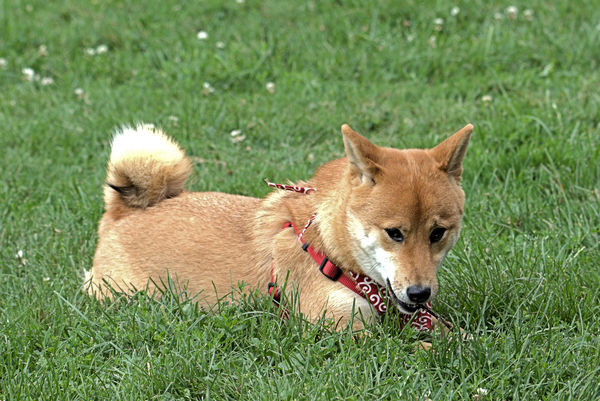
Though dogs are humanity’s oldest and most consistent animal friend, scientists have long struggled to figure out just how Canis familiaris came to be. Though researchers agree dogs are descended from wild wolves, they aren’t sure when and where domestication occurred. And as Tina Hesman Saey at Science News reports, a new study has revived the debate, suggesting that dogs were domesticated one time between 20,000 and 40,000 years ago.
Dog domestication has gotten a lot of attention in recent years. In 2016, researchers looked at the mitochondrial DNA of modern and ancient dog species, determining that dogs come from two different wolf populations, one found in Europe and one found in Asia. That means that wolves would have been domesticated in two different places, with the two lineages eventually mixing in modern dogs.
But this latest research contradicts the double-domestication hypothesis. According to Ben Guarino at the Washington Post, researchers looked at the well-preserved DNA of two ancient dogs found in Germany, one 7,000 years old and one 4,700 years old, as well as the complete genomes of 100 modern dogs and snippets of DNA from 5,600 other wolves and dogs.
They traced the rate of mutations in the over time in the dog genomes. This technique, which creates a “molecular clock,” indicates that dogs diverged from wolves 36,900 years ago to 41,500 years ago in a single domestication event. But they can’t determine exactly where the split occurred. About 20,000 years later, the molecular clock indicates dogs split into European and Asian groups. They published their results in the journal Nature Communications
Not everyone is convinced by the study. Greger Larson, Oxford evolutionary biologist and author of the earlier domestication study, tells Guarino that the latest research does not explain the “ridiculously deep split” between the genetics of ancient European and Asian dogs. He also points out that while ancient dog bones have been found in far eastern Asia and western Europe, the middle of Eurasia seems to be empty of dog bones, suggesting that there were two ancient populations, separated by vast distances.
Krishna Veeramah, a palaeogeneticist at Stony Brook University and author of the new study says he doesn’t anticipate that the paper will put the issue to rest. “More ancient dog DNA from genomes will ultimately solve the problem,” he tells Rachael Lallensack at Nature. Researchers are hoping to find more geographically diverse DNA from dogs as well as samples from different time periods.
Whether it happened once or twice, how and why did domestication occur?
As Veeramah tells Helen Briggs at the BBC that it’s likely dogs evolved from wolves that began hanging around human camps, scavenging their scraps. ”Those wolves that were tamer and less aggressive would have been more successful at this,” he says. “While the humans did not initially gain any kind of benefit from this process, over time they would have developed some kind of symbiotic relationship with these animals, eventually evolving into the dogs we see today.”
One early benefit of domesticated dogs may have been that they could help transport meat from carcasses or hunt dangerous game like cave bears and cave lions, Saey writes in an earlier Science News article.
For now, however, exactly when and where Fido first approached humans will remain a mastiff question.
ooOOoo
For my money the origins of the domestic dog are as Krishna Veeramah puts it: ”Those wolves that were tamer and less aggressive would have been more successful at this,” he says. “While the humans did not initially gain any kind of benefit from this process, over time they would have developed some kind of symbiotic relationship with these animals, eventually evolving into the dogs we see today.”
Humans and Dogs May Have Hunted Together in Prehistoric Jordan
Bones at a settlement called Shubayqa 6 show clear signs of having been digested—but were much too large to have been eaten by humans
Selection of gazelle bones from Space 3 at Shubayqa 6 displaying evidence for having been in the digestive tract of a carnivore. ( Credit: University of Copenhagen)
When and where dogs came to be domesticated is a subject of scientific debate, but there is a wealth of research that attests to the long, intertwined history of humans and their best animal buddies. One theory about the early origins of this relationship posits that dogs were used to help early humans hunt. And, as Ruth Schuster reports for Haaretz, a new study suggests that this may have been the case among prehistoric peoples of what is now Jordan.
A team of archaeologists from the University of Copenhagen and University College London studied a cache of animal bones at an 11,500-year-old settlement called Shubayqa 6, which is classified as “Pre-Pottery Neolithic A,” or belonging to the first stage of Neolithic culture in the Levant. In the Journal of Anthropological Archaeology, the researchers write that they found bones from a canid species, though they could not identify which one because the remains were poorly preserved. They also unearthed the bones of other animals that had been butchered. But perhaps most intriguing were the bones of animals—like gazelle, for instance—that bore clear signs of having passed through a digestive tract.
These bones were too big for humans to have eaten, leading the researchers to surmise that they “must have been digested by dogs,” says lead study author Lisa Yeomans, a zooarchaeologist at the University of Copenhagen. And the researchers don’t think this was a case of wild carnivores sneaking into the settlement to grab a bite.
For one, archaeological evidence indicates that Shubayqa 6 was occupied year-round, suggesting that “dogs were allowed to freely roam around the site picking over the discarded waste, but also defecating in the vicinity of where humans were inhabiting,” the study authors write.
There was also a noticeable surge in hare bones around the time that dogs started to appear at the site, and the researchers think this may be because the dogs were helping humans hunt small prey. Previously, the people of Shubayqa 6 might have relied on tools like netting to catch hares and other animals, says Yeomans, but it wouldn’t have been very effective. Dogs, on the other hand, could selectively target elusive prey.
Humans and dogs thus appear to have forged a reciprocal relationship in Jordan more than 11,000 years ago. There is in fact evidence to suggest that dogs were domesticated by humans in the Near East as early as 14,000 years ago, and some of that evidence seems to point to dogs being used during hunts. Rock art from a site near Shubayqa, for instance, seems to show dogs driving gazelle into a trap.
In light of such archaeological finds, “it would be strange not to consider hunting aided by dogs as a likely explanation for the sudden abundance of smaller prey in the archaeological record,” Yeomans says. Among the ancient peoples of Jordan, in other words, the complex history of dog domestication may have been well underway.
ooOOoo
That scientific debate mentioned in the first line of the article has been published in this place before. But I’m going to republish it tomorrow as it so perfectly goes with today’s post.
What a wonderful collection of photographs. I would have a great deal of trouble picking out by favourite even for this week let alone the whole of the series.
This is the post (and I trust I can share it with you!)
ooOOoo
If you have ever wondered what it must be like to be a bird flying alongside them is about as close as you can come.
Christian Moullec takes us some amazing flights with his birds in this wonderful video. He has been helping birds migrate from Germany to Sweden since 1995. His efforts have raised awareness about the disappearance of migratory birds in Europe. I hope you enjoy this beautiful video as much as I did!
The last day of our experience of rafting downstream the Rogue River.
We are into the section of the Rogue River where it narrows and ‘white water’ appears. (In case you wondering why there are no photographs of real white-water it’s because I had to hang on with both hands and the iPhone stayed in my pocket!)
And there are times when we are being carried down by the flow very close to the rocks.
Some of the scenery is dramatic; ergo this rock towering over the edge of the river.
Another detail of the shoreline.
Then it was time for another to enter the kayak. We nudged the dinghy into a quiet edge of the river.
It was a 12-year-old girl who wanted to have a go in the kayak. She was excellent!
Once again, we moved out from the ‘resting’ area to join the main river.
And before we know it we had arrived at our destination.
We are at Morrisons Rogue River Lodge where there is a stop for lunch while Jean and I are to return by coach back to Grants Pass. We have only drifted 9 miles!
But it has been a wonderful 9 miles!
And for the close a picture of Morrisons Rogue River Lodge halt from the Morrisons website.
P.S. There is an interesting article on the total Rogue River in Wikipedia that is worth reading. It starts:
The Rogue River (Tolowa: yan-shuu-chit’ taa-ghii~-li~’,[7]Takelma: tak-elam[8]) in southwestern Oregon in the United States flows about 215 miles (346 km) in a generally westward direction from the Cascade Range to the Pacific Ocean. Known for its salmon runs, whitewaterrafting, and rugged scenery, it was one of the original eight rivers named in the Wild and Scenic Rivers Act of 1968. Beginning near Crater Lake, which occupies the caldera left by the explosive volcanic eruption of Mount Mazama, the river flows through the geologically young High Cascades and the older Western Cascades, another volcanic province. Further west, the river passes through multiple exotic terranes of the more ancient Klamath Mountains. In the Kalmiopsis Wilderness section of the Rogue basin are some of the world’s best examples of rocks that form the Earth’s mantle. Near the mouth of the river, the only dinosaur fragments ever discovered in Oregon were found in the Otter Point Formation, along the coast of Curry County.
Continuing our journey downstream the Rogue River.
Now we are rafting!
Fairly quickly we pass under Robertson Bridge.
In fact there are two bridges; the old metal one and the modern concrete one.
But way on top of the metal bridge is an osprey’s nest.
We continue.
The river, flowing at 2,800 cubic feet per second we are told, flows into the gorge.
Behind us are the two kayaks. The one on the left is permanently manned by Christian, one of the guides, and the other one is available for anyone who wants to have a go.
Deeper into the gorge we go.
It is wild country.
We pass an old pump that some years ago was displaced by a flooding Rogue!
And as the gorge narrows the flow of the river becomes more agitated and the start of the white-water section beckons.
The experience of rafting downstream the Rogue River.
It is Tuesday, 4th June. It is 08:45.
We are early because we are excited and because the location that we have to go to is just four miles from home.
Morrisons Rafting
Neither of us have done anything like this before. But we decided to book just a half-day trip because a) the weather was warm but not roasting, and b) it was a local event and we would be back home by lunchtime to let the dogs out.
Inevitably we are early so I can’t resist wandering around the back to where the guides were loading up the truck.
Then it is time to check in.
Almost immediately we are fitted with the appropriately sized personal buoyancy protector.
Jean is ready to go!
At first we thought we were the only people going on the 9:30 trip but then a family booked in but they were going for an all-day rafting trip. But all of us on the same first raft.
The coach towing the dinghies and kayaks, and carrying all of us, left Merlin and in about 15 minutes time came down to Robertson Bridge boat jetty where we all stepped out and assembled at the head of the ramp while the crew unshipped the dinghies and kayaks and got them ready for boarding.
oooo
We were all going in a single dinghy and the other one was, I guess, a spare. It was put to one side. But the two kayaks were coming.
It’s all too easy to forget that a dog can’t cope with hot weather.
As in too hot. Especially in a car!
I want to republish a post that appeared on The Dodo blog site recently. It is about a dog trapped in a car when it was far too hot.
ooOOoo
Guy Sees Puppy In Hot Car And Realizes What He Has To Do
Photo Credit: Jason Minson
Jason Minson, an Army veteran who runs a landscaping business, was out on a job in Norfolk, Virginia, on Tuesday when the first of several unusual things happened.
Minson was inspecting a tree in a yard when he heard a bang on the street.
When he went to check, he realized that a car driving by had bumped another car parked on the street. If that hadn’t happened, Minson probably never would have approached the parked car and discovered what was inside.
A black Labrador puppy was sprawled out on the floor of the vehicle — the noise and shudder seemed to have woken him up for a moment.
And he was incessantly panting.
“It was the kind of panting that was the last effort a dog does to try to cool himself off,” Minson told The Dodo.
Photo Credit: Jason Minson
Minson immediately called 911.
The police dispatched a unit to come help the dog — but they also informed Minson that breaking the window of the car to free the dog is a crime. (The law varies depending where you are.)
Minson watched the panting puppy from behind the pane of glass. He brought one bottle of water to the sliver of opened window and the dog jumped up on the seat and started drinking from it.
The dog went through the whole bottle. And then another.
“I’m usually a pretty cool, level-headed person but I was kind of fed up,” Minson said.
Photo Credit: Jason Minson
An animal control officer arrived and she started to try to pry the door open, but it wasn’t working. And nearly 20 minutes had passed since Minson had found the dog — and he was worried they were already out of time.
“The dog had laid back down on the floor of the car and wasn’t panting as quickly,” Minson said.
“I honestly didn’t think this pup was going to make it,” Minson wrote.
That’s when he took matters into his own hands.
“Charge me,” he can be heard saying in one of the videos he shot, “I don’t give a sh*t at this point.”
Using the baton from the animal control officer, Minson smashed the window and opened the door.
The animal control officer rushed the dog over to her van and took him to the vet for urgent care. And the owner of the dog was charged by the police. Minson received a call from the police, too — but to be a witness at the hearing about the incident.
The following day, Minson went to visit the pup at the facility where he’s recovering. Already, the dog seemed to be much stronger.
Photo Credit: Jason Minson
Minson, who has a Great Dane, hopes that if someone saw his dog in trouble in any way that they would do something about it.
“This is REAL talk people,” Minson wrote on Facebook after the dog was saved. “It’s hot out and if you leave an animal in your car [he’s] going to die from the heat … Take care of your fur babies.”
ooOOoo
I can’t think of a more dramatic way of telling you about the perils of dogs in cars in hot weather!
This was read quickly towards the end of the day, as in yesterday, but I thought it well worthwhile rescheduling my doggie article until Saturday and putting this in for today.
Later on yesterday it was read more thoroughly and it is full of fascinating information such as the weight of meteorites that fall onto Planet Earth each day. I wasn’t aware of that.
Anyway, hope you too find it of interest.
ooOOoo
The tell-tale clue to how meteorites were made, at the birth of the solar system
Assistant Professor of Earth and Environmental Sciences, Wesleyan University
June 6th, 2019.
April 26, 1803 was an unusual day in the small town of L’Aigle in Normandy, France – it rained rocks.
Over 3,000 of them fell out of the sky. Fortunately no one was injured. The French Academy of Sciences investigated and proclaimed, based on many eyewitness stories and the unusual look of the rocks, that they had come from space.
The Earth is pummeled with rocks incessantly as it orbits the Sun, adding around 50 tons to our planet’s mass every day. Meteorites, as these rocks are called, are easy to find in deserts and on the ice plains of Antarctica, where they stick out like a sore thumb. They can even land in backyards, treasures hidden among ordinary terrestrial rocks. Amateurs and professionals collect meteorites, and the more interesting ones make it to museums and laboratories around the world for display and study. They are also bought and sold on eBay.
Despite decades of intense study by thousands of scientists, there is no general consensus on how most meteorites formed. As an astronomer and a geologist, we have recently developed a new theory of what happened during the formation of the solar system to create these valuable relics of our past. Since planets form out of collisions of these first rocks, this is an important part of the history of the Earth.
This meteor crater in Arizona was created 50,000 years ago when an iron meteorite struck the Earth. It is about one mile across. W. Herbst, CC BY-SA
The mysterious chondrules
Drew Barringer (left), owner of Arizona meteor crater, his wife, Clare Schneider, and author William Herbst in the Van Vleck Observatory Library of Wesleyan University, where an iron meteorite from the crater is on display. W. Herbst
About 10% of meteorites are pure iron. These form through a multi-step process in which a large molten asteroid has enough gravity to cause iron to sink to its center. This builds an iron core just like the Earth’s. After this asteroid solidifies, it can be shattered into meteorites by collisions with other objects. Iron meteorites are as old as the solar system itself, proving that large asteroids formed quickly and fully molten ones were once abundant.
The other 90% of meteorites are called “chondrites” because they are full of mysterious, tiny spheres of rock known as “chondrules.” No terrestrial rock has anything like a chondrule inside it. It is clear that chondrules formed in space during a brief period of intense heating when temperatures reached the melting point of rock, around 3,000 degrees Fahrenheit, for less than an hour. What could possibly account for that?
A closeup of the Semarkona meteorite showing dozens of chondrules. Kenichi Abe
Researchers have come up with many hypotheses through the last 40 years. But no consensus has been reached on how this brief flash of heating happened.
The chondrule problem is so famously difficult and contentious that when we announced to colleagues a few years ago that we were working on it, their reaction was to smile, shake their heads and offer their condolences. Now that we have proposed a solution we are preparing for a more critical response, which is fine, because that’s the way science advances.
The flyby model
Our idea is quite simple. Radioactive dating of hundreds of chondrules shows that they formed between 1.8 and 4 million years after the beginning of the solar system – some 4.6 billion years ago. During this time, fully molten asteroids, the parent bodies of the iron meteorites, were abundant. Volcanic eruptions on these asteroids released tremendous amounts of heat into the space around them. Any smaller objects passing by during an eruption would experience a short, intense blast of heat.
To test our hypothesis, we split up the challenge. The astronomer, Herbst, crunched the numbers to determine how much heating was necessary and for how long to create chondrules. Then the geologist, Greenwood, used a furnace in our lab at Wesleyan to recreate the predicted conditions and see if we could make our own chondrules.
Laboratory technician Jim Zareski (top) loads a programmable furnace as co-author Jim Greenwood looks on, in his laboratory at Wesleyan University. This is where the synthetic chondrules are made. W. Herbst
The experiments turned out to be quite successful.
We put some fine dust from Earth rocks with compositions resembling space dust into a small capsule, placed it in our furnace and cycled the temperature through the predicted range. Out came a nice-looking synthetic chondrule. Case closed? Not so fast.
Two problems emerged with our model. In the first place, we had ignored the bigger issue of how chondrules came to be part of the whole meteorite. What is their relationship to the stuff between chondrules – called matrix? In addition, our model seemed a bit too chancy to us. Only a small fraction of primitive matter will be heated in the way we proposed. Would it be enough to account for all those chondrule-packed meteorites hitting the Earth?
A comparison of a synthetic chondrule (left) made in the Wesleyan lab with a heating curve from the flyby model, with an actual chondrule (right) from the Semarkona meteorite. The crystal structure is quite similar, as shown in the enlargements (bottom row). J. Greenwood
Making whole meteorites
To address these issues, we extended our initial model to consider flyby heating of a larger object, up to a few miles across. As this material approaches a hot asteroid, parts of it will vaporize like a comet, resulting in an atmosphere rich in oxygen and other volatile elements. This turns out to be just the kind of atmosphere in which chondrules form, based on previous detailed chemical studies.
We also expect the heat and gas pressure to harden the flyby object into a whole meteorite through a process known as hot isostatic pressing, which is used commercially to make metal alloys. As the chondrules melt into little spheres, they will release gas to the matrix, which traps those elements as the meteorite hardens. If chondrules and chondrites form together in this manner, we expect the matrix to be enhanced in exactly the same elements that the chondrules are depleted. This phenomenon, known as complementarity, has, in fact, been observed for decades, and our model provides a plausible explanation for it.
The authors’ model for forming chondrules. A small piece of rock (right) — a few miles across or less — swings close to a large hot asteroid erupting lava at its surface. Infrared radiation from the hot lava briefly raises the temperature on the small piece of rock high enough to form chondrules and harden part of that object into a meteorite. W. Herbst/Icarus
Perhaps the most novel feature of our model is that it links chondrule formation directly to the hardening of meteorites. Since only well-hardened objects from space can make it through the Earth’s atmosphere, we would expect the meteorites in our museums to be full of chondrules, as they are. But hardened meteorites full of chondrules would be the exception, not the rule, in space, since they form by a relatively chancy process – the hot flyby. We should know soon enough if this idea holds water, since it predicts that chondrules will be rare on asteroids. Both Japan and the United States have ongoing missions to nearby asteroids that will return samples over the next few years.
If those asteroids are full of chondrules, like the hardened meteorites that make it to the Earth’s surface, then our model can be discarded and the search for a solution to the famous chondrule problem can go on. If, on the other hand, chondrules are rare on asteroids, then the flyby model will have passed an important test.