Back to Unsplash!


Photo by Vincent van Zalinge on Unsplash

Photo by Karsten Winegeart on Unsplash

Photo by Shayna Douglas on Unsplash

Photo by sippakorn yamkasikorn on Unsplash

Photo by Kinshuk Bose on Unsplash
Until next week!
Dogs are animals of integrity. We have much to learn from them.
Year: 2024
Back to Unsplash!
Photo by Vincent van Zalinge on Unsplash
Photo by Karsten Winegeart on Unsplash
Photo by Shayna Douglas on Unsplash
Photo by sippakorn yamkasikorn on Unsplash
Photo by Kinshuk Bose on Unsplash
Until next week!
This article has some deeper implications.
As 99% of you know, Jean, my wife, has Parkinson’s Disease. One of the characteristics of the disease is the effect it has on sleeping; Jean frequently has a bad night. Plus, our two dogs, Cleopatra and Oliver sleep in the bedroom on dog beds.
But if I was on my own I would find it difficult not to encourage our dogs to sleep on our double bed. That’s my assessment, at least! Over to The Conversation on the topic.
ooOOoo

Brian N. Chin, Trinity College
Sleeping with your dog in the same room could be negatively affecting your sleep quality, according to my team’s recently published research in Scientific Reports.
We recruited a nationally representative sample of more than 1,500 American adults who completed questionnaires assessing their sleep habits. Overall, about half of the participants reported co-sleeping with pets – defined in our study as sleeping in the same room with your pet for at least part of the night.
Next, our research team compared the sleep habits of people who did and didn’t co-sleep with pets. Our analyses revealed that participants who co-slept with pets had poorer sleep quality and more insomnia symptoms than those who did not. These findings persisted even after accounting for demographic differences between these groups. When considering pet type, we found evidence for a negative effect on sleep when co-sleeping with dogs but no evidence for a negative effect on sleep when co-sleeping with cats.
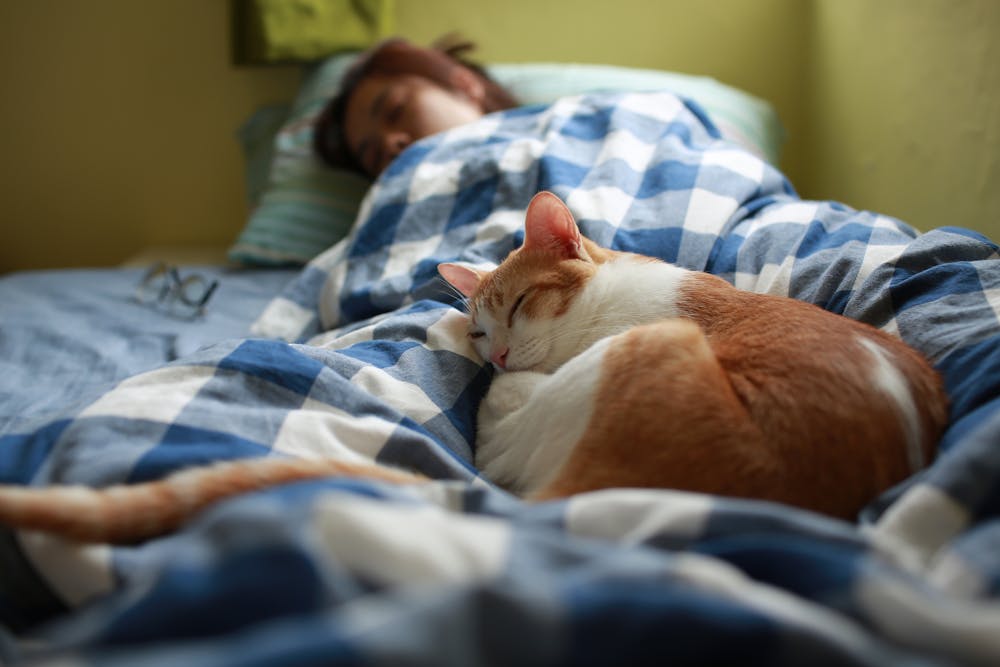
Surprisingly, 93% of people in our study who co-slept with their pets believed that their pets had either a positive or neutral overall effect on their sleep. Although more research is needed, these findings could suggest that most people are unaware of the potential negative effects their pets may have on their sleep.
Most pet owners report that their pets have a generally positive effect on their mental health. Pets can improve their owners’ health in numerous ways during the day, such as by encouraging physical activity, promoting a daily routine and providing love and companionship.
However, our study fills an important knowledge gap by indicating that co-sleeping with pets can affect sleep quality. Good sleep is a pillar of health and wellness. Even though pets may have an overall positive effect on mental health, it is possible that some of this benefit may be undermined if they are also causing you to lose sleep at night.
Although some people report that co-sleeping with their pets can provide them with a sense of comfort or intimacy, it is important for people sharing a bedroom with their pets to be aware of their potential to serve as a source of nighttime noise, heat or movement that can disrupt your ability to fall or stay asleep.
Survey-based studies like ours are unable to prove that co-sleeping with pets causes disrupted sleep, although there is some evidence suggesting that this could be the case.
One important factor that our study did not assess was whether participants were also co-sleeping with other people like a spouse or child. Previous research suggests that sharing a bed with other people can also affect our sleep and that the mental health benefits of pet ownership could be stronger for people with a romantic partner.

It probably isn’t realistic for most people to just stop co-sleeping with their pets. So, what should someone do to improve their sleep if they already share a bed with their pets?
Some expert tips include choosing a mattress that is large enough for you and your pets, washing and changing your bedding regularly, and establishing and maintaining a consistent bedtime routine with your pets. Further research is needed to identify more specific habits and routines that pet owners can adopt to ensure a good night’s sleep when sharing the bedroom with their pets.
The Research Brief is a short take about interesting academic work.
Brian N. Chin, Assistant Professor of Psychology, Trinity College
This article is republished from The Conversation under a Creative Commons license. Read the original article.
ooOOoo
Coming back to Jean and me at least we have a pretty regular routine with us going to our bedroom around 7pm to 8pm. In the morning over our daily coffees I always ask Jean what sort of night she had. Yesterday morning Jean replied that she had had a poor night. My judgement is that Jean has roughly one in two poor nights.
A wonderful, and educational, item on The Conversation.
I was listening to an item on the BBC yesterday morning and counting came up. The need for counting was incredibly early on in our history. Here is a copy of the part of the introduction to The Universal History of Numbers: From Prehistory to the Invention of the Computer.
A riveting history of counting and calculating from the time of the cave dwellers to the late twentieth century, The Universal History of Numbers is the first complete account of the invention and evolution of numbers the world over. As different cultures around the globe struggled with problems of harvests, constructing buildings, educating their citizens, and exploring the wonders of science, each civilization created its own unique and wonderful mathematical system.
Dubbed the “Indiana Jones of numbers,” Georges Ifrah traveled all over the world for ten years to uncover the little-known details of this amazing story. From India to China, and from Egypt to Chile, Ifrah talked to mathematicians, historians, archaeologists, and philosophers. He deciphered ancient writing on crumbling walls; scrutinized stones, tools, cylinders, and cones; and examined carved bones, elaborately knotted counting strings, and X-rays of the contents of never-opened ancient clay accounting balls. Conveying all the excitement and joy of the process of discovery, Ifrah writes in a delightful storytelling style, recounting a plethora of intriguing and amusing anecdotes along the way.
Now to that article on The Conversation.
ooOOoo
Manil Suri, University of Maryland, Baltimore County

Curious Kids is a series for children of all ages. If you have a question you’d like an expert to answer, send it to curiouskidsus@theconversation.com.
Why don’t numbers end? – Reyhane, age 7, Tehran, Iran
Here’s a game: Ask a friend to give you any number and you’ll return one that’s bigger. Just add “1” to whatever number they come up with and you’re sure to win.
The reason is that numbers go on forever. There is no highest number. But why? As a professor of mathematics, I can help you find an answer.
First, you need to understand what numbers are and where they come from. You learned about numbers because they enabled you to count. Early humans had similar needs – whether to count animals killed in a hunt or keep track of how many days had passed. That’s why they invented numbers.
But back then, numbers were quite limited and had a very simple form. Often, the “numbers” were just notches on a bone, going up to a couple hundred at most.
As time went on, people’s needs grew. Herds of livestock had to be counted, goods and services traded, and measurements made for buildings and navigation. This led to the invention of larger numbers and better ways of representing them.
About 5,000 years ago, the Egyptians began using symbols for various numbers, with a final symbol for one million. Since they didn’t usually encounter bigger quantities, they also used this same final symbol to depict “many.”
The Greeks, starting with Pythagoras, were the first to study numbers for their own sake, rather than viewing them as just counting tools. As someone who’s written a book on the importance of numbers, I can’t emphasize enough how crucial this step was for humanity.
By 500 BCE, Pythagoras and his disciples had not only realized that the counting numbers – 1, 2, 3 and so on – were endless, but also that they could be used to explain cool stuff like the sounds made when you pluck a taut string.
But there was a problem. Although the Greeks could mentally think of very large numbers, they had difficulty writing them down. This was because they did not know about the number 0.
Think of how important zero is in expressing big numbers. You can start with 1, then add more and more zeroes at the end to quickly get numbers like a million – 1,000,000, or 1 followed by six zeros – or a billion, with nine zeros, or a trillion, 12 zeros.
It was only around 1200 CE that zero, invented centuries earlier in India, came to Europe. This led to the way we write numbers today.
This brief history makes clear that numbers were developed over thousands of years. And though the Egyptians didn’t have much use for a million, we certainly do. Economists will tell you that government expenditures are commonly measured in millions of dollars.
Also, science has taken us to a point where we need even larger numbers. For instance, there are about 100 billion stars in our galaxy – or 100,000,000,000 – and the number of atoms in our universe may be as high as 1 followed by 82 zeros.
Don’t worry if you find it hard to picture such big numbers. It’s fine to just think of them as “many,” much like the Egyptians treated numbers over a million. These examples point to one reason why numbers must continue endlessly. If we had a maximum, some new use or discovery would surely make us exceed it.
The symbols of math include +, -, x and =.
But under certain circumstances, sometimes numbers do have a maximum because people design them that way for a practical purpose.
A good example is a clock – or clock arithmetic, where we use only the numbers 1 through 12. There is no 13 o’clock, because after 12 o’clock we just go back to 1 o’clock again. If you played the “bigger number” game with a friend in clock arithmetic, you’d lose if they chose the number 12.
Since numbers are a human invention, how do we construct them so they continue without end? Mathematicians started looking at this question starting in the early 1900s. What they came up with was based on two assumptions: that 0 is the starting number, and when you add 1 to any number you always get a new number.
These assumptions immediately give us the list of counting numbers: 0 + 1 = 1, 1 + 1 = 2, 2 + 1 = 3, and so on, a progression that continues without end.
You might wonder why these two rules are assumptions. The reason for the first one is that we don’t really know how to define the number 0. For example: Is “0” the same as “nothing,” and if so, what exactly is meant by “nothing”?
The second might seem even more strange. After all, we can easily show that adding 1 to 2 gives us the new number 3, just like adding 1 to 2002 gives us the new number 2003.
But notice that we’re saying this has to hold for any number. We can’t very well verify this for every single case, since there are going to be an endless number of cases. As humans who can perform only a limited number of steps, we have to be careful anytime we make claims about an endless process. And mathematicians, in particular, refuse to take anything for granted.
Here, then, is the answer to why numbers don’t end: It’s because of the way in which we define them.
How do the negative numbers -1, -2, -3 and more fit into all this? Historically, people were very suspicious about such numbers, since it’s hard to picture a “minus one” apple or orange. As late as 1796, math textbooks warned against using negatives.
The negatives were created to address a calculation issue. The positive numbers are fine when you’re adding them together. But when you get to subtraction, they can’t handle differences like 1 minus 2, or 2 minus 4. If you want to be able to subtract numbers at will, you need negative numbers too.
A simple way to create negatives is to imagine all the numbers – 0, 1, 2, 3 and the rest – drawn equally spaced on a straight line. Now imagine a mirror placed at 0. Then define -1 to be the reflection of +1 on the line, -2 to be the reflection of +2, and so on. You’ll end up with all the negative numbers this way.
As a bonus, you’ll also know that since there are just as many negatives as there are positives, the negative numbers must also go on without end!
Hello, curious kids! Do you have a question you’d like an expert to answer? Ask an adult to send your question to CuriousKidsUS@theconversation.com. Please tell us your name, age and the city where you live.
And since curiosity has no age limit – adults, let us know what you’re wondering, too. We won’t be able to answer every question, but we will do our best.
Manil Suri, Professor of Mathematics and Statistics, University of Maryland, Baltimore County
This article is republished from The Conversation under a Creative Commons license. Read the original article.
ooOOoo
This article was written for those a great deal younger than I am. But, to be honest, it is a fascinating account of something so utterly basic to humans and human cognition.
Enjoy!
 Learning from Dogs