Year: 2019

Picture Parade Two Hundred and Ninety-Eight

These were first shown  in February, 2017. They deserve another outing.

ooOOoo

Everybody always needs a friend!

(With many thanks to dear neighbour Dordie who passed these on to me to share with you all.)

d1oooo

d2oooo

d3oooo

d4oooo

d5oooo

d6oooo

d7oooo

ooOOoo

These are just as precious as they were in February, 2017!

Is there no end to their companionship!

A recent item in The Guardian suggests there isn’t!

I hang on to emails and files about dogs and dog stories for a very long time. For one reason that they make brilliant blog post topics. Such as this item that was published in The Guardian recently.

Have a read of it now and then see my closing comment.

ooOOoo

Experience: my dog is a champion surfer

By Judy Fridono

Fri 19th July, 2019

Judy Fridono and her dog Ricochet, who has won nine gold medals. Photograph: John Francis Peters/The Guardian

The dogs have 10 minutes to catch as many waves as they can. Judges look at length of ride, whether they make it back to shore, and how many tricks they do.

When my golden retriever, Ricochet, was born, on 20 January 2008, she took her first breath in my hands. I had launched a non-profit organisation called Puppy Prodigies, to train service dogs for people with disabilities, and I supported her mother while she had her litter. Ricochet was the ninth of 10.

She was a brilliant puppy – high energy and lots of fun; she got her name because she was literally bouncing off the walls. She began service dog training at a few days old and started off well, but at 16 weeks she began to shut down; she was more interested in chasing birds. Luckily she found something else to do.

We live in San Diego, California, half an hour from the ocean. I never planned to raise a surf dog, but she had been in a kids’ pool at eight weeks old and showed great balance on a boogie board. We progressed to a bigger pool, then the bay, then the ocean.

I got her a 6ft foam board and a pink lifejacket. I don’t surf so, as she improved, she got a water handler. Surf dog contests were becoming popular in southern California and someone suggested she take part in one, at Ocean Beach in San Diego. Ricochet was placed third of about 15 dogs. I felt so proud – not because she had a medal but because she had shown what she was capable of.

Typically in contests, the dogs have 10 minutes to catch as many waves as they can. Judges look at the length of the ride, whether they make it back to shore, and how many tricks or turns they do, such as riding a wave backwards. A big wave scores higher in the judging stakes. Breeds with shorter legs, such as bulldogs or corgis, tend to do well because they have lower centres of gravity, but all sorts of dogs have won. It all comes down to balance. There’s always a crowd of spectators on the beach.

On the board, she looks pretty serious and focused. Dogs wag their tails on the sand, but not so much on the water, where they need them for balance. She’s 11 years old now and has taken part in about 20 contests. She has nine gold medals and has been placed second or third in most of the others.

Soon after she started surfing, Ricochet started doing something more meaningful with her talent. She began to accompany children with disabilities for surf therapy, and we have used her profile to fundraise for them, working first with Patrick, a 14-year-old quadriplegic boy. Patrick enjoyed the independence and Ricochet was joyful when they shared a board.

In 2009, a video of Patrick and Ricochet went viral. It’s had more than 6.5m views. She now has 230,000 Facebook followers and 100,000 on Instagram. We get messages every week from people wanting to work with or meet her. One teenage boy with a brain tumour asked to surf with her for his Make A Wish. She’s now raised more than $500,000 for humans and animals in need.

She is a certified therapy dog, and also works with service members and veterans suffering from post-traumatic stress disorder. She connects with people on an extremely deep level and helps them express their feelings. Recently, she placed herself up against a wall to demonstrate how a naval officer she was working with was struggling inside. There is something about her that makes her excel.

Ricochet is one of only three competitive surf dogs from the original circuit still alive, but she doesn’t compete any more. Her last contest was at Imperial Beach in 2014, and she won first place. These days, competitions happen all over the world and up to 100 dogs compete for medals and bragging rights. Some dogs are sponsored, but there’s usually a charity element.

She’s in the last quarter of her life now and doesn’t have the energy for long rides on the board; but she still surfs for fun and does surf therapy work. Judges think it’s her ability to ride a wave that qualifies her as a winner. But, to me, it is her healing power that makes Ricochet a champion.

ooOOoo

Firstly, I want to thank The Guardian, well the online version, for making their content reusable.

Secondly, this article shows yet another example of the bonding that can take place between a dog and their ‘owner’. I have no doubt that there will be many more.

Finally, dogs in the main are the perfect companions to us humans. It’s such a shame that so many are homeless, humans as well as dogs!

Helping dogs with cancer, and a bonus!

This item from The Conversation website is very interesting!

Cancer touches so many people.

My father died of lung cancer in 1956. My step-father in turn died of cancer much later on (I can’t recall what cancer it was and when he died).

It’s a terrible disease.

Key facts. Cancer is the second leading cause of death globally, and is responsible for an estimated 9.6 million deaths in 2018. Globally, about 1 in 6 deaths is due to cancer. Approximately 70% of deaths from cancer occur in low- and middle-income countries.

Cancer – World Health Organization

But then this comes along and offers hope.

The Conversation

Published on Jul 23, 2019

Cheryl London, a professor of veterinary medicine at Tufts University, practices “comparative oncology,” or testing cancer treatments in animals for potential use in humans. Her trials give sick pets a chance at a longer life – and could help contribute to new therapies for people.

That seems like it’s good for dogs and good for us!

Bravo!

Dog food alert – Salmonella!

Once again an alert and this is especially important.

This dog food alert came in on Monday.

ooOOoo

Dear Fellow Dog Lover,

You’re getting this alert because you signed up on our website and asked to be notified. If you no longer wish to receive these emails, please click the “unsubscribe” link at the bottom of this message.

The U.S. Center for Disease Control (CDC) is expanding its investigation into an outbreak of Salmonella in 27 states due to contaminated pig ear dog treats.

For more information, including which states are listed in the CDC announcement, please visit the following link:

Salmonella Outbreak Linked to Dog Treats Expands

Important Best Dog Foods Update

We’ve recently updated 2 of our Best Dog Foods pages. Both lists now include more grain-free and grain-inclusive recipes to satisfy your personal feeding preferences.
Click here to view our 20 Best Dry Dog Foods for July 2019

Click here to view our 20 Best Wet Dog Foods for July 2019

Please be sure to share the news of this alert with other pet owners.

Mike Sagman, Editor
The Dog Food Advisor
Saving Good Dogs from Bad Dog Food

P.S. Not already on our dog food recall notification list? Sign up to get critical dog food recall alerts sent to you by email. There’s no cost for this service.

ooOOoo

And if you go across to that first link then you will see the following:

ooOOoo

Salmonella Outbreak Linked to Dog Treats Expands
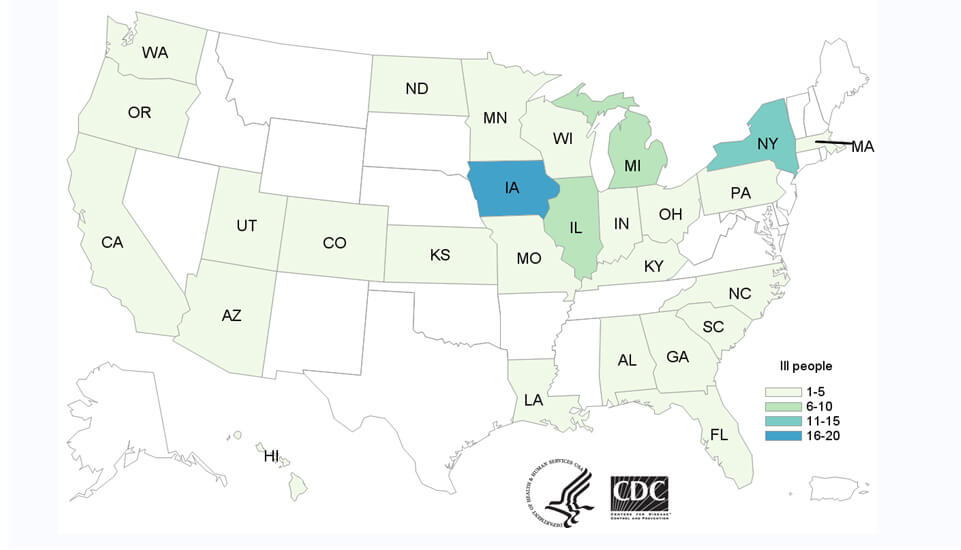
July 17, 2019 — The U.S. Centers for Disease Control and Prevention (CDC) has announced its investigation into an outbreak of Salmonella infections due to contaminated pig ears dog treats is expanding to 27 states.

Related Recall

In a related story posted July 3, 2019, by The Dog Food Advisor, Pet Supplies Plus recalled bulk pig ears stocked in open bins because they might be contaminated with Salmonella.

Link to Dog Treats Confirmed

The CDC has uncovered scientific evidence to indicate that contact with pig ear dog treats is the likely source of the outbreak.

DNA “fingerprinting” conducted by the CDC has linked the bacteria found on pig ears dog treats with the following 3 genetic strains:

  • Salmonella infantis
  • Salmonella newport
  • Salmonella london

About the Outbreak

As of July 16, 2019, a total of 93 people infected with the outbreak strains of Salmonella have been reported from 27 states.

Twenty ill people have been hospitalized. No deaths have been reported.

Illnesses might not yet be reported due to the time it takes between when a person becomes ill and when the illness is reported. This takes an average of 2 to 4 weeks.

What States?

Affected states include Alabama, Arizona, California, Colorado, Florida, Georgia, Hawaii, Illinois, Indiana, Iowa, Kansas, Kentucky, Louisiana, Massachusetts, Michigan, Minnesota, Missouri, New York, North Carolina, North Dakota, Ohio, Oregon, Pennsylvania, South Carolina, Utah, Washington, and Wisconsin.

About the Investigation

During the investigation, the Michigan Department of Agriculture and Rural Development gathered pig ear dog treats at retail locations where ill people reported buying the products.

A common supplier of pig ear dog treats has not been identified. Pet owners can take steps to keep their families healthy while feeding pets.

This investigation is ongoing and CDC will provide updates when more information is available.

About Salmonella

Most people infected with Salmonella develop diarrhea, fever, and stomach cramps 12 to 72 hours after being exposed to the bacteria.

The illness usually lasts 4 to 7 days, and most people recover without treatment.

In some people, the illness may be so severe that the patient needs to be hospitalized. Salmonella infection may spread from the intestines to the bloodstream and then to other places in the body.

Children younger than 5 years, adults 65 years and older, and people with weakened immune systems are more likely to have a severe illness.

Pets with Salmonella infections may be lethargic and have diarrhea or bloody diarrhea, fever, and vomiting.

Some pets will have only decreased appetite, fever and abdominal pain.

Infected but otherwise healthy pets can be carriers and infect other animals or humans.

What to Do?

Consumers should not feed suspected pig ears to their dog. Throw them away in a secure container so that your pets and other animals can’t eat them.

Even if some of the recalled pig ears were fed to dogs and no one got sick, do not continue to feed them to pets.

Wash containers, shelves, and areas that held the recalled pig ear dog treats with hot, soapy water.

U.S. citizens can report complaints about FDA-regulated pet food products by calling the consumer complaint coordinator in your area.

Or go to https://www.fda.gov/petfoodcomplaints.

Canadians can report any health or safety incidents related to the use of this product by filling out the Consumer Product Incident Report Form.

Get Dog Food Recall Alerts by Email

Get free dog food recall alerts sent to you by email. Subscribe to The Dog Food Advisor’s emergency recall notification system.

ooOOoo

Or follow this place because I always promote the Dog Food Alerts.

As before please share this with other dog owners.

Those puppy eyes

A revisit to the science of the evolution of dogs’ eyes.

I presented a fairly long explanation of how dogs evolved in a recent post Those Eyes. It was based on an article in The Atlantic magazine.

The AAAS magazine Science, 12th July 2019, VOL 365 Issue 6449, also had an item.

It is reproduced below and I hope it sufficiently clear that you can read the text.

If the text is not clear let me know and I will amend this post by including the above text as a typed addition.

My Corgi

This is wonderful!

I have been a subscriber to Ugly Hedgehog, a photographic forum, for a little while.

Recently Vicki posted a couple of photographs of her Corgi. They are fabulous and Vicki was kind enough to give me permission to republish them.

First Vicki in her own words:

The morning light backlit my Corgi, Lexi, as she enjoyed the sunny warmth on the back deck, and the house acted as a very large reflector. No fill flash was needed. The catchlights clearly reflect the windows of the house and may or may not be appealing.

I simplified the background with a layer mask in the second shot.

So this is Lexi!

And this is number two!

A brilliant two photographs!