The most frequent strange and unwanted behavior in dogs
Delighted to offer all you good people a guest post for today. It came about as a result of an email sent to me by Alex. This is what that email said; in part:
I am writing to you on behalf of Premier Pups, one of the main partners of Doctorpup.com. We have read your materials and we found them very interesting for dog lovers.
We have made a complex and detailed article based on Dr. Gary Rybka’s knowledge and experience (from Doctorpup.com – one of the most reputable veterinarians from Ohio) and we consider that our article will bring new information for your audience. The topic of the article is related to the most frequent strange or undesirable behaviors of dogs and their main causes. In addition, Doctor Rybka offers solutions for a great part of these behaviors.
Alex
Now there’s always a balance in my mind between expert information that should be shared with you good people and any guest article not coming over as a ‘soft sell’. Clearly, Doctorpup.com is a commercial operation but
their website does clearly state their Vision:
At doctorpup we welcome your questions. Our articles and videos provide a foundation for your questions and each question gives us the opportunity to provide answers specific to your pet and situation. You can present your questions through the doctorpup Forum Q & A, the live interactive chat or through our personal and emergency phone consultation options. You can upgrade your membership at anytime to allow more opportunity to benefit you and your puppy.
So this was accepted by me because of the useful information it offers but at the same time I must tell you that a) I receive no benefit, financial or otherwise, from the publication of this guest post, and b) I can offer no warranties about the accuracy or validity of the information the guest article contains. Hope that doesn’t come across as too negative; it’s not intended to so do.
ooOOoo
The most frequent strange and unwanted behavior in dogs

Undesirable or strange behaviors exhibited by dogs during puppyhood and adolescence are known as pediatric behavior problems and it is important to address them as early as possible with behavioral modification methods. There are also adult dogs that display strange behavior, but their acceptance depend on the effects.
According to DoctorPup.com, one of the most important cause of behavioral problems is the living in urban areas where the level of exercise and play is limited.
We have made a list of the most frequent behavioral problems of dogs and potential solutions for them:
-
How to stop destructive chewing?
Dog destructive chewing consisting in chewing and damaging the furniture or household stuff can be caused by a poor nutrition or inadequate food provisions, presence of mice or other small animals in the walls or flooring, spilled food on carpet or furniture or uninteresting toys. It is recommended to give your dog various toys and look for his interests, to hide forbidden objects or to close the doors and interrupt this unwanted behavior with a loud “no”.
-
Dogs playing or fighting?
Play biting or play fighting can become unpleasant due to your dog’s teeth that are sharp and can cause you injuries. The behavior can be generated by teasing and rough play, long confinement periods or excited greetings. It is recommended to exercise your pup, use appropriate toys to distract him, avoid games that encourage the behavior, socialize it properly and ignore the unwanted behavior such as barking, whining or pawing for attention.
-
Training dogs not to bite
Biting everything in his way can also become a serious problem. There has to be a consequence to be remembered by your dog, for example, talk loud and say “no” and then pretend your dog doesn’t exist, look at him with a menacing stare and use a few words with the same tone. Your dog has to know you don’t like him anymore. You can also put him in another room or use a leash to restrain him where he can see you but cannot interact with you.
-
Dog jumping on people
Jumping on people and placing paws on visitors or family members is caused by excitement or by an acute need for attention. It is helpful to teach your pup to sit on command, avoid games and play that encourage it to jump, and use a loud and sharp voice when it jumps.
-
Why do dogs chase their tails
Dogs that are chasing their tails are likely to have a discomfort in that area. It may seem a funny behavior and it can be caused by an excess of energy. But, if you notice that the behavior is displayed constantly, check the tail to see if you find any crusts, scaly or sensitive areas. The tail contains many nerve endings. If you find any suspicious areas, you should scrub them gently with antibacterial shampoo or soap, dry it and use an antibiotic. Tail chasing and biting can also be caused by flea allergy dermatitis or overfilled anal glands or it can be a sign of obsessive-compulsive disorder.
-
Why does my dog lick me?
If you notice your dog licks you, it may be due to his affection or his need to getting your attention. Licking is also a sensory tool for dogs, similar to reaching out and touching something. Another explanation consists in the fact the canine mothers lick their puppies for grooming and social reasons and this behavior continues into adulthood.
-
How to get a dog stop barking when I leave the room/house
If your dog begins to bark immediately after you leave the room, he may suffer from separation anxiety. It is recommended to tell it to sit and give him praise before leaving the house. If he stays, give him a treat or a favorite toy with praise. Try this method until you can leave the house and your dog remains there without making a sound. It is possible to take a few weeks, but it is worth. Your dog will be better at emotional self-control. It is also possible that your dog become overexcited and pee when he meets or greets you or someone else or to begin barking excessively when you arrive home. This is because he is very happy to see you or the person he greets and it is his way to show his love.
-
Dogs love to chase their food and roll on
This behavior is caused by the fact that your dog considers the food is a prey and he wants to ensure it is dead before eating. You can give him a command to take his food to his bowl in order to understand you do not tolerate this behavior.
-
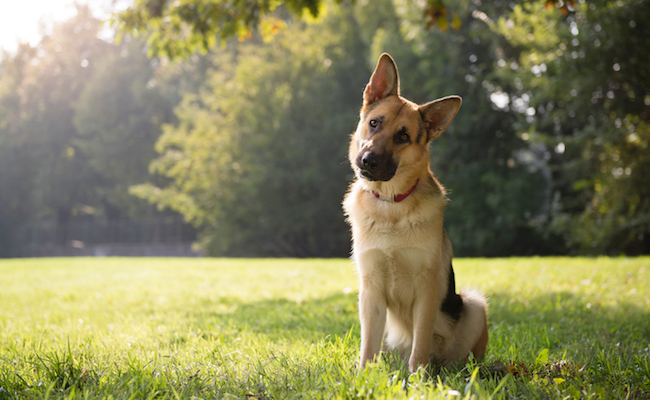
Why do dogs tilt their heads
If your pup tilts his head, it is possible that he wants to make sense of what he hears, to identify the location of a sound or to find if he’ll get something fun or rewarding.
-
Coprophagy in dogs
An unpleasant habit of some puppies consists in eating poop also called coprophagy and the phenomenon can appear because your dog is hungry, likes the smell and taste, is missing certain nutrients from his diet or simply thinks it is fun.
-
Why Do Dogs Howl?
Another pups get used to howl as an instinctive or rewarding behavior while others hump on other dogs, on people’ legs in their search for seeking attention or excitement, without sexual reasons.
-
Why does my dog stare at me?
If you notice that your dog is staring at you he probably expects to receive a treat or to show him praise and affection. Dogs generally consider direct eye contact threatening, so ensure it is not a sign of fear or aggression.
-
Why do dogs walk in circles before lying down?
There are moments when your dog walks in circles before lying down as an inherited ritual from the wolf-like dogs that used to spot to pat down the leaves or grass to make a nesting spot.
- Why do dogs sniff each other’s butts?
Another unusual habit of your pup consists in sniffing other dogs’ butts as a sign to greet them or in trashing his toys that they consider as a killing action due to his primal instincts.
-
Did you notice that your dog hate other dogs?
It is probably because he wasn’t well socialized in puppyhood or he didn’t have positive experiences with other dogs during this period.
-
Got an aggressive puppy?
If your pup shows signs of aggression it is possible to notice that the aggression disappear when you take it out of his comfort zone. That’s why, exposing him to a wide range of experiences could help teach him to adapt to the rules you want. It is also important to not tolerate his aggression.
Some behavioral issues are due to inadequate supervision, control, training, exercise and or general environment. Your response has to be immediate, consistent and result in some sacrifice for your puppy if you want to repair his behavior.
Short Bio:
Alex is the Director of Communications for Premier Pups, a purebred & designer dog breeder that offers the best selection in Texas of certified pure bred and mixed breed designer puppies. Alex has a Master degree in Communication from Michigan State University and loves so much his dog he rescued from a shelter a few years ago.
ooOOoo
Hope you found this of interest. As for me, it was just another reminder that we are never too old to learn something new. As in the word “coprophagy” that I hadn’t come across before.
To which I would close by saying that your feedback as to the value of such guest articles would be most welcome.
 oooo
oooo oooo
oooo oooo
oooo oooo
oooo Forget what’s going on around us this week. These pictures tell us what is really important!

 Learning from Dogs