Nanosecond pictures.
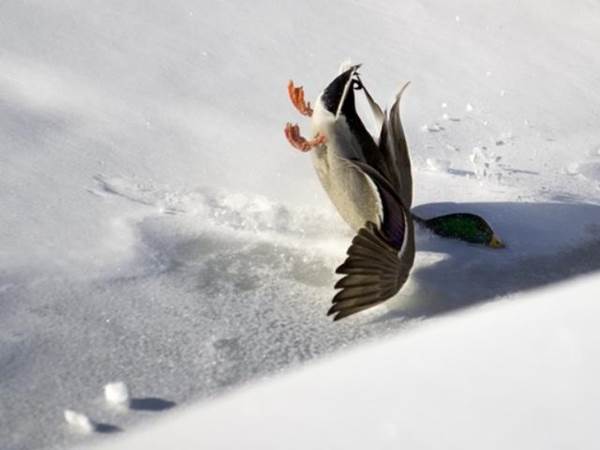
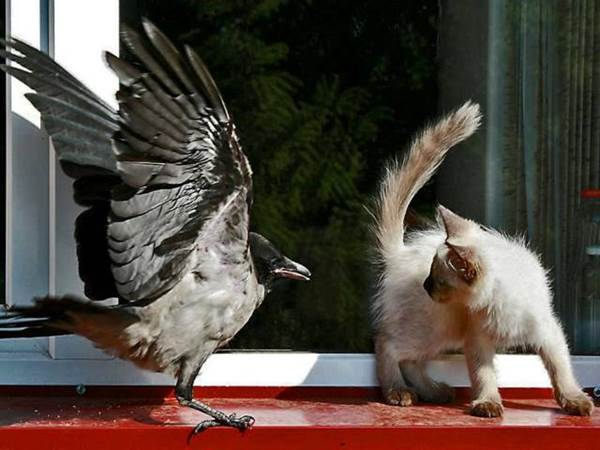
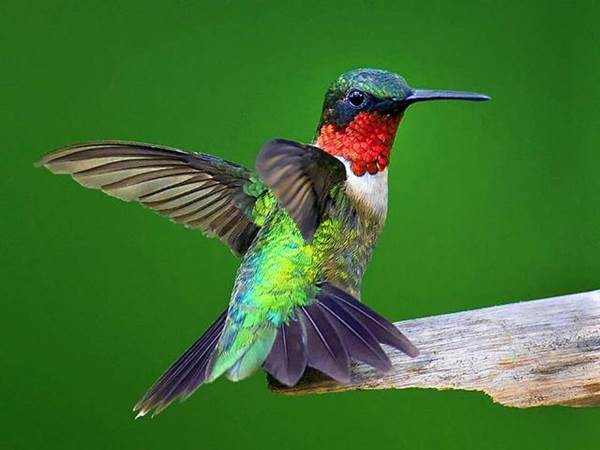
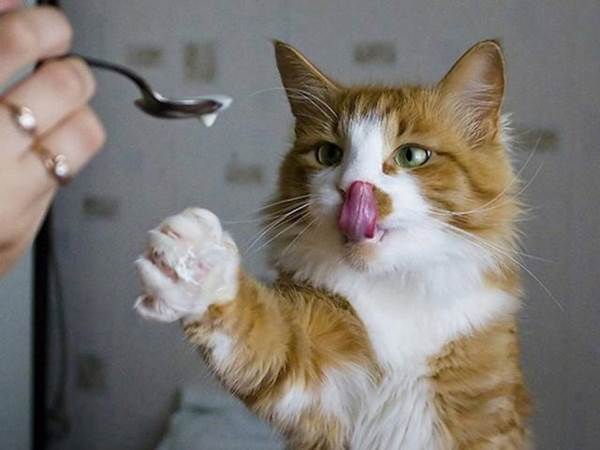
Back to these photographs sent in by John H.

oooo
oooo
oooo
oooo
oooo
oooo

oooo
More to come in a week’s time.
Meanwhile, you all take care out there.
Dogs are animals of integrity. We have much to learn from them.
Year: 2014
Nanosecond pictures.
Back to these photographs sent in by John H.
oooo
oooo
oooo
oooo
oooo
oooo
oooo
More to come in a week’s time.
Meanwhile, you all take care out there.
Just a personal reflection.
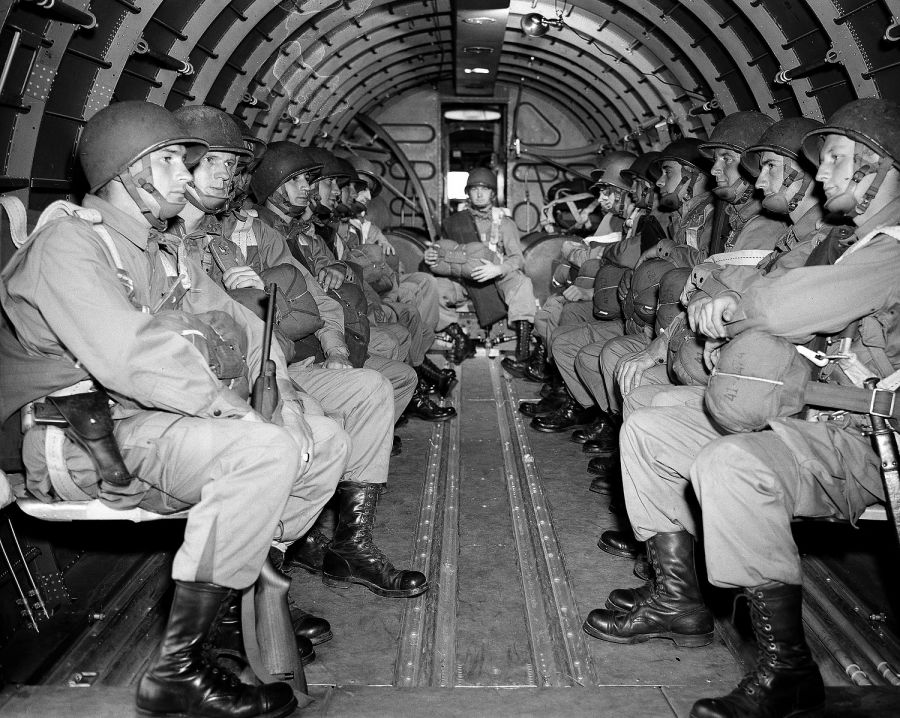
Seventy years ago, to this day, as the whole world now knows, the start of the end of World War II swung into action. As this website put it (from where this photograph came),
On D-Day, June 6, 1944, Allied troops departed England on planes and ships, made the trip across the English Channel and attacked the beaches of Normandy in an attempt to break through Hitler’s “Atlantic Wall” and break his grip on Europe. Some 215,000 Allied soldiers, and roughly as many Germans, were killed or wounded during D-Day and the ensuing nearly three months it took to secure the Allied capture of Normandy.
On this day, seventy years ago, my mother was living in London four months pregnant with yours truly. I was born in November, 1944.
The USA frequently gets a hammering in the media, including blog sites, for a whole range of activities.
But the 6th June, 1944 reminds me that when the American people turn their hand to helping others across the world, they can be a most powerful force for good.
That I have lived my almost seventy years in an environment that has allowed me freedom and opportunity and that I write this as a relatively new resident of the United States of America, living happily in rural Oregon, is a testament to that force for good.
Thank you Yankees!

A recent newspaper article offers yet more learning from dogs.
I can’t recall how I came across the article but so what! What I do recall was reading a recent item in The Washington Post and thinking that has to be reported here on Learning from Dogs.
The article, written by David Grimm, was entitled: In dogs’ play, researchers see honesty and deceit, perhaps something like morality. Here’s how it opened:
A shaggy brown terrier approaches a large chocolate Labrador in a city park. When the terrier gets close, he adopts a yogalike pose, crouching on his forepaws and hiking his butt into the air. The Lab gives an excited bark, and soon the two dogs are somersaulting and tugging on each other’s ears. Then the terrier takes off and the Lab gives chase, his tail wagging wildly. When the two meet once more, the whole thing begins again.
Watch a couple of dogs play, and you’ll probably see seemingly random gestures, lots of frenetic activity and a whole lot of energy being expended. But decades of research suggest that beneath this apparently frivolous fun lies a hidden language of honesty and deceit, empathy and perhaps even a humanlike morality.
Now I don’t have permission to reproduce the entire article but will draw your attention to this further piece:
All of this suggests that dogs have a kind of moral code — one long hidden to humans until a cognitive ethologist named Marc Bekoff began to crack it.
A wiry 68-year-old with reddish-gray hair tied back in a long ponytail, Bekoff is a professor emeritus at the University of Colorado at Boulder, where he taught for 32 years. He began studying animal behavior in the early 1970s, spending four years videotaping groups of dogs, wolves and coyotes in large enclosures and slowly playing back the tapes, jotting down every nip, yip and lick. “Twenty minutes of film could take a week to analyze,” he says.
The data revealed insights into how the animals maintained their tight social bonds — by grooming each other, for example. But what changed Bekoff’s life was watching them play. The wolves would chase each other, run, jump and roll over for seemingly no other reason than to have fun.
Few people had studied animal play, but Bekoff was intrigued. “Play is a major expenditure of energy, and it can be dangerous,” he says. “You can twist a shoulder or break a leg, and it can increase your chances of being preyed upon. So why do they do it? It has to feel good.”
Suddenly, Bekoff wasn’t interested just in behavior; he was interested also in emotions and, fundamentally, what was going on inside these animals’ heads.
Marc Bekoff’s name rang a bell with me and, sure enough, I found that previously he was mentioned here. It was a post called Daisy offers a lesson for all,:
Animal Emotions
Do animals think and feel?
by Marc Bekoff – Professor Emeritus of Ecology and Evolutionary Biology at the University of Colorado, Boulder.Daisy: The Injured Dog Who Believed She’d Walk Again and Did
Anthrozoology, also called human-animal studies (HAS), is a rapidly growing and expanding interdisciplinary field. A recent and comprehensive review of this wide-ranging discipline can be found in Paul Waldau’s book titled Animal Studies: An Introduction. Many of the essays I write for Psychology Today have something to do with anthrozoology in that they focus on the wide variety of relationships that humans establish with nonhuman animals (animals). Some essays also discuss what we can learn from other animals, including traits such as trust, friendship, forgiveness, love, and hope.
Often, a simple video captures the essence of the deep nature of the incredibly close and enduring bonds we form with other animals and they with us. As a case in point, my recent essay called “A Dog and His Man” showed a dog exuberantly expressing his deep feelings for a human companion he hadn’t seen for six months. Another essay titled “My Dog Always Eats First: Homeless People and Their Animals” dealt with the relationship between homeless people and the animals with whom they share their lives.
Daisy: An unforgettable and inspirational symbol of dedication and hope
I just saw another video called “Daisy – the Little Pup Who Believed” that is well-worth sharing widely with others of all ages. There is no way I can summarize the depth of five-month old Daisy’s resolve to walk again after she was injured or of the devotion of the woman, Jolene, who found her on the side of a road – scared, malnourished, unable to walk or wag her tail, the people who contributed money to help her along, or the wonderful veterinarians and staff at Barrie Veterinary Hospital in Ontario, Canada, who took care of her. You can also read about Daisy’s remarkable and inspirational journey here.
Please take five minutes out of your day to watch this video, read the text, listen to the song that accompanies it, and share it widely. I am sure you will get teary as you watch Daisy go from an injured little ball of fur living in a ditch on the side of a road with a broken spine to learning to walk in water to romping around wildly as if life had been that proverbial pail of cherries from the start.
I’ve watched Daisy’s journey many times and every single time my eyes get watery. Among the many lessons in this wonderful video is “stay strong and never give up”. Clearly dogs and many other animals can truly teach us about traits such as trust, friendship, forgiveness, love, and hope.
Back to that Washington Post article.
Bekoff’s recent work suggests another remarkable canine skill: the ability to know what another animal is thinking — a so-called “theory of mind.”
Dogs seem to display a rudimentary form of this skill during play. He has noticed, for example, that one dog won’t begin trying to play with another dog until he has her attention. To get her to notice, he may nip the other dog or run into her field of view. That, Bekoff says, shows that the one wanting to play knows that she’s not paying attention to him. Though this may seem like a simple skill, it’s incredibly important to our species. Without it, we can have a hard time learning or interacting with the world around us.
So will leave you with this video and return to the theme tomorrow.
The journey towards knowing better who we are.
This may seem like a bit of an ‘odd-ball’ after Celebrating Ben and Ranger on Monday and Celebrating Pharaoh yesterday. Indeed, when I had in mind those two posts, writing about self-awareness was nowhere on my mental horizon. Then along came Shakti Ghosal after Monday’s post who left this comment:
Hi Paul,
Just came a visiting and was halted by these glorious photographs. Horses embody such great qualities of trust, grace and power don’t they? What is it that makes them such a great friend of Man, I wonder? Specially when the latter species, as we know it (and we should know!), can choose to behave quite contrary to those Equine qualities above….
Shakti
As Shakti was a new visitor inevitably I went across to his blog site, ESGEE musings, and then to the About page. Where I read, in part,
About Shakti Ghosal
Born in New Delhi, India, Shakti Ghosal is an Engineer and Management Post Graduate from IIM, Bangalore. Apart from Management theory, Shakti remains fascinated with diverse areas ranging from World History, Global trends to Human Psychology & Development.
I was intrigued and starting reading some of Shakti’s posts. That is how I came across The Audacity of Who I am and a day later had been offered permission to republish it.
However, before going on to Shakti’s post let me recap a little from yesterday’s post Celebrating Pharaoh. This section:
The biggest, single reward of having Pharaoh as my friend goes back a few years. Back to my Devon days and the time when Jon Lavin and I used to spend hours talking together. Pharaoh always contentedly asleep in the same room as the two of us. It was Jon who introduced me to Dr. David Hawkins and his Map of Consciousness. It was Jon one day who looking down at the sleeping Pharaoh pointed out that Dr. Hawkins offered evidence that dogs are integrous creatures with a ‘score’ on that Map of between 205 and 210. (Background story is here.)
So this blog, Learning from Dogs, and my attempt to write a book of the same name flow from that awareness of what dogs mean to human consciousness and what Pharaoh means to me. No, more than that! From that mix of Jon, Dr. David Hawkins, and experiencing the power of unconditional love from an animal living with me day-in, day-out, came a journey into my self. Came the self-awareness that allowed me to like who I was, be openly loved by this dog of mine, and be able to love in return. As is said: “You cannot love another until you love yourself.“
I will speak a little more about this but, first, to Shakti’s post.
ooOOoo
“High above the noise and fear mongering of critics and cynics softly speaks your true self.”
– Mollie Marti, Psychologist, Lawyer & Coach, USA
The other day, I watched the Bollywood movie Queen. In it Rani, a girl from Delhi, travels to Europe after being spurned by her fiancé. The movie then goes on to explore Rani’s ‘World view’ as dictated by her Indian middle class values and how that alters, as her biases and prejudices fall away, as she is confronted by radically different value systems and perspectives. A journey of self discovery in surroundings where she is no longer weighed down by others’ expectations and diktats. As she morphs, she confuses and pisses off many people including herself. Rani emerges from this crucible of experience as a more authentic human being. As she chooses to be ‘who she is for herself and for others’, she symbolises courage as well as resistance. Walking out of the theatre, I could not help but acknowledge how Rani’s awareness and acceptance of ‘who she is for herself and for others’ left her more empowered and in control of her destiny.
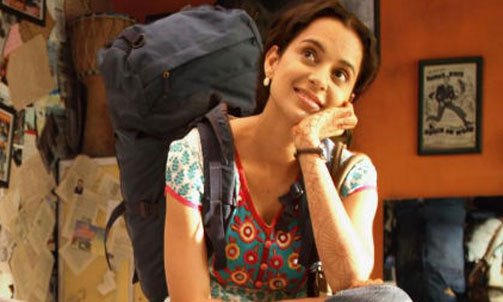
Who I am for myself and for others? How many of us are willing to make this query a daily practice as we loosen the constraints imposed by our world-view, let go of who we believe we should show up as and embrace who we really are?
What is it that makes me avoid being who I am for myself and for others? I can see this stemming from my desperation to be admired, liked and looking good. My life experiences have conditioned me to avoid being straightforward and veer towards being diplomatic if I perceive it is the latter which makes me look good. I have also been guilty of the corporate lie. On occasions I have stretched the truth about my company and its services, hidden what could have been embarrassing. On other occasions I have manipulated situations and people. All this to succeed, be admired, look good.
I muse. Have my efforts to gain admiration and look good empowered me to greater heights? Have I succeeded in engaging in my life from a place of worthiness? I remain increasingly unsure.
So if avoiding ‘who I am for myself and for others’ has not worked for me, how could I embrace it? As I think of this, I begin to see what being who I am for myself and for others could mean for me.

It would mean the audacity to show up as the ‘imperfect me’ that I am and the willingness to be vulnerable.
It would mean the audacity to let my hair down and allow myself to truly belong with the folks I choose.
It would mean the audacity to be compassionate and loving even when I hold the fear of not being good enough.
It would mean the audacity to be authentic about my own inauthenticities.
Am I committed to being this audacious?
***
“Real isn’t how you are made,’ said the Skin Horse.’ It’s a thing that happens to you. When a child loves you for a long, long time, not just to play with, but REALLY loves you, then you become Real.’
‘Does it hurt?’ asked the Rabbit.
‘Sometimes,’ said the Skin Horse, for he was always truthful. ‘When you are Real you don’t mind being hurt.’
‘Does it happen all at once, like being wound up,’ he asked, ‘or bit by bit?’
‘It doesn’t happen all at once,’ said the Skin Horse. ‘You become. It takes a long time. That’s why it doesn’t happen often to people who break easily, or have sharp edges, or who have to be carefully kept. Generally, by the time you are Real, most of your hair has been loved off, and your eyes drop out and you get loose in the joints and very shabby. But these things don’t matter at all, because once you are Real you can’t be ugly, except to people who don’t understand.”
Excerpt from ‘The Velveteen Rabbit’ by Margery Williams
In Learning….. Shakti Ghosal
ooOOoo
Now Shatki’s post is spot on. But it assumes one thing. That is that each of us has sufficient self-awareness “to show up as the ‘imperfect me’”. Sometimes, as in my case, that ‘imperfect me’ was well-hidden from the self. Stay with me a little longer.
My father died of cancer in 1956. Just 5 days before Christmas, 1956. He was 55 and I had turned 12 just 6 weeks previously. I had completed my first term at the local (Preston Road, Wembley) grammar school.
For many reasons that do not need to be shared here, the effect of my father’s death and my subsequent decline in my school performance, left me with a long-term psychological ‘dysfunction’; namely a feeling that I had been emotionally rejected. But that feeling was deeply hidden from me. In fact, that hidden belief remained with me until 2007 when Jon Lavin brought it to the surface. (Jon is a UKCP accredited therapist and NLP Practitioner).
Reflect on that for just a moment. For the thick end of fifty years, this psychological characteristic remained totally below my consciousness yet, nonetheless, influenced me in very real and tangible ways.
The negative influence was that I was drawn to any woman who offered me love and affection and, therefore, was emotionally unable to understand how good a partner she might or might not be for me. (Jean is my fourth wife!)
The positive influence was that I tried very hard to please others, to avoid their rejection, and had successful careers in selling for IBM UK, starting and building a successful business in the early days of personal computing and, later, when my company was sold in 1986 becoming a freelance journalist and business coach.
So back to Shakti’s essay.
I agree one-hundred-percent with what he says. With the proviso that in certain cases, spending time with a qualified counsellor could be your best investment ever.
How to round this off.
If you have been influenced by any of this then do give yourself time and space to counsel yourself. Let your inner person reach out in peace to your outer person.
If that inner person suggests you could be a happier, more peaceful person then reach out to someone properly qualified to hold your hand as you open up to your inner feelings.
Which is why loving a dog and being loved in return by that beautiful creature means so much. For in that private bond that animals offer us lays the truth.
I can do no better than offer this personal reason why being audacious about who you are is the supreme ‘investment’ of all in yourself.
A few months after Jon Lavin brought my fear of emotional rejection to my conscious surface, I met Jean in Mexico, Christmas 2007. I have never loved a person as I love Jean. I have never been loved by a person as Jean loves me.
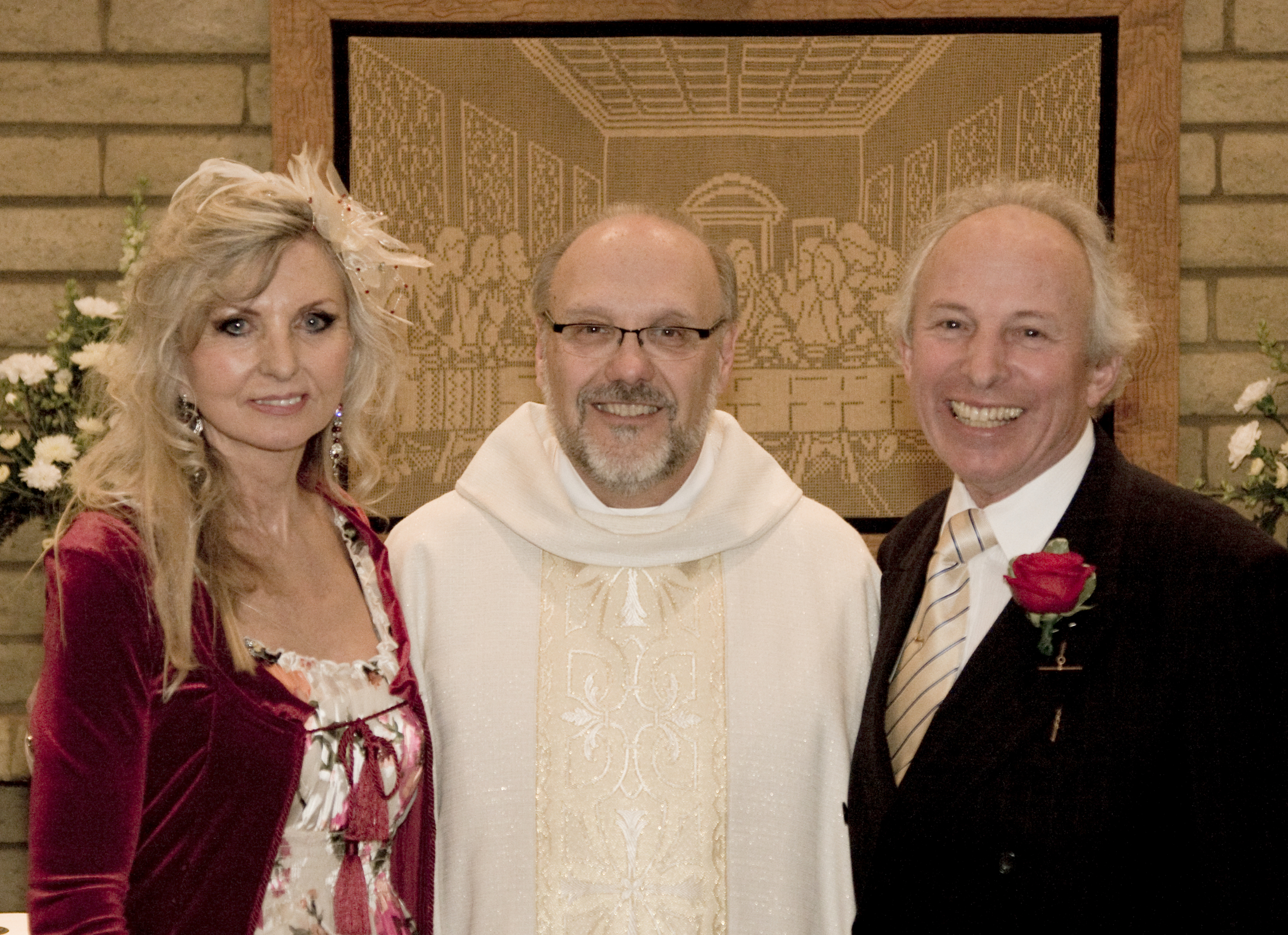
Being at peace with who you are is the most important celebration.
Say no more!
Today is the eleventh anniversary of the day Pharaoh was born.
Yes, Pharaoh was born on the 3rd June, 2003.
Last year, I celebrated Pharaoh’s tenth birthday with posts over two days. Being ten seemed such a significant milestone for him.
So rather than repeat those two posts, as much as I am tempted to so do 😉 , I will just offer you the links and repost one photograph. Thus here is that first post, Meet the dogs – Pharaoh (pt 1) and the second part is here.
Here’s the photograph of Sandra Tucker, owner of Jutone Kennels in Devon, England, holding puppy Pharaoh the day I first met him: 12th August, 2003.

It would be so easy for me to gush over having Pharaoh in my life these last eleven years. But I shall resist, dear reader! Will just repeat a few words that were said a year ago.
The biggest, single reward of having Pharaoh as my friend goes back a few years. Back to my Devon days and the time when Jon Lavin and I used to spend hours talking together. Pharaoh always contentedly asleep in the same room as the two of us. It was Jon who introduced me to Dr. David Hawkins and his Map of Consciousness. It was Jon one day who looking down at the sleeping Pharaoh pointed out that Dr. Hawkins offered evidence that dogs are integrous creatures with a ‘score’ on that Map of between 205 and 210. (Background story is here.)
So this blog, Learning from Dogs, and my attempt to write a book of the same name flow from that awareness of what dogs mean to human consciousness and what Pharaoh means to me. No, more than that! From that mix of Jon, Dr. David Hawkins, and experiencing the power of unconditional love from an animal living with me day-in, day-out, came a journey into my self. Came the self-awareness that allowed me to like who I was, be openly loved by this dog of mine, and be able to love in return. As is said: “You cannot love another until you love yourself.“
Which, serendipitously, brings me to tomorrow’s post: Celebrating Who I Am.
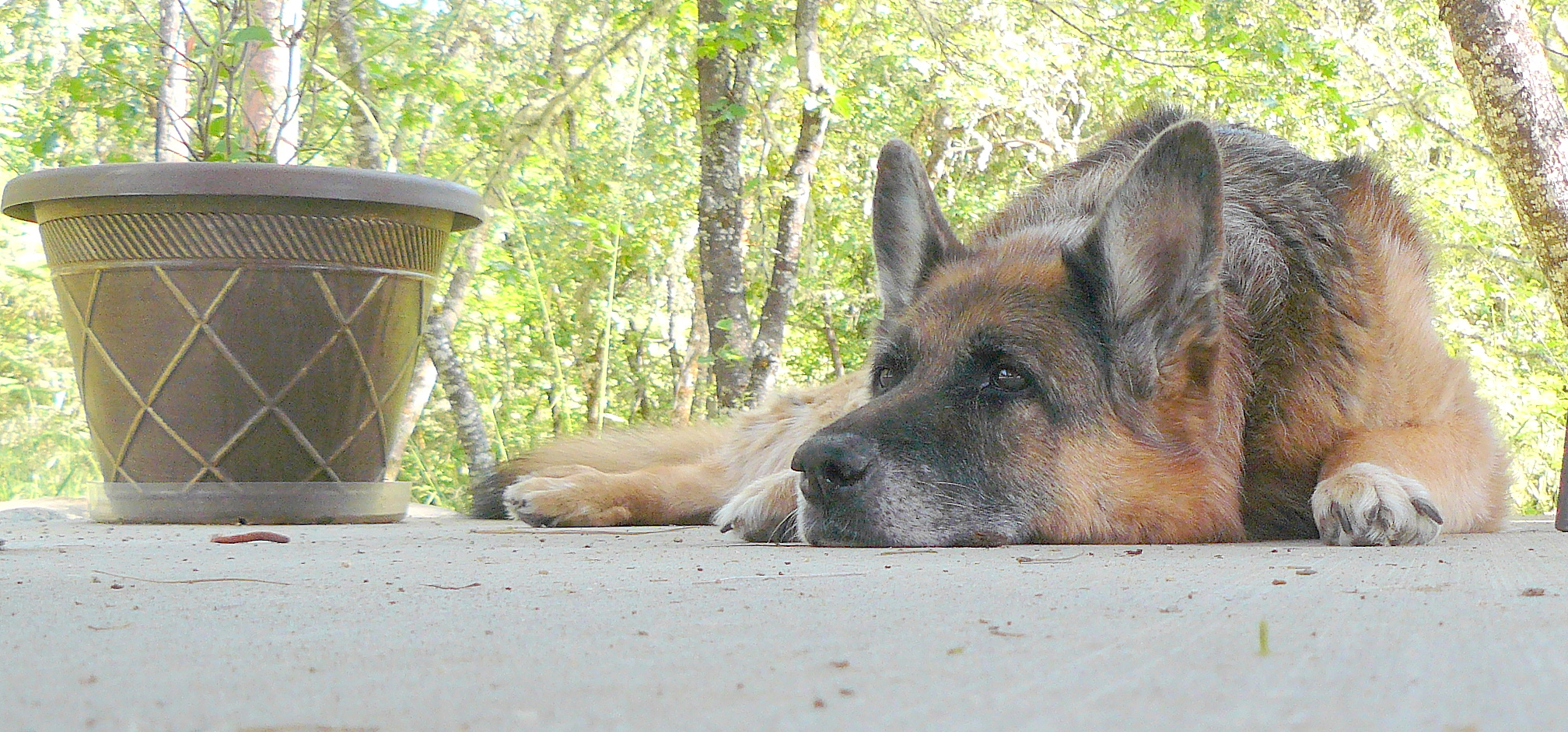
Obviously, I wanted to include some current photographs of the birthday boy but, try as I did, the perfect image wasn’t captured.
Thus will leave you with these two, both taken yesterday afternoon.
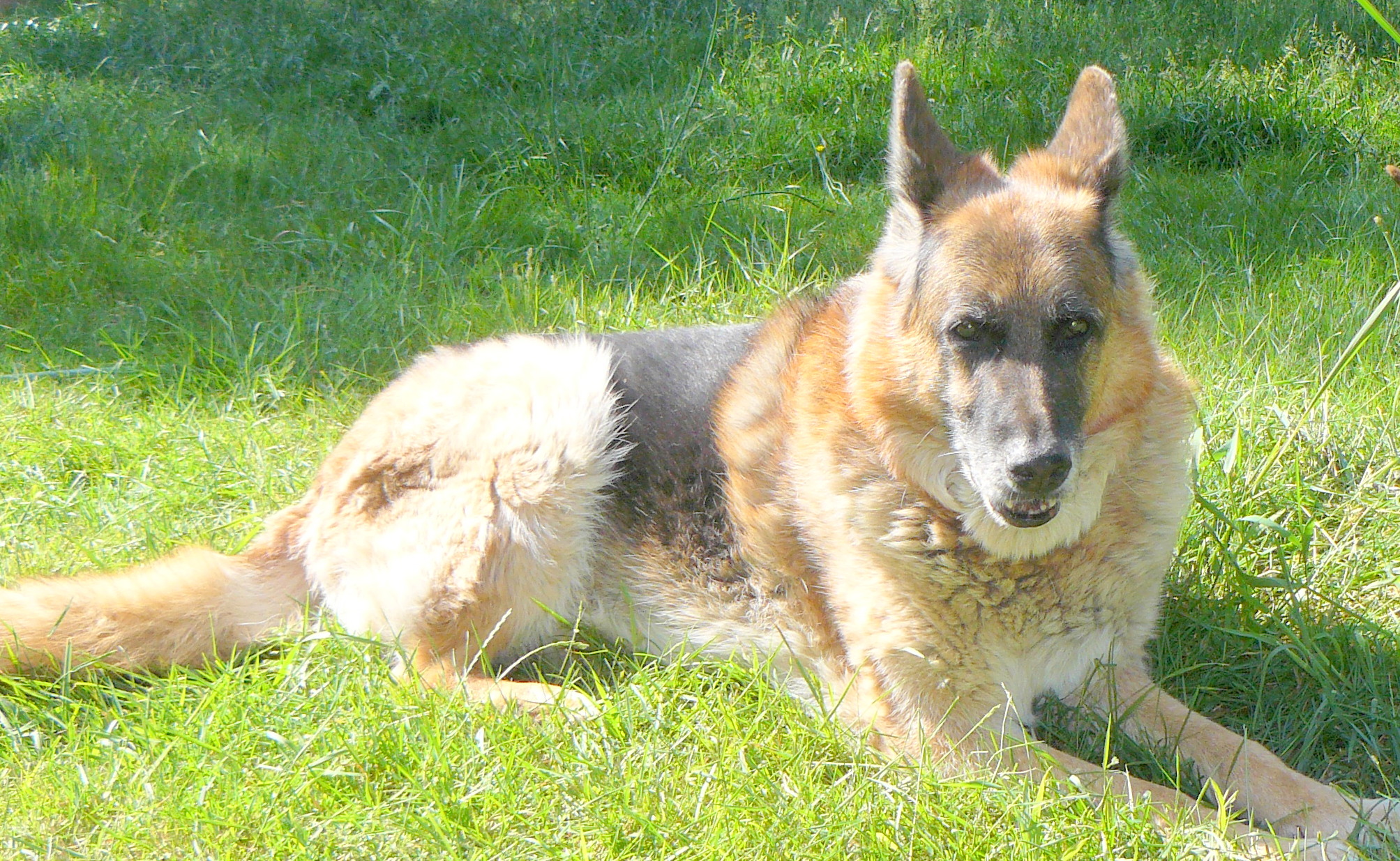
oooo
The joy these horses have given us.
It’s almost impossible, at times, to get one’s mind around life’s events. I’m not wishing to be overly philosophical but, nonetheless, it doesn’t do any harm to muse from time to time about the nature of things.
Take our two rescue horses: Ben and Ranger.
They have now been with us for coming up to three months. Considering how terribly they were treated before being rescued by Darla Clark of Strawberry Mountain Mustangs, it’s a privilege to experience the way that these two horses have so rapidly put their past behind them.
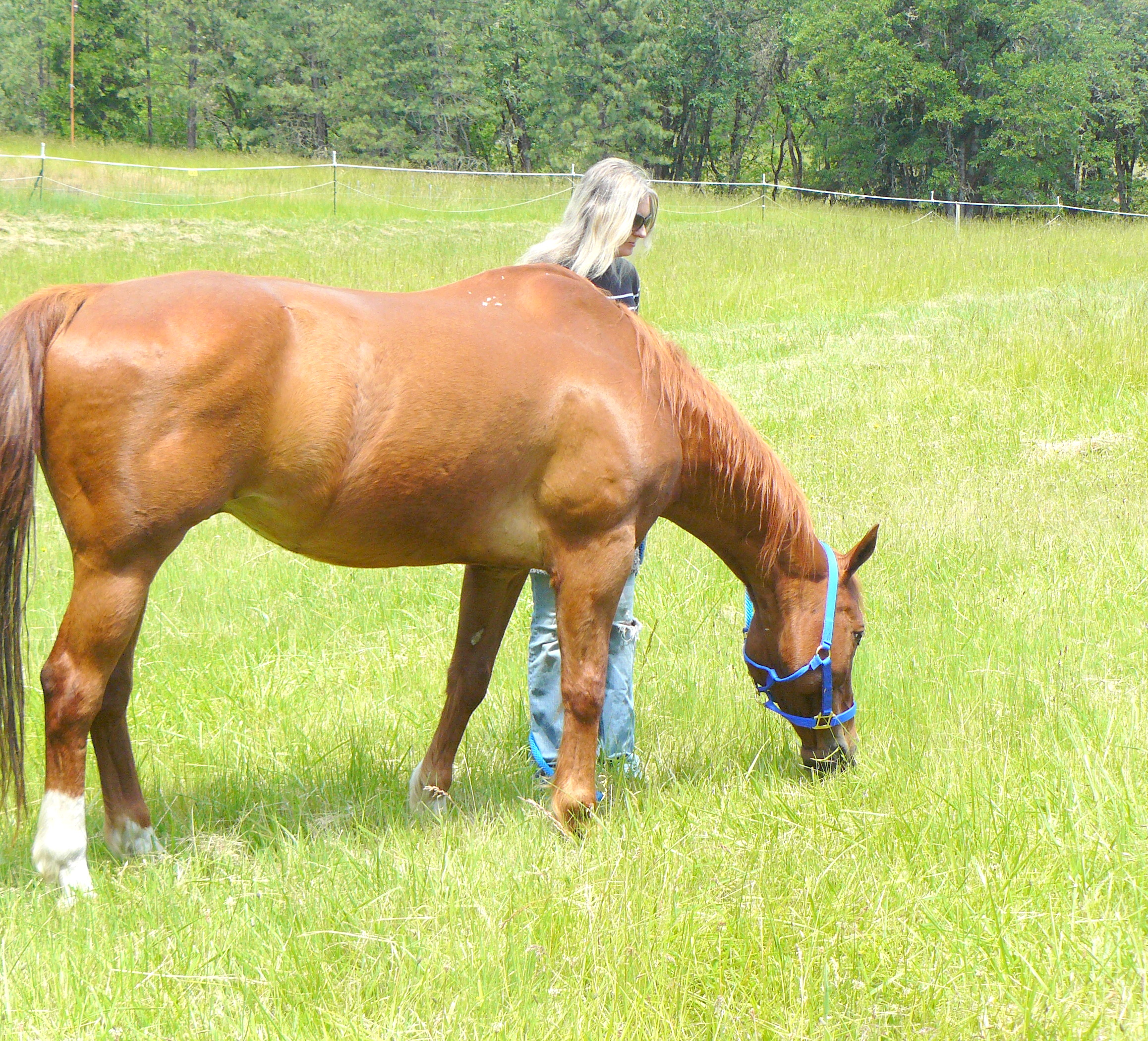
All of which is a preamble to this photograph taken just a couple of days ago.
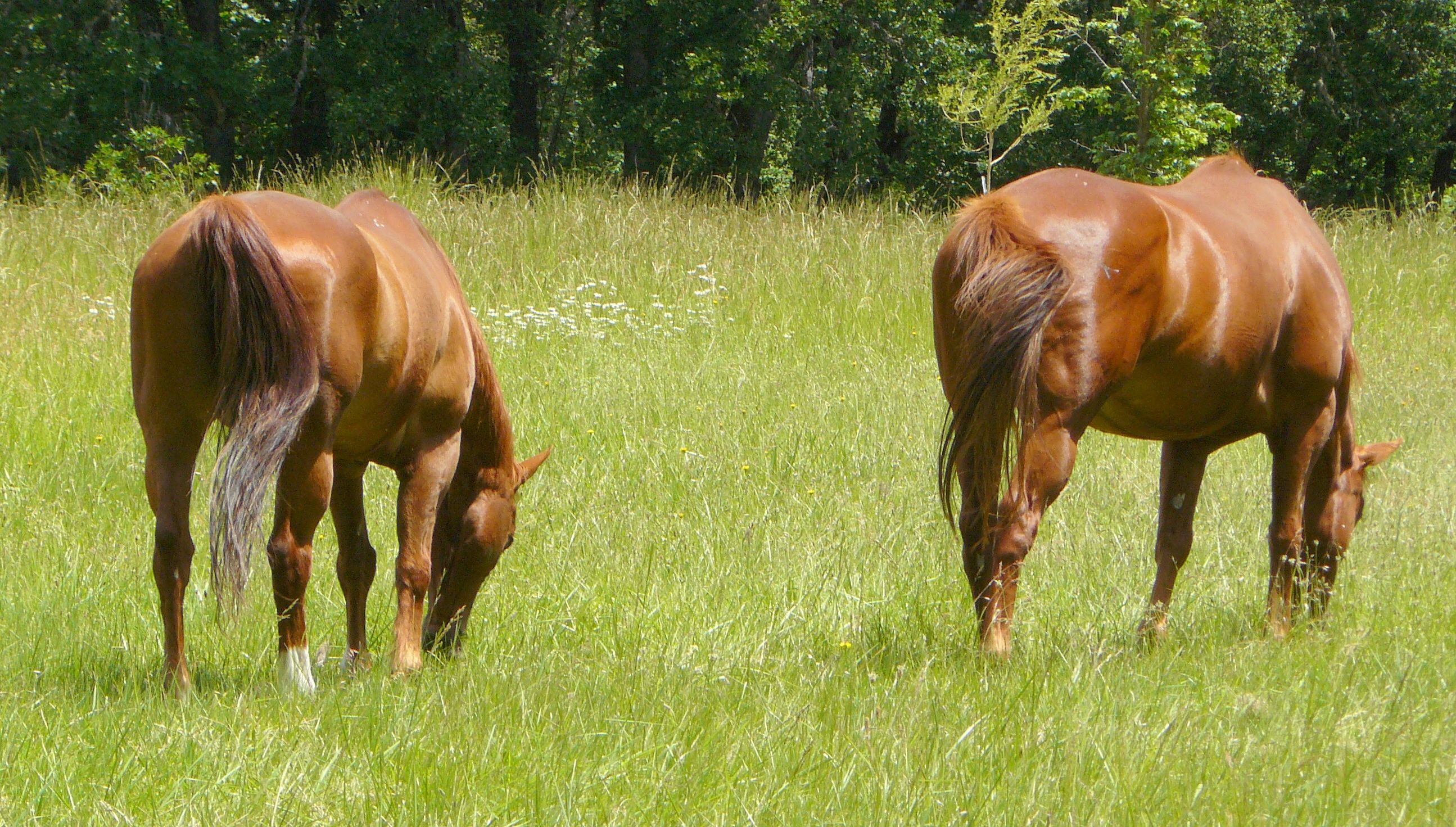
Just look at their shiny coats! Just look at them so happily munching away on the grass.
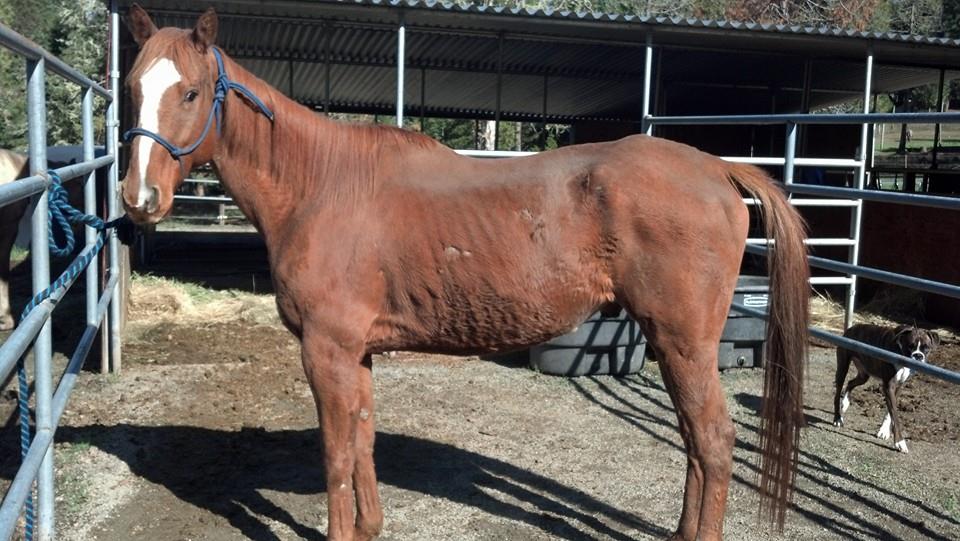
Now look at how they were not so long ago.
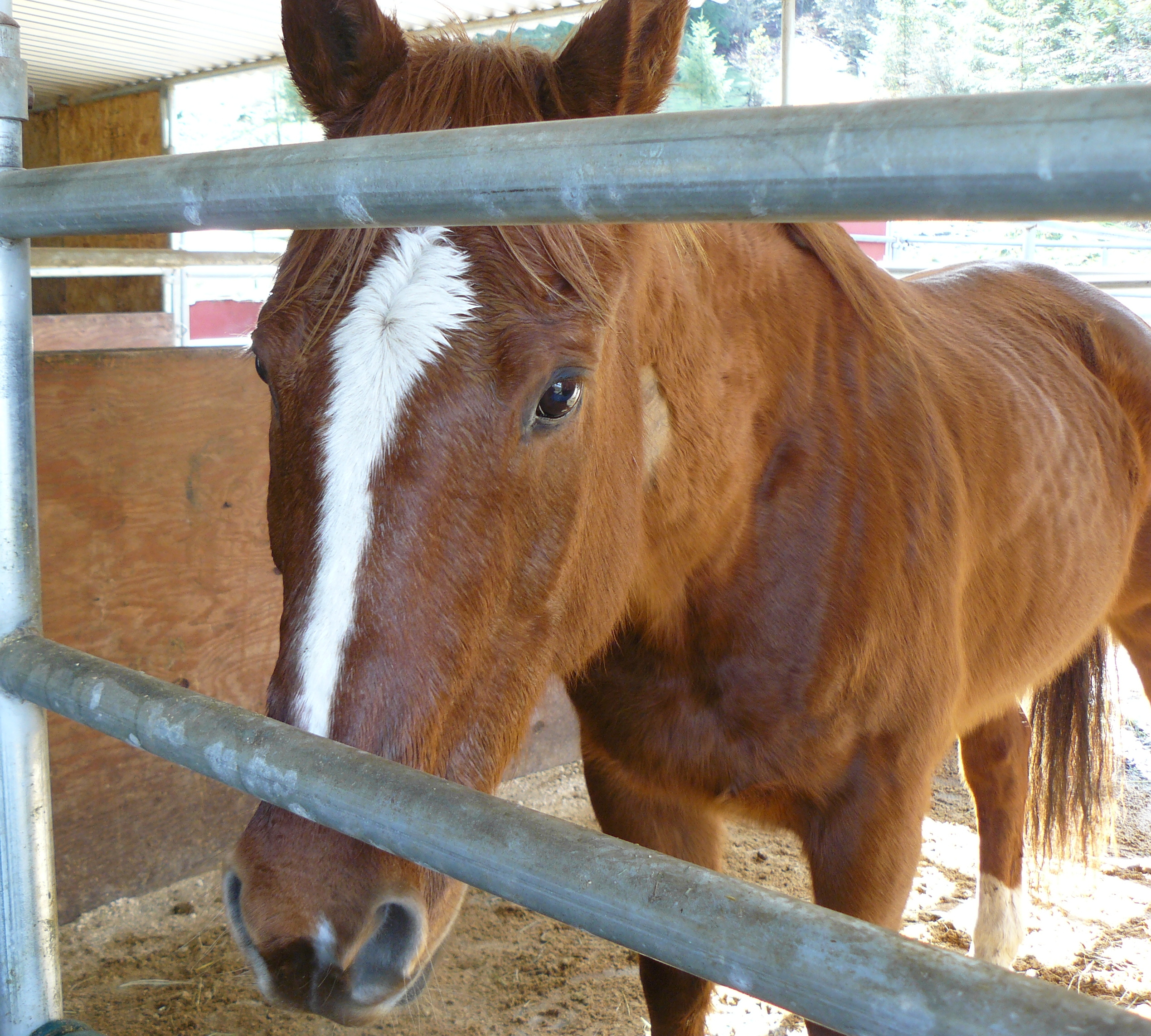
Ranger, when first seen in February.
oooo
So back to present, happy times.
The last photograph is of Jean having just put a halter on Ranger so that the two of them can be taken in at the end of the day. Ben follows Ranger in without the need of a halter. Ben and Ranger are inseparable!
oooo
Tomorrow, the celebration of another beautiful animal!

 Learning from Dogs