From The Meta Picture website, link sent to me by Suzann.
All pictures by Elena Shumilova. See her gallery on Flickr and 500px. They are breathtakingly beautiful.
ooOOoo
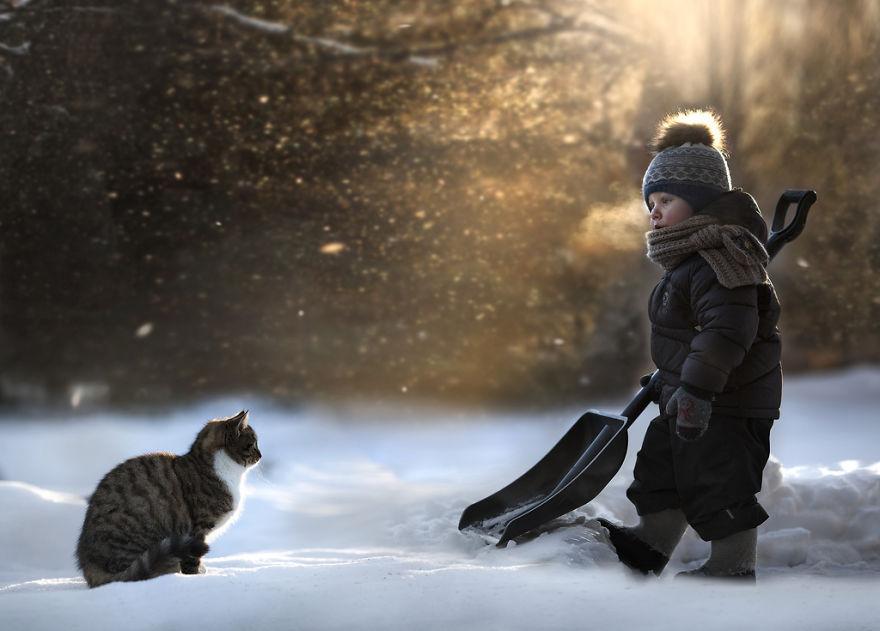
A MOTHER FROM RUSSIA TOOK THESE PICTURES AT HER FARM
ALONG WITH HER TWO SMALL BOYS, A CAT AND A DOG.
These wonderful photographs by Elena Shumilova plunge the viewer into a beautiful world that revolves around her two boys and their adorable dog, cat, duckling and rabbit friends.
Taking advantage of natural colors, weather conditions and her enchanting surroundings, the gifted Russian artist creates cozy and heartwarming photography that leaves you amazed. Elena said, “Children and animals – it’s my life. I’m a mom with two sons and we spend a lot of time on the farm.”
oooo
oooo
oooo
oooo
oooo
oooo
oooo
ooOOoo
Another eight next week; be sure to come back, they are unmissable pictures.
The fabulous story of the restoration of a British Navy Supermarine Seafire Mk.XV
From time to time I let on that in the past I was a keen private pilot and before that a glider (sailplane) pilot. My son has been a commercial airline pilot for many years. Inevitably, one gets to know other pilots, a few of whom become firm friends. One such friend is Bob Derham who recently sent me this story about the restoration of a Supermarine Seafire. For anyone interested in classic aircraft, the story of this particular aircraft is fascinating.
Seafire Mk. XV
While WikiPedia has a good description of the type, there’s a fine description of this particular aircraft over at the Salute website, (the photo above came from that website) from which I offer:
Supermarine Seafire Mk. XV
This airplane is one of only four known Seafire Mk. XVs to exist in the world and it may be the only flying Supermarine Seafire Mk. XV in the world. Dr. Wes Strickler’s immaculate Supermarine Seafire Mk. XV (also known as the “hooked Spitfire”) is based in Columbia, MO, was restored by Jim Cooper, and made its first post-restoration flight in 2010. The Supermarine Seafire was a naval version of the Supermarine Spitfire specially adapted for operation from aircraft carriers. The Seafire’s mission was primarily as a short range interceptor. The name Seafire was derived by abbreviating the longer name “Sea Spitfire”.
The Mk XV variant of the Seafire was powered by a Griffon VI (single-stage supercharger, rated at 1,850 hp driving a 10 ft 5 in Rotol propeller. It appeared to be a naval Spitfire F Mk XII but was an amalgamation of a strengthened Seafire III airframe and wings with the wing fuel tanks, retractable tailwheel, larger elevators and broad-chord “pointed” rudder of the Spitfire VIII. The engine cowling was from the Spitfire XII series, being secured with a larger number of fasteners and lacking the acorn shaped blister behind the spinner. A vee-shaped guard forward of the tailwheel prevented arrestor wires getting tangled up with the tailwheel.
One problem which immediately surfaced was the poor deck behavior of this mark, especially on take-off. At full power the slipstream of the propeller, which swung to the left (as opposed to the Merlin, which swung to the right), often forced the Seafire to swing to starboard, even with the rudder hard over on opposite lock. This sometimes led to a collision with the carrier’s island. The undercarriage oleo legs were still the same as the much lighter Merlin engined Spitfires, meaning that the swing was often accompanied by a series of hops. This undercarriage also gave it a propensity of the propeller tips “pecking” the deck during an arrested landing and occasionally bouncing over the arrestor wires and into the crash barrier.
Wing span: 36ft 10in. Max takeoff weight: 7,640 lb. Max speed: 359 mph. Power: 1,850 hp.
This is an example of incredible dedication! Jim Cooper in front of the Seafire.
When you watch the film, Jim Cooper makes it clear that there were others on the restoration project. But the film also makes it clear that without Jim this beautiful aircraft would never have been restored, let alone restored to a flying machine.
Settle back and enjoy!
Uploaded on Aug 18, 2010 by Scott Schaefer
“While Sarah Hill and I were taping the first Central Missouri Honor Flight special in the Ozark Hangar at Columbia Regional Airport in January 2009, I noticed Jim Cooper working on a plane in the corner of the hangar. I love airplanes and this sight piqued my interest.
The corner was enclosed by plastic from floor to ceiling and inside sat a plane, wings folded toward the ceiling and a paint job that left more to be desired. It was the Seafire XV – one of only a handful still in existence. As soon as I saw the plane and learned a few facts about it, I knew I wanted to do a story on it and follow Cooper through the rest of the restoration process.
Cooper had already been working on the Seafire for nearly a year and half by the time we met, but there was still plenty of work that had to be done. I started shooting that night and throughout the next year and half, whenever Cooper would move to a different stage in the restoration, he’d call and I would head to the hangar to shoot video. I didn’t shoot every part of the process, but tried to capture the big ones ?cleaning the plane, painting, revealing the paint job, testing the landing gear, testing the engine and of course the first flight.
After 10 trips to the airport, 130 miles and nearly 6 hours of video, it was time to start the editing process. Once all the video was in the system, I spent 14 hours typing the details from of every sound and interview captured in the video. That log was essential in writing the story. I needed to know exactly what was said in order to organize everything into a story that would hopefully hold people’s interest. After I had a rough script written, I began to edit the video. After about 15 hours in the edit bay tweaking every little audio and video cut? then re-tweaking them? I was finally finished. Nineteen months later. It was a tough job picking the best four minutes from six hours of video, but in the end, I think I accomplished what I set out to do.”
Leave you with another photograph.
One of a kind!
If you wanted to see the aircraft in the air, then it will be at this year’s EAA OSHKOSH. I’ve always wanted to go but never made it! Anyone fancy baby-sitting some dogs and horses around the end of July? 😉
A most fitting guest essay after yesterday. The following is published with the kind permission of the author, Jeremy Nathan Marks. I have done a ‘screen grab’ of the image associated with his blog post so you can experience it as you would see and read it from The Sand County. It seemed perfect as a follow-on to yesterday’s post Life, and mortality.
ooOOoo
The Sand County
“In wildness is the preservation of the world.” -Henry David Thoreau
My Wish for the World
If I could leave behind but one lasting accomplishment from my life it would be to have changed the hearts and minds of all those people who accept or practice cruelty towards animals. Now there are a great many worthy causes in this world which fully deserve the attention of all those who believe in justice, in fairness, and in mercy. But I also know that each of us -perhaps- has a cause that stands above and beyond all of the other noble concerns that we know exist. For me this cause is the humane treatment of animals. And when I say animals I mean ALL animals. Permit me to explain. My wife and I have two dogs. Both are mutts and both were adopted through the Animal Rescue Foundation of Ontario (ARF). I have blogged about ARF before and can only offer the highest praise for the organization. Courtesy of ARF, we have been provided with free dog training classes which have proved to be an invaluable resource in learning about dog behaviour. Better yet, the dog trainer we have worked with has made herself available for our questions outside of class. Whenever we have encountered a behavioural challenge that we have not understood or have been unsure of a proper method of approach, this trainer has been very obliging. Importantly, she believes in positive reinforcement and does not believe in the use of pain, dominance, or stress as a means of conditioning dogs. For my wife and me, this fits in with our moral beliefs and our ethics. Our eldest dog, who just turned one year old, is a 60 lbs. shepherd mix who has a “leash anxiety,” if I may call it that. When we are out on a walk and she sees another dog she becomes quite agitated and will bark loudly and lunge at the other dog. This has puzzled us because our dog loves to play with others and is frequently socialized. We grew increasingly concerned because our use of treats and positive reinforcement was not working. And because our dog is a large shepherd, we both have worried that she might develop a reputation and become a source of fear or suspicion by other people in our neighbourhood. In due course, we contacted our trainer for advice. She suggested that rather than putting our dog in a stressful situation by repeatedly walking her past other dogs (and trying to control her behaviour when she becomes agitated) we should take her out of the situation instead. So, when we see another dog approaching we turn around and walk in a different direction, all the while rewarding our dog with treats and telling her she is a good girl. We have recently started doing so and the improvements are showing. So, let us fast forward to today. . . This afternoon we took both of our dogs on a 20 km hike along the Thames River. The trail is like so many other trails; it forms a narrow path through the woods which makes passing other trail goers challenging at points. If another dog were to come toward us this narrowness would pose something of a challenge because we cannot turn around (and head home). Also, because the trail runs through the woods, there aren’t often places to step aside and let other dogs pass by without our oldest detecting them. Inevitably we encountered another dog. We were approached by a small dog that was off leash (which is posted as unlawful, actually). We heard the dog before we saw it and prepared ourselves for some nervousness on the part of our oldest. When the dog approach some barking ensued and I tried to move our dog, as best I could, off the trail to let the family that was approaching us pass by with their dog. When we informed the family that our dog is uncomfortable around other dogs when she is leashed they did not seem to understand that we wanted them to pass by us quickly. When our eldest became excited one of the women turned to us and said that we should “knee our dog in her side to show her who is dominant.” I was appalled. Some woman, whom I have never met, who knows nothing about our dog or our relationship with our dog, was suggesting we use violence against her to show her who is boss. . . And this is a woman with a dog of her own! My wife later remarked to me, as we were driving home, that she would not feel entitled to the love and affection our dogs offer us if we used violence on them in any way. I thought what she said was beautiful and captured the principle of the matter perfectly. We want our dogs to love us and to trust us. How would we have any right to their love and affection if we were to lead them to believe that -at any moment and for no apparent reason- we might use painful force on them? Dogs do not understand why you use violence against them. They do not reason or understand cause-and-effect the same way that humans do. This is not a fault. It does not mean they are stupid or of lesser value than human beings. It does not mean they deserve to be treated with cruelty or brutality. Dogs experience violence as pain and suffering that is inflicted out of the blue. They are not only unprepared for it, but are often completely defenceless against it. How could we ever defend such an inhumane practice? It troubles me immensely that someone, whom I do not know, could so nonchalantly counsel me to violence against my dog. Her arrogant presumption aside, this was a monstrous act. It was barbaric. Nowhere in polite society would someone get away with counseling violence against a child. . . or against someone who is weaker. Yet violence against animals, even against dogs who supposedly occupy a place closer to human hearts than most other animals, is countenanced and even endorsed. (I won’t even begin to explain why the Dog Whisperer horrifies and saddens me.) If a young child was caught torturing animals we would all raise the alarm. The torture of animals, by a young child, is seen as an early warning sign of severe mental disturbance and has been linked to homicidal tendencies and highly violent behaviour. One of the great villains of American literature, the character Popeye from William Faulkner’s novel Sanctuary is depicted as a torturer of animals in his youth. Now I know that increasingly there are laws on the books in many nations that are designed to prevent cruelty to animals and to prosecute perpetrators. This is a positive development that I certainly applaud. But I would argue that there is something broader, more troubling in our relationship with animals that goes beyond the bounds of this current posting. It is a topic I will return to time and again at this blog. What troubles me is how animals are frequently seen as objects if they are even seen or thought of at all. The damage that our destruction of the forests, deserts, plains, and oceans of this world does to countless species is something that has been well documented. We do this because we are interested in acquiring the resources we feel are vital to ensuring our survival. . . but often it is our comfort or our “way of life” that really is the central reason for our pursuit of these things. There is a deep seated human arrogance which treats animals as inferior forms of life. We see them as less sophisticated because they cannot compete with us for power on this planet. We suffer from what Aldo Leopold called an “Abrahamic view” toward the land. Somewhere biblical “dominion” over nature became domination. This is tragic. And it is not necessary. I was deeply troubled by what I experienced today and it reminded me that if I could leave behind but one lasting accomplishment it would be to somehow awaken a sense of love, of mercy, and a thirst for justice where the animal life on this planet is concerned. Just imagine what realizing that love would really mean. By achieving a love that transcends the will to power, the will to control, and the will to domination our embrace of animals really is, after all, the achievement of that revelatory love that is at the heart of the great religions and the religious spirit. Love for animals is love for justice and mercy. It is reverence for life. And it is peace. I think Henry Beston captures these sentiments beautifully: “Remote from universal nature, and living by complicated artifice, man in civilization surveys the creature through the glass of his knowledge and sees thereby a feather magnified and the whole image in distortion. We patronize them for their incompleteness, for their tragic fate in having taken form so far below ourselves. And therein we err, and greatly err. For the animal shall not be measured by man. In a world older and more complete than ours they move finished and complete, gifted with extensions of the senses we have lost or never attained, living by voices we shall never hear. They are not brethren; they are not underlings; they are other nations, caught with ourselves in the net of life and time, fellow prisoners of the splendour and travail of the earth.” -from The Outermost House, by Henry Beston (quoted from Farley Mowat’s A Whale For The Killing)
ooOOoo
I’m sure you will join me in thanking Jeremy for writing such a beautiful and heart-felt essay.
Possibly the most important lesson we can learn from dogs!
I was aware when writing the concluding part of Meet the dogs – Pharaoh that the next day I would be faced with writing about a subject that is a whole degree more difficult. Death!
It must have been in my mind when I wrote “of the need to smell the flowers in this short life of ours.”
What has prompted today’s post?
Simply that Dhalia developed a limp in her front, right-hand, leg. That was a few weeks ago. Naturally, we took her to our local vet, Dr. Codd, who diagnosed a strained elbow joint probably as a result of arthritis; Dhalia is believed to be ten-years-old. With the recommended medication, the limp came to an end.
Then about two weeks ago, the elbow weakness appeared in her left-hand, front leg.
On Monday, we returned to Dr. Codd who took further X-rays and sought a second opinion. That second opinion came back with the probability that it was a “osteoproliferative neoplastic lesion” or bone cancer to you and me! It’s not one-hundred-per-cent certain but likely.
It only seemed like yesterday that Jean wrote about Dhalia in our ‘Meet the dogs’ series. That post included this photograph.
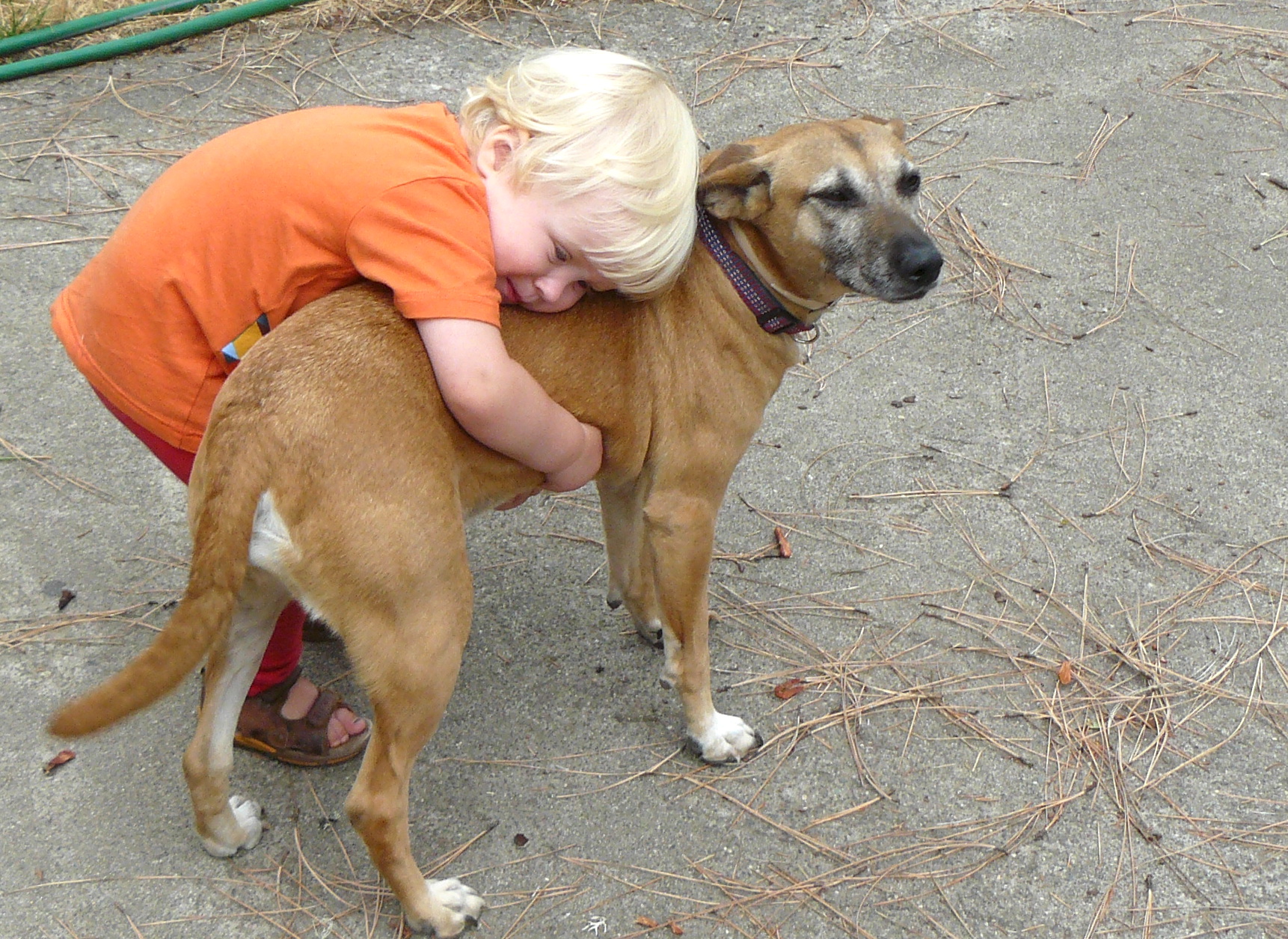
Love and Trust – Grandson Morten hugging Dhalia, September 2013.
Jean is very sad, as one would expect, nay we both are. Dhalia, like Hazel and some of the other dogs here at home, has a loving openness towards humans that is truly remarkable when one learns of how these dogs came to be rescued: Dhalia being found by Jean living rough in a desolate part of a Mexican desert. This is what Jean wrote in that ‘Meet the dogs‘ account:
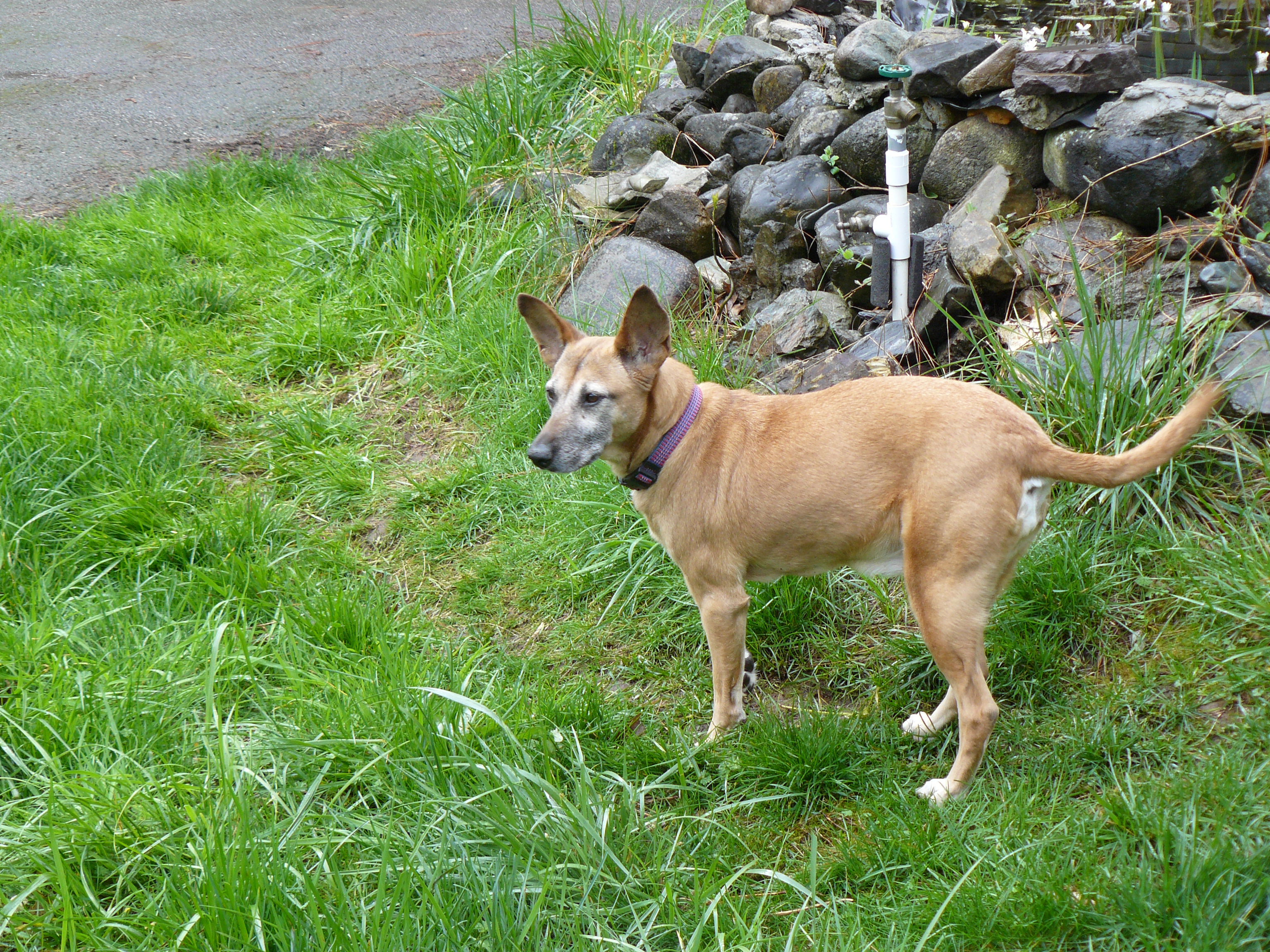
I named her Dhalia and after treatments for mange she became quite beautiful. She was the pivotal part of a short story, Messages from the Night, Paul wrote back in 2011. Under her sweet exterior remains that same will to survive so evident when I rescued her all those years ago. There has been more than one occasion that she has brought me a recently killed squirrel or an ancient bone. We love our Dhalia: she still reaches out with her front paw when she seeks attention. Dhalia will be ten-years-old this year.
Somehow, Dhalia’s possible last few weeks of life resonated with much else going on. Close to us, the recent death of a chicken, and one of our cats that does not have much longer to live. In the wider world, the Washington State mud-slide, flight MH370, and the Ukraine. The news media treat death as almost a trivial, incidental part of the scheme of things.
It takes others to offer words that elevate death to its deserved meaning. Take, for example, author Brian Beker, who writes the blog The Dog in the Clouds. Brian recently wrote the following post:
Prayer for an eagle
Please say a prayer for beautiful bald eagle who just died a death he did not deserve.
He was stuck on the ground near a concrete barrier on a stretch of interstate under construction in Arkansas. I spotted him with his head down, facing into the traffic that was passing a foot away from him.
He was an adult bald eagle-big and brave, facing down the oncoming 18 wheelers.
There was no place to pull off, concrete barriers on both sides, so I went to the next exit and backtracked. My adrenaline was rushing in horror and fear. My plan was just to stop and block traffic, and pick him up. But he had been killed by the time I got back to him three or four minutes later.
I failed that bird.
I hope he is circling over the lakes and trees he loves.
Back to learning about death from our dogs.
Dhalia’s possible terminal condition; my Pharaoh being the age he is; somewhere in there has come the recognition that we should embrace life yet also embrace our mortality; our death. As Leonardo da Vinci was reputed to have said, “While I thought that I was learning how to live, I have been learning how to die.”
What does death mean; truly mean? I don’t know. All I know is that death is the end of a life. That our immortality is only an echo, a reverberation of who we were and what we stood for. Or no better put than by American lawyer, Albert Pike, who left these words before he died on April 2nd, 1891 (Yes, I looked it up!)
What we have done for ourselves alone dies with us;
what we have done for others and the world remains and is immortal.
Last thought from our dogs. Recall that yesterday, I wrote, “Pharaoh has been my greatest inspiration of the power of unconditional love; of the need to smell the flowers in this short life of ours.”
Day in, day out, anyone with dogs in their lives know how often they offer us simple acts of love.
A life of simple acts of love – now that does give death a meaning!
In yesterday’s first part of my recollection of having Pharaoh in my life for over ten years, I focussed on the early days. Today, I want to take a more philosophical view of the relationship, right up to the present day.
The biggest, single reward of having Pharaoh as my friend goes back a few years. Back to my Devon days and the time when Jon Lavin and I used to spend hours talking together. Pharaoh always contentedly asleep in the same room as the two of us. It was Jon who introduced me to Dr. David Hawkins and his Map of Consciousness. It was Jon one day who looking down at the sleeping Pharaoh pointed out that Dr. Hawkins offered evidence that dogs are integrous creatures with a ‘score’ on that Map of between 205 and 210. (Background story is here.)
So this blog, Learning from Dogs, and my attempt to write a book of the same name flow from that awareness of what dogs mean to human consciousness and what Pharaoh means to me. No, more than that! From that mix of Jon, Dr. David Hawkins, experiencing the power of unconditional love from an animal living with me day-in, day-out, came a journey into my self. Came the self-awareness that allowed me to like who I was, be openly loved by this dog of mine, and be able to love in return. As is said: “You cannot love another until you love yourself.”
Moving on.
Trying to pick out a single example of the bond that he and I have is practically impossible. I have to rely on photographs to remind me of the thousands of times that a simple look or touch between Pharaoh and me ‘speaks’ to me in ways that words fail. Here’s an extract from my celebration of Pharaoh’s tenth birthday last June 3rd; written the following day. It comes pretty close to illustrating the friendship bond.
oooo
For many years I was a private pilot and in later days had the pleasure, the huge pleasure, of flying a Piper Super Cub, a group-owned aircraft based at Watchford Farm in South Devon. The aircraft, a Piper PA-18-135 Super Cub, was originally supplied to the Dutch Air Force in 1954 and was permitted by the British CAA to carry her original military markings including her Dutch military registration, R-151, although there was a British registration, G-BIYR, ‘underneath’ the Dutch R-151. (I wrote more fully about the history of the aircraft on Learning from Dogsback in August 2009.)
Piper Cub R151
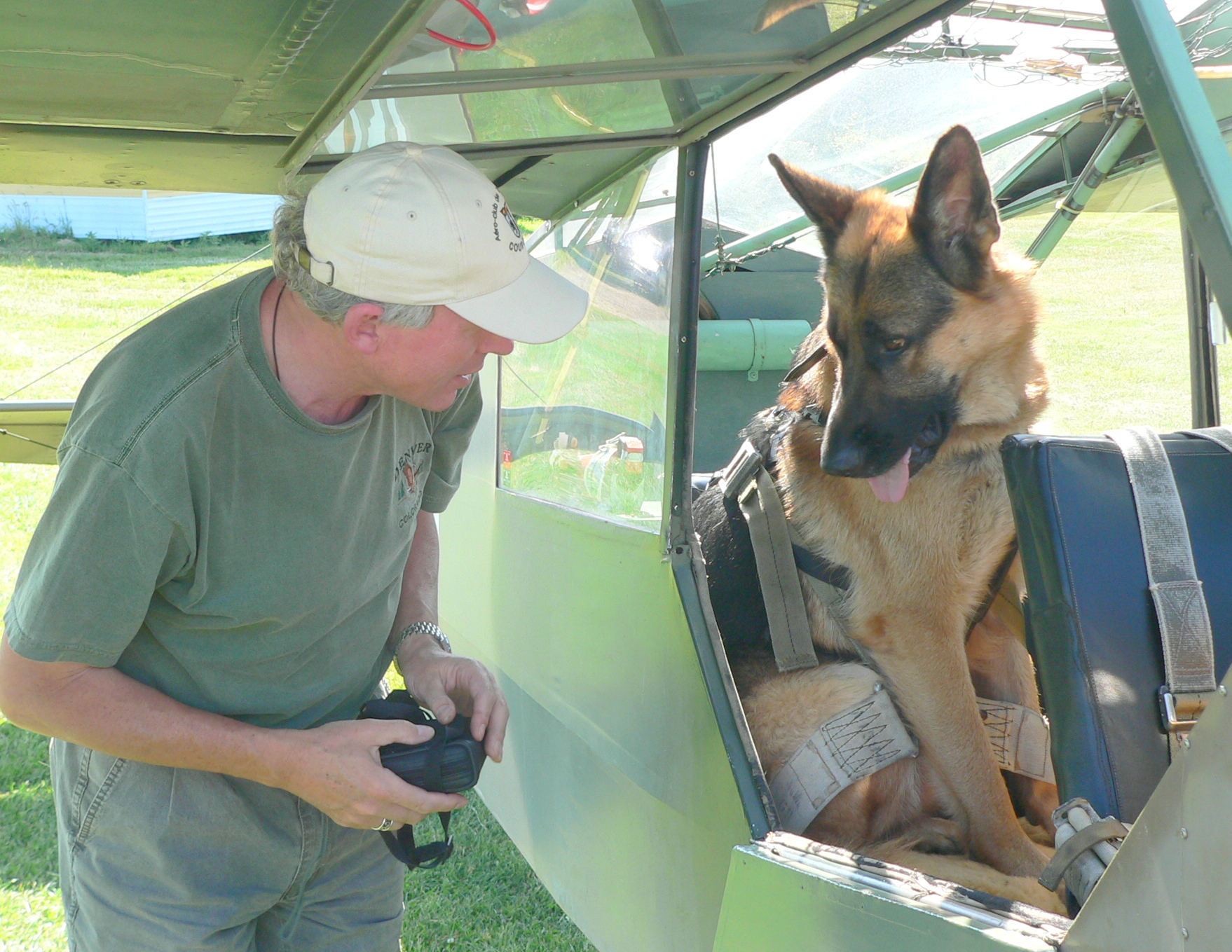
Anyway, every time I went to the airfield with Pharaoh he always tried to climb into the cockpit. So one day, I decided to see if he would sit in the rear seat and be strapped in. Absolutely no problem with that!
Come on Dad, let’s get this thing off the ground!
My idea had been to fly a gentle circuit in the aircraft. First I did some taxying around the large grass airfield that is Watchford to see how Pharaoh reacted. He was perfectly behaved.
Then I thought long and hard about taking Pharaoh for a flight. In the Cub there is no autopilot so if Pharaoh struggled or worse it would have been almost impossible to fly the aircraft and cope with Pharaoh. So, in the end, I abandoned taking him for a flight. The chances are that it would have been fine. But if something had gone wrong, the outcome just didn’t bear thinking about.
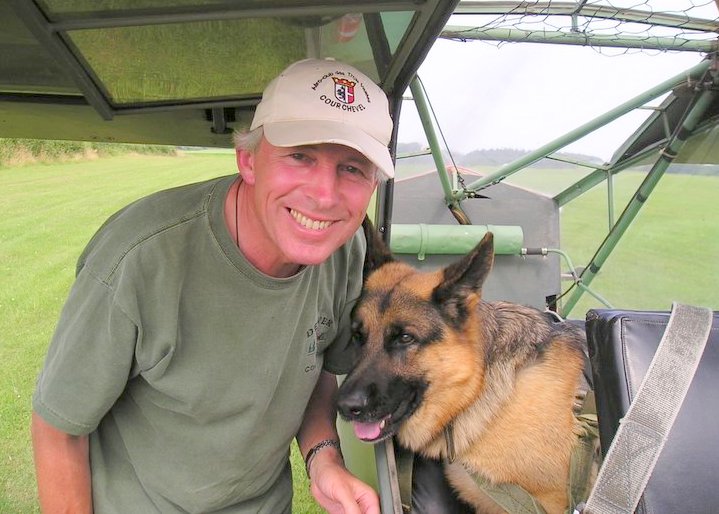
So we ended up motoring for 30 minutes all around the airfield which, as the next picture shows, met with doggie approval. The date was July 2006.
That was fun!
oooo
Moving on again. This time to another flying experience. To the day when Pharaoh and I flew out of London bound for Los Angeles and a new life with Jeannie and all her dogs (16 at that time) down in San Carlos, Sonora County, Mexico. The date: September 15th, 2008. Just ten months after I had met Jean in Mexico and realised that this was the woman that I was destined to love! (Now you will understand why I described earlier the Jon Lavin, Dr. Hawkins, Pharaoh mix as the biggest, single reward of having Pharaoh as my friend!)
There followed wonderful happy days for me and Pharaoh. Gorgeous to see how Pharaoh became so much more a dog, if that makes sense, from having his own mini-pack around him. Those happy days taking us all forwards to Payson, AZ, where Jean and I were married, and then on to Merlin, Oregon arriving here in October, 2012.
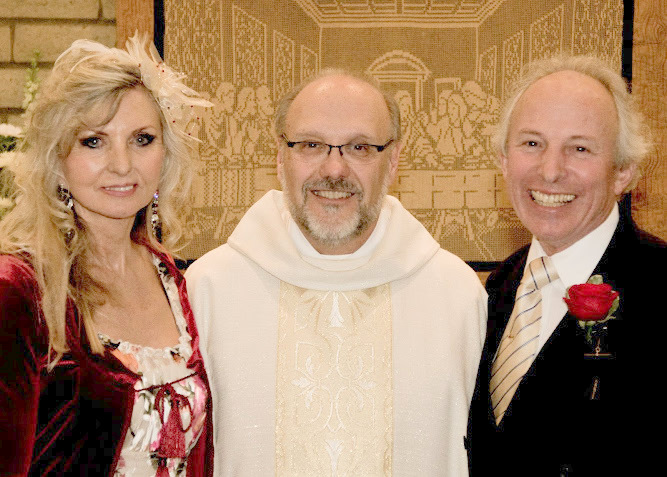
Fr. Dan Tantimonaco with the newly weds!
oooo
Pharaoh ‘married’ to his dearest friends. December, 2013.
oooo
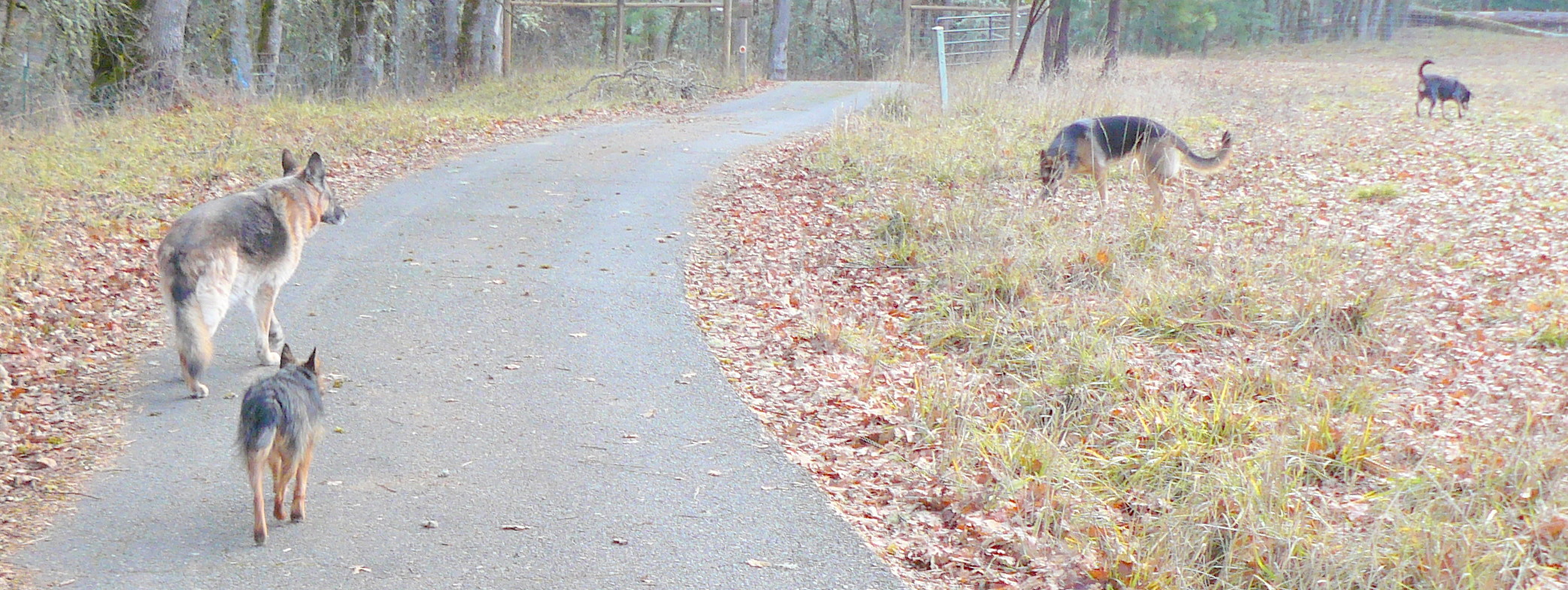
Smelling the flowers! Pharaoh and Cleo with Hazel in the middle. Taken yesterday.
I could go on! Hopefully, you get a sense, a very strong sense, of the magical journey that both Pharaoh and I have experienced since I first clasped him in my arms back in September, 2003.
Both Pharaoh and I are in the Autumn of our lives, he is 11 in June; I am 70 in November, and we both creak a little. But so what! Pharaoh has been my greatest inspiration of the power of unconditional love; of the need to smell the flowers in this short life of ours.
Almost two months ago, January 30th to be exact, the first of this ‘Meet the dogs‘ series was published. It came out of an idea from Jean and that January 30th post introduced Paloma to you, dear reader. Since then we have told you about Lilly, Dhalia, Ruby, Casey, Hazel, Sweeny, and Cleo.
So today’s post is the last of the Meet the dogs stories; it is about Pharaoh. I’m going to indulge myself and tell you the story of this most wonderful of dogs over today and tomorrow.
ooOOoo
Pharaoh
Photograph taken on the 12th August, 2003, the first day I saw Pharaoh.
This is Sandra Tucker, owner of Jutone Kennels in Devon, England, where Pharaoh was born on June 3rd, 2003. Here’s something written elsewhere that conveys my feelings that first day that I met this puppy.
oooo
In no time at all I was turning into the farm driveway, noticing the painted sign for Jutone & Felsental German Shepherds alongside the open, wooden gate.
I turned off the engine and was about to swing my legs out of the open driver’s door when I saw a woman coming towards me.
“Hi, you must be Paul, I’m Sandra. Did you have any trouble finding us?”
I shook hands with her.
“Not at all. I did as you recommended when we spoke on the phone and went in to the local store and got final directions.”
Sandra smiled, her glasses almost slipping off the end of her nose.
“Dear Beth. She’s been running that local store since God was a boy.”
She continued with a chortle in her voice, “Some say that Beth was at the store before our local pub, The Palk Arms, opened for business. And the pub’s been in the village for well over four-hundred years.” Sandra’s laugh was infectious and I caught myself already taking a liking to her. The sense of a strong, confident person struck me immediately. Indeed, a working woman evidenced by her brown slacks, revealing plenty of dog hairs, topped off with a blue T-shirt under an unbuttoned cotton blouse.
“Anyway, enough of me, Paul, you’ve come to get yourself a German Shepherd puppy.”
She turned towards a collection of grey, galvanised-sheeted barns and continued chatting as I fell into step alongside her.
“After we discussed your circumstances over the phone; where you live down there in Harberton, why you specifically wanted a German Shepherd dog, I thought about the last set of puppies that were born, just a few weeks ago.”
Sandra paused and turned towards me.
“While, of course, you can select whatever puppy you feel drawn to, my advice is to go for a male. Listening to your experiences of befriending a male German Shepherd when you were a young boy, I have no doubt that a male dog would result in you and the dog building a very strong bond. Indeed, I have a young male puppy that I want to bring out to you. Is that OK?”
Sandra turned and walked out of sight around the corner of the first barn leaving me standing there, my response presumably being taken for granted.
Something in her words struck me in a manner that I hadn’t anticipated; not in the slightest. That was her use of the word bond. I was suddenly aware of the tiniest emotional wobble inside me from Sandra’s use of that word. Somewhere deep inside me was the hint that my decision to have a dog in my life was being driven by deeper and more ancient feelings.
My introspection came to an immediate halt as Sandra re-appeared. She came up to me, a beige-black puppy cradled under her left arm, her left hand holding the pup across its mid-riff behind his front legs, her right arm across her waist supporting the rear of the tiny animal.
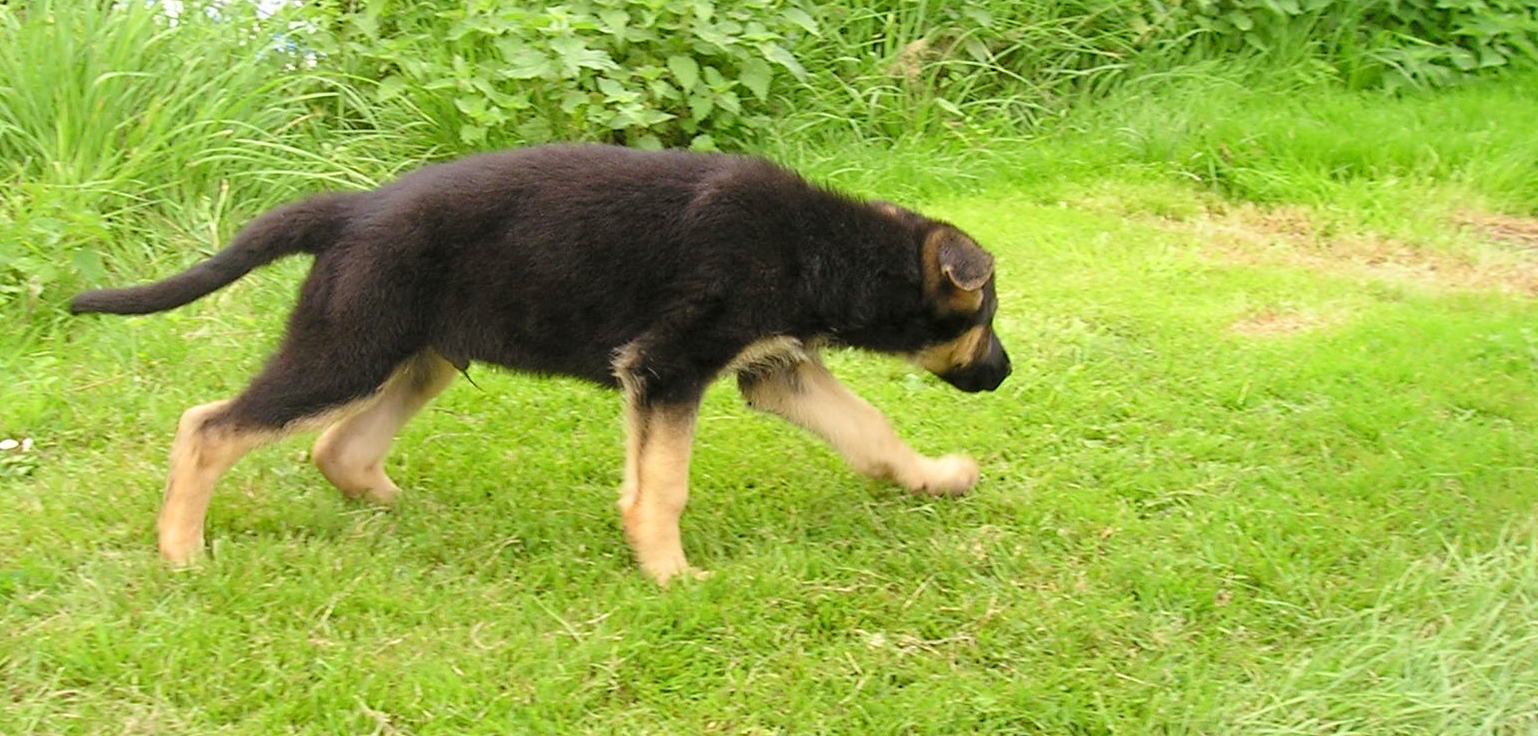
I stood very still, just aware of feelings that I couldn’t voice, could hardly even sense, as I looked down at this tiny black, furry face, outsized beige ears flopping down either side of his small head.
It was unusually warm this August day and I had previously unbuttoned my cuffs and folded the shirt sleeves of my blue-white, checked cotton shirt back above both elbows leaving my forearms bare.
Sandra offered me the young, fragile creature. As tenderly as I could, I took the pup into my arms and cradled the gorgeous animal against my chest. The pup’s warm body seemed to glow through its soft fur and as my bare arms embraced the flanks of this quiet, little dog I realised the magic, the pure magic, of the moment. Something was registering in me in ways utterly beyond words but, nonetheless, as real as a rainbow might be across the green, Devon hills.
“How old is he, Sandra?”
“This little lad was born on June 3rd. So what are we today? August 12th. So he is ten weeks old as of today.”
June 3rd, 2003. I knew that this date had now entered my life in just the same way as had the birth-dates of my son and daughter; Alex and Maija.
The power of this first meeting was beyond anything I had expected, or even imagined. I thought that it was going to be a fairly pleasant but, nonetheless, unsurprising process of choosing a puppy. How wrong could I have been! What was captivating me was the pure and simple bodily contact between this young dog and me. No more than that. I was sensing in some unspoken manner that this was equally as captivating for this precious puppy-dog. For even at the tender age of ten weeks, the tiny dog appeared to understand that me holding him so longingly was bridging a divide of many, many years.
Sandra motioned with her arm, pointing out a bench-seat a few yards away alongside a green, well-manicured, lawn.
I very carefully sat down on the wooden-slatted bench and rested the beautiful animal in my lap. The puppy was adorable. Those large, over-sized ears flopping across the top of his golden black-brown furry head. His golden-brown fur morphing into black fur across his shoulders and then on down to the predominantly beige-cream colour of his soft, gangling, front legs. That creamy fur continuing along the little creature’s underbelly.
The puppy seemed almost to purr with contentment, its deep brown eyes gazing so very intently into mine. I was entranced. I was spellbound.
Never before had I felt so close to an animal. In a life-time of nearly sixty years including having cats at home when I was a young boy growing up in North-West London, and much later the family owning a pet cat when Alex and Maija were youngsters, I had never, ever sensed the stirrings of such a loving bond as I was sensing now. As this young puppy was clearly sensing as well. This was to be my dog. Of that I was in no doubt.
oooo
Early days at home in South Devon.
Let me leave you with a couple of other photographs taken from his early days.
Pharaoh, nine months old, taken in my Devon home in 2004.
oooo
First birthday: June 3rd 2004. Again, picture taken in Devon.
Never in my wildest dreams did I imagine that in the year 2014 I would be writing about Pharaoh from a home-office desk in Southern Oregon sharing a happy life with a wonderful London lady, Jean, and more gorgeous animals than one could throw a stick at.
More on that shared journey with Pharaoh tomorrow!
Stories like this remind me that much of life is a struggle against disappointment. Perhaps I’m an idiot, but I expected a world that was so much better. I still believe it’s possible. But getting there requires a daily struggle against those who would mislead us.
George is certainly no idiot for expecting a better world, or to put it another way, if George is an idiot for such an expectation then there are millions of fellow idiots out there.
That essay from George Monbiot opened, thus:
Almost everything is fake. The brave proverbs with which we were brought up – the truth will out, cheats never prosper, virtue will triumph – turn out to be unfounded. For the most part, our lives are run and our views are formed by chancers, cheats and charlatans. [Ed. my emphasis!]
They construct a labyrinth of falsehoods from which it is almost impossible to emerge without the help of people who devote their lives to navigating it. This is the role of the media. But the media drags us deeper into the labyrinth.
So with those words still ringing in your ears, settle down for just sixteen minutes and watch anti-corruption activist, Charmian Gooch‘s recent TED Talk.
Anonymous companies protect corrupt individuals – from notorious drug cartel leaders to nefarious arms dealers – behind a shroud of mystery that makes it almost impossible to find and hold them responsible. But anti-corruption activist Charmian Gooch hopes to change all that. At TED2014, she shares her brave TED Prize wish: to know who owns and controls companies, to change the law, and to launch a new era of openness in business.
And if, having watched Charmian’s very compelling talk, you want to support her, then go to the Global Witnesswebsite.






 Learning from Dogs