Year: 2012

More interlude pics!

More ‘switch-off’ material!

There was a fantastic response to the Interlude Post that came out on the 6th March so I thought I would offer some more of those wonderful pictures.  As I said in that earlier Post, ” Cynthia, the wife of Dan Gomez, emailed me a set of wonderful photographs that had come to her from sister-in-law Suzann.”  So here are some more.  Have a peaceful and relaxed Sunday!

Did you see that!
Hey, I heard that comment!
Mummy, are we nearly there?
We can't go on meeting like this!
Well you guys don't taste that different!
One more time! I'm in charge around here!

Suzann/Cynthia – Please, please, please send more!

This is fun!

Something to keep you quiet for a while!

I’m told by the person who emailed this to me, thanks Cynthia, that there really is a cat in this picture.  Haven’t spotted it myself!

Where's the cat? There really is one in the photograph!

I must go down to the sea again, spelt H2CO3!

Starting to feel like a long way from John Masefield’s poem Sea Fever.

The call of the sea.

One of my all-time favourite poems.

I must go down to the seas again, to the lonely sea and the sky,
And all I ask is a tall ship and a star to steer her by,
And the wheel’s kick and the wind’s song and the white sail’s shaking,
And a grey mist on the sea’s face, and a grey dawn breaking.

I must go down to the seas again, for the call of the running tide
Is a wild call and a clear call that may not be denied;
And all I ask is a windy day with the white clouds flying,
And the flung spray and the blown spume, and the sea-gulls crying.

I must go down to the seas again, to the vagrant gypsy life,
To the gull’s way and the whale’s way, where the wind’s like a whetted knife;
And all I ask is a merry yarn from a laughing fellow-rover,
And quiet sleep and a sweet dream when the long trick’s over.

Why do I start this piece with that poem?

Well, read this,

Carbonic acid is a weak acid that is created when carbon dioxide (CO2) is dissolved in water (H2O), resulting in the chemical formula H2CO3. When the acid dissociates, or gives up a hydrogen ion, the resulting molecule is called a bicarbonate ion. Carbonic acid appears frequently in the natural world. It can be found in sodas, champagne, and blood. The acid even appears in rain.

But like so many things in nature, it’s all about balance.

A week ago, the 2nd March, Patrice Ayme gave me permission to reproduce an essay of his The collapse of the biosphere.  In that essay he wrote,

Besides, it’s not all about “climate change”. Half of the CO2 is presently dissolving in the oceans, so a rise of two degrees Celsius means extremely acid oceans (CO2 turns into carbonic acid after it reacts with water). At the present rate of acidification, marine life will dissolve big time by 2100. That’s how a lot of the oxygen is produced, by photosynthesizing unicellular animals, with acid sensitive skeletons. Atmospheric poisoning deniers do not want just to warm us up.

On that same day of March 2nd, Yves Smith of Naked Capitalism published an item that reinforced what Patrice wrote.  Yves very kindly gave me permission to republish her Post in full, as follows:

Current Rate of Ocean Acidification Worst in 300 Million Years

Science has published a troubling but not entirely surprising article on the fact that the oceans are acidifying at the fastest rate in 300 million years. Actually, it could be the fastest rate over an even longer time period, but we can only go back with any degree of accuracy for 300 million years

We first wrote about this issue in early 2007, and this section, which quoted Stormy from Angry Bear, will help bring readers up to speed:

….there are side effects to our love affair with CO2 that are not often mentioned. In fact, whether the earth cools or warms is absolutely irrelevant to these effects. I repeat: Absolutely irrelevant.

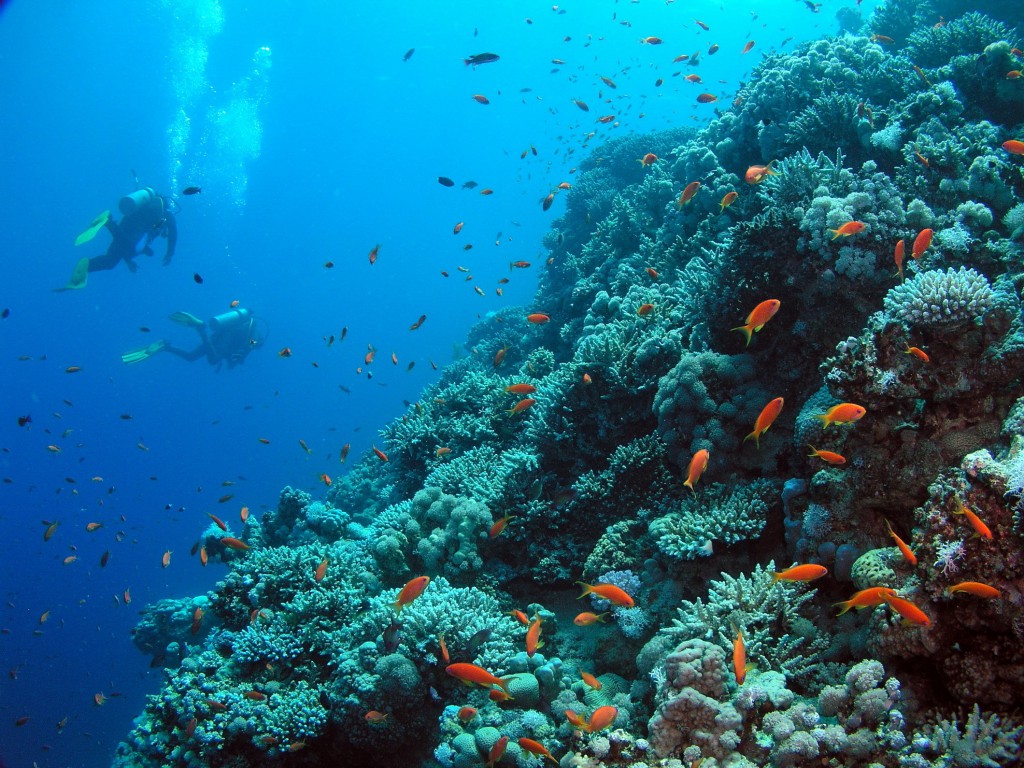
One of the most startling effects is the acidification of the oceans. Since 1750, the oceans have become increasingly acidic. In the oceans, CO2 forms carbonic acid, a serious threat to the base of the food chain, especially on shellfish of all sizes. Carbonic acid dissolves calcium carbonate, an essential component of any life form with an exoskeleton. In short, all life forms with an exoskeleton are threatened: shell fish, an important part of the food chain for many fish; coral reefs, the habitat of many species of fish….

The formation of carbonic acid does not depend upon temperature. Whether the oceans warm or cool is irrelevant. Of concern only is the amount of CO2 that enters the oceans.

Fast forward to today. Consider the scope of the paper in Science, per a very good discussion in ars technica:

A new paper in Science examines the geologic record for context relating to ocean acidification…The research group (twenty-one scientists from nearly as many different universities) reviewed the evidence from past known or suspected intervals of ocean acidification…They find that the current rate of ocean acidification puts us on a track that, if continued, would likely be unprecedented in last 300 million years.

There is an important driver of this process that this overview mentions only in passing further on, and it’s useful to have it in mind when you review the discussion of the historical record:ocean acidification depends primarily on the rate of atmospheric CO2 increases, not the absolute concentration. Look at how attenuated the rate of past CO2 changes was in the past versus the speed now:

The first period the researchers looked at was the end of the last ice age, starting around 18,000 years ago. Over a period of about 6,000 years, atmospheric CO2 levels increased by 30 percent, a change of roughly 75 ppm. (For reference, atmospheric CO2 has gone up by about the same amount over the past 50 years.) Over that 6,000 year time period, surface ocean pH dropped by approximately 0.15 units. That comes out to about 0.002 units per century. Our current rate is over 0.1 units per century—two orders of magnitude greater, which lines up well with a model estimate we covered recently.

The last deglaciation did not trigger a mass extinction, but it did cause changes in some species…

During the Pliocene warm period, about 3 million years ago, atmospheric CO2 was about the same as today, but pH was only 0.06 to 0.11 units lower than preindustrial conditions. This is because the event played out over 320,000 years or so. We see species migration in the fossil record in response to the warming planet, but not ill effects on calcifiers…

Next, the researchers turned their focus to the Paleocene-Eocene Thermal Maximum (or PETM), which occurred 56 million years ago. Global temperature increased about 6°C over 20,000 years due to an abrupt release of carbon to the atmosphere (though this was not as abrupt as current emissions). The PETM saw the largest extinction of deep-sea foraminifera of the last 75 million years, and was one of the four biggest coral reef disasters of the last 300 million years…

The group also examined the several mass extinctions that defined the Mesozoic—the age of dinosaurs. The boundary between the Triassic and Jurassic included a large increase in atmospheric CO2 (adding as much as 1,300 to 2,400 ppm) over a relatively short period of time, perhaps just 20,000 years. The authors write, “A calcification crisis amongst hypercalcifying taxa is inferred for this period, with reefs and scleractinian corals experiencing a near-total collapse.” Again, though, it’s unclear how much of the catastrophe can be blamed on acidification rather than warming.

Finally, we come the big one—The Great Dying. The Permian-Triassic mass extinction (about 252 million years ago) wiped out around 96 percent of marine species. Still, the rate of CO2 released to the atmosphere that drove the dangerous climate change was 10-100 times slower than current emissions…

In the end, the researchers conclude that the PETM, Triassic-Jurassic boundary, and Permian-Triassic boundary are the closest analogs to the modern day, at least as far as acidification is concerned. Due to the poor ocean chemistry data for the latter two, the PETM is the best event for us to compare current conditions. It’s still not perfect—the rate of CO2 increase was slower than today…

The authors conclude, “[T]he current rate of (mainly fossil fuel) CO2 release stands out as capable of driving a combination and magnitude of ocean geochemical changes potentially unparalleled in at least the last ~300 [million years] of Earth history, raising the possibility that we are entering an unknown territory of marine ecosystem change.”

Translation: “We’re probably fucked, but the data is so far outside of historical parameters, we can’t say anything with a high degree of certainty.”

Worth protecting, worth saving, worth caring about!

Reply to a skeptic

“Unless someone like you cares a whole awful lot, Nothing is going to get better. It’s not.”

I came across this wonderful quotation on a blogsite called Wibble!  It was a comment to a post with the compelling title of It is vitally important not to make connections and explains that the quote was made by Dr. Seuss in the film The Lorax.

For me that quotation sums up how I would like to reply to not only my dear friend, Dan Gomez, who is a denialist of anthropogenic climate change, as last Monday’s Post illustrated, but also to skeptics everywhere else.

I should also add the important qualifier that I am neither a scientist nor have any expert skills in the relevant areas.  But, then again, neither does Dan.  He and I are both citizens of Planet Earth with a passion for the truth.

So where to go from here?  There is no question that the Earth’s climate is complex and endeavouring to understand ’cause and effect’ relies heavily on mathematical models.  But many complex aspects of our world are treated similarly, therefore so what!  Dan and I share with millions of others a lack of scientific competence, ergo we have to be rely on the scientific views expressed by those who do have the scientific competencies.

Would one challenge the competence of Scientific American magazine, that in an article on March 18, 2007, (five years ago!) opened thus,

Paris–The signs of global climate change are clear: melting glaciers, earlier blooms and rising temperatures. In fact, 11 of the past 12 years rank among the hottest ever recorded.

and continued later with this, [my emboldening]

For example, after objections by Saudi Arabia and China, the report dropped a sentence stating that the impact of human activity on the earth’s heat budget exceeds that of the sun by fivefold. “The difference is really a factor of 10,” says lead author Piers Forster of the University of Leeds in England: compared with its historical output, the sun currently contributes an extra 0.12 watt of energy for each square meter of the earth’s surface, whereas man-made sources trap an additional 1.6 watts per square meter.

Or what ‘influence’ might be at play when the British newspaper The Guardian reported earlier this year that,

Wall Street Journal rapped over climate change stance

, US environment correspondent

The Wall Street Journal has received a dressing down from a large group of leading scientists for promoting retrograde and out-of-date views on climate change.  In an opinion piece run by the Journal on Wednesday, nearly 40 scientists, including acknowledged climate change experts, took on the paper for publishing an article disputing the evidence on global warming.

The offending article, No Need to Panic About Global Warming, which appeared last week, argued that climate change was a cunning ploy deployed by governments to raise taxes and by non-profit organisations to solicit donations to save the planet.

It was signed by 16 scientists who don’t subscribe to the conventional wisdom that climate change is happening and is largely man-made – but as Wednesday’s letter points out, many of those who signed don’t actually work in climate science.

Later in that article Suzanne writes, referring to the 40 scientists, [again, my emboldening]

The letter goes on to note that some 97% of researchers who actively publish on climate science agree that climate change is real and caused by humans. It concludes: “It would be an act of recklessness for any political leader to disregard the weight of evidence and ignore the enormous risks that climate change clearly poses.”

There’s much, much more evidence that shows that the science is clear – mankind is risking the future viability of this planet for the species homo sapiens and countless other species!

One of the important points made by Dan in that Post last Monday was about the book, written by Senator James Inhofe, The Greatest Hoax.  Dan wrote, “This is all about money and power, not weather.

There are a number of independent websites across the world where one can quickly research the credentials and background by name of any person.  Try Skeptical Science as an example.  A quick enquiry using Senator Inhofe’s name came up with this: Quotes by James Inhofe – Climate Myth/What the Science Says.  Read It!  And read this on the website Think Progress.  There are other websites where one can do that type of research.

In an email just a day ago, Dan wrote, “My message/warning remains the same: “Follow the Money”.  When the “End-of-the-World” is the message, what politician can resist?”  If only it was that easy.

OK, I’m going to start rounding this all off by first asking you to watch this 4-minute video that I came across thanks to Pedantry’s blogsite Wibble.

A link between climate change and Joplin tornadoes? Never!

Next I’m going to repeat something that I have previously mentioned on Learning from Dogs.  There’s a saying in the aviation industry, “If there’s any doubt, there’s no doubt!”  That saying underpins the culture that has turned commercial air transport into one of the safest means of travel in history.

Let’s ponder that idea of doubt.

There is no question that there is a great deal of doubt.  Back in 2010 Gallup Poll reported that “42% of adults worldwide who see global warming as a threat to themselves and their families in 2010 hasn’t budged in the last few years“.

Would you get into a commercial airliner to fly from ‘a’ to ‘b’ if 42% of the passengers saw the flight as a threat to themselves?  No, of course not!

So one certainly wouldn’t fly then if 62% thought it was risky!  From here,

The newest study from the National Survey of American Public Opinion on Climate Change, which is a biannual survey taken since fall 2008 and organized by the Brookings Institute, shows that 62 percent of Americans now believe that man-made climate change is occurring, and 26 percent do not. The others are unsure.

So back to the theme that started this Post.  For the sake of all of us on this planet, for all our children and grandchildren and beyond, we need to start caring deeply about the future, changing our life-styles in as many ways as we can and demanding that our politicians and leaders are similarly committed to the future.

Not because the future is anything like certain – but to reduce the risks of a global catastrophy.  I have a grandson who will be one-year-old on March 21st.  I want to be certain that he has a viable life ahead of him for many, many years.  That means caring ‘a whole awful lot‘, letting hope motivate me to change, and recognising that change is already taking place, as the following trailer so superbly demonstrates.

“Unless someone like you cares a whole awful lot, Nothing is going to get better. It’s not.”

Pebble Bay in Alaska

The challenge of what to ‘farm’ from our planet.

Last Sunday, after the mid-morning service, one of the congregation passed me a letter she had received from the Natural Resources Defense Council.  It was all about the proposed mine in Alaska known as the Pebble Mine.  She asked if I might write about it on Learning from Dogs.  WikiPedia introduces the project thus,

Pebble Mine is the common name of an advanced mineral exploration project investigating a very large porphyry copper, gold, and molybdenum mineral deposit in the Bristol Bay region of Southwest Alaska, near Lake Iliamna and Lake Clark. The proposal to mine the ore deposit, using large-scale operations and infrastructure, is controversial. Proponents argue that the mine will create jobs, provide tax revenue to the state of Alaska, and reduce American dependence on foreign sources of raw materials. Opponents argue that the mine would adversely affect the entire Bristol Bay watershed; and that the possible consequences to fish populations, when mining effluents escape planned containments, are simply too great to risk. Much of this debate concerns the tentative plan to impound large amounts of water, waste rock, and mine tailings behind several earthen dams at the mine site.

Proposed mine location

My instinct is to join the side of those protesting because, once again, it seems like another example of mankind working hard to exhaust every natural jewel in the planet’s crown.

Yet, I was also conscious that I’m sitting in front of a computer that will have it’s fair share of copper inside it and that we, as in Jean and me, use a whole range of sophisticated materials in our daily lives, ergo leading a life that genuinely reduces our footprint on Planet Earth is easier said than done.

Here’s one ‘protest’ website that sets out the reasons for not proceeding with this mine,

1. Bristol Bay is home to the world’s largest sockeye salmon run.
2. Pebble mine would generate toxic waste in a seismically active region.
3. A majority of the people of Bristol Bay do not want the mine.
4. Native people live in Bristol Bay, and they subsist off the land.
5. Bristol Bay is home to an abundance of animals that need pristine habitat.
6. Bristol Bay has thousands of rivers and streams that would be degraded.
7. Commercial and sport fishing jobs would be jeopardized.
8. Wild salmon provide us with omega-3 fatty acids.
9. The Pebble Limited Partnership is untrustworthy.
10. Future generations depend on us to protect their most important and lasting legacy–the land.

There is a website that supports the project, where you will read their ‘core value’ expressed as, “Responsible mining technologies that actively support a healthy, respectful and sustainable co-existence with the environment and Southwest Alaska culture.

Ultimately, it all comes down to there being too many people competing for too few resources.  Nay, worse than that.  It comes down to too many people living on this small planet, over-consuming what the planet can deliver and running out of time.  There are millions who instinctively feel very uncomfortable about the future but, as yet, no global movement with real political power to make a difference.

That, I regret, is the core issue for humanity.

Interlude

Only so much ‘heavy’ stuff that one can take at a time!

Yesterday, I wrote a piece about my dear friend Dan’s skeptic view of man-cause climate change.  Last Friday, I published a guest post from Patrice Ayme under the title of The collapse of the biosphere.  In the last 24 hours I also wrote a long comment to Martin Lack’s latest post, No cause for alarm? – You cannot be serious!  So, don’t know about you, dear reader, but it felt appropriate for today’s Post to be full of fluffy stuff.

First an update on our latest member of our family, Kaysee (although we prefer the spelling Casey!).  Can’t believe that it was only a week ago since we got Casey from the local Humane Society but that’s what it was, Casey joined us on the 28th February.  Here are two photographs of Casey taken last Saturday, four days ago!

H'mm, let me try his lap!
No, this is definately the better one!

So I think one can say that Casey has settled in very well!

Next, Cynthia, the wife of Dan Gomez, emailed me a set of wonderful photographs that had come to her from sister-in-law Suzann.  Here’s a small selection for you to drool over.

Hallo! You're cute!
Love it when the phone is left on 'vibrate'!
Hey Mum, can I have fur as soft as this?
Sorry guys, I can't open the door for you!
Ah, that's perfect! Maybe a tad lower!

Meanwhile tomorrow it’s back to the grind!

A skeptic’s view

Dan Gomez offers up an alternative view.

Many of you read the post I called Please help! that came out exactly a week ago.  If you were one of those readers you will have read how Dan and I go back 33 years.  In many ways we see eye-to-eye but not over mankind’s influence over the climate of our Planet.  To be clear, my own view is that we are very close, if not already past, the point of preventing a massive collapse of the biosphere.  Dan believes that we are living through possibly the biggest hoax in history.

Dan, however, has been willing to provide evidence that supports his view and has given me permission to reproduce some of his emails to me.  That’s generous of him – thanks Dan.

Let’s start with Dan’s reply to my offer to buy him the book Betrayal of Science and Reason by Paul & Anne Ehrlich.  This is what Dan sent to me,

PH – I guess I could write all day and provide numerous scientific papers and positioning that would repudiate a lot of the popular press on “Global Warming” or “Climate Change”, if that is more PC.  Read a little from the good Senator below and then I’ll buy you HIS book.

This is all about money and power, not weather. As the Senator points out, when he saw that the “Cap and Trade” bill was shot down, he stopped commenting. Then, more and more regulation from the UN and EPA Agency provoked this new book.

Once again, the science is at best moot and at worst fraudulent. Each of us must make up his own mind. Global climate cooling or heating will continue operating under geological time rules and, oh yeah, the Sun, Oceans and Regional Oscillations contribute a little.

As long as world governments don’t take public money or redistribute public money for their own “climate control” self-interests, I don’t really care. If there was no public money at stake, there would be no controversy.

People will continue to build houses below sea level in New Orleans. Another, bigger hurricane will flood them out again. Apparently, we can’t even stop this kind of nonsense through more legislation and then expensive emergency re-routing of public funds. This is part of the reason that the public sector is broke.

If private agencies wish to donate money to stop the rising seas or just support related studies, tant mieux. Just don’t add yet another set of agencies and regulations as another layer of big government. This only results in an ever higher tax structure and declining standards of living.

Book Description

Publication Date: February 28, 2012

Americans are over-regulated and over-taxed. When regulation escalates, the result is an increase in regulators. In other words, bigger government is required to enforce the greater degree of regulation. Bigger government means bigger budgets and higher taxes. “More” simply doesn’t mean “better.” A perfect example is the entire global warming, climate-change issue, which is an effort to dramatically and hugely increase regulation of each of our lives and business, and to raise our cost of living and taxes. In The Greatest Hoax, Senator James Inhofe will reveal the reasons behind those perpetuating the Hoax of global warming, who is benefitting from the general acceptance of the Hoax and why the premise statements are blatantly and categorically false.

In another couple of emails, Dan wrote,

There are two questions to answer: Whose science do you want to believe and who profits? My source of direction stems from a natural skepticism of big science when big money is involved. One of the definitions of science is that it is never completely understood and new discoveries as well as new methods of collecting data are ever changing. As we know, new evidence pops up everyday. So, to assume that “my science or your science” is irrefutable relevant to global warming, is not “good science”. Taking billions of global dollars out of private enterprise as well as higher public sector tax in order to “change the world- maybe” is irresponsible and dangerous.

Oh yeah, and I forgot, the world’s broke. Ask a Greek plumber or, for that matter, a Greek apparatchik, where global warming fits into his budget decisions……?

Then Dan wrote in another email,

 Emotionalism aside, I can’t argue the science issues except by contributing relevant articles by other scientists with opposing views. There are many.  I can comment on the political power and self-interest motivations of many proponents and that’s always fun……

Finally, Dan sent me the full copy of a recent article published by Roy Spencer, Ph. D. called Ten Years after The Warming.  He introduced it thus,

Before spending trillions that the world does not have, let’s see if we can get the conversation a little more firmed up…..  We need to really find out how sensitive the atmosphere, lithosphere and hydrosphere really are –  without assumptions.  Pretty hard thing to do even with advanced mainframes, GIGO…..

and then offered the article,

Ten Years After the Warming

February 26th, 2012 by Roy W. Spencer, Ph. D.

The version of global warming theory being pushed by the IPCC is that anthropogenic emissions of greenhouse gases are causing a radiative energy imbalance of the climate system, leading to warming.

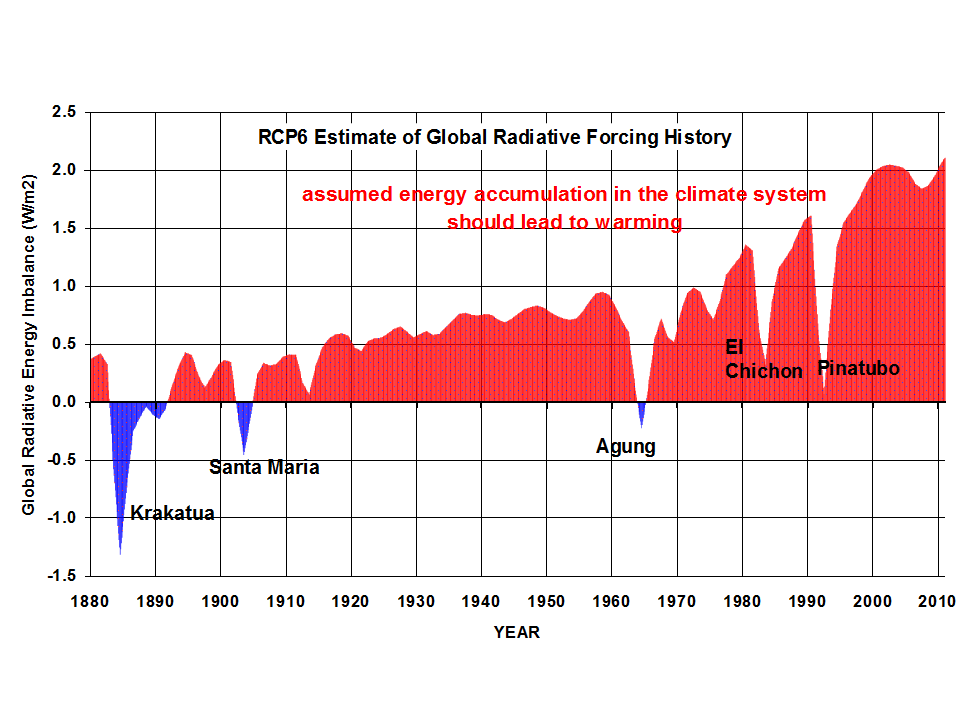
The radiative forcing history being used in the latest IPCC climate models looks something like the following, with red areas representing times when the climate system’s “stove is turned up”, that is, with heat accumulating in the system.

(Actually, the correct analogy would be that the stove setting remains the same, but the lid partially covering the pot is covering it a little more over time…but that’s too hard to explain.)

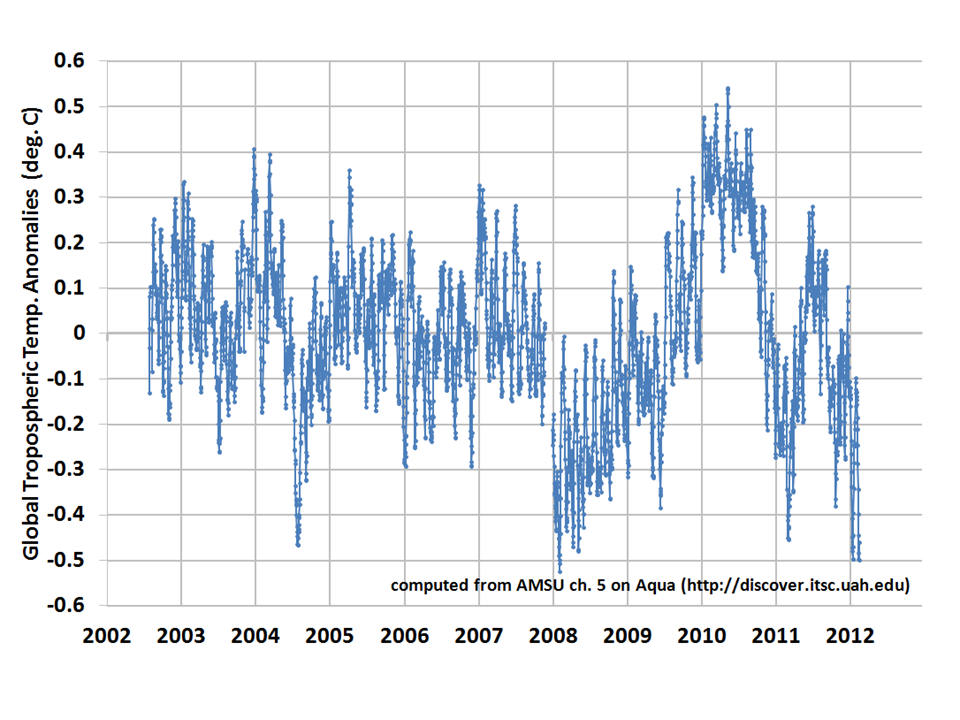
As can be seen, in the last 10 years the estimated forcing has been the strongest. Yet, most if not all temperature datasets show little or no global-average warming recently, either in the atmosphere, at the surface, or in the upper 700 meters of the ocean. For example, here are the tropospheric temperatures up though a few days ago:

So what is happening? You cannot simply say a lack of warming in 10 years is not that unusual, and that there have been previous 10-year periods without warming, too. No, we are supposedly in uncharted territory with a maximum in radiative forcing of the climate system. One cannot compare on an equal basis the last 10 years with any previous decades without warming.

There are 5 possibilities for the recent cessation of warming which are most discussed:

1) cooling from anthropogenic aerosols has been cancelling out warming from more greenhouse gases

2) natural cooling from internal climate fluctuations or the sun is cancelling out the GHG warming

3) increased ocean mixing is causing the extra energy to be distributed into the deep ocean

4) the temperature ’sensitivity’ of the climate system is not as large as the IPCC assumes.

5) there is something fundamentally wrong with the GHG warming theoryitself

Of course, some combination of the above 5 explanations is also possible.

The 1st possibility (aerosol cooling is cancelling out GHG forcing) is one of the more popular explanations with the climate modelers, and especially with NASA’s James Hansen. The uncertain strength (and even sign) of aerosol forcing allows the climate modelers to use aerosols as a tuning knob (aka fudge factor) in making their models produce warming more-or-less consistent with past observations. Using an assumed large aerosol cooling to cancel out the GHG warming allows the modelers to retain high climate sensitivity, and thus the fear of strong future warming if those aerosols ever dissipate.

The 2nd possibility (natural cooling) is a much less desirable explanation for the IPCC crowd because it opens the door to Mother Nature having as much or more influence on the climate system than do humans. We can’t have that, you know. Then you would have to consider the possibility that most of the warming in the last 50 years was natural, too. Goodbye, AGW funding.

The 3rd possibility (increased ocean mixing) is one of the more legitimate possibilities, at least theoretically. It’s popular with NCAR’s Kevin Trenberth. But one would need more observational evidence this is happening before embracing the idea. Unfortunately, how vertical mixing in the ocean naturally varies over time is poorly understood; the different IPCC models have widely varying strengths of mixing, and so ocean mixing is a huge wild card in the global warming debate, as is aerosol cooling. I believe much of past climate change on time scales of decades to many centuries might be due to such variations in ocean mixing, along with their likely influence on global cloud cover changing the amount of solar input into the climate system.

The 4th possibility (the climate system is relatively insensitive to forcing) is the top contender in the opinion of myself, Dick Lindzen, and a few other climate researchers who work in this field.

The 5th possibility (increasing GHGs don’t really cause warming) is total anathema to the IPCC. Without GHG warming, the whole AGW movement collapses. This kind of scientific finding would normally be Nobel Prize territory…except that the Nobel Prize has become more of a socio-political award in recent years, with only politically correct recipients. The self-flagellating elites don’t like the idea humans might not be destroying the Earth.

The longer we go without significant warming, the more obvious it will become that there is something seriously wrong with current AGW theory. I don’t think there is a certain number of years – 5, 10, 20, etc. – which will disprove the science of AGW….unless the climate system cools for the next 10 years. Eek! But I personally doubt that will happen.

As long as strong warming does not resume, the heat-hiding-in-the-deep-ocean explanation will provide refuge for many years to come, and will be difficult to convincingly rule out as an explanation since it takes so long for the deep ocean to warm by even a tiny amount.

Instead, there probably will be a tipping point (sooner than later) in popular perception when the public and Congress decide the jig is up, and they are no longer interested in hearing how we ‘might’ be headed for Armageddon.

The public already knows how awful scientists are at forecasting the future…especially a future of doom, which curiously seems to be the only future scientists know how to predict.

Now the challenge in this Post is not to make it so long that it becomes tiresome on the eyes, irrespective of the content.

So I’m going to leave it at this point and, perhaps, next time include some of Dan’s other points and comments in the light of how readers respond to this Post.