Beautiful images that will make appreciate the majesty of wild animals.
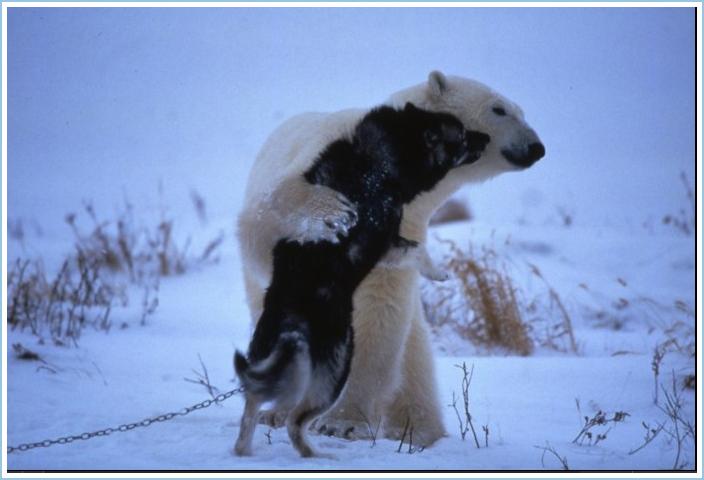
First a big thank you to Mary and Ed G. for passing me an email that contained fabulous photographs of the polar bear playing with a husky dog. From that email it was the matter of a few moments to find more on the Internet.
Let’s start with a YouTube video of a short talk by Stuart Brown called Animals at Play.
Then another YouTube video that is from FirstScience TV, which appears to be a defunct website.
These charming pictures were taken by renowned nature photographer Norbert Rosing, whose work has appeared inNational Geographic and other magazines, as well as several books including The World of the Polar Bear (Firefly Books, 1996), in which Rosing recounts the story of how these particular photographs came to be taken.
The location was a kennel outside Churchill, Manitoba owned by dog breeder Brian Ladoon, who kept some 40 Canadian Eskimo sled dogs there when Rosing visited in 1992. A large polar bear showed up one day and took an unexpected interest in one of Ladoon’s tethered dogs. The other dogs went crazy as the bear approached, Rosing says, but this one, named Hudson, “calmly stood his ground and began wagging his tail.” To Rosing and Ladoon’s surprise, the two “put aside their ancestral animus,” gently touching noses and apparently trying to make friends.
Just beautiful!
If you want to watch the whole sequence of photographs including background notes to each picture, click here.
John H, a good friend of us here in Payson, lent us the Leonardo DiCaprio film The 11th Hour. More information on the film’s website. Here’s the trailer,
The plot of the film, if plot is the right word, is as follows,
With contributions from over 50 politicians, scientists, and environmental activists, including former Soviet leader Mikhail Gorbachev, physicist Stephen Hawking, Nobel Prize winner Wangari Maathai, and journalist Paul Hawken, the film documents the grave problems facing the planet’s life systems. Global warming, deforestation, mass species extinction, and depletion of the oceans’ habitats are all addressed. The film’s premise is that the future of humanity is in jeopardy.
The film proposes potential solutions to these problems by calling for restorative action by the reshaping and rethinking of global human activity through technology, social responsibility and conservation.
Whether or not you watch the film, and I strongly suggest you do, the action website that supports making a difference is For the Love of Action. Drop in and make your own mind up.
Following on from that film is this apt reminder of the world we have created. I tend to write articles a few days ahead of the publish date, so it wasn’t possible to have this post come out on the 20th April, last Wednesday, which was Earth Day. Shame. Because as this email from the Alaska Wilderness League pointed out, it’s also a sad reminder of our love affair with oil.
Dear Paul,
The next Deepwater Horizon could be amid the broken sea ice and polar bear habitat of America’s Arctic: unless we prevent it now. Donate to the League.
It was one year ago today. I remember sitting in my living room after dinner when the news alert flashed across the screen:Deepwater Horizon oil rig explodes in the Gulf of Mexico; 11 workers dead or missing.
Huddled around the office television the next morning, there was no way we could anticipate the true magnitude of the disaster. Images of ruined lives and tarnished lands poured out of the Gulf formonths on end. As the oil industry’s feeble attempts to contain the destruction grew evermore cartoony – ‘top hat,’ ‘junk shot,’ ‘top kill’ – we learned just how little they had prepared for the eventual catastrophe of an oil spill.
Our government rubber-stamped the faulty plans for this oil rig. They had a chance to prevent this disaster, but didn’t. What’s worse: they continue to approve plans for America’s Arctic that are functionally identical to the plans that caused the Gulf disaster. America’s Arctic could be our next Deepwater Horizon tragedy. The effects of deadly crude oil spilling into the broken sea ice and polar bear habitat of America’s Arctic would be disastrous: unless we stop it.
When Deepwater Horizon exploded in the Gulf, the League had just completed a campaign to highlight the incredible annual migration of Arctic birds that begins in the Arctic Refuge and extends through each U.S. state. Some of these birds fly as far as the southern tip of Argentina! Many of them rely on critical nesting grounds around the Gulf of Mexico.
The League moved quickly to save these birds, distributing ‘Arctic Garden Kits’ to help donors across the country to provide sustenance and shelter to Arctic birds in their own backyards. Proceeds from the fundraiser helped us fight faulty plans from moving forward in America’s Arctic for the last two summers.
Shell Oil, the biggest threat for Arctic drilling, remains undaunted by our success. Their drilling plans for 2012 have ballooned from one drill rig to six. This is their big move – their cards are on the table. We need your help and support to go over the top to stop their escalating plans.
The way in which the League responded to the Gulf disaster – stemming the damage to wildlife and preventing the next disaster – was one of the most inspiring experiences of my life. You have a chance to be a part of this continuing work. Help us save America’s Arctic before it suffers the fate of another Deepwater Horizon.
Finally, let me close rather pointedly, perhaps, by this video of the fires in Texas which are burning out of control and have already scorched 1.6 million acres.; long-term drought being part of the cause.
The second of two fascinating films about two very beautiful minds, Hugh Everett III and Stephen Hawking.
I am slightly hesitant in pursuing this, after my article about Hugh Everett on the 19th. Said slightly tongue-in-cheek following a fascinating, as always, exchange of comments with Patrice Ayme. Here’s a taste of Ayme’s writings, and here’s the exchange,
Patrice first wrote,
The question is: what happened? The multiverse answer is that, whatever it is, it happened in one universe, and it did not happen, in another universe. And if it is not a matter of discrete choice, as in a 2 slit experiment, an uncountable number of universes will be created. In other words, if one wants a proof of the insanity of some of today’s physicists, the multiverse is all we need. According to this lamentable spasm of the mind, during every single, smallest amount of time imaginable, an uncountable infinity of universes appear.
OK, the inflationary universe has the same problem, and is about as insane. But being surrounded by mad men does not excuse one’s own insanity. So we shall laugh.
To which I replied,
Dear Patrice, the challenge presented at this end, in terms of how to evaluate your comment, is that your anonymous profile (that is truly respected, by the way) makes it impossible to determine your academic and social backgrounds. Therefore are you replying from the position of a great thinker, or of a great thinker with significant scientific and philosophical accreditations? Your writings are powerful and impressive but nonetheless to assume (as I read into your approach) that the world of quantum physics is a ‘done deal’ is not something I can share. I anticipate that you will feel similarly ready to laugh on Thursday when I publish some words on Stephen Hawking.
Eliciting a further very thoughtful reply from PA,
Thoughts have to learn to stand on their own. The authority fallacy (if you forgive this neo sentence) is no ersatz for truth. Some (previously) immensely respected physics Nobel prizes were member of the Nazi party before Hitler. That did not make their physics any less insane.
Most top thinkers of the scientific revolution in the 17C were not respected tenured professors at the university (although Galileo and Newton were, not so for Kepler, Bruno,Descartes, Fermat, Pascal, Leibnitz…). We have no historical distantiation to judge what’s going on now.
I respect some of the work of Hawking. And certainly respect him tremendously as a person (although he dumped his wife for his nurse).
I appreciate the fact you tease me with Quantum Mechanics as a “done deal”. I actually believe that QM is the most precise theory we have, but it’s most certainly false or crazy as Newton basically said about his own theory of gravitation, and pretty much for the same reasons… This shows that I have to express myself more clearly…
In any case QM got no traction with the Quantum computer, so far. To say the least, many questions have been found to not be answered…
As far as accreditations are concerned, I will refer to the PhDs of Qaddafi’s children, and the movie “Ghostwriter”. Speaking of Harvard, what about Huntington’s “Clash of Civilizations”, of an incredibly low scholarly level, and the numerous professors there on Qaddafi’s payroll? Does that mean they were accreditated by Qaddafi?
I am quite familiar with academia, and I think too much credit is given, quite often.
I am going to put a more extended version of my various remarks on my site, insisting on the fact QM, however impressive, is no deal. The multiverse was a desperate attempt to make it a deal, precisely, as it was made to eschew the problem of the non existence of a detailled mechanism of wave packet collapse. [Ironically I was once punished on a “philosophy” site for saying that QM was a live subject of research; I never went back to that site, which has academic pretentions: they had told me they checked with physics professors…]
Best wishes to you too, and I look forward chewing on Hawking very slowly… meanwhile I shall put my anti-multiverse blast on my site…
So here goes!
Prof. Hawking
Professor Stephen William Hawking was born in 1942 in Oxford, England. His own website has a nice summary of his life which may be read here. There is a huge amount that could be written about this most amazing man. His book A Brief History of Time has sold in the millions which for a man who deals with some pretty big personal challenges, is no small feat. Here’s a relatively recent talk (2008) from TED2008,
But like the Hugh Everett posting, I wanted to draw your attention to the 48 minute programme, originally from the BBC Horizon series, that explores some of the challenges that are starting to appear to Hawking’s long-held theories about the start of the universe.
It struck me recently that many of you readers that come to Learning from Dogs on a regular basis, say, over the last 18 months, may not be clear as to why it’s called what it is, and the deeper issues behind the name.
First, the name. Quite a few years ago I was sitting chatting with Jon Lavin, the co-founder of the Blog, in his home in South-West England. My German Shepherd, Pharaoh (that’s him on the home page) was sleeping on the floor while Jon and I were nattering about the works of Dr David Hawkins of Veritas Publishing. Jon mentioned that David Hawkins had measured the consciousness of dogs and that they came out about 205. In other words they were integrous creatures and firmly on the truthful side of the boundary between truth and falsehood.
I was fascinated by that idea. Later, back at my home, less than an hour away from Jon’s house, I was idly looking at domain names that were available, and imagine my glee when I discovered that learningfromdogs (dot) com was free. It was rapidly grabbed.
A rather chaotic period of my life descended upon me but the notion that we have much to learn from dogs stayed with me. Much later, when I was happily settled with Jean, the vision and purpose of the Blog got me under way. The first post was published on 15th July, 2009.
The ideas behind the theme that dogs have an extraordinary relationship with man is contained in a very early piece written for the Blog back in July 19th, 2009. That article is called Dogs and integrity. But nothings stays still. In that piece, I wrote,
Because of this closeness between dogs and man, we (as in man!) have the ability to observe the way they live. Now I’m sure that scientists would cringe with the idea that the way that a dog lives his life sets an example for us humans, well cringe in the scientific sense.
However, on Sunday evening we watched a video from PBS that showed that scientists are now taking a very close interest in dogs and why they have such a special relationship with man, perhaps even a critical part in enabling man to prosper as hunter-gatherers. Here’s a preview of that video programme.
Unfortunately, the video is not freely available from PBS. However, it was based on the BBC Horizon programme, The Secret Life of the Dog, which I wrote about back in the 25th January, 2011. (The YouTube link on that post appears to have been curtailed.)
Luckily there are a couple of options to watch this fascinating and very revealing documentary. You can either watch it in sections from YouTube, the first 10 minutes is below, or you can watch it in full, if you don’t mind some Chinese translations here. Your choice.
That’s enough for today, I shall return to this theme next week.
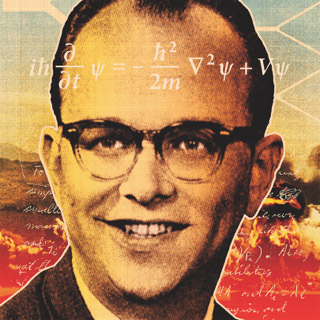
A documentary on PBS entitled Parallel World, Parallel Lives traces in a deeply personal way, the efforts of the son of Hugh Everett, Mark Oliver Everett, to find out more about his father, who died in 1982, just 51 years old. Mark Everett is an accomplished musician and much of his music makes it onto the soundtrack of the film. Here’s a brief extract from an article from Scientific American.
Hugh Everett III
Hugh Everett III was a brilliant mathematician, an iconoclastic quantum theorist and, later, a successful defense contractor with access to the nation’s most sensitive military secrets. He introduced a new conception of reality to physics and influenced the course of world history at a time when nuclear Armageddon loomed large. To science-fiction aficionados, he remains a folk hero: the man who invented a quantum theory of multiple universes. To his children, he was someone else again: an emotionally unavailable father; “a lump of furniture sitting at the dining room table,” cigarette in hand.
A fascinating programme and one which shows great courage and bravery from Mark Everett in dealing with his memories and emotions about a brilliant but emotionally flawed father.
A wonderful tribute to Yuri Gagarin and all his team.
When I recently wrote of it being 41 years since Swigert on board Apollo 13 transmitted “Okay, Houston, we’ve had a problem here.” I also included a closing reflection as follows,
Finally, this Post is published, not only on the 41st anniversary of that memorable Apollo Flight but the day after the 50th anniversary of Yuri Gagarin’s first flight of a human into space, the 12th April, 1961.
Coincidentally, our favourite documentary film website, Top Documentary Films, featured on April 14th the new film First Orbit. We watched the film that night. It was a most unusual format for a film, yet a most haunting experience. Watching the credits, it then became clear that the film was a co-operative venture made especially for the 50th anniversary of that remarkable, historic flight.
Of course, had I previously been aware of the venture and this remarkable film then it would have been promoted on Learning from Dogs in good time before the anniversary date. However, better late than never!
Indeed, there is a dedicated website in recognition of this First Orbit. Here’s the background to the film,
April 12th 1961 – Yuri Gagarin is about to see what no other person has seen in the history of humanity – the Earth from space. In the next 108 minutes he’ll see more than most people do in a lifetime. What sights awaited the first cosmonaut silently gliding over the world below? What was it like to view the oceans and continents sailing by from such a height?
By matching the orbital path of the Space Station, as closely as possible, to that of Gagarin’s Vostok 1spaceship and filming the same vistas of the Earth through the new giant cupola window, astronaut Paolo Nespoli, and documentary film maker Christopher Riley, have captured a new digital high definition view of the Earth below, half a century after Gagarin first witnessed it.
Weaving these new views together with historic, recordings of Gagarin from the time, (subtitled in Englsih) and an original score by composer Philip Sheppard, we have created a spellbinding film to share with people around the world on this historic anniversary.
The music in the film is most beautiful, quite moving. Here’s the background to the music from the First Orbit website,
First Orbit’s producer Christopher Riley first worked with Philip in 2006 on the Sundance Award winning feature documentary film ‘In the Shadow of the Moon‘ and since then Philip had been working on a new suite of music inspired by spaceflight.
“We’d been working with some of these tracks on another project” says Chris, “and we suddenly realised how perfectly they could compliment ‘First Orbit’ as well. We contacted Philip to ask his permission to use them, only to find that his entire Cloud Song album was already in orbit onboard the International Space Station!”
“NASA astronaut Cady Coleman, had them on her iPod” says Philip. “Her husband Josh Simpson is a friend of mine and they’d listened to a lot of my music together before she left, so I made up a playlist for her!”
Quite by coincidence Cady had been listening to the music in ‘First Orbit’ at one end of the Space Station whilst European Space Agency astronaut Paolo Nespoli was shooting for the film at the other end, without either of them knowing the connection!
Back on Earth Chris and the film’s editor Stephen Slater took Philip’s tracks from Cloud Song and weaved them together with Paolo’s new views of the Earth to create the different moods of the film; from the first views of snowy Siberia to the darkness of night over the Pacific Ocean and the homecoming over Africa, as Gagarin starts to re-enter the atmosphere.
The result is a mesmerising combination of imagary and music which we hope convey the spectrum of emotions which no doubt went through Yuri’s mind as he gazed down upon the Earth.
Finally, here’s the film. It’s an hour and thirty-nine minutes and, as I said, an unconventional film experience. But if any part of you either remembers the event or wonders what it was like, those 50 years ago, then find somewhere out of reach of interruptions and watch the film.


 Learning from Dogs