Year: 2010

SR-71 Blackbird breakup at Mach 3.18!

More on that truly amazing aviation survival

Yesterday, I wrote a brief Post about the story retold by Bill Weaver, Chief Test Pilot at Lockheed.  For those that read the Post but didn’t click through to the full article, here it is.

It comes from the aviation website The Digital Aviator and I trust that republishing it once again doesn’t offend.

———————————————–

By Bill Weaver

Chief Test Pilot, Lockheed


Among professional aviators, there’s a well-worn saying: Flying is simply hours of boredom punctuated by moments of stark terror. But I don’t recall too many periods of boredom during my 30-year career with Lockheed, most of which was spent as a test pilot. By far, the most memorable flight occurred on Jan. 25, 1966.

Jim Zwayer, a Lockheed flight-test specialist, and I were evaluating systems on an SR-71 Blackbird test from Edwards. We also were investigating procedures designed to reduce trim drag and improve high-Mach cruise performance The latter involved flying with the center-of-gravity (CG) located further aft than normal, reducing the Blackbird’s longitudinal stability.

We took off from Edwards at 11:20 a.m. and completed the mission’s first leg without incident. After refueling from a KC-135 tanker, we turned eastbound, accelerated to a Mach 3.2 cruise speed and climbed to 78,000 ft., our initial cruise-climb altitude.

Several minutes into cruise, the right engine inlet’s automatic control system malfunctioned, requiring a switch to manual control. The SR-71’s inlet configuration was automatically adjusted during supersonic flight to decelerate airflow in the duct, slowing it to subsonic speed before reaching the engine’s face. This was accomplished by the inlet’s center-body spike translating aft, and by modulating the inlet’s forward bypass doors.

Normally, these actions were scheduled automatically as a function of Mach number, positioning the normal shock wave (where air flow becomes subsonic) inside the inlet to ensure optimum engine performance. Without proper scheduling, disturbances inside the inlet could result in the shock wave being expelled forward- a phenomenon known as an “inlet unstart.”

That causes an instantaneous loss of engine thrust, explosive banging noises and violent yawing of the aircraft, like being in a train wreck. Unstarts were not uncommon at that time in the SR-71’s development, but a properly functioning system would recapture the shock wave and restore normal operation.

On the planned test profile, we entered a programmed 35-deg. bank turn to the righ t. An immediate unstart occurred on the right engine, forcing the aircraft to roll further right and start to pitch up. I jammed the control stick as far left and forward as it would go. No response. I instantly knew we were in for a wild ride. I attempted to tell Jim what was happening and to stay with the airplane until we reached a lower speed and altitude. I didn’t think the chances of surviving an ejection at Mach 3.18 and 78,800 ft. were very good. However, g-forces built up so rapidly that my words came out garbled and unintelligible, as confirmed later by the cockpit voice recorder.

The cumulative effects of system malfunctions, reduced longitudinal stability, increased angle-of-attack in the turn, supersonic speed, high altitude and other factors imposed forces on the airframe that exceeded flight control authority and the stability augmentation system’s ability to restore control.

Everything seemed to unfold in slow motion. I learned later the time from event onset to catastrophic departure from controlled flight was only 2-3 seconds. Still trying to communicate with Jim, I blacked out, succumbing to extremely high g-forces.

Then the SR-71 literally disintegrated around us. From that point, I was just along for the ride. And my next recollection was a hazy thought that I was having a bad dream. Maybe I’ll wake up and get out of this mess, I mused. Gradually regaining consciousness, I realized this was no dream; it had really happened. That also was disturbing, because I COULD NOT HAVE SURVIVED what had just happened.
I must be dead. Since I didn’t feel bad- just a detached sense of euphoria- I decided being dead wasn’t so bad after all. As full awareness took hold, I realized I was not dead. But somehow I had separated from the airplane.

I had no idea how this could have happened; I hadn’t initiated an ejection. The sound of rushing air and what sounded like straps flapping in the wind confirmed I was falling, but I couldn’t see anything. My pressure suit’s face plate had frozen over and I was staring at a layer of ice.

The pressure suit was inflated, so I knew an emergency oxygen cylinder in the seat kit attached to my parachute harness was functioning. It not only supplied breathing oxygen, but also pressurized the suit, preventing my blood from boiling at extremely high altitudes. I didn’t appreciate it at the time, but the suit’s pressurization had also provided physical protection from intense buffeting and g-forces. That inflated suit had become my own escape capsule

My next concern was about stability and tumbling. Air density at hi gh altitude is insufficient to resist a body’s tumbling motions, and centrifugal forces high enough to cause physical injury could develop quickly. For that reason, the SR-71’s parachute system was designed to automatically deploy a small-diameter stabilizing chute shortly after ejection and seat separation. Since I had not intentionally activated the ejection system–and assuming all automatic functions depended on a proper ejection sequence–it occurred to me the stabilizing chute may not have deployed.

However, I quickly determined I was falling vertically and not tumbling. The little chute must h ave deployed and was doing its job. Next concern: the main parachute, which was designed to open automatically at 15,000 ft. Again I had no assurance the automatic-opening function would work.

I couldn’t ascertain my altitude because I still couldn’t see through the iced-up faceplate. There was no way to know how long I had been blacked-out or how far I had fallen. I felt for the manual-activation D-ring on my chute harness, but with the suit inflated and my hands numbed by cold, I couldn’t locate it. I decide d I’d better open the faceplate, try to estimate my height above the ground, then locate that “D” ring. Just as I reached for the faceplate, I felt the reassuring sudden deceleration of main-chute deployment.

I raised the frozen faceplate and discovered its uplatch was broken. Using one hand to hold that plate up, I saw I was descending through a clear, winter sky with unlimited visibility. I was greatly relieved to see Jim’s parachute coming down about a quarter of a mile away. I didn’t think either of us could have survived the aircraft’s breakup, so se eing Jim had also escaped lifted my spirits incredible.I could also see burning wreckage on the ground a few miles from where we would land. The terrain didn’t look at all inviting–a desolate, high plateau dotted with patches of snow and no signs of habitation.

I tried to rotate the parachute and look in other directions. But with one hand devoted to keeping the face plate up and both hands numb from high-altitude, subfreezing temperatures, I couldn’t manipulate the risers enough to turn Before the bre akup, we’d started a turn in the New Mexico-Colorado-Oklahoma-Texas border region. The SR-71 had a turning radius of about 100 miles at that speed and altitude, so I wasn’t even sure what state we were going to land in. But, because it was about 3:00 p.m., I was certain we would be spending the night out here.

At about 300 ft. above the ground, I yanked the seat kit’s release handle and made sure it was still tied to me by a long lanyard. Releasing the heavy kit ensured I wouldn’t land with it attached to my derriere, which could break a leg or cause other injuries. I then tried to recall what survival items were in that kit, as well as techniques I had been taught in survival training.
Looking down, I was startled to see a fairly large animal- perhaps an antelope- directly under me. Evidently, it was just as startled as I was because it literally took off in a cloud of dust.

My first-ever parachute landing was pretty smooth. I landed on fairly soft ground, managing to avoid rocks, cacti and antelopes. My chute was still billowing in the wind, though. I struggled to collapse it with one hand, holding the still-frozen faceplate up with the other.“Can I help you? ” a voice said. Was I hearing things? I must be hallucinating. Then I looked up and saw a guy walking toward me, wearing a cowboy hat. A helicopter was idling a short distance behind him. If I had been at Edwards and told the search-and-rescue unit that I was going to bail out over the Rogers Dry Lake at a particular time of day, a crew couldn’t have gotten to me as fast as that cowboy-pilot had.
The gentleman was Albert Mitchell, Jr., owner of a huge cattle ranch in northeastern New Mexico. I had landed about 1.5 mi. from his ranch house–and from a hangar for his two-place Hughes helicopter. Amazed to see him, I replied I was having a little trouble with my chute. He walked over and collapsed the canopy, anchoring it with several rocks. He had seen Jim and me floating down and had radioed the New Mexico Highway Patrol, the Air Force and the nearest hospital.
Extracting myself from the parachute harness, I discovered the source of those flapping-strap noises heard on the way down. My seat belt and shoulder harness were still draped around me, attached and latched.
The lap belt had been shredded on each side of my hips, where the straps had fed through knurled adjustment rollers. The shoulder harness had shredded in a similar manner across my back. The ejection seat had never left the airplane. I had been ripped out of it by the extreme forces, with the seat belt and shoulder harness still fastened.

I also noted that one of the two lines that supplied oxygen to my pressure suit had come loose, and the other was barely hanging on. If that second line had become detach ed at high altitude, the deflated pressure suit wouldn’t have provided any protection. I knew an oxygen supply was critical for breathing and suit-pressurization, but didn’t appreciate how much physical protection an inflated pressure suit could provide.
That the suit could withstan d forces sufficient to disintegrate an airplane and shred heavy nylon seat belts, yet leave me with only a few bruises and minor whiplash was impressive. I truly appreciated having my own little escape capsule.

After helping me with the chute, Mitchell said he’d check on Jim. He climbed into his helicopter, flew a short distance away and returned about 10 minutes later with devastating news: Jim was dead. Apparently, he had suffered a broken neck during the aircraft’s disintegration and was killed instantly. Mitchell said his ranch foreman would soon arrive to watch over Jim’s body until the authorities arrived. I asked to see Jim and, after verifying there was nothing more that could be done, agreed to let Mitchell fly me to the Tucumcari hospital, about 60 mi. to the south.

I have vivid memories of that helicopter flight, as well. I didn’t know much about rotorcraft, but I knew a lot about “red lines,” and Mitchell kept the airspeed at or above red line all the way. The little helicopter vibrated and shook a lot more than I thought it should have. I tried to reassure the cowboy-pilot I was feeling OK; there was no need to rush. But since he’d notified the hospital staff that we were inbound, he insisted we get there as soon as possible. I couldn’t help but think how ironic it would be to have survived one disaster only to be done in by the helicopter that had come to my rescue.
However, we made it to the hospital safely–and quickly. Soon, I was able to contact Lockheed’s flight test office at Edwards. The test team there had been notified initially about the loss of radio and radar contact, then told the aircraft had been lost They also knew what our flight conditions had been at the time, and assumed no one could have survived. I explained what had happened, describing in fairly accurate detail the flight conditions prior to breakup.

The next day, our flight profile was duplicated on the SR-71 flight simulator at Beale AFB, Calif. The outcome was identical. Steps were immediately taken to prevent a recurrence of our accident. Testing at a CG aft of normal limits was discontinued, and trim-drag issues were subsequently resolved via aerodynamic means. The inlet control system was continuously improved and, with subsequent development of the Digital Automatic Flight and Inlet Control System, inlet unstarts became rare.

sr71cockpit Investigation of our accident revealed that the nose section of the aircraft had broken off aft of the rear cockpit and crashed about 10 mi from the main wreckage. Parts were scattered over an area approximately 15 miles long and 10 miles wide. Extremely high air loads and g-forces, both positive and negative, had literally ripped Jim and me from the airplane. Unbelievably good luck is the only explanation for my escaping relatively unscathed from that disintegrating aircraft.

Two weeks after the accident, I was back in an SR-71, flying the first sortie on a brand-new bird at Lockheed’s Palmdale, Calif., assembly and test facility It was my first flight since the accident, so a flight test engineer in the back seat was probably a little apprehensive about my state of mind and confidence.

As we roared do wn the runway and lifted off, I heard an anxious voice over the intercom.

“Bill! Bill! Are you there?”
“Yeah, George. What’s the matter?”

“Thank God! I thought you might have left.”

The rear cockpit of the SR-71 has no forward visibility–only a small window on each side–and George couldn’t see me. A big red light on the master-warning panel in the rear cockpit had illuminated just as we rotated, stating: “Pilot Ejected.” Fortunately, the cause was a misadjusted micro switch, not my departure.

sr-71_ss

– – – – – – – – – – – – – – – – – – – –

Bill Weaver flight-tested all models of the Mach-2 F-104 Starfighter and the entire family of Mach 3+ Blackbirds–the A-12, YF-12 and SR-71. He subsequently was assigned to Lockheed’s L-1011 project as an engineering test pilot, and became the company’s chief pilot. He later retired as Division Manager of Commercial Flying Operations.

He still flies Orbital Sciences Corp.’s L-1011, which has been modified to carry the Pegasus satellite-launch vehicle. And as an FAA Designated Engineering Representative Flight Test Pilot, he’s also involved in various aircraft-modification projects, conducting certification flight tests.

By John Lewis
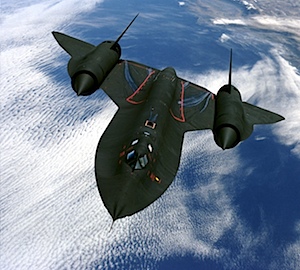
Not your average day in the ‘office’!

There are escapes, lucky escapes and this …..

Flying an SR-71 Blackbird must have been one of the more extreme forms of aviation at the best of times.

Surviving the breakup up of one at Mach 3.18 and 78,800 feet is unlikely beyond all measure, but not impossible, as this story describes.

The severity of this incident is captured many times over in this story. Can you even imagine thinking:

I had no idea how this could have happened; I hadn’t initiated an ejection.

And the scale of the navigational issues are extreme too:

Before the breakup, we’d started a turn in the New Mexico-Colorado-Oklahoma-Texas border region. The SR-71 had a turning radius of about 100 miles at that speed and altitude, so I wasn’t even sure what state we were going to land in.

Above all, for me, the matter-of-fact way that stories like this are told is testament to the professionalism of these pilots.

[In fact this is such an amazing story that the full account will be published tomorrow, Ed.]

By John Lewis

Captain Thomas Murray – RIP

Regular readers of Learning from Dogs will know that we usually only post a single article on week-end days.  But yesterday I received news that a business friend of many years standing had lost his battle against ill-health and died peacefully in the afternoon.  His name was Tom Murray and it’s my wish to celebrate his life by reproducing in full the email that was sent to me. It’s serendipitous that the planned posts by John Lewis for this week-end are aviation related.

Capt. Tom Murray

On Thursday afternoon the world lost a respected, influential, and creative aviator, one of the “Great Ones”.

Captain Thomas Murray was a pilot, artist, inventor, musician, and father.

A noted jet pilot, he explored the far corners of the globe, mapping out the Canadian Arctic, flying thousands of hours in Africa, Europe, the Himalayas, and the Americas.

Whether flying Gulf streams, Falcon, Hawkers, Learjets or old DC3s, Tom was a pilot’s pilot, the friendly, knowledgeable kind of guy who knew his craft so thoroughly that airmen the world over would “just call Tom”, whenever they needed answers.

He thrilled everyone he met with exciting stories of his travels…

…such as the time he found himself lost while flying over what should have been a large African lake, only to realize the lake had dried up. The only hope of finding civilization was to dead-reckon his way in a straight line and hope he hit the tiny “dot of a town” that was his final destination.

…Or the time his oxygen system failed in the Himalayas at 20,000 feet forcing him to dive the airplane into an 8000-foot valley to find out he was the only conscious crewmember.

…Or the time the entire front panel of his Hawker 800 fell onto his lap during takeoff because someone had forgotten to screw it in.

An adventurer to the max, he was also an inventor and visionary.

Tom took an ordinary problem such as converting hard-to-read aircraft performance charts into easy-to-read tables, and then turned that process into a successful business.

Tom created one of the first electronic documents to find its way into a cockpit – tables of aircraft performance data that minimized the chance of pilot error due to miscalculation that he called “EPADS”.

Constantly working to organize the cockpit, provide higher levels of safety and better information to the pilots, he invented one of the world’s first electronic flight bags, and established the process of managing aircraft electronic checklists, a process that the FAA later modeled their ECL guidelines after.

He joked that the entire cockpit should have a mode that turned it into a simulator during flight to alleviate boredom amongst pilots and give them a chance to train in truly challenging simulations during long flights.

He invented games for children, played flute, and wrote a storybook.

An accomplished artist, he relaxed by attending artist workshops and amazing all with his skill and precision. Just last summer, Tom held his first art exhibition.

His greatest creation with wife Daisy was his son, Thomas Alexander Murray, who was born with the charismatic smile and sense of mischief that characterized Tom at his best.

Tom’s inventions were his “other child”.  He would latch onto a design problem like a pit bull.

He cherished the fact that he would uncompromisingly focus on a design and refuse to leave it go it until it was “perfect”, even to his own financial detriment when those around him insisted he was losing sight of the “big picture”.

To this effect, during his last year, he asked me to form a foundation in his name, to offer an annual award (which I’ll see if it’s possible to do)…

“To the individual who focuses on solving difficult problems; who is clearly addicted to finding the solution; who is unrelenting in the face of opposition – which may seem to be (or genuinely be) to their own personal detriment”

Perhaps he wanted an award, he knew he’d win!

Tom was well known for acting as “pilot in command” in his daily life, often forcing people to act “my way or the highway” and insisting that his way was the “right way”.

While this trait was annoying and frustrating to colleagues and friends, what was possibly more frustrating was the number of times one was forced to humble oneself when he was indeed “right”.

In the last year of his life, Tom worked relentlessly to teach others his design philosophy and prepare several of us to run the company he’d created, the vessel that would carry his vision and concern for the safety of his fellow pilots into the future.

Tom loved life and spent his days on a personal mission to make the world a better place, a more interesting place, a more ordered place, a more beautiful place, a more fun place to live…

Tom wasn’t always too clear with his emotions, and though he often maintained a “business” exterior, at heart he was the artist, and his appreciation and depth of love for his family, fellow pilots, and the people who worked for him and with him, his friends — was endless.

You always knew when he respected you, he’d give you a big pilot’s “Thumbs up!”

We will miss him dearly.

Today, we salute a great airman, Captain Thomas Murray.

On behalf of Tom, I know he would wish you a warm, “Thumbs up!”

Charles Guerin President
On-Board Data Systems (OBDS)

Horror at Smolensk

Will this air crash be a milestone in improving relationships with the Russians?

The Poles are naturally turning out to mourn their President and other leaders killed in the tragic accident at Smolensk.

Sadly, I fear that if and when the investigation turns up the truth about what happened the reaction may be more questionable. The Russians have apparently recovered the black boxes and presumably cockpit recordings, and what already seems clear from ATC Officers involved is that the pilot had categorically refused “instructions” to land at another airport, Smolensk being judged by ATC to be too dangerous.

Now others on Learning from Dogs will know far better than me, but it seems to me extraordinary that a professional, experienced pilot would refuse such advice and try to land in such appalling weather conditions.

This of course begs the question of why he did so, which is where the deceased President may come in.  An extract from the NY Times of April 12th:

Investigators examining the crash appeared to be focusing on why the pilot did not heed instructions from air traffic controllers to give up trying to land in bad weather in western Russia on Saturday morning.

Their inquiry may lead to an even more delicate question: whether the pilot had felt under pressure to land to make sure that the Polish delegation would not be late for a ceremony on Saturday in the Katyn forest, where more than 20,000 Polish officers and others were massacred by the Soviets during World War II.

Let us hope that it was mechanical failure of some kind (though early reports seem to rule this out) rather than the repetition of a previous incident where the Polish President had argued with the pilot of his plane.

This tragic event is of course surreally-ironic, as if the grisly hand of Josef Stalin had risen from the grave to cause the deaths of yet more Poles in addition to the 20,000 or so murdered in Katyn Forest on his direct orders.

As one who grew up during decades of Soviet denials of responsibility for this cruel genocide, I have been moved by the reaction of the Russians to all this, and no more so than by Putin himself. This is a man who referred to the demise of the Soviet Union as “the greatest tragedy of my life”, yet his grief and fellow-feeling for the Poles have been clear and genuine.

It was already a major breakthrough that Russia should have after all this time so clearly accepted responsiblity – and made apologies – for the Katyn massacre. That Putin and others have shown such fellow-feeling for the Polish loss gives one hope for a deeper reconciliation after the terrible schism in Europe caused by the Russian Revolution and seizure of power by Stalin, possibly the most murderous dictator in history. It was always insane that Russia should be our enemy; let us hope that by and by they will become our firm friends and allies.

By Chris Snuggs

Innovation? What innovation?

We’ve always known “why?”

Eureka!

We can carry on doing the same old things!
Along the way, we can improve, sell more, and cut costs.
But in end, sooner or later, we need to do something different.
That is why we innovate.

Now we know “how?”

Nowadays, everyone is talking about innovation!
Many things seem mysterious for a long time, and then we bring them under control.
It happened in “sales”, then in “quality”, now it is the turn of “innovation”.
In the past, a few people knew that they could manage innovation; now everyone knows.
There are processes for managing innovation using “ideation”, “co-creation” and, even, “open innovation”.
That is how we innovate.

But do we know “what?”

How do we know what to innovate?

Now there is a question!

By John Lewis

Today’s No-Brainer

Bottled water …..

… in developed countries is not only an insanity but also an obscenity.

  • It is no healthier than tapwater. If it were essential to health then how come we oldies survived before? Logically, the Human Race should have died out.
  • It tastes no different, unless you buy it fizzy – but you could add your own fizz at home.
  • It costs VASTLY more than tapwater.
  • It is VASTLY more profitable to producers than gasoline for oil companies.
  • It is VASTLY more expensive to produce – around 1500 times more than an equivalent quantity of tap water.
  • Its transportation produces significant amounts of harmful emissions.
  • It is VASTLY wasteful; water is scarce, yet it takes 7 litres of water to make a 1 litre bottle plus the contents.
  • It leads to VASTLY-INCREASED pollution. ‘see “Giant Rubbish Dump Accumulating in the Pacific
  • It soaks up resources that could be better used, including to save lives of people dying from lack of or dirty water.

In short, it is absolute folly. What on earth is there going for it? At the same time, it is big business and very popular? Why?

  • Are people ignorant about all the above? That’s quite worrying …. not much future with so much ignorance about.
  • Are people paranoid about what comes out of their taps? Oh dear –  paranoia is not good for us.
  • Do people place their vanity and status-image before the above-mentioned points? Hmmmm …..
  • Are many people just suckers for slick advertising? I guess the answer to that one is a straight “Yes”.
  • Have millions of people no common-sense and/or social conscience? Oh dear, this time it’s a clear “No”.
This is pretty!

Bottled water is nonsense, except of course where there is no alternative.

If rich, fat Westerners really like bottled water they could export it to developing countries where millions die through lack of or poisoned/polluted water every year while at the same time pouring funds into building water infrastructure for these very same people.

Yes, I know the industry provides jobs, but so did making nerve-gas for the Nazis.

The point is, we should direct our energy and money into things which are not totally unnecessary and destructive. I’m not a great fan of the “nanny-state”, but in some areas – and this is one – the government should be taking a more forceful lead. Help us kick our silly, selfish, faddish and destructive addiction to bottled water.

Some excellent links on this topic:

By Chris Snuggs

Elliot’s schooling – the positives

Elliot Engstrom – Guest Author

On April 1st I set the scene for the essays that I wanted to write for Learning from Dogs as follows:

I often ask myself just how effective the modern US schooling system is as a tool of education, and whether or not its costs outweigh its benefits. I hope to have at least a rough answer to this question in the

Elliot Engstrom

final post of this series.

In the following posts, I will examine three topics:

In what ways does the modern schooling system function as a positive tool for education?

What costs involved in modern schooling hinder its ability as an educative tool, and even make it a negative influence on students?

Considering the analyses put forth in the first two posts, do the costs or benefits or this system outweigh the other? On the whole, are school and education complements or antagonists?

Here is the first one looking at the positive aspects of the American educational system.

Intellectual exploration

My kindergarten teacher told me to always start with something positive, so I’ll be beginning my analysis of American schooling by looking at how it is a positive tool for education.

One facet of the American education system that I once disapproved of but now find extremely useful and educative is the long period of time that students have before they must commit to a career choice.

I used to view this lag as a waste of resources. However, living in France and being a student at a French university changed my mind. The French system begins to lock children into a career path as early as the closing years of middle school. If a student in France wants to be a doctor, for example, they enter into medical school immediately upon leaving high school. The same is true for professions like pharmacology and law. There is very little opportunity for intellectual exploration in the country’s schools. Rather, one simply must make the best of wherever one ends up.

While the American system is more long-winded, it is a better tool for education in that it allows for a more dynamic range of studies. A liberal arts education forces students to delve into a wide range of subjects, giving students the chance to explore their interests and abilities.

Socrates (or Plato, depending on your interpretation of Plato’s dialogues), believed that a liberal arts education also encouraged the development of critical thinking skills. However, it should be noted that many of the greatest critical

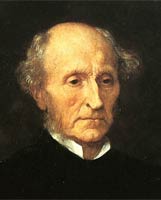
John Stewart Mill, (1806–1873)

thinkers in history did not go through formal schooling. (Socrates himself and John Stewart Mill come to mind.)

This system also allows students to change their mind, pursuing those fields of study that truly interest them the most. It is amazing how many students in the American university system change majors during their tenure as students. This often is because they find that the career path they thought was for them is in fact not their liking – the number of students who abandon the premed track during college is a perfect example of this.

Education also entails socializing with other human beings. The American education system also facilitates this form of education quite well, as a liberal arts form of study at both the high school and university levels mixes together students of different interests.

Whereas in the French model a student studying medicine is constantly surrounded by other students of the same mindset, a premed student in the United States will have classes with students in other fields of study, expanding their social horizons and forcing them to relate to people with whom they may have little in common.

In my next post, I will examine the American schooling system as an antagonist to education, and will then close this series by attempting to weigh the system’s costs and benefits against each other.

By Elliot Engstrom

A Teen’s Reflections

This is the second Guest post from AJ Easton, a 13-year-old girl from North Carolina, USA. AJ first wrote about Learning from Horses on January 17th this year. This is a more reflective essay that would have been a credit to someone with many, many more years.

Trust is a complicated thing…

You have to learn to trust, but it is not something that can be taught in schools. You also have to earn trust, by keeping secrets and not spreading rumors.

With the people you trust, you do things you wouldn’t do with other people . Your true self comes out with the people you trust. You don’t worry about being judged; you don’t worry about people disliking you for who you are.

AJ Easton

But, in our modern-day world, it seems as if everyone judges.

People seem to hate for reasons as stupid as one’s appearance. People don’t trust people anymore because it seems that we are constantly warned to avoid strangers because they might hurt you, murder you, or completely mess up your life in some way, shape, or form.

And in school, if you trust someone enough to tell them a secret, they don’t keep it. And then, in your point of view, the world has ended.

All because of some secret that got out about who you like, or what you did with the person you were dating, or something else that, in the end, isn’t all that important.

Then everyone will judge you based on that rumor until you leave the school or graduate. They do this to make themselves feel “cool” and “important.”  And you learn not to trust.

Social status has become such a big factor in everything we do these days. Everyone feels as though they have to be highly ranked socially to mean anything to the world.

But, truly, all you have to do is love what you do and respect yourself, to follow your dream and be determined. We should make decisions that help us move forward, not dwelling on the past.  Every second is different; everything is unique. Nothing is the same. Not a single person, or tree, or moment.  Each moment represents a new opportunity.

Don’t have regrets. What has happened has already happened and you can’t change it. Time travel is fictitious, not a reality. You can’t rewind your life to change what you have already done. There is a reason behind everything: remember this when you are having doubts about what you have done.  Learn from your past but don’t let it eat at you.

Live your own life. And learn to trust yourself, and those who love you.

By AJ Easton

Today’s Quiz

The British General Election is really hotting up, with mud flying in all directions.

Mr Pott. Your proposal to keep NI (National Insurance contributions for employers and employed)  as it is rather than putting it up as we propose (as usual) will leave a black hole in the country’s finances.

Mr Kettle: a Black hole? YOU are worried about a black hole??? Ha, Ha, Ha ……

Your quiz question: Who are the real Mr Pott and Mr Kettle?

Answers soon …..

The Hawker Hunter aircraft

What a beautiful aircraft!

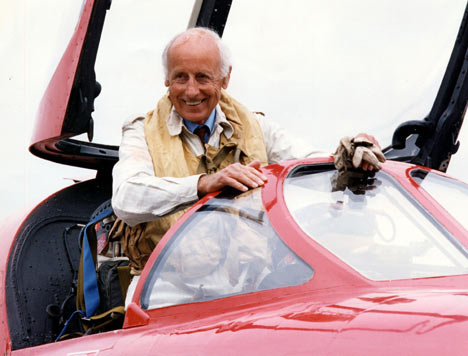
On April 2nd, I published an account of a flight in a Hawker Hunter that my dear cousin, Richard, experienced in 2003, the 50th anniversary of Neville Duke’s breaking of the existing world speed record on September 7th, 1953.  Neville Duke died in 2007 at the age of 85.

Squadron Leader Neville Duke, 85, flew 485 operational sorties during the war

It seemed fitting to add a little more information about this marvellous aircraft from an era when Britain built some of the best aircraft in the world.

As always, WikiPedia has an excellent account of the history of the aircraft.  So this Post will just present a few images for readers to ooh, aah over!

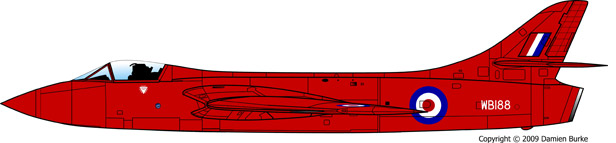
Thunder and Lightnings has some excellent images of all the different types including WB188 that Duke broke the speed record in.

Copyright 2009 Damien Burke

F.3 WB188, Hawker Aircraft, RAF Tangmere, 1953; author
As at 7th September 1953, when World Absolute Speed Record of 722.2 mph gained by Neville Duke; pointed nose, reheated engine, additional curved/raked windscreen
Later scheme of Scarlet Red

There is also a distant connection with our erstwhile editor, Paul.  Paul used to fly a TB2o from Exeter Airfield in SW England which is where the Hunter Club is based.  Jonathan Whaley, who commanded the Hunter that Richard flew in, has his own personal Hunter – Miss Demeanour – registration G-PSST so during the summer months it was not uncommon to see Hunters in the sky above Exeter.

Hawker Hunter 'Miss Demeanour'

Finally, a couple of videos to drool over.

and a lovely display at RAF Waddington in rather unpleasant weather conditions

Wonderfully nostalgic!

By Bob Derham