“Son, your ego’s writing checks your body can’t cash.”
Well, this may be old hat for specialists but it surprised me. Is the same true for Britain? In either case, as Friedman says, it suggests we should explore more forcefully the ways we could aid business startups.
I always find Thomas Friedman excellent value for the time invested in reading him! See here:
“Here’s my fun fact for the day, provided courtesy of Robert Litan, who directs research at the Kauffman Foundation, which specializes in promoting innovation in America: “Between 1980 and 2005, virtually all net new jobs created in the U.S. were created by firms that were 5 years old or less,” said Litan. ‘That is about 40 million jobs. That means the established firms created no new net jobs during that period.’”
And if you want to know where the opening quote comes from, read the Friedman article!
This is the concluding part four of a multipart series on the factors that drive U.S. and foreign bond prices and yields.
[Part One is here, Part Two here, Part Three here Ed.]
Bond’s in a weak or faltering economy will generate a lower return to lenders than bonds in a strong economy, absent inflation or any other material changes in the purchasing power of the currency. Weak demand for goods and services means weak demand for financial capital which means low rates of return on financial capital.
The policies of the government can increase the borrowing costs of private industry. Fiscal policy that increases taxes reduces the profitability of projects and undermines the ability of companies to pay coupons and repay principal. Monetary policy that increases the money supply may lead to inflation, which also increases the cost of borrowing and reduces economic activity.
Lastly, and of the greatest concern of late, is the level of borrowing by the U.S. government. Debt levels are at record highs, with no relief in sight. The AAA rating of U.S. debt is reportedly in jeopardy (Chicago Tribune editorial).
Moody's Corporate Logo
Both existing and new lenders worry about the ability of the U.S. government to repay. Yes, the can simply roll over existing debt by raising taxes or creating money to retire old debt and replace it with new, but the interest rate required by new lenders goes up as the ability of the private economy to sustain tax revenues falls and the risk of inflation rises (Moody’s explains U.S. bond ratings).
Both factors are in play now: an anemic economy with little hope that this administration will undertake policies that support business, and a ballooning money supply and weak dollar that undermine the purchasing power of the returns to lenders. The returns to U.S. debt may still be healthy relative to those one can earn in other countries, but the spread is shrinking. The private economy remains fundamentally strong, thanks to the work ethic of the American people and the profit motive of the capitalistic system, but the policies of the U.S. government are straining those resources.
Nonsense, Sir? Then why are the police involved again?
Again?
Yes, Sir. They’re also investigating the mysterious unthinking think-tank remember?
Oh yes, I’d forgotten that.
There’s a rumour going round the canteen that the police are going to set up an incident room on the terrace of the House of Commons, Sir.
On the terrace?
Yes Sir. The idea is to save time going to and fro’ the house; deal with the criminals, sorry MPs, in batches – benefit from economies of scale sort of thing ….
Perkins! That’s the kind of silly rumour started by malicious gossips. I’m surprised you even listen to such tittle-tattle.
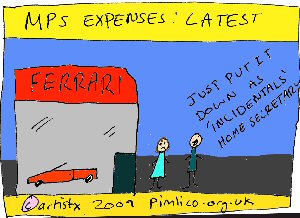
But you must admit it’s a rum do, Sir – using public money to finance his son’s university education!
But Perkins, it was only his expenses that he used!
That money is supposed to be used – if I may say so – for expenses, Sir.
But those WERE expenses, Perkins! Goodness, you are being obtuse, today. When your son goes to university you certainly have expenses, I can tell you!
I meant his parliamentary expenses, Sir.
Oh really, Perkins. If we’re going to start nit-picking over every pound in every expense account in the House of Commons then where will we be?
I don’t know where we’ll be, Sir, but I know where the police will be and where half of our illustrious MPs will end up ……..
But Perkins, we’re talking about money already earmarked for expenses. Once it’s allocated then it doesn’t really exist any more; it’s virtually spent!
Well, it seems this money was actually spent, Sir – and after all, it was public money, Sir!
Public money? What on earth are you talking about, Perkins! It was the government’s money!
But it came from the public, Sir!
Aha! Got you there, Perkins. Granted it WAS the public’s money originally but once it left their bank accounts it became Government money! Surely you can see the distinction?


 Learning from Dogs