A woman who knew no bounds when it came to rescuing three large dogs.
This is such a beautiful account of Veronica Shea taking action, and personal risks, to provide, firstly trust, and then love for Princess George, Grace and Steve, as they were named. The story was published on The Dodo.
Please read for yourself.
ooOOoo
Woman Visits Mountain Every Day To Convince Huge Dogs To Let Her Rescue Them
“They couldn’t be touched. They couldn’t be leashed. They were just terrified.”
In 2020, Veronica Shea was out hiking with her dog in the Angeles National Forest in California, when she spotted something strange moving ahead of them.
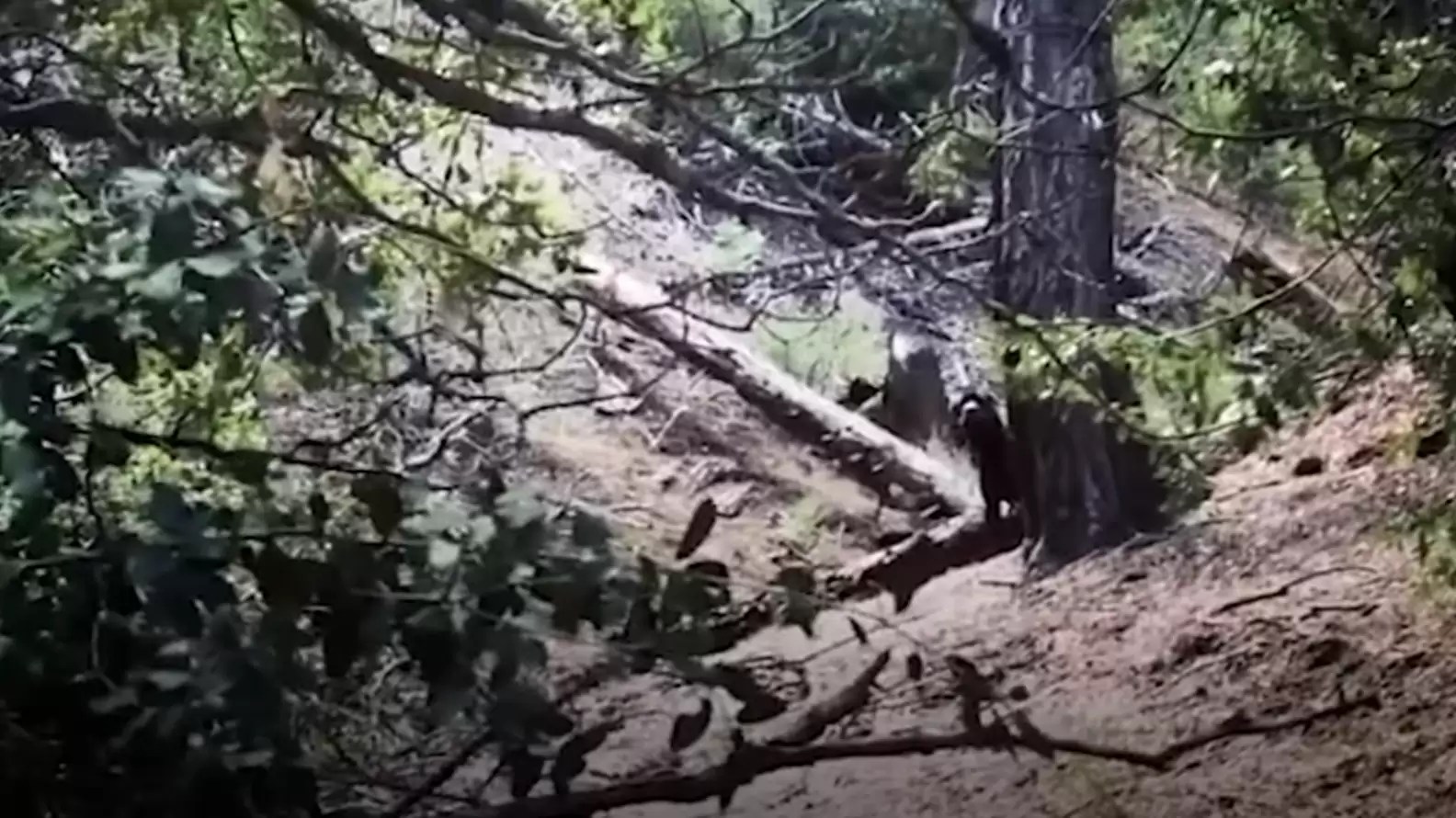
“We whip around the curve, and I look over and there was this huge black thing,” Shea told The Dodo. “He went up the side of a cliff.”
Veronica Shea
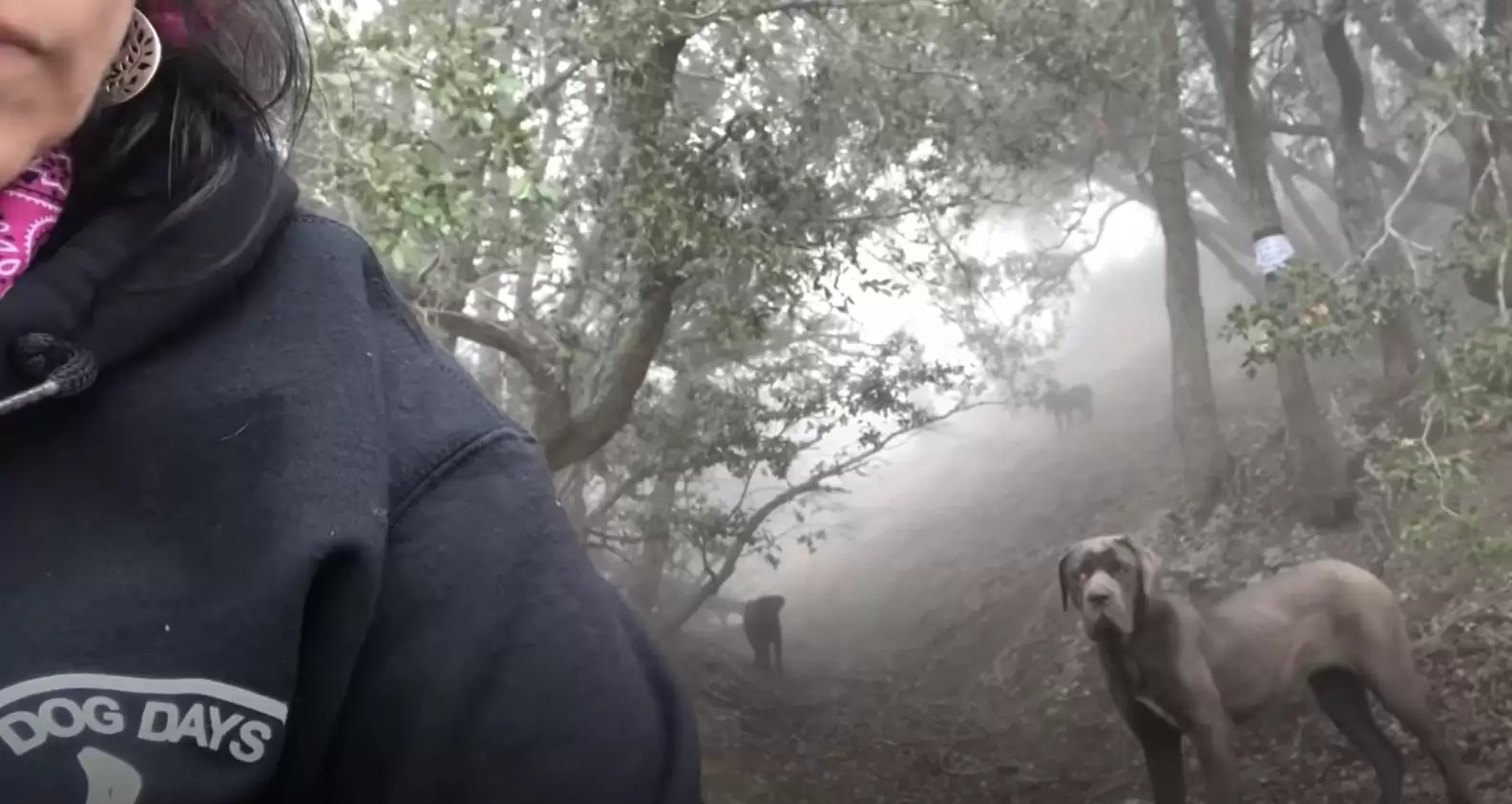
Shea followed the furry animal and came face to face with three malnourished dogs alone in the wilderness. Realizing the dogs had been abandoned, she knew she had to help them. Every day for several weeks, Shea trudged up the mountain to feed the dogs and work on gaining their trust.
Veronica Shea
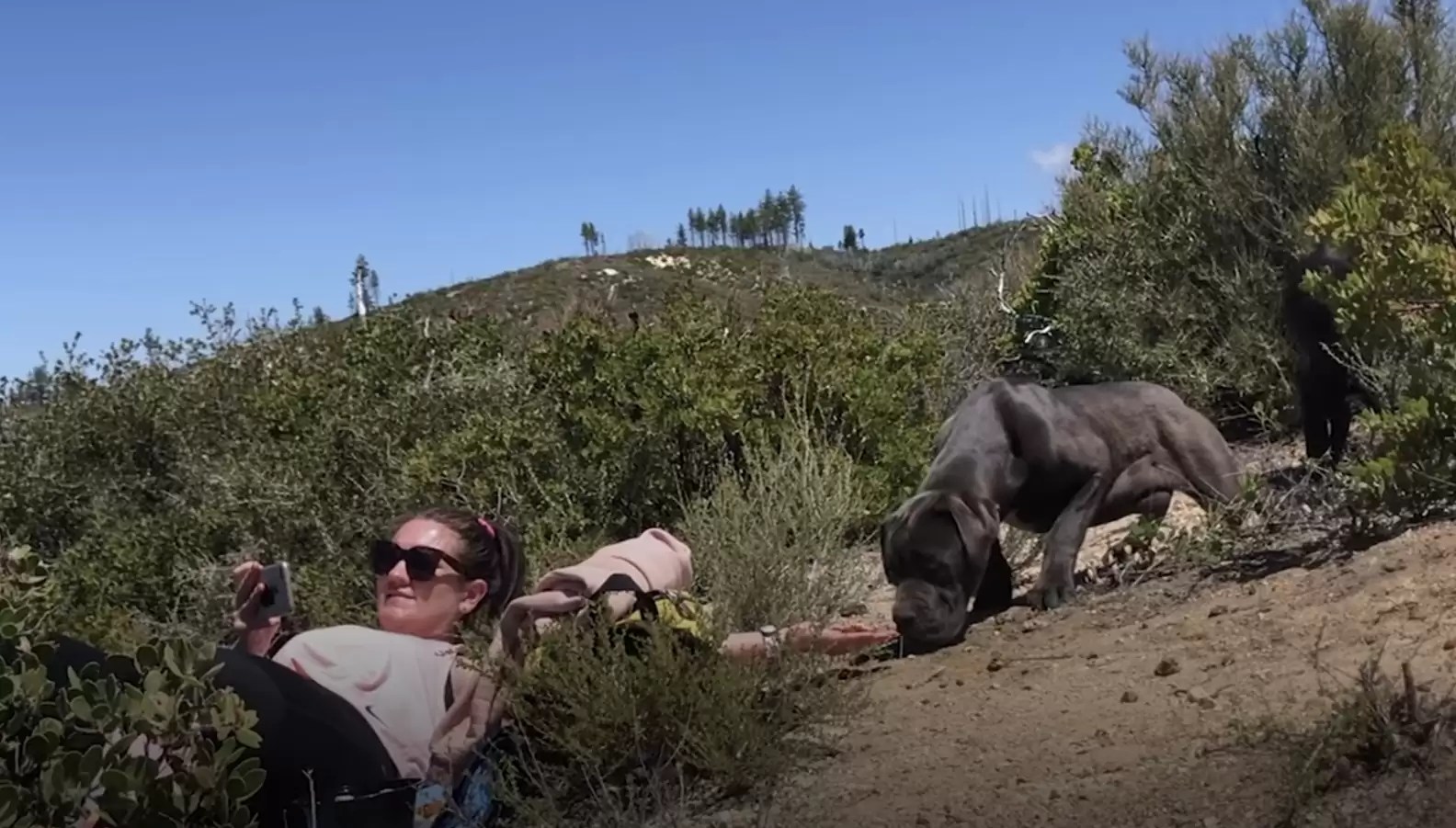
Slowly, the dogs got used to her and even began eating out of her hand. But Shea had no idea how to get them off the mountain. If she trapped one dog, would the others flee? She knew she couldn’t do it alone.
Veronica Shea
When she asked for help, a whole team of rescuers stepped forward. Together, they carried equipment up the mountain and put together a makeshift cage. The rescuers carefully lured the dogs inside and carried them down the mountain.
The three dogs —mastiffs named Princess George, Grace and Steve, who are believed to be siblings — were safe now. But they still had a long journey ahead.
Veronica Shea
The rescuers approached Cheri Wulff Lucas, a well known dog behaviorist and trainer in California, to see if she could help the nervous dogs learn to trust again.
“They weren’t adoptable the way they came,” Lucas told The Dodo. “They couldn’t be touched. They couldn’t be leashed. They were just terrified.”
Princess George, Grace and Steve responded well to Lucas’ training. Still, they continued to have a “very strong startle reflex,” said Lucas. This made it difficult to find them the perfect home.
“It was going to take a very special home for them to go into because they’re not the kind of dogs that are going to go to the dog park,” Lucas said. “Even walking them on city streets would be a lot for them. And if they do spook, they weigh 125 pounds, so [they would be] very hard to contain.”
But Lucas knew the dogs were safe on her own property.
“I’m out in the middle of nowhere,” Lucas said. “There’s no traffic around here. You can’t even see another home from here. So if they did get out, they would just come back here to me.”
Veronica Shea
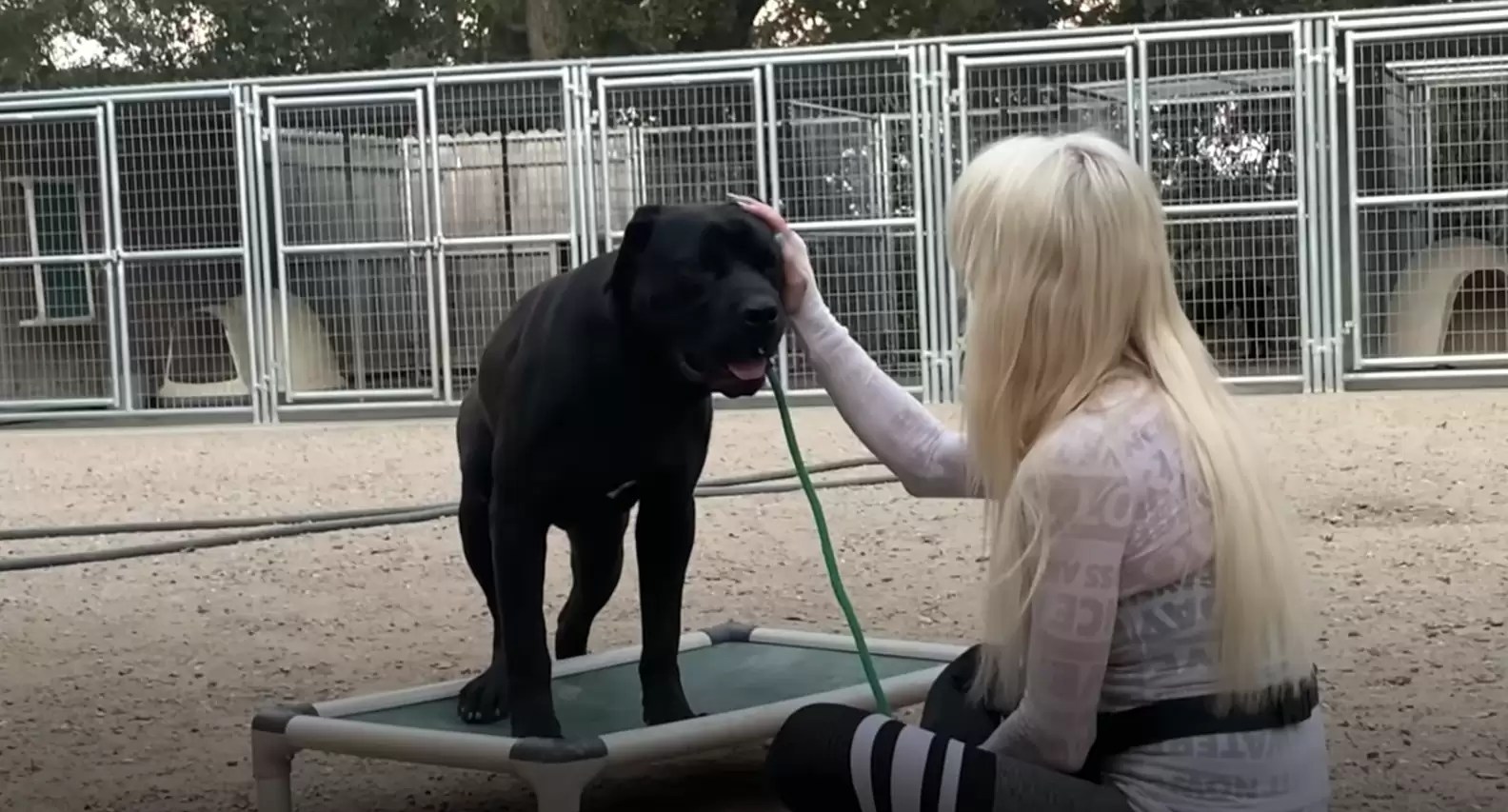
While Lucas never planned on keeping the dogs herself, that’s exactly what she ended up doing. This turned out to be the best decision for everyone. Princess George, Grace, and Steve continued to live in a safe and supportive environment. And Lucas discovered that the dogs could help her with her work as a trainer.
“If I get dogs that needs socialization — to be more familiar and less reactive with other dogs — I use my pack to help rehabilitate them,” Lucas said. “And all three of them are highly social with dogs. They know how to smell properly, how to not overpower the dog that needs the socialization. They’re just flawless. And that’s not something I taught them — they came that way.”
Veronica Shea
The threesome were particularly helpful when Lucas started working with another dog named Andi, who was rescued from a hoarding case.
“She had lived in a pen for seven years without human touch or being leashed or anything and she was terrified,” Lucas said. “They just came in and really made her feel comfortable. It was really sweet to see. They brought her around in a way that I never could as a human.”
Lucas ended up adopting Andi as well, bringing her personal pack of dogs to 12.
Princess George, Grace and Steve have been living with Lucas now for over three years, and they’re completely different dogs now.
“They’re incredibly playful,” Lucas said. “If you came to my house and did not know their backstory, you would think they were like any other dog.”
Lucas describes George as a “couch potato” who loves hanging around the house and socializing with the other dogs. Steve is the one who likes to play endless games of “chase” out in the yard. Grace remains a bit timid, but she shares a very close relationship with Steve.
“They’re pets — they’re really pets now,” she said. “They’re not cases for me anymore.”
ooOOoo
Lucas sums it up perfectly in that last sentence; “They’re pets – they’re really pets now,“
Lucas reminds me of Jean for when we first met, in December 2007, Jean had more than twenty dogs at home, all rescues, and led to me publishing my first book in 2009: Learning from Dogs.
I make no apologies for returning to the subject of scams and fakes. Because the advances in the equipment we have for viewing the internet are growing appreciably, and quickly.
We should include scams in this topic. Just a couple of days ago I had a text on my cell-phone that purported to have come from the United States Post Office, the USPS, and at first I was taken in. Luckily I left it for a while and then discovered it was a scam.
ooOOoo
No, you’re not that good at detecting fake videos − 2 misinformation experts explain why and how you can develop the power to resist these deceptions
By
Sam Wineburg Professor of Education and (by courtesy) History, Stanford University
Michael Caulfield Research Scientist, Center for an Informed Public, University of Washington
Someone tracking the conflict raging in the Middle East could have seen the following two videos on social media. The first shows a little boy hovering over his father’s dead body, whimpering in Arabic, “Don’t leave me.” The second purports to show a pregnant woman with her stomach slashed open and claims to document the testimony of a paramedic who handled victims’ bodies after Hamas’ attack in Israel on Oct. 7, 2023.
Even though these videos come from different sides of the Israel-Hamas war, what they share far exceeds what separates them. Because both videos, though real, have nothing to do with the events they claim to represent. The clip of the boy is from Syria in 2016; the one of the woman is from Mexico in 2018.
Cheap but effective fakes
Recent headlines warn of sophisticated, AI-driven deepfakes. But it is low-tech cheap fakes like these that fuel the latest round of disinformation. Cheap fakes are the Swiss army knife in the propagandist’s tool belt. Changing a date, altering a location or even repurposing a clip from a video game and passing it off as battlefield combat require little know-how yet effectively sow confusion.
The Israel-Hamas war has unleashed a flood of fake videos on social media.
The good news is that you can avoid being taken in by these ruses – not by examining the evidence closely, which is liable to mislead you, but by waiting until trusted sources verify what you’re looking at. This is often hard to do, however.
In the largest survey of its kind, 3,446 high school students evaluated a video on social media that purported to show election fraud in the 2016 Democratic primary. Students could view the whole video, part of it or leave the footage to search the internet for information about it. Typing a few keywords into their browsers would have led students to articles from Snopes and the BBC debunking the video. Only three students – less than one-tenth of 1% – located the true source of the video, which had, in fact, been shot in Russia.
Your lying eyes
Why were students so consistently duped? The problem, we’ve found, is that many people, young and old alike, think they can look at something online and tell what it is. You don’t realize how easily your eyes can be deceived – especially by footage that triggers your emotions.
When an incendiary video dodges your prefrontal cortex and lands in your solar plexus, the first impulse is to share your outrage with others. What’s a better course of action? You might assume that it is to ask whether the clip is true or false. But a different question – rather, a set of related questions – is a better starting place.
Do you really know what you’re looking at?
Can you really tell whether the footage is from atrocities committed by Russian forces in the Donbas just because the headline blares it and you’re sympathetic to the Ukrainian cause?
Is the person who posted the footage an established reporter, someone who risks their status and prestige if it turns out to be fake, or some random person?
Is there a link to a longer video – the shorter the clip, the more you should be wary – or does it claim to speak for itself, even though the headline and caption leave little room for how to connect the dots?
These questions require no advanced knowledge of video forensics. They require you only to be honest with yourself. Your inability to answer these questions should be enough to make you realize that, no, you don’t really know what you’re looking at.
Patience is a powerful tool
Social media reports of “late-breaking news” are not likely to be reporting at all, but they are often pushed by rage merchants wrapping an interpretation around a YouTube video accompanied by lightning bolt emojis and strings of exclamation points. Reliable reporters need time to establish what happened. Rage merchants don’t. The con artist and the propagandist feed on the impatient. Your greatest information literacy superpower is learning to wait.
If there are legs to the video, rest assured you’re not the only one viewing it. There are many people, some of whom have mastered advanced techniques of video analysis, who are likely already analyzing it and trying to get to the bottom of it.
You won’t have to wait long to learn what they’ve found.





 Learning from Dogs