Back to Unsplash.
All these photos show dogs together with other dogs.

oooo

oooo

oooo

oooo

oooo

oooo

I can’t guarantee that some of these haven’t been shared with you in previous Picture Parades.
Dogs are animals of integrity. We have much to learn from them.
Year: 2023
Back to Unsplash.
All these photos show dogs together with other dogs.
oooo
oooo
oooo
oooo
oooo
oooo
I can’t guarantee that some of these haven’t been shared with you in previous Picture Parades.
A fascinating post on Treehugger.
It is Wednesday morning in Southern Oregon and already I am having to think about the post for tomorrow. Not that this is a problem it is just one more thing that I want to do. Plus we are in the middle of a local heat wave with temperatures expected to be well above 100 degrees F and possibly 109 deg F (42.8 deg C.).
So I am turning to Treehugger for a dog post and hoping that I shall be able to share it with you all.
ooOOoo
Dogs Could Revolutionize the Sustainability of Future Pandemic Testing
Scent dogs are quicker, more effective, and create less healthcare waste than conventional COVID tests.
Senior Editorial Director
Published July 17, 2023

One of the more frustrating roadblocks in navigating the COVID-19 pandemic was the difficulty in getting quick, accurate test results. Sometimes, results for PCR tests took up to two weeks, rendering their diagnosis useless for planning isolation scenarios. Meanwhile, rapid tests still oftentimes provide a false negative if taken too soon after infection. When I had COVID, I was four days into symptoms before I got a positive at-home test—I’ve heard many people recount similar stories.
The testing we have is certainly better than nothing, but it leaves a lot to be desired. If only there were a better way, say, using something with remarkable innate sensitivity. Like, dogs. Far-fetched? Not at all.
A review of recent research concluded that scent dogs may represent a cheaper, faster, and more effective way to detect COVID-19 and could be a key tool in future pandemics. This could be a game-changer for sustainability as well, eliminating the enormous amount of waste that comes with billions of testing kits.
The review, published in De Gruyter’s Journal of Osteopathic Medicine, found that scent dogs are as effective, or even more effective, than conventional COVID-19 tests such as PCR tests.
Most of us know that dogs have a remarkable sense of smell; they sniff out drugs and explosives and have even successfully identified patients with certain cancers, Parkinson’s, and diabetes. They have up to 300 million olfactory cells, compared to 5 or 6 million in humans. And they use one-third of their brains to process scent information—humans just use 5%.
Professor Tommy Dickey of the University of California, Santa Barbara, and Heather Junqueira of BioScent Detection Dogs analyzed 29 different studies in which dogs detected COVID-19. “The studies were performed using over 31,000 samples by over 400 scientists from more than 30 countries using 19 different dog breeds. In some studies, the scent dogs sniffed people directly, sometimes in public places as a health screening. In others, the dogs sniffed patient samples such as sweat, saliva, or urine samples,” explains a press statement from De Gruyter.
The dogs ranged from Labrador retrievers and Belgian malinois to beagles and English springer spaniels. In most of the studies, the dogs demonstrated similar or better sensitivity and specificity than the current gold-standard PCR tests or antigen tests.
“In one study, four of the dogs could detect the equivalent of less than 2.6 x 10⁻¹² copies of viral RNA per milliliter. This is equivalent to detecting one drop of any odorous substance dissolved in ten and a half Olympic-sized swimming pools and is three orders of magnitude better than modern scientific instruments,” notes De Gruyter.
Remarkably, they not only detected COVID-19 in symptomatic, pre-symptomatic, and asymptomatic patients, but they could also sniff out COVID variants and even long COVID.
One thing we certainly don’t want is for dogs to become collateral damage in the pursuit of better testing. The study authors acknowledge this, writing that the “safety of scent dogs, their handlers, and those who are inspected by the dogs is critical for the acceptance and implementation of the scent dog screening and testing approach.”
“This is consistent with the One Health paradigm,” they add, “which defines health as more than the absence of disease and recognizes the interrelationships among humans, animals, and environmental welfare.”
The authors evaluated whether medical detection dogs could contract and become ill with the COVID-19 virus and if dogs pass on the COVID-19 virus to humans. From a number of studies, they concluded that dogs are in the low-risk category. “To our knowledge, there have been no deaths of dogs that can be unequivocally attributed to COVID-19,” the authors explain. “Importantly, the studies described above suggest that it is safe for healthy individual handlers to utilize scent dogs to directly screen and test individuals who may be infected with the COVID-19 virus.”
A major benefit of using the dogs is their speed. In one study, researchers were able to do a lineup with 40 samples, including sample collection, lineup loading, and unloading, within just 3 minutes.
“The time between RT-PCR sampling and the return of results can be up to days, whereas the RAG test results are obtained within about 15 min.,” write the study authors. “Again, if scent dogs directly sniff individuals, results are learned in seconds, or a few minutes if samples are taken and sniffed soon after by the dogs.”
“The criticality of the speed of the return of test results cannot be overemphasized,” the authors add.
That dogs could provide a result in seconds to minutes is crucial. But additionally, and importantly, scent tests by dogs don’t require expensive lab equipment or create mountains of plastic waste, unlike conventional diagnostic approaches.
As of December 22, 2022, the United States alone had performed around 1.15 billion tests for COVID-19. Thinking of all the material for the testing kits and all the resources used for testing labs and sending samples around, etc., the reduction in ecological footprint is potentially tremendous.
Not to mention the cost. Some of the research in the review was, in fact, motivated by the need for inexpensive testing in developing nations, the authors note.
“Although many people have heard about the exceptional abilities of dogs to help humans, their value to the medical field has been considered fascinating, but not ready for real-world medical use,” says Dickey. “Having conducted this review, we believe that scent dogs deserve their place as a serious diagnostic methodology that could be particularly useful during pandemics, potentially as part of rapid health screenings in public spaces. We are confident that scent dogs will be useful in detecting a wide variety of diseases in the future.”
ooOOoo
In the interests of expanding the argument, here is a copy of a comment left to that original post:
Here we go again, using animals for testing. I believe that dogs can’t smell covid and detected it 100%, but we humans NEVER treat animals with the respect and equality they deserve, so I am very concern for the safety and health of testing “smell Covid” dogs… I know a person that have esophageal cancer and for almost 5 years before it was diagnosed, his dog (an adorable mutt) insisted on crawling over her owner chest every single time that he laid down, in an attempt to “cure” the inflammation in that spot. After the cancer was eliminated with chemo and surgery the dog stopped doing it…
I which we humans were more connected and attentive with animal wisdom, to learn from them, respecting and became better people.
I think that second sentence should read can smell covid but have left it how it was printed.
Anyway, I will leave readers to cover the main article which speaks very highly of man’s best friend.
What is the truth?
Today, August 14th, here in Southern Oregon we are expecting 111 degrees Fahrenheit or 43.8 degrees C. That is really hot! (And at home it reached 108 deg. F. at 3pm.)
So it seems pertinent to republish a post from The Conversation that was published on July 21st, 2023.
ooOOoo
Is it really hotter now than any time in 100,000 years?
Professor of Earth and Environmental Sciences, Northern Arizona University
As scorching heat grips large swaths of the Earth, a lot of people are trying to put the extreme temperatures into context and asking: When was it ever this hot before?
Globally, 2023 has seen some of the hottest days in modern measurements, but what about farther back, before weather stations and satellites?
Some news outlets have reported that daily temperatures hit a 100,000-year high.
As a paleoclimate scientist who studies temperatures of the past, I see where this claim comes from, but I cringe at the inexact headlines. While this claim may well be correct, there are no detailed temperature records extending back 100,000 years, so we don’t know for sure.
Here’s what we can confidently say about when Earth was last this hot.
Scientists concluded a few years ago that Earth had entered a new climate state not seen in more than 100,000 years. As fellow climate scientist Nick McKay and I recently discussed in a scientific journal article, that conclusion was part of a climate assessment report published by the Intergovernmental Panel on Climate Change (IPCC) in 2021.
Earth was already more than 1 degree Celsius (1.8 Fahrenheit) warmer than preindustrial times, and the levels of greenhouse gases in the atmosphere were high enough to assure temperatures would stay elevated for a long time.
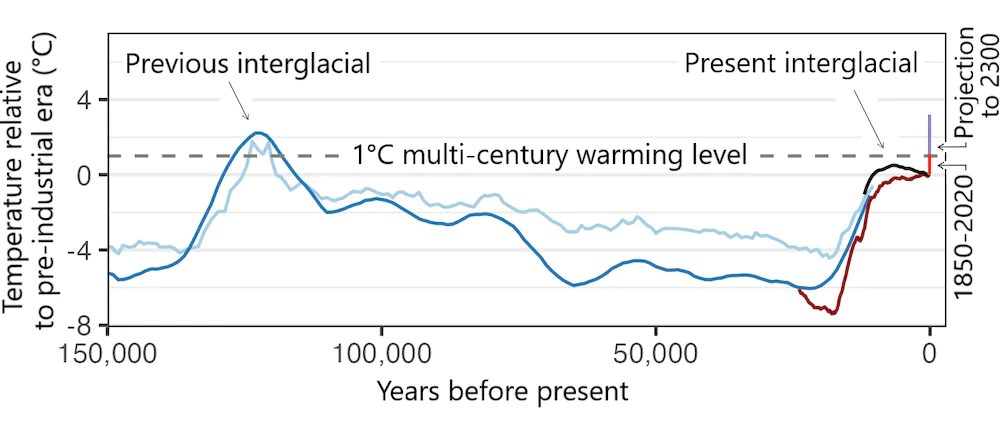
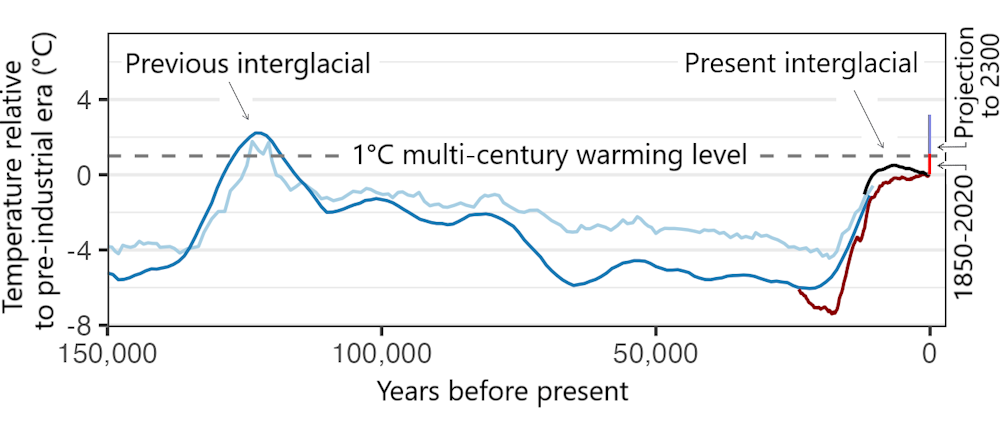
Even under the most optimistic scenarios of the future – in which humans stop burning fossil fuels and reduce other greenhouse gas emissions – average global temperature will very likely remain at least 1 C above preindustrial temperatures, and possibly much higher, for multiple centuries.
This new climate state, characterized by a multi-century global warming level of 1 C and higher, can be reliably compared with temperature reconstructions from the very distant past.
To reconstruct temperatures from times before thermometers, paleoclimate scientists rely on information stored in a variety of natural archives.
The most widespread archive going back many thousands of years is at the bottom of lakes and oceans, where an assortment of biological, chemical and physical evidence offers clues to the past. These materials build up continuously over time and can be analyzed by extracting a sediment core from the lake bed or ocean floor.

These sediment-based records are rich sources of information that have enabled paleoclimate scientists to reconstruct past global temperatures, but they have important limitations.
For one, bottom currents and burrowing organisms can mix the sediment, blurring any short-term temperature spikes. For another, the timeline for each record is not known precisely, so when multiple records are averaged together to estimate past global temperature, fine-scale fluctuations can be canceled out.
Because of this, paleoclimate scientists are reluctant to compare the long-term record of past temperature with short-term extremes.
Earth’s average global temperature has fluctuated between glacial and interglacial conditions in cycles lasting around 100,000 years, driven largely by slow and predictable changes in Earth’s orbit with attendant changes in greenhouse gas concentrations in the atmosphere. We are currently in an interglacial period that began around 12,000 years ago as ice sheets retreated and greenhouse gases rose.
Looking at that 12,000-year interglacial period, global temperature averaged over multiple centuries might have peaked roughly around 6,000 years ago, but probably did not exceed the 1 C global warming level at that point, according to the IPCC report. Another study found that global average temperatures continued to increase across the interglacial period. This is a topic of active research.
That means we have to look farther back to find a time that might have been as warm as today.
The last glacial episode lasted nearly 100,000 years. There is no evidence that long-term global temperatures reached the preindustrial baseline anytime during that period.
If we look even farther back, to the previous interglacial period, which peaked around 125,000 years ago, we do find evidence of warmer temperatures. The evidence suggests the long-term average temperature was probably no more than 1.5 C (2.7 F) above preindustrial levels – not much more than the current global warming level.
Without rapid and sustained reductions in greenhouse gas emissions, the Earth is currently on course to reach temperatures of roughly 3 C (5.4 F) above preindustrial levels by the end of the century, and possibly quite a bit higher.
At that point, we would need to look back millions of years to find a climate state with temperatures as hot. That would take us back to the previous geologic epoch, the Pliocene, when the Earth’s climate was a distant relative of the one that sustained the rise of agriculture and civilization.
ooOOoo
It is difficult to know what to say other than one hopes that Governments and country leaders recognise the situation and DO SOMETHING!
As Dr. Michael Mann put it in the last issue of The Humanist: “The only obstacles aren’t the laws of physics, but the flaws in our politics.“
I have a son and a daughter in their early 50’s and a grandson who is 12. They, along with millions of other younger people, need action now.
Please!
 Learning from Dogs