More of those delightful photos from Capt. Bob.
A republication of an earlier Picture Parade.
Stay Happy Good People!

oooo
 oooo
oooo
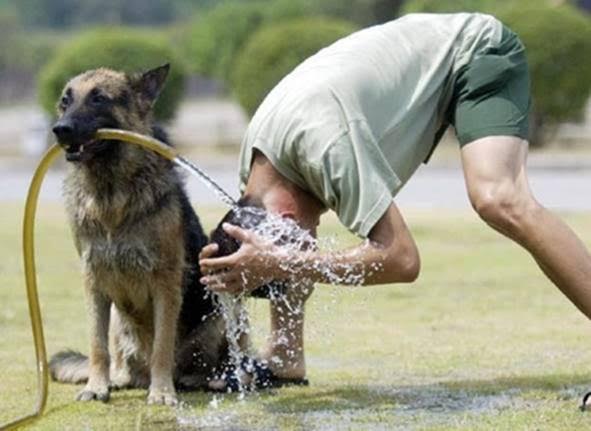 oooo
oooo
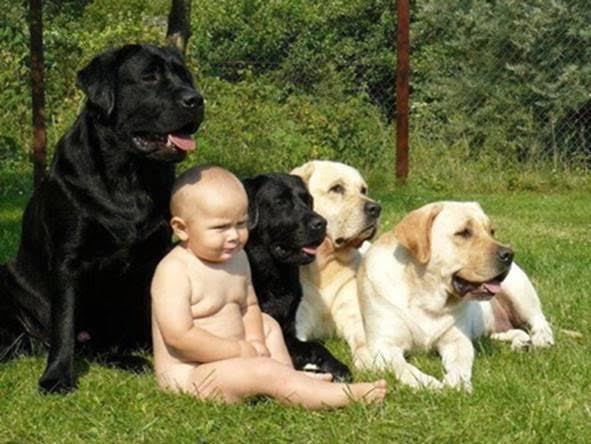 oooo
oooo
 Many thanks, Bob!
Dogs are animals of integrity. We have much to learn from them.
Year: 2020
More of those delightful photos from Capt. Bob.
A republication of an earlier Picture Parade.
Stay Happy Good People!
oooo
oooo
oooo
oooo
Many thanks, Bob!
The background to breeds.
Funnily enough, Jeannie and I were speaking just recently about the creation of breeds, in particular because we were fascinated as to the breed origins of Oliver.
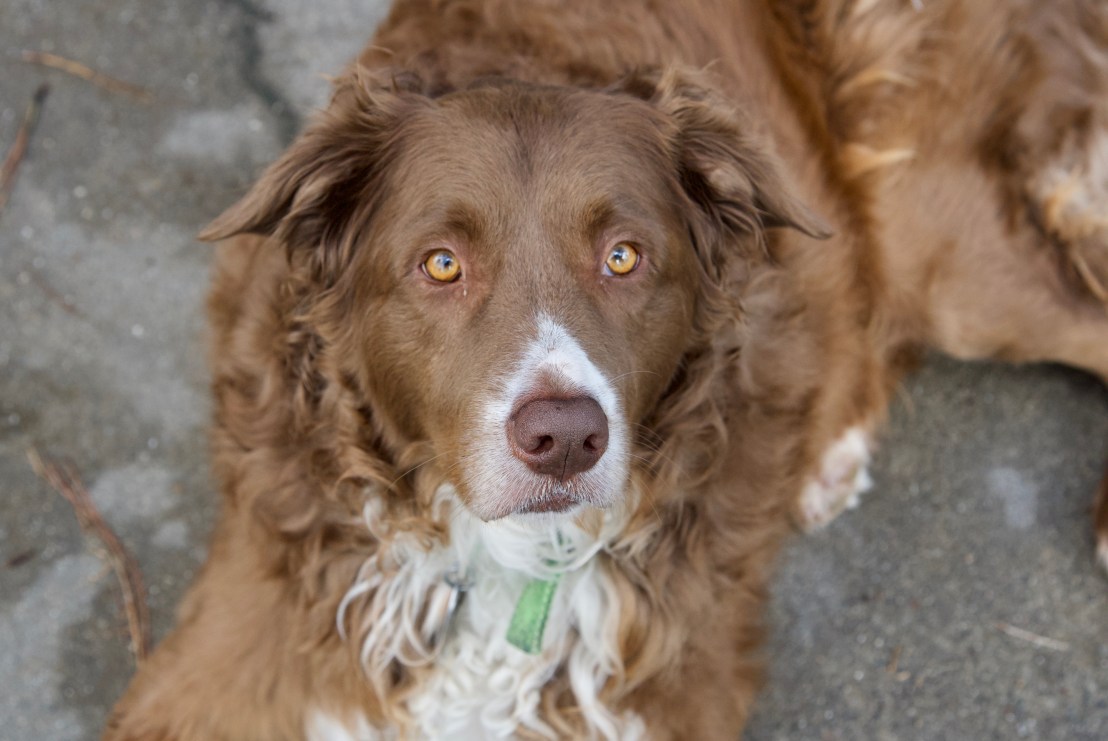
Oliver’s eyes are to die for!
Well a recent article on the Treehugger blog threw some light on this.
I hope it is permissible to share it with you.
ooOOoo
Study helps deepen understanding about how breeds are formed.
By Mary Jo DiLonardo
Published September 22, 2020

The Australian creator of the Labradoodle was trying to find the perfect guide dog for a blind woman whose husband was allergic to dog hair. He tried about a dozen poodles before breeding a poodle with a Labrador retriever. The resulting Australian Labradoodles became incredibly popular as a mix of two well-liked breeds.
But a new study finds that the breed that developed from that popular cross isn’t an even split of both breeds – it is primarily poodle.
Australian Labradoodles have been around for several decades and have been bred to each other and tinkered with since then. By contrast, many Labradoodles that are found in the U.S. are first-generation mixes of one Labrador and one poodle. These dogs were used as the control dogs in the study, researcher Elaine Ostrander, geneticist at the National Human Genome Research Institute of the National Institutes of Health, tells Treehugger.
“We were interested in taking a genomic snapshot of a breed in the making—the Australian Labradoodle. The breed has only been around since the 1980s as opposed to the many breeds we see at the dog park which have been around since Victorian times and were created in Western Europe,” she says.
The Australian Labradoodle has gone through several generations, with careful and thoughtful addition of Labradors and poodles added, reflecting what breeders and owners want. We wanted to see if genomics could be used to tell what was happening to the genome of these dogs as they evolved into a breed.
The Fédération Cynologique Internationale (FCI), an international federation of many national kennel clubs, recognizes about 350 dog breeds. The American Kennel Club (AKC) recognizes 195 breeds. The Labradoodle is not an official breed.
“We were also curious to see if the breed met the statistical definition of a breed. There are many measures in terms of genomic diversity and ability to ‘breed true’ that are taken into account when determining when a dog population is really a ‘breed’ at the genetic level,” Ostrander says.
Many of these breeds have been created through intense breeding programs focused on enhancing specific traits. When designer breeds are created, the genetic diversity is limited because there are a small number of animals being bred together. This often leads to a high incidence of disease and other problems.
Lots of Poodle DNA
For the study, researchers analyzed genetic data from Australian Labradoodles, Labrador retrievers, poodles, and a number of other breeds. The results were published in PLOS Genetics.
Ostrander says they were somewhat surprised at what they found.
“First, the Australian Labradoodle meets the definition of a breed at the statistical level. Those arguing for it to have breed status with various registries have a good argument,” she says. “What we didn’t expect was the degree to which today’s Australian Labradoodle has such a large component of its genome from the poodle. While the breed started as a 50-50 mix, it is clear that poodle traits are highly valued and many more poodles than Labradors have been added to the breed at strategic points.”
That’s likely because poodles have a reputation for being hypoallergenic, she points out, and elicit a lower allergic reaction than many other dog breeds in people with allergies or asthma.
“Owners buy Labradoodles for many reasons including their trainability, family friendly traits, and, importantly, they want a dog that won’t make them sneeze or otherwise respond,” she says. “Interestingly, the Labrador is very much present in every Australian Labradoodle we tested. Likely people are seeking the family-friendly traits of the Labrador and breeders work hard to retain that as well.”
Labradoodles weren’t the first doodle dogs and definitely are not the last. The first poodle mixes were likely Cockapoos because Cocker spaniels and poodles were two of the most popular dog breeds in the U.S. in the 1940s. Today, you’ll find schnoodles (schnauzers), sheepadoodles (Old English sheepdog), and whoodles (soft-coated wheaten terrier). Poodles have been mixed with beagles, pugs, Australian shepherds, corgis, and even Saint Bernards.
The lore behind Australian Labradoodles is that English and American Cocker spaniels were mixed in with the breed early on.
“We did find some minor evidence for the addition of other breeds in some lineages of Australian Labradoodle. Likely this represents the historical relationship of those breeds with the poodle or Labrador more than anything else,” Ostrander says. “We did not see that in every lineage we looked at and where we did see it, the addition was very small and, likely, many generations ago.”
The findings are helpful, the researchers point out, because it shows how quickly genetics can be changed by thoughtful breeding.
“Imagine a breed has a significant risk for a disease. Careful breeding can reduce the incidence of those deleterious variants in just a few generations,” Ostrander says. “This is incredibly important to breeders who have taken very seriously the criticism they have received over the years regarding how established breeds are less healthy than mixes. We all want our dogs to be healthy, regardless of what breed they are.”
ooOOoo
This deserves a very careful read and, to those really interested in the subject, perhaps this will serve as an incentive to do more research. There are links in the article to the FCI and AKC.
And I will finish with the closing statement by Elaine Ostrander: “We all want our dogs to be healthy, regardless of what breed they are.“
An article in The Dodo describes good dogs perfectly.
When we came up from Mexico to Arizona back in 2010 we had 16 dogs. They were all pretty well behaved. When we came to Oregon in 2012 we were down to 12 dogs and, again, pretty well behaved.
But having said that getting all 12 dogs to sit still and look at the camera would have been impossible! I’m not sure I could manage it now and we have only 6 dogs.
Which makes the following article recently published in The Dodo most remarkable.
Have a read!
ooOOoo
They literally know the phrase ‘picture time!’
By Lily Feinn Published on 9/24/2020
Throwing a party for 12 dogs can get pretty wild, but the pups at Lending Paws Pet Care are the goodest boys and girls you’ll ever meet.
Whenever a dog at the doggy day care has a birthday, Aubrey Thweatt makes sure they get a special party with all their best friends. The celebration includes goodies, party hats and cute photos to commemorate the day.
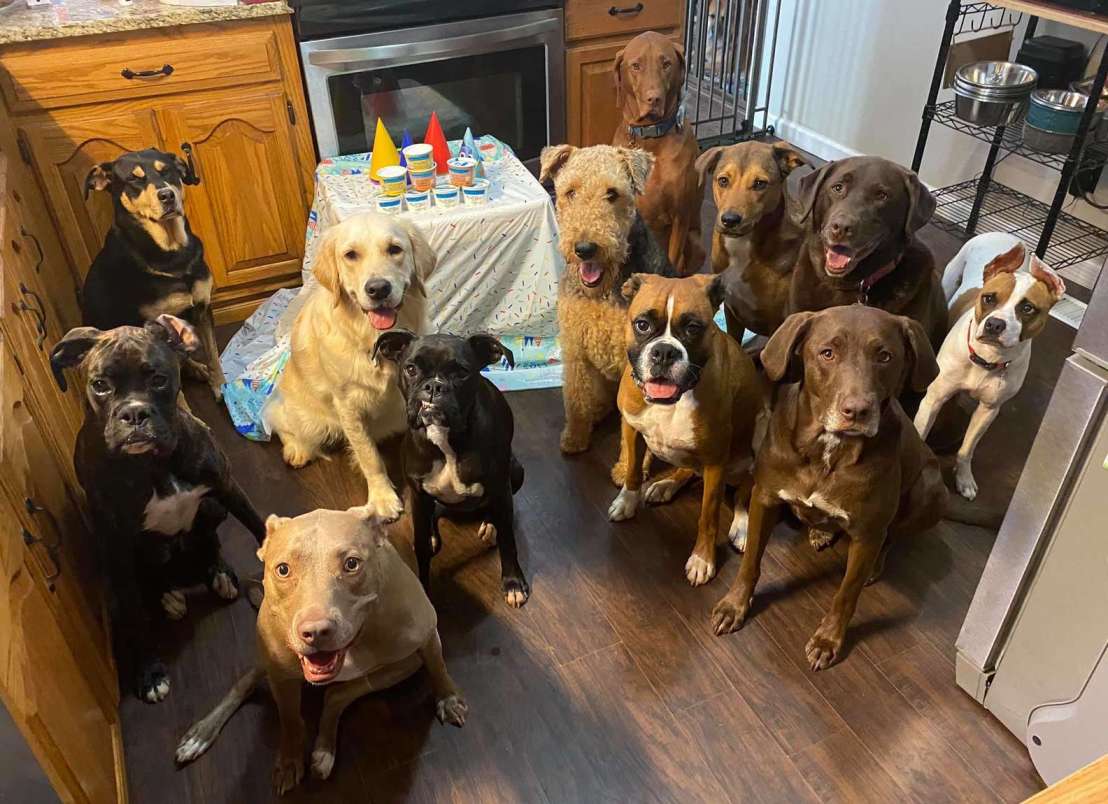
“I started doing birthday pics and goodies with my own dogs and so when one of my client’s pups would have a birthday … they would send goodies for the group,” Thweatt, owner of Lending Paws Pet Care, told The Dodo. “It just sort of evolved from there.”
And when it comes to posing for the birthday party photo, these dogs are pros. They don’t even mind wearing a party hat.
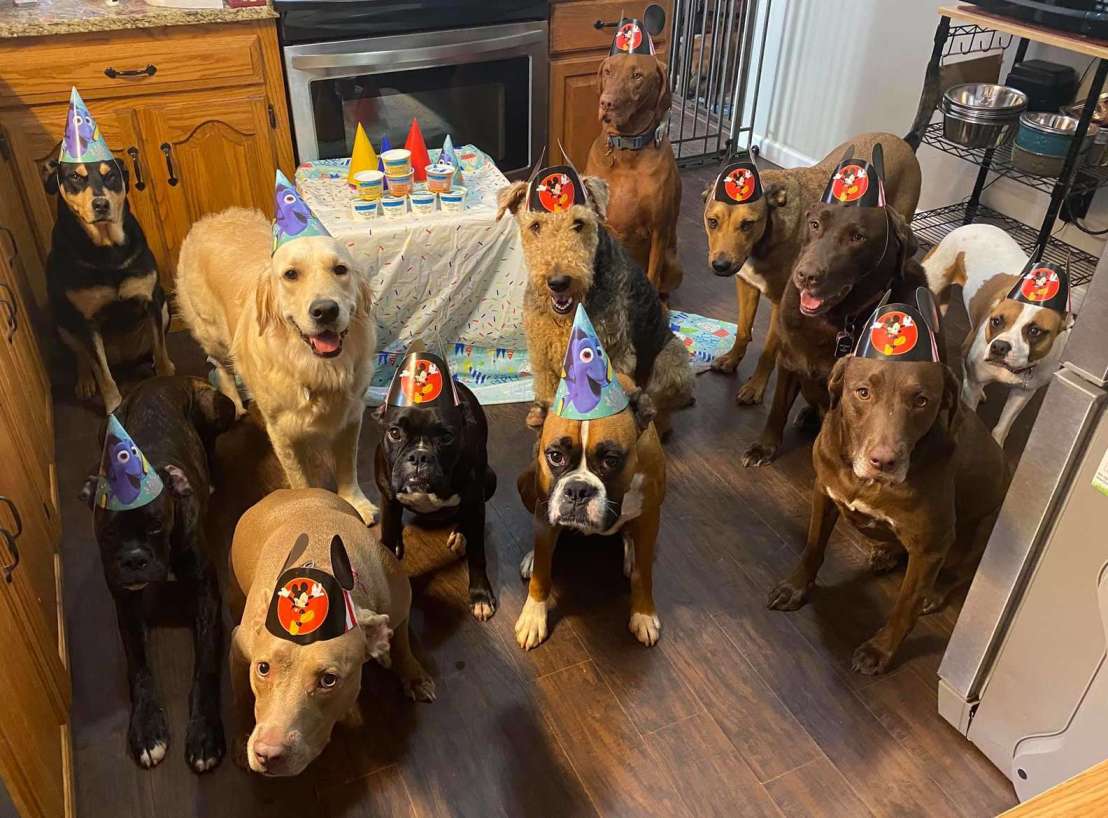
When a gray pittie named Rosemary celebrated her 4th birthday, Thweatt snapped a photo, never expecting it to go viral. But after one of the dog owners posted it on Twitter, people couldn’t get over the dogs’ unique expressions and expert sitting skills.
“They have been coming for years. We do group pictures daily so they are used to it,” Thweatt said. “We do ‘sit and stay’ for everything.”
“We have lots of fun and they literally know the phrase ‘picture time!’” Thweatt added. “They will all run in the direction I’m walking to get to a spot to sit.”

While at doggy day care, the pups have the run of the house. They can play in the backyard, or relax and recharge during naptime, and always get plenty of praise and treats. After spending so many years together, the pups are all best friends and look forward to spending the day with Thweatt.
“Everything I do is for them,” Thweatt said. “They have the entire house and I am just here to constantly clean up after them and make sure they have lots of playtime and socializing!”
ooOOoo
Aubrey Thweatt knows perfectly how her dogs are to be treated. That is they are loved for being the animals that they are. Dogs are smart. They know their own names. They have a sense of smell that is literally millions of times better than ours. They are very observant of our behaviours.
And this is the result. Dogs that may be photographed in a group perfectly.
These are tough times.
Recently I was contacted by a person and I thought it was a scammer. My mistake entirely but it was an unusual name; well it was to me!
As it happens this person not only writes well but does it for a job! It shows.
Because millions of people have cats and dogs and a very large percentage of those will be concerned as to what to do.
ooOOoo
ooOOoo
I would take issue with the author over one tiny point. I think, but I have no medical experience on this, that worrying that your dogs and cats may be somehow a carrier for Covid-19 is worrying too far.
Nevertheless, this is a good guest post.
(Subsequent conversations revealed that the author wanted the post cancelled because I wouldn’t add a link to the commercial website.)
It’s both beautiful and yet beyond comprehension.
When we have a clear night there are two occasions for me to gaze upwards and become lost in thought. One is in the evening when the dogs are outside just before going to bed. The other is in the morning because we are usually awake well before sunrise.
We are very lucky in that there is no light pollution locally.
So, in the evening, while I look at the broad expanse of stars, my eyes are drawn to the Big Dipper and to Orion.
In the morning, when we look to the East there is Venus sparkling bright in the night-sky over the hills.
I still vividly remember all those years ago when I was sailing in the Western Mediterranean coming on deck in the middle of the night to find the stars down to the horizon all 360 degrees about me. I am sure it will be one of the last memories of mine just before I die! I hope so!
But I speak of the solar system. Here’s an article that was recently published by EarthSky that goes way beyond the solar system. It is a wonderful essay and almost mystical.
ooOOoo
Posted by Andy Briggs in ASTRONOMY ESSENTIALS, September 25, 2020
We live in a galaxy called the Milky Way. But there is so much more to know about these grand and glorious star islands in space! Click in here, and prepare to have your mind expanded.
 This is a giant galaxy cluster known as Abell 2744, aka Pandora’s Cluster, located in the direction of the constellation Sculptor. The cluster is about 4 million light-years across and has the mass of 4 trillion suns. It appears to be the result of a simultaneous pile-up of at least 4 separate, smaller galaxy clusters that took place over a span of 350 million years. Read more about this image at HubbleSite. Image via NASA/ ESA/ J. Lotz/ M. Mountain/ A. Koekemoer/ the Hubble Frontier Fields Team.
A galaxy is a vast island of stars in an ocean of space. Galaxies are typically separated from one another by huge distances measured in millions of light-years. Galaxies are sometimes said to be the building blocks of our universe. Their distribution isn’t random, as one might suppose: galaxies are strung out along unimaginably long filaments across the universe, a cosmic web of star cities.
A galaxy can contain hundreds of billions of stars and be many thousands of light-years across. Our own galaxy, the Milky Way, is around 100,000 light-years in diameter. That’s about 587,900 trillion miles, nearly a million trillion kilometers.
Galaxies are of widely varying sizes, too.
There are an estimated two trillion galaxies in the universe.
 Illustration showing snapshots from a simulation by astrophysicist Volker Springel of the Max Planck Institute in Germany. It represents the growth of cosmic structure (galaxies and voids) when the universe was 0.9 billion, 3.2 billion and 13.7 billion years old (now). Image via Volker Springel / MPE/ Kavli Foundation.
Galaxies group together in clusters. Our own galaxy is part of what is called the Local Group, for example: a cluster comprising 55 galaxies that we know of so far.
In turn, galaxy clusters themselves group into superclusters. Our Local Group is part of the Virgo Supercluster.
The “glue” that binds stars into galaxies, galaxies into clusters, clusters into superclusters and superclusters into filaments is – of course – gravity, the universe’s construction worker, which sculpts all the structures we see in the cosmos.

Distances from the Local Group for selected groups and clusters within the Local Supercluster, which is called the Virgo Supercluster.
There are several basic types of galaxy, each containing sub-types. Galaxies were first systematically classified, based on their visual appearance, by the famous astronomer Edwin P. Hubble in the late 1920s and 30s, during years of painstaking observations. Hubble’s Classification of Galaxies, as it is known, is still very much in use today, although, since Hubble’s time, like any good classification system it has been updated and amended in the light of new observations.
Before Hubble’s study of galaxies, it was believed that our galaxy was the only one in the universe. Astronomers thought that the smudges of light they saw in their telescopes were in fact nebulae within our own galaxy and not, as Hubble discovered, galaxies in their own right. It was Hubble who demonstrated, by measuring their velocities, that they lie at great distances from us, millions of light-years beyond the Milky Way, distances so huge that they appear tiny in all but the largest telescopes. Moreover, he demonstrated that, wherever he looked, galaxies are receding from us in all directions, and the further away they are, the faster they are receding. Hubble had discovered that the universe is expanding.
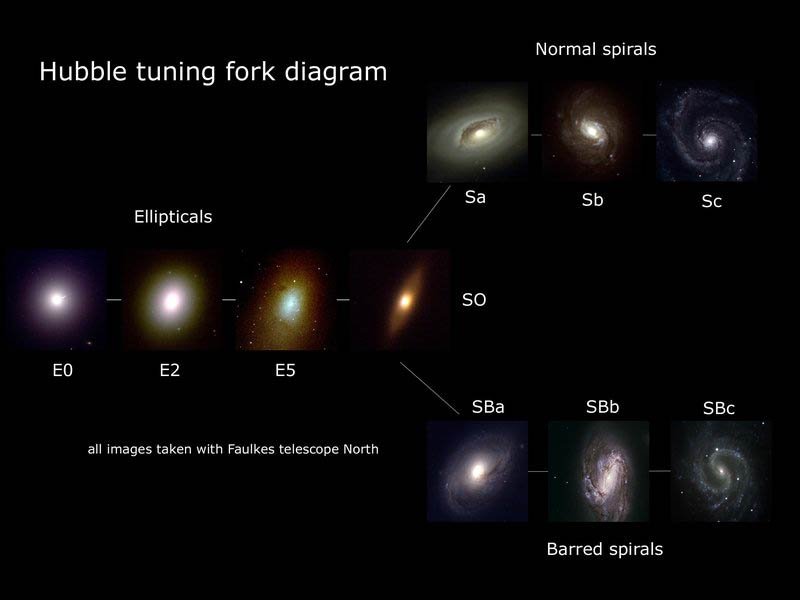
A diagrammatic representation of Edwin Hubble’s “tuning fork diagram.” In the late 1920s and 30s, Hubble conducted the laborious observations needed to begin to classify galaxies. His original classification scheme was published in 1936 in a book called “The Realm of the Nebulae.” His original scheme is – like all scientific work – continually being modified. But his idea of a “tuning fork diagram” has continued to be useful. Image via Las Cumbres Observatory.
The most common type of galaxy is the one most people are familiar with: the spiral galaxy. The Milky Way is of this family. Spiral galaxies have majestic, sweeping arms, thousands of light years long, made up of millions upon millions of stars. Our solar system is situated about 2/3 of the way out from the galactic center towards the periphery of the galaxy, embedded in one of these spiral arms.
Spiral galaxies are also characterised by having a bright center, made up of a dense concentration of stars, so tightly packed that from a distance the galaxy’s center looks like a solid ball. This ball of stars is known as the galactic bulge. At the center of the Milky Way – within the galactic bulge – the density of stars has been calculated at 1 million per 34 cubic light-years, for example.
Meanwhile, in the vicinity of our sun, the stellar density has been estimated as 0.004 stars per cubic light-year. Big difference!
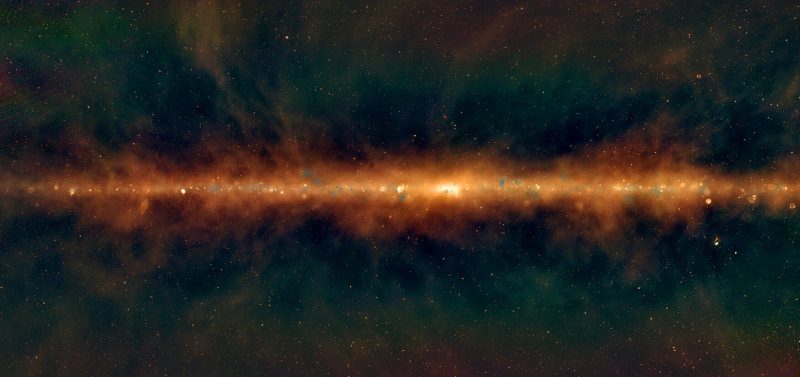
A stunning view of the center of our Milky Way galaxy as seen by the Murchison Widefield Array (MWA) telescope in Australia in 2019. Image via Natasha Hurley-Walker (ICRAR/ Curtin)/ GLEAM Team/ Phys.org.
The Milky Way is, in fact, in one of Hubble’s spiral galaxy sub-types: it’s a barred spiral, which means it has a bar of stars protruding out from either side of the center. The ends of the bar form the anchors of the spiral arms, the place from where they sweep out in their graceful and enormous arcs. This is a fairly recent discovery: how the bar forms in a galaxy is not yet understood.
Also established recently is the fact that the disk of the Milky Way is not, as most diagrams depict, flat: it is warped, like a long-playing vinyl record left too long in the sun. Exactly why is not known, but it is thought to be the result of a gravitational encounter with another galaxy early in the Milky Way’s history.

Artist’s illustration of our warped Milky Way. Image via Ogle/ Warsaw University/ BBC.
Elliptical galaxies are the universe’s largest galaxies. They are huge and football-shaped.
They come to be because – although most galaxies are flying apart from each other – those astronomically close to each other will be mutually gravitationally attracted. Caught in an inexorable gravitational dance, eventually they merge, passing through each other over millions of years, eventually forming a single, amorphous elliptical galaxy. Such mergers may result in the birth of new generations of stars as gravity’s shock-wave compresses huge clouds of interstellar gas and dust.
The Milky Way is caught in such a gravitational embrace with M31, aka the Andromeda galaxy, which is 2 1/2 million light-years distant. Both galaxies are moving toward each other because of gravitational attraction: they will merge in about 6 billion years from now. However, both galaxies are surrounded by huge halos of gas which may extend for millions of light-years, and it was recently discovered that the halos of the Milky Way and M31 have started to touch.
The two galaxies have had their first kiss.
Galaxy mergers are not uncommon: the universe is filled with examples of galaxies in various stages of merging together, their structures disrupted and distorted by gravity, forming bizarre and beautiful shapes.

Galaxies may take billions of years to fully merge into a single galaxy. As astronomers look outward in space, they can see only “snapshots” of this long merger process. Located 300 million light-years away in the constellation Coma Berenices, these 2 colliding galaxies have been nicknamed The Mice because of the long tails of stars and gas emanating from each galaxy. Otherwise known as NGC 4676, the pair will eventually merge into a single giant galaxy. Image via Wikimedia Commons.
At the lower end of the galactic size scale, there are the so-called dwarf galaxies, consisting of a few hundred to up to several billion stars. Their origin is not clear. Usually they have no clearly defined structure. Astronomers believe they were born in the same way as larger galaxies like the Milky Way, but for whatever reason they stopped growing. Ensnared by the gravity of a larger galaxy, they orbit its periphery. The Milky Way has around 20 dwarf galaxies orbiting it that we know of, although some models predict there should be many more.
The two most famous dwarf galaxies for us earthlings are, of course, the Small and Large Magellanic Clouds, visible to the unaided eye in Earth’s Southern Hemisphere sky.
Eventually, these and other dwarf galaxies will be ripped apart by the titanic maw of the Milky Way’s gravity, leaving behind a barely noticeable stream of stars across the sky, slowly dissipating over eons.

Lynton Brown captured this beautiful image of the Milky Way over Taylor’s Lake near Horsham, Australia, on April 22, 2019. The 2 objects on the right are the Magellanic Clouds. Thank you, Lynton!
It is believed that all galaxies rotate: the Milky Way takes 226 million years to spin around once, for example. Since its birth, therefore, the Earth has travelled 20 times around the galaxy.
At the center of most galaxies lurks a supermassive black hole, of millions or even billions of solar masses. The record holder, TON 618, has a mass 66 billion times that of our sun.
The origin and evolution of supermassive black holes are not well understood. A few years ago, astronomers uncovered a surprising fact: in spiral galaxies, the mass of the supermassive black hole has a direct linear relationship with the mass of the galactic bulge. The more mass the black hole has, the more stars there are in the bulge. No one knows exactly what the significance of this relationship is, but its existence seems to indicate that the growth of a galaxy’s stellar population and that of its supermassive black hole are inextricably linked.
This discovery comes at a time when astronomers are beginning to realize that a supermassive black hole may control the fate of its host galaxy: the copious amounts of electromagnetic radiation emitted from the maelstrom of material orbiting the central black hole, known as the accretion disk, may push away and dissipate the clouds of interstellar hydrogen from which new stars form. This acts as a throttle on the galaxy’s ability to give birth to new stars. Ultimately, the emergence of life itself may be tied to the activity of supermassive black holes. This is an area of much ongoing research.
While astronomers still know very little about exactly how galaxies formed in the first place – we see them in their nascent forms existing only a few hundred million years after the Big Bang – the study of galaxies is an endless voyage of discovery.
Less than a hundred years after it was realized that other galaxies beside our own exist, we have learned so much about these grand, majestic star cities. And there is still much to learn.
Bottom line: What is a galaxy? Learn about these starry islands in space.
ooOOoo
There are an estimated two trillion galaxies out there. It is beyond comprehension. Well it is to this mind sitting in front of his Mac in a rural part of Oregon. Two trillion! I can’t even get my mind around the fact that our local galaxy, our Milky Way, is 100,000 light years across. Although some would say that it is even larger; about 150,000 light years across. And what is a light year?
Here’s NASA to answer that:
A light-year is a unit of distance. It is the distance that light can travel in one year. Light moves at a velocity of about 300,000 kilometers (km) each second. So in one year, it can travel about 10 trillion km. More precisely, one light-year is equal to 9,500,000,000,000 kilometers.
Why would you want such a big unit of distance? Well, on Earth, a kilometer may be just fine. It is a few hundred kilometers from New York City to Washington, DC; it is a few thousand kilometers from California to Maine. In the universe, the kilometer is just too small to be useful. For example, the distance to the next nearest big galaxy, the Andromeda Galaxy, is 21 quintillion km. That’s 21,000,000,000,000,000,000 km. This is a number so large that it becomes hard to write and hard to interpret. So astronomers use other units of distance.
In our solar system, we tend to describe distances in terms of the Astronomical Unit (AU). The AU is defined as the average distance between the Earth and the Sun. It is approximately 150 million km (93 million miles). Mercury can be said to be about 1/3 of an AU from the Sun and Pluto averages about 40 AU from the Sun. The AU, however, is not big enough of a unit when we start talking about distances to objects outside our solar system.
For distances to other parts of the Milky Way Galaxy (or even further), astronomers use units of the light-year or the parsec . The light-year we have already defined. The parsec is equal to 3.3 light-years. Using the light-year, we can say that :
So here we are. In a remote part of our galaxy, the Milky Way, far, far from everywhere, on a pale blue dot. As Carl Sagan put it in his talk from The Age of Exploration given in 1994:
On it, everyone you ever heard of… The aggregate of all our joys and sufferings, thousands of confident religions, ideologies and economic doctrines, every hunter and forager, every hero and coward, every creator and destroyer of civilizations, every king and peasant, every young couple in love, every hopeful child, every mother and father, every inventor and explorer, every teacher of morals, every corrupt politician, every superstar, every supreme leader, every saint and sinner in the history of our species, lived there on a mote of dust, suspended in a sunbeam. …
Think of the rivers of blood spilled by all those generals and emperors so that in glory and triumph they could become the momentary masters of a fraction of a dot.
Carl Sagan, Cornell lecture in 1994
It all seems impossible for us mortals to understand.
But it won’t stop me from peering up into the night sky and wondering about the universe with total awe.
And thank goodness for dogs!

 Learning from Dogs