Last Thursday, Val published a beautiful poem that she, in turn, had seen over on Mindfulbalance, a blog that I hadn’t come across but suspect that I am going to like.
Going to close today’s post by repeating something that is in a little book that I have had for years: Extracts from Peace In Every Step by Thich Nhat Hanh originally published by Bantam Books.
Aimlessness
There is a word in Buddhism that means “witlessness” or “aimlessness”. The idea is that you do not put something in front of you and run after it, because everything is already here, in yourself.
While we practice walking meditation, we do not try to arrive anywhere. We only make peaceful, happy steps.
By taking good care of the present moment, we take good care of the future.
I opened the week last Monday by publishing a post under the title of Beyond humans. That post included me writing about Michael Mountain’s talk at the Personhood Beyond the Human conference at Yale University. That talk, that may be listened to in that post, was described in the following abstract:
Abstract: The past 50 years have seen enormous growth in the animal protection movement. But the situation for nonhuman animals in every sphere, with the exception of homeless pets, continues to deteriorate. Any small advances remain incremental. Animal rights and welfare groups find themselves at a loss to explain their inability to influence the general public. But the work of Ernest Becker (The Denial of Death) and of psychologists in the field of Terror Management Theory (TMT) offer essential insight.
In this talk, we discuss how our need, as humans, to proclaim that “I am not an animal!” and to deny personhood to other animals affects our relationship with them at a fundamental level. We argue that to be effective, the animal protection movement needs to understand TMT and take it into account. And we conclude that a new kind of relationship to the world of nature in the 21st Century is not only essential to the mitigation of the catastrophic effects of the Sixth Great Extinction, but that it also holds the key to Becker’s still-unanswered question of how we can begin to relate positively to our own terror of personal mortality — and therefore our own future as a species.
Thus I want to close the week by reinforcing Michael Mountain’s message by using an article published yesterday over at Mother Nature Network.
ooOOoo
Many Americans support equal rights for animals
Animal rights cases and films like ‘Blackfish’ are credited with influencing public opinion.
By: Tanya Lewis, LiveScience
Tue, May 26, 2015 at 11:08 AM
About 33 percent of people said they were ‘very concerned’ about the use of animals in research, and 21 percent were very concerned about zoo animals. (Photo: Pavel L Photo and Video/Shutterstock)
Nearly one-third of Americans believe animals should have the same rights as people, a recent poll finds.
Thirty-two percent of the people surveyed believe animals and humans should have equal rights, up from 25 percent in 2008. Another 62 percent believe animals deserve some protection from harm and exploitation, but it is “still appropriate to use them for the benefit of humans.” Only 3 percent believe animals don’t require protection from harm and exploitation “since they are just animals,” according to the poll.
Gallup interviewed a random sample of more than 1,000 people across the United States on May 6 to 10, 2015. About half of those surveyed were asked about the protection of animals, while the other half were surveyed about the treatment of animals in various settings. The poll’s margin of sampling error was 5 percentage points. [The 5 Smartest Non-Primates on the Planet]
Across all demographic groups, an increasing fraction of people support equal rights for animals, although women were more likely than men to have this view, the poll found. About 42 percent of the women polled supported full animal equality in 2015, compared with 22 percent of men. However, the percentage of men and women who support this view has increased by about the same amount since 2008 — from 35 percent to 42 percent for women, and 14 percent to 22 percent for men.
In addition, Democrats and Democratic-leaning independents were more likely than their Republican counterparts to support complete animal equality. About 39 percent of liberal-leaning people supported that view this year, compared with 23 percent of conservative-leaning people. But the number of both Democrats and Republicans who support animal equality has increased since the last poll, according to Gallup.
The poll found little difference between the views of younger and older Americans.
Gallup also asked Americans how they felt about the treatment of animals in different settings. About 33 percent of people said they were “very concerned” about the use of animals in research, compared with 21 percent who were very concerned about zoo animals. About two-thirds of people said they were “very or somewhat” concerned about animals in the circus; in competitive animal sports or contests; or in research. About 46 percent of people said they were very or somewhat concerned about the treatment of household pets.
The increasing concern for animals can be seen, for example, in the recent court case where animal-rights advocates sought personhood for chimpanzees. The Nonhuman Rights Project has argued for a writ of habeas corpus — a court order to prevent unreasonable detention — to free a pet chimpanzee named Tommy being kept in a cage in upstate New York.
Meanwhile, views on the treatment of marine or farm animals may have been influenced by popular documentaries such as “Blackfish” and “Food, Inc.,” which sought to expose truths about the treatment of whales at SeaWorld and of farm animals raised for consumption, respectively.
Concerns about the treatment of pets may reflect campaigns to stop cruelty toward these animals by organizations such as the American Society for the Prevention of Cruelty to Animals.
Follow Tanya Lewis on Twitter. Follow us @livescience, Facebook & Google+. This story was originally written for LiveScience and was republished with permission here. Copyright 2015 LiveScience, a Purch company. All rights reserved.
ooOOoo
The MMN article above included a number of links; too many on balance for me to insert in this republication.
So I recommend strongly that if this article strikes a chord of interest with you that you go to this place and check out all the many links.
Published exactly as it was received by me in a recent email.
Dear Fellow Dog Lover,
Because you signed up on our website and asked to be notified, I’m sending you this special recall alert.
On May 27, 2015, PetSmart announced that Himalayan Corporation of Mukilteo, Washington, is recalling specific lots of its Himalayan Ruff Roots All-Natural Dog Chews due to possible metal contamination.
To learn which products are affected, please visit the following link:
I was researching for a chapter on Communities for my book and came across a wonderful essay by an Erik Kennedy. It was so brimful of common-sense that I wanted to share it with you.
We may be the pinnacle of millions of years of evolution, but we’re throwing our birthright straight out the window of our comfortable suburban homes. In this essay, we’re going to discuss walking across our family-sized lawn, climbing over our questionably large picket fence, and retrieving that birthright.
Then a little later on, Mr Kennedy writes (my emphasis):
The Tribe
Human beings are no strangers to group living. Call it a family trait. Our closest animal relatives spend a good bulk of their time eating bugs off of their friends’ back. While I’m overjoyed we’re not social in that manner, I’m less pleased that we’re not social more to that degree. In study after study, having and spending time with close friends is consistently correlated with happiness and well-being. And yet, the last few decades in America have seen a remarkable decline in many things associated with being in a tight-knit social circle—things like family and household size, club participation, and number of close friends. Conversely, we’ve seen an increase in things associated with being alone—TV, commutes, and the internet, for example.
This trend is quite unhealthy. It’s no surprise that humans are social animals—but it may be surprising that we’re such social animals that merely joining a club halves your chance of death in the next year—or that living in a close-knit town of three-generation homes can almost singlehandedly keep you safe from heart disease.
Any of you that have a few dogs around you at home know what wonderful close-knit groups they make. Frequently highlighted here on Learning from Dogs.
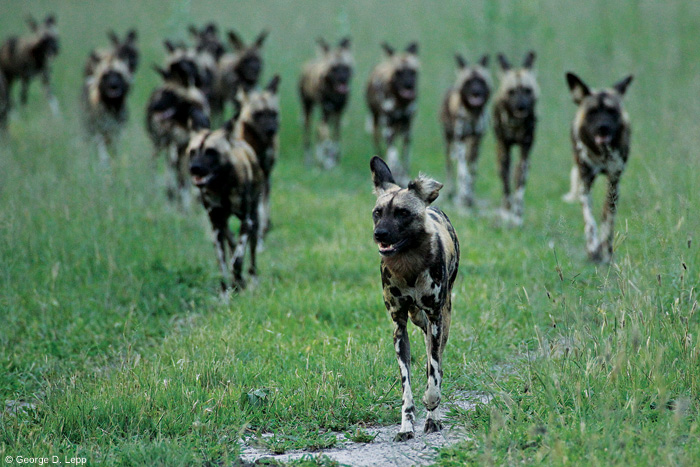
Group of wild dogs from a photograph taken by George Lepp.
Dogs offer many beautiful examples of the benefits of community. For the reason that their ancient genes, long before they became domesticated animals, still guide their behaviours. When dogs lived in the wild, their natural pack size was around fifty animals. There were just three dogs that had pack status; the alpha, beta and omega dogs. Or more usefully described as the Mentor, Minder and Nanny dogs. (As is still the case in wild dog pack families.)
As has been explained previously in this place, all three dogs of status, wild or domesticated, are born into their respective roles, with their ‘duties’ in their pack being instinctive. There was no such thing as competition for that role as all the other dogs in that natural pack grouping would be equal participants with no ambitions to be anything else.
One doesn’t need to reflect for very long before the obvious question arises: If fifty dogs is the optimum number for a pack of dogs, is there a limit to the number of people we can have in the human equivalent of a pack?
Well, says anthropologist Robin Dunbar, that number is about 150 persons. Robin Dunbar achieved fame by drawing a graph that plotted primates’ social group size as a function of their brain sizes. He inputted the average human brain size into his model, and up came the number 150. Beyond that number is past the upper bounds for both hunter-gatherer tribes and Palaeolithic farming villages. More than that, it appears that everything from startup employee counts to online social networks show this number as a fairly consistent maximum for creating and maintaining close social ties.
Once more, a great lesson from our dogs – wrap the strength of a community around you.
I’m writing this post approaching midnight (UTC) on the afternoon of Tuesday, 26th May, 2015. In other words, approaching 00:00 UTC 27/05/15. (Or, in American speak 05/27/15.)
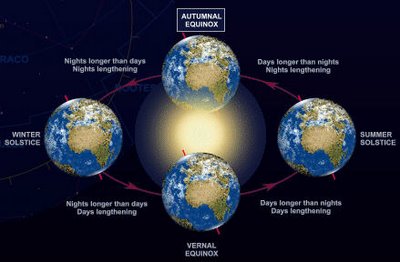
In fewer than four weeks it will be the moment of the Summer solstice, as in the Northern Hemisphere’s Mid-Summer’s Day. More precisely explained over on EarthSky.org together with a number of very interesting facts:
The solstice comes on June 21, 2015 at 16:38 UTC. For North American time zones, that places the solstice at 12:38 p.m. EDT, 11:38 a.m. CDT, 10:38 a.m. MDT and 9:38 a.m. PDT.
The planet Earth has been in orbit around the sun for a very long time! Time beyond imagination. By comparison, in a very short time one species alone, namely homo sapiens, has altered the biosphere of Planet Earth. It’s almost beyond comprehension!
To expand on that notion, let me republish an essay from TomDispatch from last September. Republished with the kind permission of Tom Engelhardt.
ooOOoo
Tomgram: Rebecca Solnit, What to Do When You’re Running Out of Time
Posted by Rebecca Solnit at 8:09am, September 18, 2014.
Follow TomDispatch on Twitter @TomDispatch.
Just when no one needed more lousy news, the U.N.’s weather outfit, the World Meteorological Organization (WMO), issued its annual Greenhouse Gas Bulletin. It offered a shocking climate-change update: the concentrations of long-lasting greenhouse gases in the Earth’s atmosphere (carbon dioxide, methane, and nitrous oxide) rose at a “record-shattering pace” from 2012 to 2013, including the largest increase in CO2 in 30 years — and there was a nasty twist to this news that made it even grimmer.
While such increases reflected the fact that we continue to extract and burn fossil fuels at staggering rates, something else seems to be happening as well. Both the oceans and terrestrial plant life act as carbon sinks; that is, they absorb significant amounts of the carbon dioxide we release and store it away. Unfortunately, both may be reaching limits of some sort and seem to be absorbing less. This is genuinely bad news if you’re thinking about the future warming of the planet. (As it happens, in the same period, according to the Yale Project on Climate Change Communication, parts of the American public stopped absorbing information in no less striking fashion: the number of those who believe that global warming isn’t happening rose 7% to 23%.)
So consider this a propitious moment for a major climate-change demonstration, possibly the largest in history, in New York City this Sunday. [Ed:it turned out to be the largest climate march in history.] As the WMO’s Secretary-General Michel Jarraud pointed out, there is still time to make a difference. “We have the knowledge and we have the tools,” he said, “for action to try to keep temperature increases within 2°C to give our planet a chance and to give our children and grandchildren a future. Pleading ignorance can no longer be an excuse for not acting.” As TomDispatch regular Rebecca Solnit, author of the indie bestseller Men Explain Things to Me, points out, the pressure of mass movements can sometimes turn history upside down. Of course, the only way to find out if climate change is a candidate for this treatment is to get out in the streets. So, for those of you anywhere near New York, see you this Sunday! Tom
The Wheel Turns, the Boat Rocks, the Sea Rises
Change in a Time of Climate Change
By Rebecca Solnit
There have undoubtedly been stable periods in human history, but you and your parents, grandparents, and great-grandparents never lived through one, and neither will any children or grandchildren you may have or come to have. Everything has been changing continuously, profoundly — from the role of women to the nature of agriculture. For the past couple of hundred years, change has been accelerating in both magnificent and nightmarish ways.
Yet when we argue for change, notably changing our ways in response to climate change, we’re arguing against people who claim we’re disrupting a stable system. They insist that we’re rocking the boat unnecessarily.
I say: rock that boat. It’s a lifeboat; maybe the people in it will wake up and start rowing. Those who think they’re hanging onto a stable order are actually clinging to the wreckage of the old order, a ship already sinking, that we need to leave behind.
As you probably know, the actual oceans are rising — almost eight inches since 1880, and that’s only going to accelerate. They’re also acidifying, because they’re absorbing significant amounts of the carbon we continue to pump into the atmosphere at record levels. The ice that covers the polar seas is shrinking, while the ice shields that cover Antarctica and Greenland are melting. The water locked up in all the polar ice, as it’s unlocked by heat, is going to raise sea levels staggeringly, possibly by as much as 200 feet at some point in the future, how distant we do not know. In the temperate latitudes, warming seas breed fiercer hurricanes.
The oceans are changing fast, and for the worse. Fish stocks are dying off, as are shellfish. In many acidified oceanic regions, their shells are actually dissolving or failing to form, which is one of the scariest, most nightmarish things I’ve ever heard. So don’t tell me that we’re rocking a stable boat on calm seas. The glorious 10,000-year period of stable climate in which humanity flourished and then exploded to overrun the Earth and all its ecosystems is over.
But responding to these current cataclysmic changes means taking on people who believe, or at least assert, that those of us who want to react and act are gratuitously disrupting a stable system that’s working fine. It isn’t stable. It is working fine — in the short term and the most limited sense — for oil companies and the people who profit from them and for some of us in the particularly cushy parts of the world who haven’t been impacted yet by weather events like, say, the recent torrential floods in Japan or southern Nevada and Arizona, or the monsoon versions of the same that have devastated parts of India and Pakistan, or the drought that has mummified my beloved California, or the wildfires of Australia.
The problem, of course, is that the people who most benefit from the current arrangements have effectively purchased a lot of politicians, and that a great many of the rest of them are either hopelessly dim or amazingly timid. Most of the Democrats recognize the reality of climate change but not the urgency of doing something about it. Many of the Republicans used to — John McCain has done an amazing about-face from being a sane voice on climate to a shrill denier — and they present a horrific obstacle to any international treaties.
Put it this way: in one country, one party holding 45 out of 100 seats in one legislative house, while serving a minority of the very rich, can basically block what quite a lot of the other seven billion people on Earth want and need, because a two-thirds majority in the Senate must consent to any international treaty the U.S. signs. Which is not to say much for the president, whose drill-baby-drill administration only looks good compared to the petroleum servants he faces, when he bothers to face them and isn’t just one of them. History will despise them all and much of the world does now, but as my mother would have said, they know which side their bread is buttered on.
As it happens, the butter is melting and the bread is getting more expensive. Global grain production is already down several percent thanks to climate change, says a terrifying new United Nations report. Declining crops cause food shortages and rising food prices, creating hunger and even famine for the poorest on Earth, and also sometimes cause massive unrest. Rising bread prices were one factor that helped spark the Arab Spring in 2011. Anyone who argues that doing something about global warming will be too expensive is dodging just how expensive unmitigated climate change is already proving to be.
It’s only a question of whether the very wealthy or the very poor will pay. Putting it that way, however, devalues all the nonmonetary things at stake, from the survival of myriad species to our confidence in the future. And yeah, climate change is here, now. We’ve already lost a lot and we’re going to lose more, but there’s a difference between terrible and apocalyptic. We still have some control over how extreme it gets. That’s not a great choice, but it’s the choice we have. There’s still a window open for action, but it’s closing. As the Secretary-General of the World Meteorological Society, Michel Jarraud, bluntly put it recently, “We are running out of time.”
New and Renewable Energies
The future is not yet written. Look at the world we’re in at this very moment. The Keystone XL tar sands pipeline was supposed to be built years ago, but activists catalyzed by the rural and indigenous communities across whose land it would go have stopped it so far, and made what was supposed to be a done deal a contentious issue. Activists changed the outcome.
Fracking has been challenged on the state level, and banned in townships and counties from upstate New York to central California. (It has also been banned in two Canadian provinces, France, and Bulgaria.) The fossil-fuel divestment movement has achieved a number of remarkable victories in its few bare years of existence and more are on the way. The actual divestments and commitments to divest fossil fuel stocks by various institutions ranging from the city of Seattle to the British Medical Association are striking. But the real power of the movement lies in the way it has called into question the wisdom of investing in fossil fuel corporations. Even mainstream voices like the British Parliament’s Environmental Audit Committee and publications like Forbes are now beginning to question whether they are safe places to put money. That’s a sea change.
Renewable energy has become more efficient, technologically sophisticated, and cheaper — the price of solar power in relation to the energy it generates has plummeted astonishingly over the past three decades and wind technology keeps getting better. While Americans overall are not yet curtailing their fossil-fuel habits, many individuals and communities are choosing other options, and those options are becoming increasingly viable. A Stanford University scientist has proposed a plan to allow each of the 50 states to run on 100% renewable energy by 2050.
Since, according to the latest report of the U.N.’s Intergovernmental Panel on Climate Change, fossil fuel reserves still in the ground are “at least four times larger than could safely be burned if global warming is to be kept to a tolerable level,” it couldn’t be more important to reach global agreements to do things differently on a planetary scale. Notably, most of those carbon reserves must be left untapped and the modest steps already taken locally and ad hoc show that such changes are indeed possible and that an encouraging number of us want to pursue them.
ooOOoo
In case you are wondering why this TomDispatch essay has been published in this place some ten months after it first appeared over at TD, it is simply because I made a note to leave it for a few months to see if the benefit of some hindsight put the essay into context.
Here’s the context.
In the month of September, 2014, when this essay was published over on TomDispatch, the Atmospheric CO2 monthly average was 395.26 ppm. In April, 2015 it was 403.26 ppm. I can’t spell it out any better than what is written on the home page of CO2Now.org:
What the world needs to watch
Global warming is mainly the result of CO2 levels rising in the Earth’s atmosphere. Both atmospheric CO2 and climate change are accelerating. Climate scientists say we have years, not decades, to stabilize CO2 and other greenhouse gases.
To help the world succeed, CO2Now.org makes it easy to see the most current CO2 level and what it means. So, use this site and keep an eye on CO2. Invite others to do the same. Then we can do more to send CO2 in the right direction.
Reinforcing the need to move personhood beyond the human person.
Yesterday, I wrote about the moves to have the concept of personhood extended to chimpanzees. Here’s a small extract:
The order to show cause on the issue of habeas corpus is the first step in a process which Steven Wise and the Nonhuman Rights Project (NhRP) hope will secure Hercules and Leo’s bodily liberty and integrity. If the court were to find in their favour, the chimpanzees would no longer be kept for research and could be moved to a sanctuary in Florida.
Last Friday, George Monbiot published an essay that reinforced our need to regard our animals differently than hitherto; especially our larger animals. It is my pleasure to republish it with Mr. Monbiot’s permission.
ooOOoo
Megadeath
22nd May 2015
The destruction of some of the last of the huge animals that shaped us inflicts a great wound in our lives.
By George Monbiot, published on the Guardian’s website 22nd May 2015
When I read about the attacks on the world’s remaining elephants and rhinos, the first thought that enters my head is: “these creatures used to be everywhere”. Almost every area of land and sea, in every region of the world, had a megafauna. Elephants lived throughout Europe, Asia, Africa and America until very recently in ecological time (30,000 years ago in Europe, 14,000 years ago in the Americas). Rhinos lived across Africa, Asia and Europe. Temperate forest rhinos lived in Britain during previous interglacials, and woolly rhinos lived here in colder periods. Russia was haunted by two gigantic species: humpbacked rhinos the size of elephants, eight feet to the crest, weighing perhaps five tonnes.
Lions were everywhere except Australasia (that had a marsupial equivalent); tigers ranged to the borders of Europe; hippos wallowed in British rivers; hyaenas survived into the early Mesolithic in Britain and northern Europe. All this is easily forgotten in a world afflicted by Shifting Baseline Syndrome: our habit of conceptualising as natural and normal the ecosystems that prevailed in our own youth, unaware that they were, even then, in an extremely degraded state.
The places in which monsters remain are the last tiny redoubts of what was once a global population. Of the 42 species of terrestrial mammals weighing more than a tonne that existed on Earth when modern humans left Africa, just eight are left: the African and Asian elephants, the larger of the two hippopotamus species and the black, white, Indian, Javan and Sumatran rhinos. Seven of them are threatened and four are critically endangered.
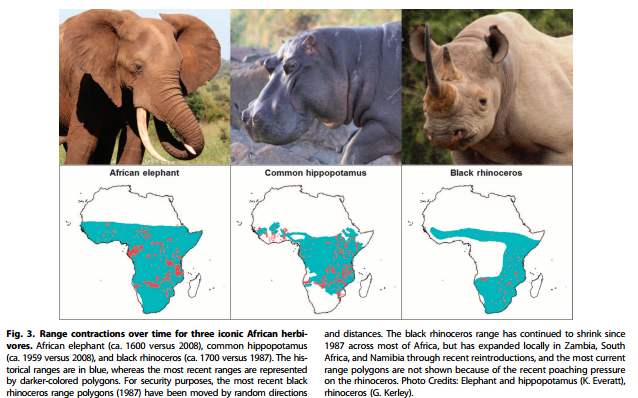
Even in the relatively recent past, the area of land over which these animals roamed has drastically declined. Maps published in a new paper in the journal Science Advances show that elephants, hippos and black rhinos occupied most of sub-Saharan Africa when their populations were first encountered by modern Europeans, but are now confined to a few tiny specks of land.
From William J. Ripple et al, 1st May 2015. Collapse of the world’s largest herbivores. Science Advances. 2015;1:e1400103
Why do the very large animals prove most susceptible to destruction? It’s partly because they reproduce slowly and partly because they require plenty of land and food for their survival, so the destruction of wild places tends to hit them sooner than it affects smaller species. But it’s also, I believe, because we have a deep-rooted urge to assert our status by killing them and owning their body parts. Even when people don’t do the killing themselves, possessing their skins, heads, tusks or horns has long been a means of acquiring bragging rights.
From the exquisite sculpture of two reindeer migrating across a river, carved from a piece of mammoth ivory 13,000 years ago and now housed in the British Museum, to the tiger skin rugs and heads of exotic beasts exhibited in stately homes today, bigging ourselves up by displaying our mastery of great beasts seems to be a fundamental human trait. Today’s aristocrats, some of whom are descendants of tribal chiefs, hang their ancestors on the wall to establish their genealogy and the heads of the animals they have killed beside them, to establish their prowess. Not much has changed in thousands of years.
Many of the world’s great sagas, tales of Ulysses, Sinbad, Sigurd, Beowulf, Cú Chulainn, St George, Arjuna, Lạc Long Quân and Glooskap, tell of struggles with megafauna real or imagined. Doubtless at least some of these stories originated in real battles with beasts whose true nature has been forgotten, as a result of their extinction. Think of Sinbad and the roc, which might be a garbled version of encounters with the elephant bird of Madagascar.
Today, some very rich people try to recreate these battles in ways that seem to me grotesque. They bid on the internet for the right to shoot a particular animal, sometimes paying tens of thousands of dollars, arrange a date, a time and a place, then fly over, in some cases with their taxidermists in tow, to bag the creature they have bought.
The animal is waiting for them – sometimes in an enclosure, sometimes just after being released from one, sometimes in the wild but already located by guides. There is no question about the outcome; otherwise the money would have to be repaid. I have heard that in some cases these people fly to a country for just a couple of days, during which they have booked the killing of several spectacular animals. Their diary secretaries arrange their schedules so that they can fit them all in. Once they have posed triumphantly with a foot on the beast they have just killed, they leave it for the taxidermist to process and move on to the next appointment with death.
This looks to me as dry and joyless as it is brutal and unsporting. Though I would struggle nowadays to bring myself to shoot a mammal or a bird (in my youth I killed and ate a few rabbits, squirrels and pigeons), I can understand the attraction of doing so in difficult circumstances, stalking and crawling and lying in wait much as a wild predator would. Canned, predetermined hunting of this kind seems empty of challenge and romance, bought rather than won. But such is the drive to establish dominion over the largest and most magnificent of beasts, and such is the obsession with conspicuous outcomes, that, for some people, none of this appears to matter.
Others are satisfied to remove themselves even further from contingency, by purchasing pieces of animals that have already been killed. My guess is that the use of rhino horn, tiger bones and other such body parts in traditional Chinese medicine, which are of course clinically useless, might be another manifestation of this deep-rooted drive, to make ourselves feel better by association with creatures larger or fiercer than ourselves.
You might have imagined that there were now plenty of alternative means of asserting our status and persuading ourselves of our own value, but traits that resonate with our evolutionary past – our ghost psyche – die hard.
So this great global tragedy continues. I know I should write about it more often. But I find it too upsetting.
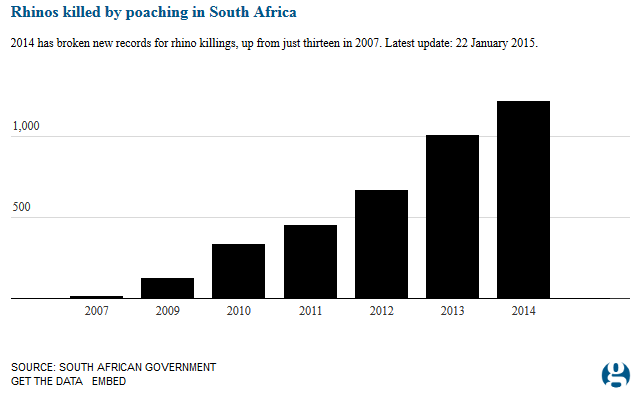
Until 2008, conservationists, in some places at least, appeared to be winning. But in that year the number of rhinos killed in South Africa rose (from 13 in 2007) to 83. By 2011, the horrible tally had risen to 448. It climbed to 668 in 2012, 1004 in 2013 and 1215 in 2014. In the first four months of this year, 393 rhinos have been killed there, which is 18% more than in the same period last year.
The reasons for this acceleration in the Great Global Polishing are complex and not always easy to tease out. But they appear to be connected to rising prosperity in Vietnam, the exhaustion of illegal stocks held by Chinese doctors and, possibly, speculative investment in a scarce and tangible asset during the financial crisis. Corruption and judicial failure help to keep the trade alive.
Already, the western black rhino is extinct (the declaration was made in 2011). The northern white rhino has been reduced to five animals: a male at the end of its anticipated lifespan and four females, scattered between Kenya, the US and the Czech Republic.
Similar stories can be told about some populations of elephants – in particular the forest elephants of West and central Africa.
It’s not just these wonderful, enchanting creatures that are destroyed by poaching, but also many of the living processes of the places they inhabit. Elephants and rhinos are ecological engineers, creating conditions that hundreds of other species have evolved to exploit.
As the paper in Science Advances notes, the great beasts maintain a constantly shifting mosaic of habitats through a cycle of browsing and toppling and trampling, followed by the regrowth of the trees and the other plants they eat. They open up glades for other herbivores, and spaces in which predators can hunt. They spread the seeds of trees that have no other means of dispersal (other animals are too small to swallow the seeds whole, and grind them up). Many trees in Africa and Asia are distributed exclusively by megaherbivores.
They transport nutrients from rich places to poor ones and in some places reduce the likelihood of major bushfires, by creating firebreaks and eating twigs and leaves that would otherwise accumulate as potential fuel on the ground. Many animal species have co-evolved with them: the birds that eat their ectoparasites, the fish that feed on hippos’ fighting wounds (some of these species, I believe, are now used for fish pedicures), the wide range of life that depends on their dung for food and moisture, on their wallows for habitats, on the fissures they create in trees for nesting holes.
Who knows what ecological processes the world has already lost through the retreat of the megafauna? Everywhere on earth, living systems have been radically altered by the loss of the great beasts. (I’ll be discussing the impacts of the extinction of European elephants in next month’s edition of BBC Wildlife magazine).
The destruction of some of the last populations of the animals that shaped us, as well as the natural world, inflicts, I feel, a great wound in our lives, diminishing the wonderful planet on which we evolved, shrinking imagination, crushing experience. All of us should have an interest in supporting those who seek to save these wonderful creatures.
Dear Reader, I don’t intend to cast you in some dark mental place with the republication of this dark essay from Mr. Monbiot. Yet if you care about the world that we are leaving for the next generation, and I’m certain that the majority, the vast majority, of you readers do so care, then these terrible aspects of humanity must be highlighted. For if just one person is moved to make a difference then the mental pain is a necessary step on that journey of making a difference.
“Always search for the rainbow – it’s there somewhere. If
Loving the animals on this planet must be more than a romantic notion.
Before you read on, take a small break in your busy day and watch the following:
On December 8, 2013 Michael Mountain spoke on “”I Am Not an Animal” — The Signature Cry of our Species” at the Personhood Beyond the Human conference at Yale University.
Michael Mountain is Past President and one of the founders of Best Friends Animal Sanctuary, the nation’s largest sanctuary for abused and abandoned animals.
Abstract: The past 50 years have seen enormous growth in the animal protection movement. But the situation for nonhuman animals in every sphere, with the exception of homeless pets, continues to deteriorate. Any small advances remain incremental. Animal rights and welfare groups find themselves at a loss to explain their inability to influence the general public. But the work of Ernest Becker (The Denial of Death) and of psychologists in the field of Terror Management Theory (TMT) offer essential insight.
In this talk, we discuss how our need, as humans, to proclaim that “I am not an animal!” and to deny personhood to other animals affects our relationship with them at a fundamental level. We argue that to be effective, the animal protection movement needs to understand TMT and take it into account. And we conclude that a new kind of relationship to the world of nature in the 21st Century is not only essential to the mitigation of the catastrophic effects of the Sixth Great Extinction, but that it also holds the key to Becker’s still-unanswered question of how we can begin to relate positively to our own terror of personal mortality — and therefore our own future as a species.
Me spending time becoming better acquainted with the subject of rights for other animals besides us humans coincided with a recent item published over on The Conversation and republished here within their rights.
ooOOoo
May 19 2015, 4.05pm EDT
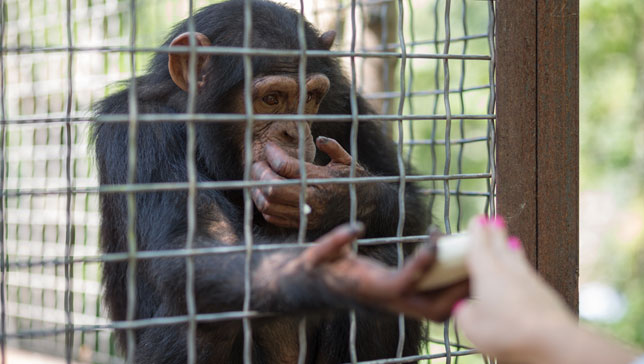
Climbing the tree: the case for chimpanzee ‘personhood’
Should primates such as chimpanzees be given rights normally reserved for humans? phil/Flickr, CC BY-NC-SA
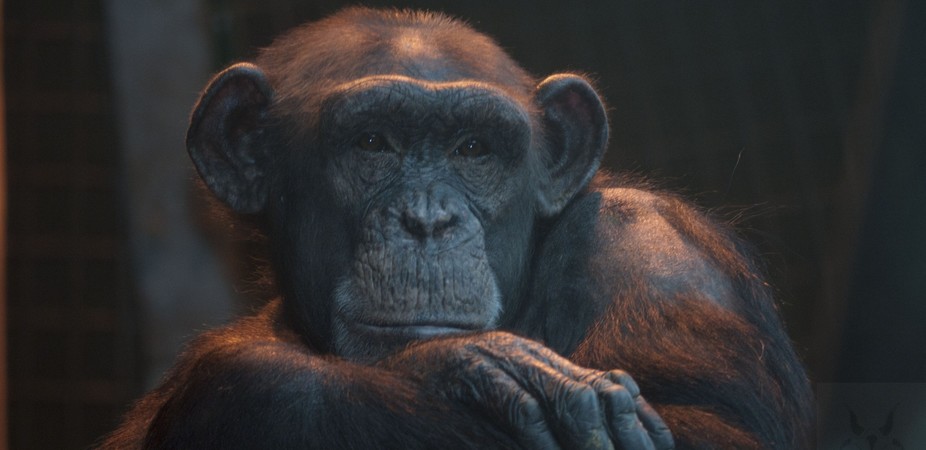
Hercules and Leo don’t know it, but a decision about their future has made history. In granting an order to show cause on whether Hercules and Leo (who just happen to be chimpanzees) are illegally imprisoned, a Supreme Court judge in Manhattan has kept open the possibility that some nonhuman animals will be granted legal rights under common law.
The plaintiffs are currently used for biomedical research at New York’s Stony Brook University. What the lawyers running the case hope to show is that Hercules and Leo shouldn’t be treated as if they were just things or property, but should instead be given the status of persons.
Showing that any animal has what is needed for legal personhood is a difficult task. But chimpanzees seem promising candidates as there is a wealth of scientific evidence showing they possess complex cognitive abilities, like self-awareness and autonomy.
The order to show cause on the issue of habeas corpus is the first step in a process which Steven Wise and the Nonhuman Rights Project (NhRP) hope will secure Hercules and Leo’s bodily liberty and integrity.
If the court were to find in their favour, the chimpanzees would no longer be kept for research and could be moved to a sanctuary in Florida.
NhRP was founded by Wise in 2007 and after years of research it filed its first cases back in December 2013. To date it has brought three cases on behalf of chimpanzees held in captivity in the state of New York. But NhRP is ambitious, aiming to run as many cases on behalf of animals as it can fund.
If it can find suitable plaintiffs, NhPR hopes to mount cases for the personhood of elephants, whales and dolphins too.
Different perspectives on personhood for animals
Reactions to treating nonhuman animals as persons vary widely. Some people think it is ridiculous to even entertain the idea. Persons have to be human – end of story.
For philosophers, this is not very satisfactory. It tries to answer the question of whether animals can be persons by asserting a definition rather than offering an argument. It gets more interesting when people give reasons to support their view.
One approach to defending the idea that only humans are persons involves saying that persons need to participate in society. Society is founded on reciprocity; you can’t just take rights without also assuming responsibilities. And animals like chimpanzees can’t take on responsibilities, so they can’t have rights.
Another tactic is to suggest that there is a whole heap of criteria that one has to meet to be a person. And although humans meet these criteria, nonhuman animals don’t. These criteria could include things like being rational, self-aware, autonomous, having culture and being able to communicate.
The problem is neither of these kinds of arguments stand up to interrogation. There are lots of humans who get the benefit of rights without living up to reciprocal responsibilities, such as young children and people with certain physical or mental impairments.
There are similar difficulties when using a criteria based approach. Just as there are many humans who don’t meet certain criteria for personhood, there are some nonhuman animals who do.
This is known as the “problem of marginal cases”. Taking a consistent approach would mean treating some animals, but not all humans, as worthy of moral consideration.
This is known as the “problem of marginal cases”. Taking a consistent approach would mean treating some animals, but not all humans, as worthy of moral consideration.
There are other people who are sympathetic towards giving greater ethical consideration to animals, but who don’t think using personhood is the best approach. Utilitarians, for example, worry about the capacity to suffer. If a chimpanzee – or for that matter a dog, cat or rat – can experience pleasure and pain, then they matter regardless of whether they meet a test for personhood.
Implications of nonhuman animals as persons
If Wise and the NhRP win their case it will be a significant precedent and other cases will surely follow. Chimpanzees in jurisdictions where successful cases are mounted will no longer be permitted to be used in research or kept in zoos and circuses.
However, less charismatic animals – ones that don’t look like us or where it is not in our interests to grant them rights – won’t be so fortunate. Historically, there is a deep inconsistency in how we treat different types of animals that is not easily overturned, even in the face of compelling legal and ethical arguments.
The case of Hercules and Leo also has connections to Australia. Wise was inspired to practice animal law back in the 1980s after reading the work of Australian philosopher, Peter Singer. The hearing of the case in New York was actually interrupted due to Wise’s long-standing commitment to visit Australia and deliver the 2015 Voiceless Animal Law Lecture Series.
The hearing is now scheduled for 10:30am Wednesday May 27 at the New York County Supreme Court. Those interested in seeking rights for nonhuman animals keenly await the outcome.
ooOOoo
Towards the end of that piece, one sentence stood out. This one: “Historically, there is a deep inconsistency in how we treat different types of animals that is not easily overturned, even in the face of compelling legal and ethical arguments.“
Well it has to be overturned if mankind is to have any future on this planet!
Yet another aspect of our lives where taking a lesson from our dogs would do us no harm.
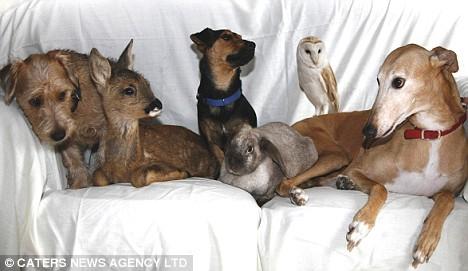
Pictured left to right are: “Toby”, a stray Lakeland dog; “Bramble”, orphaned roe deer; “Buster”, a stray Jack Russell; a dumped rabbit; “Sky”, an injured barn owl; and “Jasmine”. All told a mother’s heart doing best what a caring mother does.


 Learning from Dogs