I stuck this in my drafts folder and then promptly forgot about it!
But despite the aurora taking place nearly two months ago, the pictures are stunning and I wanted still to share them with you. They came to my attention thanks to the EarthSky blogsite.
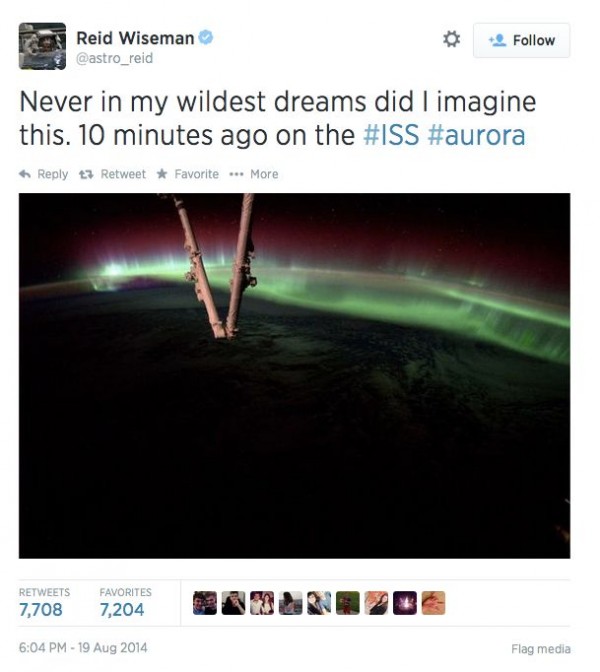
One of the first auroras of the 2014 autumn season appeared last night at northerly latitudes. Astronaut Reid Wiseman caught it from space. Photographer Göran Strand caught it from Sweden.
oooo
Astronaut Reid Wiseman captured these images from the window of the International Space Station last night (August 19, 2014). SpaceWeather.com says:
A moderate (G2-class) geomagnetic storm that erupted following a CME strike on August 19th is subsiding now. At its peak, the storm sparked auroras around both poles visible from the ground and from space.
Last night I got to see my first Aurora for the season, two days earlier than last year but five days later than my personal record from 2011 (August 14th).
It was a faint aurora that lasted for several hours and as you can see it was quite cloudy. The orange/yellow clouds to the right are clouds that are lit up by the street lights from the city of Östersund and Frösön.
Finally the dark nights are here so we can enjoy the auroras ahead and let us hope that there will be lots of them during the coming season.
Don’t you think Göran Strand’s photograph is just wonderful!
Like many who read yesterday’s post about this possibly being an age of loneliness I was struck by a terrible sense of sadness in George Monbiot’s words. Take these sentences:
Three months ago we read that loneliness has become an epidemic among young adults. Now we learn that it is just as great an affliction of older people. A study by Independent Age shows that severe loneliness in England blights the lives of 700,000 men and 1.1m women over 50, and is rising with astonishing speed.
Ebola is unlikely ever to kill as many people as this disease strikes down. Social isolation is as potent a cause of early death as smoking 15 cigarettes a day; loneliness, research suggests, is twice as deadly as obesity. Dementia, high blood pressure, alcoholism and accidents – all these, like depression, paranoia, anxiety and suicide, become more prevalent when connections are cut. We cannot cope alone.
It’s my proposition that not being able to cope with being alone derives from being unable to be fully at peace with oneself.
Yet, as dogs remind us so incredibly well, the ability to be on one’s own, to allow the brain to quieten down, to meditate in other words, is essential to our mental well-being. It is an essential part of the journey to find and like oneself. (I hasten to add that I write this without the benefit of any relevant professional knowledge!)
I am a neuropsychologist and have written and taught about the essential inner skills of personal well-being, psychological growth, and contemplative practice – as well as about relationships, family life, and raising children.Probably like you, there’s been a lot of to-ing and fro-ing in my life these days. Change can be interesting, exciting, and fun – but after awhile you start to long for something quieter, more stable.
A couple of weeks ago, the Just One Thing newsletter was all about stillness. It is republished below.
ooOOoo
Just One Thing (JOT) is the free newsletter that suggests a simple practice each week for more joy, more fulfilling relationships, and more peace of mind.
A small thing repeated routinely adds up over time to produce big results.
Things keep changing. The clock ticks, the day unfolds, trees grow, leaves turn brown, hair turns gray, children grow up and leave home, attention skitters from this to that, the cookie is delicious but then it’s all gone, you’re mad about something for awhile and then get over it, consciousness streams on and on and on.
Many changes are certainly good. Most people are glad to put middle school behind them. I’m still happy about shifting thirty years ago from single to married. Painkillers, flush toilets, and the internet seem like pretty good ideas. It’s lovely to watch grass waving in the wind or a river passing. Fundamentally, if there were no change, nothing could happen, reality would be frozen forever. I once asked my friend Tom what he thought God was and he said “possibility.”
On the other hand, many changes are uncomfortable, even awful. The body gets creaky, and worse. We lose those we love and eventually lose life itself. Families drift apart, companies fail, dictators tighten their grip, nations go to war. The planet warms at human hands, as each day we pour nearly a billion tons of carbon into the atmosphere. Countless species go extinct. As William Yeats wrote: “Things fall apart; the centre cannot hold.”
And change itself is often – maybe innately – stressful. When you really open to the fact always in front of our noses that each moment of now decays and disappears in the instant it arises – it can feel rather alarming. Life and time sweep us along. As soon as something pleasant occurs in the mind’s flow we reach for it but whoosh it passes away right through our fingers leaving disappointment behind. Inherently, anything that changes is not a reliable basis for enduring contentment and fulfillment.
Yet it is also true that some things remain always the same. In their stillness you can find a refuge, an island in the stream of changes, a place to stand for perspective and wisdom about events and your reactions to them, a respite from the race, quiet amidst the noise. Perhaps even find a sense of something transcendental, outside the frame of passing phenomena.
How?
Stillness, a sense of the unchanging, is all around, and at different levels. Look for it, explore its effects on you, and let it sink in.
For example, it’s not the ultimate stillness, but there is that lovely feeling when the house is quiet and you’re sitting in peace, the dishes are done and the kids are fine (or the equivalent), and you can really let down and let go. In your character, you have enduring strengths and virtues and values; situations change, but your good intentions persist. In relationships, love abides – even for people who drive you crazy!
More subtly, there is the moment at the very top of a tossed ball’s trajectory when it’s neither rising nor falling, the pause before the first stroke of the brush, that space between exhalation and inhalation, the silence in which sounds occur, or the discernible gap between thoughts when your mind is quiet.
In your mind there is always an underlying calm and well-being that contains emotional reactions, like a riverbed that is still even as the flood rushes over it (if you’re not aware of this, truly, with practice you can find and stabilize a sense of it). There is also the unchanging field of awareness, itself never altered by the thoughts passing through it.
More abstractly, 2+2=4 forever; the area of a circle will always be pi times the radius squared; etc. The fact that something has occurred will never change. The people who have loved you will always have loved you; they will always have found you lovable. Whatever is fundamentally true – including, ironically, the truth of impermanence – has an unchanging stillness at its heart. Things change, but the nature of things – emergent, interdependent, transient – does not.
Moving toward ultimate matters, and where language fails, you may have a sense of something unchangingly transcendental, divine. Or, perhaps related, an intuition of that which is unconditioned always just prior to the emergence of conditioned phenomena.
Wherever you find it, enjoy stillness and let it feed you. It’s a relief from the noise and bustle, a source of clarity and peace. Give yourself the space, the permission, to be still – at least in your mind – amidst those who are busy. To use a traditional saying:
May that which is still be that in which your mind delights.
Much as I respect Mr. Monbiot’s views, I hope he is wrong in this respect.
I have long admired the writings of George Monbiot and, as often as not, have republished his essays in this place.
But an essay by George that was published in the UK Guardian newspaper yesterday portrays a frightening picture of modern-day Britain. It was called Falling Apart and is republished, with George’s permission, today.
I want to offer a personal response to the essay, that immediately follows George’s piece.
ooOOoo
Falling Apart
October 14, 2014
Competition and individualism are forcing us into a devastating Age of Loneliness
By George Monbiot, published in the Guardian 15th October 2014
What do we call this time? It’s not the information age: the collapse of popular education movements left a void now filled by marketing and conspiracy theories(1). Like the stone age, iron age and space age, the digital age says plenty about our artefacts but little about society. The anthropocene, in which humans exert a major impact on the biosphere, fails to distinguish this century from the previous twenty. What clear social change marks out our time from those that precede it? To me it’s obvious. This is the Age of Loneliness.
When Thomas Hobbes claimed that in the state of nature, before authority arose to keep us in check, we were engaged in a war “of every man against every man”(2), he could not have been more wrong. We were social creatures from the start, mammalian bees, who depended entirely on each other. The hominims of East Africa could not have survived one night alone. We are shaped, to a greater extent than almost any other species, by contact with others. The age we are entering, in which we exist apart, is unlike any that has gone before.
Three months ago we read that loneliness has become an epidemic among young adults(3). Now we learn that it is just as great an affliction of older people. A study by Independent Age shows that severe loneliness in England blights the lives of 700,000 men and 1.1m women over 50(4), and is rising with astonishing speed.
Ebola is unlikely ever to kill as many people as this disease strikes down. Social isolation is as potent a cause of early death as smoking 15 cigarettes a day(5); loneliness, research suggests, is twice as deadly as obesity(6). Dementia, high blood pressure, alcoholism and accidents – all these, like depression, paranoia, anxiety and suicide, become more prevalent when connections are cut(7,8). We cannot cope alone.
Yes, factories have closed, people travel by car instead of buses, use YouTube rather than the cinema. But these shifts alone fail to explain the speed of our social collapse. These structural changes have been accompanied by a life-denying ideology, which enforces and celebrates our social isolation. The war of every man against every man – competition and individualism in other words – is the religion of our time, justified by a mythology of lone rangers, sole traders, self-starters, self-made men and women, going it alone. For the most social of creatures, who cannot prosper without love, there is now no such thing as society, only heroic individualism. What counts is to win. The rest is collateral damage.
British children no longer aspire to be train drivers or nurses, more than a fifth now say they “just want to be rich”: wealth and fame are the sole ambitions of 40% of those surveyed(9). A government study in June revealed that Britain is the loneliness capital of Europe(10). We are less likely than other Europeans to have close friends or to know our neighbours. Who can be surprised, when everywhere we are urged to fight like stray dogs over a dustbin?
We have changed our language to reflect this shift. Our most cutting insult is loser. We no longer talk about people. Now we call them individuals. So pervasive has this alienating, atomising term become that even the charities fighting loneliness use it to describe the bipedal entities formerly known as human beings(11). We can scarcely complete a sentence without getting personal. Personally speaking (to distinguish myself from a ventriloquist’s dummy), I prefer personal friends to the impersonal variety and personal belongings to the kind that don’t belong to me. Though that’s just my personal preference, otherwise known as my preference.
One of the tragic outcomes of loneliness is that people turn to their televisions for consolation: two-fifths of older people now report that the one-eyed god is their principal company(12). This self-medication enhances the disease. Research by economists at the University of Milan suggests that television helps to drive competitive aspiration(13). It strongly reinforces the income-happiness paradox: the fact that, as national incomes rise, happiness does not rise with them.
Aspiration, which increases with income, ensures that the point of arrival, of sustained satisfaction, retreats before us. The researchers found that those who watch a lot of television derive less satisfaction from a given level of income than those who watch only a little. Television speeds up the hedonic treadmill, forcing us to strive even harder to sustain the same level of satisfaction. You have only to think of the wall-to-wall auctions on daytime TV, Dragon’s Den, the Apprentice and the myriad forms of career-making competition the medium celebrates, the generalised obsession with fame and wealth, the pervasive sense, in watching it, that life is somewhere other than where you are, to see why this might be.
So what’s the point? What do we gain from this war of all against all? Competition drives growth, but growth no longer makes us wealthier. Figures published this week show that while the income of company directors has risen by more than a fifth, wages for the workforce as a whole have fallen in real terms over the past year (14). The bosses now earn – sorry, I mean take – 120 times more than the average full-time worker. (In 2000, it was 47 times). And even if competition did make us richer, it would make us no happier, as the satisfaction derived from a rise in income would be undermined by the aspirational impacts of competition.
The top 1% now own 48% of global wealth(15), but even they aren’t happy. A survey by Boston College of people with an average net worth of $78m found that they too are assailed by anxiety, dissatisfaction and loneliness(16). Many of them reported feeling financially insecure: to reach safe ground, they believed, they would need, on average, about 25% more money. (And if they got it? They’d doubtless need another 25%). One respondent said he wouldn’t get there until he had $1 billion in the bank.
For this we have ripped the natural world apart, degraded our conditions of life, surrendered our freedoms and prospects of contentment to a compulsive, atomising, joyless hedonism, in which, having consumed all else, we start to prey upon ourselves. For this we have destroyed the essence of humanity: our connectedness.
Yes, there are palliatives, clever and delightful schemes like Men in Sheds and Walking Football developed by charities for isolated older people(17). But if we are to break this cycle and come together once more, we must confront the world-eating, flesh-eating system into which we have been forced.
Hobbes’s pre-social condition was a myth. But we are now entering a post-social condition our ancestors would have believed impossible. Our lives are becoming nasty, brutish and long.
As closing sentences go, that’s about as tough as it gets.
Nevertheless, I’m going to offer a perspective, something that George doesn’t mention. That is the importance of community.
Back in 2008 BBC Timewatch screened a programme about the revelations that came from the latest archaeological dig at Stonehenge, near Amesbury in Wiltshire in England. I wrote about the programme over four years ago: Stonehenge – a place of healing.
Stonehenge is one of Britain’s most famous historical sites, deservedly so because Stonehenge was one of the most important places in ancient Europe.
Stonehenge
But evidence from a dig that was authorised in 2008 has shown that not only is Stonehenge a much older site of human habitation but that it’s purpose is altogether different to what has been assumed. It was, indeed, a healing place, possibly the most important in Europe.
Professors Tim Darvill and Geoff Wainwright are the world-renowned archaeologists who believe they have cracked the conundrum of Stonehenge’s original purpose.
If you would like to watch that Timewatch episode, and it is highly recommended, then someone has neatly uploaded it to YouTube.
The programme clearly offers evidence from the carbon-dating of seeds buried under the famous blue stones that dates this settlement to some 9,000 years BP. The detailed examination of ancient humans buried nearby indicates they came to Stonehenge with a range of diseases, many terminal in nature.
So back to George Monbiot’s essay and the element that screams out at me.
We have lost sight of the huge healing benefits that come from old-fashioned, shoulder-to-shoulder communities.
Not to mention the healing properties of a loving dog or two in one’s life!
Let’s start with the Ebola outbreak with the latest news from the BBC suggesting:
The death toll from the Ebola virus outbreak has risen to 4,447, with the large majority of victims in West Africa, the World Health Organization (WHO) says.
WHO assistant director-general Bruce Aylward also said there could be up to 10,000 new cases a week within two months if efforts were not stepped up,
But the rate of new infections in some areas has slowed down, he added.
Next up.
I’ve been musing as to whether or not I was going to republish a recent essay from George Monbiot. The one in question being The Kink in the Human Brain. It opens, thus:
Pointless, joyless consumption is destroying our world of wonders.
By George Monbiot, published in the Guardian 2nd October 2014
This is a moment at which anyone with the capacity for reflection should stop and wonder what we are doing.
If the news that in the past 40 years the world has lost over 50% of its vertebrate wildlife (mammals, birds, reptiles, amphibians and fish) fails to tell us that there is something wrong with the way we live, it’s hard to imagine what could. Who believes that a social and economic system which has this effect is a healthy one? Who, contemplating this loss, could call it progress?
In fairness to the modern era, this is an extension of a trend that has lasted some two million years. The loss of much of the African megafauna – sabretooths and false sabretooths, giant hyaenas and amphicyonids (bear dogs), several species of elephant – coincided with the switch towards meat eating by hominims (ancestral humans). It’s hard to see what else could have been responsible for the peculiar pattern of extinction then.
My spirits continued downward, especially when I clicked on that first link and read this from the Guardian website:
Rubbish dumped on the tundra outside llulissat in Greenland stand in stark contrast to icebergs behind from the Sermeq Kujullaq or llulissat Ice fjord – a Unesco world heritage site. Photograph: Global Warming Images/WWF-Canon
The number of wild animals on Earth has halved in the past 40 years, according to a new analysis. Creatures across land, rivers and the seas are being decimated as humans kill them for food in unsustainable numbers, while polluting or destroying their habitats, the research by scientists at WWF and the Zoological Society of London found.
“If half the animals died in London zoo next week it would be front page news,” said Professor Ken Norris, ZSL’s director of science. “But that is happening in the great outdoors. This damage is not inevitable but a consequence of the way we choose to live.” He said nature, which provides food and clean water and air, was essential for human wellbeing.
“We have lost one half of the animal population and knowing this is driven by human consumption, this is clearly a call to arms and we must act now,” said Mike Barratt, director of science and policy at WWF. He said more of the Earth must be protected from development and deforestation, while food and energy had to be produced sustainably.
Then a few days ago, one of our neighbours sent me an email with his latest news about ISIS. This is what he sent:
Got this from one of my closest friends today, it came from his brother so I’m pretty confident that it’s true. There is some really bad stuff on the horizon and it’s probably gonna come this way like a runaway train!! Everybody better start thinking about where they want to stand when push comes to shove!
With “this’ being in part:
Missionaries who are in the areas that are being attacked by ISIS. ISIS has taken over the town they are in today. He said ISIS is systematically going house to house to all the Christians and asking the children to denounce Jesus. He said so far not one child has. And so far all have consequently been killed. But not the parents. The UN has withdrawn and the missionaries are on their own. They are determined to stick it out for the sake of the families – even if it means their own deaths. They are very afraid, have no idea how to even begin ministering to these families who have had seen their children martyred. Yet he says he knows God has called them for some reason to be His voice and hands at this place at this time. Even so, they are begging for prayers for courage to live out their vocation in such dire circumstances. And like the children, accept martyrdom if they are called to do so. These brave parents instilled such a fervent faith in their children that they chose martyrdom. Please surround them in their loss with your prayers for hope and perseverance.
One missionary was able to talk to her brother briefly by phone. She didn’t say it, but I believe she believes it will be their last conversation. Pray for her too. She said he just kept asking her to help him know what to do and do it. She told him to tell the families we ARE praying for them and they are not alone or forgotten — no matter what. Please keep them all in your prayers.
Love the poem/verse Illusion. The lines, Following the herd, bleating like sheep, Held captive, half asleep. hit a strong note with me.
As we often wonder why people can’t think for themselves outside the box but then again maybe that is part of being human. Life is a mystery isn’t it? Enjoyed the post,
Maria’s comment about life being a mystery was interpreted by me as humans being a mystery and the realisation that it has ever been so. For it resonated with a recent programme over on the BBC that included information on the ancient Teotihuacan people who ruled in what is present-day Mexico some 2,000 years ago. From Wikipedia:
View of the Avenue of the Dead and the Pyramid of the Sun, from Pyramid of the Moon (Pyramide de la Luna).
Teotihuacan /teɪˌoʊtiːwəˈkɑːn/, also written Teotihuacán (Spanish About this sound teotiwa’kan (help·info)), was a pre-Columbian Mesoamerican city located in the Valley of Mexico, 30 miles (48 km) northeast of modern-day Mexico City, known today as the site of many of the most architecturally significant Mesoamerican pyramids built in the pre-Columbian Americas. Apart from the pyramids, Teotihuacan is also anthropologically significant for its complex, multi-family residential compounds, the Avenue of the Dead, and the small portion of its vibrant murals that have been exceptionally well-preserved. Additionally, Teotihuacan exported a so-called “Thin Orange” pottery style and fine obsidian tools that garnered high prestige and widespread utilization throughout Mesoamerica.
The city is thought to have been established around 100 BC, with major monuments continuously under construction until about AD 250. The city may have lasted until sometime between the 7th and 8th centuries AD, but its major monuments were sacked and systematically burned around 550 AD. At its zenith, perhaps in the first half of the 1st millennium AD, Teotihuacan was the largest city in the pre-Columbian Americas, with a population estimated at 125,000 or more, making it at minimum the sixth largest city in the world during its epoch. Teotihuacan began as a new religious center in the Mexican Highland around the first century AD. This city came to be the largest and most populated center in the New World. Teotihuacan was even home to multi-floor apartment compounds built to accommodate this large population. The civilization and cultural complex associated with the site is also referred to as Teotihuacan or Teotihuacano.
That BBC programme also included the fact that almost on a daily basis the Teotihuacan authorities viewed the assassinations of often hundreds of lower class people as perfectly normal.
In other words, despicable cruelty of man upon man, not to mention an utter disregard for the natural world, has been going on for thousands of years!
Thus it underlined to me, in spades, that what ‘other people’ get up to is, to a very great extent, irrelevant. Because whatever the circumstances we have a choice: we always have a choice. Or if you will forgive me for repeating my closing sentences in yesterday’s post:
Whatever is going on in the world, whatever has the power to create fear in our minds, in the end it comes down to another power, the power of thought, and our choice of the behaviors that we offer the world.
That is why dogs are so important. Because they almost predominantly love sharing and living their lives in the company of humans.
A wonderful message from Sue of Sue Dreamwalker. Reders will recall that last Saturday, under the post title of And we’re back!, I offered a beautiful story told by the coal-mouse bird about the power of change. It included this sentence: “You see, it takes just one snowflake to make a difference.” In a very real sense, an example of that power of one snowflake was perfectly conveyed in Sue’s post a few days previously. Just read it, republished here with Sue’s blessings, and you will understand.
ooOOoo
Illusion.
What do you see in this Reality?
Do not your eyes view what is real to see?
Can you not touch the tangible fusion?
Or do we gaze into the ethers of illusion,
What trickery mocks us as we take in the lies
Binding our thoughts in roots of indoctrination
Following the herd, bleating like sheepHeld captive, half asleep.
What happened to the land of the Free?
Conform or suffer, or pay the penalty
What is your reality?
Come, let me walk you through the misty vale.
To where this illusion significantly pales
We are magnificent magicians whose thoughts cast their magic
Where all is possible, where to doubt is tragic
Seek and Find, let go of fear
Dance in joy as Light penetrates your sphere
For you have forgotten our Time’s lost spell
As into the abyss of darkness you dwell.
Open your eyes and open your hearts.
Let the Light dispel all dark
Fear nothing, hate less, and embrace ALL
Seek a new illusion before you fall.
Stop following blindly, grasp hold of Love today
Remember your tomorrows, forget your yesterdays
Reach for the memory held high up in the stars
And heal from within, let go of all your scars
Sit in the silence; begin to know who you are
As illusion drifts away revealing Ancient Stars
Your time is but a moment, live each moment well,
For soon the illusion shatters, broken like a spell.
I resurrected this poem which I published 4 years ago.. As it seems we are bombarded on all sides from the negative energies which are being put out..
Detach and spend some time in your Quiet zones of thought.. Bring in the Peace around you, and know that we are Magnificent BEings who have remarkable powers..
The Power of Thought!
What we Think we Create
We are the ones creating the chaos… So choose to create Peace.. Don’t allow yourselves to get caught up within the Fear being put out..
Know your time is but a moment, Live each moment well
For soon the Illusion shatters,
Broken like a Spell.
Enjoy your week
Blessings
Sue
ooOOoo
Whatever is going on in the world, whatever has the power to create fear in our minds, in the end it comes down to another power, the power of thought, and our choice of the behaviors that we offer the world.
That is why dogs are so important. Because they almost predominantly love sharing and living their lives in the company of humans.
Do you remember when puppy Oliver came to live with us?
Pharaoh passing on his wisdom to young Oliver.
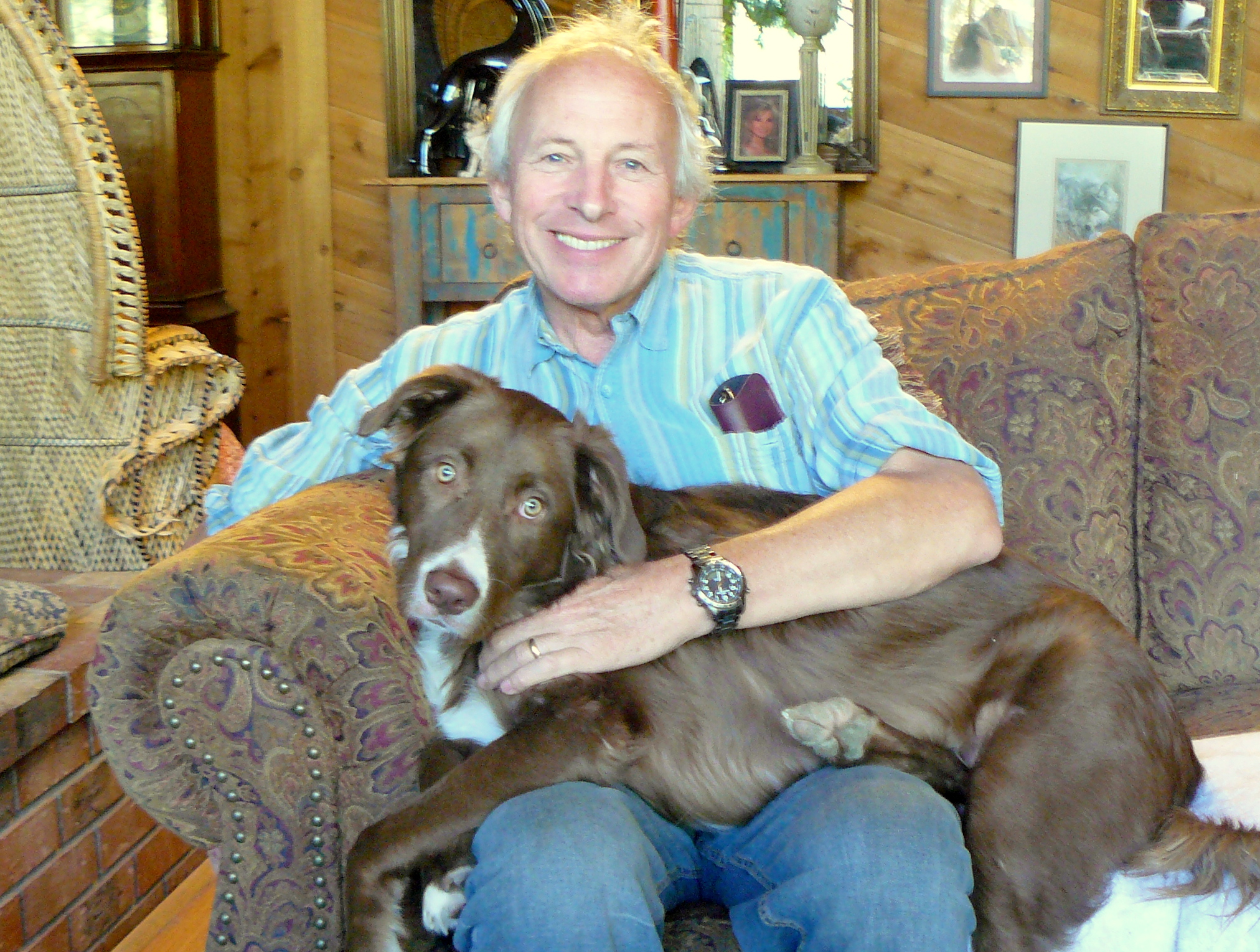
Another picture of Oliver sitting on the lap of yours truly taken in the last couple of days.
How time passes by! For both of us in the picture!
Su Reeve is a good friend of Learning from Dogs as yesterday’s picture parade underlined.
She is also a passionate friend of the many needy feral dogs down in that part of Mexico where she lives with husband Don.
I write this to set the context of an email that came in yesterday from Su addressed to me and Jean.
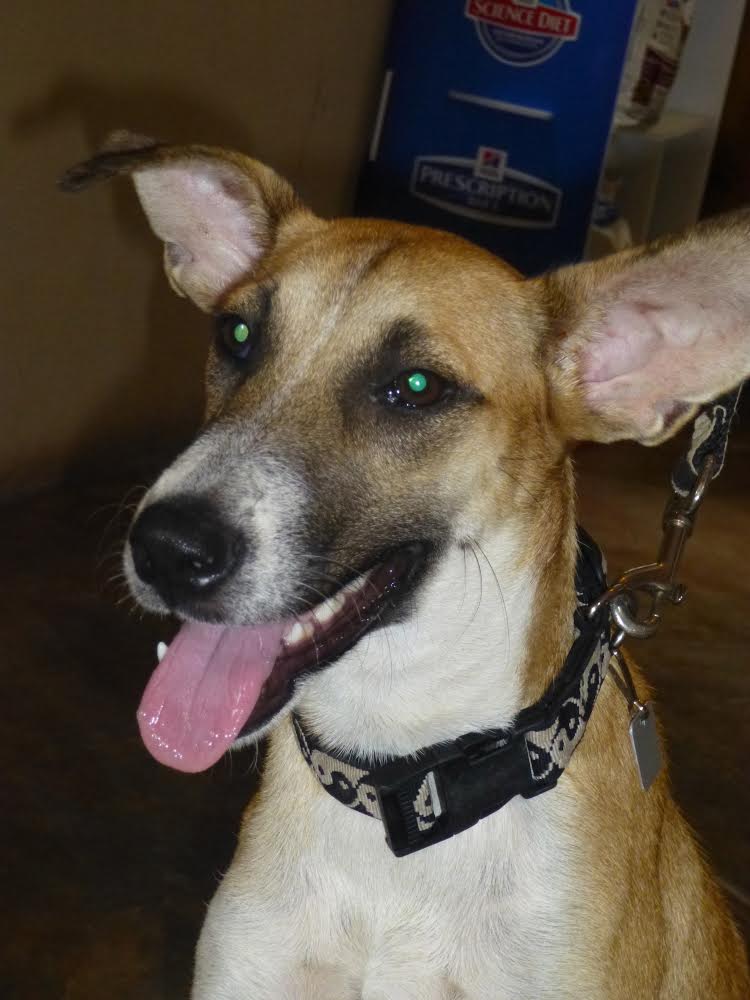
I found her July 2nd in a parking lot in San Carlos (Mexico). I fed her and her mom, who were looking for food. At least the mom was looking for food for her baby girl.
She was about 6 months old and a beautiful, darling little girl.
She came to live with me the 28th of July … and she was the light of our lives. I have written about her before, and at this time do not want to go into it again.
Because at around 9 am this morning, this wonderful, impish little baby girl died suddenly of Acute Pulmonary Edema. She was healthy, happy, fully alive and wonderful. Two minutes later, she was dead …. at 10 months old.
My gardener came in to the house and told me he had the worst news ever…..”please come with me“, he said. I went out to the garage and saw her lying there. I rushed up and pushed on her stomach area and rubbed her body and talked to her for 20 minutes, but she was gone. She had defecated and pee’d and then died.
Oh my dear God, I cannot stop crying. She was so precious. She now is buried in my lower garden with many of my and Jeannie’s dogs and cats, guarded over by a statue of Saint Francis, the Saint of all animals.
Now I must go on and I don’t know how.
Rest in peace, my little one.
Jean and I were aghast at the news and Jean felt the pain as if it had happened to her. I wrote Su asking for permission to publish her email, which was granted promptly as Su’s reply explains.
Diamonte was the most fun-loving, active, playful dog of all of them put together. She was always smiling and happy. I just cannot believe it.
I thought at first she got her collar caught and expired that way, and I heaped all of the fault on myself … tough to bear …. but on second look, there was no movement in the puppy corral and it was not out of place. It was a lot quieter this morning, as she was also the most vocal of the lot …. but I’d give anything to hear her barking this morning ….. 😦
I just cannot believe she is gone. Can’t stop crying over her death.
Please post if you’d like.
Then a little later Su sent me this poem.
I EXPERIENCED A TERRIBLE LOSS YESTERDAY.
IN MY AMATEURISH WAY I WANTED TO LEAVE A TRIBUTE TO A WONDERFUL DOG, AND TO SHARE IT WITH ALL OF YOU.
Diamonte – just nine months old.
I promised your mother I’d protect you, little one.
And now, the only thing I want to do is run.
You died from your heart not wanting to beat.
Your life was so short, but ever so sweet.
You were the one who made us all laugh,
and I am so devastated on your behalf.
I hope that I see you again some day,
And please know we miss you and oh, by the way,
We love you little one.
Even though your life is done,
You lie in my garden with Poncho and others,
along with sisters and brothers.
God wants you with Him to help people see,
That His name spelled backward on earth is the key.
Learning From Dogs is what we must do,
To know how to best live our lives ….. love Sue.
Goodbye little Diamonte,
I miss you so much.
The love we humans experience from our dogs is as close to perfect unconditional love as one can get. It is the one lesson above all others that dogs offer us.
The famous words from British poet Alfred, Lord Tennyson come to mind:
I hold it true, whate’er befall; I feel it when I sorrow most; ‘Tis better to have loved and lost Than never to have loved at all.
I know that everyone who reads today’s post will offer up thoughts of love and compassion to Su.










 Learning from Dogs