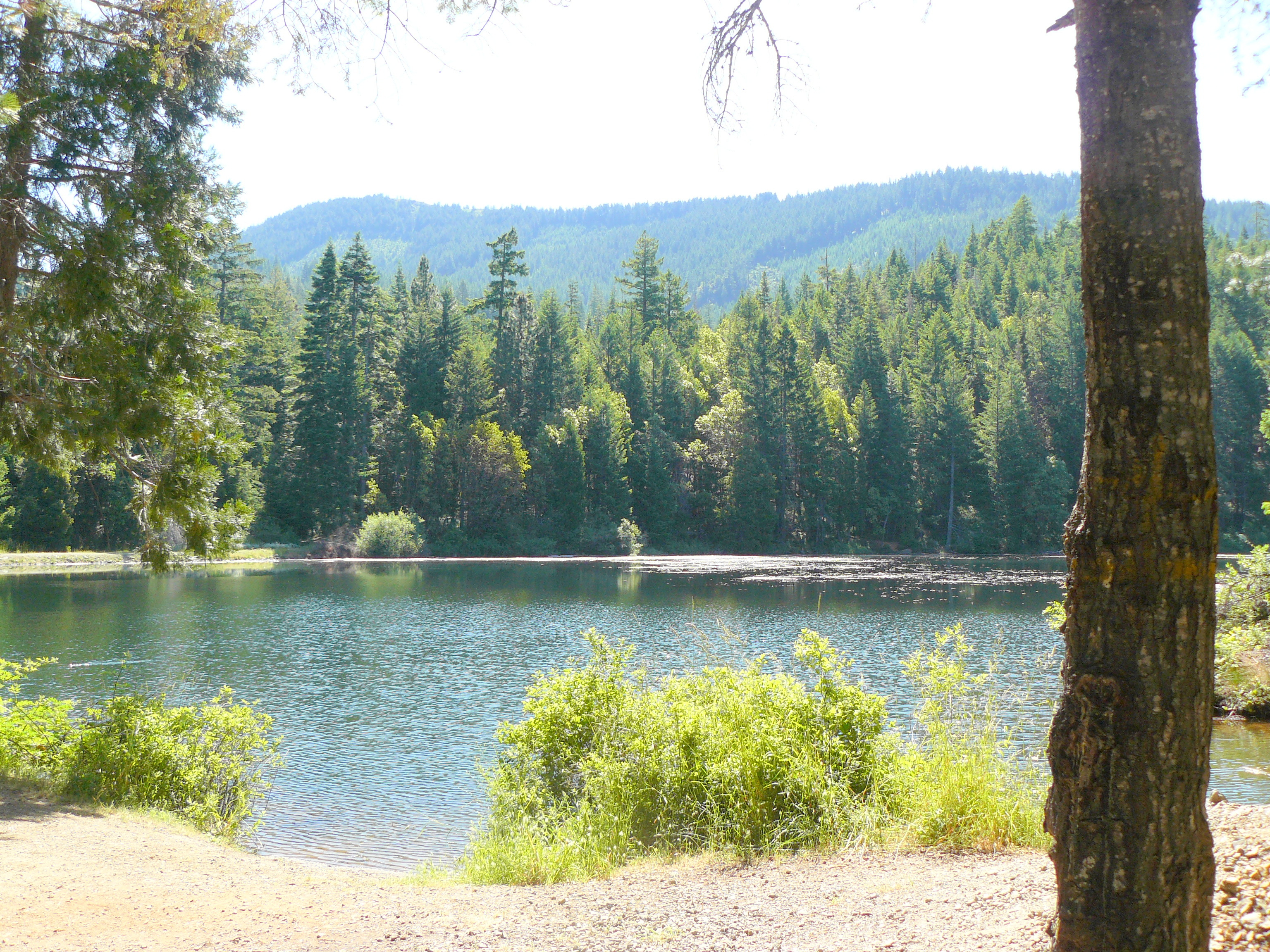
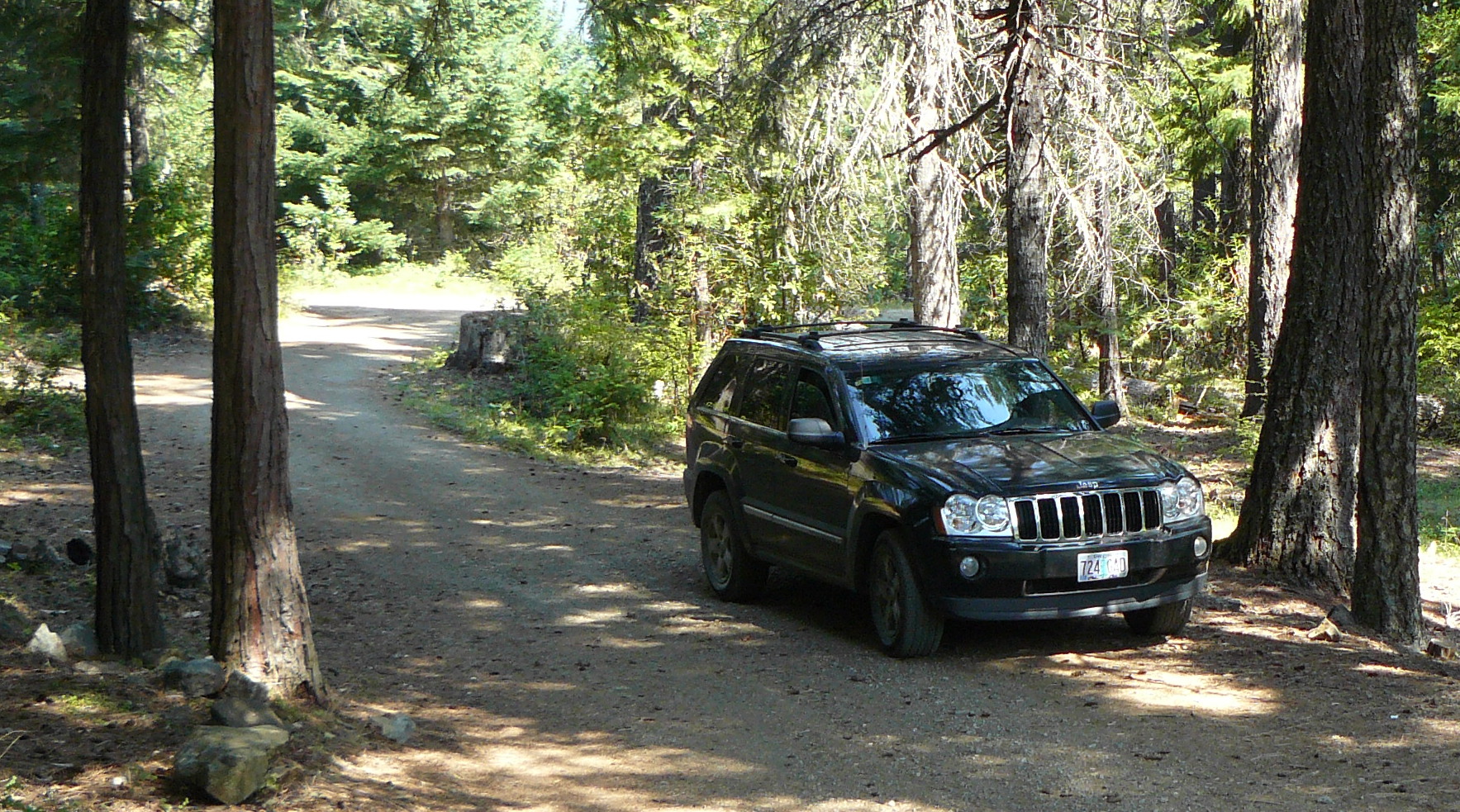
Many of you will know that Elizabeth, my mother from North-West London, is staying with us for a short while. Last Friday, it was decided to drive the 20 miles to the North and along Speaker Road into BLM land and thence up to Secesh Reservoir. This beautiful spot was previously written about in June when we first went to find Secesh. It seemed a perfect spot to take my mother.
Secesh Reservoir.
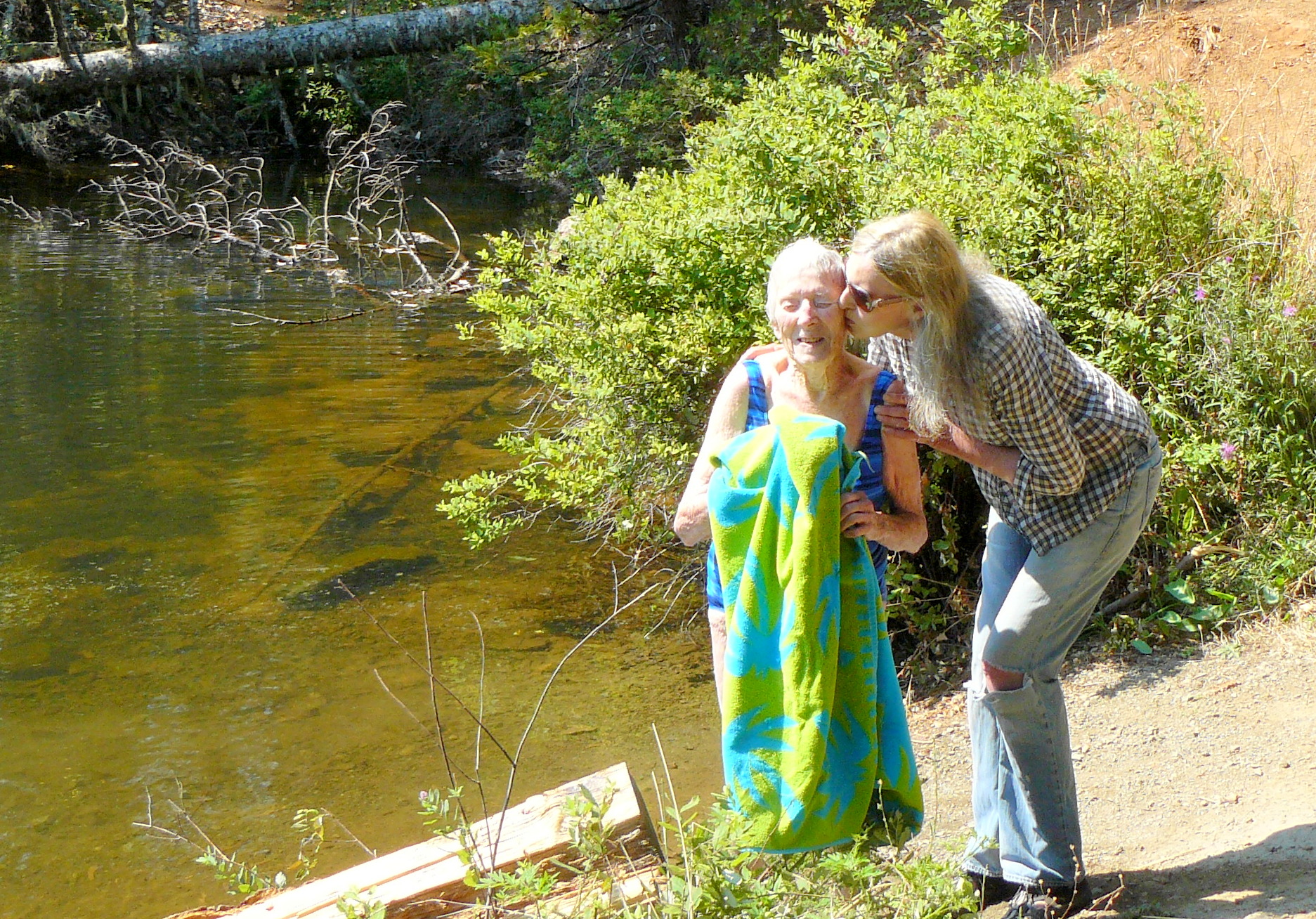
What neither Jean nor I had anticipated was that my mother was determined to swim in Secesh; the remote reservoir is at an altitude of 2,870 feet.
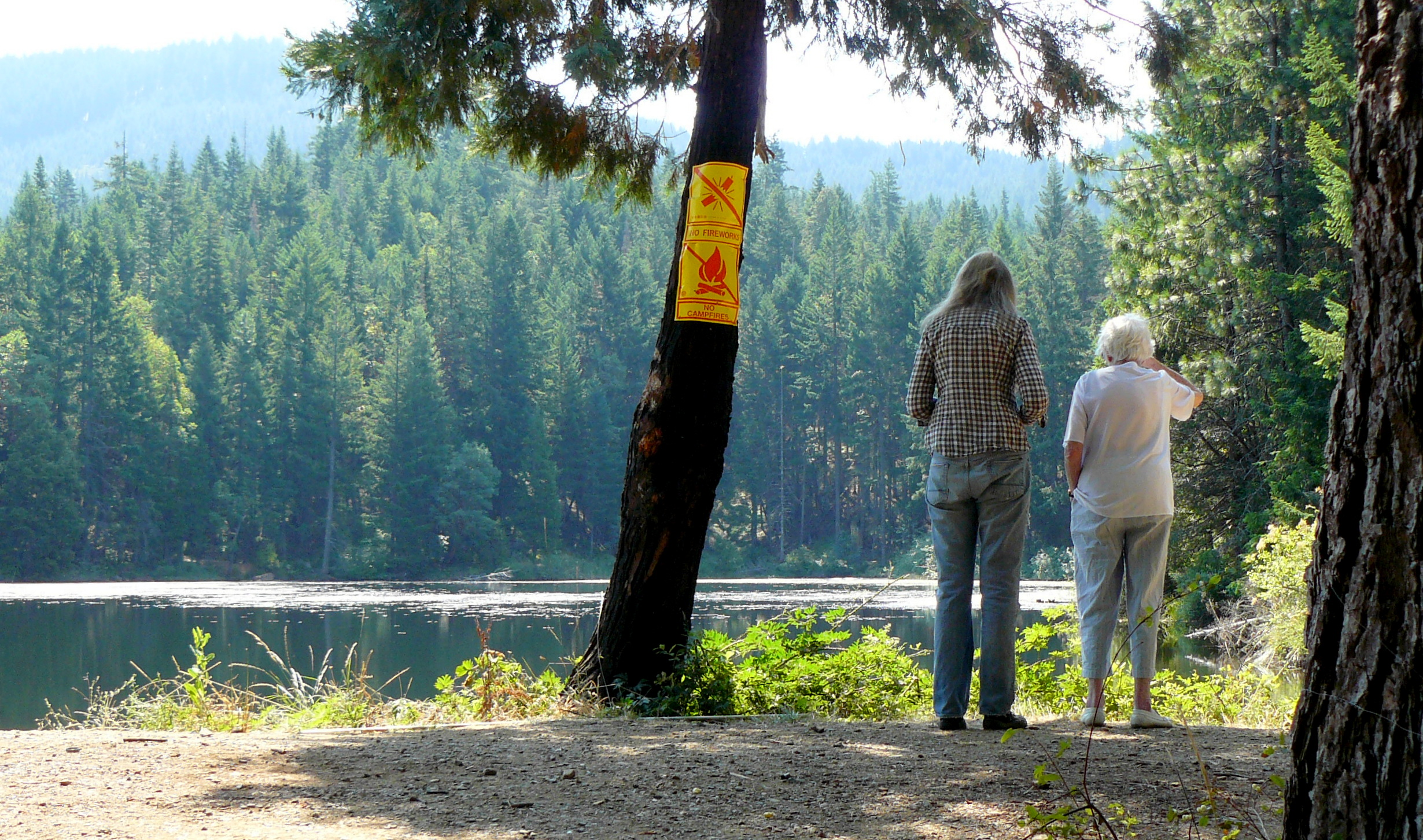
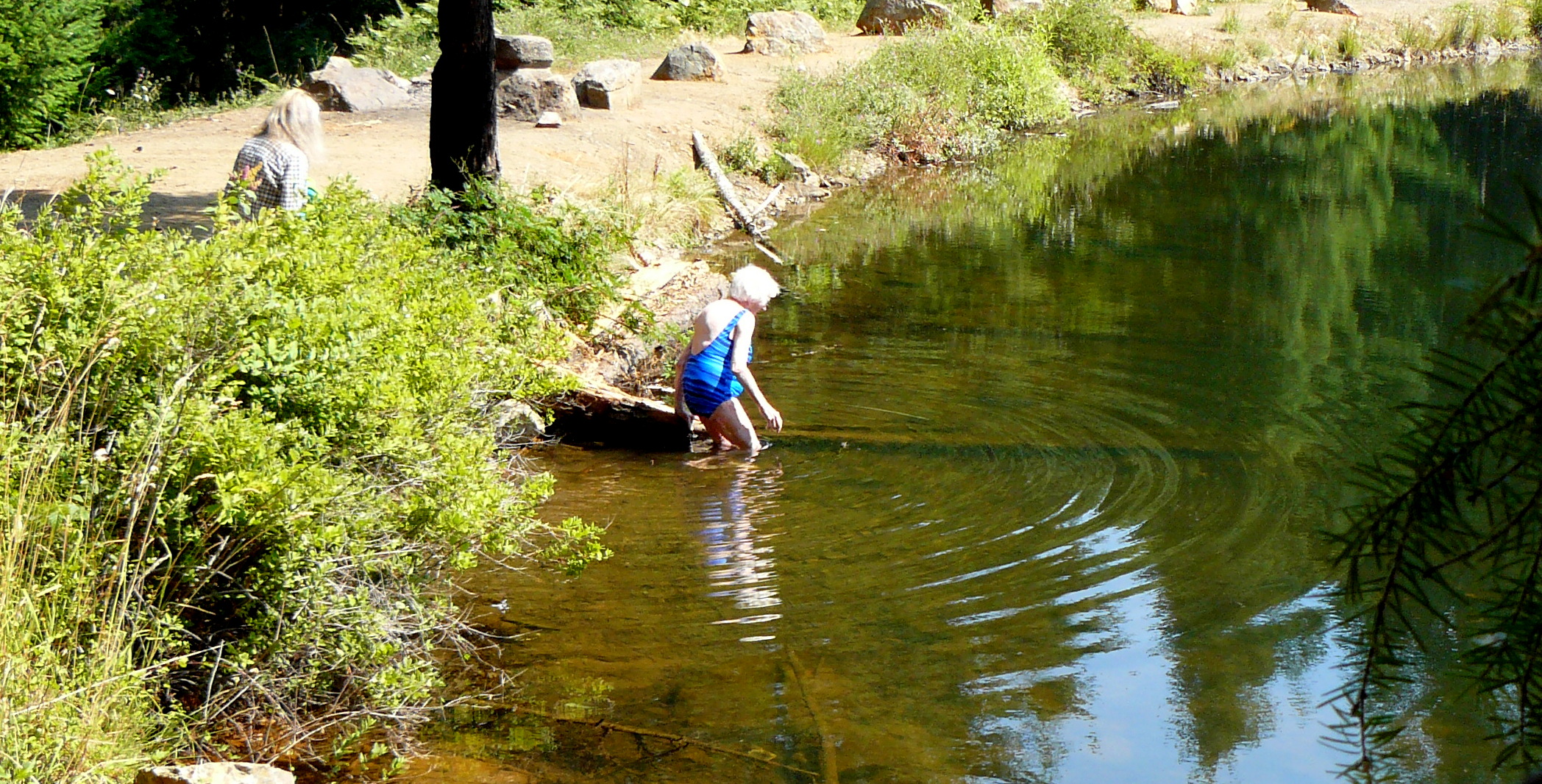
Checking out the best way in!
oooo
Gently does it!
oooo
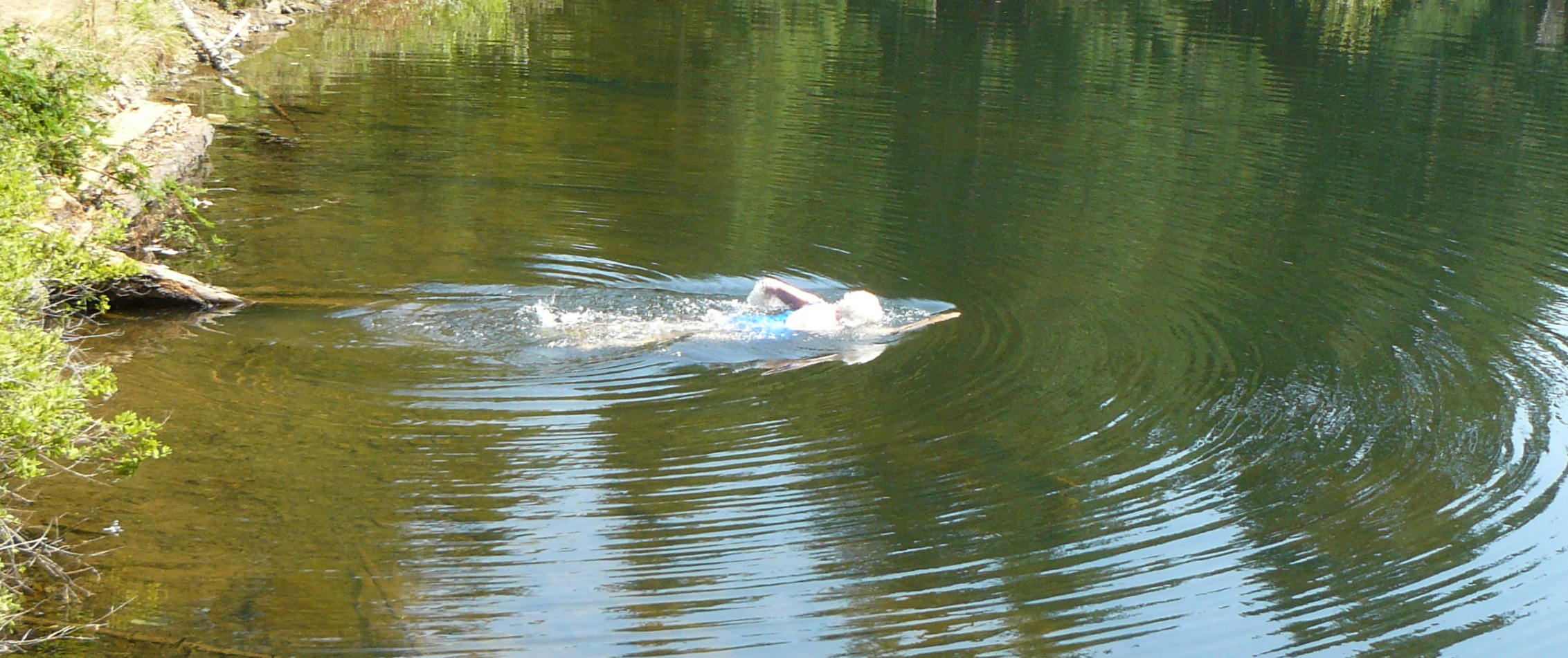
And away we go!
oooo
Fearless!
oooo
And safely back to the shore.
oooo
Jean expressing her love and admiration.
oooo
All good things come to a close.
oooo
Pity about the traffic noise! 😉
Oh, nearly forgot to mention that Elizabeth was born in 1919! That’s 94, by the way!
As I said in the sub-title, this takes some beating!
Jealous wags: Dogs show envy is ‘primordial’ emotion
By Matt McGrath – Environment correspondent, BBC News
These border collies inspired the study on jealousy in dogs.
Jealousy is not just a human condition according to researchers, as it appears to be hard wired into the brains of dogs as well.
Scientists in California found that canines succumbed to the green eyed monster when their owners showed affection to a stuffed dog in tests.
Some experts have argued that jealousy requires complex cognition and is unique to people.
But the authors say their work shows it may also come in a more basic form.
These findings probably won’t be a major surprise to anyone who’s ever owned a dog, but the team say this is the first experimental test of jealous behaviours in man’s best friend.
Human jealousy is a complicated emotion, requiring a “social triangle” and usually arising when an interloper threatens an important relationship.
It is said to be the third leading cause of non-accidental homicide across cultures.
Building on research that shows that six month old infants display jealousy, the scientists studied 36 dogs in their homes and video recorded their actions when their owners displayed affection to a realistic-looking stuffed canine.
Faux fido
Over three quarters of the dogs were likely to push or touch the owner when they interacted with the decoy.
The envious mutts were more than three times as likely to do this for interactions with the stuffed dog compared to when their owners gave their attention to other objects including a book.
Around a third tried to get between the owner and the faux fido, while a quarter of the put-upon pooches snapped at the dummy dog.
“Our study suggests not only that dogs do engage in what appear to be jealous behaviours but also that they were seeking to break up the connection between the owner and a seeming rival,” said Prof Christine Harris from University of California in San Diego.
“We can’t really speak to the dogs’ subjective experiences, of course, but it looks as though they were motivated to protect an important social relationship.”
The researchers believe that the dogs understood that the stuffed dog was real. The authors cite the fact that 86% of the dogs sniffed the toy’s rear end, during and after the experiment.
Jealousy, according to the authors, may have evolved in species that have multiple dependent young that concurrently compete for food and affection.
The argue that jealousy might give an advantage to a young animal that is not only alert to the interactions between its siblings and its parents but is motivated to intervene.
“Many people have assumed that jealousy is a social construction of human beings – or that it’s an emotion specifically tied to sexual and romantic relationships,” said Prof Harris.
“Our results challenge these ideas, showing that animals besides ourselves display strong distress whenever a rival usurps a loved one’s affection.”
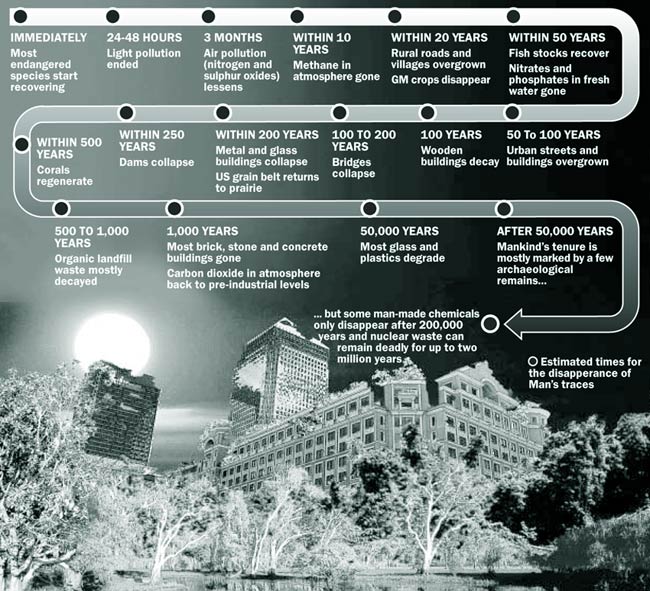
Yesterday, I published a post under the title of Just to focus our minds. It featured a chart that demonstrated how long Planet Earth would take to ‘recover’ if the human race disappeared today.
Why today’s post seemed a perfect companion was because it explores how we could think better. For if the human race doesn’t quickly find a way to think better, then that aforementioned chart may not be such an academic abstract after all.
The post is more or less a copy of what appeared on the Big Think blogsite, a site I have been following for some time now.
ooOOoo
Want to Make a Difference in the World? Think Small
Stephen Dubner
Ambition can work against you by leading you to set unrealistic and overwhelming goals. Want to make a difference in the world? Think small. It’s much less complicated, you’ll have easier access to the data that you’ll need. Most importantly, you will preserve one of your most precious resources: optimism.
Having the will to attack an issue at its root—from launching a socially conscious business to demanding more green spaces in your neighborhood—requires energy and enthusiasm to see the project through. By being less ambitious in your plans you’re more likely to stick with them and be successful.
Besides, when you first developed your problem-solving skills you were small—a child. Stephen Dubner, the co-author, with economist Steven Levitt, of Freakonomics and Think Like a Freak, wants you to go back to that way of thinking:
One of the most powerful pieces of thinking like a child that we argue is thinking small. So I realize that this runs exactly counter to the philosophy of the arena in which I’m appearing which is thinking big, Big Think, but our argument is this. Big problems are by their nature really hard to solve for a variety of reasons. One is they’re large and therefore they include a lot of people and therefore they include a lot of crossed and often mangled and perverse incentives. But also a big problem – when you think about a big problem like education reform. You’re dealing with an institution or set of institutions that have gotten to where they’ve gotten to this many, many years of calcification and also accidents of history. What I mean by that is things have gotten the way they’ve gotten because of a lot of things a few people did many, many years ago and traditions were carried on.
Want to break those traditions and build something new and forward-thinking? Then curb your ambition. Start to look at the world again with the eyes of a child.
Stephen Dubner talks about [that YouTube link reveals the transcript of the talk. PH] the importance of thinking small in order to tackle some of the world’s biggest problems piece by piece. Dubner is the co-author of Think Like a Freak
ooOOoo
Stephen Dubner and economist Steven Levitt co-authored the book Freakonomics. If you are interested, the Freakonomics website is here.
Just to put this into context, if you watched the George Monbiot speech that was the highlight of my post last Tuesday, The Goon Show, you might well have been forgiven for wondering if these are starting to feel like the end-times for species homo sapiens.
Almost perfectly on cue, on Monday, John Hurlburt down in Payson, AZ., sent me the following. It does make one think!
Time Required for the Earth to Heal if the Human Race Disappeared Today
Time Required for the Earth to Heal if the Human Race Disappeared Today.
(While John over the telephone read out the URL that was the source of this ‘chart’, I was unable to link to it. Thus apologies for not recognising the author.)
Then if you are up for more of the same theme, here’s a film that will ‘entertain’ you.
Published on Sep 2, 2012
What will happen when humans disappear from the face of the Earth? This movie will certain make you think about the impact we have made on this beautiful planet. But when humans are gone… Earth does continue.
Imagine if one minute from now, every single person on Earth disappeared. All 6.6 billion of us. What would happen to the world without humans?
How long would it be before our nuclear power plants erupted, skyscrapers crumbled and satellites dropped from the sky?
What would become of the household pets and farm animals? And could an ecosystem plagued with years of pollution ever recover?
Similar to the History Channel’s special Life After People (recommended), Aftermath features what scientists and others speculate the earth, animal life, and plant life might be like if humanity no longer existed, as well as the effect that humanity’s disappearance would have on the artefacts of civilisation.
FAIR USE NOTICE: The material on this channel is provided solely for educational and informational purposes. It may contain copyrighted material, the use of which has not been specifically authorized by the copyright owner. Infringement of copyright is not intended. The material is made available to help educate people about health related issues. It is believed that this constitutes a ‘FAIR USE’ of any such copyrighted material as provided for in Title 17, section 107 of the US Copyright Law. The material is distributed without profit to those who would like to use such material for research and educational purposes.
Undoubtedly, those of you that watched the George Monbiot speech in yesterday’s post will have been struck by at least two key aspects. The first being the utter absurdity in the way that we are being governed (UK and the USA) and the second that change can only come from people bonding at a local level. For it is within local communities that groups of people share their ideas and develop a vision for change that they can stand behind in an open and demonstrable manner.
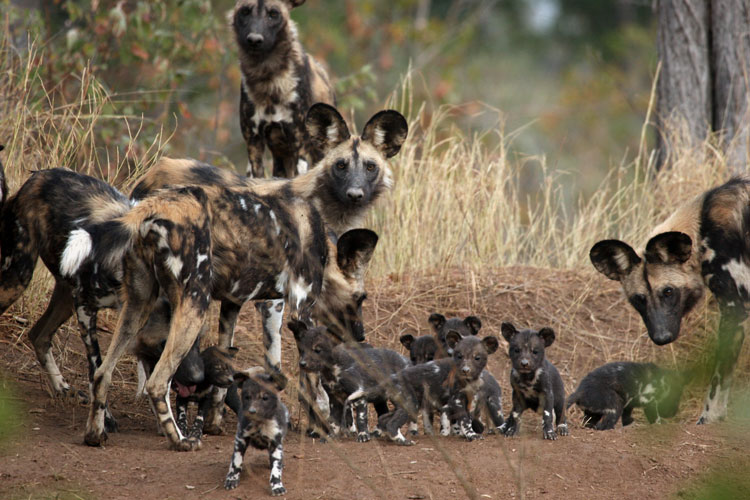
The history of mankind is inseparable from the history of living in communities. It’s only in recent times that so many have chosen to live in cities and towns. Dogs, of course, offer a brilliant and wonderful example of the benefits of community life.
Back to George Monbiot. Here are some of Mr. Monbiot’s words towards the end of his speech. (My emphasis.)
As Lakoff has pointed out, these people are trying to do the right thing but they are completely failing to apply a frames analysis. A frame is a mental structure through which you understand an issue. Instead of framing the issue with our own values and describing and projecting our values – which is the only thing in the medium- to long-term that ever works – we are abandoning them and adopting instead the values of the people who are wrecking the environment. How could there be any long-term outcome other than more destruction?
There’s another way of looking at this, which says the same thing in different ways. All of us are somewhere along a spectrum between intrinsic values and extrinsic values. Extrinsic values are about reputation and image and money. They’re about driving down the street in your Ferrari and showing it to everyone. They are about requiring other people’s approbation for your own sense of well-being.
Intrinsic values are about being more comfortable with yourself and who you are. About being embedded in your family, your community, among your friends, and not needing to display to other people in order to demonstrate to yourself that you are worth something.
The desire for humans to belong to a community was highlighted in a recent article in Time Magazine under it’s Culture section (August 4th). The article was called Atheist “Churches” Gain Popularity—Even in the Bible Belt(again, my emphasis).
Jerry Dewitt (Left), A former Pentecostal minister, DeWitt now leads the secular Community Mission Chapel in Lake Charles, La. Mike Aus (Right), In September 2012, Aus began Houston Oasis, an atheist service that is considered a model for nonbelievers nationwide.
On a clear, Sunny July morning, as churchgoers all around Houston take to their pews, dozens of nonbelievers are finding seats inside a meeting room in a corporate conference center on the city’s west side to listen to a sermon about losing faith. But first there’s the weekly “community moment”–remarks on a chosen topic delivered by the group’s executive director, this time focused on how we’re hardwired to read sensationalized news–as well as announcements about an upcoming secular summer camp. In between, a musician sings softly of Albert Einstein.
The men speaking before the assembled gathering–executive director Mike Aus, who regularly leads the group, and Jerry DeWitt, a visitor who heads a similar gathering in Louisiana–are both deeply familiar with the idea of Sunday ritual.
Later in the article, Mike Aus (see picture above) goes on to say (once more, my emphasis):
There are a lot of people in the free-thought movement who say: Well, this is just mimicking church. But if we don’t offer regular human community and support for nonbelievers, it would be detrimental to the movement.
Whether we like it or not, change is being thrown at us by nature at an unprecedented scale; certainly unprecedented in the experience of homo sapiens. Our only hope is to turn away from the destructive agendas of our present governments all across the world and build change from the grassroots up.
Over this day, the number of subscribers to Learning from Dogs has gone from 1,048 to 1,052!
Usually when a new person opts to follow these scribblings of mine, I have the opportunity to email them or go to their own blog and leave a note of grateful thanks.
But for reasons unknown, these recent new subscribers have signed up ‘anonymously’!
So whoever you are, I want you to know that readers and subscribers are the only reasons this blog has gone on for more than five years.
I’m really showing my age and cultural upbringing through the choice of this title to today’s post.
For The Goon Show was an integral part of my ‘education’ during my formative years. Spike Milligan was an outstanding actor in The Goon Show, a comedy legend, along with Peter Sellers and Harry Secombe; not forgetting the narratives from Wallace Greenslade.
The Goon Show ran from 1951 to 1960 (I was born in 1944) broadcast by the BBC Home Service.
Spike Milligan after receiving his Order of the British Empire (OBE) in 1992.
What’s this all leading up to?
Simply that a recent speech by George Monbiot reveals such utter madness in the upper echelons of the United Kingdom that only reflecting on The Goon Show offers any meaning to this old Brit. Not that the USA escapes Mr. Monbiot’s analysis.
Here’s how the speech opens:
The Pricing of Everything
Ladies and gentlemen, we are witnessing the death of both the theory and the practice of neoliberal capitalism. This is the doctrine which holds that the market can resolve almost all social, economic and political problems. It holds that people are best served, and their prosperity is best advanced, by the minimum of intervention and spending by the state. It contends that we can maximise the general social interest through the pursuit of self-interest.
To illustrate the spectacular crashing and burning of that doctrine, let me tell you the sad tale of a man called Matt Ridley. He was a columnist on the Daily Telegraph until he became – and I think this tells us something about the meritocratic pretensions of neoliberalism – the hereditary Chair of Northern Rock: a building society that became a bank. His father had been Chair of Northern Rock before him, which appears to have been his sole qualification.
While he was a columnist on the Telegraph he wrote the following:
The government “is a self-seeking flea on the backs of the more productive people of this world. … governments do not run countries, they parasitize them.”(1) He argued that taxes, bail-outs, regulations, subsidies, interventions of any kind are an unwarranted restraint on market freedom. When he became Chairman of Northern Rock, Mr Ridley was able to put some of these ideas into practice. You can see the results today on your bank statements.
In 2007 Matt Ridley had to go cap in hand to the self-seeking flea and beg it for what became £27 billion. This was rapidly followed by the first run on a British bank since 1878. The government had to guarantee all the deposits of the investors in the bank. Eventually it had to nationalise the bank, being the kind of parasitic self-seeking flea that it is, in order to prevent more or less the complete collapse of the banking system. (2)
You can read the full transcript and look up the references over on the George Monbiot website.
However, a real bonus is that his speech (delivered without notes!), his SPERI Annual Lecture, hosted by the Sheffield Political Economy Research Institute at the University of Sheffield, was recorded on video.
Please set aside a quiet hour (and a tad) to listen to George Monbiot and wonder at the goon show that we are all acting out! In fact, watching his speech and his answers to a number of questions from the audience will give you something that the transcript just can’t convey. Watch it! You will be inspired!
(SPERI Annual Lecture by George Monbiot: “The Pricing of Everything” at the Octagon in Sheffield, UK, on 29th April 2014.)
Back to dear old Spike Milligan and to close with what seems like a very apt quote of his.
“All I ask is the chance to prove that money can’t make me happy.“
As I have been intimating previously, today is the start of my mother from London visiting us here in Oregon. Thus, as one would expect, time for blogging is going to be restricted. Then in a week’s time, we are also joined by my sister, Elizabeth, who lives in Tokyo. So, dear reader, you will understand if there is a deficit of creative writing, assuming you find some of it creative, why that is.
Thus today, I’m leaning heavily on a recent item I read on the EarthSky blogsite. It’s all about pronking! Yes, I hadn’t come across the word before.
ooOOoo
Does your dog pronk?
Among wild animals, pronking may be a way of avoiding predators. But when you see an animal pronk, you can’t but think it’s leaping for joy.
Alpacas, gazelles, some deer and baby lambs are all known to pronk. That is, they leap into the air as if leaping for joy, lifting all four feet off the ground at once. The fact that – in some species like sheep – young animals do it more than older ones does suggest playfulness. But, among wild animals, pronking may be a way of avoiding predators. It means something like, “Hey, I’m very fit so don’t bother chasing me.”
But how about dogs? I didn’t find much online discussion about true dog-pronking, although many of us, at one time or another, may have seen our dog leaping for joy. I recall my own dog Snoop (rest his soul) released from the car in a South Dakota meadow, leaping and running like crazy through the long grass for maybe 20 minutes, until we called him back. It was one of the most joyful things I’ve ever seen, and definitely one of my best memories of Snoop.
So enjoy the videos below. And, by the way, although it is a survival strategy for some, the very word pronk comes from an Afrikaans verb pronk-, which means show off or strut. It has the same linguistic derivation as our English verb prance.
“Pronking” seems to occur when an animal gets excited and jumps around his field, leaving the ground with all four feet simultaneousl, almost as though he had springs attached to his feet..Often these jumps can be high in the air.No-one really knows why llamas pronk. Certainly it is the response to some sort of excitement or disturbance. It is often infectious; sometimes my entire herd will take off. I am told that it isn’t only llamas but sheep and goats. Those of you old enough to remember BBC’s Magic Roundabout may well recall that Zebedee was a “pronker”. We never had a telly as kids, but I believe Zebedee was a dog (??).
Okay, well, maybe some sheep and wild animals like this young springbok – in Etosha National Park, Namibia – are the only true pronkers. Maybe true pronking has to have the downward-pointing head and stiff-leggedness. But if you ever see your dog do what the dogs in these videos do … you’ll feel happy. Image via Wikipedia.
Bottom line: Among wild animals, pronking seems to be a way of avoiding predators. But when you see an animal pronk, you can’t but think it’s leaping for joy.
ooOOoo
So there you go. Don’t say that Learning from Dogs doesn’t teach you some new words from time to time!







 Learning from Dogs