Year: 2012

Congratulations, Ma’am.

A small tribute from two of Her Majesty’s subjects!

Best wishes for many years ahead as our Queen!

Jean and I managed to watch the hour-long tribute by Prince Charles to his mother’s wonderful Diamond Jubilee week-end.

Here’s a small extract of that programme that appeared on ITN News.

Then thanks to Martin Lack’s latest Post, I discovered that You Tube have the full programme as well.  Here it is – do watch it if you can, it is a lovely, personal and intimate reflection by Prince Charles.

At the end of the programme, both Jean and I felt very nostalgic about the long reign of Her Majesty Queen Elizabeth II.  However much we appreciate the life that we have here in Payson, Arizona, these two old Londoners still feel proud to be British.

There’s a great website here full of all the details of this very special time for Britain.

Finally, the extreme dry conditions of our forest mean that lighting a Jubilee Beacon here at home is out of the question.  The following is our alternative:

Beltane Fire Ritual, Edinburgh, Scotland

It’s what Jean and I do most Sunday evenings anyway!

Fighting pet homelessness, one animal at a time.

With big thanks to Trish for sending me these details.

It may seem entirely irrelevant to the wider world to focus on one homeless dog now taken into care and looking for a loving home but if one ‘raises’ the theme to that of which Learning from Dogs is all about, namely Dogs are integrous animals. We have much to learn from them then not so!

I’m not going to waffle around this for much longer except to ask you to go across to Patrice Ayme’s Blog and read his recent essay, Blood: Appetite Comes With Eating.  It’s a very erudite, and deeply upsetting, commentary on something I touched on in a recent Post.  Patrice writes, “Today we have just one civilization. If it dies, it will have no replacement.”  So go and read the full essay.

So when we wonder why there seems such a departure from integrity within the higher echelons of society, it makes my heart leap to be reminded of the innocence and integrity of dogs (and, of course, all of nature’s animals), and the outstanding beauty of all those who love and care for them.

So forget about the big, wide world for a while and read what Trish emailed me,

Tiny Tinker needs a forever home

Tinker

Found fending for himself on the hot streets of South Phoenix, Tinker is six and a half pounds of pure puppy love! This sweet survivor was in very tough shape when he was rescued from the county shelter and brought to the vet. But while he was being examined, Tinker wouldn’t stop trying to kiss everyone around him, and couldn’t stop wagging his tail! Currently recovering in a foster home, this little trooper desperately needs to find a forever home where he’ll be loved for the rest of his life.

Can you help?

Tinker is a spunky sweetheart who loves to snuggle with people. According to the vet, this 12-year-old Chihuahua is the victim of bad genes and neglect. The poor baby was born with only one good eye, permanently dislocated back knees, and terrible teeth. He’ll have dental work done soon, so he can go to his new home with a healthy smile. But first, he needs to recover completely from kennel cough. His ragged ears are most likely the result of flies biting off the edges.

Despite everything, Tinker is one of the happiest little dogs you’ll ever meet. Extremely affectionate and full of energy, blood tests show he’s in overall good health. He’s already neutered, housetrained and up-to-date on his shots. And once he recovers, all he’ll need is medication for his knees to make him more comfortable. Tinker seems to like other dogs, so would welcome canine companions.

Small Chihuahuas can lead very long lives. And if ever a dog deserved to enjoy many years as someone’s cherished pet, it’s Tinker! If you or someone you know can offer him a good home, please contact Jill at (480) 363-8449 or jill@cdsframing.com.  She’d be thrilled to hear from you and delighted to introduce you to the terrific Tinker, who is living in Phoenix.

You can also help Tinker find a home by posting his adoption flyer wherever you work, play or shop.

Thank you for anything you can do to help Tinker and for everything you do for the animals. Each act of kindness brings us one step closer to No More Homeless Pets®.

And from that flyer comes the following information …

Breed: Mix Chihuahua
Location: Phoenix, Arizona
Sex: Male
Age: Senior
Description: Little Tinker found himself abandoned and left to fend for himself on the rough lonely and HOT streets in Phoenix, Arizona. His previous life, he was not well loved or cared for. When I met this little bugger, I fell in immediate love with him and got him fully vetted. He still needs a couple of teeth extractions but he is in excellent health otherwise – all bloodwork came back negative and normal for any possible under-lying medical conditions.

This is one happy boy! GREAT SELF-ESTEEM, his tail never stops wagging and he only weighs 6 1/2 itty bitty little pounds and yes he is around 12 years old. He is now current on all his vaccinations and is neutered. He has a lot of life and spunk about him despite all he has been thru….very lovable, snuggly, and affectionate little pooch. Tinker would love nothing more than to be your sweet little lap boy and car rides – yes, he loves to go in the car with you.

Pleae consider giving him a loving home – he deserves it!!!!
Contact: Jill Lenz Phone: 480-363-8449 Email: jill@cdsframing.com

So if you know someone who could help, then please follow that up.  If you don’t, then circulate these details just as far and wide as possible.  And if you are a person who might be interested or know someone who might be, and you are in another US State, then email or call Jill Lenz and say you saw the details on Learning from Dogs and somehow we can all work out how to get little Tinker in to your arms.

Thank you.

Talking physics with your dog!

Not as silly as one might think!

Back on the 25th April I ran a Post called Dogs and the Mathematics of Calculus that had been prompted by a lovely email from Richard Hake who is Emeritus Professor of Physics at Indiana University.  (Now here’s a question for yours truly; what does it mean for a Professor to be an Emeritus Professor? Answers as comments please.)

It was very well received.  Then just a few days ago Professor Hake, who admits to being a dedicated lurker of this blogsite, sent me another email with a number of fascinating links.  So here goes with one of those links.

Talking to Your Dog About Physics

A conversation with Chad Orzel

So, why do you talk to your dog about physics?

Lots of reasons, but the main one is that I’m a physics professor. Talking about physics is what I do. Sooner or later I talk to everybody about physics.

I bet that’s a big hit at parties.

You might be surprised. I mean, sure, I get a lot of people making faces and saying how much they hated physics when they took it in college. But some of those same people turn right around and start asking interested questions about the subject.

OK, but why the dog?

Talking to the dog about physics is worthwhile because it can help me see how to explain physics to my human students. Humans all come at the subject with the same set of preconceptions about how the world works, and what “should” happen, and it can be very hard to shake those off. That’s a big barrier to understanding something like quantum physics.

Dogs look at the world in a very different way. To a dog, the world is a neverending source of wonder and amazement. You can walk your dog past the same rock every morning, and every morning, she’ll sniff that rock like she’s never sniffed it before. Dogs are surprised by things we take for granted, and they take in stride things that would leave us completely baffled.

Can you give an example?

Well, take the dog’s bowl, for example. Every now and then, we put scraps from dinner in the bowl when she’s not looking, and she’s become convinced that her bowl is magic– that tasty food just appears in it out of nowhere. She’ll wander over a couple of times a day, and look just to see if anything good has turned up, even when we haven’t been anywhere near the bowl in hours.

This puts her in a better position to understand quantum electrodynamics than many humans.

It does?

Sure. One of the most surprising features of QED, in Feynman’s formulation, is the idea of “virtual particles.” You have an electron that’s moving along, minding its own business, and every now and then, particle-antiparticle pairs just pop into existence for a very short time. They don’t stick around very long, but they have a real and measurable influence on the way electrons interact with each other, and with other particles.

You’re making this up, right?

No, not at all. One set of these interactions is described by a number called the “g-factor” of the electron, and this has been measured to something like fifteen decimal places, and the experimental measurement agrees perfectly with the theoretical prediction. If there weren’t electrons and positrons popping out of nowhere, there’s no way you could get that sort of agreement.

So, what’s this have to do with the dog?

Well, like I said, the dog is perfectly comfortable with the idea of stuff popping into existence out of nowhere. If a great big steak were to suddenly appear on your dining room table, you’d probably be a little perturbed. The dog, on the other hand, would feel it was nothing more than her due.

So she’s perfectly ok with the idea of virtual particles, unlike most humans, who tend to say things like “You’re making this up, right?” She was already convinced that there were bunnies made of cheese popping in and out of the backyard, and just regards QED as a solid theoretical justification for her beliefs.

And this helps humans, how, exactly?

Physics has a reputation as a difficult and unapproachable subject, especially in fields like quantum mechanics, where the predictions of the theory confound our human preconceptions. If you can put aside a few of your usual notions of how the world works, and think about how things look to a dog, some aspects of physics that seem absolutely impossible to accept become a lot more approachable.

Why does this matter, though? Isn’t this all stuff that you need a billion-dollar particle accelerator to see?

Actually, no. It’s a common misconception, but most of the really cool aspects of quantum mechanics that we talk about in the book are experiments that are done on a table-top scale. One of them, the “quantum eraser,” you can even do yourself with a laser pointer and a couple of pairs of polarized sunglasses.

OK, but what is it good for, in a practical sense?

Lots of things. It’s not an exaggeration to say that modern life as we know it would be impossible without an understanding of quantum phyiscs. You need to understand quantum ideas to build the lasers we use in modern telecommunications, and the transistors that are the basis of all modern electronics. The computer I’m typing this on wouldn’t exist without quantum physics.

And there are a whole host of future technologies that are based on quantum ideas. There are exotic applications like quantum computers that can do calculations that would be impossible with any normal computer, and quantum cryptography systems that allow us to make unbreakable codes. But even relatively mundane “green” technologies like more efficient light bulbs, batteries, and solar panels rely on quantum ideas to work.

Quantum physics is everywhere, and drives a huge amount of modern science and technology.

So that’s why people should teach quantum physics to their dogs?

Exactly. Also, it’s just about the coolest thing ever.

How to Teach Physics to Your Dog is published by Scribner can be ordered from Amazon.comIndieBound,Barnes and Noble, and Powell’s.

How to Teach Relativity to Your Dog is published by Basic Books and can be ordered from AmazonBarnes & NoblePowell’s.


Talking or sleeping about physics?

OK, two thoughts to close this off.  The first is to remind you of an early sentence that Chad Orzel wrote, “Talking to the dog about physics is worthwhile because it can help me see how to explain physics to my human students.” and to add that in my next life, I wouldn’t mind coming back as one of Chads dogs!

The second thought is that Chad’s talks with his dogs are pretty relaxed affairs, as the picture above bears out!

Thank you, Professor Hake!


The noblest astronomy affords

Don’t miss the transit of Venus across the Sun.

The full quotation is “This sight…is by far the noblest astronomy affords…” and was reputed to have been made by Sir Edmond Halley of Halley’s Comet fame, see here.  But today’s Post is about Venus.

Venus — Sister to Earth

From the NOAA Science on a Sphere website, we can read this about Venus,

Venus has been referred to as the sister or even twin to Earth by many because of its similar chemical composition, density and size. That, however, is where the similarities end. Venus is not only the hottest planet in the solar system, but also the brightest. Both of these characteristics are the result of the atmosphere that surrounds the planet, which is mainly composed of carbon dioxide and some sulfuric acid. This composition allows for the greenhouse effect to be astronomical causing the planet to have a constant temperature of 864°F. The planet is the brightest because the clouds, composed of sulfur dioxide and sulfuric acid, are highly reflective. The pressure of the atmosphere that surrounds Venus is 90 times that of the atmosphere around Earth, crushing any probes that land on Venus in a matter of hours.

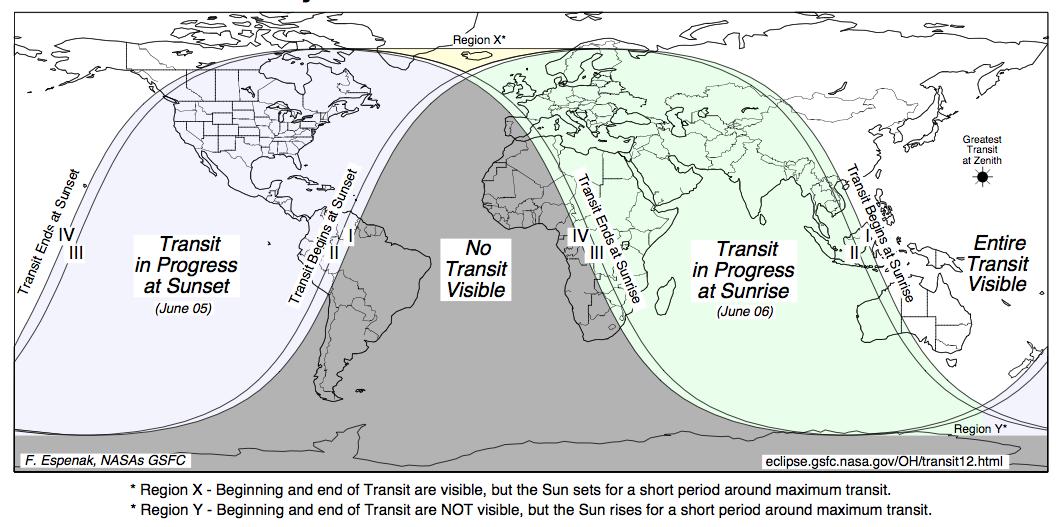
Depending on where you live on Planet Earth you will see the transit on the 5th June, the 6th June or not at all!

Courtesy of Fred Espenak (NASA GSFC), who provides additional transit of Venus data from NASA.

(That additional data referred to above may be found here.)

That transit diagram plus mounds of other interesting stuff is on the Transit of Venus website and on that website this page has the details allowing you to work out what day and time the transit occurs depending on where you are.

To close let me be a little cheeky and reproduce, in full, what appeared on the Science Daily website on the 1st May.

Venus to Appear in Once-In-A-Lifetime Event

ScienceDaily (May 1, 2012) — On 5 and 6 June this year, millions of people around the world will be able to see Venus pass across the face of the Sun in what will be a once-in-a-lifetime experience.

It will take Venus about six hours to complete its transit, appearing as a small black dot on the Sun’s surface, in an event that will not happen again until 2117.

In this month’s Physics World, Jay M Pasachoff, an astronomer at Williams College, Massachusetts, explores the science behind Venus’s transit and gives an account of its fascinating history.

Transits of Venus occur only on the very rare occasions when Venus and Earth are in a line with the Sun. At other times Venus passes below or above the Sun because the two orbits are at a slight angle to each other. Transits occur in pairs separated by eight years, with the gap between pairs of transits alternating between 105.5 and 121.5 years — the last transit was in 2004.

Building on the original theories of Nicolaus Copernicus from 1543, scientists were able to predict and record the transits of both Mercury and Venus in the centuries that followed.

Johannes Kepler successfully predicted that both planets would transit the Sun in 1631, part of which was verified with Mercury’s transit of that year. But the first transit of Venus to actually be viewed was in 1639 — an event that had been predicted by the English astronomer Jeremiah Horrocks. He observed the transit in the village of Much Hoole in Lancashire — the only other person to see it being his correspondent, William Crabtree, in Manchester.

Later, in 1716, Edmond Halley proposed using a transit of Venus to predict the precise distance between Earth and the Sun, known as the astronomical unit. As a result, hundreds of expeditions were sent all over the world to observe the 1761 and 1769 transits. A young James Cook took the Endeavour to the island of Tahiti, where he successfully observed the transit at a site that is still called Point Venus.

Pasachoff expects the transit to confirm his team’s theory about the phenomenon called “the black-drop effect” — a strange, dark band linking Venus’s silhouette with the sky outside the Sun that appears for about a minute starting just as Venus first enters the solar disk.

Pasachoff and his colleagues will concentrate on observing Venus’s atmosphere as it appears when Venus is only half onto the solar disk. He also believes that observations of the transit will help astronomers who are looking for extrasolar planets orbiting stars other than the Sun.

“Doing so verifies that the techniques for studying events on and around other stars hold true in our own backyard.. In other words, by looking up close at transits in our solar system, we may be able to see subtle effects that can help exoplanet hunters explain what they are seeing when they view distant suns,” Pasachoff writes.

Not content with viewing this year’s transit from Earth, scientists in France will be using the Hubble Space Telescope to observe the effect of Venus’s transit very slightly darkening the Moon. Pasachoff and colleagues even hope to use Hubble to watch Venus passing in front of the Sun as seen from Jupiter — an event that will take place on 20 September this year — and will be using NASA’s Cassini spacecraft, which is orbiting Saturn, to see a transit of Venus from Saturn on 21 December.

“We are fortunate in that we are truly living in a golden period of planetary transits and it is one of which I hope astronomers can take full advantage,” he writes.

Editors note: Looking directly at the sun can cause severe and permanent eye damage. Do not look directly at Venus’ transit of the sun.

For more information see Wikipedia article.

Footnote:

I’m going to republish this in full on Monday, 4th June at the usual Learning from Dogs release time of 0700 UTC so to increase the odds of all my readers who would like to see the Transit having the information in good time!

Civilisations do fail!

Any lessons for today from the Valley of the Pyramids at Tucume in Peru?

The view of Huaca Larga (Photo: Heinz Plege/PromPerú)

Let’s set the scene,

It’s amazing to think that anyone lived here, that this valley was once green. Now it is sun-blasted, scorching hot, and the only life is the circling vultures and the rainbow-colored iguanas, like something out of a desert hallucination, skittering across the rocks.

The reminders of past life rise up around me, however, eroded to look more like drip castles than the pyramids they once were. I am in Túcume, the once-grand capital of the Sican culture, Peru’s mythical Valley of the Pyramids.

I am not far from Chiclayo, and even closer to the city of Lambayeque, where the Royal Tombs of Sipán Museum serves as one of the major tourist attractions on the north coast. Here at Túcume however, there are few visitors.

It is not hard to get to the site. Combis leave regularly from Chiclayo and Lambayeque, dropping passengers in the modern village of Túcume, from which an quick mototaxi ride leads to the ruins. By car or taxi, it is about a 30 minute ride from Chiclayo.

There are two main trails marked out across the desert plain in Túcume. One leads to Cerro Purgatorio, a craggy hill overlooking the 26 pyramids that comprise the site. The trail winds across the scorched valley, between several of the pyramids, before arriving at a staircase leading to different scenic overlooks on the face of Purgatorio.

WikiPedia, too, has a short reference.

Then there’s a long and revealing article on the InkaNatura Travel Site, which I recommend you go to.

So what happened at Túcume to cause the civilisation to fail?  Maybe this 10-minute film gives the answers, but just a note to say that there are some potentially upsetting scenes for the younger or more sensitive among us.

So anyone sufficiently brave to say that history won’t repeat itself.

Wonder which would be the ‘cursed cities’?

Inequality, a rich man speaks!

A personal reflection offered by Nick Hanauer.

Mr. Nick Hanauer

I hadn’t come across Mr. Hanauer before but thanks to some Facebook comments by Patrice Ayme found this YouTube video that is well-worth watching.  That’s an understatement!

The fundamental message that is contained in this short video seems critical, well to me it does, to society (that’s all of us, by the way) understanding why so many things seem to be going so very wrong for so many people.  But let me stop there before it becomes another of my rants!

Who is Nick Hanauer?  Here is a small extract from Nick Hanauer’s website,

Nicolas J Hanauer is a partner with Second Avenue Partners, a Seattle venture capital partnership specializing in early state startups and emerging technology. He has had a hand in such companies as Amazon.com and aQuantive among others.

Hanauer’s career began with a position as executive VP of Sales and Marketing at Pacific Coast Feather Company, a family owned manufacturer of basic bedding. In his time in that role, he helped grow Pacific Coast from several million dollars to more than $300 million in sales. Hanauer subsequently served as the company’s Co-Chairman and Chief Strategy Officer and remains Chief Executive Officer.

In 1988, Hanauer co-founded Museum Quality Framing Company, a company that has emerged the largest of its kind on the west coast with 60 locations. Hanauer was also one of the first investors in Amazon.com in 1995, where he served as a Board Advisor until January of 2000.

In 1996, he founded and served as CEO of internet media company Avenue A Media (later re-named aQuantive, Inc.) and became Chairman of the Board upon the first public offering in 2000. aQuantive was purchased by Microsoft in August of 2007 for 6.4 billion dollars; the largest acquisition in Microsoft history.

Now the video; less than 6 minutes long – do watch it!

As  a one-time entrepreneur back in the 80’s I can vouch for much of what Mr. Hanauer proclaims in his video.  The essence of successful marketing for any business, large and small, is understanding your market. Seeing the customer’s world through the customer’s eyes would be another way of putting that.

In plain language that means carefully and closely understanding what your customers, both actual and prospective, require, objectively and subjectively, and providing it to them profitably.  As the middle-classes (don’t like the term but it will have to do) are often the largest market opportunity, then it does follow that a healthy and vibrant middle-class is going to be best overall for the health and vibrancy of a country.  Indeed, in this very inter-connected world, that really equates to the health and vibrancy of our planet.

Which so easily leads on to a core truth. This one.  If all the Governments democratically elected on this planet truly acknowledged the democratic foundation, as Lincoln so ably put it, “government of the people, by the people, for the people” then those governments would be united in the one most important task facing the people – creating a sustainable way for us to live on the only planet we have!

Apologies, it did turn into a rant!

You may also want to read this TED and inequality: The real story.

Dog goes for a 1,700 km run!

A wonderful news item from the BBC from their China ‘desk’.

Some dog run! All 1,700 kilometres across China

Here’s how it was presented on the BBC News website.

A stray dog has completed a 1700km journey across China after joining a cycle race from Sichuan province to Tibet.

The dog, nicknamed “Xiaosa”, joined the cyclists after one of them gave him food.

He ran with them for 20 days, covering up to 60km a day, and climbing 12 mountains.

Cyclist Xiao Yong started a blog about Xiaosa’s adventures, which had attracted around 40,000 fans by the end of the race.

Yong now hopes to adopt Xiaosa.

Luckily, someone smart grabbed the BBC footage and uploaded it to YouTube thus allowing me to include that below:

I did several Google searches for Xiao Yong’s blog but failed to come across it – never mind, it doesn’t detract from a delightful story this Memorial Day week-end here in America.