Year: 2011

The power of shine!

A delightful presentation by Terry Hershey.

Regular followers of Learning from Dogs will recall that in March we had the pleasure of a visit to St Paul’s Episcopal Church, here in Payson, of the well-known Terry Hershey.  He is a great inspirational speaker, based on deep and sound personal values.  Terry’s website is here.

Well it seemed like a nice idea to offer some more of TH.  Here is his presentation on World Communion Day, October 4th 2009, at the First Community Church, Columbus, Ohio.  Letting the light that is in each one of us shine out.

Part One

Part Two

Kathryn Schulz, being right about being wrong!

Life is not a success-only journey. Even the best-laid plans sometimes must be altered and changed. Be open to input and consider any potentially viable alternative. Be willing to be wrong and be willing to start over.” Dr. Phil.

Kathryn Schulz

I am indebted to Daniela Caride of The Daily Tail for passing me details of Kathryn Schulz someone, I must admit, that I had not heard of before.  But Kathryn is the author of the book, Being Wrong.  Here’s how she is described on the TED Talks website,

Kathryn Schulz is a journalist, author, and public speaker with a credible (if not necessarily enviable) claim to being the world’s leading wrongologist.  Her freelance writing has appeared in the New York Times Magazine, Rolling Stone, TIME Magazine, the Boston Globe, the “Freakonomics” blog of The New York Times, The Nation, Foreign Policy, and the New York Times Book Review, among other publications. She is the former editor of the online environmental magazine Grist, and a former reporter and editor for The Santiago Times, of Santiago, Chile, where she covered environmental, labor, and human rights issues. She was a 2004 recipient of the Pew Fellowship in International Journalism (now the International Reporting Project), and has reported from throughout Central and South America, Japan, and, most recently, the Middle East. A graduate of Brown University and a former Ohioan, Oregonian and Brooklynite, she currently lives in New York’s Hudson Valley.

Her website is here and her Blogsite here.

Here’s a flavour of this woman.

Still on the theme of this Blog

More on why this Blog gets written.

Last Wednesday, I set out to explain why the blog is called Learning from Dogs.  If you missed that then it is here.  The focus was on the very special relationship between man and dog that goes back thousands of years.  It has been a critically important relationship for both species.

But there is another aspect to this Blog, as follows: The relationship between dogs and man goes back thousands of years. The theory is that dogs were domesticated between 15,000 and 40,000 years ago although DNA evidence suggests dogs split away from the grey wolf around 100,000 years ago.  Certainly, the dog was the first animal to be domesticated by man. In fact, some archaeologists speculate that man could not have been a successful ‘hunter-gatherer’ without his relationship with the dog and thus been able to progress to farming the earth for food.

The relationship between Planet Earth and man, as in H. sapiens, goes back around 200,000 years. There is little doubt that most people, even with a minimum of awareness about the world that we live in, are deeply worried. On so many fronts there are forbidding and scary views. It feels as though all the certainty of past times has gone; as if all the trusted models of society are now broken. Whether we are talking politics, economics, employment or the environment, nothing seems to be working.

Why is this? What’s the cause?

It would be easy to condemn man’s drive for progress and an insatiable self-centredness as root causes. But it’s not the case.

The root cause is clear. It is this. How mankind has developed is the result of mankind’s behaviours. All of us behave in many ways that are hugely damaging to the survival of our species. It is likely that these behaviours are little unchanged over thousands of years.

But 2000 years ago, the global population of man was just 300 million.

Twelve-hundred years later, in 1800, it was 1 billion. In 1927, just 127 years later, the two-billionth baby was born. In 1960, only 33 years on, the three-billionth baby. (Remember the moon landing in 1969?  Well, of course you do!  There were about three and a half billion people on the planet!)

Just 16 years on, in 1974, the four-billionth baby was born. In 1987, 13 years later, five billion. Around October 1999, the sixth-billionth baby was born!

It’s trending to a billion every decade. 100 million population growth every year, or about 270,000 every single day!

Combine man’s behaviours with this growth of population and we have the present situation. A totally unsustainable situation disconnected from the planet that supports us.

The only viable solution is to amend our behaviours. To tap into the powers of integrity, self-awareness and mindfulness and change our game.

We all have to work with the fundamental, primary relationships we have with each other and with the planet upon which we all depend. We need a level of consciousness with each other and with the living, breathing planet that will empower change. We need spiritual enlightenment on a grand scale.

That’s why we have so much to learn from dogs. They are man’s best friend. They are man’s oldest friend. They have a relationship with us that is very special; almost certainly telepathic. They can show us how we need to live our lives.

Man's oldest, and wisest, friend.

That’s the real reason why this Blog gets written.  Phew! Glad that’s off my chest!

Chernobly, Fukushima and change.

From out of darkness has to come the dawn

One side effect of the earthquake and tsunami that hit Northern Japan on the 11th March causing an explosion at the Fukushima nuclear power station is that the anniversary of the Chernobyl disaster is much more a news item than I suspect it might have been.

The nuclear accident at Chernobyl in Russia occurred on the 26th April, 1986, twenty-five years ago today.  One major difference between the two disasters was, of course, how they were reported.

Here’s a small extract from a fuller article in The Financial Times published on the 19th April written by Tony Barber who was in Russia those 25 years ago.

Twenty-five years after the explosion at the Ukrainian facility, I vividly recall every detail of those terrible days of April 1986. I was a 26-year-old foreign correspondent working in Moscow for Reuters news agency. On Friday, April 25, I flew to Kiev to spend a couple of days with Rhona, an ebullient Scottish friend who was teaching at the city’s university under a British Council programme. I was the only western journalist in Kiev that weekend.

While we caroused the night away, extraordinary events were unfolding 130km to the north. Technicians were conducting experiments that involved the disabling of automatic shutdown mechanisms at the plant’s fourth reactor. After a tremendous power surge, the reactor blew up at 1.23am on Saturday, April 26.

Except for high-ranking Communist party officials, the KGB and a number of scientists, doctors and fire-fighters, no one in the Soviet Union, let alone the wider world, knew anything about this. Soviet habits of secrecy and deception kept millions of people in the dark even as radiation spread across Ukraine, Belarus, Russia and beyond.

Certainly the disaster in Japan was widely broadcast across the world without any delays or restraints.  But the thrust of this Post today is to point out what, in the end, will have to be understood by the majority of the world’s peoples and their representatives in power.  That is that our dependence, our love affair, with cheap carbon-based energy has to come to an end, and soon.

On the 26th March, The Economist published a briefing on nuclear power entitled, When the steam clears.  As with so many of this newspaper’s essays, it was very well written [I am a subscriber to The Economist; have been for years.]  Here’s a taste of the article,

When last year a volcano closed the skies over Europe and a blown-out oil-rig turned the Gulf of Mexico black, there was no widespread enthusiasm for giving up oil or air travel. But nuclear power is much less fundamental to the workings of the world than petrol or aeroplanes. Nuclear reactors generate only 14% of the world’s electricity, and with a median age of about 27 years (see chart) and a typical design life of 40 a lot are nearing retirement. Although the world is eager to fly and thirsts for oil, it has had little appetite for new nuclear power for the past quarter of a century.

And towards the end of the article, this,

Distressing though it is, the crisis at Fukushima Dai-ichi is not in itself a reason for the world to change energy policy. The public-health effects seem likely, in the long run, to be small. Coal, with its emissions of sulphur, mercury and soot, will continue to kill far more people per kilowatt hour than nuclear does. But as an opportunity to reflect it may be welcome.  [my italics]

Power of hope

We need a continued growing awareness of the craziness of using coal and oil as primary sources of energy, and from that awareness a growing political pressure for change.  Change that recognises that mankind’s present energy strategies of continuing to pump carbon-based gases into the atmosphere are insane; pure and simple.

We need more of these examples:

Science Daily

University of Minnesota researchers are a key step closer to making renewable petroleum fuels using bacteria, sunlight and carbon dioxide.

Scientific American magazine

As the world continues to grapple with energy-related pollution and poverty, can innovation help?

The clock is ticking, as I wrote here a few days ago.

Earth Policy Release

Finding the right solutions for the 21st century and the next generation.

Just before presenting the release from the Earth Policy Institute that came out on the 20th, here’s a reminder about watching the film, Plan B, that I wrote about on the 4th April.  It’s a very good film from an excellent and creditable source.  You can watch it for FREE from PBS, BUT ONLY UNTIL THE END OF APRIL!

Here’s the link – Plan B, the film

Now to the release published in full on Learning from Dogs.

Earth Policy Release
World on the Edge
Book Byte
April 19, 2011

“LET NO MAN SAY IT CANNOT BE DONE”

www.earth-policy.org/book_bytes/2011/wotech13_ss5

By Lester R. Brown

We need an economy for the twenty-first century, one that is in sync with the earth and its natural support systems, not one that is destroying them. The fossil fuel-based, automobile-centered, throwaway economy that evolved in western industrial societies is no longer a viable model—not for the countries that shaped it or for those that are emulating them. In short, we need to build a new economy, one powered with carbon-free sources of energy—wind, solar, and geothermal—one that has a diversified transport system and that reuses and recycles everything. We can change course and move onto a path of sustainable progress, but it will take a massive mobilization—at wartime speed.

Whenever I begin to feel overwhelmed by the scale and urgency of the changes we need to make, I reread the economic history of U.S. involvement in World War II because it is such an inspiring study in rapid mobilization. Initially, the United States resisted involvement in the war and responded only after it was directly attacked at Pearl Harbor. But respond it did. After an all-out commitment, the U.S. engagement helped turn the tide of war, leading the Allied Forces to victory within three-and-a-half years.

In his State of the Union address on January 6, 1942, one month after the bombing of Pearl Harbor, President Franklin D. Roosevelt announced the country’s arms production goals. The United States, he said, was planning to produce 45,000 tanks, 60,000 planes, and several thousand ships. He added, “Let no man say it cannot be done.”

No one had ever seen such huge arms production numbers. Public skepticism abounded. But Roosevelt and his colleagues realized that the world’s largest concentration of industrial power was in the U.S. automobile industry. Even during the Depression, the United States was producing 3 million or more cars a year.

After his State of the Union address, Roosevelt met with auto industry leaders, indicating that the country would rely heavily on them to reach these arms production goals. Initially they expected to continue making cars and simply add on the production of armaments. What they did not yet know was that the sale of new cars would soon be banned. From early February 1942 through the end of 1944, nearly three years, essentially no cars were produced in the United States.

In addition to a ban on the sale of new cars, residential and highway construction was halted, and driving for pleasure was banned. Suddenly people were recycling and planting victory gardens. Strategic goods—including tires, gasoline, fuel oil, and sugar—were rationed beginning in 1942. Yet 1942 witnessed the greatest expansion of industrial output in the nation’s history—all for military use. Wartime aircraft needs were enormous. They included not only fighters, bombers, and reconnaissance planes, but also the troop and cargo transports needed to fight a war on distant fronts. From the beginning of 1942 through 1944, the United States far exceeded the initial goal of 60,000 planes, turning out a staggering 229,600 aircraft, a fleet so vast it is hard even today to visualize it. Equally impressive, by the end of the war more than 5,000 ships were added to the 1,000 or so that made up the American Merchant Fleet in 1939.

In her book No Ordinary Time, Doris Kearns Goodwin describes how various firms converted. A sparkplug factory switched to the production of machine guns. A manufacturer of stoves produced lifeboats. A merry-go-round factory made gun mounts; a toy company turned out compasses; a corset manufacturer produced grenade belts; and a pinball machine plant made armor-piercing shells.

In retrospect, the speed of this conversion from a peacetime to a wartime economy is stunning. The harnessing of U.S. industrial power tipped the scales decisively toward the Allied Forces, reversing the tide of war. Germany and Japan, already fully extended, could not counter this effort. British Prime Minister Winston Churchill often quoted his foreign secretary, Sir Edward Grey: “The United States is like a giant boiler. Once the fire is lighted under it, there is no limit to the power it can generate.”

The point is that it did not take decades to restructure the U.S. industrial economy. It did not take years. It was done in a matter of months. If we could restructure the U.S. industrial economy in months, then we can restructure the world energy economy during this decade.

With numerous U.S. automobile assembly lines currently idled, it would be a relatively simple matter to retool some of them to produce wind turbines, as the Ford Motor Company did in World War II with B-24 bombers, helping the world to quickly harness its vast wind energy resources. This would help the world see that the economy can be restructured quickly, profitably, and in a way that enhances global security.

The world now has the technologies and financial resources to stabilize climate, eradicate poverty, stabilize population, restore the economy’s natural support systems, and, above all, restore hope. The United States, the wealthiest society that has ever existed, has the resources and leadership to lead this effort.

One of the questions I hear most frequently is, What can I do? People often expect me to suggest lifestyle changes, such as recycling newspapers or changing light bulbs. These are essential, but they are not nearly enough. Restructuring the global economy means becoming politically active, working for the needed changes, as the grassroots campaign against coal-fired power plants is doing. Saving civilization is not a spectator sport.

Inform yourself. Read about the issues. Share the Earth Policy Institute’s publications with friends. Pick an issue that’s meaningful to you, such as tax restructuring to create an honest market, phasing out coal-fired power plants, or developing a world class-recycling system in your community. Or join a group that is working to provide family planning services to the 215 million women who want to plan their families but lack the means to do so. You might want to organize a small group of like-minded individuals to work on an issue that is of mutual concern. You can begin by talking with others to help select an issue to work on.

Once your group is informed and has a clearly defined goal, ask to meet with your elected representatives on the city council or the state or national legislature. Write or e-mail your elected representatives about the need to restructure taxes and eliminate fossil fuel subsidies. Remind them that leaving environmental costs off the books may offer a sense of prosperity in the short run, but it leads to collapse in the long run.

During World War II, the military draft asked millions of young men to risk the ultimate sacrifice. But we are called on only to be politically active and to make lifestyle changes. During World War II, President Roosevelt frequently asked Americans to adjust their lifestyles and Americans responded, working together for a common goal. What contributions can we each make today, in time, money, or reduced consumption, to help save civilization?

The choice is ours—yours and mine. We can stay with business as usual and preside over an economy that continues to destroy its natural support systems until it destroys itself, or we can be the generation that changes direction, moving the world onto a path of sustained progress. The choice will be made by our generation, but it will affect life on earth for all generations to come.

Adapted from Chapter 13, “Saving Civilization,” in Lester R. Brown, World on the Edge: How to Prevent Environmental and Economic Collapse (New York: W.W. Norton & Company, 2011), available online at www.earth-policy.org/books/wote

Additional data and information sources at www.earth-policy.org

So much to learn from dogs

Beautiful images that will make appreciate the majesty of wild animals.

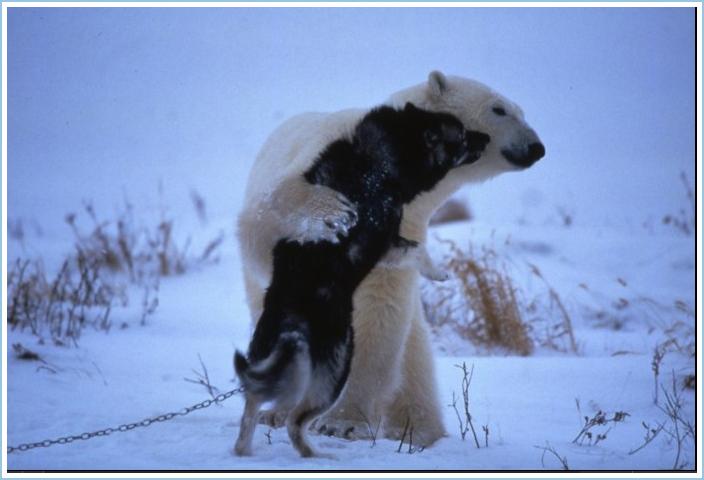
First a big thank you to Mary and Ed G. for passing me an email that contained fabulous photographs of the polar bear playing with a  husky dog.  From that email it was the matter of a few moments to find more on the Internet.

Let’s start with a YouTube video of a short talk by Stuart Brown called Animals at Play.

Then another YouTube video that is from FirstScience TV, which appears to be a defunct website.

Here’s Norbert Rosing’s website and here’s the website for the charity, Polar Bears International.

Enjoy your week-end.

These charming pictures were taken by renowned nature photographer Norbert Rosing, whose work has appeared inNational Geographic and other magazines, as well as several books including The World of the Polar Bear (Firefly Books, 1996), in which Rosing recounts the story of how these particular photographs came to be taken.

The location was a kennel outside Churchill, Manitoba owned by dog breeder Brian Ladoon, who kept some 40 Canadian Eskimo sled dogs there when Rosing visited in 1992. A large polar bear showed up one day and took an unexpected interest in one of Ladoon’s tethered dogs. The other dogs went crazy as the bear approached, Rosing says, but this one, named Hudson, “calmly stood his ground and began wagging his tail.” To Rosing and Ladoon’s surprise, the two “put aside their ancestral animus,” gently touching noses and apparently trying to make friends.

Just beautiful!

If you want to watch the whole sequence of photographs including background notes to each picture, click here.

Earth Day and The 11th Hour

Some very thought-provoking ideas.

John H, a good friend of us here in Payson, lent us the Leonardo DiCaprio film The 11th Hour.  More information on the film’s website.  Here’s the trailer,

The plot of the film, if plot is the right word, is as follows,

With contributions from over 50 politicians, scientists, and environmental activists, including former Soviet leader Mikhail Gorbachev, physicist Stephen HawkingNobel Prize winner Wangari Maathai, and journalist Paul Hawken, the film documents the grave problems facing the planet’s life systems. Global warming, deforestation, mass species extinction, and depletion of the oceans’ habitats are all addressed. The film’s premise is that the future of humanity is in jeopardy.

The film proposes potential solutions to these problems by calling for restorative action by the reshaping and rethinking of global human activity through technology, social responsibility and conservation.

Whether or not you watch the film, and I strongly suggest you do, the action website that supports making a difference is For the Love of Action.  Drop in and make your own mind up.

Following on from that film is this apt reminder of the world we have created.  I tend to write articles a few days ahead of the publish date, so it wasn’t possible to have this post come out on the 20th April, last Wednesday, which was Earth Day.  Shame.  Because as this email from the Alaska Wilderness League pointed out, it’s also a sad reminder of our love affair with oil.

Dear Paul,

The next Deepwater Horizon could be amid the broken sea ice and polar bear habitat of America’s Arctic: unless we prevent it now. Donate to the League.

It was one year ago today. I remember sitting in my living room after dinner when the news alert flashed across the screen:Deepwater Horizon oil rig explodes in the Gulf of Mexico; 11 workers dead or missing. 

Huddled around the office television the next morning, there was no way we could anticipate the true magnitude of the disaster. Images of ruined lives and tarnished lands poured out of the Gulf formonths on end. As the oil industry’s feeble attempts to contain the destruction grew evermore cartoony – ‘top hat,’ ‘junk shot,’ ‘top kill’ – we learned just how little they had prepared for the eventual catastrophe of an oil spill.

Our government rubber-stamped the faulty plans for this oil rig. They had a chance to prevent this disaster, but didn’t. What’s worse: they continue to approve plans for America’s Arctic that are functionally identical to the plans that caused the Gulf disaster. America’s Arctic could be our next Deepwater Horizon tragedy. The effects of deadly crude oil spilling into the broken sea ice and polar bear habitat of America’s Arctic would be disastrous: unless we stop it.

We are fighting the next horrifying oil spill every step of the way. Help us prevent it – donate now! 

When Deepwater Horizon exploded in the Gulf, the League had just completed a campaign to highlight the incredible annual migration of Arctic birds that begins in the Arctic Refuge and extends through each U.S. state. Some of these birds fly as far as the southern tip of Argentina! Many of them rely on critical nesting grounds around the Gulf of Mexico.

The League moved quickly to save these birds, distributing ‘Arctic Garden Kits’ to help donors across the country to provide sustenance and shelter to Arctic birds in their own backyards. Proceeds from the fundraiser helped us fight faulty plans from moving forward in America’s Arctic for the last two summers.

Shell Oil, the biggest threat for Arctic drilling, remains undaunted by our success. Their drilling plans for 2012 have ballooned from one drill rig to six. This is their big move – their cards are on the table. We need your help and support to go over the top to stop their escalating plans.

Help us stop the next disaster in America’s Arctic. Give today.

The way in which the League responded to the Gulf disaster – stemming the damage to wildlife and preventing the next disaster – was one of the most inspiring experiences of my life. You have a chance to be a part of this continuing work. Help us save America’s Arctic before it suffers the fate of another Deepwater Horizon.

Thank you for all that you do,

Cindy Shogan
Executive Director
Alaska Wilderness League

Finally, let me close rather pointedly, perhaps, by this video of the fires in Texas which are burning out of control and have already scorched 1.6 million acres.; long-term drought being part of the cause.

Beautiful minds, today Stephen Hawking

The second of two fascinating films about two very beautiful minds, Hugh Everett III and Stephen Hawking.

I am slightly hesitant in pursuing this, after my article about Hugh Everett on the 19th.  Said slightly tongue-in-cheek following a fascinating, as always, exchange of comments with Patrice Ayme.  Here’s a taste of Ayme’s writings, and here’s the exchange,

Patrice first wrote,

The question is: what happened? The multiverse answer is that, whatever it is, it happened in one universe, and it did not happen, in another universe. And if it is not a matter of discrete choice, as in a 2 slit experiment, an uncountable number of universes will be created. In other words, if one wants a proof of the insanity of some of today’s physicists, the multiverse is all we need. According to this lamentable spasm of the mind, during every single, smallest amount of time imaginable, an uncountable infinity of universes appear.

OK, the inflationary universe has the same problem, and is about as insane. But being surrounded by mad men does not excuse one’s own insanity. So we shall laugh.

To which I replied,

Dear Patrice, the challenge presented at this end, in terms of how to evaluate your comment, is that your anonymous profile (that is truly respected, by the way) makes it impossible to determine your academic and social backgrounds. Therefore are you replying from the position of a great thinker, or of a great thinker with significant scientific and philosophical accreditations? Your writings are powerful and impressive but nonetheless to assume (as I read into your approach) that the world of quantum physics is a ‘done deal’ is not something I can share. I anticipate that you will feel similarly ready to laugh on Thursday when I publish some words on Stephen Hawking. ;-)

Eliciting a further very thoughtful reply from PA,

Thoughts have to learn to stand on their own. The authority fallacy (if you forgive this neo sentence) is no ersatz for truth. Some (previously) immensely respected physics Nobel prizes were member of the Nazi party before Hitler. That did not make their physics any less insane.

Most top thinkers of the scientific revolution in the 17C were not respected tenured professors at the university (although Galileo and Newton were, not so for Kepler, Bruno,Descartes, Fermat, Pascal, Leibnitz…). We have no historical distantiation to judge what’s going on now.

I respect some of the work of Hawking. And certainly respect him tremendously as a person (although he dumped his wife for his nurse).

I appreciate the fact you tease me with Quantum Mechanics as a “done deal”. I actually believe that QM is the most precise theory we have, but it’s most certainly false or crazy as Newton basically said about his own theory of gravitation, and pretty much for the same reasons… This shows that I have to express myself more clearly…

In any case QM got no traction with the Quantum computer, so far. To say the least, many questions have been found to not be answered…

As far as accreditations are concerned, I will refer to the PhDs of Qaddafi’s children, and the movie “Ghostwriter”. Speaking of Harvard, what about Huntington’s “Clash of Civilizations”, of an incredibly low scholarly level, and the numerous professors there on Qaddafi’s payroll? Does that mean they were accreditated by Qaddafi?

I am quite familiar with academia, and I think too much credit is given, quite often.

I am going to put a more extended version of my various remarks on my site, insisting on the fact QM, however impressive, is no deal. The multiverse was a desperate attempt to make it a deal, precisely, as it was made to eschew the problem of the non existence of a detailled mechanism of wave packet collapse. [Ironically I was once punished on a “philosophy” site for saying that QM was a live subject of research; I never went back to that site, which has academic pretentions: they had told me they checked with physics professors…]

Best wishes to you too, and I look forward chewing on Hawking very slowly… meanwhile I shall put my anti-multiverse blast on my site…

So here goes!

Prof. Hawking

Professor Stephen William Hawking was born in 1942 in Oxford, England.  His own website has a nice summary of his life which may be read here.  There is a huge amount that could be written about this most amazing man.  His book A Brief History of Time has sold in the millions which for a man who deals with some pretty big personal challenges, is no small feat.  Here’s a relatively recent talk (2008) from TED2008,

But like the Hugh Everett posting, I wanted to draw your attention to the 48 minute programme, originally from the BBC Horizon series, that explores some of the challenges that are starting to appear to Hawking’s long-held theories about the start of the universe.

The film may be watched from here.

Why the Blog is called Learning from Dogs.

A reflection on the starting point of this Blog.

It struck me recently that many of you readers that come to Learning from Dogs on a regular basis, say, over the last 18 months, may not be clear as to why it’s called what it is, and the deeper issues behind the name.

First, the name.  Quite a few years ago I was sitting chatting with Jon Lavin, the co-founder of the Blog, in his home in South-West England.  My German Shepherd, Pharaoh (that’s him on the home page) was sleeping on the floor while Jon and I were nattering about the works of Dr David Hawkins of Veritas Publishing.  Jon mentioned that David Hawkins had measured the consciousness of dogs and that they came out about 205.  In other words they were integrous creatures and firmly on the truthful side of the boundary between truth and falsehood.

I was fascinated by that idea.  Later, back at my home, less than an hour away from Jon’s house, I was idly looking at domain names that were available, and imagine my glee when I discovered that learningfromdogs (dot) com was free.  It was rapidly grabbed.

A rather chaotic period of my life descended upon me but the notion that we have much to learn from dogs stayed with me.  Much later, when I was happily settled with Jean, the vision and purpose of the Blog got me under way.  The first post was published on 15th July, 2009.

The ideas behind the theme that dogs have an extraordinary relationship with man is contained in a very early piece written for the Blog back in July 19th, 2009.  That article is called Dogs and integrity.  But nothings stays still.  In that piece, I wrote,

Because of this closeness between dogs and man, we (as in man!) have the ability to observe the way they live.  Now I’m sure that scientists would cringe with the idea that the way that a dog lives his life sets an example for us humans, well cringe in the scientific sense.

However, on Sunday evening we watched a video from PBS that showed that scientists are now taking a very close interest in dogs and why they have such a special relationship with man, perhaps even a critical part in enabling man to prosper as hunter-gatherers.  Here’s a preview of that video programme.

Unfortunately, the video is not freely available from PBS.  However, it was based on the BBC Horizon programme, The Secret Life of the Dog, which I wrote about back in the 25th January, 2011.  (The YouTube link on that post appears to have been curtailed.)

Luckily there are a couple of options to watch this fascinating and very revealing documentary.  You can either watch it in sections from YouTube, the first 10 minutes is below, or you can watch it in full, if you don’t mind some Chinese translations here.  Your choice.

That’s enough for today, I shall return to this theme next week.