The incredible achievements of man.
From the BBC website,
By Jonathan Amos
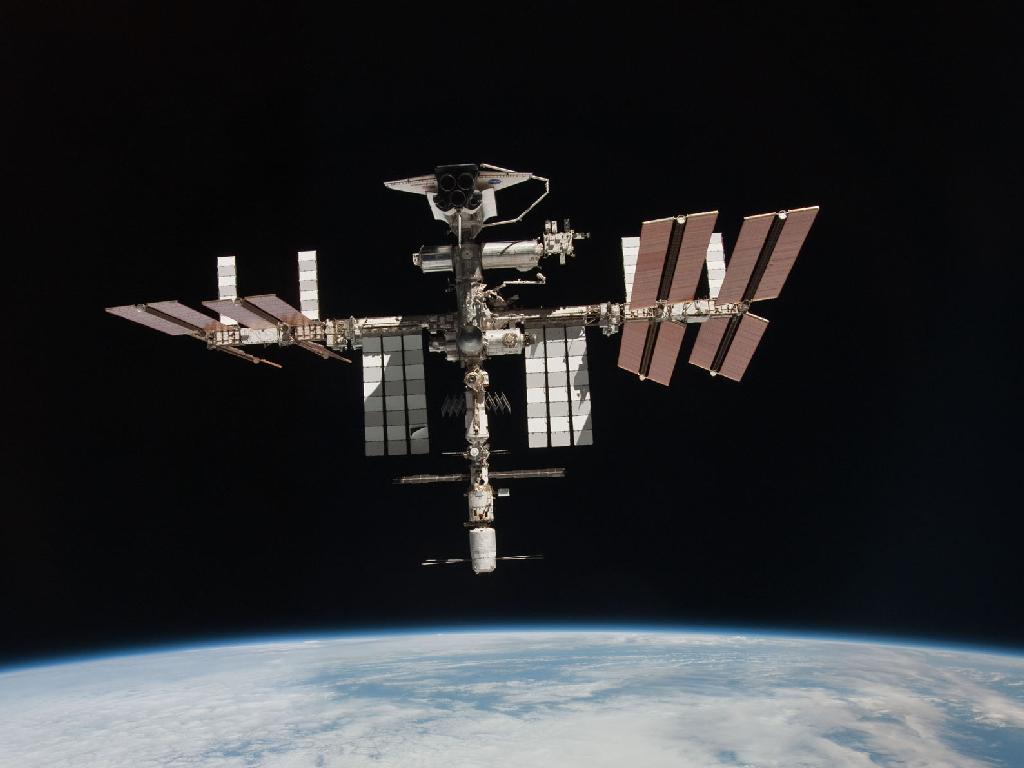
Science correspondent, BBC NewsIt is a stunning image and one that is bound to be reproduced over and over again whenever they recall the history of the US space shuttle.
The picture was taken by Italian astronaut Paolo Nespoli as he left the International Space Station in May in a Soyuz capsule to return to Earth.
Safety procedures mean the Russian vehicle would never normally be in transit when a shuttle is present.
It makes this the first-ever image of an American orbiter docked to the ISS.
Endeavour sits firmly on the bow of the station, which is moving across the surface of the Earth at a speed of 27,000km/h (17,000mph) and at an altitude of approximately 355km (220 miles).
Nespoli’s camera is looking along the ISS’s truss, or backbone, which carries the four sets of giant solar wings. The stern is occupied by Europe’s robotic freighter – the Johannes Kepler ship.
The pictures were acquired on 23 May but were only released by the US space agency (Nasa) on Tuesday [7th June, PH]. They had been eagerly awaited by space fans.
Nespoli had spent a lot of time during his 159-day stay at the station taking pictures of Earth and life aboard the international outpost. Many of these images were posted on his mission Flickr account. It was widely expected therefore that the European Space Agency astronaut would get some excellent shots during the unique departure.
Enthusiasts on the ground with telescopes routinely try to snap a shuttle attached to the ISS, and some of the results have been very impressive. But none of these pictures compares to the majestic portrait acquired by Nespoli so close to the orbiting complex.
The timing and subject are also perfect. Endeavour is seen here making her final sortie into orbit, making the last big US assembly item delivery – a $2bn particle physics experiment known as the Alpha Magnetic Spectrometer. The seven-tonne machine now sits on top of the platform.
Endeavour was also the orbiter chosen to take up the first American segment of the platform when the project had just got started in the late 1990s.
The youngest of Nasa’s shuttles returned to Earth on 1 June and will now be prepared for public display at a science museum in California. Sister ship Atlantis stands ready on the launch pad in Florida for a swansong of her own in July. Once her mission is done, no orbiter will ever fly again.
Nespoli’s crewmates in the Soyuz were Russian cosmonaut and Expedition 27 commander Dmitry Kondratyev; and Nasa astronaut Cady Coleman. Apart from the photo opportunity, their departure was a standard ISS crew rotation flight.
Their replacements blasted off from Kazakhstan on Tuesday in another Soyuz vehicle. Nasa astronaut Mike Fossum, Russian cosmonaut Sergei Volkov and Japanese astronaut Satoshi Furukawa are scheduled to arrive at the ISS on Thursday, raising its complement once again to six individuals.
The venerable Soyuz will be the only way for astronauts and cosmonauts to reach the platform in the years following the retirement of the shuttle fleet.
Nasa hopes some US commercial carriers will become available in the middle of the decade.
The NASA weblink attributed above is here, from which can be read,
This image of the International Space Station and the docked space shuttle Endeavour, flying at an altitude of approximately 220 miles, was taken by Expedition 27 crew member Paolo Nespoli from the Soyuz TMA-20 following its undocking on May 23, 2011 (USA time). The pictures taken by Nespoli are the first taken of a shuttle docked to the International Space Station from the perspective of a Russian Soyuz spacecraft. Onboard the Soyuz were Russian cosmonaut and Expedition 27 commander Dmitry Kondratyev; Nespoli, a European Space Agency astronaut; and NASA astronaut Cady Coleman. Coleman and Nespoli were both flight engineers. The three landed in Kazakhstan later that day, completing 159 days in space.
Do go to the NASA website here as there are a total of 40 stunning images.
 Learning from Dogs
I’m not fooled for a moment – I can see this for what it is – the latest in satellite dog monitoring. Is there no stopping the US in its race for supremacy in all things? 🙂
LikeLike
Blast – been rumbled! Thanks for stopping by, Paul
LikeLike