This Post for Learning from Dogs was inspired by a simple email. An email sent out automatically by Facebook inviting me to join a group committed to holding the Nobel prize in Economics accountably for the crisis.
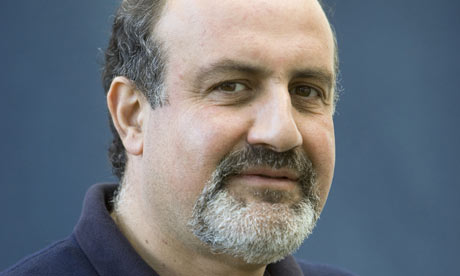
Nassim Nicholas Taleb
That intrigued me. Like thousands of others I had previously read The Black Swan, a book The Times newspaper describes as ” as one of the 12 most influential books since World War II”.
Wikipedia has a thorough description of Taleb much recommended if you have 10 minutes to read it.
Bryan Appleyard of The Times wrote an excellent piece on Taleb on the 1st June, 2008 which may be read here. Here’s an extract from near the front of that piece in The Times:
He spilt the tea – bear with me; this is important – while grabbing at his BlackBerry. He was agitated, reading every incoming e-mail, because the Indian consulate in New York had held on to his passport and he needed it to fly to Bermuda. People were being mobilised in New York and, for some reason, France, to get the passport.
The important thing is this: the lost passport and the spilt tea were black swans, bad birds that are always lurking, just out of sight, to catch you unawares and wreck your plans. Sometimes, however, they are good birds. The recorders cost $20 less than the marked price owing to a labelling screw-up at Circuit City. Stuff happens. The world is random, intrinsically unknowable. “You will never,” he says, “be able to control randomness.”
To explain: black swans were discovered in Australia. Before that, any reasonable person could assume the all-swans-are-white theory was unassailable. But the sight of just one black swan detonated that theory. Every theory we have about the human world and about the future is vulnerable to the black swan, the unexpected event. We sail in fragile vessels across a raging sea of uncertainty. “The world we live in is vastly different from the world we think we live in.”
Despite the article being over two years old, it is still an important piece for anyone trying to understand the causes of the financial mess we are all still in.
Finally, Taleb’s own website is a rich resource of much that will allow us all to better understand where we got to, where we are and what has to change if we are to have real hope for a better future.
Here’s a YouTube video of a TV interview taken in May, 2010.
Here’s an earlier video of Taleb explaining what his theory of black swans is about.
Work to line the top of an escape shaft with metal tubing is expected to finish in the next few hours at the mine where 33 men are trapped in northern Chile.
A winch and pulley will be installed and the shaft tested before the rescue begins, it is hoped, on Wednesday.
Amid the final preparations for the rescue the Chilean health minister said some of the miners were gallantly insisting they should be last to leave.
And some wonderful pictures on the BBC website here.
I’m sure the vast majority of Learning from Dogs readers will be on top of the news that is spreading around the globe reporting that the Chilean miners have been reached. Here’s the BBC:
Rescuers have drilled through to the underground chamber where 33 Chilean miners have been trapped since August.
The breakthrough at the San Jose mine came shortly after 0800 local time (1200 GMT).
It means efforts to remove the miners through the tunnel should begin within days. Tim Willcox was at the mine when the breakthrough happened.
Rescuer workers have broken through to the 33 Chilean miners trapped half a mile underground.
Engineers and relatives of the men began celebrating on Saturday morning after the escape shaft reached the point where the miners have been stuck now for over two months.
Mining minister Laurence Golborne warned though it could take days before attempts start to remove the men from the San Jose mine.
All fabulous news.
Picture from the Daily Mail online.
Contact: Rescue workers broke through to the 33 trapped Chilean miners earlier on Saturday morning
For some reason I have been thinking a lot recently about my school English Master, perhaps as a result of feature articles on the Dead Poets Society and the Oxford Boys.
With a slightly unusual name, and some knowledge of an area I might concentrate on, I checked the internet and, indeed, found an address and phone number which might tie up.
Bearing in mind I left school in 1968, and probably last saw him in 1970, I was apprehensive about him remembering me. I called the phone number.
A man answered, “Are you Mr Anthony Weeks-Pearson?” I asked. “Yes”, he said.
“My name is Robert Derham, I was a pupil at your old school during the 60s”, replied I.
“Oh”, he said, “I was thinking about you only yesterday!”
We then proceeded to have an hour-long conversation covering detailed facts from my happy school days. He was as sharp as a button, and had forgotten nothing!
I learnt so much more about him in that conversation and am looking forward to meeting him again next month. Isn’t that wonderful.
But there’s an even more interesting aspect to this event. That is, what is the nature of coincidences? This video throws some light on this.
I don’t know about you but I’m picking up more and more ‘vibes’ from all over the place that strongly suggest an increasing awareness of the need for real change in society. Anyway, more of this another time.
My article today is base on an editorial in the Mole Valley Farmers Newsletter
MVF logo
for October 2010 (no. 557). First some background to this organisation.
Mole Valley Farmers was started in 1960 by a small group of farmers around South Molton* who were concerned by the discriminatory practices and the large margins being taken by many of their input suppliers. From the outset it was decided to treat all members equally, subject only to quantity allowance and that the Company would operate on the minimum margin to allow continuity and growth. Today it remains one of a few true co-operatives in the supply industry.
Mole Valley Farmers consists of:
Nine branches in the south west supplying a vast range of goods to farmers and the public alike. These range from farm requirements to clothing, footwear, garden supplies, pet food and accessories, domestic goods and power tools
Our own feed mills for all animal feeds
Fertiliser blending plants
A specialist mineral plant
A quality farm building division
Of special importance are our farmer customers who purchase animal feed, fertilisers and minerals, all manufactured to a high specification by Mole Valley Farmers and delivered direct from point of manufacture to farm or to branches for collection in small lots.
* South Molton is in Devon, England about half-way between Barnstaple and Tiverton and the history of this interesting firm may be found here.
I have to declare a certain interest in that when I lived in Harberton, Devon for a number of years, we were non-farmer Members of Mole Valley Farmers for feed for our chickens and ducks and later on for Pharaoh. So when I arrived to stay recently for a week with friends in Brixham, Devon, my eye quickly picked up the familiar look of the MVF Newsletter lying on the table.
This is the editorial, reproduced in full with the kind permission of the Newsletter editor, from the pen of David Burke, Chairman of MVF.
Commodity trading
Until relatively recently, the price of food was set by the forces of supply and demand for the food itself, which worked reasonably well in developed countries able to purchase in times of shortage. For the last century farmers have been able to reduce some of the market risk by forward selling crops to a trader in that market, at a price that fair to both parties.
This type of trading was tightly regulated and only those who were directly involved could participate and it worked well. At some time in the mid-90s, Goldman Sachs, with other financial institutions, successfully lobbied for the regulations to be abolished.
Forward contracts became derivatives, which could be bought and sold repeatedly by traders, which enabled the financial institutions to become involved. This type of investment really took off when the American and European pension market collapsed, together with that for normally traded derivatives like metals, prior to the recession, although actual food supply and demand remained relatively in balance. Last year Goldman Sachs reportedly made £3.2bn profit from derivatives trading.
In spite of Russia’s grain export ban and some other weather affected harvests, both the EU commission and the International Grains Council report more than adequate reserves of grain to meet demand and that the carry-over stocks are likely to be the second highest for years. The rumoured (but non-existent) wheat shortage that is driving up all feed prices, is entirely due to actions of the world’s principle investment bankers and their investors, which have serious implications throughout the globe. Whilst few in the developed world mostly in the Northern Hemisphere, will go hungry, it is a growing tragedy for the poorer countries in the Southern Hemisphere where three-quarters of the world’s population live. According to the Food and Agricultural Organisation, one third of the population lack food security and 792m people there are undernourished to varying degrees of starvation. But most damning of all, some 12m children die annually of malnourishment. Derivative speculation, which pushes up the cost of grains and in particular wheat, is responsible for food inflation that is proportionally greater for the impoverished nations.
Re-regulation of the basic food market to prevent a recurrence of the spikes of 2007 and 2010 would go some way to stabilising global food costs and help with developing nations, though without a great deal of pressure from compassionate people, this will be difficult, given the influence that the world’s richest investors have over governments. Alternatively, primary food producers worldwide are paid a high enough price for their produce to enable them to invest in research and best practice, as well as in efficient equipment. This concept received the approval of the European Parliament on 9th September and although they are considering legislation to ensure farmers receive a fairer share of the consumer price, it may be difficult to implement other than through a properly funded and regulated CAP.
Well said, Mr Burke.
NB. The web links in Mr Burke’s article have been inserted by me, they were not in the original article.
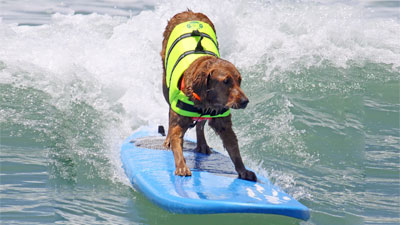
Yesterday, Learning from Dogs published a Post about Ricochet, the surfing dog.
Ricochet - follow this dog!
I was delighted to receive a ‘reply’ from this wonderful canine which is reproduced in full here.
Thank you for posting about my work. It really helps raise awareness of my causes, and I appreciate it!
Here is the latest video of me & little Ian with the brain injury. He experienced a huge milestone in this video, during the session. http://www.youtube.com/watch?v=-iIv5t2qKL4
Indeed, I have to offer my thanks for the reply from Ricochet because my travels over the last few days made it impossible to keep the Blog posts running. This reply, turned into a Post, prevented a day being missed which, if it would have happened, would have been the first missed day since the Blog started on July 15th, 2009!
This story has spread far and wide but, nonetheless, deserves a Post on Learning from Dogs because it is the essence of what dogs offer the world – unconditional love.
To gain the trust of a dog and enter the special relationship that humans have with dogs is to understand the significance of taking people at their face value and expect nothing in return, as dogs do.
Ricochet was born as a service dog and entered into the appropriate training. But there was a hic-cup in her learning, fortuitous as it happened and …. no, that’s enough from me. Watch it yourself ….
Now take a few minutes and understand what Ricochet and Ian McFarland demonstrated to the world.
Fascinating research on how dolphins develop ‘speech’
Once again, I am indebted to Yves Smith for posting a link in the edition of Naked Capitalism published on the 1st October that really caught my eye. This follows nicely after my piece a couple of days ago about how the stray dogs in Moscow are learning new ways to survive.
It was a piece on the BBC Earth website about how dolphins attempt to learn the language of other dolphin groups.
The BBC article starts thus:
Just magnificent
When two dolphin species come together, they attempt to find a common language, preliminary research suggests.
Bottlenose and Guyana dolphins, two distantly related species, often come together to socialise in waters off the coast of Costa Rica.
Both species make unique sounds, but when they gather, they change the way they communicate, and begin using an intermediate language.
That raises the possibility the two species are communicating in some way.
Biologist Dr Laura May-Collado of the University of Puerto Rico in San Juan made the discovery studying dolphins swimming in the Gandoca-Manzanillo Wildlife Refuge of the southern Caribbean coast of Costa Rica.
Later the article says:
As yet, Dr May-Collado cannot be sure if both species are changing the way they communicate, or whether it is one species attempting to call more like the other.
That is because her sound equipment could only record the total calls produced by mixed species groups of dolphins, and could not separate out sounds made by individuals.
“This limits how much I can say about how much they are communicating,” says Dr May-Collado.
However, dolphins are known to have an extraordinary ability to change their calls when ‘talking’ to other individuals, or to ensure they are heard over the din of background noise pollution.
So “I wouldn’t be surprised that they can modify their signals to mimic, and even possibly communicate with other species. Particularly when their home ranges force them to interact on a daily basis, which is the case of this study,” she says.




 Learning from Dogs