Year: 2010

The secret life of the dog, Part Three

Continuing this fascinating insight into the extraordinary relationship between dogs and man.

If this is your first sight of this multi-part article about dogs then you will need to start at the beginning:

Part One is here.

Part Two is here.

By Paul Handover

The secret life of the dog, Part Two

Continuing this fascinating insight into the extraordinary relationship between dogs and man.

If this is your first sight of this multi-part article about dogs then you will need to start at the beginning:

Part One is here.

By Paul Handover

Capitalism and The Daimler-Chrysler Saga: Part 2 of 3

In a new departure for Learning from Dogs, Sherry Jarrell publishes a three-part article on the Daimler-Chrysler merger.  Learning from Dogs is indebted to Professor Jarrell for both giving so freely of her time to the Blog and for sharing such erudite material.

Here is Part Two.  If you missed Part One then it is here.

What does the Daimler-Chrysler merger demonstrate in broader terms?

The 1998 Daimler-Chrysler  “merger of equals” was widely expected to realize both operating efficiencies and better access to international capital markets. Instead, when DCX incorporated it adopted German corporate governance standards.  U.S. institutional ownership in Chrysler was largely replaced by European banks that not only directly monitor the working capital financing of DCX but also may sit on its Management and Supervisory Boards.

Such superior access and corporate control created distinct advantages for large German institutional owners relative to minority owners; foreign shareholders in the U.S. found themselves among this minority group.  These advantages included the ability to: expropriate the private benefits of control from minority shareholders; share these benefits with management, effectively creating a collusion, and; profit from trading DCX shares with superior information.  As a result, minority owners priced their shares less aggressively – i.e., the bid-ask spread widened — to minimize their losses from transacting with controlling shareholders.  As their spread increased, U.S. minority shareholders’ trading costs rose and U.S. trading volume fell as it migrated to Germany, the relatively cheaper trading venue.

The Crossfire: first DCX combined product

The merger between Chrysler and Daimler and consequent changes in corporate governance create an ideal clinical study for isolating our hypothesis about the failure of the enhanced disclosure requirements to effectively compensate for lax corporate governance standards in protecting minority shareholders.

To test this hypothesis, we explored changes in the bid-ask spread that are associated with the change in corporate governance and the control over the flow of information about the Chrysler assets.  We look “inside” the trading mechanism that creates the observed transacted stock price, namely the bid-ask spread, to generate evidence on shifts in the quality and quantity of information available to minority versus controlling shareholders.  The bid-ask spread should grow as minority shareholders learn that traders on the other side of the spread possess superior information about the company, information which is linked to their majority control of the firm and its senior management compensation, asset disposition, and financing and risk-taking strategies.

We find that the decision to merge and become a German stock corporation significantly weakened the protection of minority shareholders, particularly prior owners of Chrysler assets, and led to their expropriation by controlling shareholders and principal creditors of the consolidated firm.  How? We find that the answer lies in the lack of protection afforded minority shareholders by the corporate governance structure of the newly combined DCX entity.

By Sherry Jarrell – Part Three continues tomorrow.

Remarkable people: Charlie Simpson

What a contribution!

How does a 7 year old contribute more in one day than most people contribute in a whole lifetime?

To give your time and effort to raise money for charity is noble and worthwhile, and many people do it for a variety of causes and for a variety of personal and public reasons.

To maximise the benefit of your efforts, however, is also important; anyone who has had difficulty finding sponsors for their swim, run or ride can tell you that!

Connecting with people

Charlie Simpson made a short video in his attempt to raise money for people of Haiti as they deal with the consequences of the earthquake there.

That video is clear, it is personal and I defy anyone who watches it not to feel a connection with this young boy from London.

He aimed for £500. At the time of writing, he has passed £118,000 !! You can give here

By John Lewis

The secret life of the dog, Part One

This may be of no surprise to dog owners!

The BBC recently screened one of the most fascinating programmes in ages (OK, subjective comment!).  It was about the relationship between dogs and humans.  The hour-long programme demonstrated just how important that relationship between dog and man really is.

Indeed, within the first few minutes of the programme, one of the contributors says that without that early domestication of dogs, civilisation of man might not have taken place!

Luckily someone has uploaded this programme onto YouTube.  This Post contains the link to the first of 6 parts with the following 5 parts being presented on this Blog each day.

Please, please take time to watch these videos – they will amaze you, and very possibly bring tears to your eyes.

So if you are a dog owner, prepare to see your dog friend in a totally new way.

By Paul Handover

Capitalism and the Daimler-Chrysler Merger Saga

In a new departure for Learning from Dogs, Sherry Jarrell publishes a three-part article on the Daimler-Chrysler merger.  Learning from Dogs is indebted to Professor Jarrell for both giving so freely of her time to the Blog and for sharing such erudite material.

Here is Part One

What does the Daimler-Chrysler merger demonstrate in broader terms?

In a paper co-authored with Rick Harris, Tom McInish and Bob Wood, we explored the Daimler-Chrysler merger of 1998 to examine the interplay between disclosure rules in the U.S. and corporate governance standards in Germany.  Here is an overview of what we found.

Large shareholders typically control European and Asian industrial giants, leaving minority shareholders less than well protected.  In several studies of the legal protection afforded minority shareholders across 27 countries, German shareholder protection ranked among the very worst. In the early 1990s, Daimler-Benz, one of the largest firms in Germany, was no exception.  In 1993, with Deutsche Bank owning 24% of the equity, Mercedes AG Holding 25%, and the Emirate of Kuwait 14%, its controlling shareholders decided to cross-list Daimler-Benz on the New York Stock Exchange (NYSE).

1997 Daimler Mercedes

All foreign firms that cross-list [list their shares for sale in more than one country] in the U.S. subject themselves to stricter disclosure standards.    In addition to listing on a major U.S. stock exchange, Daimler was required to file financial statements with the SEC and report any material non-financial information as well.   Cross-listed firms are also followed more closely by U.S. stock analysts and the business press.  These legal disclosure requirements and additional scrutiny by the investing community improved both the quantity and quality of information available to all shareholders about Daimler.

1997 Chrysler Town and Country Minivan

By early 1998, the cross-listed Daimler shares were widely held and actively traded worldwide, including significant volume originating in the United States. In September of 1998, Daimler and Chrysler shareholders, majority and minority owners alike, overwhelmingly approved a merger creating DaimlerChrysler AG (DCX) through an exchange of the cross-listed share for the first “global registered share” (GRS).  The so-called “merger of equals” was widely expected to realize both operating efficiencies and, via the informational transparency of the GRS, improved access to international capital markets.

By Sherry Jarrell – Part Two continues tomorrow.

And a P.S. to the Thanks, Guys.

The Los Angeles Times update on this wonderful story.

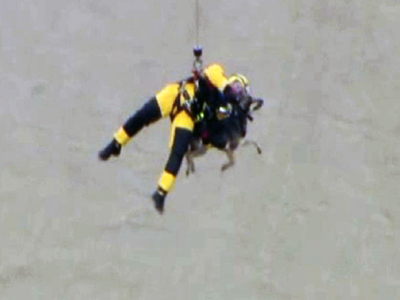
The Los Angeles Fire Department firefighter who rescued a panicked dog from the brown, rushing waters of the Los Angeles River this afternoon said that unless firefighters acted, someone else was likely to have ventured into the concrete wash and wound up a casualty.

Joe St. Georges, 50, the firefighter who captivated much of  Los Angeles as he was lowered by a tether into the churning waters to rescue the hound, told reporters late Friday that he suffered a bite to his thumb but was otherwise OK.

“I didn’t have time to establish a rapport with the dog,” St. Georges said, in a classic understatement, as he held his heavily bandaged hand in the air. “He did what dogs do.”

Joe St. Georges and 'Vernon' the dog!

The dog was taken by [human] ambulance to a Downey shelter run by the Southeast Area Animal Control Authority, which serves 14 cities, including Vernon.

Animal Control Officer Justin Guzman said the 6-year-old German shepherd mix was cold and wet, but otherwise unhurt. He showed no further aggression, and shelter staff named him Vernon.

“He’s really lovable,” Guzman said. “He’s appreciating all the attention he’s getting here.“
Guzman said there were a “million” ways and reasons Vernon could have gotten into the river channel.

“Whether he got scared by the thunderstorm and jumped the fence, we don’t know,” he said.
The dog was never really swept away, but managed for the most part to maintain his footing on a slender ledge in the middle of the river, the officer said.

The dog will be quarantined and watched for signs of rabies.

Marcia Mayeda, director of the Los Angeles County Department of Animal Care and Control, said the disease is extremely rare in domestic animals. Untagged and loose, the dog was technically in violation of city codes, but the owners will face no repercussions if they step forward and take him home, Guzman said.

If they don’t, the shelter by early evening already had a list of 20 people who want to adopt Vernon.

Mayeda said she was very impressed by St. Georges’ actions.

It’s a great and lovely story.

By Paul Handover

Thank you, guys!

Fire-fighters rescue dog from flooded Los Angeles river.

Tomorrow on Learning from Dogs there is part one of a six-part Post about The Secret Life of the Dog.  It includes the amazing proposition that our relationship with dogs was instrumental in early man becoming civilised.  (Assuming, of course, that you believe mankind is civilised!)

Thus it is with great pride that today’s Post presents the courageous and successful efforts of LA Fire Fighters rescuing a German Shepherd dog, scared out of its wits, from drowning in a river.

Here’s an extract from the Los Angeles Times:

We don’t know about you, but we were glued to our TV screen earlier this afternoon as the effort to rescue a large dog trapped in the flooded Los Angeles River was broadcast live.  The rainstorms that have been pummeling L.A. over the past few days have caused the river to swell.  It’s unclear who, if anyone, owns the dog, or how it managed to fall into the fast-moving river in Vernon.

The full article and a video of the rescue may be seen here. The article goes on to say:

Firefighters first attempted to rescue it by dangling flotation devices from a bridge overhead, to no avail.  The dog then evaded firefighters who tried to approach it, sloshing further down the river.  Around 12:30 p.m., it managed to reach the edge of the river and attempted to climb up a steep concrete wall to safety, but several times fell back into the river.

Finally, a firefighter dangling beneath a helicopter managed to grab hold of the terrified dog, who responded (rather predictably) by biting its rescuer and thrashing about.  Despite the inherent difficulty of rescuing an animal that doesn’t want to be rescued, the firefighter managed to lift the dog to safety; both were deposited on a nearby bridge.  The dog was transferred to an ambulance for veterinary care and its rescuer was taken to a hospital for treatment of bite wounds, KTLA reported.

The BBC also has a nice video clip here

And a great set of pictures here. Such as this one …

Well done, all involved.

Fantastic effort.

By Paul Handover

Craftsmanship and business in the modern age

Sally Ryan for the New York Times

Pizza and a business plan

Here is a wonderful story of craftsmanship in the modern age and its interaction with business expectations. There is a very small, but reportedly excellent, pizza place in Chicago called “Great Lake”; and I learnt about it when a friend referred me to an article about its culture, its success and the consequences published by the New York Times.

The effect of extremely good reviews has been that they have been overwhelmed by demand and some customers have reacted unfavourably as a result. I think that they should stick to their guns and not compromise their principles and standards. However, this does not mean that they could not be doing some other things too!

There also seems to be an interesting systems story here! Continue reading “Craftsmanship and business in the modern age”

“The People Just Don’t Understand”

US politics and health care

The latest political spin in the U.S. is that the Democrats lost the seat that was held by the late Senator Edward Kennedy in Massachusetts because the people “just don’t understand the health care legislation.”  It is not, so they say, that the legislation is bad or that it will raise taxes or result in rationing.  No, it is not the legislation at all. It is that the White House has failed to communicate the key elements of the health care legislation clearly.

I beg to disagree.  I think that we, the electorate, understand the legislation, but we do not like it, and do not want it.  We do not want it shoved down our throats; we do not want our tax dollars used to blatantly buy off votes for the legislation; we do not want our voices to be ignored.

And the White House knows that the public has turned against this legislation because it now knows more about the bill, not less.  Why else would they endorse the secretive, closed-door sessions to draft the language of the bill?  Why else would they want to hide the legislation from the light of day, from the scrutiny of the press and the public?  Because the less we know, the more likely it is that this shameful legislation will slither through and  become law.

So, spare us, White House.  The reason people do not like the health care legislation is not because you haven’t communicated it clearly enough. It’s because we understand it all too well.

By Sherry Jarrell