Year: 2010

Horror at Smolensk

Will this air crash be a milestone in improving relationships with the Russians?

The Poles are naturally turning out to mourn their President and other leaders killed in the tragic accident at Smolensk.

Sadly, I fear that if and when the investigation turns up the truth about what happened the reaction may be more questionable. The Russians have apparently recovered the black boxes and presumably cockpit recordings, and what already seems clear from ATC Officers involved is that the pilot had categorically refused “instructions” to land at another airport, Smolensk being judged by ATC to be too dangerous.

Now others on Learning from Dogs will know far better than me, but it seems to me extraordinary that a professional, experienced pilot would refuse such advice and try to land in such appalling weather conditions.

This of course begs the question of why he did so, which is where the deceased President may come in.  An extract from the NY Times of April 12th:

Investigators examining the crash appeared to be focusing on why the pilot did not heed instructions from air traffic controllers to give up trying to land in bad weather in western Russia on Saturday morning.

Their inquiry may lead to an even more delicate question: whether the pilot had felt under pressure to land to make sure that the Polish delegation would not be late for a ceremony on Saturday in the Katyn forest, where more than 20,000 Polish officers and others were massacred by the Soviets during World War II.

Let us hope that it was mechanical failure of some kind (though early reports seem to rule this out) rather than the repetition of a previous incident where the Polish President had argued with the pilot of his plane.

This tragic event is of course surreally-ironic, as if the grisly hand of Josef Stalin had risen from the grave to cause the deaths of yet more Poles in addition to the 20,000 or so murdered in Katyn Forest on his direct orders.

As one who grew up during decades of Soviet denials of responsibility for this cruel genocide, I have been moved by the reaction of the Russians to all this, and no more so than by Putin himself. This is a man who referred to the demise of the Soviet Union as “the greatest tragedy of my life”, yet his grief and fellow-feeling for the Poles have been clear and genuine.

It was already a major breakthrough that Russia should have after all this time so clearly accepted responsiblity – and made apologies – for the Katyn massacre. That Putin and others have shown such fellow-feeling for the Polish loss gives one hope for a deeper reconciliation after the terrible schism in Europe caused by the Russian Revolution and seizure of power by Stalin, possibly the most murderous dictator in history. It was always insane that Russia should be our enemy; let us hope that by and by they will become our firm friends and allies.

By Chris Snuggs

Innovation? What innovation?

We’ve always known “why?”

Eureka!

We can carry on doing the same old things!
Along the way, we can improve, sell more, and cut costs.
But in end, sooner or later, we need to do something different.
That is why we innovate.

Now we know “how?”

Nowadays, everyone is talking about innovation!
Many things seem mysterious for a long time, and then we bring them under control.
It happened in “sales”, then in “quality”, now it is the turn of “innovation”.
In the past, a few people knew that they could manage innovation; now everyone knows.
There are processes for managing innovation using “ideation”, “co-creation” and, even, “open innovation”.
That is how we innovate.

But do we know “what?”

How do we know what to innovate?

Now there is a question!

By John Lewis

Today’s No-Brainer

Bottled water …..

… in developed countries is not only an insanity but also an obscenity.

  • It is no healthier than tapwater. If it were essential to health then how come we oldies survived before? Logically, the Human Race should have died out.
  • It tastes no different, unless you buy it fizzy – but you could add your own fizz at home.
  • It costs VASTLY more than tapwater.
  • It is VASTLY more profitable to producers than gasoline for oil companies.
  • It is VASTLY more expensive to produce – around 1500 times more than an equivalent quantity of tap water.
  • Its transportation produces significant amounts of harmful emissions.
  • It is VASTLY wasteful; water is scarce, yet it takes 7 litres of water to make a 1 litre bottle plus the contents.
  • It leads to VASTLY-INCREASED pollution. ‘see “Giant Rubbish Dump Accumulating in the Pacific
  • It soaks up resources that could be better used, including to save lives of people dying from lack of or dirty water.

In short, it is absolute folly. What on earth is there going for it? At the same time, it is big business and very popular? Why?

  • Are people ignorant about all the above? That’s quite worrying …. not much future with so much ignorance about.
  • Are people paranoid about what comes out of their taps? Oh dear –  paranoia is not good for us.
  • Do people place their vanity and status-image before the above-mentioned points? Hmmmm …..
  • Are many people just suckers for slick advertising? I guess the answer to that one is a straight “Yes”.
  • Have millions of people no common-sense and/or social conscience? Oh dear, this time it’s a clear “No”.
This is pretty!

Bottled water is nonsense, except of course where there is no alternative.

If rich, fat Westerners really like bottled water they could export it to developing countries where millions die through lack of or poisoned/polluted water every year while at the same time pouring funds into building water infrastructure for these very same people.

Yes, I know the industry provides jobs, but so did making nerve-gas for the Nazis.

The point is, we should direct our energy and money into things which are not totally unnecessary and destructive. I’m not a great fan of the “nanny-state”, but in some areas – and this is one – the government should be taking a more forceful lead. Help us kick our silly, selfish, faddish and destructive addiction to bottled water.

Some excellent links on this topic:

By Chris Snuggs

Elliot’s schooling – the positives

Elliot Engstrom – Guest Author

On April 1st I set the scene for the essays that I wanted to write for Learning from Dogs as follows:

I often ask myself just how effective the modern US schooling system is as a tool of education, and whether or not its costs outweigh its benefits. I hope to have at least a rough answer to this question in the

Elliot Engstrom

final post of this series.

In the following posts, I will examine three topics:

In what ways does the modern schooling system function as a positive tool for education?

What costs involved in modern schooling hinder its ability as an educative tool, and even make it a negative influence on students?

Considering the analyses put forth in the first two posts, do the costs or benefits or this system outweigh the other? On the whole, are school and education complements or antagonists?

Here is the first one looking at the positive aspects of the American educational system.

Intellectual exploration

My kindergarten teacher told me to always start with something positive, so I’ll be beginning my analysis of American schooling by looking at how it is a positive tool for education.

One facet of the American education system that I once disapproved of but now find extremely useful and educative is the long period of time that students have before they must commit to a career choice.

I used to view this lag as a waste of resources. However, living in France and being a student at a French university changed my mind. The French system begins to lock children into a career path as early as the closing years of middle school. If a student in France wants to be a doctor, for example, they enter into medical school immediately upon leaving high school. The same is true for professions like pharmacology and law. There is very little opportunity for intellectual exploration in the country’s schools. Rather, one simply must make the best of wherever one ends up.

While the American system is more long-winded, it is a better tool for education in that it allows for a more dynamic range of studies. A liberal arts education forces students to delve into a wide range of subjects, giving students the chance to explore their interests and abilities.

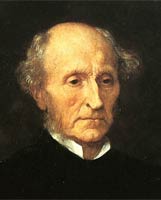
Socrates (or Plato, depending on your interpretation of Plato’s dialogues), believed that a liberal arts education also encouraged the development of critical thinking skills. However, it should be noted that many of the greatest critical

John Stewart Mill, (1806–1873)

thinkers in history did not go through formal schooling. (Socrates himself and John Stewart Mill come to mind.)

This system also allows students to change their mind, pursuing those fields of study that truly interest them the most. It is amazing how many students in the American university system change majors during their tenure as students. This often is because they find that the career path they thought was for them is in fact not their liking – the number of students who abandon the premed track during college is a perfect example of this.

Education also entails socializing with other human beings. The American education system also facilitates this form of education quite well, as a liberal arts form of study at both the high school and university levels mixes together students of different interests.

Whereas in the French model a student studying medicine is constantly surrounded by other students of the same mindset, a premed student in the United States will have classes with students in other fields of study, expanding their social horizons and forcing them to relate to people with whom they may have little in common.

In my next post, I will examine the American schooling system as an antagonist to education, and will then close this series by attempting to weigh the system’s costs and benefits against each other.

By Elliot Engstrom

A Teen’s Reflections

This is the second Guest post from AJ Easton, a 13-year-old girl from North Carolina, USA. AJ first wrote about Learning from Horses on January 17th this year. This is a more reflective essay that would have been a credit to someone with many, many more years.

Trust is a complicated thing…

You have to learn to trust, but it is not something that can be taught in schools. You also have to earn trust, by keeping secrets and not spreading rumors.

With the people you trust, you do things you wouldn’t do with other people . Your true self comes out with the people you trust. You don’t worry about being judged; you don’t worry about people disliking you for who you are.

AJ Easton

But, in our modern-day world, it seems as if everyone judges.

People seem to hate for reasons as stupid as one’s appearance. People don’t trust people anymore because it seems that we are constantly warned to avoid strangers because they might hurt you, murder you, or completely mess up your life in some way, shape, or form.

And in school, if you trust someone enough to tell them a secret, they don’t keep it. And then, in your point of view, the world has ended.

All because of some secret that got out about who you like, or what you did with the person you were dating, or something else that, in the end, isn’t all that important.

Then everyone will judge you based on that rumor until you leave the school or graduate. They do this to make themselves feel “cool” and “important.”  And you learn not to trust.

Social status has become such a big factor in everything we do these days. Everyone feels as though they have to be highly ranked socially to mean anything to the world.

But, truly, all you have to do is love what you do and respect yourself, to follow your dream and be determined. We should make decisions that help us move forward, not dwelling on the past.  Every second is different; everything is unique. Nothing is the same. Not a single person, or tree, or moment.  Each moment represents a new opportunity.

Don’t have regrets. What has happened has already happened and you can’t change it. Time travel is fictitious, not a reality. You can’t rewind your life to change what you have already done. There is a reason behind everything: remember this when you are having doubts about what you have done.  Learn from your past but don’t let it eat at you.

Live your own life. And learn to trust yourself, and those who love you.

By AJ Easton

Today’s Quiz

The British General Election is really hotting up, with mud flying in all directions.

Mr Pott. Your proposal to keep NI (National Insurance contributions for employers and employed)  as it is rather than putting it up as we propose (as usual) will leave a black hole in the country’s finances.

Mr Kettle: a Black hole? YOU are worried about a black hole??? Ha, Ha, Ha ……

Your quiz question: Who are the real Mr Pott and Mr Kettle?

Answers soon …..

The Hawker Hunter aircraft

What a beautiful aircraft!

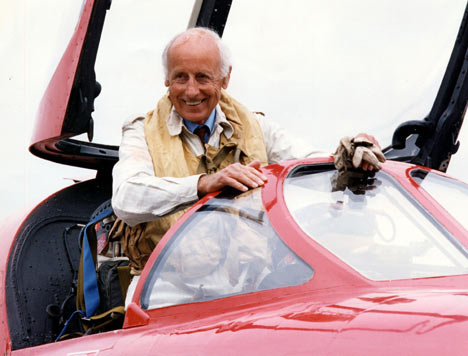
On April 2nd, I published an account of a flight in a Hawker Hunter that my dear cousin, Richard, experienced in 2003, the 50th anniversary of Neville Duke’s breaking of the existing world speed record on September 7th, 1953.  Neville Duke died in 2007 at the age of 85.

Squadron Leader Neville Duke, 85, flew 485 operational sorties during the war

It seemed fitting to add a little more information about this marvellous aircraft from an era when Britain built some of the best aircraft in the world.

As always, WikiPedia has an excellent account of the history of the aircraft.  So this Post will just present a few images for readers to ooh, aah over!

Thunder and Lightnings has some excellent images of all the different types including WB188 that Duke broke the speed record in.

Copyright 2009 Damien Burke

F.3 WB188, Hawker Aircraft, RAF Tangmere, 1953; author
As at 7th September 1953, when World Absolute Speed Record of 722.2 mph gained by Neville Duke; pointed nose, reheated engine, additional curved/raked windscreen
Later scheme of Scarlet Red

There is also a distant connection with our erstwhile editor, Paul.  Paul used to fly a TB2o from Exeter Airfield in SW England which is where the Hunter Club is based.  Jonathan Whaley, who commanded the Hunter that Richard flew in, has his own personal Hunter – Miss Demeanour – registration G-PSST so during the summer months it was not uncommon to see Hunters in the sky above Exeter.

Hawker Hunter 'Miss Demeanour'

Finally, a couple of videos to drool over.

and a lovely display at RAF Waddington in rather unpleasant weather conditions

Wonderfully nostalgic!

By Bob Derham

Today’s Quickie

Thomas Friedman of the Intl Herald Tribune

“Son, your ego’s writing checks your body can’t cash.”

Well, this may be old hat for specialists but it surprised me. Is the same true for Britain? In either case, as Friedman says, it suggests we should explore more forcefully the ways we could aid business startups.

I always find Thomas Friedman excellent value for the time invested in reading him! See here:

“Here’s my fun fact for the day, provided courtesy of Robert Litan, who directs research at the Kauffman Foundation, which specializes in promoting innovation in America: “Between 1980 and 2005, virtually all net new jobs created in the U.S. were created by firms that were 5 years old or less,” said Litan. ‘That is about 40 million jobs. That means the established firms created no new net jobs during that period.’”

And if you want to know where the opening quote comes from, read the Friedman article!

By Chris Snuggs

Should you invest in U.S. bonds? Part 4

This is the concluding part four of a multipart series on the factors that drive U.S. and foreign bond prices and yields.

[Part One is here, Part Two here, Part Three here Ed.]

Bond’s in a weak or faltering economy will generate a lower return to lenders than bonds in a strong economy, absent inflation or any other material changes in the purchasing power of the currency.  Weak demand for goods and services means weak demand for financial capital which means low rates of return on financial capital.

The policies of the government can increase the borrowing costs of private industry.  Fiscal policy that increases taxes reduces the profitability of projects and undermines the ability of companies to pay coupons and repay principal.  Monetary policy that increases the money supply may lead to inflation, which also increases the cost of borrowing and reduces economic activity.

Lastly, and of the greatest concern of late, is the level of borrowing by the U.S. government.   Debt levels are at record highs, with no relief in sight. The AAA rating of U.S. debt is reportedly in jeopardy (Chicago Tribune editorial).

Moody's Corporate Logo

Both existing and new lenders worry about the ability of the U.S. government to repay. Yes, the can simply roll over existing debt by raising taxes or creating money to retire old debt and replace it with new, but the interest rate required by new lenders goes up as the ability of the private economy to sustain tax revenues falls and the risk of inflation rises (Moody’s explains U.S. bond ratings).

Both factors are in play now: an anemic economy with little hope that this administration will undertake policies that support business, and a ballooning money supply and weak dollar that undermine the purchasing power of the returns to lenders.  The returns to U.S. debt may still be healthy relative to those one can earn in other countries, but the spread is shrinking. The private economy remains fundamentally strong, thanks to the work ethic of the American people and the profit motive of the capitalistic system, but the policies of the U.S. government are straining those resources.

By Sherry Jarrell

Perkins and the Dodgy Expenses

It’s not really the public’s money, is it!

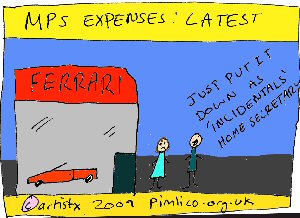
MP's expenses
[This cartoon is licensed under a Creative Commons Attribution-Noncommercial-No Derivative Works 3.0 Unported License.You can use it on your own site under the relevant useage rule.]

Good morning, Sir ….

Is it, Perkins?

Oh Dear …. what’s happened now, Sir?

It’s this dratted expenses nonsense.

Nonsense, Sir? Then why are the police involved again?

Again?

Yes, Sir. They’re also investigating the mysterious unthinking think-tank remember?

Oh yes, I’d forgotten that.

There’s a rumour going round the canteen that the police are going to set up an incident room on the terrace of the House of Commons, Sir.

On the terrace?

Yes Sir. The idea is to save time going to and fro’ the house; deal with the criminals, sorry MPs, in batches – benefit from economies of scale sort of thing ….

Perkins! That’s the kind of silly rumour started by malicious gossips. I’m surprised you even listen to such tittle-tattle.

But you must admit it’s a rum do, Sir – using public money to finance his son’s university education!

But Perkins, it was only his expenses that he used!

That money is supposed to be used – if I may say so – for expenses, Sir.

But those WERE expenses, Perkins! Goodness, you are being obtuse, today. When your son goes to university you certainly have expenses, I can tell you!

I meant his parliamentary expenses, Sir.

Oh really, Perkins. If we’re going to start nit-picking over every pound in every expense account in the House of Commons then where will we be?

I don’t know where we’ll be, Sir, but I know where the police will be and where half of our illustrious MPs will end up ……..

But Perkins, we’re talking about money already earmarked for expenses. Once it’s allocated then it doesn’t really exist any more; it’s virtually spent!

Well, it seems this money was actually spent, Sir – and after all, it was public money, Sir!

Public money? What on earth are you talking about, Perkins! It was the government’s money!

But it came from the public, Sir!

Aha! Got you there, Perkins. Granted it WAS the public’s money originally but once it left their bank accounts it became Government money! Surely you can see the distinction?

I’m sorry, Sir. I didn’t go to public school ….

By Chris Snuggs