Year: 2010

Greek Farce: Act III, Scene I

Greeks taking farce to new heights

Athens

Well, Ancient Greeks used to have tragedies; modern ones are better at farce, and so the “Shall we bung Greece billions of taxpayers’ money or not” farce rumbles on ….

It seems that the rising cost of borrowing for Greeks plus various warnings from people like George Soros about the possible collapse of the euro have pushed the EU (and in particular Germany) down a path they would have preferred not to go.

A vast loan at 5% has been offered, which is substantially below what the Greeks were having to pay before. So, crisis over? They can sleep well in Brussels again?

Errrmmmm …… hands up those who think Greece will ever be able to repay this money? Oh, at the time of writing (Monday 12th April) they haven’t yet ASKED for the money …. it really IS a farce rather than a tragedy, isn’t it?

Is there anyone on the planet who thinks they WON’T have to take the money? That they can get out of this mess WITHOUT it? No, nobody, except perhaps (as I speak) the Greek government itself. Well, they got the country into this humungous shambles in the first place so you’d hardly expect them to know what to do about getting out of it. This of course is in sharp contrast to the British government, which claims it is the ONLY party that can get out of the mess it itself created.

The reaction of German and British taxpayers to the bailing out of Greece (even though technically speaking it hasn’t yet occurred) is not yet clear ……. Neither is that of the other group of PIGS (Portugal, Italy and Spain). Incidentally, I am not sure how close the UK is to becoming a member of this rather grisly club, but as the country is still borrowing vast amounts at every tick of the clock it can’t be far off qualifying for full membership.

I did see a calculation this morning that the British taxpayer (I refuse to say government; all they do is pass on OUR money) will have to cough up around £600 million to help save Greece.

Of course, in return the Greeks will immediately start working as long and hard as we do, collecting taxes as efficiently as we do and avoiding corruption as well as we do. Yes, I am reporting from cloud-cuckoo land.

Well, we seem to be around Act III, Scene I in this farce, so there is plenty more entertainment yet to come, no doubt some of it tragic.

Today’s quiz question: What have lazy, corrupt, inefficient little countries in common with large, obscenely-rich banks? Answer -> They can’t be allowed to fail and some poor, hard-working mutt somewhere is going to have to bail them out, not that he’ll have any choice in the matter, this all being decided by the Great and Good (and Rich) in some posh office somewhere far away.

What you once couldn’t have made up now seems an almost daily occurrence.

By Chris Snuggs

No, No, No – STOP IT!!!

A suit was filed last week in the US against Goldman Sachs by the US government’s financial watchdog, the Securities and Exchange Commission.

GS is an example of all that is morally and practically wrong with capitalism. This is an obscenely-rich company whose ludicrously-rewarded executives do not actually do anything that I would describe as “work”. Their activities do not in

Goldman Sachs HQ

my estimation benefit the world in any meaningful way. They are parasites which feed off the backs of real workers (nurses, police, teachers, firemen, bridge-builders, electricians and so on) and – as in the recent shambles – end up practically killing the host.

There is a good case for forcibly putting them out of business and completely reorganising financial services, with the accent on SERVICES. A functioning society needs investment and jobs. Banks should be there to look after money and provide investment to companies, not shuffle around paper to make themselves obscenely-rich.

GS and others apparently have some sort of electronic system that operates automatically and instantaneously to market movements, allowing them to make vast sums by doing no work. NO WONDER bright graduates seek to join such leech-like firms instead of becoming teachers, researchers or otherwise seeking to do something useful for society apart from themselves.

If they are guilty, I hope we see the company broken up and put out of business. The criminal deception is no different from that at Enron, where people pretending (with already vast salaries) to serve the public were conniving to do criminal damage to put up the cost of their product. They were given a severe  penalty, and it should be the same for any white-collar worker if found guilty. I don’t have much hope for the eventual down-to-earth-sizing of GS (they are well-connected and can afford good lawyers …), but I am not the only person angry about all this greed. Get past the cosy confines of Wall Street bars into the real America and there are plenty more who feel the same way.

By Chris Snuggs

Man proposes, nature disposes.

A salutary reminder of the power of nature

This is being written at 15:00 UTC on Tuesday, 20th April.  It’s still anyone’s guess as to when the airspace that commercial aircraft fly in will be free from volcanic fallout.

Nature disposing

Based in Arizona but planning to fly to the UK in about three weeks, it’s also very frustrating finding really good, accurate information to help one think through plans and back-up plans.

But here’s a web site for UK glider (sailplane) pilots that goes a very long way to providing really solid information.  Check it out. (And, once again, thanks to Yves Smith of Naked Capitalism for finding the site.)

Well done GlideMet.

By Paul Handover (ex British Gliding Association pilot/instructor.)

This Month’s PAFF Award

Bob Dylan  a serious threat to ….. only China knows!

Congratulations China. You win this month’s Paranoid Fascist Fatuosity award by refusing to allow an ageing Bob Dylan to perform in Beijing and Shanghai.

It seems you are concerned that he might inspire people, and no doubt mostly your youth, to revolt. And (apart from political freedom of course) revolution is the last thing on your mind, even though a revolution spawned you 60 years ago.

So Dylan will live on for Asians only on CD, but thank goodness for that! Michael Jackson may have been the self-styled “King of Rock”, but Dylan was astonishingly and iconically original and unique.

I say “was” of course not out of disrespect to today’s version, but with those amazing years of the 60s in mind when protest was in our very soul and played its part in the revolutions of 1968 and later the big one, the fall of the Berlin Wall and the end of the USSR.

On second thoughts, perhaps the Chinese Communist Party is not so paranoid after all. As my psychiatrist once said to me: “No Mr Snuggs, you’re not paranoid; they really are out to get you.”

Still, what a pity. What a sad reflection on the so far failure of “globalisation” to penetrate far into CPP mindset. Where is the Chinese “Glasnost”? Where lurks the Chinese Gorbachev?

Just in case you’d forgotten, here are some of the words that apparently strike such fear into the Forbidden City. Just as in the British civil service, “change” is not something welcomed with open arms:

Come mothers and fathers throughout the land,
And don’t criticise what you can’t understand.
Your sons and daughters are beyond your command,
Your old road is rapidly aging.
Please get out of the new one if you can’t lend a hand,
For the times, they are a-changing.

The line it is drawn, the curse it is cast.
The slow one now will later be fast,
As the present now will later be past.
The order is rapidly fading,
And the first one now will later be last,
For the times, they are a-changing.

PS Most “serious” western newspapers did in fact report that the tour was cancelled because permission was refused by the authorities. However, just because the CPP is fascist – and of course all fascists maintain strong censorship – it doesn’t necessarily mean they are ALWAYS guilty. “The truth” is sometimes an elusive quantity. Well, re the Dylan tour, here is an alternative version of what happened …. perhaps the last page has not been told.

Bob Dylan

By Chris Snuggs

Amazing accuracy

Better navigational accuracy in the air may be approaching its limits.

For passengers travelling with scheduled airlines, times have changed, sadly, and no longer can you visit the flight deck, and see from there the views that pilots get.

New meaning to the term 'on track'.

It was not so long ago, that aircraft navigation was carried out using beacons on the ground, either on VHF, or Medium wavebands.

For longer trips with no ground aids a Navigator would plot your route using Astro (sun or the stars) navigation, until companies like Decca produced other radio systems to give you a position, but these from my memory had their problems.

Today in the modern aircraft we have Inertial Navigation Systems using laser gyros together with radio VHF back up, taking cross cuts from beacons, coupled with Distance measuring equipment to pinpoint your position, and now the magic Global Positioning System (GPS) with it`s startling accuracy.

Often with only 1000 feet between, you can see aircraft either above, or below you, often on the same track. This picture of an Emirates airline Airbus A380 was taken northbound over Turkey. The trails left behind are ice crystals which are left by the water vapour that passes through the engine, and freezes immediately at temperatures of some minus 60 degrees C.

The vortex from the wings causes the rotating trail from each engine to be disturbed, and if you pass through such disturbed air following the wake of another aircraft you often get a bump as your aircraft will be travelling at 500 MPH, some 7 miles per minute, a closing speed of 1000MPH if heading towards each other.

As the accuracy is so good these days, airlines have taken to introducing an offset of one or two miles to the left or right of track, just in case there is an error of timing, or in severe turbulence an aircraft could lose or gain the amount of separation which is between machines.

I think we get the best seats in the house!

By Bob Derham

[Bob is a Captain on a privately operated Airbus A319. Ed.]

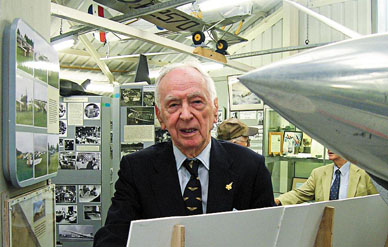
Captain Eric Brown. MBE, OBE, CBE, DSC, AFC.

Now Think Sound Barrier!

I was excited to see details of a lecture held recently in Glasgow, recounting the Struggle to Break the Sound Barrier.  [Nice history on WikiPedia, Ed]

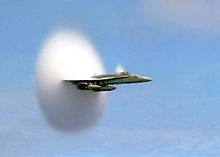
FA-18 breaking sound barrier

How easy it is today to jump into an aircraft, and expect to fly safely round the world in the luxury of an arm chair 7 miles or more above the surface of the earth, or know that the modern aircraft of our Air Forces can fly on every limit known, in the knowledge that all the aerodynamic tests and trials have been carried out.

Eric Brown is now 92. He gave up his wings at 70, but still 22 years later is lecturing on a subject which was at the time uncharted territory, a race to fly faster than Mach1, the Speed of Sound. Chuck Yeager got there first, but now ponder the following.

Captain “Winkle” Brown was with the Royal Navy for 31 years, much of it as an outstanding test pilot.

He flew 487 different types, (not variants) and made 2407 Aircraft Carrier landings, both World records.

At University he studied German, so at the end of the war as a linguist he interrogated many leading German aviation personalities such as Willy Messerschmitt, Ernst Heinkel, and Hanna Reitsch..

Capt. Eric Brown

What an interesting life, and still with stories to tell, and knowledge to pass on. There’s a lovely interview with Capt. Brown here.

By Bob Derham

Letter from Payson – the language barrier!

America and England are two Nations divided by a common language

The other day I was in Payson’s local Home Depot looking for what I call a torch.  As usual, if one has an air of not knowing where to look, it is only a matter of moments before a sales assistant asks if he or she may help.

The Home Depot - Payson, Az

Me: Excuse me but do you sell rechargeable torches?

Sales Assistant: I don’t think so, Sir, you would be best advised to ask at the Information Desk.

A few moments later, at said Information Desk … Do you stock rechargeable torches?

The young girl types on a keyboard, looks up at the screen and replies … I’m sorry Sir, we don’t stock those.

Surprised, I get on looking for the other items that I need.

About 10 minutes later, halfway down an aisle I notice – guess what – a decent selection of rechargeable torches! Pleased, I make my selection and on the way out to the tills pass by the original sales assistant who came to help me.

Me: You see you do sell rechargeable torches!

Sales Assistant:  Ah, we call them flashlights!

The point of this rather mundane story is to point out that the differences in language between American English and UK English are much more involved than the famous ones such as rubber and condom!

In fact there are so many different terms in the D-I-Y arena that I have stopped asking for items in what, to me, is the

Ace Hardware

obvious name and now tend to describe the problem that I am trying to fix.

Thank goodness, most of the assistants in Home Depot, and the equally efficient Ace Hardware, now see me coming and know that I’m still learning to speak American!

Is there a deeper element to this language difference?

I believe so.  Because the assumption is that you are going to be understood straight off.  If one was in a country where the natural language was other than English then, without doubt, you would know that verbal communication was going to be strained, to say the least.

In America we just take the language for granted. In practice, I suspect that verbal communications are much less effective than one assumes.

Finally, it’s interesting to note that Jean, who was married to an American for 30 years, effortlessly switches to both an American accent and vocabulary as soon as she is talking to the locals.  Will I, too, make the switch over time?

(If you are in need of a rechargeable torch yourself, here is a Home Depot coupon. Good luck!)

By Paul Handover

P.S. The quote that started this article appears to have been originated by George Barnard Shaw and not Winston Churchill as I previously thought.

SR-71 Blackbird breakup at Mach 3.18!

More on that truly amazing aviation survival

Yesterday, I wrote a brief Post about the story retold by Bill Weaver, Chief Test Pilot at Lockheed.  For those that read the Post but didn’t click through to the full article, here it is.

It comes from the aviation website The Digital Aviator and I trust that republishing it once again doesn’t offend.

———————————————–

By Bill Weaver

Chief Test Pilot, Lockheed


Among professional aviators, there’s a well-worn saying: Flying is simply hours of boredom punctuated by moments of stark terror. But I don’t recall too many periods of boredom during my 30-year career with Lockheed, most of which was spent as a test pilot. By far, the most memorable flight occurred on Jan. 25, 1966.

Jim Zwayer, a Lockheed flight-test specialist, and I were evaluating systems on an SR-71 Blackbird test from Edwards. We also were investigating procedures designed to reduce trim drag and improve high-Mach cruise performance The latter involved flying with the center-of-gravity (CG) located further aft than normal, reducing the Blackbird’s longitudinal stability.

We took off from Edwards at 11:20 a.m. and completed the mission’s first leg without incident. After refueling from a KC-135 tanker, we turned eastbound, accelerated to a Mach 3.2 cruise speed and climbed to 78,000 ft., our initial cruise-climb altitude.

Several minutes into cruise, the right engine inlet’s automatic control system malfunctioned, requiring a switch to manual control. The SR-71’s inlet configuration was automatically adjusted during supersonic flight to decelerate airflow in the duct, slowing it to subsonic speed before reaching the engine’s face. This was accomplished by the inlet’s center-body spike translating aft, and by modulating the inlet’s forward bypass doors.

Normally, these actions were scheduled automatically as a function of Mach number, positioning the normal shock wave (where air flow becomes subsonic) inside the inlet to ensure optimum engine performance. Without proper scheduling, disturbances inside the inlet could result in the shock wave being expelled forward- a phenomenon known as an “inlet unstart.”

That causes an instantaneous loss of engine thrust, explosive banging noises and violent yawing of the aircraft, like being in a train wreck. Unstarts were not uncommon at that time in the SR-71’s development, but a properly functioning system would recapture the shock wave and restore normal operation.

On the planned test profile, we entered a programmed 35-deg. bank turn to the righ t. An immediate unstart occurred on the right engine, forcing the aircraft to roll further right and start to pitch up. I jammed the control stick as far left and forward as it would go. No response. I instantly knew we were in for a wild ride. I attempted to tell Jim what was happening and to stay with the airplane until we reached a lower speed and altitude. I didn’t think the chances of surviving an ejection at Mach 3.18 and 78,800 ft. were very good. However, g-forces built up so rapidly that my words came out garbled and unintelligible, as confirmed later by the cockpit voice recorder.

The cumulative effects of system malfunctions, reduced longitudinal stability, increased angle-of-attack in the turn, supersonic speed, high altitude and other factors imposed forces on the airframe that exceeded flight control authority and the stability augmentation system’s ability to restore control.

Everything seemed to unfold in slow motion. I learned later the time from event onset to catastrophic departure from controlled flight was only 2-3 seconds. Still trying to communicate with Jim, I blacked out, succumbing to extremely high g-forces.

Then the SR-71 literally disintegrated around us. From that point, I was just along for the ride. And my next recollection was a hazy thought that I was having a bad dream. Maybe I’ll wake up and get out of this mess, I mused. Gradually regaining consciousness, I realized this was no dream; it had really happened. That also was disturbing, because I COULD NOT HAVE SURVIVED what had just happened.
I must be dead. Since I didn’t feel bad- just a detached sense of euphoria- I decided being dead wasn’t so bad after all. As full awareness took hold, I realized I was not dead. But somehow I had separated from the airplane.

I had no idea how this could have happened; I hadn’t initiated an ejection. The sound of rushing air and what sounded like straps flapping in the wind confirmed I was falling, but I couldn’t see anything. My pressure suit’s face plate had frozen over and I was staring at a layer of ice.

The pressure suit was inflated, so I knew an emergency oxygen cylinder in the seat kit attached to my parachute harness was functioning. It not only supplied breathing oxygen, but also pressurized the suit, preventing my blood from boiling at extremely high altitudes. I didn’t appreciate it at the time, but the suit’s pressurization had also provided physical protection from intense buffeting and g-forces. That inflated suit had become my own escape capsule

My next concern was about stability and tumbling. Air density at hi gh altitude is insufficient to resist a body’s tumbling motions, and centrifugal forces high enough to cause physical injury could develop quickly. For that reason, the SR-71’s parachute system was designed to automatically deploy a small-diameter stabilizing chute shortly after ejection and seat separation. Since I had not intentionally activated the ejection system–and assuming all automatic functions depended on a proper ejection sequence–it occurred to me the stabilizing chute may not have deployed.

However, I quickly determined I was falling vertically and not tumbling. The little chute must h ave deployed and was doing its job. Next concern: the main parachute, which was designed to open automatically at 15,000 ft. Again I had no assurance the automatic-opening function would work.

I couldn’t ascertain my altitude because I still couldn’t see through the iced-up faceplate. There was no way to know how long I had been blacked-out or how far I had fallen. I felt for the manual-activation D-ring on my chute harness, but with the suit inflated and my hands numbed by cold, I couldn’t locate it. I decide d I’d better open the faceplate, try to estimate my height above the ground, then locate that “D” ring. Just as I reached for the faceplate, I felt the reassuring sudden deceleration of main-chute deployment.

I raised the frozen faceplate and discovered its uplatch was broken. Using one hand to hold that plate up, I saw I was descending through a clear, winter sky with unlimited visibility. I was greatly relieved to see Jim’s parachute coming down about a quarter of a mile away. I didn’t think either of us could have survived the aircraft’s breakup, so se eing Jim had also escaped lifted my spirits incredible.I could also see burning wreckage on the ground a few miles from where we would land. The terrain didn’t look at all inviting–a desolate, high plateau dotted with patches of snow and no signs of habitation.

I tried to rotate the parachute and look in other directions. But with one hand devoted to keeping the face plate up and both hands numb from high-altitude, subfreezing temperatures, I couldn’t manipulate the risers enough to turn Before the bre akup, we’d started a turn in the New Mexico-Colorado-Oklahoma-Texas border region. The SR-71 had a turning radius of about 100 miles at that speed and altitude, so I wasn’t even sure what state we were going to land in. But, because it was about 3:00 p.m., I was certain we would be spending the night out here.

At about 300 ft. above the ground, I yanked the seat kit’s release handle and made sure it was still tied to me by a long lanyard. Releasing the heavy kit ensured I wouldn’t land with it attached to my derriere, which could break a leg or cause other injuries. I then tried to recall what survival items were in that kit, as well as techniques I had been taught in survival training.
Looking down, I was startled to see a fairly large animal- perhaps an antelope- directly under me. Evidently, it was just as startled as I was because it literally took off in a cloud of dust.

My first-ever parachute landing was pretty smooth. I landed on fairly soft ground, managing to avoid rocks, cacti and antelopes. My chute was still billowing in the wind, though. I struggled to collapse it with one hand, holding the still-frozen faceplate up with the other.“Can I help you? ” a voice said. Was I hearing things? I must be hallucinating. Then I looked up and saw a guy walking toward me, wearing a cowboy hat. A helicopter was idling a short distance behind him. If I had been at Edwards and told the search-and-rescue unit that I was going to bail out over the Rogers Dry Lake at a particular time of day, a crew couldn’t have gotten to me as fast as that cowboy-pilot had.
The gentleman was Albert Mitchell, Jr., owner of a huge cattle ranch in northeastern New Mexico. I had landed about 1.5 mi. from his ranch house–and from a hangar for his two-place Hughes helicopter. Amazed to see him, I replied I was having a little trouble with my chute. He walked over and collapsed the canopy, anchoring it with several rocks. He had seen Jim and me floating down and had radioed the New Mexico Highway Patrol, the Air Force and the nearest hospital.
Extracting myself from the parachute harness, I discovered the source of those flapping-strap noises heard on the way down. My seat belt and shoulder harness were still draped around me, attached and latched.
The lap belt had been shredded on each side of my hips, where the straps had fed through knurled adjustment rollers. The shoulder harness had shredded in a similar manner across my back. The ejection seat had never left the airplane. I had been ripped out of it by the extreme forces, with the seat belt and shoulder harness still fastened.

I also noted that one of the two lines that supplied oxygen to my pressure suit had come loose, and the other was barely hanging on. If that second line had become detach ed at high altitude, the deflated pressure suit wouldn’t have provided any protection. I knew an oxygen supply was critical for breathing and suit-pressurization, but didn’t appreciate how much physical protection an inflated pressure suit could provide.
That the suit could withstan d forces sufficient to disintegrate an airplane and shred heavy nylon seat belts, yet leave me with only a few bruises and minor whiplash was impressive. I truly appreciated having my own little escape capsule.

After helping me with the chute, Mitchell said he’d check on Jim. He climbed into his helicopter, flew a short distance away and returned about 10 minutes later with devastating news: Jim was dead. Apparently, he had suffered a broken neck during the aircraft’s disintegration and was killed instantly. Mitchell said his ranch foreman would soon arrive to watch over Jim’s body until the authorities arrived. I asked to see Jim and, after verifying there was nothing more that could be done, agreed to let Mitchell fly me to the Tucumcari hospital, about 60 mi. to the south.

I have vivid memories of that helicopter flight, as well. I didn’t know much about rotorcraft, but I knew a lot about “red lines,” and Mitchell kept the airspeed at or above red line all the way. The little helicopter vibrated and shook a lot more than I thought it should have. I tried to reassure the cowboy-pilot I was feeling OK; there was no need to rush. But since he’d notified the hospital staff that we were inbound, he insisted we get there as soon as possible. I couldn’t help but think how ironic it would be to have survived one disaster only to be done in by the helicopter that had come to my rescue.
However, we made it to the hospital safely–and quickly. Soon, I was able to contact Lockheed’s flight test office at Edwards. The test team there had been notified initially about the loss of radio and radar contact, then told the aircraft had been lost They also knew what our flight conditions had been at the time, and assumed no one could have survived. I explained what had happened, describing in fairly accurate detail the flight conditions prior to breakup.

The next day, our flight profile was duplicated on the SR-71 flight simulator at Beale AFB, Calif. The outcome was identical. Steps were immediately taken to prevent a recurrence of our accident. Testing at a CG aft of normal limits was discontinued, and trim-drag issues were subsequently resolved via aerodynamic means. The inlet control system was continuously improved and, with subsequent development of the Digital Automatic Flight and Inlet Control System, inlet unstarts became rare.

sr71cockpit Investigation of our accident revealed that the nose section of the aircraft had broken off aft of the rear cockpit and crashed about 10 mi from the main wreckage. Parts were scattered over an area approximately 15 miles long and 10 miles wide. Extremely high air loads and g-forces, both positive and negative, had literally ripped Jim and me from the airplane. Unbelievably good luck is the only explanation for my escaping relatively unscathed from that disintegrating aircraft.

Two weeks after the accident, I was back in an SR-71, flying the first sortie on a brand-new bird at Lockheed’s Palmdale, Calif., assembly and test facility It was my first flight since the accident, so a flight test engineer in the back seat was probably a little apprehensive about my state of mind and confidence.

As we roared do wn the runway and lifted off, I heard an anxious voice over the intercom.

“Bill! Bill! Are you there?”
“Yeah, George. What’s the matter?”

“Thank God! I thought you might have left.”

The rear cockpit of the SR-71 has no forward visibility–only a small window on each side–and George couldn’t see me. A big red light on the master-warning panel in the rear cockpit had illuminated just as we rotated, stating: “Pilot Ejected.” Fortunately, the cause was a misadjusted micro switch, not my departure.

sr-71_ss

– – – – – – – – – – – – – – – – – – – –

Bill Weaver flight-tested all models of the Mach-2 F-104 Starfighter and the entire family of Mach 3+ Blackbirds–the A-12, YF-12 and SR-71. He subsequently was assigned to Lockheed’s L-1011 project as an engineering test pilot, and became the company’s chief pilot. He later retired as Division Manager of Commercial Flying Operations.

He still flies Orbital Sciences Corp.’s L-1011, which has been modified to carry the Pegasus satellite-launch vehicle. And as an FAA Designated Engineering Representative Flight Test Pilot, he’s also involved in various aircraft-modification projects, conducting certification flight tests.


By John Lewis

Not your average day in the ‘office’!

There are escapes, lucky escapes and this …..

Flying an SR-71 Blackbird must have been one of the more extreme forms of aviation at the best of times.

Surviving the breakup up of one at Mach 3.18 and 78,800 feet is unlikely beyond all measure, but not impossible, as this story describes.

The severity of this incident is captured many times over in this story. Can you even imagine thinking:

I had no idea how this could have happened; I hadn’t initiated an ejection.

And the scale of the navigational issues are extreme too:

Before the breakup, we’d started a turn in the New Mexico-Colorado-Oklahoma-Texas border region. The SR-71 had a turning radius of about 100 miles at that speed and altitude, so I wasn’t even sure what state we were going to land in.

Above all, for me, the matter-of-fact way that stories like this are told is testament to the professionalism of these pilots.

[In fact this is such an amazing story that the full account will be published tomorrow, Ed.]

By John Lewis

Captain Thomas Murray – RIP

Regular readers of Learning from Dogs will know that we usually only post a single article on week-end days.  But yesterday I received news that a business friend of many years standing had lost his battle against ill-health and died peacefully in the afternoon.  His name was Tom Murray and it’s my wish to celebrate his life by reproducing in full the email that was sent to me. It’s serendipitous that the planned posts by John Lewis for this week-end are aviation related.

Capt. Tom Murray

On Thursday afternoon the world lost a respected, influential, and creative aviator, one of the “Great Ones”.

Captain Thomas Murray was a pilot, artist, inventor, musician, and father.

A noted jet pilot, he explored the far corners of the globe, mapping out the Canadian Arctic, flying thousands of hours in Africa, Europe, the Himalayas, and the Americas.

Whether flying Gulf streams, Falcon, Hawkers, Learjets or old DC3s, Tom was a pilot’s pilot, the friendly, knowledgeable kind of guy who knew his craft so thoroughly that airmen the world over would “just call Tom”, whenever they needed answers.

He thrilled everyone he met with exciting stories of his travels…

…such as the time he found himself lost while flying over what should have been a large African lake, only to realize the lake had dried up. The only hope of finding civilization was to dead-reckon his way in a straight line and hope he hit the tiny “dot of a town” that was his final destination.

…Or the time his oxygen system failed in the Himalayas at 20,000 feet forcing him to dive the airplane into an 8000-foot valley to find out he was the only conscious crewmember.

…Or the time the entire front panel of his Hawker 800 fell onto his lap during takeoff because someone had forgotten to screw it in.

An adventurer to the max, he was also an inventor and visionary.

Tom took an ordinary problem such as converting hard-to-read aircraft performance charts into easy-to-read tables, and then turned that process into a successful business.

Tom created one of the first electronic documents to find its way into a cockpit – tables of aircraft performance data that minimized the chance of pilot error due to miscalculation that he called “EPADS”.

Constantly working to organize the cockpit, provide higher levels of safety and better information to the pilots, he invented one of the world’s first electronic flight bags, and established the process of managing aircraft electronic checklists, a process that the FAA later modeled their ECL guidelines after.

He joked that the entire cockpit should have a mode that turned it into a simulator during flight to alleviate boredom amongst pilots and give them a chance to train in truly challenging simulations during long flights.

He invented games for children, played flute, and wrote a storybook.

An accomplished artist, he relaxed by attending artist workshops and amazing all with his skill and precision. Just last summer, Tom held his first art exhibition.

His greatest creation with wife Daisy was his son, Thomas Alexander Murray, who was born with the charismatic smile and sense of mischief that characterized Tom at his best.

Tom’s inventions were his “other child”.  He would latch onto a design problem like a pit bull.

He cherished the fact that he would uncompromisingly focus on a design and refuse to leave it go it until it was “perfect”, even to his own financial detriment when those around him insisted he was losing sight of the “big picture”.

To this effect, during his last year, he asked me to form a foundation in his name, to offer an annual award (which I’ll see if it’s possible to do)…

“To the individual who focuses on solving difficult problems; who is clearly addicted to finding the solution; who is unrelenting in the face of opposition – which may seem to be (or genuinely be) to their own personal detriment”

Perhaps he wanted an award, he knew he’d win!

Tom was well known for acting as “pilot in command” in his daily life, often forcing people to act “my way or the highway” and insisting that his way was the “right way”.

While this trait was annoying and frustrating to colleagues and friends, what was possibly more frustrating was the number of times one was forced to humble oneself when he was indeed “right”.

In the last year of his life, Tom worked relentlessly to teach others his design philosophy and prepare several of us to run the company he’d created, the vessel that would carry his vision and concern for the safety of his fellow pilots into the future.

Tom loved life and spent his days on a personal mission to make the world a better place, a more interesting place, a more ordered place, a more beautiful place, a more fun place to live…

Tom wasn’t always too clear with his emotions, and though he often maintained a “business” exterior, at heart he was the artist, and his appreciation and depth of love for his family, fellow pilots, and the people who worked for him and with him, his friends — was endless.

You always knew when he respected you, he’d give you a big pilot’s “Thumbs up!”

We will miss him dearly.

Today, we salute a great airman, Captain Thomas Murray.

On behalf of Tom, I know he would wish you a warm, “Thumbs up!”

Charles Guerin President
On-Board Data Systems (OBDS)