Year: 2010

Freedom starts at home

Freedom as something one must endeavor to gain and maintain!

The power of a cup of tea!

There is a quiet self-contradiction developing in the Tea Party movement that needs addressing, for it is a contradiction that, if left uncorrected, could turn a force with truly revolutionary potential into one more element of an oligarchic political stasis.

This movement, which as a culture attempts in many ways to be an imitation of the founders, is steering away from its origins and failing to take hold of perhaps the single most important insight of the entire American Revolution – that national change is the result of local change, not its cause.

It was not homesickness that led Thomas Jefferson to return to his home state of Virginia and decline a re-election to
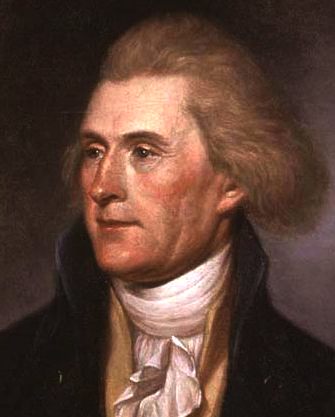
Thomas Jeffersen

Congress after penning the Declaration of Independence. At the forefront in Jefferson’s mind on July 5, 1776, was not the welfare of the new nation as a whole, but rather the welfare of his home state of Virginia.

For Jefferson, Virginia was not simply one part of the ultimate goal of the United States, but in fact an ultimate goal in itself. It was at the local level that Jefferson knew provisions for the future freedom of his fellow Virginians had to be made.

Voltairine de Cleyre, an anarchist who lived in the late 19th and early 20th centuries, greatly admired the founding generation and Jefferson in particular.

In her essay “Anarchism and American Traditions,” she wrote that one of the greatest traits of the American revolutionaries was their recognition “that the little must precede the great; that the local must be the basis of the general; that there can be a free federation only when there are free communities to federate; that the spirit of the latter is carried into the councils of the former.”

“Anarchism” today is often employed as a pejorative term rather than as a description of the political and economic philosophy taken seriously by such great minds as J.R.R. Tolkien, Henry David Thoreau, Thomas Jefferson and William Lloyd Garrison. In fact, de Cleyre’s political philosophy had many similarities with modern libertarianism and traditional conservatism.

Continue reading “Freedom starts at home”

Today’s Funny

The art of saying something and meaning something totally different.

I must confess to being a bit fed up with Greece.

In Anglo-Saxon language their attitude used to be called “taking the piss“.  Today’s “funny” (or if preferred take your pick from: tragic, surreal, ludicrous, ridiculous,bizarre, insane or indeed all of these at once) is something the Greek Prime Minister said. Admittedly he said it in February and I’ve only just picked up on it.

Here’s an extract from what was said:

‘We are a country which cannot alone deal with the speculation. So this has become a European problem, because if we do have a major problem, this could create a contagion for other countries too who are not to blame.’

Brilliant and I especially love the use of the word “speculation”.

This makes it seem as if it isn’t Greece’s fault at all; it’s all down to those nasty fat people in suits and sunglasses, the evil international financial mafia seeking to destabilize his country.

Then there is the “if” word. Now normally this is associated with a condition, but anyone who even in February thought that there was any conditionality involved in Greece’s meltdown must have been looney, or perhaps the Head of the International Monetary Fund (IMF) who said this on March 8th:

Greece will be able to deal with its own financial problems without needing a bailout, the head of the International Monetary Fund said today.

IMF managing director Dominique Strauss-Kahn said that Greece’s debt mountain is unlikely to spread to other eurozone countries with high levels of public debt.

And Mr Strauss-Kahn dismissed market speculation of potential default by other heavily indebted eurozone countries such as Portugal, Spain or Ireland as scare-mongering.

IMF Director Dominique Strauss-Kahn answers questions on a panel with Bob Geldof in Nairobi yesterday. Mr Strauss-Kahn has said he believes Greece will not need an IMF bailout .

Yes, this is the same DSK who is paid a vast salary and expenses and could be the next President of the EU.Of course he could have been lying to try to restore “confidence”. However, lying is lying, for whatever reason. Or he could have just been humungously wrong.

That’s the trouble with our leaders and financial experts these days; you never know whether they’re lying or just stupid; it’s usually one or the other and sometimes of course both.

And Papandreou’s quote continues: ” a contagion for other countries“. Indeed, Mr P. And what do we do with a “contagion” in the body? We destroy it and get rid of it …. and finally we have “other countries too who are not to blame“.

AHA! At last! Proof that my old Mum in the UK on her measly pension is not to blame. Thanks Mr P. At last some recognition fo the truth. Let’s have a bit more of that ….

As for the merits of Greece’s plea for funds, you only have to read this devastating article to feel your flabber gasting to breaking point.

No wonder the Germans are increasingly threatening to dump Greece, and so they should. Not the German government (all governments seem currently to lack the guts to do anything really necessary or serious).

No, this time it’s an economics professor threatening to take the EU to court if they allow this blatantly EU-illegal bailout, and public opinion is increasingly on his side.

It is a horrendous mess, but the only solution is for Greece to leave the euro. Bailing them out is a black hole. Does anyone in their right mind think the Greeks can really change their traditional practices and suddenly become honest, thrifty and hard-working?

Well, the answer is probably  “Yes”, but then cloud-cuckoo land is becoming seriously over-populated.

Which reminds me, I must get back to the British General Election Campaign ……

By Chris Snuggs

The aroma of British politics!

Such a shame that British electioneering couldn’t be honest.

Well, the British General Election Campaign meanders along towards the final week before we are put out of our misery on May 6th.

Sadly, the main topic of interest has been the success of Nick Clegg in the Leaders’ TV debates. The new young face on

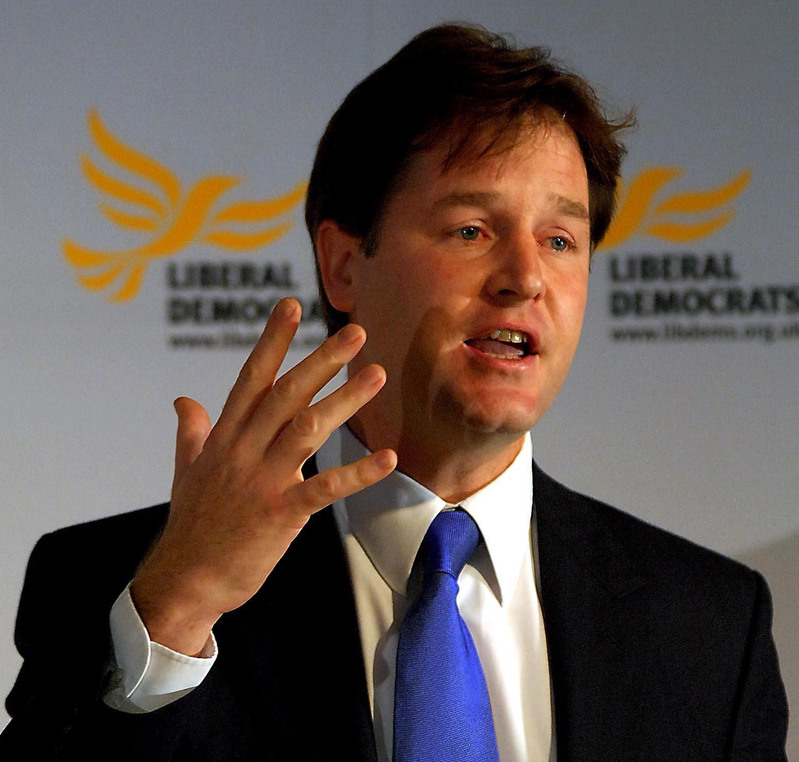
Nick Clegg

the block has proved once and for all the huge power of television. Not one single Lib-Dem policy or personnel changed during the debate, yet the mere appearance on the telly of a new, personable kid on the block has rocketed his party up the ratings.

Well, not exactly rocket science, but sobering all the same. However, more importantly, most policy discussion seems mired in a series of scare-mongering ploys along the lines of, “Don’t vote for that lot or this terrible thing will happen.”

Yes, perhaps this is the stuff of all elections, but this one should have been a bit different since

A) it comes after a long period of power held by the Labour Party and whichever way it goes will mark a historic change and,

B) the stakes are so high as Britain hovers on the edge of joining the economically-challenged PIIGS [Portugal, Italy, Ireland, Greece, Spain, Ed.] of Europe.

We desperately need a government that can take us safely away from that particular event horizon, but to choose one rationally, we need the “truth” about what really needs to be done to reduce debt.

But sadly, we seem infected by the Greek syndrome, an ability to see the bleedin’ obvious, which is that nobody can live beyond their means for ever, much as they might like to.

So, we’re having to look for “the truth” further afield, to the Institute for Fiscal Studies (IFS), for example. According to them, the cuts in public costs will have to be as deep as any made since World War II. (Oh, and thank you to Labour and the banks for jointly getting us into this sorry mess.)

Here’s a brief quote from that BBC link:

The UK faces the deepest spending cuts since the late 1970s if the three main parties are to meet their budget commitments, new analysis suggests.

The years between 2011 and 2015 must see the largest cuts since 1976-80, according to a report from the Institute for Fiscal Studies (IFS).

Here’s Stephanie Flanders, the BBC’s Economics Editor writing in her blog:

They may disagree in public, but privately they couldn’t agree more. On the single most important issue facing the country after this election, our politicians think it’s better to keep us in the dark.

WHERE is the party explaining this clearly and unambiguously to the people? In other words, TELLING THE TRUTH?

I don’t see it. Neither of the big, old dinosaur parties are being straight with us. The Tories are proposing to spend even MORE on the NHS, (National Health Service) that sacred cow that nobody dare speak any ill of, while Labour seem to be promising to spend more on just about everything despite our £163 billion borrowing this year.

Why is this? It can – I submit – only be because they don’t think the public will understand and accept “the truth”.

If party A tells the truth and admits the cuts in public services will be deep and involve some pain and party B LIES and says it will “preserve frontline services” (the Labour line) then they (Party A) fears the public will not buy their version and opt for whoever promises them a fantasy instead, or in other words a gradual recovery without too much pain and in particular for themselves.

So, there is deep cynicism and an extreme economy with the truth from all parties who fear a voter backlash if they tell it. This is rather a sad reflection on the Labour Party’s proud boast of “education, education, education” of 1997.

Apparently, the British public is so stupid that they can’t be trusted to believe the truth when they get it. Of course, this could possibly be because they are so UNUSED to getting it and moreover because this policy of spinning smoke and mirrors worked so well in previous Labour victories.

Clear as mud!

By Chris Snuggs

Giving Up!

[With this Post, Jon introduces a series of forthcoming articles looking at the inner person and exploring ways in which each of us can enhance our feelings of contentment and happiness. Ed.]

Stop the world, I want to get off!

Starting again requires giving up

Whichever way we look, there appear to be huge problems. Not insurmountable but, metaphorically speaking, sheer vertical cliffs without any easy way up.

One might ponder if the last 50 years, that post-war period of growth and prosperity, have, in reality given society real, sustainable, core improvements or whether all the ‘gains’ have come at such a cost that the net benefit is questionable?

This could be seen as pessimism gone mad. Undoubtedly, there have been some huge gains from a scientific point of view and we now enjoy lives that are greatly enhanced and longer. But not to ask such a fundamental question is to assume the alternative, that everything in the garden is rosy.

Now this may seem a strange introduction to a topic that is going to be deeply personal and private.

But both the private, individual world of the ‘self’ and the great, interconnected world of the planet are indivisible. Every aspect of our lives, our livelihoods, our environment and the future of our children depends on how well, and how sustainably, we manage our personal, local, national and international interests.

For example, if Prof. Lovelock’s theory on the planet being a self-regulating organism is correct, his Gaia theory,  then possibly in the lifetimes of our children, and certainly in the lifetimes of our grandchildren, worrying about a job or repaying the mortgage will be irrelevant. Our descendants will be worrying about their very survival!

I called this piece Giving Up. Why?

Because the only way forward is to give up on the present. I will expand on this theme in future Posts.

The future depends on each of us being happy and contented with ourselves and avoiding looking out there for the magic cure to all our troubles. Being, as far as we are able, at peace with our circumstances and able to do the best, individually, as well as the best for our families, our friends and the larger world in which we work and play.

I have heard people ask the question before, “How can I best help the world?” The only truthful answer is to develop ourselves as individuals. In doing this, the field of consciousness that we are all connected to is also lifted or elevated to a higher level.

At this stage of history, either…the general population will take control of its own destiny and will

Noam Chomsky

concern itself with community interests guided by values of solidarity and sympathy and concern for others or alternately there will be no destiny for anyone to control.

-Noam Chomsky

By Jon Lavin

[Anyone who has been affected by this article and wishes to contact Jon may find his contact details here. Ed.]

Well done, Bill Moyers!

A giant of US television retires from the screen

One of the fascinating aspects of my new American life is seeing how loud the volume of dissent is from the American

Bill Moyers

people about the shenanigans on Wall Street and the Too Big To Fail banks.  There is an intensity and passion that I can’t see happening on the other side of the Pond.  Maybe this is the cultural legacy of a people that just a short time ago, relatively speaking, were opening up this giant country seeking a better way of life than the ‘old countries’.

This intensity and passion is why, in the end, I believe that the solution to the huge crisis that still awaits us will start from this side of the Atlantic.  But it will get a whole lot worse before it gets better, such is the complexity and depth of the fraud that is being visited on decent, ordinary folks in this and many other fine countries.

Bill Moyers of the Bill Moyers Journal on PBS is retiring.  He’s approaching 76 and that’s a grand age to be dealing with the workload and stress of a weekly television presentation.  His last Journal was broadcast on the 23rd April, a week ago today airing two really important topics.  My only regret is that I haven’t been here sufficiently long to view many more of his Journals.

William K Black

In that last broadcast on the 23rd, Bill had two key interviews.  In this Post, I want to bring to your attention his first report, which was an interview with William K Black, now an academic but, just as importantly, a former bank regulator.  William Black really understands what is going on in banking.

The interview is both fascinating and captivating because, well to me anyway, it explains in terms that us laymen can understand, exactly what is going on and why it is so terribly important that legislation and regulations are brought into force to stop this fraud ever happening again.

This interview has not yet made it’s way onto YouTube so I can only post the link to the Bill Moyers website.

But, please, if you care about what is happening to us in whatever country you live in, click on this link and watch the interview.

And if you want to watch the earlier interview that Bill Moyers had with William Black then here it is.

By Paul Handover

Happy Birthday, Hubble!

The Hubble Space Telescope (HST) has been in space for 20 years!

This week, twenty years ago, the HST was launched into orbit.  There’s much online if you want to read about it both on WikiPedia and on the Hubble web site so this post is going to offer just two items.

A beautiful picture

Nucleus of Galaxy Centaurus A

And an interesting audio slideshow tribute from the BBC – click here, introduced thus:

Take a look at some of the sights it has seen in that time with Professor Alec Boksenberg from the Institute of Astronomy in Cambridge – who was on the European team that helped build Hubble.

By Paul Handover (in awe of what is beyond our skies)

Today’s Understatement of the Year

The EU Bailout!

German Chancellor Angela Merkel

German Chancellor Angela Merkel has questioned whether Greece should have been allowed into the eurozone in the first place.

She said the decision “may not have been scrutinised closely enough”.

Indeed, Angela. Indeed it may not, especially as Goldman Sachs organised some “credit swaps” (now illegal) that helped Greece disguise the size of its deficit.

Perhaps something is lost in translation, but why the “may”? Why can’t people bring themselves to call a spade a spade? The “may” is totally misplaced, isn’t it? So why say it?

See also this recent piece on the BBC.

By Chris Snuggs

Georgia O`Keeffe

The Marriott Hotel Home, New York

Due to my work I am one of the lucky people who has the opportunity to stay for short periods in various cities around the globe, and mostly the Hotels we stay in are the best around, and depending where we are, the flavour is often special.

I remember a stay in the Hilton Amsterdam where John Lennon had stayed, and had a week in bed to “Give Peace a Chance”, but a recent stay in the Marriott Eastside Hotel, New York caught my eye.

Georgia O'Keefe, 1918 photograph by Alfred Stieglitz

Georgia O`Keeffe lived here for 10 years!

I remember, she was the lady who painted the large scale flowers, and in particular “The Petunia”, and when she painted that particular piece, she was living in a suite on the 32nd floor of the very hotel I was staying in.

Georgia O`Keeffe was born in 1887 in Sun Prairie, Wisconsin. She studied art in Chicago, and New York, and became an Art Teacher at Columbia College, South Carolina.

One of her friends had shown some of her works to Alfred Stieglitz the photographer. She came to New York, and there the two eventually married, and moved later into the Shelton Hotel, Lexington Avenue, which is now called the Marriott Hotel, Eastside.

The Petunia picture was painted in 1924, and was one of a large number of her works that were exhibited in 1925.

Her husband Alfred Steiglitz died in 1946, after which she moved to an isolated ranch in New Mexico, but she continued to produce great works. Paintings of Desert Cliffs, Animal Bones, and Flowers are among the worlds most admired works of art, and she continued to draw, paint and sculpt until her death in 1986, aged 98.

Petunia - 1925

I rather liked a comment she made at the age of 90.

Success takes more than talent. It takes a kind of nerve.”

And a lot of hard, hard work, if you ask me!

By Bob Derham

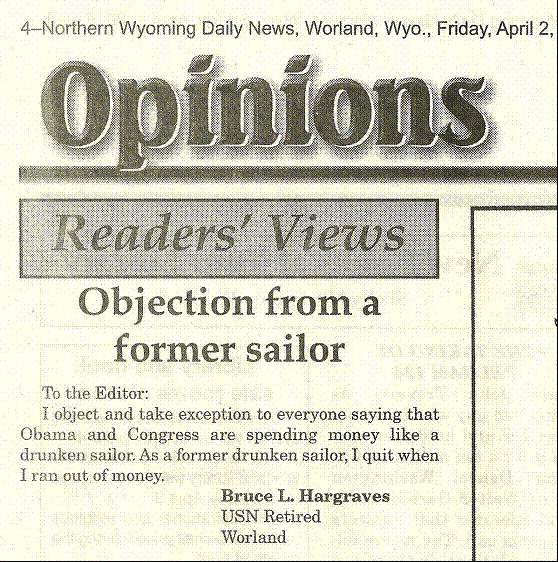
Drunken sailors

With thanks to one of our very regular followers, Gordon, for passing this on.

Well said, that sailor!

By Paul Handover

Elliot’s schooling – the negatives

Author Update – the Learning from Dogs author team are delighted to welcome Elliot to their ranks.

On April 1st I set the scene for the essays that I wanted to write for Learning from Dogs as follows:

I often ask myself just how effective the modern US schooling system is as a tool of education, and whether or not its costs outweigh its benefits. I hope to have at least a rough answer to this question in the final post of this series.

I intend to examine three topics:

In what ways does the modern schooling system function as a positive tool for education?

What costs involved in modern schooling hinder its ability as an educative tool, and even make it a negative influence on students?

Considering the analyses put forth in the first two posts, do the costs or benefits or this system outweigh the other? On the whole, are school and education complements or antagonists?

The author

On April 15th, I looked at the positive aspects of the American educational system.  Now I look at the other side of the coin, so to speak.

Intellectual failure

While in my last post I attempted to put a positive spin on the United States education system, I must here admit that I personally tend to view it in a much more negative light.  There are several reasons for this, three of which I will try to elaborate on here.

My first major concern about education in the United States is its lack of critical thinking skills, which produces students who do not know how to question the “system” for what is truly is, but rather constantly take the context of things presented as fact (the two-party political system is a perfect example of this.)

I am not necessarily arguing that the specific curriculum is being chosen to suit this purpose, though I think this argument could be made (it would, however, require quite a bit of research.)

Rather, consider the required courses – very rarely do you see courses on economics or logic.  While some schools offer these as electives, they are almost never required.  This is quite sad, as a sound ability to question the established authorities and the nature of the world as a whole requires a strong background in these two fields in particular.

The history of economics is a history of government policies that have failed because of their disregard for this very topic.

The economist Ludwig von Mises wrote that “the unpopularity of economics is the result of its analysis of the effects of privileges. It is impossible to invalidate the economists’ demonstration that all privileges hurt the interests of the rest of the nation or at least a great part of it.

A second negative aspect of the American education system is what it does to the human mind.  It essentially takes the mind and makes it into a factory that is able to take in information and then spit it back out.  I think there is a direct relationship between the formerly mentioned lack of classes on logic and economics and this production of human beings who are essentially taught to be cogs in a machine.

Economically, the schooling system can, in this light, be seen as a massive subsidy to corporations, who are handed people already trained in how to listen then do and repeat.

Finally, I must admit that I am skeptical as to the true purpose of compulsory education.  I have rarely in history seen it as a tool for true learning, as it seems to tend to rather be a system of control.  I see no reason why our school system would be any different.

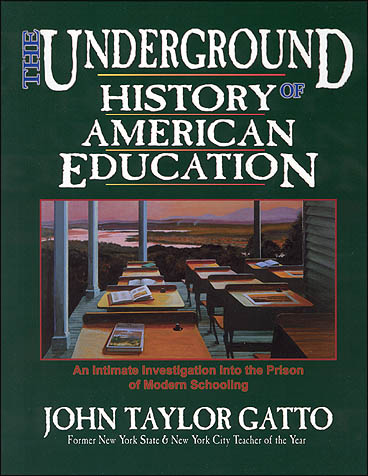
J T Gatto's book

John Taylor Gatto, a former school teacher and avid critic of mandatory schooling,  has written that the purpose of modern schooling is a combination of six different functions:

  • The adaptive function – Establish a fixed reaction to authority.
  • The integrating function – People taught to conform are predictable, and are easier to use in a large labor force.
  • The directive function – School determines each student’s social role.The differentiating function – Children are trained as far as they need to go according to their prescribed social role
  • The selective function – Tag the unfit with poor grades and disciplinary actions clearly enough that their peers will see them as unsuitable for reproduction, helping along natural selection.
  • The propaedeutic function – A small fraction is quietly taught how to manage the rest.

I am not sure if I completely agree with Gatto, but he makes some interesting points.  In my final article, I’ll attempt to weight the costs against the benefits, and see which comes out on top.

By Elliot Engstrom