This is a guest post from Captain Dave Jones. Dave and I go back many years to the time when I was studying for my Instrument Rating, a flying rating that allows one to fly in the same airspace as commercial aircraft. He is what I call a Total Aviation Person! Dave read the posts from John Lewis about the SR-71 and mentioned that he had once had a instructor at Mojave Airport, California who had been a civilian SR-71 pilot. Ed.
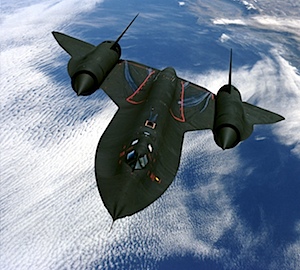
The SR-71, a truly great aircraft
John’s couple of articles about the SR-71 here and here reminded me of the time that I was given an article by my instructor at Mojave. He was a military test pilot and ended up with NASA and he was one of a select few to fly the Blackbird as a civilian….a great chap to talk to…
This is his article [broken into two posts because of its length. Ed.] with an intro from my instructor.
Awesome story about a truly great aircraft. I only let it go as high as Mach 3.27 once (the design speed was 3.2) but it could do all that is in this story, Cheers, Rogers
In April 1986, following an attack on American soldiers in a Berlin
disco, President Reagan ordered the bombing of Muammar Qaddafi's terrorist
camps in Libya. My duty was to fly over Libya and take photos recording the
damage our F-111s had inflicted. Qaddafi had established a "line of death,"
a territorial marking across the Gulf of Sidra, swearing to shoot down any
intruder that crossed the boundary. On the morning of April 15, I rocketed
past the line at 2,125 mph.

        I was piloting the SR-71 spy plane, the world's fastest jet,
accompanied by Maj. Walter Watson, the aircraft's reconnaissance systems
officer (RSO). We had crossed into Libya and were approaching our final turn
over the bleak desert landscape when Walter informed me that he was
receiving missile launch signals. I quickly increased our speed, calculating
the time it would take for the weapons-most likely SA-2 and SA-4
surface-to-air missiles capable of Mach 5 - to reach our altitude. I
estimated that we could beat the rocket-powered missiles to the turn and
stayed our course, betting our lives on the plane's performance.


        After several agonizingly long seconds, we made the turn and blasted
toward the Mediterranean. "You might want to pull it back," Walter
suggested. It was then that I noticed I still had the throttles full
forward. The plane was flying a mile every 1.6 seconds, well above our Mach
3.2 limit. It was the fastest we would ever fly. I pulled the throttles to
idle just south of Sicily, but we still overran the refueling tanker
awaiting us over Gibraltar.

        Scores of significant aircraft have been produced in the 100 years
of flight, following the achievements of the Wright brothers, which we
celebrate in December. Aircraft such as the Boeing 707, the F-86 Sabre Jet,
and the P-51 Mustang are among the important machines that have flown our
skies. But the SR-71, also known as the Blackbird, stands alone as a
significant contributor to Cold War victory and as the fastest plane
ever-and only 93 Air Force pilots ever steered the "sled," as we called our
aircraft.

        As inconceivable as it may sound, I once discarded the plane.
Literally. My first encounter with the SR-71 came when I was 10 years old in
the form of molded black plastic in a Revell kit. Cementing together the
long fuselage parts proved tricky, and my finished product looked less than
menacing. Glue, oozing from the seams, discolored the black plastic. It
seemed ungainly alongside the fighter planes in my collection, and I threw
it away.

        Twenty-nine years later, I stood awe-struck in a Beale Air Force
Base hangar, staring at the very real SR-71 before me. I had applied to fly
the world's fastest jet and was receiving my first walk-around of our
nation's most prestigious aircraft. In my previous 13 years as an Air Force
fighter pilot, I had never seen an aircraft with such presence. At 107 feet
long, it appeared big, but far from ungainly.

        Ironically, the plane was dripping, much like the misshapen model I
had assembled in my youth. Fuel was seeping through the joints, raining down
on the hangar floor. At Mach 3, the plane would expand several inches
because of the severe temperature, which could heat the leading edge of the
wing to 1,100 degrees. To prevent cracking, expansion joints had been built
into the plane. Sealant resembling rubber glue covered the seams, but when
the plane was subsonic, fuel would leak through the joints.

        The SR-71 was the brainchild of Kelly Johnson, the famed Lockheed
designer who created the P-38, the F-104 Starfighter, and the U-2. After the
Soviets shot down Gary Powers' U-2 in 1960, Johnson began to develop an
aircraft that would fly three miles higher and five times faster than the
spy plane-and still be capable of photographing your license plate. However,
flying at 2,000 mph would create intense heat on the aircraft's skin.
Lockheed engineers used a titanium alloy to construct more than 90 percent
of the SR-71, creating special tools and manufacturing procedures to
hand-build each of the 40 planes. Special heat-resistant fuel, oil, and
hydraulic fluids that would function at 85,000 feet and higher also had to
be developed.

        In 1962, the first Blackbird successfully flew, and in 1966, the
same year I graduated from high school, the Air Force began flying
operational SR-71 missions. I came to the program in 1983 with a sterling
record and a recommendation from my commander, completing the weeklong
interview and meeting Walter, my partner for the next four years. He would
ride four feet behind me, working all the cameras, radios, and electronic
jamming equipment. I joked that if we were ever captured, he was the spy and
I was just the driver. He told me to keep the pointy end forward.

        We trained for a year, flying out of Beale AFB in California, Kadena
Airbase in Okinawa, and RAF Mildenhall in England. On a typical training
mission, we would take off near Sacramento, refuel over Nevada, accelerate
into Montana, obtain high Mach over Colorado, turn right over New Mexico,
speed across the Los Angeles Basin, run up the West Coast, turn right at
Seattle, then return to Beale. Total flight time: two hours and 40 minutes.

        One day, high above Arizona, we were monitoring the radio traffic of
all the mortal airplanes below us. First, a Cessna pilot asked the air
traffic controllers to check his ground speed. "Ninety knots," ATC replied.
A twin Bonanza soon made the same request. "One-twenty on the ground," was
the reply. To our surprise, a navy F-18 came over the radio with a ground
speed check. I knew exactly what he was doing. Of course, he had a ground
speed indicator in his cockpit, but he wanted to let all the bug-smashers in
the valley know what real speed was. "Dusty 52, we show you at 620 on the
ground," ATC responded.

        The situation was too ripe. I heard the click of Walter's mike
button in the rear seat. In his most innocent voice, Walter startled the
controller by asking for a ground speed check from 81,000 feet, clearly
above controlled airspace. In a cool, professional voice, the controller
replied, "Aspen 20, I show you at 1,982 knots on the ground." We did not
hear another transmission on that frequency all the way to the coast.

        The Blackbird always showed us something new, each aircraft
possessing its own unique personality. In time, we realized we were flying a
national treasure. When we taxied out of our revetments for takeoff, people
took notice. Traffic congregated near the airfield fences, because everyone
wanted to see and hear the mighty SR-71. You could not be a part of this
program and not come to love the airplane. Slowly, she revealed her secrets
to us as we earned her trust.

        One moonless night, while flying a routine training mission over the
Pacific, I wondered what the sky would look like from 84,000 feet if the
cockpit lighting were dark. While heading home on a straight course, I
slowly turned down all of the lighting, reducing the glare and revealing the
night sky. Within seconds, I turned the lights back up, fearful that the jet
would know and somehow punish me. But my desire to see the sky overruled my
caution, I dimmed the lighting again.

        To my amazement, I saw a bright light outside my window. As my eyes
adjusted to the view, I realized that the brilliance was the broad expanse
of the Milky Way, now a gleaming stripe across the sky. Where dark spaces in
the sky had usually existed, there were now dense clusters of sparkling
stars. Shooting stars flashed across the canvas every few seconds. It was
like a fireworks display with no sound.

        I knew I had to get my eyes back on the instruments, and reluctantly
I brought my attention back inside. To my surprise, with the cockpit
lighting still off, I could see every gauge, lit by starlight. In the
plane's mirrors, I could see the eerie shine of my gold spacesuit
incandescently illuminated in a celestial glow. I stole one last glance out
the window. Despite our speed, we seemed still before the heavens, humbled
in the radiance of a much greater power. For those few moments, I felt a
part of something far more significant than anything we were doing in the
plane. The sharp sound of Walt's voice on the radio brought me back to the
tasks at hand as I prepared for our descent.
Part Two is tomorrow
 Learning from Dogs