First General Motors, then Student Loans. What’s next, Mr. President?
In a Bloomberg BusinessWeek article, the most recent seizure of private industry in Venezuela was reported, with as much calm and lack of alarm as one may report on the the weather or a walk in the park.
I fear that this is where the U.S. is headed in the all too near future, given the takeover of the auto and student loan industries, and President Obama’s apparent admiration of President Chavez and all he does.
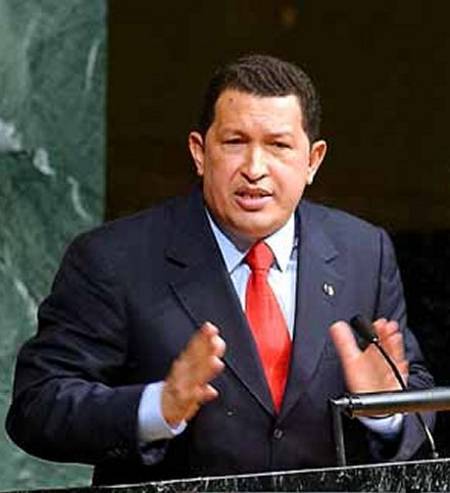
Pres. Chavez
To quote from the article, which speaks for itself:
President Hugo Chavez announced Saturday the expropriation of a group of iron, aluminum and transportation companies in Venezuela’s mining region.
Among the expropriated companies is Materiales Siderurgicos, or Matesi, which is the Venezuelan subsidiary of Luxembourg-based steel maker Tenaris SA.
Venezuela’s socialist president said in a televised that his government was going to take over Matesi because “we couldn’t reach an amicable and reasonable settlement with the owners.”
Chavez said production at the company has been paralyzed since midway through last year, when Venezuela’s president announced plans to nationalize it.
Chavez said he was also going to expropriate Venezuelan-owned Orinoco Iron and aluminum-maker Norpro de Venezuela C.A., which is an affiliate of the U.S. company Norpro in association with France’s Saint Gobain, among other companies.
As well, Venezuela will take over transport companies that ship raw materials in areas southeast of Caracas. He did not name the companies.
Since coming to power more than a decade ago, Chavez has nationalized major companies in the electricity, oil, steel and coffee sectors, as well as other private businesses.
You eventually pay for LIES and STUPIDITY, even if it takes time. Sadly, the euro was born in a lie and now Merkel has compounded the problems by giving in to French pressure and being stupid. But the German people (in contrast to their leaders) have no desire to be the bankers of all Europe.
What Merkel has done is utter folly and, worse, won’t even fix the problem. The ONLY way to fix a problem is to DO THE RIGHT THING, which is not rescue people from their idiocy but allow them to take the consequences of it. This is not wishing to be cruel but just the way people learn difficult lessons. As J J Rousseau observed, “The fastest way to teach a child about the danger of fire is to let him burn himself once”… or words to that effect!
J J Rousseau, philosopher
Besides, the euro WITHOUT Greece would be a damned sight more convincing than WITH it. The Germans gave up the Deutschmark on the PROMISE that the euro would be as strong by following strict rules. The EU even MADE A RULE that no country could have a budget deficit of more than 3%. This was insisted on by Germany PRECISELY in order to avoid this sort of surreal situation where the Greeks, Portuguese, Irish, etc. (and Britain, but we are not in the euro …) would NOT wildly overspend.
These “strict rules” were breached before they had hardly started, first by letting in Greece and then France a year or so later, justifying the decision by saying that the rules didn’t apply to big countries — in other words, the rules didn’t apply to themselves. Brussels, and the French and German elites, LIED to the people.
The criminal bit is that these countries just IGNORED the rules. And even more criminal, they (Germany included) just IGNORED what was going on in Greece and elsewhere until, surprise, surprise, it all reared up out of the sand and hit them in the face. Now the Germans have to accept even MORE tax increases, despite being already very highly taxed, just like the French and – increasingly – the British. The British finally got fed up with being lied to and dumped their government. Germany may be going the same way. (France swings wildly from left to right anyway, and each time it seems worse than before.)
Besides, Germany can’t AFFORD to bankroll the whole of Europe. France, too, is ludicrously over-spent and top-heavy with her state. The consequence of all this will no doubt be vast political gains for the left in both countries, but the left have even LESS idea about how to run an economy – see Gordon Brown of “I do know how to run an economy” fame(perhaps he meant “ruin an economy?!”).
Europe is in deep trouble and I really don’t think the politicians even now understand it. Some say that a gradual decline of Europe is already inevitable as Asia rises; the current mentality of lying, overspending, over-borrowing, bailing out undeserving basket cases and over-centralisation will only accelerate this decline.
But for some, of course – such as Jose Manuel “Boring”oso – this crisis is manna from Heaven; a big step towards a United States of Europe and vastly increased power for Brussels. For God’s sake call his bluff. We don’t WANT an “economic union” run from Brussels. It will be a bureaucratic, tax-heavy nightmare, as in France.
Jose Manuel Barroso, EU President
“Let’s be clear,” said the European Commission president, Jose Manuel Barroso, last week. “You can’t have a monetary union without having an economic union. Member states should have the courage to say whether they want an economic union or not. And if they don’t, it’s better to forget monetary union altogether.”EuroActiv May 12, 2010.
These people are really unbelievable. If Barroso is so sure about not being able to have monetary union without economic union (and, of course, ipso facto political union as well) then why didn’t he say this at the beginning? The pro-USE lobby really kept that quiet, didn’t they. It is all a big LIE.
So, to cure indebtedness, you incur FURTHER vast debts? It is surreal. Niall Ferguson, an economic historian at Harvard University, put it this way: “This bailout wasn’t done to help the Greeks; it was done to help the French and German banks. They’ve poured some water on the fire, but the fire has not gone out.” NYT May 17, 2010
The European rescue plan, which totals 750 billion euros thus far and was intended to head off the risk of default, will instead greatly increase borrowing. That could be the end of Europe’s nascent recovery.
Derivative securities are not inherently evil, though the media would have you think otherwise. It seems that any
Are they evil?
type of investment that does not directly involve commodities is an easy target these days.
But derivatives are just another type of investment, those whose value is derived from some underlying security or asset or event. Insurance is a type of derivative investment, as a matter of fact. If the bad event happens (a car accident, flood, or fire, for example), then a claim is made against the policy. If not, the policy expires. The value of the policy is derived from the insured asset or event.
If derivatives are bad, then so too is insurance. If derivatives are bad, then so too are leases with the option to own. If derivatives are bad, then so too is the equity in any type of company, small or large, private or public, including those that produce real products and commodities, for stock is nothing more than an option to buy the underlying assets of the company for the price of the face value of its debt. If derivatives are bad, then so too are convertible securities and most every other type of financial innovation we’ve witnessed in the last 30 years, and for decades to come.
Several times a week, I drop into Karl Denninger’s blog The Market Ticker. While frequently the articles are too technical for me, it’s still, nonetheless, possible to get the drift of Karl’s messages.
As his overall theme is strongly coincident with my own views on my pension investments, and which have served me proud over the last 10 years, especially the last 2 years, it’s natural that I like what Karl does.
But the point of this Post is to underline just how much time and effort Karl puts in to his work, all of which is free to the world at the click of a mouse.
Are there others who devote equal amounts of time to their Blogs and websites? Yes, many! And many of them are also heroes (and heroines!)
Of course, I have no doubt that The Market Ticker is part of Karl’s business strategy but, again, he could choose other ways to make his income without sharing, for free, so many valuable ideas.
Here are a couple of examples to underline my deep respect for this man. (Taken from Market Ticker on the 13th May.)
I’d love to engage in a discussion with you — and interested others — about the appropriate role of government in education.
The Federalist Papers made it clear, to me at least, that our founding fathers believed that the government, our federal government in particular, should have nothing to do with educating the populace.
The government providing public education? How did THAT happen?
I realize it sounds a bit radical now, but I believe that any discussion of what is right and wrong about public education today must begin with a healthy debate about whether the federal government should be involved in public education at all.
Transocean Deepwater Horizon Explosion-A Discussion of What Actually Happened?
The trouble with the way that the news is presented and consumed is that major events are delivered in ‘headline’ style and even something as terrible as the oil spill in the Gulf of Mexico is starting to compete with other, more current, news stories.
The other issue with news channels is that it is uncommon to be presented with a real insight into the human scale of massive catastrophes. Thank goodness for the web!
Drilling Ahead is a website that describes itself as A Social Network of Oil & Gas Professionals. Another website find courtesy of Naked Capitalism.
An Ill-fated Discovery
According to news accounts, at about 10 p.m. CDT last Tuesday, Deepwater Horizon was stable, holding an exact position in calm, dark seas about 45 miles south of the Louisiana coastline. Water depth in the area is 5,000 feet. The vessel manifest listed 126 souls on board.
Deepwater Horizon was finishing work on an exploration well named Macondo, in an area called Mississippi Canyon Block 252. After weeks of drilling, the rig had pushed a bit down over 18,000 feet, into an oil-bearing zone. The Transocean and BP personnel were installing casing in the well. BP was going to seal things up, and then go off and figure out how to produce the oil — another step entirely in the oil biz.
The Macondo Block 252 reservoir may hold as much as 100 million barrels. That’s not as large as other recent oil strikes in the Gulf, but BP management was still pleased. Success is success —
certainly in the risky, deep-water oil environment. The front office of BP Exploration was preparing a press release to announce a “commercial” oil discovery.
This kind of exploration success was par for the course for Deepwater Horizon. A year ago, the vessel set a record at another site in the Gulf, drilling a well just over 35,000 feet and discovering the 3 billion barrel Tiber deposit for BP. SoDeepwater Horizon was a great rig, with a great crew and a superb record. You might even say that is was lucky.
But perhaps some things tempt the Gods. Some actions may invite ill fate. Because suddenly, the wild and wasteful ocean struck with a bolt from the deep.
The Lights Went out;
and Then...
Witnesses state that the lights flickered on the Deepwater Horizon. Then a massive thud shook the vessel, followed by another strong vibration. Transocean employee Jim Ingram, a seasoned
offshore worker, told the U.K. Times that he was preparing for bed after working a 12-hour shift. “On the second [thud],” said Mr. Ingram, “we knew something was wrong.” Indeed, something was very wrong.
Within a moment, a gigantic blast of gas, oil and drilling mud roared up through three miles of down-hole pipe and subsea risers. The fluids burst through the rig floor and ripped up into the gigantic draw-works. Something sparked. The hydrocarbons ignited. In a fraction of a second, the drilling deck of the Deepwater Horizon exploded into a fireball. The scene was an utter conflagration.
German Chancellor Angela Merkel’s party and its coalition allies have been defeated in regional elections in North Rhine-Westphalia.
North Rhine-Westphalia, Germany
German Chancellor Merkel appears to have lost the state vote in NRW and may see her control of parliament reduced or eliminated. It’s her own fault.
Germany and in particular NRW (the industrial powerhouse of Germany) are in a serious economic situation with enforced cuts left, right and centre and yet she has loaned (aka given) billions to feckless, idle, corrupt and shambolic Greece.
The Germans have had to tighten their belts and are still paying vast sums to bring East Germany up to speed, yet Merkel feels she can fritter away her people’s money to “save the euro“. It won’t save Greece or the euro.
The Greeks fully deserve to go bankrupt and are incapable of complying with the degree of “cuts” the Germans are demanding. Other European countries will lose money if Greece defaults. Tough.
Better to suffer a one-off loss than an endless shelling-out into a black hole. No bailout of Greece, Portugal, Spain, Ireland or Britain. Did the PEOPLE of ANY of the rest of EU countries have ANY say in this at all?
It seems the French pushed hard for a bailout. What a coincidence that some of their insurance companies have invested heavily in Greece. TOO BAD. Greece’s problems have been well-known for years; which moron poured billions into their black-hole, retire-at-53, inherit-your-sister’s-pension, go-to-work-if-you-feel-like-it economy?
And the Greeks? They seem to feel it is the fault of the REST of us that they have to make cuts. Was a reality check ever more fully needed? Sadly, but inevitably, there will be social breakdown in Greece from which something new will emerge. What that is, one cannot say, but I do not believe it can include membership of the Euro.
The Brussels Overlords think differently. Their little Euro brainchild must be saved at all costs. But they are all personally very well off and have no problems with money, unlike the majority of their constituents thanks to the despicable fraud perpetrated on them by the banks under the appallingly-negligent supervision of a multitude of governments.
I have written about Greece several times in recent weeks since to me it is a symbol of the combination of arrogance and utter folly of many of Europe’s governments – and in particular Brussels – who have overspent wildly, who have allowed their banks to make fraudulent loans and have imposed an ever-increasing burden of bureaucracy, Human rights, paperwork and regulations on the peoples of Europe.
How we are supposed to compete effectively when we A) price ourselves out of the market and B) wildly overspend is a mystery.
Has Europe now to prepare itself for a long period of decline and retrenchment in living standards as Asia maintains its inexorable growth and raw materials rocket in price? I fear so, but it’ll be the ordinary people bearing the brunt of all this, not the increasingly-remote politicians in national governments and Brussels.
Greece is a warning for the rest of us. There is no law that says we cannot go the same way. The UK and France in particular have bloated, feather-bedded public sectors. The chickens always come home to roost, and they are now flocking rapidly towards the hen-house.
Young Australian, Jessica Watson, is home safe and sound.
(Circumstances required that I had to prepare this Post well ahead of the confirmation that Jessica is back and as it happens, the chances are that when Jessica made it past the Sydney Heads finish line I was onboard a flight from Los Angeles to London.)
05-May-2010
The youngest person to sail around the world solo, non-stop and unassisted, 16 year old Australian Jessica Watson, is expected to complete her historic voyage, arriving back in Sydney to a hero’s welcome on Saturday 15 May.
Jessica left Sydney on 18 October 2009 and has so far overcome every challenge that Mother Nature has thrown at her to achieve her goal.
Jessica needs to cross the finish line at Sydney Heads to officially complete her voyage. She will then cruise down Sydney Harbour before disembarking at Sydney Opera House.
It is anticipated that Jessica will cross the finish line at approximately 11:30am and arrive at the Sydney Opera House around 12.30pm, the first time she will have set foot on land in almost seven months.
Readers of Learning from Dogs will know that we recognised Jessica’s brave and courageous voyage in a Post published on November 12th, 2009.
Soon memories such as this:
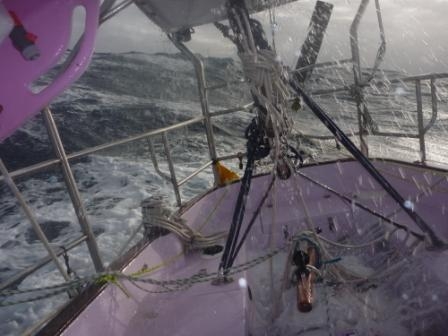
With the drogue trailing behind Ella's Pink Lady shaking off one wave with the next 10m monster coming up behind!
The new British Conservative & Liberal-Democrat Cabinet
I can’t remember a more momentous week in British politics. It seemed silly to comment as events unfolded so swiftly – one would have risked being out of date before finishing the article – but it is perhaps time to summarize what has happened:
The outcome was in retrospect the best possible, even if none of the parties might think of it that way.
We have a stable government locked into a coalition that commands a large majority in the House of Commons and a considerable majority of the popular vote. Nobody can deny this coalition “the right to govern”, whichever way you regard the statistics.
The country’s finances are in a terrible mess and a stable government was essential to put things right and recover confidence.
Yes, there will be strains and stresses in each party, but both have now invested so much in this that neither can afford to rock the boat and risk another general election to let Labour back in under a new and more charismatic leader.
Both parties have shown a spirit of compromise and both have had to ditch some of their cherished (and more wacky) policies.
“First Past the Post” has taken a lot of stick and it seems the time of electoral reform has arrived. The Lib-Dems have a firm commitment to a referendum on the Alternative Vote (not optimal, but an improvement) plus other essential elements – long-delayed by the previous Labour dinosaur – such as fixed term parliaments, a redistribution of votes per constituency and a reduced number of MPs.
The country has seemed fragmented and divided in recent years, with much bitterness and a sense of drift and failure. The coalition has brought fresh hope, though it is born in very difficult times. But as a coalition it is perhaps better-placed than one single party to make the very difficult decisions needed. A single party would have had to make the same decisions but with the risk of losing a vote in the HOC and a lurch to the other side to start all over again.
The wretched previous government is gone. The most pleasing aspect of this is that those architects of spin and PR, the unelected Lord Mandelson and the unelectable Alistair Campbell, have seen their stars not only wane but disappear into a black hole. Their last-ditch attempt to stagger on in a Lib-Lab coalition was effectively torpedoed by their own back-benchers and party Grandees, who found the whole process undignified. It is indeed the end of Noo Labour, and few will regret its passing.
Last but not least, the Labour Party survives, whereas there was a time when it seemed it might be humiliated and destroyed. The extent of the defeat could not be spun – even if Mandelson et al had a go at it – but it survives as an essential part of the British political scene. Moreover, though Brown rightly had to go, he was not humiliated either and was able to depart with grace and dignity. One is far from sad to see him retire to the back benches, but the bad feeling that anything worse might have produced has been avoided.
The change has been momentous. Politics is unpredictable, so who can tell if this bold experiment will work. But “Who dares, Wins”, and they should have the best wishes of all who love their country.
I plan to have my final post on education finished very soon. However, with my last week of finals and papers at the undergraduate level (which is finally over!) constantly hoarding my time, I have not yet quite been able to truly decide on which side I plan to end up.
My instinct tells me that the costs of the US schooling system far outweigh its benefits, but I feel I must be sure that this is truly a case that can be supported with logic and not simply my own biases coming through.
However, while I continue to ponder, I thought that readers might find this video interesting. It’s a different take on the nature of institutionalized schooling than is often seen. It’s on the longer side — approximately 20 minutes long — but I definitely think it is worth a watch for anyone pursuing a clear and well thought-out perspective on education, and it’s actually quite humorous and entertaining.
The video is of a presentation by Sir Ken Robinson, an internationally recognized leader in the development of innovation and human resources. His thesis statement is as follows:
My contention is that creativity is as important in education as literacy, and we should treat it with the same status.
I hope the Learning From Dogs community enjoys this video. Upon my return from celebrating my college graduation in Charleston, I plan to present my final finding on whether the costs or the benefits of schooling in the United States outweighs the other.







 Learning from Dogs