Tag: Vermont

Fracking Hell!

Is it me or are we all totally mad?  Only if we don’t take action!

I’ve quoted this expression before so forgive me for using it again.  That’s the old Devon expression, “All the world’s a little queer, ‘cept thee and me, and I ha’ me doubts about thee!”  It really does seem as if most of us are ‘a little queer!’

Yesterday, I expressed the tip of much frustration, nay incredulity, in a rant about why society showed such complacency towards the impending crisis of our civilisation.  As I wrote,

Why isn’t there such a huge outpouring of anger at the complacency of the world’s leaders?  How far does the collapse of the conditions, both social and physical, as in biosphere, have to go before we get real, urgent change?

Well today’s Post is taking a selection of recent items that have been published to show why I feel as I do.  I make no apologies for this being a longish Post but that doesn’t make it anything other than incredibly important; personal opinion, of course!

Let’s start with our love affair with carbon-based fuels, in this case natural gas (that’s methane you know).  Over on Lack of Environment Martin Lack recently published a piece on Fracking.  Here’s an extract,

Burning fossil fuels just because they are there is insane
For a long time, I have told anyone that would listen that we should leave unconventional hydrocarbons in the ground because of the extremely high probability that James Hansen is right; if we burn them all the runaway greenhouse effect is a “dead certainty” (i.e. on page 236 of Storms of My Grandchildren). However, thanks to the persistence of my many friends in the blogosphere, I have now also woken up to the reality that unconventional fossil fuel extraction – and hydraulic fracturing (known as fracking) in particular – is having significant immediate adverse environmental impacts. Pendantry has described this as humanity “fouling its own nest”; but I think my own description of it as “defecating in our own pig pen” conveys a more appropriate image.

In the USA, fracking has recently been prohibited in the State of Vermont and it must be hoped that other States will now do the same. The Vermont legislature took this action as a result of reports confirming the link between fracking and minor earthquakes; and because of high profile campaigns mounted by those communities already being adversely impacted by fracking. However, the latter should not be confused with NIMBYism. This is because opposition to fracking is a response to real environmental problems afflicting real people as a result of real stupidity on an industrial scale.
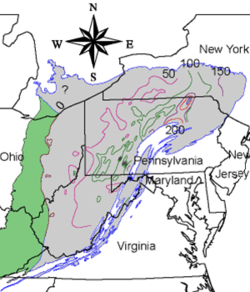
The Marcellus Shale formation

Martin also included a 17-minute feature from Link TV on the use, and dangers, of extracting natural gas from the Marcellus Shale in the US North-East.  It’s a sobering reminder of how we are playing with fire with the planet, both literally and metaphorically.  This is the video:

My next reference is an article published in the latest issue of Nature.  Only a summary is available freely online, but here it is anyway,

Approaching a state shift in Earth’s biosphere

Localized ecological systems are known to shift abruptly and irreversibly from one state to another when they are forced across critical thresholds. Here we review evidence that the global ecosystem as a whole can react in the same way and is approaching a planetary-scale critical transition as a result of human influence. The plausibility of a planetary-scale ‘tipping point’ highlights the need to improve biological forecasting by detecting early warning signs of critical transitions on global as well as local scales, and by detecting feedbacks that promote such transitions. It is also necessary to address root causes of how humans are forcing biological changes.

The overall theme of this issue of Nature is shown in their leading story, again taking the liberty of republishing an extract.  First how the article opens,

Return to Rio: Second chance for the planet

Twenty years ago, when the world’s leaders pledged to protect Earth’s climate and biodiversity at the Rio Earth Summit, they knew it would not be easy. But few could have guessed how much worse the situation would get. In 1992, the atmosphere held fewer than 360 parts per million (p.p.m.) of carbon dioxide; the concentration is now nearing 400 p.p.m. and surging upwards. At the same time, species are disappearing at an accelerating rate.

On the eve of the second Rio Earth Summit, Nature explores the causes and consequence of those changes, as well as the efforts that are being made to avert the worst outcomes. Our assessment shows how little progress nations have made towards honouring the commitments they made in 1992.

Then how that article closes,

Anthony Barnosky and his colleagues argue that the global ecosystem could eventually pass a tipping point and shift into a new state, the likes of which are hard for science to predict. But there are ways to avoid that fate, say Paul Ehrlich and his colleagues (page 68), who suggest techniques to make societies more sustainable and to head off many of the world’s chronic environmental problems.

Earth and its inhabitants have a second chance in Rio. They may not get many more.

There’s more and more of this but, yes, I know, one can only take so much.  So let me head for the close with a message of what you and I, and all of us, can do.

The United Nations Environment Programme recently released a video showing how inadequate have been our leaders.  Watch it first and then I’ll offer a solution.

The fifth edition of the Global Environmental Outlook (GEO-5), launched on the eve of the Rio+20 Summit, assessed 90 of the most-important environmental goals and objectives and found that significant progress had only been made in four.

More on the report findings here.

So join with me as I focus my rant from yesterday into something more valuable – asking you to take action – in whatever way you can!

Go here and sign the petition from 350.org.

Add your name to this:

To the G20 and World Leaders:

As concerned global citizens, we urge you to honour your previous commitments to end taxpayer handouts to the fossil fuel industry. To save our planet we need a game-changer now — we call on you to first lead by example, and then make ending all polluter payments the top global priority for the Rio Earth Summit.

So do it now – Go here and sign the petition from 350.org.

Then when you have signed that plea to world leaders to stop the subsidies to fossil fuels, pass this link to everyone you can – www.350.org/rio

And get close to 350.org and stay in touch.

Let’s do this; it’s so much better than ranting!
Connecting the dots

On the 23rd March, I wrote a piece entitled The most important alarm ever heard.  It opened as follows:

The most important alarm ever heard.

The heading says it all.

In fact the heading was taken from an email that came in from Bill McKibben’s 350.org yesterday.  But before reproducing that email in full, let me take you back to the 6th January this year when I published a piece simply called Keystone XL pipeline.  This is how that Post opened up,

Yesterday, I had published a lecture given in Melbourne by Britain’s eminent Astronomer Royal, Lord Martin Rees.  Lord Rees concluded his lecture with the call for us to take better care of our own planet. He, like many others, recognises the unique place in history that we occupy. For the first time a single species is capable of exerting profound changes on the Earth’s natural and physical environments.

Over and over again, scientists are reporting the rise in climate temperature of Planet Earth and the implications thereof if we do not wakeup soon to changing our ways.  The Keystone pipeline is a huge potential mistake!

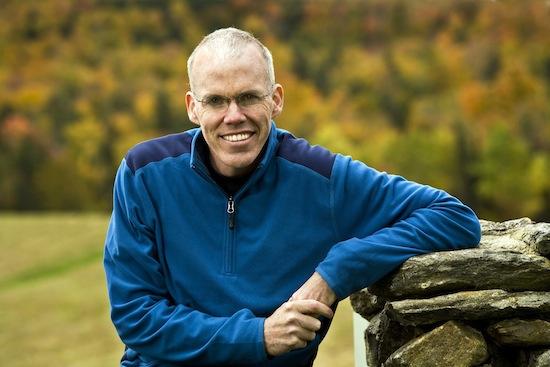
Bill McKibben of 350.org

Not easy to focus on a single sentence from Lord Rees but this one’s pretty direct, “For the first time a single species is capable of exerting profound changes on the Earth’s natural and physical environments.”

Now have a read of the article on 350orbust.com called Things Happen, But It’s Time To Connect The Dots. I’ve taken the liberty of republishing it in full.  But first the video:

Things Happen, But It’s Time To Connect The Dots

APRIL 16, 2012

Thailand has the worst flooding in its history, only a month after Central America has the worst flood in its history, a month after Vermont has the worst flooding in its history in the same year that the Mississippi river has the worst flooding in its history. And Queensland in Australia has its worst floods only a few months after Pakistan floods so badly that 20 million people are forced from their homes – it’s connected, folks.

Across the planet now we see ever more flood, ever more drought, ever more storms. People are dying, communities are being wrecked — the impacts we’re already witnessing from climate change are unlike anything we have seen before.

But because the globe is so big, it’s hard for most people to see that it’s all connected. That’s why, on May 5, we will Connect the Dots.

In places from drought-stricken Mongolia to flood-stricken Thailand, from fire-ravaged Australia to Himalayan communities threatened by glacial melt, we will hold rallies reminding everyone what has happened in our neighborhoods. And at each of those rallies, from Kenya to Canada, from Vietnam to Vermont, someone will be holding a…dot. A huge black dot on a white banner, a “dot” of people holding hands, encircling a field where crops have dried up, a dot made of fabric and the picture taken from above — you get the idea. We’ll share those images the world around, to put a human face on climate change–we’ll hold up a mirror to the planet and force people to come face to face with the ravages of climate change.

Anyone and everyone can participate in this day. Many of us do not live in Texas, the Philippines, or Ethiopia — places deeply affected by climate impacts. For those communities, there are countless ways to stand in solidarity with those on the front-lines of the climate crisis: some people will giving presentations in their communities about how to connect the dots. Others will do projects to demonstrate what sorts of climate impacts we can expect if the crisis is left unchecked. And still others of us will express our indignation to local media and politicians for failing to connect the dots in their coverage of “natural disasters.”

However you choose to participate, your voice is needed in this fight — and you can sign up here: www.climatedots.org

These will be beautiful events, we’re sure. But they will also have an edge. It’s important for all of us whose lives are being damaged to know that it’s right that we get a little angry at those forces causing this problem. The fossil fuel industry is at fault, and we have to make that clear. Our crew at 350.org will work hard to connect all these dots — literally — and weave them together to create a potent call to action, and we will channel that call directly to the people who need to hear it most.

May 5 is coming soon; we need to work rapidly. Because climate change is bearing down on us, and we simply can’t wait. The world needs to understand what’s happening, and you’re the people who can tell them.

Please join us–we need you to send the most important alarm humanity has ever heard:www.climatedots.org

Onwards,

Bill McKibben for the whole team at ClimateDots.org

Nature’s voice.

A republication of a recent Post from Kate of Climate Sight.

Introduction

My apologies for a second republication of another’s Post in two days, but a number of things today (Tuesday) have robbed me of the time I usually have for writing for Learning from Dogs.  So the Post from ClimateSight that I had planned to bring to you on Thursday has been brought forward.

To Kate’s Post on ClimateSight but first a little of Kate’s background,

Kate is a B.Sc. student and aspiring climatologist from the Canadian Prairies.

She became interested in climate science several years ago, and increasingly began to notice the discrepancies between scientific and public knowledge on climate change. She started writing this blog when she was sixteen years old, simply to keep herself sane, but she hopes she’ll be able to spread accurate information far and wide while she does so.

Kate is getting into climate modelling, and presented the results of her first research project at the 2011 AGU Fall Meeting.

I subscribe to ClimateSight and, thus, on the 1st April, I received the following.  I republish it in full with Kate’s written permission.

March Migration Data

In my life outside of climate science, I am an avid fan of birdwatching, and am always eager to connect the two. Today I’m going to share some citizen science data I collected.

Last year, I started taking notes during the spring migration. Every time I saw a species for the first time that year, I made a note of the date. I planned to repeat this process year after year, mainly so I would know when to expect new arrivals at our bird feeders, but also in an attempt to track changes in migration. Of course, this process is imperfect (it simply provides an upper bound for when the species arrives, because it’s unlikely that I witness the very first arrival in the city) but it’s better than nothing.

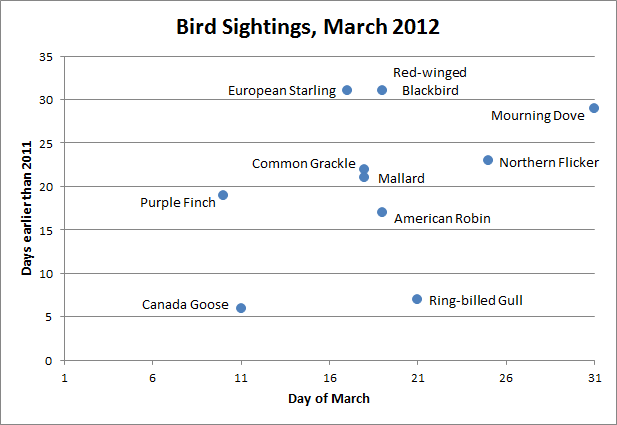
Like much of the Prairies and American Midwest, we’ve just had our warmest March on record, a whopping 8 C above normal. Additionally, every single bird arrival I recorded in March was earlier than last year, sometimes by over 30 days.

I don’t think this is a coincidence. I haven’t been any more observant than last year – I’ve spent roughly the same amount of time outside in roughly the same places. It also seems unlikely for such a systemic change to be a product of chance, although I would need much more data to figure that out for sure. Also, some birds migrate based on hours of daylight rather than temperature. However, I find it very interesting that, so far, not a single species has been late.

Because I feel compelled to graph everything, I typed all this data into Excel and made a little scatterplot. The mean arrival date was 20.6 days earlier than last year, with a standard deviation of 8.9 days.

Back to me.

What is equally interesting as Kate’s Post above are some of the comments.  Like this one,

Roger

Doesn’t always work…

Here in central Illinois the robins depart in the fall and arrive in the spring; that’s the way it’s always been and that’s the way it should be, right?

Not anymore. Some years recently we’ve seen robins nearly the entire winter, if we can still call it that.

Our Canadian Geese have forgotten how to migrate.

and these two from ‘Climatehawk1’.

climatehawk1

Thanks, interesting info. I heard a mourning dove here (Vermont) Feb. 6, which is extraordinary. Some other items on birds:

Link to Boreal ducks said hurt by global warming

Link to Climate change plays major role in decline of blackbird species

climatehawk1

And also, specifically relating to recent migration patterns:

Link to In an Unusual Winter–Where and Why Birds Traveled

Thank you Kate for that interesting article.