Tag: University of Arizona

This is counter-intuitive.

The universe and normal matter.

Frequently I look up at the night sky and ponder about so many things that I cannot understand. I wish I did but it is far too late now. But that doesn’t stop me from reading about the science and more. Here is a perfect example of that and I am delighted to be able to share it with you.

ooOOoo

Most normal matter in the universe isn’t found in planets, stars or galaxies – an astronomer explains where it’s distributed

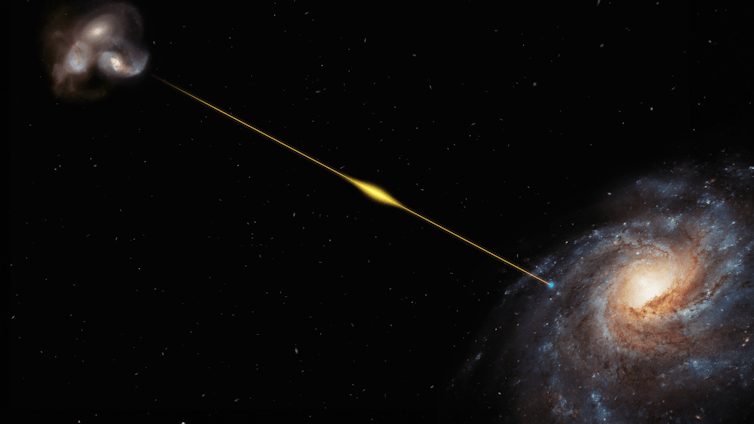
Mysterious blasts of radio waves from across the universe called fast radio bursts help astronomers catalog matter. ESO/M. Kornmesser, CC BY-SA

Chris Impey, University of Arizona

If you look across space with a telescope, you’ll see countless galaxies, most of which host large central black holes, billions of stars and their attendant planets. The universe teems with huge, spectacular objects, and it might seem like these massive objects should hold most of the universe’s matter.

But the Big Bang theory predicts that about 5% of the universe’s contents should be atoms made of protons, neutrons and electrons. Most of those atoms cannot be found in stars and galaxies – a discrepancy that has puzzled astronomers.

If not in visible stars and galaxies, the most likely hiding place for the matter is in the dark space between galaxies. While space is often referred to as a vacuum, it isn’t completely empty. Individual particles and atoms are dispersed throughout the space between stars and galaxies, forming a dark, filamentary network called the “cosmic web.”

Throughout my career as an astronomer, I’ve studied this cosmic web, and I know how difficult it is to account for the matter spread throughout space.

In a study published in June 2025, a team of scientists used a unique radio technique to complete the census of normal matter in the universe.

The census of normal matter

The most obvious place to look for normal matter is in the form of stars. Gravity gathers stars together into galaxies, and astronomers can count galaxies throughout the observable universe.

The census comes to several hundred billion galaxies, each made of several hundred billion stars. The numbers are uncertain because many stars lurk outside of galaxies. That’s an estimated 1023 stars in the universe, or hundreds of times more than the number of sand grains on all of Earth’s beaches. There are an estimated 1082 atoms in the universe.

However, this prodigious number falls far short of accounting for all the matter predicted by the Big Bang. Careful accounting indicates that stars contain only 0.5% of the matter in the universe. Ten times more atoms are presumably floating freely in space. Just 0.03% of the matter is elements other than hydrogen and helium, including carbon and all the building blocks of life.

Looking between galaxies

The intergalactic medium – the space between galaxies – is near-total vacuum, with a density of one atom per cubic meter, or one atom every 35 cubic feet. That’s less than a billionth of a billionth of the density of air on Earth. Even at this very low density, this diffuse medium adds up to a lot of matter, given the enormous, 92-billion-light-year diameter of the universe.

The intergalactic medium is very hot, with a temperature of millions of degrees. That makes it difficult to observe except with X-ray telescopes, since very hot gas radiates out through the universe at very short X-ray wavelengths. X-ray telescopes have limited sensitivity because they are smaller than most optical telescopes.

Deploying a new tool

Astronomers recently used a new tool to solve this missing matter problem. Fast radio bursts are intense blasts of radio waves that can put out as much energy in a millisecond as the Sun puts out in three days. First discovered in 2007, scientists found that the bursts are caused by compact stellar remnants in distant galaxies. Their energy peters out as the bursts travel through space, and by the time that energy reaches the Earth, it is a thousand times weaker than a mobile phone signal would be if emitted on the Moon, then detected on Earth.

Research from early 2025 suggests the source of the bursts is the highly magnetic region around an ultra-compact neutron star. Neutron stars are incredibly dense remnants of massive stars that have collapsed under their own gravity after a supernova explosion. The particular type of neutron star that emits radio bursts is called a magnetar, with a magnetic field a thousand trillion times stronger than the Earth’s.

An illustration of a bright star with circular rings around it representing magnetic field lines
A magnetar is a rare type of neutron star with an extremely strong magnetic field. ESO/L. Calçada, CC BY-ND

Even though astronomers don’t fully understand fast radio bursts, they can use them to probe the spaces between galaxies. As the bursts travel through space, interactions with electrons in the hot intergalactic gas preferentially slow down longer wavelengths. The radio signal is spread out, analogous to the way a prism turns sunlight into a rainbow. Astronomers use the amount of spreading to calculate how much gas the burst has passed through on its way to Earth.

Puzzle solved

In the new study, published in June 2025, a team of astronomers from Caltech and the Harvard Center for Astrophysics studied 69 fast radio bursts using an array of 110 radio telescopes in California. The team found that 76% of the universe’s normal matter lies in the space between galaxies, with another 15% in galaxy halos – the area surrounding the visible stars in a galaxy – and the remaining 9% in stars and cold gas within galaxies.

The complete accounting of normal matter in the universe provides a strong affirmation of the Big Bang theory. The theory predicts the abundance of normal matter formed in the first few minutes of the universe, so by recovering the predicted 5%, the theory passes a critical test.

Several thousand fast radio bursts have already been observed, and an upcoming array of radio telescopes will likely increase the discovery rate to 10,000 per year. Such a large sample will let fast radio bursts become powerful tools for cosmology. Cosmology is the study of the size, shape and evolution of the universe. Radio bursts could go beyond counting atoms to mapping the three-dimensional structure of the cosmic web.

Pie chart of the universe

Scientists may now have the complete picture of where normal matter is distributed, but most of the universe is still made up of stuff they don’t fully understand.

The most abundant ingredients in the universe are dark matter and dark energy, both of which are poorly understood. Dark energy is causing the accelerating expansion of the universe, and dark matter is the invisible glue that holds galaxies and the universe together.

A pie chart showing the composition of the universe. The largest proportion is dark energy, at 68%, while dark matter makes up 27% and normal matter 5%. The rest is neutrinos, free hydrogen and helium and heavy elements.
Despite physicists not knowing much about it, dark matter makes up around 27% of the universe. Visual Capitalist/Science Photo Library via Getty Images

Dark matter is probably a previously unstudied type of fundamental particle that is not part of the standard model of particle physics. Physicists haven’t been able to detect this novel particle yet, but we know it exists because, according to general relativity, mass bends light, and far more gravitational lensing is seen than can be explained by visible matter. With gravitational lensing, a cluster of galaxies bends and magnifies light in a way that’s analogous to an optical lens. Dark matter outweighs conventional matter by more than a factor of five.

One mystery may be solved, but a larger mystery remains. While dark matter is still enigmatic, we now know a lot about the normal atoms making up us as humans, and the world around us.

Chris Impey, University Distinguished Professor of Astronomy, University of Arizona

This article is republished from The Conversation under a Creative Commons license. Read the original article.

ooOOoo

The details are incredible. Take for example that three-quarters of the matter out there is found outside the galaxies. Or that there are more stars in the universe than all of the sand grains on Planet Earth.

Just amazing!

Artificial Intelligence and Mars

NASA hasn’t landed humans on Mars yet. But thanks to robotic missions, scientists now know more about the planet’s surface than they did when the movie, The Martian, was released.

Our human knowledge is constantly growing. In many, many directions. Here is a fascinating (well it is to me!) article from The Conversation.

ooOOoo

A decade after the release of ‘The Martian’ and a decade out from the world it envisions, a planetary scientist checks in on real-life Mars exploration

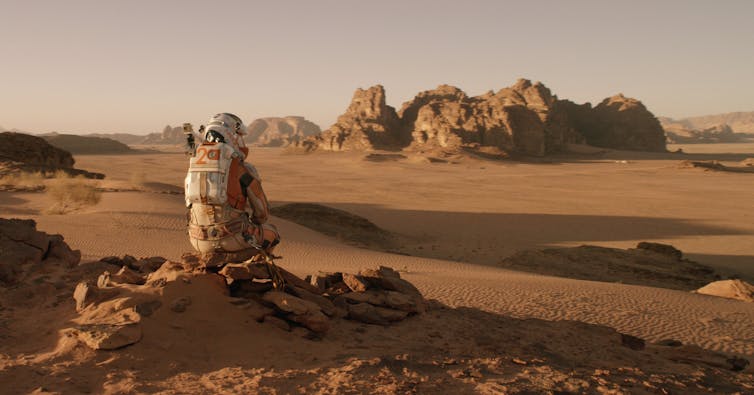
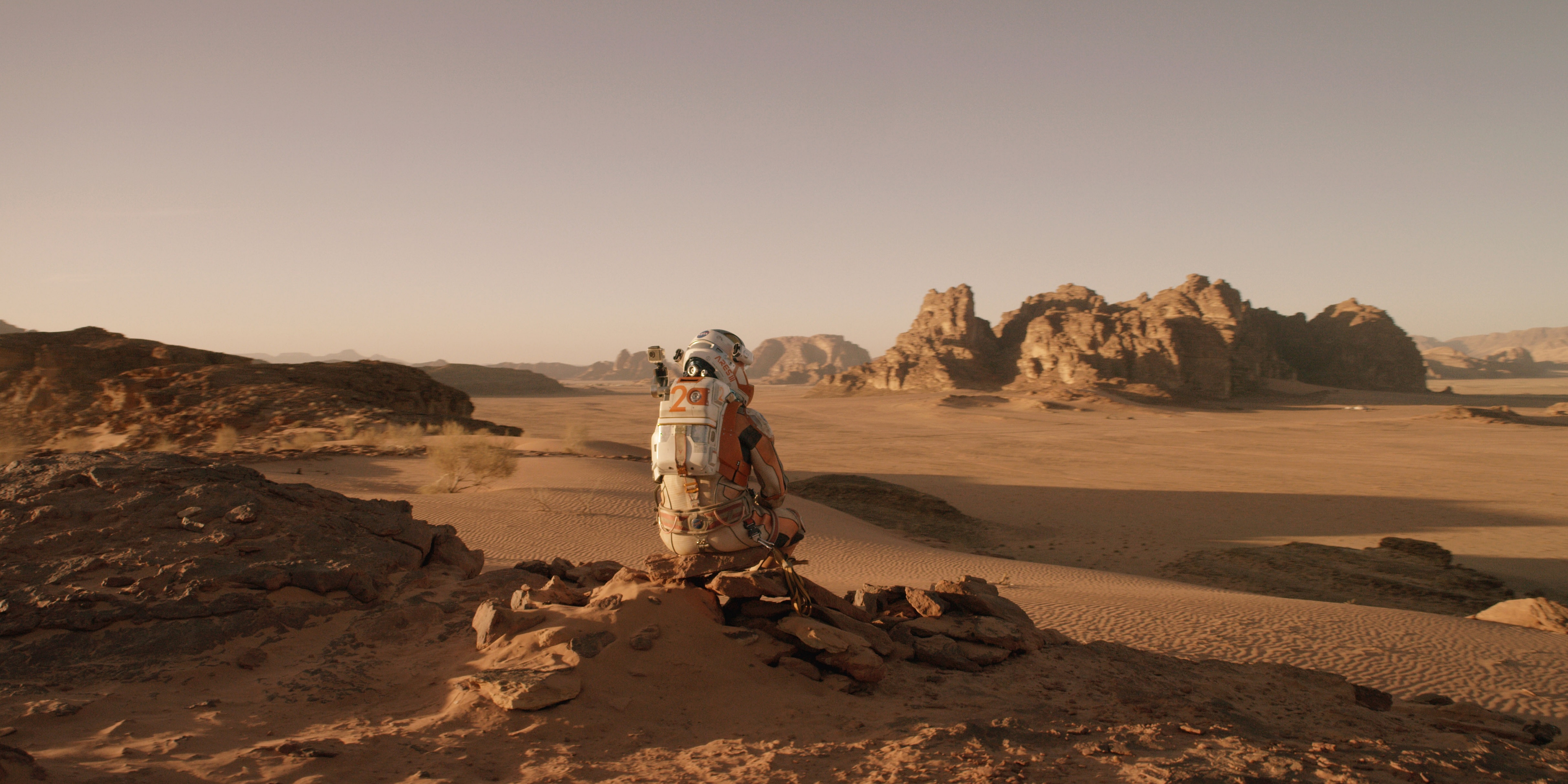
‘The Martian’ protagonist Mark Watney contemplates his ordeal. 20th Century Fox

Ari Koeppel, Dartmouth College

Andy Weir’s bestselling story “The Martian” predicts that by 2035 NASA will have landed humans on Mars three times, perfected return-to-Earth flight systems and collaborated with the China National Space Administration. We are now 10 years past the Hollywood adaptation’s 2015 release and 10 years shy of its fictional timeline. At this midpoint, Mars exploration looks a bit different than how it was portrayed in “The Martian,” with both more discoveries and more controversy.

As a planetary geologist who works with NASA missions to study Mars, I follow exploration science and policy closely. In 2010, the U.S. National Space Policy set goals for human missions to Mars in the 2030s. But in 2017, the White House Space Policy Directive 1 shifted NASA’s focus toward returning first to the Moon under what would become the Artemis program.

Although concepts for crewed missions to Mars have gained popularity, NASA’s actual plans for landing humans on Mars remain fragile. Notably, over the last 10 years, it has been robotic, rather than crewed, missions that have propelled discovery and the human imagination forward.

A diagram showing the steps from lunar missions to Mars missions. The steps in the current scope are labeled 'Human presence on Moon,' 'Practice for Mars Exploration Demo' and 'Demo exploration framework on Mars.' The partial scope step is labeled 'Human presence on Mars.'
NASA’s 2023 Moon to Mars Strategy and Objectives Development document lays out the steps the agency was shooting for at the time, to go first to the Moon, and from there to Mars. NASA

Robotic discoveries

Since 2015, satellites and rovers have reshaped scientists’ understanding of Mars. They have revealed countless insights into how its climate has changed over time.

As Earth’s neighbor, climate shifts on Mars also reflect solar system processes affecting Earth at a time when life was first taking hold. Thus, Mars has become a focal point for investigating the age old questions of “where do we come from?” and “are we alone?

The Opportunity, Curiosity and Perseverance rovers have driven dozens of miles studying layered rock formations that serve as a record of Mars’ past. By studying sedimentary layers – rock formations stacked like layers of a cake – planetary geologists have pieced together a vivid tale of environmental change that dwarfs what Earth is currently experiencing.

Mars was once a world of erupting volcanoes, glaciers, lakes and flowing rivers – an environment not unlike early Earth. Then its core cooled, its magnetic field faltered and its atmosphere drifted away. The planet’s exposed surface has retained signs of those processes ever since in the form of landscape patterns, sequences of layered sediment and mineral mixtures.

Rock shelves layered on top of each other, shown from above.
Layered sedimentary rocks exposed within the craters of Arabia Terra, Mars, recording ancient surface processes. Photo from the Mars Reconnaissance Orbiter High Resolution Imaging Science Experiment. NASA/JPL/University of Arizona

Arabia Terra

One focus of scientific investigation over the last 10 years is particularly relevant to the setting of “The Martian” but fails to receive mention in the story. To reach his best chance of survival, protagonist Mark Watney, played by Matt Damon, must cross a vast, dusty and crater-pocked region of Mars known as Arabia Terra.

In 2022 and 2023, I, along with colleagues at Northern Arizona University and Johns Hopkins University, published detailed analyses of the layered materials there using imagery from the Mars Reconnaissance Orbiter and Mars Odyssey satellites.

By using infrared imagery and measuring the dimensions of surface features, we linked multiple layered deposits to the same episodes of formation and learned more about the widespread crumbling nature of the terrain seen there today. Because water tends to cement rock tightly together, that loose material indicates that around 3.5 billion years ago, that area had a drying climate.

To make the discussions about this area easier, we even worked with the International Astronomical Union to name a few previously unnamed craters that were mentioned in the story. For example, one that Watney would have driven right by is now named Kozova Crater, after a town in Ukraine.

More to explore

Despite rapid advances in Mars science, many unknowns remain. Scientists still aren’t sure of the precise ages, atmospheric conditions and possible signatures of life associated with each of the different rock types observed on the surface.

For instance, the Perseverance rover recently drilled into and analyzed a unique set of rocks hosting organic – that is, carbon-based – compounds. Organic compounds serve as the building blocks of life, but more detailed analysis is required to determine whether these specific rocks once hosted microbial life.

The in-development Mars Sample Return mission aims to address these basic outstanding questions by delivering the first-ever unaltered fragments of another world to Earth. The Perseverance rover is already caching rock and soil samples, including ones hosting organic compounds, in sealed tubes. A future lander will then need to pick up and launch the caches back to Earth.

Sampling Mars rocks could tell scientists more about the red planet’s past, and whether it could have hosted life.

Once home, researchers can examine these materials with instruments orders of magnitude more sensitive than anything that could be flown on a spacecraft. Scientists stand to learn far more about the habitability, geologic history and presence of any signs of life on Mars through the sample return campaign than by sending humans to the surface.

This perspective is why NASA, the European Space Agency and others have invested some US$30 billion in robotic Mars exploration since the 1960s. The payoff has been staggering: That work has triggered rapid technological advances in robotics, telecommunications and materials science. For example, Mars mission technology has led to better sutures for heart surgery and cars that can drive themselves.

It has also bolstered the status of NASA and the U.S. as bastions of modern exploration and technology; and it has inspired millions of students to take an interest in scientific fields.

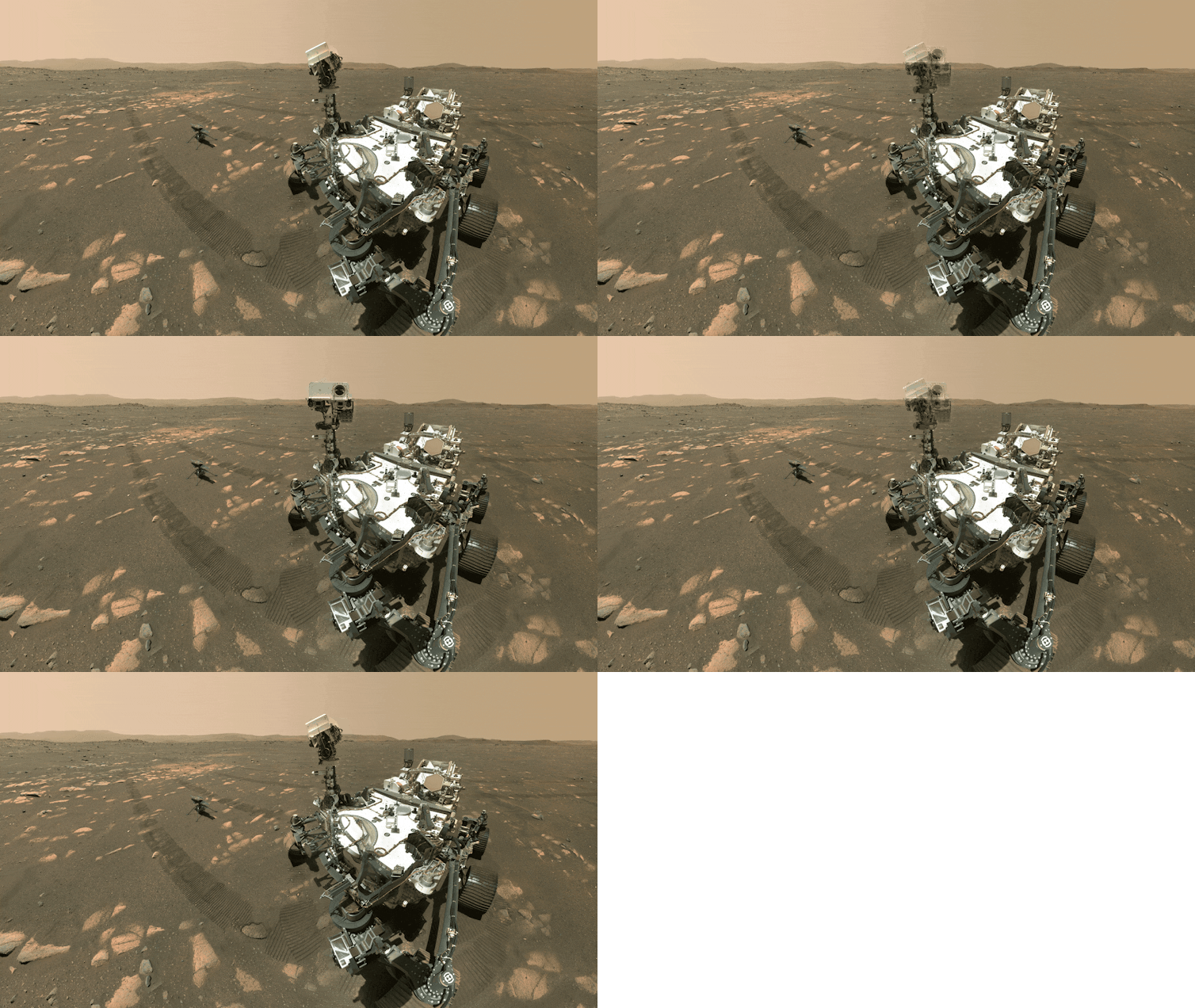
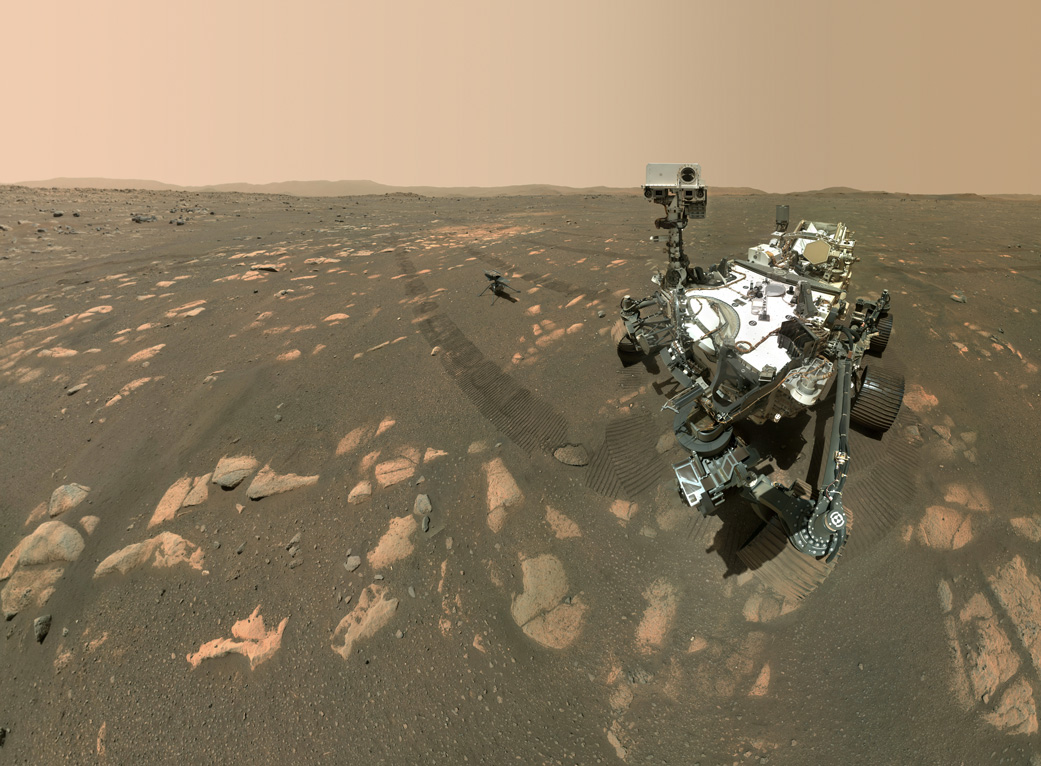
The Perseverance rover and the Ingenuity helicopter on the Martian surface, with the rover's camera moving to look down at Ingenuity.
A selfie from NASA’s Perseverance Mars rover with the Ingenuity helicopter, taken with the rover’s extendable arm on April 6, 2021. NASA/JPL-Caltech/MSSS

Calling the red planet home?

Colonizing Mars has a seductive appeal. It’s hard not to cheer for the indomitable human spirit while watching Watney battle dust storms, oxygen shortages and food scarcity over 140 million miles from rescue.

Much of the momentum toward colonizing Mars is now tied to SpaceX and its CEO Elon Musk, whose stated mission to make humanity a “multi-planetary species” has become a sort of rallying cry. But while Mars colonization is romantic on paper, it is extremely difficult to actually carry out, and many critics have questioned the viability of a Mars habitation as a refuge far from Earth.

Now, with NASA potentially facing a nearly 50% reduction to its science budget, the U.S. risks dissolving its planetary science and robotic operations portfolio altogether, including sample return.

Nonetheless, President Donald Trump and Musk have pushed for human space exploration to somehow continue to progress, despite those proposed cuts – effectively sidelining the robotic, science-driven programs that have underpinned all of Mars exploration to date.

Yet, it is these programs that have yielded humanity’s richest insights into the red planet and given both scientists and storytellers like Andy Weir the foundation to imagine what it must be like to stand on Mars’ surface at all.

Ari Koeppel, Postdoctoral Scientist in Earth and Planetary Science, Dartmouth College

This article is republished from The Conversation under a Creative Commons license. Read the original article.

ooOOoo

Nothing to add from yours truly except to say that this quote is highly relevant: “Challenges are what make life interesting and overcoming them is what makes life meaningful.” – Joshua J. Marine

(And this was the result of me looking online for quotes and coming across 50 quotes from USA Today.)

Darkness!

Chris Impey writes about his specialty in observational cosmology.

This has nothing to do with life, nothing that we are dealing with in our daily affairs, and has nothing to do with our dear dogs. BUT! This is incredibly interesting! Incredibly and beautifully interesting!

ooOOoo

The most powerful space telescope ever built will look back in time to the Dark Ages of the universe

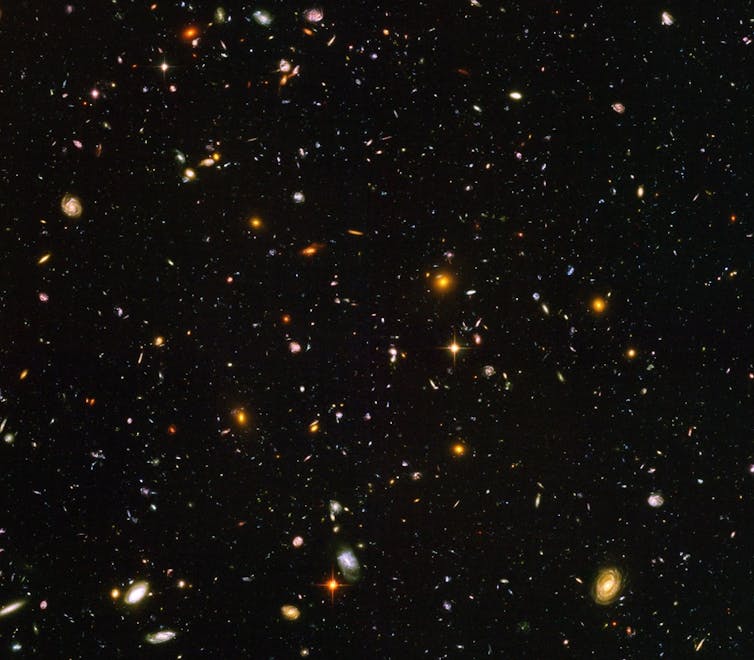
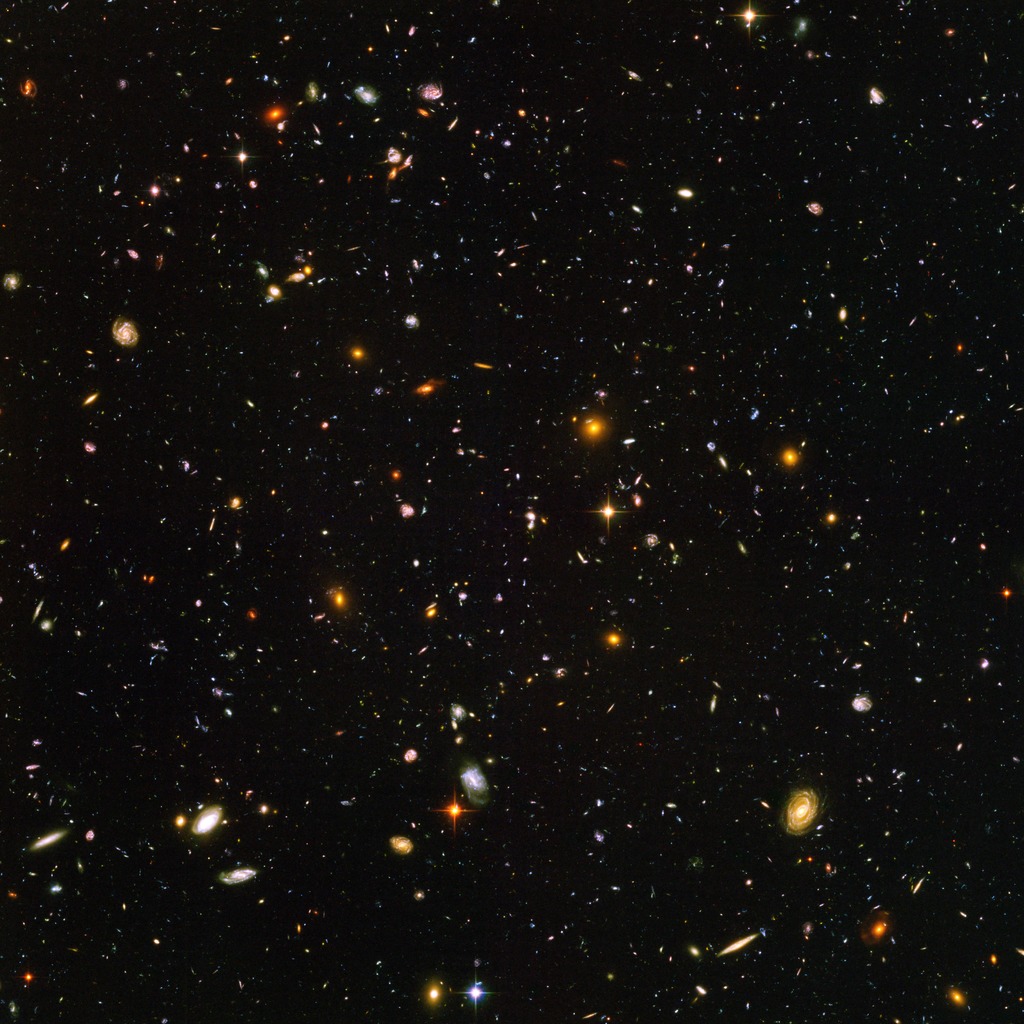
Hubble took pictures of the oldest galaxies it could – seen here – but the James Webb Space Telescope can go back much farther in time. NASA

Chris Impey, University of Arizona

Some have called NASA’s James Webb Space Telescope the “telescope that ate astronomy.” It is the most powerful space telescope ever built and a complex piece of mechanical origami that has pushed the limits of human engineering. On Dec. 18, 2021, after years of delays and billions of dollars in cost overruns, the telescope is scheduled to launch into orbit and usher in the next era of astronomy.

I’m an astronomer with a specialty in observational cosmology – I’ve been studying distant galaxies for 30 years. Some of the biggest unanswered questions about the universe relate to its early years just after the Big Bang. When did the first stars and galaxies form? Which came first, and why? I am incredibly excited that astronomers may soon uncover the story of how galaxies started because James Webb was built specifically to answer these very questions.

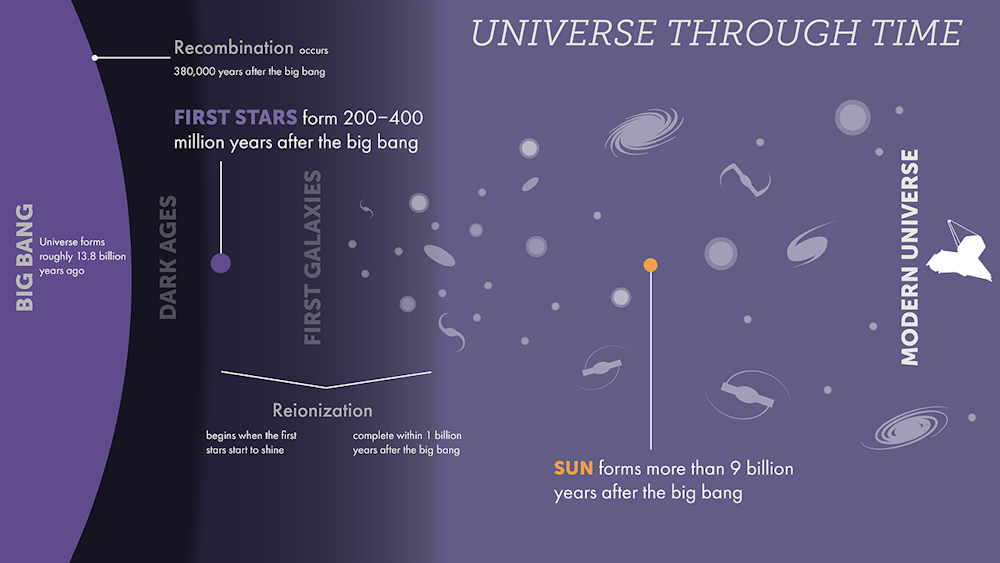
A graphic showing the progression of the Universe through time.
The Universe went through a period of time known as the Dark Ages before stars or galaxies emitted any light. Space Telescope Institute

The ‘Dark Ages’ of the universe

Excellent evidence shows that the universe started with an event called the Big Bang 13.8 billion years ago, which left it in an ultra-hot, ultra-dense state. The universe immediately began expanding after the Big Bang, cooling as it did so. One second after the Big Bang, the universe was a hundred trillion miles across with an average temperature of an incredible 18 billion F (10 billion C). Around 400,000 years after the Big Bang, the universe was 10 million light years across and the temperature had cooled to 5,500 F (3,000 C). If anyone had been there to see it at this point, the universe would have been glowing dull red like a giant heat lamp.

Throughout this time, space was filled with a smooth soup of high energy particles, radiation, hydrogen and helium. There was no structure. As the expanding universe became bigger and colder, the soup thinned out and everything faded to black. This was the start of what astronomers call the Dark Ages of the universe.

The soup of the Dark Ages was not perfectly uniform and due to gravity, tiny areas of gas began to clump together and become more dense. The smooth universe became lumpy and these small clumps of denser gas were seeds for the eventual formation of stars, galaxies and everything else in the universe.

Although there was nothing to see, the Dark Ages were an important phase in the evolution of the universe.

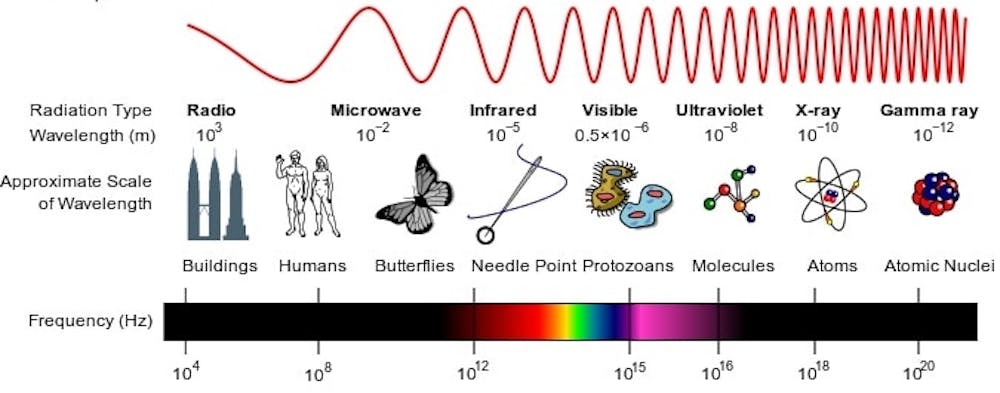
A diagram showing different wavelengths of light compared to size of normal objects.
Light from the early universe is in the infrared wavelength – meaning longer than red light – when it reaches Earth. Inductiveload/NASA via Wikimedia Commons, CC BY-SA

Looking for the first light

The Dark Ages ended when gravity formed the first stars and galaxies that eventually began to emit the first light. Although astronomers don’t know when first light happened, the best guess is that it was several hundred million years after the Big Bang. Astronomers also don’t know whether stars or galaxies formed first.

Current theories based on how gravity forms structure in a universe dominated by dark matter suggest that small objects – like stars and star clusters – likely formed first and then later grew into dwarf galaxies and then larger galaxies like the Milky Way. These first stars in the universe were extreme objects compared to stars of today. They were a million times brighter but they lived very short lives. They burned hot and bright and when they died, they left behind black holes up to a hundred times the Sun’s mass, which might have acted as the seeds for galaxy formation.

Astronomers would love to study this fascinating and important era of the universe, but detecting first light is incredibly challenging. Compared to massive, bright galaxies of today, the first objects were very small and due to the constant expansion of the universe, they’re now tens of billions of light years away from Earth. Also, the earliest stars were surrounded by gas left over from their formation and this gas acted like fog that absorbed most of the light. It took several hundred million years for radiation to blast away the fog. This early light is very faint by the time it gets to Earth.

But this is not the only challenge.

As the universe expands, it continuously stretches the wavelength of light traveling through it. This is called redshift because it shifts light of shorter wavelengths – like blue or white light – to longer wavelengths like red or infrared light. Though not a perfect analogy, it is similar to how when a car drives past you, the pitch of any sounds it is making drops noticeably. Similar to how a pitch of a sound drops if the source is moving away from you, the wavelength of light stretches due to the expansion of the universe.

By the time light emitted by an early star or galaxy 13 billion years ago reaches any telescope on Earth, it has been stretched by a factor of 10 by the expansion of the universe. It arrives as infrared light, meaning it has a wavelength longer than that of red light. To see first light, you have to be looking for infrared light.

Telescope as a time machine

Enter the James Webb Space Telescope.

Telescopes are like time machines. If an object is 10,000 light-years away, that means the light takes 10,000 years to reach Earth. So the further out in space astronomers look, the further back in time we are looking.

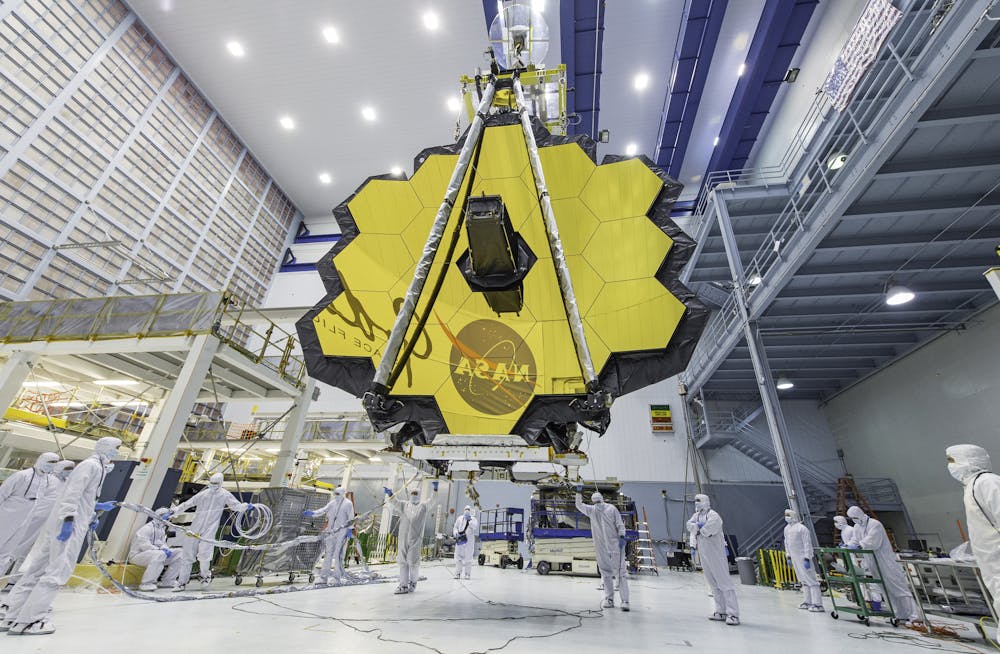
A large golden colored disc with a sensor in the middle and scientists standing below.
The James Webb Space Telescope was specifically designed to detect the oldest galaxies in the universe. NASA/JPL-Caltech, CC BY-SA

Engineers optimized James Webb for specifically detecting the faint infrared light of the earliest stars or galaxies. Compared to the Hubble Space Telescope, James Webb has a 15 times wider field of view on its camera, collects six times more light and its sensors are tuned to be most sensitive to infrared light.

The strategy will be to stare deeply at one patch of sky for a long time, collecting as much light and information from the most distant and oldest galaxies as possible. With this data, it may be possible to answer when and how the Dark Ages ended, but there are many other important discoveries to be made. For example, unraveling this story may also help explain the nature of dark matter, the mysterious form of matter that makes up about 80% of the mass of the universe.

James Webb is the most technically difficult mission NASA has ever attempted. But I think the scientific questions it may help answer will be worth every ounce of effort. I and other astronomers are waiting excitedly for the data to start coming back sometime in 2022.

Chris Impey, University Distinguished Professor of Astronomy, University of Arizona

This article is republished from The Conversation under a Creative Commons license. Read the original article.

ooOOoo

The dark ages of the universe that lasted for millions of years until gravity started to form some order out of the ‘soup’.

I don’t know about you but the winter nights, when the sky is clear, have me waiting outside for the dogs to come in looking up at the night sky just lost in the sheer wonder of it all.

The very best of luck to NASA on December 18th!

This is amazing!

Puppies are born ready to communicate with humans!

This was an article that I saw in The Smithsonian and, as such, I am not allowed to reproduce it in full.

But I will give you a small extract:

ooOOoo

By Alex Fox

SMITHSONIANMAG.COM 
JUNE 3, 2021

Dog owners might not be too impressed when they’re able to point out a fallen piece of chicken or a thrown stick to their pooch, but dogs’ ability to follow that seemingly simple gesture places them in rare air in the animal kingdom. Some research suggests that even chimpanzees, our closest evolutionary relatives, don’t understand pointing as well as dogs.

For decades, researchers have debated whether dogs obtain their ability to understand pointing by spending time with humans and learning it or if our furry companions are born with a capacity to comprehend this deceptively complex feat of communication.

ooOOoo

And if one follows that link above then one comes to Current Biology and, again, an extract:

ooOOoo

Summary

Human cognition is believed to be unique in part because of early-emerging social skills for cooperative communication.1Comparative studies show that at 2.5 years old, children reason about the physical world similarly to other great apes, yet already possess cognitive skills for cooperative communication far exceeding those in our closest primate relatives.2,3 A growing body of research indicates that domestic dogs exhibit functional similarities to human children in their sensitivity to cooperative-communicative acts. From early in development, dogs flexibly respond to diverse forms of cooperative gestures.4,5 Like human children, dogs are sensitive to ostensive signals marking gestures as communicative, as well as contextual factors needed for inferences about these communicative acts.678 However, key questions about potential biological bases for these abilities remain untested. To investigate their developmental and genetic origins, we tested 375 8-week-old dog puppies on a battery of social-cognitive measures. We hypothesized that if dogs’ skills for cooperating with humans are biologically prepared, then they should emerge robustly in early development, not require extensive socialization or learning, and exhibit heritable variation. Puppies were highly skillful at using diverse human gestures, and we found no evidence that their performance required learning. Critically, over 40% of the variation in dogs’ point-following abilities and attention to human faces was attributable to genetic factors. Our results suggest that these social skills in dogs emerge early in development and are under strong genetic control.

ooOOoo

And I am going to sneak one of the photographs in the original article!

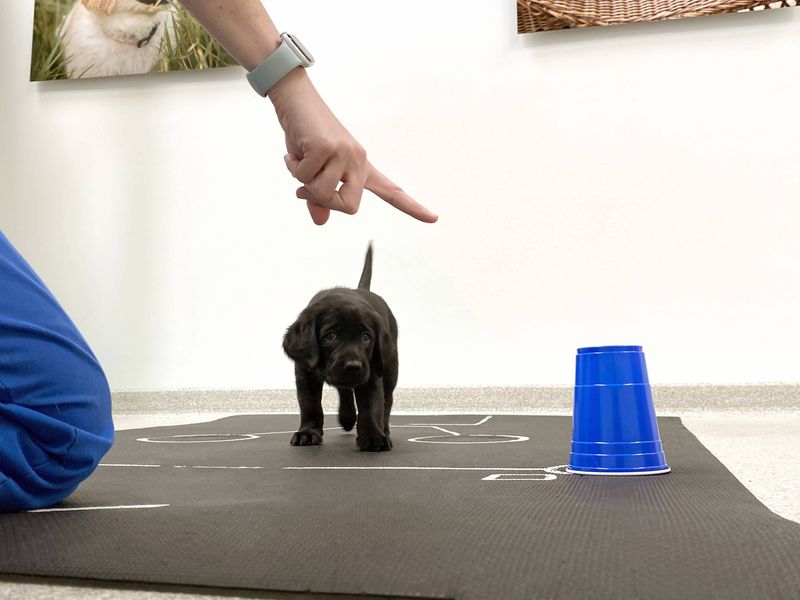
A young puppy responds to a human pointing to a treat during an experiment conducted by scientists at the University of Arizona. (Canine Companions for Independence)

And what better to close the post that one of the photos I showed yesterday of dear Joy.

The science of dog learning.

A very interesting article in The Smithsonian Magazine.

There are countless breeds of dogs and they represent thousands of years of breeding.

But recent work in determining the genetic background behind the many different features of dogs has revealed so much.

The Smithsonian Magazine published an article nearly a month ago and hopefully it is alright to share it with you.

ooOOoo

What a Crowdsourced Study Taught Us About How Dogs Learn

A new study looks at the genes that underlie traits from self control to communication


Three dogs sit at attention ( MediaProduction

By Viviane Callier, July 31, 2020

Thousands of years of selective dog breeding has created a fantastic diversity of domestic canine companions, from the workaholic border collie to the perky Pomeranian. In cultures around the world, humans bred different dogs to be good at tasks including guarding, hunting and herding. Later, in Victorian England, kennel clubs established breed standards related not only to their behavior, but also their appearance.

As genomic sequencing has become more affordable, scientists have begun to understand the genes behind physical features such as body shape and size. But understanding the genes behind dog cognition—the mental processes that underlie dogs’ ability to learn, reason, communicate, remember, and solve problems—is a much trickier and thornier task. Now, in a pair of new studies published in Animal Cognition and in Integrative and Comparative Biology, a team of researchers has begun to quantify just how much variation in dog cognition exists, and to show how much of it has a genetic basis.

To study canine cognition, the studies’ authors turned to publicly available genetic information from a 2017 study, and a large community science project, Dognition.com, in which dog owners tested their own pets. “These papers offer an exciting integration of two forms of big data,” says Jeff Stevens, a psychologist at the University of Nebraska-Lincoln who was not involved in the study.

Previous studies often compared cognition in one breed against another using small sample sizes of dogs from each. This study, by contrast, is the first to examine the variation in cognition across three dozen breeds, and the genetic basis of that variation, explains Evan MacLean, a comparative psychologist at the University of Arizona who oversaw the pair of new studies. MacLean says dog breeds may be an ideal way to study the heritability of cognitive traits because breeds—all part of the same species—represent close genetic relatives with an incredibly diverse range of appearances and behaviors.

To gather a sufficient amount of data on how dogs reason and solve problems, the researchers looked to the Dognition.com portal. The initiative, created by Duke University dog researcher Brian Hare, started with tests in the lab. Researchers developed methods to understand how dogs think. They then stripped those methods down, and simplified them for dog owners to do themselves. In an earlier project, the researchers tested dogs in the lab and compared their results to those from owners testing the same dog at home. The results were the same, giving them confidence that the results from the citizen science project were reliable.

To participate in this project, dog owners tested their pups on 11 standardized tasks used by animal behaviorists on a variety of species that reflect four aspects of cognition: inhibitory control, communication, memory and physical reasoning. One task that measured inhibitory control, for example, involved having an owner put a treat on the floor in front of the dog and then verbally forbidding the dog from taking it. The owner then measured how long the dog would wait before eating the treat. In a task to assess communication skills, the dog owner placed two treats on the ground and gestured towards one of them. The owner then determined if the dog approached the indicated treat. To assess memory, the owner visibly placed food under one of two cups, waited for a few minutes, and then determined if the dog remembered which cup the food was placed under. To test physical reasoning, the owner hid food under one of two cups, out of view of the dog. The owner lifted the empty cup to show the dog that there was no food and then assessed whether the dog approached the cup with the food underneath.

The participating dog owners reported their dog’s scores and breed, producing a dataset with 1,508 dogs across 36 breeds. The researchers analyzed the scores and found that about 70 percent of the variance in inhibitory control was heritable, or attributable to genes. Communication was about 50 percent heritable, while memory and physical reasoning were about 20 percent heritable.

“What’s so cool about that is these two traits that are highly heritable [control and communication] are those that are thought to be linked to dogs’ domestication process,” says Zachary Silver, a graduate student in the Canine Cognition Center at Yale who was not involved in the study.

Dogs are better at following humans’ communicative cues than wolves, and this is something that seems to be highly heritable, explains Silver. In contrast, there’s some evidence that wolves are better than dogs at physical reasoning.

Some of these traits are also influenced by environment and how the dog was handled as a puppy, so there are both genetic and environmental components. In fact, there is so much environmental and experiential influence on these traits that Gitanjali Gnanadesikan, a graduate student in MacLean’s lab and lead author of the new studies, cautions against the idea that these findings support certain breed restrictions or stereotypes. “Even the highly heritable traits have a lot of room for environmental influence,” she says. “This shouldn’t be interpreted as, ‘each of these breeds is just the way they are, and there’s nothing that can be done about it.’”

In the same way that women are on average shorter than men, but there’s quite a lot of overlapping variation within each sex, dog breeds also show a lot of variation within each breed that overlaps with variation among breeds.

Previous work has linked differences in inhibitory control to the estimated size of dogs’ brains. Comparative studies across many different species, ranging from tiny rodents to elephants and chimpanzees, also show that some aspects of self-control are strongly related to brain size. The bigger the brain size, the more self-control the animals seem to have, MacLean says.

Stevens notes that a lot of things—not just inhibitory control—correlate with brain size across species. And brain size, metabolic rate, lifespan, home range size are all correlated with body size. When many traits are correlated with each other, it is not clear which of these factors may underlie the cognitive differences. So there are a number of questions remaining to be explored.

After showing the degree to which different aspects of dog cognition are heritable, Gnanadesikan and MacLean used publicly available information on the genomes of dog breeds to search for genetic variation that was associated with the cognitive traits of interest. The researchers found that, like many other complex traits, there were many genes, each with small effect, that contribute to dogs’ cognitive traits. That is in contrast to morphological features in dogs; about 50 percent of variation in dog body size can be accounted for by variation in a single gene.

One of the limitations of the study is that the researchers did not have cognitive and genetic information from the same dogs; the genomes were breed averages. In the future, the researchers are planning to collect genetic data from the very same dogs that are completing the cognitive tests, to get measures of cognitive and genetic variation at the level of individual dogs. “This gives us a roadmap for places that we might want to look at more carefully in the future,” MacLean explains.

ooOOoo

Now this is an article that deserves to be read carefully so if you are in a hurry bookmark this and wait until you can sit and absorb the messages the article contains.

I was minded to look up Gitanjali’s details and I am glad I did. These are the details:

Gitanjali Gnanadesikan
I am an evolutionary biologist and comparative psychologist who is interested in social behavior and cognition. I work with Evan MacLean in the Arizona Canine Cognition Center studying the development and evolution of behavior and cognition in dogs and wolves.

I think I will reach out to her and see if she has more information she would like to share with us all.

Doggedly seeking the truth.

As a dog follows a scent.

P1110019
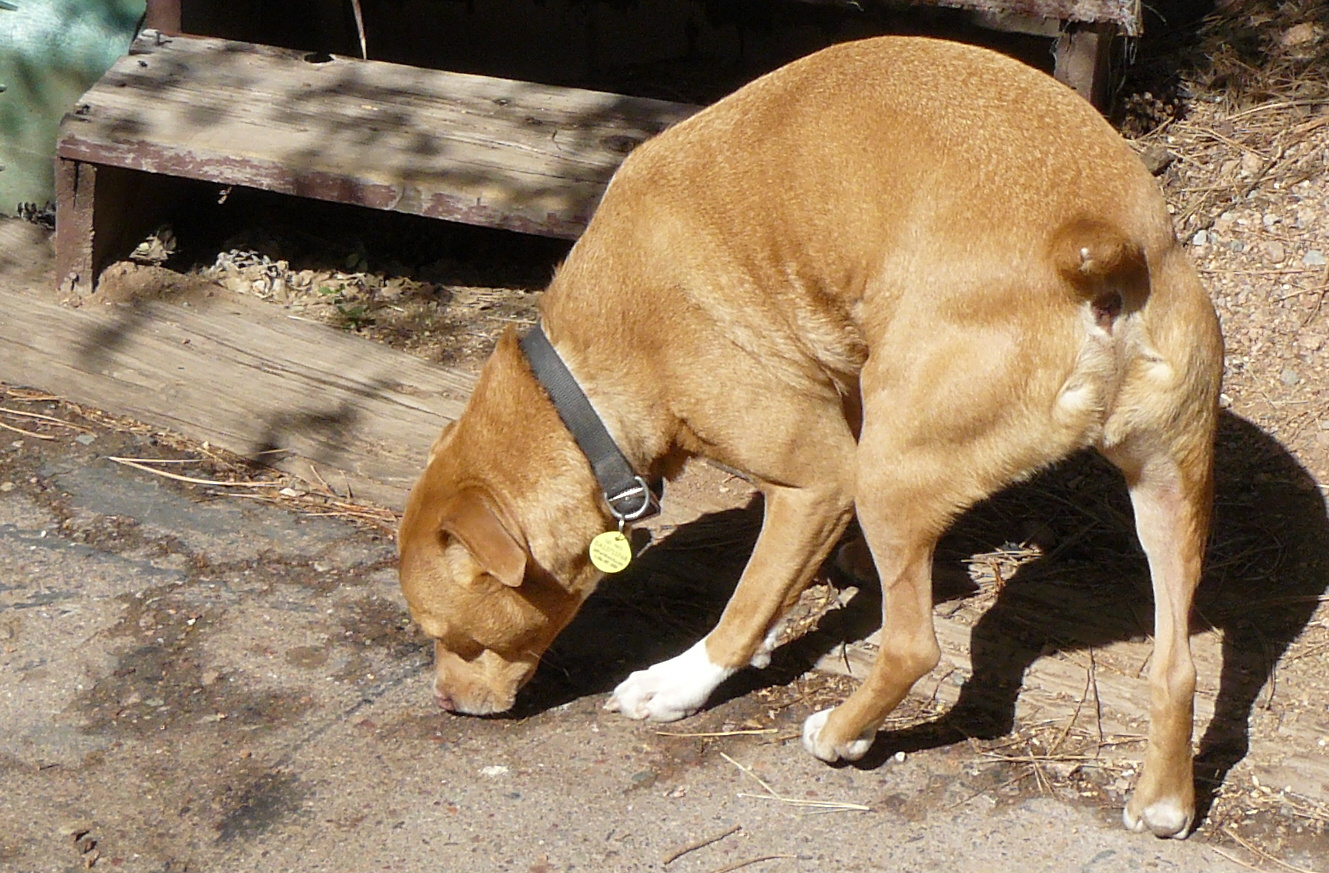
Casey doing what dogs do so well – picking up a scent.

I have been pondering about how one gets to the truth of a complex issue.  And there’s none more complex nor more essential in terms of the truth of an issue than Anthropogenic Global Warming (AGW).

It was kicked off by an email received from Dan Gomez.  Followers of Learning from Dogs will have seen mention of Dan’s name as he regularly sends me bits and pieces.  Indeed, let me refer you to a post that came out last August, Feeling depressed? Join your pals in the pool! and this extract:

Regular followers of Learning from Dogs will know that Dan and I go back a long way; far too long! In fact the occasion of me becoming aware of Mr. Daniel Gomez was at a Commodore Computer dealers conference in Boston, Mass.

I was giving a talk promoting a UK word-processing program that I was marketing for the Commodore. That software was called Wordcraft and I think the year was 1979, possibly 1980. Anyway, I used the word ‘fortnight’, which back in England is a common word meaning two weeks. Immediately, a voice called out from the audience, “Hey Handover, what’s a fortnight?“

The session deteriorated rapidly thereafter! Dan and I became very good friends and his LA company Cimarron became my West Coast USA distributor for Wordcraft. And it was Dan’s sister, Suzann, who invited me down to Mexico for Christmas 2007 which led to me meeting my beloved Jeannie! Funny old world!

Dan is a smart cookie. He holds a degree in psychology, as well as being a very easy guy to get along with.  We have been good friends for more than 30 years.

Anyway, back to the theme of the post; determining the truth of a complex issue.

Recently, Dan sent me an email with the subject heading of The Controversy Continues – A couple of Articles for your Digestive Tract….

The first article was:

Report shows UN admitting solar activity may play significant role in global warming

A leaked report by a United Nations’ group dedicated to climate studies says that heat from the sun may play a larger role than previously thought.

“[Results] do suggest the possibility of a much larger impact of solar variations on the stratosphere than previously thought, and some studies have suggested that this may lead to significant regional impacts on climate,” reads a draft copy of a major, upcoming report from the U.N.’s Intergovernmental Panel on Climate Change (IPCC).

The man who leaked the report, StopGreenSuicide blogger Alec Rawls, told FoxNews.com that the U.N.’s statements on solar activity were his main motivation for leaking the document.

The second article was from the Dick Morris website, from which I offer this extract (if, like me, you hadn’t heard of Mr. Morris before, details are here):

According to Bloomberg News, US carbon emissions are down 13% over the past five years and that they are now the lowest since 1994. In fact, we are more than halfway to President Obama’s goal of a 17% reduction below our peak year of 2007.

….

Coal has fallen to only 18% of our energy use (down from 23% in 2007) and natural gas is up to 31%. Natural gas has half the carbon emissions of coal.

Evidence suggests that climate change and global warming are happening, but at a much slower rate than doomsday warnings suggested. We are now on track for an increase in global temperatures of one degree centigrade by 2100. This increase is not enough to cause major flooding or rises in sea levels.

Please feel free to read the whole Dick Morris piece here.

So on the face of it, two convincing reports, especially the one from Alec Rawls.

Professor McPherson
Professor McPherson

Now let me turn to Professor Guy McPherson; professor emeritus at the University of Arizona.  Just take a peek at the professional recognition granted to Professor McPherson.

Guy McPherson writes a blog called Nature Bats Last.  It is described thus:

This blog focuses on the natural world, with a particular emphasis on the twin sides of our fossil-fuel addiction: (1) global climate change and (2) energy decline. Because these phenomena impact every aspect of life on Earth, specific topics range widely, and include philosophy, evolution, economics, humanity, politics, current events, and many aspects of the human condition.

Less than 3 months ago, Guy McPherson visited Greenfield Community College in western Massachusetts to deliver his presentation “The Twin Sides of the Fossil-Fuel Coin: Developing Durable Living Arrangements in Light of Climate Change and Energy Decline.

It lasts for just 40 minutes and needs to be watched.  Why do I say needs to be watched?  Because tomorrow I delve deeper into the challenges facing ordinary folk and watching the presentation and reflecting on the start of this post are very pertinent to following the scent of truth.

An ancient bond, indeed!

The mystery of the call of a dog in need of help.

Two days ago, I wrote a piece about how the evolution of the domestic dog has been reliably re-calibrated back to around 33,000 years ago.  I quoted from an article in the Arizona Republic, here are the opening paragraphs of that article.

Tamed dogs may go back 33,000 years

by Anne Ryman – Jan. 24, 2012 11:33 PM
The Republic | azcentral.com

Dogs have been “man’s best friend” longer than any other animal. And, as it turns out, longer than previously thought.

A pair of research papers published in the past few years, one most recently by a team that includes the University of Arizona, significantly pushes back the timeline for domestication of dogs from about 14,000 years ago to more than 30,000 years ago.

Researchers at UA and universities in England and the Netherlands used radiocarbon dating to determine that the skull of a Siberian dog was about 33,000 years old. Slightly older dog remains were identified in Belgium a few years ago by a separate research team.

The full Post is here.

So moving on, and apologies for a bit of a personal muse.

Last night (the night of the 30th/31st Jan.) a single, gentle yelp from Pharaoh had me instantly awake. Initially hadn’t a clue about the time but instinctively knew it was an un-Godly hour!  Jean and I had been late to bed and I was pretty tired when the lights went out – off to sleep in an instant.  Ergo, waking up at 2am as it turned out to be, the classic deep-sleep time of the night, was challenging!  It is also relevant to mention that Pharaoh is reliably a very good sleeper at night.

Yet, in literally an instant of time, I had transitioned from being totally asleep to being mentally alert wondering what had caused him to cry out.  Pharaoh came to the side of the bed and let me rub his head, then went back to near the door and uttered another soft yelp.  I knew without any doubt at all that he was in pain and lay on my back anticipating what would be coming – putting a dressing-gown on and leading his nibs out into a very cold and dark night!

Then a clawed paw on the door told me to get moving, and within moments of Pharaoh being outside, it was clear that he had a badly upset tummy.

The whole episode was repeated around 4.45 am.

It was later in the morning that I was reflecting with Jean about the evolution of the dog-human relationship that a) gave the dog the instinctive confidence to call out to his ‘master’ in a different ‘I need help‘ tone, and b) that the call was so rapidly interpreted by a human as a call for help from another species.

But dogs sleeping near or around their human companions for more than 30,000 years allows plenty of time for species bonding to develop in ways that are both beautiful and mysterious.  Long may that bonding remain beautiful and mysterious.

Fabulous animals!

Pharaoh. June 2008, 3 months before we both left for Mexico!

Consciousness, science or God?

More of Peter Russell’s insightful ideas.

It was back in March, the 8th to be precise, when I first wrote about Peter Russell.  Well just over a week ago, I came across another article by Russell from the Huffington Post.  It was then a moment’s work to find it on Peter Russell’s own website.  (This links to various essays on the topic.)

Here’s a ‘taste’ from the first essay.

The Anomaly of Consciousness

Excerpted from book From Science to God

Science has had remarkable success in explaining the structure and functioning of the material world, but when it comes to the inner world of the mind science falls curiously silent. There is nothing in physics, chemistry, biology, or any other science that can account for our having an interior world. In a strange way, scientists would be much happier if there were no such thing as consciousness.

David Chalmers, professor of philosophy at the University of Arizona, calls this the “hard problem” of consciousness. The so-called “easy problems” are those concerned with brain function and its correlation with mental phenomena: how, for example, we discriminate, categorize, and react to stimuli; how incoming sensory data are integrated with past experience; how we focus our attention; and what distinguishes wakefulness from sleep.

It would be wrong to publish anything more so if you are interested in more, then go here and pick away or better still buy the book!

If you have a quiet 30 minutes, settle down and watch these videos

Part One

Part Two

Part Three

Arizona geology

An interesting insight into Arizona geology.

I’m taking a little gamble that the owners of the copyright in the following article will not mind the complete re-publishing of this piece.

While I have practically zero knowledge of the geology of much of the USA living here close to the Mogollon Rim makes it almost impossible not to sense the ageless beauty of the surrounding hills and mountains.  Anyway, this article was found on the Arizona Geology website. It is called Putting Earth Science Back in its Place, written by STEVEN SEMKEN of ARIZONA STATE UNIVERSITY.

The ancient landscape of Arizona

One of the most universal and fundamental things that humans do is to make places. We do this by sensing and experiencing the space around us, and attaching meanings to parts of it: here is a beautiful mountain, here is where my house is, here is where we have found copper, here is where my ancestors lived.  The meanings that we affix to places can be aesthetic, ceremonial, historic, practical, and mythical, as well as scientific. Humans develop emotional attachments to meaningful places, sometimes to the point of making significant personal sacrifices to preserve or protect them. The combination of meanings and attachments that connect us to places is called the sense of place.

We study and teach about Earth through its places. From Monument Valley to Organ Pipe, the landscapes of Arizona are set with places that are not only great geological exemplars, but meaningful to people for all kinds of reasons. It is only human for us to become interested in these diverse place meanings even as we explore our surroundings scientifically. Our students may also have, or can be encouraged to develop, rich senses of these places—particularly ones that are relevant to their personal interests, family experiences, or cultural backgrounds. This is the nature ofplace-based teaching, which encourages students to explore, and become involved in, local environments and communities. Urban places are just as meaningful, and can be just as instructive, as rural or remote places.

It is not simply teaching about the geology of a place such as Grand Canyon or the Río Salado Valley. It is finding ways for your students to experience the place: if possible by bringing them there, but alternatively by bringing them local rock specimens, images, maps, and readings to investigate, or enabling them to explore virtually using Google Earth. It is also helping them to become moreinvested in local places: by being able to explain how they get their weather, drinking water, fuel, and electrical power; by doing a community-service project; by creating art that celebrates the beauty of land and environment. And authentically place-based teaching and learning are as trans-disciplinary as place meanings themselves are. Here are reason and motivation for Earth science teachers to collaborate with their colleagues in life sciences, geography, history, language, literature, and so on, to develop ways to explore and understand the natural and cultural landscapes of Arizona across the curriculum.

Why is this important? On one hand, cultural forces such as the pervasiveness and popularity of digital entertainment and the homogenizing effects of global commerce conspire against student and community interest in local places and concerns. There is mounting research and anecdotal evidence that children and families spend less time outdoors. To be oblivious to the importance of local places is to forego opportunities to learn from them and protect them from environmental and cultural degradation. On the other hand, right here in Arizona we are already faced with a number of what many scientists and policymakers have labeled “grand challenges” to sustainability if not human existence, including depletion of water resources, lessened biodiversity, declining air quality, continued dependence on fossil energy, and climate change.  Place-based teaching is an appropriate response. And it is intellectually and emotionally delightful to reacquaint yourself and your students with the places of home.

SELECTED, RECOMMENDED READINGS

ONE PLACE-BASED TEACHING AND LEARNING:
Gruenewald, D. A., & Smith, G. A. (Eds.). (2008). Place-Based Education In The Global Age: Local Diversity.
New York: Lawrence Erlbaum. ISBN 978-0-8058-5864-8.

Sobel, D. (2004). Place-Based Education: Connecting Classrooms And Communities.
Great Barrington, MA: The Orion Society. ISBN 0-913098-54-X.

ON THE MANY PLACE MEANINGS OF ARIZONA AND THE SOUTHWEST:
Basso, K. H. (1996). Wisdom Sits In Places: Landscape And Language Among The Western Apache.
Albuquerque, NM: University Of New Mexico Press. ISBN 0-8263-1724-3.

Ffolliott, P. F., & Davis, O. K. (2008).  Natural Environments Of Arizona: From Deserts To Mountains.
Tucson, AZ: University Of Arizona Press.  ISBN 978-0-8165-2697-0.

Granger, B.H. (1982).   Will C. Barnes’s Arizona Place Names, Facsimile Edition.
Tucson, AZ: University Of Arizona Press. ISBN 0-8165-0729-5.

Kamilli, R. J., & Richard, S. M. (Eds.). (1998). Geologic Highway Map Of Arizona, Map M-33.
Tucson, AZ: Arizona Geological Society And Arizona Geological Survey. ISBN 1-891924-00-1.

McNamee, G. (1993).  Named In Stone And Sky: An Arizona Anthology.
Tucson, AZ: University Of Arizona Press.  ISBN 0-8165-1348-1.

Nations, D., & Stump, E. (1996).  Geology Of Arizona, Second Edition.
Dubuque, IA: Kendall-Hunt Publishing.  ISBN 0-7872-2525-8.

Trimble, M. (1986).  Roadside History Of Arizona.
Missoula, MT:  Mountain Press Publishing Company.  ISBN 978-0-8784-2198-5.

Wiewandt, T., & Wilks, M. (2001). The Southwest Inside Out: An Illustrated Guide To The Land And Its History.
Tucson, Arizona: Wild Horizons Publishing. ISBN 1-879728-03-6.