Without doubt, President Obama’s recent speech on climate change was very welcome. I fervently hope this is a genuine commitment to change the course of the biggest and most powerful nation on our planet. Abandoning the Keystone XL pipeline would be the proof to my mind. UPDATE: But read this!
But the runaway, exponential growth in CO2 has a brother; huge growth in the world’s population.
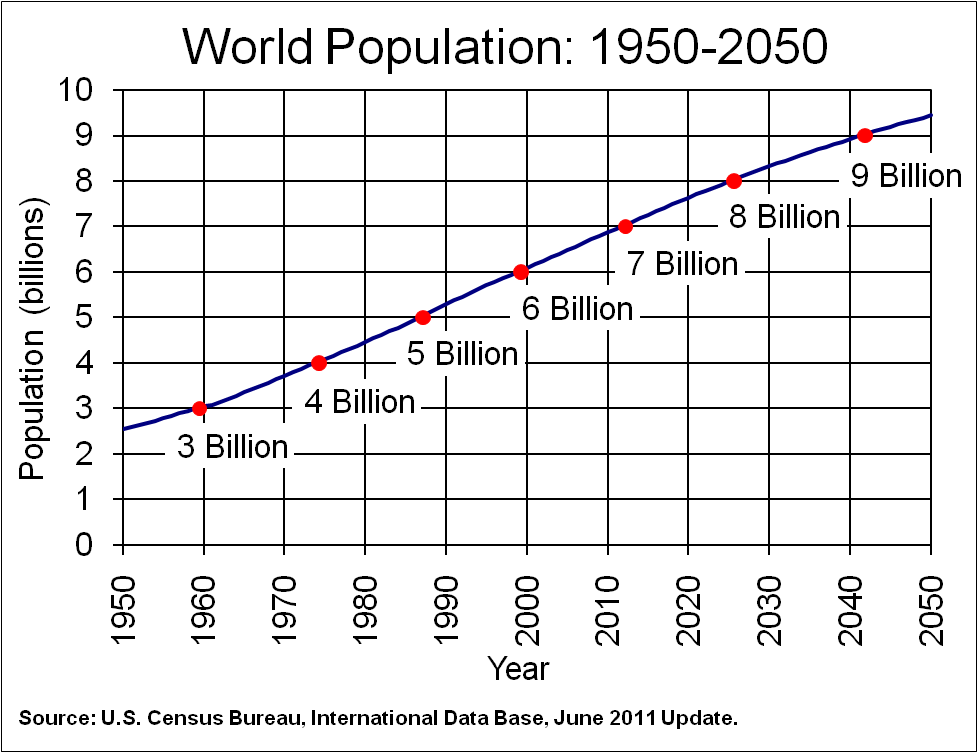
I’m going to ‘smack you in the face‘ with this population chart.
To put that into context from a personal perspective, when I was born in 1944 the global population was 2.5 billion persons. Some 4.7 billion fewer people than today!
But that prediction from the U.S Census Bureau in June, 2011 is already out of date!
13 June 2013 – The current world population of 7.2 billion is projected to increase by 1 billion over the next 12 years and reach 9.6 billion by 2050, according to a United Nations report launched today, which points out that growth will be mainly in developing countries, with more than half in Africa.
Now please humour me for a few moments. If the world population is presently 7.2 billion people and by 2050 the prediction is 9.2 billion people, that is an increase of 2,400,000,000 persons.
The end of 2050 is 438 months away. Now do the maths. That growth in population in that time period is the equivalent of an increase in population of 5,479,000 persons every single month!
Need to find a darkened room – I feel a headache coming on!
Why the choice of this sub-heading? Well, just because a number of quite separate articles and essays have come together to offer a powerful, cohesive argument for reconsidering the role of Nature in the future of mankind.
Of course, my use of words in that preceding sentence is completely ludicrous; the suggestion that ‘Nature’ is disconnected from ‘mankind’. Yet millions of us, to a greater or lesser degree, do behave as if we are the masters of the world.
So let me dip into what has been ‘crossing my desk’ in recent times.
On May 28th, George Monbiot published in The Guardian newspaper an essay entitled A Manifesto for Rewilding the World. (The link takes you to the article on the Monbiot blogsite.) Here’s how that essay opened,
Until modern humans arrived, every continent except Antarctica possessed a megafauna. In the Americas, alongside mastodons, mammoths, four-tusked and spiral-tusked elephants, there was a beaver the size of a black bear: eight feet from nose to tail(1). There were giant bison weighing two tonnes, which carried horns seven feet across(2).
The short-faced bear stood thirteen feet in its hind socks(3). One hypothesis maintains that its astonishing size and shocking armoury of teeth and claws are the hallmarks of a specialist scavenger: it specialised in driving giant lions and sabretooth cats off their prey(4). The Argentine roc (Argentavis magnificens) had a wingspan of 26 feet(5). Sabretooth salmon nine feet long migrated up Pacific coast rivers(6).
During the previous interglacial period, Britain and Europe contained much of the megafauna we now associate with the tropics: forest elephants, rhinos, hippos, lions and hyaenas. The elephants, rhinos and hippos were driven into southern Europe by the ice, then exterminated around 40,000 years ago when modern humans arrived(7,8,9). Lions and hyaenas persisted: lions hunted reindeer across the frozen wastes of Britain until 11,000 years ago(10, 11). The distribution of these animals has little to do with temperature: only where they co-evolved with humans and learnt to fear them did they survive.
I’m not going to reproduce the bulk of the article; just hoped that I have tickled your curiousity sufficient for you to read it in full here. But will just show you how it closed:
Despite the best efforts of governments, farmers and conservationists, nature is already beginning to return. One estimate suggests that two thirds of the previously-forested parts of the US have reforested, as farming and logging have retreated, especially from the eastern half of the country(23). Another proposes that by 2030 farmers on the European Continent (though not in Britain, where no major shift is expected) will vacate around 30 million hectares (75 million acres), roughly the size of Poland(24). While the mesofauna is already beginning to spread back across Europe, land areas of this size could perhaps permit the reintroduction of some of our lost megafauna. Why should Europe not have a Serengeti or two?
Above all, rewilding offers a positive environmentalism. Environmentalists have long known what they are against; now we can explain what we are for. It introduces hope where hope seemed absent. It offers us a chance to replace our silent spring with a raucous summer.
Then further research for this post brought to light an interview with David Suzuki in February. Widely reported, I picked the version published on Straight.com, from which comes:
In December, Canadian specialty TV channel Business News Network interviewed me about the climate summit in Copenhagen. My six-minute interview followed a five-minute live report from Copenhagen, about poor countries demanding more money to address climate change and rich countries pleading a lack of resources. Before and after those spots were all kinds of reports on the Dow Jones Industrial Average, the price of gold and the loonie, and the implications of some new phone technology.
For me, this brought into sharp focus the inevitable failure of our negotiating efforts on climate change. BNN, like the New York-based Bloomberg channel, is a 24-hour-a-day network focused completely on business. These networks indicate that the economy is our top priority. And at Copenhagen, money dominated the discussions and the outcome.
But where is the 24-hour network dealing with the biosphere? As biological creatures, we depend on clean air, clean water, clean soil, clean energy, and biodiversity for our well-being and survival. Surely protecting those fundamental needs should be our top priority and should dominate our thinking and the way we live. After all, we are animals and our biological dependence on the biosphere for our most basic needs should be obvious.
The economy is a human construct, not a force of nature like entropy, gravity, or the speed of light or our biological makeup. It makes no sense to elevate the economy above the things that keep us alive. But that’s what our prime minister does when he claims we can’t even try to meet the Kyoto targets because that might have a detrimental effect on the economy.
This economic system is built on exploiting raw materials from the biosphere and dumping the waste back into the biosphere. And conventional economics dismisses all the “services” that nature performs to keep the planet habitable for animals like us as “externalities”. As long as economic considerations trump all other factors in our decisions, we will never work our way out of the problems we’ve created.
Concluding:
Nature is our home. Nature provides our most fundamental needs. Nature dictates limits. If we are striving for a truly sustainable future, we have to subordinate our activities to the limits that come from nature. We know how much carbon dioxide can be reabsorbed by all the green things in the oceans and on land, and we know we are exceeding those limits. That’s why carbon is building up in the atmosphere. So our goal is clear. All of humanity must find a way to keep emissions below the limits imposed by the biosphere.
The only equitable course is to determine the acceptable level of emissions on a global per capita basis. Those who fall below the line should be compensated for their small carbon footprint while those who are far above should be assessed accordingly. But the economy must be aligned with the limits imposed by the biosphere, not above them.
Quite clearly, if we continue to turn our backs on Nature, the consequences won’t be long in tapping us on the shoulder.
So, going to close it today with this, seen nearly a month ago on the PRI website:
Imagine the type of world we could see
If instead of saying ‘pray,’ we said, ‘plant a tree’.
With this one little change so much more could be done
To protect all living things found under the sun.
We could ‘plant a tree’ for our troops sent away into war
So when they return they’d come home to find more.
We could ‘plant a tree’ at our churches with our husband or wife
To praise the Creator through a celebration of life.
We could ‘plant a tree’ for the needy and for those with no food
We could even plant in public without seeming rude.
The government would not have to introduce rules,
And most likely we could ‘plant a tree’ at our schools.
If we took it to task to ‘plant trees’ for the poorest,
We would all soon be reaping the wealth of a forest.
We could plant freely with those of all religions and creeds,
The improvement of earth would be based on these deeds.
We could plant with our neighbours, our family, and friends,
And ‘plant a tree’ with our enemies to help make amends.
If we ‘plant a tree’ for the sick to show them we care,
We would also be healing the soil, water, and air.
We could ‘plant a tree’ to observe when two people wed,
And plant one with our kids each night before bed.
Throughout the history of the whole human race
We find respect for the ‘tree’ has always had a place.
The great Ash of the Norse was their tree of the World,
And on a tree in the Garden is where the serpent once curled.
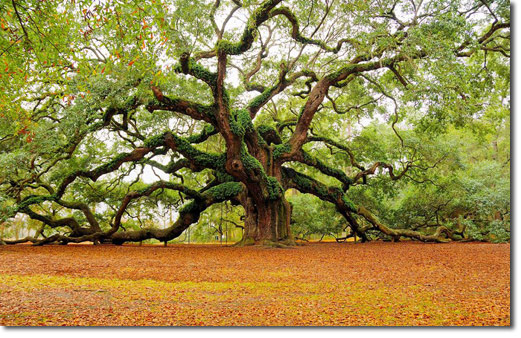
It was in groves of Oaks that the Druid priests wandered,
And under the Bodhi where the great Buddha pondered.
In the Bible it’s clear that we have all that we need:
‘All the trees with their fruits and plants yielding seed’.
Despite all these lessons that the past has taught
Now days, it seems, we cut our trees without thought.
This is confirmed by the Koran, for in it we read:
‘Many are the marvels of earth, yet we pay them no heed’.
We all have a duty, no matter what nation
To perform our part in protecting Creation.
Just think what we’d have if we had picked up a spade
Every time each one of us bowed our heads and prayed.
I read a recent article posted by Rob Hopkins on the Transition Culture blogsite, a blog that I subscribe to. Those who are unfamiliar with Rob, the Transition Culture site has his background, from which I quote this snippet:
Rob Hopkins, with a familiar Totnes building in the background.
“Rob Hopkins brings humour, imagination and vision to the great challenges of our time, and argues that what is needed, above all else, at this time in history, is “engaged optimism”. The rapidly-spreading Transition movement which he was pivotal in establishing, is an embodiment of that. Nicholas Crane, presenter of BBC2’s recent ‘Town’ series, recently referred to Transition as “the biggest urban brainwave of the century”.
Anyway, back to the article. It struck me as so absurd that I tried my hand at asking Rob for permission to republish. Back, almost immediately, came his positive reply. Thank you, Rob.
Oh, and before going to Rob’s article, for those that, like me, are a bit rusty on the composition of the G8, here’s a Wikipedia extract:
The Group of Eight (G8) is a forum for the governments of the world’s eight wealthiest countries. The forum originated with a 1975 summit hosted by France that brought together representatives of six governments: France, West Germany, Italy, Japan, the United Kingdom, and the United States, thus leading to the name Group of Six or G6. The summit became known as the Group of Seven or G7 the following year with the addition of Canada. The G7, that is active even after the creation of the G8, is composed by 7 of 8 of the wealthiest countries on Earth (as net wealth and not GDP). In 1997, Russia was added to the group which then became known as the G8. The European Union is represented within the G8 but cannot host or chair summits.
Now without any further ado, here is that article.
oooOOOooo
12 Jun 2013
Why even the G8 prefer vibrant, diverse local economies really …
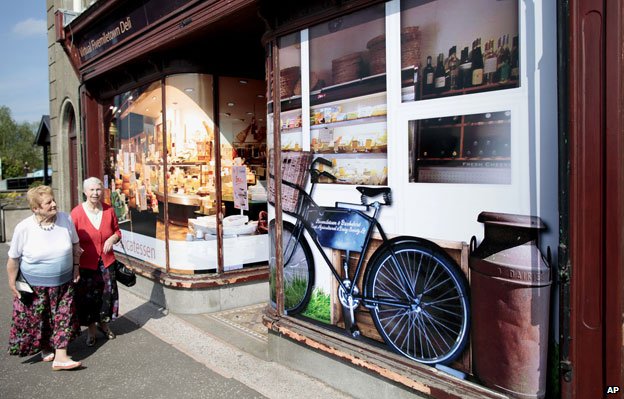
If there was one picture that captured the times we are living through it is this. It appeared on the BBC website recently with the following caption:
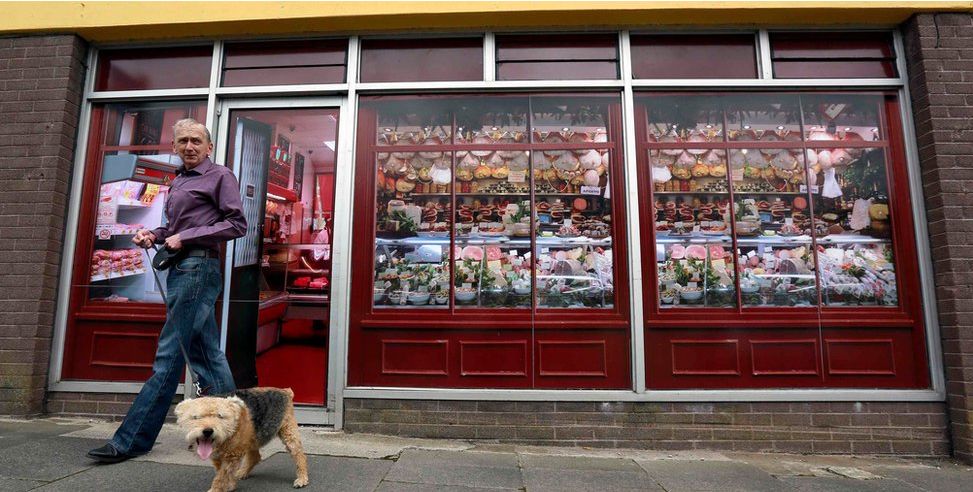
Kevin McGuire walks his dog past a vacant shop in Belcoo, Northern Ireland. The empty shop is one of a number that have had graphics placed on the windows to make them look like working shops ahead of the G8 summit which takes place nearby later this month.
Let’s take that a bit more slowly. Here is a shop, one of many that has gone out of business due, among other things, to the growth-fixated policies of the G8, situated in a place G8 ministers will be driven past en route to their summit. Rather than their being able to see how things are actually unfolding in the real world, the division and misery being caused by their approach to the economy, the windows have been plastered with stickers that present it as a fully-stocked, thriving shop. As singer/comic Mitch Benn put it on BBC Radio 4′s The Now Show on Friday, ”the last thing you’d want would be for a bunch of people meeting to fix the economy to see how bad the economy’s got”.
County Fermanagh’s district council sanctioned the fake retail units as part of a £1m makeover before it hosts the G8 summit. The event takes place on 17 and 18 June at the Lough Erne golf resort near Enniskillen. The chief executive of Fermanagh District Council has defended the optical illusion.
“It was aimed at undeveloped sites at the entrance to the town and then right throughout the county in terms of the other towns and villages, looking at those vacant properties and really just trying to make them look better and more aesthetically pleasing,” says Brendan Hegarty
Here’s the thing that fascinated me most though. It’s the kind of shop they chose to portray it as. They didn’t print up large stickers that would present the shop as being a Tesco Metro, a Sainsbury’s Local, an Aldi perhaps, or even branch of one of the banks that contributed significantly to our getting into this mess in the first place. They didn’t make one huge sticker, one false façade, that showed a new shopping precinct, glittering with all the usual chain stores that dominate every such precinct. Or a Travelodge perhaps. Rather they set out deliberately and in considerable detail to portray the kind of vibrant, local, independent business that has either become extinct, or which survives in spite of, rather than because of, the policies of the G8. Here’s another one…
The windows are hung with delicious-looking hams, the display features meats and a whole range of delicious local produce, beautifully arranged. Although the cut-and-paste nature of the graphic design rather gives the game away (the same arrangements of hams appear two or three times), what they are trying to portray here is that most endangered of species, the local, independent butcher.
In the mid-1990s there were 22,000 butchers in the UK, by 2010 there were just 6,553. The independent butcher is making something of a spirited fightback though, although certainly not aided, in any sense, by the G8. The butcher that would have occupied that shop no longer exists, most likely because a supermarket opened nearby and completely shifted the balance of the Belcoo economy (any readers from Belcoo who might like to write in and tell us what led to this shop’s demise would be most welcome).
The other day I spoke to Nick Sherwood of REconomy Herefordshire, who has co-ordinated the Herefordshire Economic Evaluation (the second such piece of work, the Totnes one already being published, and Brixton’s coming soon). Our conversation will be published here soon, but one of the things that really struck me was the following:
We estimate that the top five major supermarkets in Herefordshire account for between 71% – 83% of all household expenditure on ‘brought home’ food and drink, or up to £180m annually. In addition, around £30m per year is spent in the smaller ‘chain’ supermarkets.
Their conclusion is that the true ‘local spend’ figure, i.e through local, independent businesses in Herefordshire, could be around 16% of the total. In terms of a national version of that figure, the best I can find is the figure from the Portas Review that states that 8,000 supermarkets now account for over 97% of all UK grocery sales. Although clearly other smaller supermarkets account for some of the remaining sales, let’s assume, for argument’s sake, that nationally, 3% of what we spend on groceries goes out through local and independent businesses.
I would imagine that everyone seeks an economy that is able to provide jobs, economic activity, stronger and happier communities and community resilience, while also skilfully reducing its carbon emissions on the scale required. The question of our times though, as far as I’m concerned, is whether that is best achieved by expanding the 97% of our economy currently dominated by huge supermarkets, the kinds of enterprise that the UK government and the G8 see as leading the push for growth, or protecting and enhancing the 3%?
It’s a vital question, because at the moment the push to eradicate the 3% altogether, or at least squeeze it a lot harder, continues apace. Yet that 3% is better suited to meeting those core needs of ours. As the recent report by Localise West Midlands on ‘community economic development’ states:
Our research has found strong evidence that local economies with higher levels of SMEs and local ownership perform better in terms of employment growth (especially disadvantaged and peripheral areas), the local multiplier effect, social and economic inclusion, income redistribution, health, civic engagement and well-being than places heavily reliant on inward investment where there are fewer, larger, remotely owned employers.
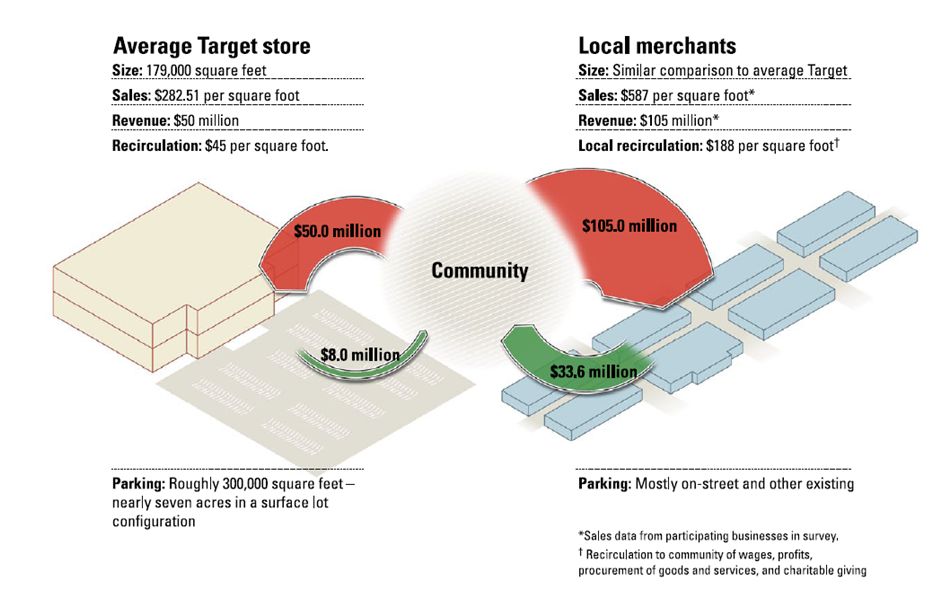
A study focusing on New Orleans compared 179,000 square feet of retail space that is home to 100 independent businesses to the same-sized space that is home to a single supermarket. The former generated $105 million in sales with $34 million staying in the local economy, while the latter generated $50 million in sales with just $8 million staying locally, and necessitated 300,000 square feet of parking space (see graphic below).
Santander’s ‘Market of Hope’ which I wrote about here last year is a great example of how a city can be fed by looking at large retail spaces in such a way that they boost and support the local independent economy rather than undermine it. When Sir Terry Leahy, CEO of Tesco, was asked whether there was any alternative to supermarkets, replied:
“… queueing at one store than trudging down Watford High Street in the rain to another shop … is this what people actually want to go back to?”
But no, it’s not about “going back”, rather about going forward in a way that meets our needs rather than those of the City of London. What we now know is that even G8 ministers would rather pass through High Streets populated with small, independent butchers, bakers, grocers, would rather see shop windows overflowing with delicious food, trusting that the relationship they have built up with the shopkeeper over many years will mean that he/she stocks the best produce they can find. It feels right. It’s human scale. It makes sense. It’s an economy that is ours, it belongs to local people, to the local economy. Even G8 ministers would now appear to prefer a shopping experience that actually involves interacting with other human beings rather than wandering anonymously around a superstore and then cashing yourself out at the end.
The core argument of The Power of Just Doing Stuff, published on Friday, is that if we really want to achieve our goals of jobs, economic activity, stronger and happier communities and community resilience, while also skilfully reducing our carbon emissions on the scale required, we’d be better off focusing on growing the 3% rather than the 97%. It’s a pretty simple idea, and, to me at least, a blindingly obvious one, but that doesn’t mean it’s easy.
However, the experience is that this fightback has already begun. The explosion of new bakeries, pop-up shops, community renewable energy projects, craft breweries, independent record shops, complementary currencies and communities acquiring their own assets is already happening around us, but it needs us to get behind it, to put our shoulders, our spending power, our sheer bloody will, to making it 10%, 30% 70%. If we want a stable climate, reduced energy vulnerability, economic stability, and a healthy human culture, we really have no choice. As Maria van der Hoeven of the IEA said recently at the launch of a World Energy OutlookSpecial Report, Redrawing the Energy-Climate Map, ”the path we are currently on is more likely to result in a temperature increase of between 3.6 °C and 5.3 °C”.
Fortunately, it’s a push that is life-enhancing, thrill-generating and in which we discover a resourcefulness, a kindness and a passion in ourselves that we may have forgotten was there. I’ll leave you with a quote from the book, from Helen Cunningham of DE4 Food, a social enterprise food hub in Derbyshire that grew out of Transition Matlock. The project grew from helping a local farmer with lambing and has grown into an innovative new business:
“Never in my life did I imagine that I’d be able to bring lambs into the world! It wasn’t a skill I ever expected to have. It was such a different thing from what we were doing in the rest of our lives, and I think from then we’ve all thought “OK, we can learn these new skills, we can learn how to lamb, we can learn how to grow vegetables and learn how to do Excel Profit and Loss sheets and whatever.” I think we all just really wanted to change the way we live, and change our own personal lives and to change things and live different lives ourselves as well as a different life in our community”.
You can pre-order your copy of The Power of Just Doing Stuff here.
oooOOOooo
As has been said before, and undoubtedly will be said many times more, it really is a very strange world we live in!
Starting with Monday’s video of Carl Sagan reminding us all that Planet Earth is just a grain of sand in the vast cosmos right through to yesterday’s Dealing with madness post, much of the week has been reminding us all of one very fundamental truth. No better expressed than in a comment from Patrice Ayme [my emphasis]:
… there is no healthy man without a healthy world.
Regulars will have noted the high levels of debate this week. Thank you all for those comments.
I have also received a couple of emails with feedback and comments, sent to me on a personal basis. One of those emails had such a powerful message that I begged for permission to publish it on Learning from Dogs. I was asked to keep the author’s identity private but, trust me, it is from someone I know well who subscribes to ideas of integrity and honesty in spades.
The author also strongly recommended publishing in association with his personal essay an extract from Chris Hedges’ book “Death of the Liberal Class”. That extract follows straight on from the essay.
oooOOOooo
Reflections from a Vietnam Combat Veteran
War is an unnatural dichotomy. Both sides are morally and materially diminished. A future World War would most probably finish us as the self-appointed predominant intelligent species on planet earth. It seems worth noting that German industrialists coordinated fundamentalist propaganda to foster the bigotry, hatred and fear which fueled their profitable war engines prior to World War II.
United States commercial media today reflects a financially dominated military-industrial culture with liberty and justice for sale. The results are divisive and lead to both a declared international war against nebulous assailants we have been taught to dislike and an internal political war that has polarized our once fair nation.
We’ve stopped investing in the future in response to radicals who want to destroy government, human rights and what remains of the earth’s surface resources. There is an emerging police state mentality on display with a variety of candidates for local dictator.
It’s well past time for moderate republicans to ignore their uber-conservative brethren. It’s well past time for moderate democrats to renounce their corporate ties. This will only happen when our financial and political leaders awaken to the reality of what is in the best long-term interests for all life on this planet rather than our present unsustainable global economy.
To complicate the problem, our planet is under attack by a swarm of vociferous human locusts seeking profit without regard to the consequences. Meanwhile, despite human denial, the universe continues to emerge. Species which do not adapt to change do not survive.
It’s important to remember that we’re in the midst of a battle that’s as old as the conscious awareness of the human species. We generally have very little idea of the inclusive nature of our being; let alone the nature of our collective being as a species. We have as yet to learn how to surrender to reality. The battle is with our own species.
Committing collective suicide for quarterly profit is not a sane way of life. What we’ve created is a neo-feudal global economy without any foundation that feeds on an empire of consumption. When we combine a neo-feudal economy with neo-fascist politics we arrive at a moral and biological dead end.
The coup d’état of the current Corporate State is the Citizen’s United ruling that makes money a form of free speech. Money has no DNA. In case anyone missed how the “occupy” movement was crushed, there’s no question that we’re rapidly criminalizing all forms of dissent. These actions are being taking under the 1917 Espionage Act and related state secrets acts. No discernment of moral value is considered and no public hearings are conducted. People who speak up are locked up. We’ve become a fearful and secretive population.
Our self-appointed elite power structure is completely irrational in its belief that human reason is our ultimate power and money is its servant. We are made of the stuff of the stars. At best, we’re in our adolescence as a species. We think we know the answers rather than admitting our ignorance. What little we know is vastly less than what we have as yet to learn. We are often unaware of being unaware.
The lives we presently lead can not be sustained in ways that we have become accustomed to; ways we take for granted. What’s going to need to change? The simple answer is everything. Our species has systemically corrupted the small part of the cosmos which sustains our being. Nature has no sense of humor, no patience for human squabbles and no financial interest.
Fortunately, we already know what we need to do to adapt. We know how nature works through the wisdom of our earth sciences. The answer is simple. Love the earth. Love life. Share compassion. Educate, naturally energize, and transform. The resulting process of change will help re-establish a realistic world economic foundation.
The following selection is taken from the first chapter of the book, published in October 201 by Nation Books.
In a traditional democracy, the liberal class functions as a safety valve. It makes piecemeal and incremental reform possible. It offers hope for change and proposes gradual steps toward greater equality. It endows the state and the mechanisms of power with virtue. It also serves as an attack dog that discredits radical social movements, making the liberal class a useful component within the power elite.
But the assault by the corporate state on the democratic state has claimed the liberal class as one of its victims. Corporate power forgot that the liberal class, when it functions, gives legitimacy to the power elite. And reducing the liberal class to courtiers or mandarins, who have nothing to offer but empty rhetoric, shuts off this safety valve and forces discontent to find other outlets that often end in violence. The inability of the liberal class to acknowledge that corporations have wrested power from the hands of citizens, that the Constitution and its guarantees of personal liberty have become irrelevant, and that the phrase consent of the governed is meaningless, has left it speaking and acting in ways that no longer correspond to reality. It has lent its voice to hollow acts of political theater, and the pretense that democratic debate and choice continue to exist.
The liberal class refuses to recognize the obvious because it does not want to lose its comfortable and often well-paid perch. Churches and universities—in elite schools such as Princeton, professors can earn $180,000 a year—enjoy tax-exempt status as long as they refrain from overt political critiques. Labor leaders make lavish salaries and are considered junior partners within corporate capitalism as long as they do not speak in the language of class struggle. Politicians, like generals, are loyal to the demands of the corporate state in power and retire to become millionaires as lobbyists or corporate managers. Artists who use their talents to foster the myths and illusions that bombard our society live comfortably in the Hollywood Hills.
The media, the church, the university, the Democratic Party, the arts, and labor unions—the pillars of the liberal class—have been bought off with corporate money and promises of scraps tossed to them by the narrow circles of power. Journalists, who prize access to the powerful more than they prize truth, report lies and propaganda to propel us into a war in Iraq. Many of these same journalists assured us it was prudent to entrust our life savings to a financial system run by speculators and thieves. Those life savings were gutted. The media, catering to corporate advertisers and sponsors, at the same time renders invisible whole sections of the population whose misery, poverty, and grievances should be the principal focus of journalism.
In the name of tolerance—a word the Rev. Dr. Martin Luther King Jr., never used—the liberal church and the synagogue refuse to denounce Christian heretics who acculturate the Christian religion with the worst aspects of consumerism, nationalism, greed, imperial hubris, violence, and bigotry. These institutions accept globalization and unfettered capitalism as natural law. Liberal religious institutions, which should concern themselves with justice, embrace a cloying personal piety expressed in a how-is-it-with-me kind of spirituality and small, self-righteous acts of publicly conspicuous charity. Years spent in seminary or rabbinical schools, years devoted to the study of ethics, justice, and morality, prove useless when it comes time to stand up to corporate forces that usurp religious and moral language for financial and political gain.
Universities no longer train students to think critically, to examine and critique systems of power and cultural and political assumptions, to ask the broad questions of meaning and morality once sustained by the humanities. These institutions have transformed themselves into vocational schools. They have become breeding grounds for systems managers trained to serve the corporate state. In a Faustian bargain with corporate power, many of these universities have swelled their endowments and the budgets of many of their departments with billions in corporate and government dollars. College presidents, paid enormous salaries as if they were the heads of corporations, are judged almost solely on their ability to raise money. In return, these universities, like the media and religious institutions, not only remain silent about corporate power but also condemn as “political” all within their walls who question corporate malfeasance and the excesses of unfettered capitalism.
Unions, organizations formerly steeped in the doctrine of class struggle and filled with members who sought broad social and political rights for the working class, have been transformed into domesticated negotiators with the capitalist class. Cars rolling off the Ford plants in Michigan were said to be made by UAW Ford. But where unions still exist, they have been reduced to simple bartering tools, if that. The social demands of unions in the early twentieth century that gave the working class weekends off, the right to strike, the eight-hour workday, and Social Security, have been abandoned. Universities, especially in political science and economics departments, parrot the discredited ideology of unregulated capitalism and have no new ideas. The arts, just as hungry as the media or the academy for corporate money and sponsorship, refuse to address the social and economic disparities that create suffering for tens of millions of citizens. Commercial artists peddle the mythical narrative, one propagated by corporations, self-help gurus, Oprah and the Christian Right, that if we dig deep enough within ourselves, focus on happiness, find our inner strength, or believe in miracles, we can have everything we desire.
Such magical thinking, a staple of the entertainment industry, blinds citizens to corporate structures that have made it impossible for families to lift themselves out of poverty or live with dignity. But perhaps the worst offender within the liberal class is the Democratic Party.
The party consciously sold out the working class for corporate money. Bill Clinton, who argued that labor had nowhere else to go, in 1994 passed the North American Free Trade Agreement (NAFTA), which betrayed the working class. He went on to destroy welfare and in 1999 ripped down the firewalls between commercial and investment banks to turn the banking system over to speculators. Barack Obama, who raised more than $600 million to run for president, most of it from corporations, has served corporate interests as assiduously as his party. He has continued the looting of the U.S. Treasury by corporations, refused to help the millions of Americans who have lost their homes because of bank repossessions or foreclosures, and has failed to address the misery of our permanent class of unemployed.
Populations will endure the repression of tyrants, as long as these rulers continue to manage and wield power effectively. But human history has demonstrated that once those in positions of power become redundant and impotent, yet insist on retaining the trappings and privileges of power, their subject populations will brutally discard them. Such a fate awaits the liberal class, which insists on clinging to its positions of privilege while at the same time refusing to play its traditional role within the democratic state. The liberal class has become a useless and despised appendage of corporate power. And as corporate power pollutes and poisons the ecosystem and propels us into a world where there will be only masters and serfs, the liberal class, which serves no purpose in the new configuration, is being abandoned and discarded. The death of the liberal class means there is no check to a corporate apparatus designed to enrich a tiny elite and plunder the nation. An ineffectual liberal class means there is no hope, however remote, of a correction or a reversal. It ensures that the frustration and anger among the working and middle classes will find expression outside the confines of democratic institutions and the civilities of a liberal democracy.
The second of two essays reflecting the ‘New World Order’.
Yesterday, I introduced the first essay from Patrice Ayme. Today, the second essay is a complete ‘copy and paste‘ as it appeared on TomDispatch. The importance of such writers as Patrice Ayme, the authors that are published on TomDispatch, and many more besides, is beyond measure. As the old saying goes, “The only thing required for evil to triumph is for good men to do nothing“.
So without further ado, here is that TomDispatch essay.
oooOOOooo
Tomgram: Mattea Kramer and Jo Comerford, Congress Tweeted While America Burned
[Note for TomDispatch Readers:Those of you who were struck by the recent TD piece “You Are a Guinea Pig: How Americans Became Exposed to Biohazards in the Greatest Uncontrolled Experiment Ever Launched” shouldn’t miss last Sunday’s fascinating Bill Moyers interview with its authors, David Rosner and Gerald Markowitz, who have written the new book Lead Wars: The Politics of Science and the Fate of America’s Children. Tom]
Three days after the terrorist attacks of September 11, 2001, Congress passed a joint resolution called an Authorization for Use of Military Force (AUMF). You might remember it. In layman’s terms, it was a carte blanche for the Bush administration to go to war wherever it wanted, whenever it wanted, however it wanted, under the guise of fighting anyone who “planned, authorized, committed, or aided” the September 11th attackers, or “harbored” any terrorists or terror organizations connected to the attacks. That document, more than any other, launched the Global War on Terror or GWOT. President Obama long ago ditched the name and acronym, but he kept the global war.
And don’t expect that to change. On Thursday, Assistant Secretary of Defense Michael Sheehan went before Congress and insisted that the Defense Department couldn’t be more “comfortable” with AUMF, as it was written, and that not a word should be altered or amended for changed circumstances. The Pentagon was so comfortable, in fact, that its officials foresee using that resolution to continue its drone-powered “dirty wars” in the Greater Middle East and Africa for years to come. “In my judgment,” Sheehan said, “this is going to go on for quite a while, yes, beyond the second term of the president… I think it’s at least 10 to 20 years.”
So there you have it. The military got its blank check for overseas wars, for sending out the drones and the special operations forces, and has no plans to change that before 2023, if not 2033. In other words, for at least the next decade, the GWOT, whatever label it’s given, will continue to be the central fixture of American foreign policy. It’s not going anywhere. Today, TomDispatch regulars Mattea Kramer and Jo Comerford of the invaluable National Priorities Project look at the “homeland” a decade into the future, as the effects of Congress’s austerity policies sink in. Put the two together and what a grim scene you have: a country investing in war in distant lands as it crumbles here at home. Andy Kroll
The streets are so much darker now, since money for streetlights is rarely available to municipal governments. The national parks began closing down years ago. Some are already being subdivided and sold to the highest bidder. Reports on bridges crumbling or even collapsing are commonplace. The air in city after city hangs brown and heavy (and rates of childhood asthma and other lung diseases have shot up), because funding that would allow the enforcement of clean air standards by the Environmental Protection Agency is a distant memory. Public education has been cut to the bone, making good schools a luxury and, according to the Department of Education, two of every five students won’t graduate from high school.
It’s 2023 — and this is America 10 years after the first across-the-board federal budget cuts known as sequestration went into effect. They went on for a decade, making no exception for effective programs vital to America’s economic health that were already underfunded, like job training and infrastructure repairs. It wasn’t supposed to be this way.
Traveling back in time to 2013 — at the moment the sequester cuts began — no one knew what their impact would be, although nearly everyone across the political spectrum agreed that it would be bad. As it happened, the first signs of the unraveling which would, a decade later, leave the United States a third-world country, could be detected surprisingly quickly, only three months after the cuts began. In that brief time, a few government agencies, like the Federal Aviation Administration (FAA), after an uproar over flight delays, requested — and won — special relief. Naturally, the Department of Defense, with a mere $568 billion to burn in its 2013 budget, also joined this elite list. On the other hand, critical spending for education, environmental protection, and scientific research was not spared, and in many communities the effect was felt remarkably soon.
Robust public investment had been a key to U.S. prosperity in the previous century. It was then considered a basic part of the social contract as well as of Economics 101. As just about everyone knew in those days, citizens paid taxes to fund worthy initiatives that the private sector wouldn’t adequately or efficiently supply. Roadways and scientific research were examples. In the post-World War II years, the country invested great sums of money in its interstate highways and what were widely considered the best education systems in the world, while research in well-funded government labs led to inventions like the Internet. The resulting world-class infrastructure, educated workforce, and technological revolution fed a robust private sector.
Austerity Fever
In the early years of the twenty-first century, however, a set of manufactured arguments for “austerity,” which had been gaining traction for decades, captured the national imagination. In 2011-2012, a Congress that seemed capable of doing little else passed trillions of dollars of what was then called “deficit reduction.” Sequestration was a strange and special case of this particular disease. These across-the-board cuts, instituted in August 2011 and set to kick in on January 2, 2013, were meant to be a storm cloud hanging over Congress. Sequestration was never intended to take effect, but only to force lawmakers to listen to reason — to craft a less terrible plan to reduce deficits by a wholly arbitrary $1.2 trillion over 10 years. As is now common knowledge, they didn’t come to their senses and sequestration did go into effect. Then, although Congress could have cancelled the cuts at any moment, the country never turned back.
It wasn’t that cutting federal spending at those levels would necessarily have been devastating in 2013, though in an already weakened economy any cutbacks would have hurt. Rather, sequestration proved particularly corrosive from the start because all types of public spending — from grants for renewable energy research and disadvantaged public schools to HIV testing — were to be gutted equally, as if all of it were just fat to be trimmed. Even monitoring systems for possible natural disasters like river flooding or an imminent volcanic eruption began to be shut down. Over time the cuts would be vast: $85 billion in the first year and $110 billion in each year after that, for more than $1 trillion in cuts over a decade on top of other reductions already in place.
Once lawmakers wrote sequestration into law they had more than a year to wise up. Yet they did nothing to draft an alternate plan and didn’t even start pointing out the havoc-to-come until just weeks before the deadline. Then they gave themselves a couple more months — until March 1, 2013 — to work out a deal, which they didn’t. All this is, of course, ancient history, but even a decade later, the record of folly is worth reviewing.
If you remember, they tweeted while Rome burned. Speaker of the House John Boehner, for instance, sent out dozens of tweets to say Democrats were responsible: “The president proposed sequester, had 18 mo. to prioritize cuts, and did nothing,” he typically wrote, while he no less typically did nothing. For his part, Senate Majority Leader Harry Reid tweeted back: “It’s not too late to avert the damaging #sequester cuts, for which an overwhelming majority of Republicans voted.” And that became the pattern for a decade of American political gridlock, still not broken today.
Destruction Begins
March 1st came and went, so the budgetary axe began to fall.
At first, it didn’t seem so bad. Yes, the cuts weren’t quite as across the board as expected. The meat industry, for example, protested because health inspector furloughs would slow its production lines, so Congress patched the problem and spared those inspectors. But meat production aside, there was a sense that the cuts might not be so bad after all.
They were to be doled out based on a formula for meeting the arbitrary target of $85 billion in reductions in 2013, and no one knew precisely what would happen to any given program. In April, more than a month after the cuts had begun, the White House issued the president’s budget proposal for the following year, an annual milestone that typically included detailed information about federal spending in the current year. But across thousands of pages of documents and tables, the new budget ignored sequestration, and so reported meaningless 2013 numbers, because even the White House couldn’t say exactly what impact these cuts would have on programs and public investment across the country.
As it happened, they didn’t have to wait long to find out. The first ripples of impact began to spread quickly indeed. Losing some government funding, cancer clinics in New Mexico and Connecticut turned away patients. In Kentucky, Oregon, and Montana, shelters for victims of domestic violence cut services. In New York, Maryland, and Alabama, public defenders were furloughed, limiting access to justice for low-income people. In Illinois and Minnesota, public school teachers were laid off. In Florida, Michigan, and Mississippi, Head Start shortened the school year, while in Kansas and Indiana, some low-income children simply lost access to the program entirely. In Alaska, a substance abuse clinic shut down. Across the country, Meals on Wheels cut four million meals for seniors in need.
Only when the FAA imposed furloughs on its air traffic controllers did public irritation threaten to boil over. Long lines and airport delays ensued, and people were angry. And not just any people — people who had access to members of Congress. In a Washington that has gridlocked the most routine business, lawmakers moved at a breakneck pace, taking just five days to pass special legislation to solve the problem. To avoid furloughs and shorten waits for airline passengers, they allowed the FAA to spend funds that had been intended for long-term airport repairs and improvements.
Flights would leave on time — at least until runways cracked and crumbled. (You undoubtedly remember the scandal of 2019 at Cincinnati International Airport, when a bright young candidate for Senate met her demise in a tragic landing mishap.)
And then, of course, the Pentagon asked for an exemption, too. We’re talking about the military behemoth of planet Earth, which in 2013 accounted for 40% of military spending globally, its outlays exceeding the next 10 largest militaries combined. It, too wanted a special exemption for some of its share of the cutbacks.
Meat inspectors, the FAA, and the Department of Defense enjoyed special treatment, but the rest of the nation was, as the history books recount, not so lucky. Children from middle-class and low-income families saw ever fewer resources at school, closing doors of opportunity. The young, old, and infirm found themselves with dwindling access to basic resources such as health care or even a hot dinner. Federal grants to the states dried up, and there was less money in state budgets for local priorities, from police officers to lowly streetlights.
And remember that, just as the sequestration cuts began, carbon concentration in the atmosphere breached 400 parts per million. (Climate scientists had long been warning that the level should be kept below 350 for human security.) Unfortunately, as with the groundbreaking research that led to the Internet, it takes money to do big things, and the long-term effects of cutting environmental protection, general research, and basic infrastructure meant that the U.S. government would do little to stem the extreme weather that has, in 2023, become such a part of our world and our lives.
Looking back from a country now eternally in crisis, it’s clear that a Rubicon was crossed back in 2013. There was then still a chance to reject across-the-board budget cuts that would undermine a nation built on sound public investment and shared prosperity. At that crossroads, some fought against austerity. Losing that battle, others argued for a smarter approach: close tax loopholes to raise new revenue, or reduce waste in health care, or place a tax on carbon, or cut excessive spending at the Pentagon. But too few Americans — with too little influence — spoke up, and Washington didn’t listen. The rest of the story, as you well know, is history.
Mattea Kramer is Research Director at National Priorities Project, where Jo Comerford is Executive Director. Both are TomDispatch regulars. They wrote A People’s Guide to the Federal Budget.
Two very different essays that, nonetheless, do sing to a common tune.
I sit here with a heavy heart. Why, you may ask?
Because I really wish I wasn’t setting the scene to a couple of disturbing essays. The first from Patrice Ayme. His essay is called Plutocracy: New World Order with the subtitle of The New World Thinking. The New World Emoting. The second essay is from Mattea Kramer and Jo Comerford under the TomDispatch umbrella. Their title is How America Became a Third World Country.
That heaviness comes from an emotional conflict. The conflict between never having been more contented in our beautiful Oregonian home and the tiny voice in my head that says that I shouldn’t throwing darts at the country that has been generous in welcoming me as a resident.
But I justify publishing these two essays in this manner. Just as Pharaoh leads the barking whenever the dogs sense something threatening their ‘territory’, then too should citizens (I use the term in the broadest sense) start barking when they sense something threatening the integrity of their country.
So today the Patrice Ayme essay and tomorrow the TomDispatch essay. I’m very grateful to both Patrice and Tom for their permission to republish their essays.
oooOOOooo
PLUTOCRACY: NEW WORLD ORDER
Obama just nominated Commerce Secretary the billionaire heiress who discovered him, and introduced him to the Rubin-Summers-Goldman-Sachs-Citigroup conspiracy. Penny Priztker was condemned to pay a 460 million dollar fine by the Federal government in 2001, for financial malfeasance. 460 million, that’s more than Mitt Romney’s fortune, that made small rank and file democrats huff and puff, in indignation, a few months ago, just like their mighty masters told them to do.
Now, if the 460 million dollars fine felon becomes chief, that’s fine, as long as the masters of the people don’t ask the People to huff and puff about the fine. The finer the fine, the finer the master, say the little People, and they bleat, satisfied. As Obama put it:”Priztker is one of the most eminent personalities of our country“. When Pluto reigns, down is up.
When Common Decency Is A Hindrance
Plutocracy is the New World Order. The New World Thinking. The New World Emoting.
To get some perspective on this, it’s good to have a retrospective look at the greatest plutocratic realms of the past, and ponder why extremely wealthy fascism rose, increasingly, in the Orient, while clever democracy rose, occasionally, in the West. And sometimes fell, disastrously, for reasons related.
It turns out that, when Rome became fascist and plutocratic, it turned to Oriental despotism, and criminals, indeed, came to command and control.
***
PERSIA REIGNED WITH ALL CRAFTS; YET NOT SMART ENOUGH:
Establishing giant, metastatic empires in the Orient is nothing new: the Hittites tried it, they proceeded to invade Lebanon and the rich valleys behind, Egyptian territory. However young Pharaoh Ramses II, defeated them at Qadesh, next to present day Damascus. Through courageous combat in that battle which defined his long rule, Ramses rescued victory from the jaws of defeat, somewhat miraculously.
Ramses lost ground, though, and later made a loving peace with his enemies. Then, the Hittites having been destroyed by the mysterious coalition of the Peoples of the Sea, the Assyrians tried to impose their own giant metastatic empire, using the harshest methods. That brought them so many enemies that they got invaded from all quarters, annihilated as a nation first, and an army, later.
Then the union of Medes and Persians, thanks to three remarkable leaders, established a giant fascist empire, from Ethiopia to Central Asia, Libya to India. The third emperor, Darius, besides being excellent at sword-play in the dark, and a great general, proved capable of using a free market economy, switching to so called Keynesianism, and then a command and control economy, as needed. Darius established a giant “Royal” road network (ancestral to the one the Romans would build, four centuries later).
A Persian Pony Express, with posts every five miles, would bring news from distant corners of the empire in a week. Darius went on to invade the Scythians, land of the Amazons, present day Ukraine.
Darius’ Persia was the greatest empire, so far, larger than the present day continental USA. It became so, thanks to a great variety of methods of socio-economic governance. Some of these methods would later be used by the West, massively. Not just the communication network, the free market, the command and control, but also a crafty diplomacy of seduction, cooptation and local autonomy (that’s how the Ionian Greeks and Phoenicians became collaborators of Persia; whereas Alexander would annihilate Tyr).
However, unbelievably, tiny Athens broke the Persian empire, inaugurating the next great event, still on-going, the rise of the West. Again and again, minuscule Greek armies routed the juggernauts of professional giant armies. Again and again, small democracies proved superior to large fascist foes. I claimed that mental superiority entailed military superiority.
***
FREE IN THE WEST, SLAVES IN THE EAST
Herodotus explained the Greeks’ military superiority: free men are more motivated in battle, as they fight for themselves, he said. But it’s not clear that elite Persian soldiers did not feel free.
So I hold something slightly different: free men are, living in an “open society” are not just more motivated, but, simply, more intelligent. Yes, intelligent.
Yet how come that the free men tended to be in the West, and the subjugated ones, in the East? And this for 4,000 years, defining the “West” as anything west of Mount Lebanon. Why did so much of the Mediterranean turn out propitious to freedom and individual initiative? What of the enormous Celto-German forests, from Spain to the Baltics?
Two factors played a role:
1) Trade, with the big man, the leader being the ship owner-captain (Tyr, Phoenicia, Crete, Athens, Carthage, etc.). This required to excel at technology and adaptative intelligence, confronting nature.
2) Small owner-peasants. The West’s agricultural system did better thanks to small, free owner-peasants. The owner peasant was captain of his own plot of land, and found himself in a situation roughly similar to the ship captain. Such people worked hard, and thought hard about outwitting nature. All of Germany was this way, until the military encroachment of Rome in the beginning of its plutocratic phase, brought, by reaction, a militarization of German society (this is what archeology shows).
A demographic core of owner-peasants was the core of the success of the Roman republic, and its successors, the Imperium Francorum, and France, or anything working along French lines (most of Europe). When enjoying this basic culture, of free, independent peasants, the West did very well. Why so? Because thinking by oneself, for oneself, makes one more intelligent.
***
WHY THE ORIENT IS DUMBER:
The Orient did better when the peasants could cultivate. That meant, when they had water. That was not obvious in the increasingly parched lands, from the Maghreb to India. First, there, one needed to bring water to agricultural lands. Whereas in the West, both water and arable land were in the same place, not so in the East. In the East water was on rocky mountains, arable lands in parts of plains at the bottom of said mountains. To bring the former to the latter, one needed great hydraulic works. Underground canalizations, sometimes fifty feet deep, could extend dozens of miles.
Such extensive works meant armies of workers and maintenance people. And also standing armies to establish and protect the necessary order. Plus a field army to roam around the empire, and keep the static defenses obedient.
In other words, food on the carpet in the parched, basin and range Orient meant a large fascist system to make it possible, and everybody enslaved to it, in a military organization (Christianity and Islam, both oriental religions, kept much of this essential psychological character: fascist god on top, giving absolute, even capricious orders to its slaves below).
***
ALL TOGETHER NOW, DOWN THE ROMAN ROAD TO HELL?
What consequences today? Western countries do not depend upon small owner-peasants anymore, but upon giant farms, or agribusinesses, for food procurement. Even trade has become unbalanced: production on one end of the Earth, increasing unemployment, at the other end.
Giant agribusinesses, and unbalanced trade became facts of empire in Rome, and lasted centuries. It was a deliberate plot of Roman plutocracy. At some point, six senatorial families owned most of North Africa. Seneca, Nero’s tutor, the plutocratic philosopher of note, used to boast that he had no idea how many giant properties he owned on the various continents.
That delocalization and globalization made Rome, and Italy into an empty shell of its former self. As those who had the power, the senatorial families, wished. What they feared first, was a proud, potent, empowered People.
(Part of) Italy would resurrect as independent republics, more than a millennium later.
What’s the morality of the story? Men have a strong instinct for doing things right. In a plutocratic system, though, men who do things wrong get rewarded, and this goes on, until the situation exponentiates and breaks down. Thus plutocratic systems are intrinsically pathological: they reward criminals. Not just criminal according to the laws of men, but criminals according to the laws of nature.
In the Orient, life is harder, less natural, militarization exploits part of the Dark Side, because human beings, by living there, live in a less optimal situation. In the West, the rise of plutocracy did not have these excuses.
The Romans knew this well. The Roman republic was the product of a revolution against Tarquinus Superbus, the king of Rome, of Etruscan origin. So the founding act of five centuries of Roman republic was an anti-plutocratic revolt. Same for Athens (several times, during the same centuries).
The Romans passed a strong anti-plutocratic law. That law limited, by force the size of a family’s fortune; it fixed an upper bound on how much one could own. The Second Punic war saw the death, on the battlefield, of too many of the best leading Romans. Meanwhile the conspirators of wealth, back behind the walls of the fortified cities, as Hannibal was roaming the countryside, established a New World order of rents.
When Carthage got defeated, those men of greed kept on pushing, and tried to grab control of the state. After several wars of distraction against Macedonia, Carthage, Numantia, Corinth, etc. it became clear that was what was going on to thousands of the best Romans, led by top nobles (in mind and ancestry), the Gracchi.
The Gracchis mostly tried to impose the wealth limitation law. They also succeeded to impose a land redistribution (an unthinkable socialist measure in the post Thatcher-Reagan world!). Yet, the Gracchi and their supporters lost a civil war. All got killed, by the private armies of the plutocrats. By 100 BCE, when Caesar was born, the dice had long been thrown. Only extreme measures could address the situation (extreme measures that Caesar and Cicero, on the good side, would try).
Now what? Losing democracy, means, ultimately, that we will lose not just freedom, but intelligence itself. It is difficult to imagine how the Americans will pull out of their present death spiral into furthering the wealth of the .1%. When bandits are called “philanthropists”, all values have been inverted in a country: gangsters are in control, the mafia has got metastatic. It will go on, all inverted, until it explodes, or get trampled over. The commerce chief will be a certified felon.
The situation in Europe is not as desperate: conditions for a revolt exist. Although Goldman Sachs has its servants in place all over, the Italians threw out one of them, a Goldman Sachs partner, Mario Monti, at the first chance they got.
Some may sneer, as they notice that, once again I used “Orient” and “Occident” according to old Greco-Roman semantics. What of the true Orient, the far-out East, China and company? Well, I will hide behind my usual observation: it’s Western culture that conquered the world. Present day China’s ideology has very little that is specifically Chinese, besides what the West and China had in common, such as the more or less free market. The idea of “People” (Populus) and “Republic” (Respublica) are Roman. So the very title of China, the “People Republic of China” is, well, (Greco-)Roman.
The dangers threatening China, accordingly, like those threatening us, are those that devastated the Roman republic. For the reasons exposed above, the development in the West, of a more advanced civilization was first, thus why everybody adopted it later. Rome was first to rise as high as it did. But, the greater the rise, the greater the fall. By 700 CE, the fall of Rome had been so great, that China had risen higher, on many indicators. The West, invaded by hordes of savages for more than six hundred years (beyond even 400 CE to 1000 CE) was fighting for survival.
Plutocracy as a New World Order is not just the end of many things. In the fullness of time, plutocracy is the end of everything.
Even the Will to Power. Slave masters are not so masterful. After all, they are enslaved to their slaves.
When Rome went down, Roman plutocrats whined that the “world was getting old“. By this they meant that resources were being exhausted, and that, in its stupidity plutocratic civilization could not find a technology out.
Right now, the world is not getting old, it’s getting killed. And that’s worst.
In my last essay on love that was published on Friday, I quoted Carl Sagan, “For small creatures such as we the vastness is bearable only through love.Carl Sagan” My conclusion about love was:
… that if we don’t love our planet with all the ardour and passion of a teenager’s first romance, all those other loves in our lives will ultimately become irrelevant.
In researching for that essay, I visited Carl Sagan’s website, a rich source of information and materials for anyone interested in the far Cosmos right down to our future on this planet.
Just a little over three months ago, I wrote a post with the title of Carl Sagan with the objective of promoting his beautiful and awe-inspiring film called Pale Blue Dot.
Back to the present. On YouTube I came across this short video that seems so relevant to our need to love the only planet we have.
Carl Sagan explains the immensity of space and time in this clip is from Carl Sagan’s Cosmos episode 8, “Journeys in Space and Time.
“Those worlds in space are as countless as all the grains of sand on all the beaches of the Earth. Each of those worlds is as real as ours. In every one of them, there’s a succession of incidence, events, occurrences which influence its future. Countless worlds, numberless moments, an immensity of space and time.
And our small planet, at this moment, here we face a critical branch-point in the history. What we do with our world, right now, will propagate down through the centuries and powerfully affect the destiny of our descendants. It is well within our power to destroy our civilization, and perhaps our species as well. If we capitulate to superstition, or greed, or stupidity we can plunge our world into a darkness deeper than time between the collapse of classical civilization and the Italian Renaissance.
But we are also capable of using our compassion and our intelligence, our technology and our wealth, to make an abundant and meaningful life for every inhabitant of this planet. To enhance enormously our understanding of the Universe, and to carry us to the stars.”
Today, in the USA it is Memorial Day. The day of remembering the men and women who died while serving in the United States Armed Forces. It doesn’t seem out of order to reflect that all those courageous men and women died with a belief in the future. That belief in the future surely must embrace “… using our compassion and our intelligence, our technology and our wealth, to make an abundant and meaningful life for every inhabitant of this planet.“
The trouble with today’s post title is that while the analogy with the loss of the Titanic is accurate, indeed too bloody accurate, the phrase has dissolved into the depths of the barrel of smart, clever-dick sayings. The brutal consequence of ‘fiddling while Rome burns‘, to use another ‘smart’ saying, is obscured.
So before you read this guest post from regular contributor, John Hurlburt, let me plead for something?
That is that you don’t treat this as just another anecdote in the affairs of man, but a symptom of the blindness of societies right across the world. As my guest essay tomorrow reveals, waiting for leadership on this planet is a wait that you and I and millions of others just can’t afford. Each and every one of us has to do something, however minute, to make a difference. Even just sharing John’s words.
oooOOOooo
It seems that there’s no escaping politics in daily life.
I recently got together one evening with two friends at our local Elks Club.
They are a couple. Two old friends of about ten years who live across the street and around the corner from me during the summer season. They’ve been together for more than half their lifetimes and spend the fall, winter and early spring in Yuma.
He is a frequent fishing buddy. Sometimes wears a side arm when we fish the beautiful mountain lakes above Payson. Mountain lakes and related campgrounds that are maintained and supervised by the U.S. Forest Service. Rather cheekily, I once asked if the plan was to hook trout or shoot them!
Anyhow, this was our first get together of the season. It was noted that attendance and participation is down in Arizona for such fraternal organizations as the Elks and the Moose. We had a discussion with club management about the nature of the problem.
Fraternal club management tends to be cautious and well paid. However, it seems that placing discomforting restrictions on people is not popular. The case in point was a recent club smoking ban. The logic seemed reasonable enough. Unfortunately, no realistic accommodation was made for the members who chose to smoke. The reaction was emotional.
For many, it was apparently the last straw. There were perhaps four other people at the Payson Elks club at 5:30 p.m. that Friday evening. An evening with a moderately priced dinner buffet on hand that had been advertised online, in a newsletter and by word of mouth.
There was a point when a comment seemed appropriate. I offered the observation that the source of the problem might be political. No one seemed to register the observation.
We talked a bit about aches and pains; the usual organ recital. We spoke about what we’ve been doing. I told them about church and transition town activities. The conversation turned to our illusion of a stable economy. An observation was made that the USA was leveraged over twenty-two times above any material foundation. There was no disagreement.
Despite the clear New York Times warning that morning, climate change never entered the conversation. A remedy was to note that so far Katrina has cost U.S. taxpayers over sixteen Billion dollars and climbing. Sandy is expected to cost American taxpayers as much as sixty Billion dollars.
It was a pleasant evening and we plan to get together again soon.
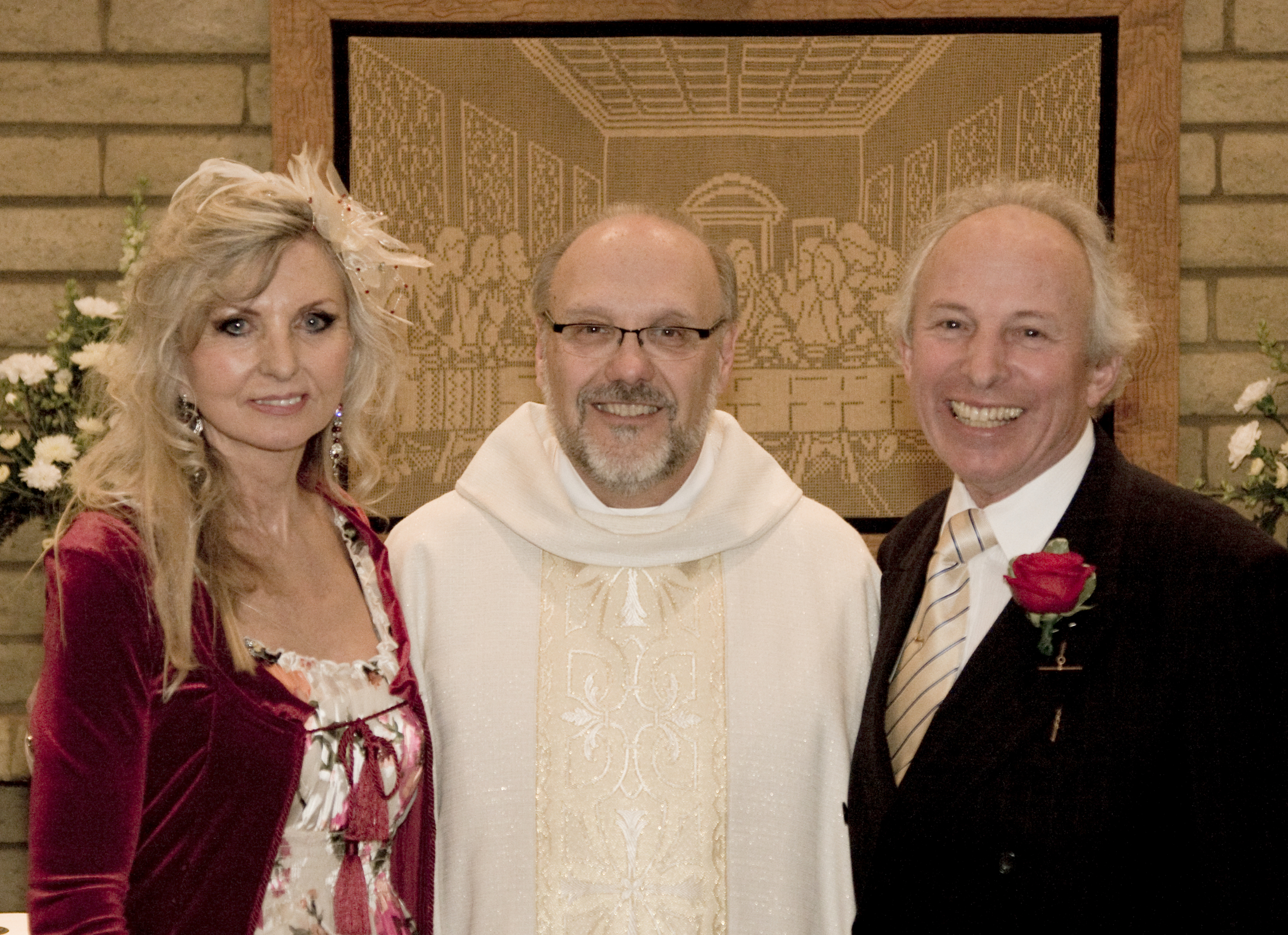
I’m not sure that I should admit that my dearest Jeannie is my 4th wife! Long story that goes back to when I had just turned 12 years-old, back in 1956. I suffered an event that I interpreted as emotional rejection and promptly buried that deep into my subconscious where it stayed for over 50 years.
Then brought to the surface in 2007 (thanks Jon) after the failure of marriage number 3. I met Jean some 6 months later, in December 2007, and we were married in Payson, AZ in November, 2010. Being with Jean has been the happiest days of my life!
Jean, Father Dan and yours truly. St Paul’s Episcopal Church, Payson, AZ. November 20th, 2010.
Inevitably, while being married to Jean seems such a natural relationship, one is curious about what makes for a happy, lifelong relationship. Let’s face it, divorce is not uncommon. In fact, the Divorce Rate website reveals that in 2012, the divorce rate was 3.4 couples per 1,000 population in the USA; the sixth highest in the world.
So it was fascinating to listen to a recent radio programme broadcast under the BBC’s Point of View series. Just 10 minutes long, this particular programme was a talk by Adam Gopnik: The secret of a happy marriage 29th March 2013. (Adam Gopnik is an American commentator and writes for The New Yorker.)
You should be able to listen to the programme by going here. Or you can download the programme by going here, and following the instructions. (Not sure how long the programme will be available to listen/download, so don’t delay.)
The programme was also featured on the BBC News Magazine Website. From which I quote:
A Point of View: Is there a secret to a happy marriage?
Nobody can explain the secret to a happy marriage, says Adam Gopnik, but it doesn’t stop people trying.
Anyone who tells you their rules for a happy marriage doesn’t have one. There’s a truth universally acknowledged, or one that ought to be anyway.
Just as the people who write books about good sex are never people you would want to sleep with, and the academics who write articles about the disappearance of civility always sound ferociously angry, the people who write about the way to sustain a good marriage are usually on their third.
Nonetheless (you knew there was a nonetheless on its way) although I don’t have rules, I do have an observation after many years of marriage (I’ve promised not to say exactly how many, though the name “Jimmy Carter” might hold a clue).
Later, Adam Gopnik speaks about Charles Darwin whose marriage to Emma he describes “as something close to an ideal marriage.”
So what is it we learn from dogs?
So, marriages are made of lust, laughter and loyalty – but the three have to be kept in constant passage, transitively, back and forth, so that as one subsides for a time, the others rise.
Now Adam writes about the special form of loyalty that dogs offer us:
Be lit by lust, enlightened by laughter, settle into loyalty, and if loyalty seems too mired, return to lust by way of laughter.
I have had this formula worked out – and repeated it, waggishly, to friends, producing for some reason an ever more one-sided smile on the face of my beautiful wife.
Until, not long ago, I realised that there was a flaw in this idea. And that was that I had underestimated the reason that loyalty had such magnetic power, drawing all else towards it.
For I had been describing loyalty in marriage as though it were a neutral passive state – a kind of rest state, a final, fixed state at the end of the road of life.
And then, against our better wishes, and our own inner version of our marriage vows, at our daughter’s insistence we got a dog. And this is what changed my view.
“The expense and anxiety of children” indeed. Our daughter’s small Havanese dog, Butterscotch, has instructed us on many things, but above all on the energy that being loyal really implies.
Dogs teach us many things – but above all they teach us how frisky a state loyalty can be.
Dogs, after all – particularly spayed city dogs that have been denied their lusts – have loyalty as an overriding emotion. Ours will wait for hours for one of its family, and then patiently sit right alongside while there is work to be done.
Loyalty is what a dog provides. The ancient joke-name for a dog, Fido, is in truth the most perfect of all dog names – I am faithful. I am loyal. I remain.
Dogs are there to remind us that loyalty is a jumpy, fizzy emotion. Loyalty leaps up at the door and barks with joy at your return – and then immediately goes to sleep at your side. Simple fidelity is the youngest emotion we possess.




 Learning from Dogs