Maybe less is more is really at the heart of our thirst for something more
A number of disparate recent experiences seem to have an underlying common thread.
See if these strike you in a similar fashion.
Yesterday, Joelle Jordan wrote about joy, about the wonderful relationship that dogs have with the world around them. As Joelle wrote,
Joy is a difficult commodity to come by these days. I don’t mean entertainment, I don’t mean a good laugh, I mean pure joy, where, even just for a single moment, all worries and doubts, frustration and anger are lifted as though by Atlas.
Like so many other humans in our world, I often find myself in a constant state of stress. There always seems to be something to worry about, whether it’s money, job fulfilment, the state of my relationships, getting the house cleaned, finding time to get to the market, and more. If given the chance, I know we all could spend nearly all of our waking hours (and some of our sleeping hours, too) worrying about something. We spend so much time on the many things that inevitably work themselves out, and so little time on things that will create a memory and a crystal moment of joy.
My little dog Charlie spends his time in the completely opposite fashion; spending his waking hours seeking joy, and committing less time to things that worry him.
Charlie seems to exist normally in three states of being; content, happy and utterly joyful.
How many of us can echo Charlie’s existance in our own lives?
Then last Sunday, Father D’s sermon spoke about our tendency to develop habitual behaviours and rarely challenge the point of them.
The truth is that we get used to doing things a certain way and keep doing them without ever thinking of what we are doing. We say things in the liturgy without even thinking of what we are saying. I’m sure many people utter the words in the Book of Common Prayer without thinking of the theology behind the words, or the relationship between church and state that they express.
Later on,
There was a desire for “something more” but it was hard to put a finger on what it was. I realized from these conversations that we are involved today in a time of intense searching. Few of us are satisfied with what the church and society have served up.
The honest among us will readily admit we lead fractured lives – with a disembodied spirituality on one side, and a soulless daily existence on the other. We are desperate for something more, for a faith with the power to transform both ourselves and our world.
“…. we are involved today in a time of intense searching“! That smacked me right in the eye!
These are clearly challenging times with mankind facing increasing odds of an ecological disaster of Old Testament proportions, and much of the western world on the cusp of a long and difficult recession. It is so easy to go on “doing things a certain way and keep doing them without ever thinking of what we are doing” while we wait for the leaders of our societies to fix our problems.
The truth is that we have to be the first to change, to question what we do on a daily basis and amend it if it is not truly healthy for us and for the planet. As was said in that sermon, “It means bringing forth each day the fruits of the Spirit: Love, joy, patience, kindness, generosity, faithfulness, gentleness and self-control.”
Go back and read yesterday’s Post and reflect on how many of those ‘fruits’ are the ways of dogs.
My final connection with the theme of today’s essay is with a recent series from the BBC called ‘Status Anxiety’. The programmes are still on YouTube and the first 10 minutes is below,
Status Anxiety discusses the desire of people in many modern societies to “climb the social ladder” and the anxieties that result from a focus on how one is perceived by others. De Botton claims that chronic anxiety about status is an inevitable side effect of any democratic, ostensibly egalitarian society. De Botton lays out the causes of and solutions to status anxiety.
Or if you prefer, all 2 hours 23 minutes may be watched on Top Documentary Films, described thus,
De Botton's book
Why doesn’t money (usually) buy happiness? Alain de Botton breaks new ground for most of us, offering reasons for something our grandparents may well have told us, as children.
It is rare, and pleasing, to see a substantial philosophical argument sustained as well as it is in this documentary. De Botton claims that we are more anxious about our own importance and achievements than our grandparents were. This is status anxiety.
Alain quotes philosophical writings, such as Democracy in America, a report by Alexis de Tocqueville on his visit to the USA in 1831. De Tocqueville noted that American equality, notable in those times, was accompanied by a climate of envy.
We jump to present-day USA, and see what, to de Botton, are some awful examples ofThe American Way. A Christian preaches get rich. A steelworker tells of his insecure life in an industry being closed down through others’ love of money.
Our protagonist points out the advantage of high status: those with high status will enjoy the care and attention of the world. Then joins this advantage with the illusion, orattempt at meritocracy in the USA, mentioning Jefferson’s notion of an aristocracy of talent.
Some of the messages towards the end of the programme are very thought-provoking indeed. Let me draw this all together.
If you own a dog, or a cat, or any pet, stop a while today and see how their simplicity of life brings them so much more. Naturally, we can never live life in the same way that our pet does but there are strong metaphors that carry equally strong messages for us. Less is more.
Now watch the last part of Status Anxiety even if you didn’t watch the first segment above, Reason? Watch and it will become clear.
With big thanks to Cynthia S. for sending me the pics.
GET OUT AND ENJOY NATURE
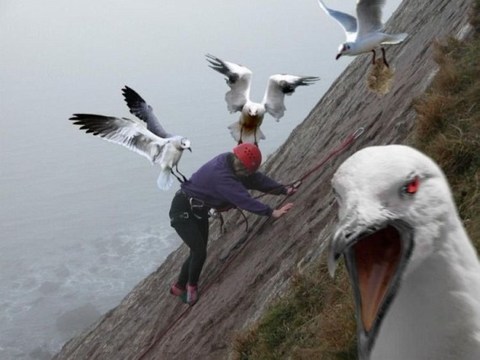
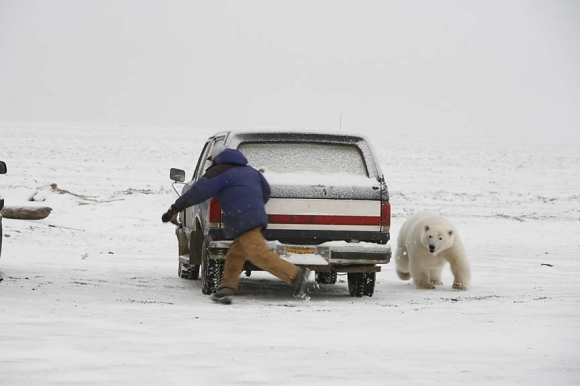
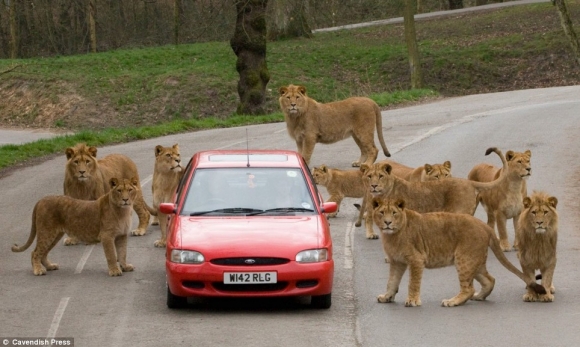
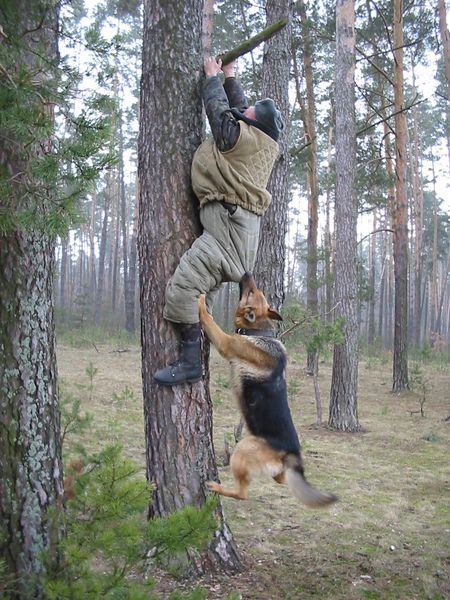
Don’t sit around the house . . . Get out and enjoy nature!
No! I'm not stealing your eggs!So much for offering him a biscuit!Hey! Gimme a fish!Just want our tummies rubbed!Hope you're being nice to my friend!What part of the word 'no' you have trouble with, mister?
Martin Luther King, (January 15, 1929-April 4, 1968)
One of the aspects of modern life that is deeply unsatisfactory is the way that politicians and leaders of democratic societies fudge the truth in the hope that trying to be all things to all men means wider acceptance of their messages.
Think of the quote from Martin Luther King, Jr., “A genuine leader is not a searcher for consensus but a molder of consensus. ”
These words serve as an introduction to some beautiful thoughts from a loyal American living here in Payson. This is a man who is deeply spiritual, who has fought for his country, and who is soft and gentle to the core. This is a man who is not afraid to offer a personal vision to the world. I regard it as a real bonus that Jean and I have his friendship.
Here is the first of two contributions from John H.
The Passion of Enlightenment
Enlightenment includes deep grief and a passion to leave life a bit better than we found it. Enlightenment has little practical value in a growing and constantly consuming cultural demographic. Consumers tend to spiritually disconnect when faced by a need for change or when morality becomes inconvenient.
Is God truth? What is the opposite of truth? We’ve lost our way as a species. Does God tell us to worship money? Does God tell us to ignore our finite earth? Does God tell us to kill each other? Does God tell us to ignore human history and the emerging network of scientific understandings?
Human wisdom has been far greater in the past than it is today. God is not known through empirical knowledge. Man is as limited as the finite planet which gave life to our species and sustains our existence. Matter and energy are interchangeable as fundamental forces. God is experienced through our inner being and understood through the wisdom tradition of our species.
Sustainability includes the well-being of our planet and the life it supports. Sustainability includes serving as caretakers rather than acting as owners. Sustainability includes surrendering our addictions, our illusions and our delusions. Surrendering includes the courage to speak the truth and walk as we talk. Surrendering assures our common well-being as a conscious component of God. We have nothing to fear.
Consider world leadership. Who are the aggressors? Who are the oppressed? Who serves God? Who serves Mammon? We each must search our heart, mind and soul to answer these questions honestly. We need to face our shame and guilt in order to redeem ourselves and make a sustained effort to change.
The roots of wisdom in a constantly changing world are God, nature, history, and science. We’ve come a long way since we first learned to use tools. What have we forgotten in the process? We can’t wait for the truth to become popular. We each need to help make the truth popular.
Reflections on these present times, concluding part.
I closed yesterday with, So maybe there’s a blindness with humans, and then set out the characteristics of that blindness. One of those characteristics being,
Our obsession with how things are now prevents us from reflecting on those signs that indicate changes are under way, even when the likely conclusions are unmistakeable. The ecological and climatic changes being the most obvious example of this strange blindness that mankind possesses.
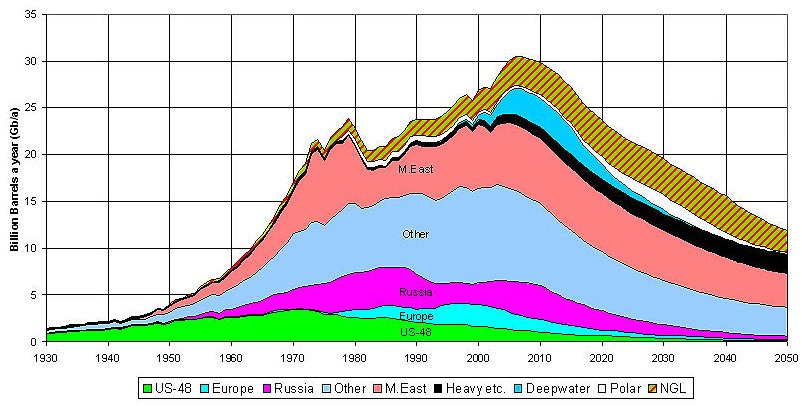
Let’s move this on a little. The arguments from a wide range of scientists are overwhelmingly in favour of the proposition that mankind is using vastly more resources from the planet than the planet can provide. Take oil. This graph show past and projected oil production for the whole Earth out to 2050, less than 40 years away.
Here’s an extract from that website which I encourage you to read in full,
The part before 2007 is historical fact. The part that comes afterward is an ASPO extrapolation.
This graph is worth careful attention as a lot of world history is written into it. Note the steep rise in oil production after World War II. Note that 1971 was the peak in oil production in the United States lower 48. There is a sliver of white labled Arctic oil. That is mostly Alaskan Prudhoe Bay oil, which peaked in 1990. Prudhoe Bay was almost big enough to counteract the lower 48 peak of 1971. The sliver is very narrow now. The OPEC oil embargo of 1973 is very visible. The oil produced by non-OPEC countries stayed nearly constant while OPEC production nearly halved. The embargo caused the world economy to slow. But the high cost of energy spurred the development of energy efficient automobiles and refrigerators and a lot of other things. Note the effect of the collapse of the Russian economy in 1990 on Russian oil production. Note the rapid increase in oil production when the world economy boomed near the end of the twentieth century. Oil was $12 a barrel at that time. Note that European (North Sea) oil peaked in 2000. Note especially what would have happened if the 1973 embargo had not occurred. It is possible that the world would now be on the steep part of the right side of the Hubbert curve.
Take population growth. Here’s a graph that shows that going through seven billion, which is due shortly, is likely to be way short of the eventual peak. Likely peak might be in the range of eight to ten billion! Just take a look at that graph,
Take global warming. Here’s a graph from NASA, from which I quote,
The five warmest years since the late 1880s, according to NASA scientists, are in descending order 2005, 1998, 2002, 2003 and 2006. (reported in the year 2007!)
No apologies for bashing you around the head with these graphs and figures – most people have a good sense about these aspects of our life on this planet. But, in a very real sense, that’s the point.
The point that despite powerful and obvious evidence, mankind has great difficulty accepting obvious trends and understanding that whatever ‘today’ feels like, ‘tomorrow’ is almost certainly not going to be more of the same.
At the risk of hammering this point to death, here are two pictures and some text to show how quickly ‘today’ changes and becomes ‘tomorrow’.
Scientist left speechless as vast glacier turns to water
THESE images show the astonishing rate of break-up of an enormous glacier in north Greenland – from ice to water in just two years.
The before and after photographs, which left a Welsh scientist who led the 24-month project “speechless”, reveal the worrying effects of climate change in an area previously thought too cold to be much affected.
The Petermann glacier pictured August, 5th, 2009Petermann glacier, pictured from same position, July 24th, 2011
Dr Alun Hubbard, a reader at Aberystwyth University’s Centre for Glaciology, returned from the Petermann Glacier in north-west Greenland a month ago, but did not see the stark images documenting the changes until this week.
He said: “Although I knew what to expect in terms of ice loss from satellite imagery, I was still completely unprepared for the gob-smacking scale of the break-up, which rendered me speechless. It was just incredible to see. This glacier is huge, 20km across, 1,000m high.”
“It’s like looking into the Grand Canyon full of ice and coming back two years later to find it’s full of water.”
“It’s quite hard to get your head around the scale of the change. To be able to see that, everything changed in such a short period of time, I was speechless.”
Do read the full article on the Wales Online website here.
Stay with me a little longer, if you will.
Yves Smith in her wonderfully broad and addictive Blog, Naked Capitalism, had the first part of a powerful interview with Satyajit Das published on the 7th. Here are a couple of extracts,
It’s amazing how much money you can make just shuffling paper backwards and forwards. Malcolm Gladwell wrote a piece praising John Paulson who made a killing from the subprime disaster as an entrepreneur. But what did he make? What did he leave behind? Paul Volcker, the former chairman of the Federal Reserve, argued: “I wish someone would give me one shred of neutral evidence that financial innovation has led to economic growth — one shred of evidence. US financial services increased its share of value added from 2% to 6.5% but is that a reflection of your financial innovation, or just a reflection of what you’re paid?”
Just let that quote from Paul Volcker stay with you for a while. Satyajit goes on to say,
Management and directors of financial institutions cannot really understand what is going on – it’s simply not practical. They cannot be across all the products. For example, Robert Rubin, the former head of Goldman Sachs and Treasury Secretary under President Clinton, encouraged increased risk taking at CitiGroup. He was guided by a consultant’s report and famously stated that risk was the only underpriced asset. He encouraged investment in AAA securities assuming that they were ‘money good’. He seemed not to be aware of the liquidity puts that Citi had written which meant that toxic off-balance sheet assets would come back to the mother ship in the case of a crisis. Now, if he didn’t understand, others would find it near impossible. And I’m talking about executive management.
Non executives are even further removed. Upon joining the Salomon Brothers Board, Henry Kaufman, the original Dr. Doom found that most non-executive directors had little experience or understanding of banking. They relied on board reports that were, “neither comprehensive … nor detailed enough … about the diversity and complexity of our operations.” Non-executive directors were reliant “on the veracity and competency of senior managers, who in turn … are beholden to the veracity of middle managers, who are themselves motivated to take risks through a variety of profit compensation formulas.”
Kaufman later joined the board of Lehman Brothers. Nine out of ten members of the Lehman board were retired, four were 75 years or more in age, only two had banking experience, but in a different era. The octogenarian Kaufman sat on the Lehman Risk Committee with a Broadway producer, a former Navy admiral, a former CEO of a Spanish-language TV station and the former chairman of IBM. The Committee only had two meetings in 2006 and 2007. AIG’s board included several heavyweight diplomats and admirals; even though Richard Breeden, former head of the SEC told a reporter, “AIG, as far as I know, didn’t own any aircraft carriers and didn’t have a seat in the United Nations.”
In other words, there is no shortage of information from all corners of the world to show, with very little doubt, that the last few decades have seen unprecedented mistakes by national governments, mistakes in corporate governance, a lack of understanding of economic fundamentals, poor financial and social management, and on and on and on.
But practically all of us, and I mean all of us, didn’t see it at the time, didn’t see where it was heading and only now, when it is full in our faces, do we get it and see it for what it has really been, a long period of over two decades where the ‘me‘ has been more important than the ‘us‘.
That me versus us even being promoted, if that’s the right word, by a British Prime Minister twenty-five years ago. That quote from Margaret Thatcher back in 1987, “And, you know, there is no such thing as society. There are individual men and women, and there are families.” (Margaret Thatcher, talking to Women’s Own magazine, October 31 1987)
Let me draw this all together, yesterday’s part and this concluding part.
There is significant evidence, real hard evidence, that the patterns of mankind’s behaviours of the last few decades cannot continue. Simply because mankind will go over the edge of self-extinction. Darwin’s evidence and all that! We have to accept that humans will see the bleedin’ obvious before it is too late. We have to keep the faith that our species homo sapiens is capable of huge and rapid change when that tipping point is reached, so eloquently written by Paul Gilding in his book, The Great Disruption, reviewed by me here. We have to embrace the fact that just because the world and his wife appears to be living in total denial, the seedlings of change, powerful change, are already sprouting, everywhere, all over the world.
So let’s welcome those changes. Let’s nurture those seedlings, encourage them to grow and engulf our society with a new richness, a new fertile landscape.
Let’s embrace the power of now, the beauty of making today much better and letting go of tomorrow.
For today, I am in charge of my life,
Today, I choose my thoughts,
Today, I choose my attitudes,
Today, I choose my actions and behaviours.
With these, I create my life and my destiny.
It’s very difficult to make predictions, especially when they involve the future!
A President with more speech writers than one could imagine.
Got a vested interest or a strong view? Then draft a speech for the President of the United States of America. Many do. Some are clearly very tongue-in-cheek, some are pertinent. The following from CASSE fits into the latter category. Enjoy.
President Obama’s (Hoped for) “Amaze Speech”
Speechwriter: Brian Czech
President Obama’s hoped-for speech first appeared in the Daly News on August 7. We reprint it this week in anticipation of the President’s September 8th speech.
Pres. Obama
Fellow Americans, this evening I have a special message for you. It’s an unprecedented and surprising message, but ultimately it will resonate with your common sense, good will, and patriotic spirit. It turns out that the recessionary cloud we’re under does have an extremely valuable silver lining. I know; it sounds like something only a politician would say, but wait. I think you’ll be surprised to hear my explanation.
Now before I elaborate on the silver lining, I want to make it clear that the cloud has some rain, too. As a nation, we are struggling with debt, credit ratings, and worst of all, the painful experience of unemployment. The last thing I want is to mislead you into thinking these are problems I take lightly, or problems that will be automatically solved by the markets or policy makers. These problems were many years in the making — decades in fact — and it’s going to take years of diligence and readjustment to solve them.
Yet none of these problems can deny us the silver lining, which is this: the economic turmoil we experience today will change the course of history in such a way as to secure the future for American posterity, starting with our children and grandchildren. Let me reiterate, our own kids and grandkids — the most precious American treasure — will have a secure future as a result of the problems we face today. Here’s why…
Far from the trading floors of Wall Street and the policy meetings of the Federal Reserve, crucial discoveries have been made by scientists, economists, anthropologists, historians, and others collaborating under a broad umbrella called “sustainability science.” No, they haven’t discovered an unlimited energy source, a pollution-free car, or a method to stabilize our climate at optimum conditions. They’ve discovered something far more important and exciting: the key to permanent economic security.
For the past few years, as time has allowed, I and my economic advisors, with the assistance of numerous scholars, have studied this key to economic security. The theory and evidence for it is absolutely irrefutable. The only reason this key to security hasn’t broken into public dialog is because it serves no short-term vested interests; no wealthy corporations, think tanks, or political parties that would stand to profit before the next shareholders meeting or election cycle. But that’s also the beauty of it: the key to security is a non-partisan, scientifically sound approach to the long-run interests of all, especially our kids and grandkids. Fortunately for us, it’s surprisingly simple as well.
What is this key to a secure future? We could coin a new phrase to get credit for the idea or to improve its political flavor, but I believe the clearest term is what the scientists already call it: the “steady state economy.” Political advisors think it’s a bit on the dry side, but after what we’ve been through – stock market crashes, insurance crises, banker bailouts, panic over the debt ceiling, having our credit downgraded — doesn’t a “steady state economy” sound like just what the doctor ordered?
In the coming weeks and months, I and my Cabinet will be helping to introduce fellow Americans to the basics of steady state economics, especially what it means for producers, consumers, and public policy. We’ll do this through a series of public announcements, publications, and townhall meetings. Meanwhile, this evening, I’ll provide a brief summary, first by noting what a steady state economy is not.
A steady state economy is not communism, Marxism, or anything at odds with the Constitution of the United States. A steady state economy is not a stagnant, flat-lined economy but is rather continuously dynamic and creative. A steady state economy is not established overnight with draconian policies; instead it evolves as a matter of consumer preference and prudent policy. Most importantly, a steady state economy is in no way opposed to jobs and full employment. To the contrary, a steady state economy is the only economy that can ensure full employment, for your kids and theirs.
The most fundamental feature of the steady state economy is stability. The idea is to stabilize good conditions; stable agriculture, stable manufacturing, stable services, stable production and consumption, stable currency, stable markets, stable international trade, stable impact on the environment, stable air and water, stable climate… You get the picture, and remember, all this stability is at a good level — a level that ensures life, liberty and happiness for us and future generations. At this point in history, the steady state economy is the right goal, and the first step in getting there is recognizing it.
Perhaps you find this amazing. I think you should be amazed. After all, I haven’t said a word about economic growth; in fact I’ve called growth into question. The closest thing to this in presidential history is when President Carter encouraged Americans to consume a little less after the OPEC oil embargo. But President Carter was before his time, and his speech was maligned as the “malaise speech.”
Well, at this point in history, we can no longer afford — literally or figuratively — to pull out all the stops for economic growth. Therefore, tonight you’re hearing the “amaze speech,” the speech that introduces our nation to steady state economics, the alternative to growth.
I understand the adjustment in thinking that this will entail. I’ve gone through it myself. With the exception of President Carter in 1979, my predecessors for over 50 years have prioritized economic growth in their speeches, campaigns, and policies. None even mentioned steady state economics in a speech. Yet with every new president, the pursuit of economic growth has become less realistic, less sustainable, and even less desirable.
Earlier I mentioned the profound developments in sustainability science. Among the sustainability scholars are behavioral scientists and psychologists who have found compelling evidence that economic growth stopped contributing to a happier United States somewhere from the 1950′s to the 1970′s. After that, our gross domestic product continued to rise, but our happiness did not. If you’re like me — meaning old enough to remember — this probably resonates with you. Somewhere along the line the brighter lights, bigger houses and fancier cars stopped making us better off. In fact, all the new “stuff” started working against us. Now we struggle to find enough oil, water, “green space,” solitude, free time, and the peace of mind that comes with a stable climate. It’s all the sign of an economy grown too big.
They say the definition of insanity is doing the same thing over and over again and expecting a different result. I think we’ve all done some crazy things in life, but I don’t want to go down in history as the insane president who kept trying every trick in the book to “stimulate the economy,” when stimulating the economy was neither bound to work nor even desirable by that point in history. I don’t want to oversee more banker bailouts, more stimulus spending, more loosening of environmental protections in a vain attempt to increase GDP growth. That would be insane. Instead, I’m going to tell it like it is: the pursuit of economic growth has become a dangerous obsession that we must overcome. I say this with the backing of sound science, the lessons I’ve learned, and the concern I have for the future of America.
I’m going to test your common sense now. Do you think there is a limit to economic growth? Remember, economic growth is increasing production and consumption of goods and services. It means more and more people, more and more stuff. It takes more energy, water, space to operate in, and places to put out the trash.
Now as a politician, I can assure you that, in the coming days, well-paid pundits will conjure up magical concepts of perpetual growth based on “dematerializing” the economy. Well when they’re ready to dematerialize it, maybe they can beam us up. Meanwhile, the rest of us in the real economy know what perpetual GDP growth would take: evermore people, evermore stuff. And we know we’re running out of evermore room, resources, and patience for unreal notions of evermore growth.
I know that for some, and perhaps for many, this is hard to swallow. For decades we Americans have been encouraged to believe in the notion of continual economic growth. But look at it this way: to think there is no limit to economic growth on Earth is like thinking we could fit a stabilized economy into a perpetually shrinking area. For example, with computers, robots, nanotechnology and the like, we could squish the $70 trillion global economy into North America, then the United States, then Iowa, then into the foyer of the Des Moines Chamber of Commerce, leaving the rest of the world as a designated wilderness area! It’s a ludicrous notion, and it’s precisely as ludicrous as thinking there’s no limit to economic growth in Des Moines, the United States, or Earth.
Now, let’s consider some of the problems we will face if we continue pulling out all the stops for economic growth. The first is inflation. Typically we use monetary policy — such as increasing the money supply — to stimulate growth. But when the real economy isn’t meant to grow as easily as increasing the money supply, the result is inflation. Nothing could be more harmful to our economy at this point than inflation, which is like a devastating tax on the nation.
Another problem is debt. As you know, my Administration injected a major fiscal stimulus into the economy. It helped somewhat and spun off some jobs, but it did not produce the wave of jobs we’d get in an economy with plenty of room to grow. Meanwhile, it added to our deficit and ultimately our debt. Now our credit is coming into question, as with so many nations in a global economy bumping up against the limits to growth.
Of course, there is no shortage of special interests to pounce on the news of faltering fiscal policy. The answer, they say, is to turn over as much as possible to Wall Street. “Take care of national security,” they say, “and let the markets take care of the economy.” The problem with that approach is that national security is about more than having the biggest military. National security starts with a sustainable economy, which requires a stable environment to support the agricultural, fishing, logging, mining, and ranching activities that have always been and always will be the foundation of the American and global economy. Our manufacturing and service sectors — the best in the world — are the best because we have the biggest and best agricultural and extractive sectors. And we have those because we have protected the environment from overuse, pollution, and displacement.
Consider what will happen if we take an unbalanced approach and prioritize economic growth even more over environmental protection. Does anyone really question whether we will have more environmental problems, including devastating problems? More oil spills in the Gulf of Mexico and Gulf of Alaska, more mountaintop mining in the Appalachians, more scraping for shale oil in the Rockies, more nuclear waste, more endangered species, more greenhouse gas emissions, and all the while less water, less fish and wildlife, less wilderness, less nature, less beauty. Does anyone question whether such trends diminish the quality of life for future generations? No, the problems caused by economic growth are unquestionable. It’s just that, for much of American history, the benefits of increasing GDP outweighed the costs. That’s no longer the case, and I’m confident that most of us can sense it.
In fact, the more I thought about this speech, the more amazed I became. Why did it take us so long, in America, to have an open discussion of limits to growth and alternatives to growth? The principles are irrefutable. Neither growth nor recession is sustainable in the long run; a steady state economy is the obvious policy for long-run security. Yet based on the politics of the past 50 years, you’d think economic growth had supplanted apple pie as the companion to motherhood.
Well, now we’re entering a new era of dealing squarely with sustainability. It turns out that economic growth was not a good companion to motherhood, not in the long run. We want apple pie back. We want loving homes for our children, quality time with family and friends, the occasional escape to the great outdoors, and peace. That’s the American dream in a nutshell, and it’s too valuable to sacrifice for economic growth.
So let’s roll up our sleeves and wash our hands of the dirty business of growth at all costs. We know what the right goal is, and malaise won’t get us there. We have work to do to stabilize the economy for our children and grandchildren. Our decisions — what we eat, what we drive, what we build, and frankly how many kids we have — all these will determine the quality of life for the kids that we do have. Meanwhile, those of us privileged to hold public office are responsible for developing the policies to help you thrive in a steady state economy, and for avoiding the policies that force us onto an unsustainable pathway of evermore growth. You could say we are tasked now with “steady statesmanship.”
To conclude, my fellow Americans, do stay tuned. In the coming days and weeks we’ll be discussing the details of transitioning from growth to a steady state. We’ll be talking with you about employment, population growth, stock markets, the banking system, and more. Don’t fear any shocks to the system; you’ve seen most of the shocks already as the policies of economic growth have failed. One by one, we’re going to turn these “failures” into steady state successes.
The powerful anti-democratic forces that will threaten civilisation.
In one sense this post today carries an underlying political message – and in another sense, it does not. It does in the sense that if every American voter truly understood the risks of a continued relationship with oil then the tar-sands projects wouldn’t have a prayer of a chance of being allowed.
In the other sense, it does not. Because the influence and power of ‘behind-the-scenes’ oil and money is beyond imagination and, just possibly, outside the reach of democracy.
So what’s got me so agitated?
Well first is that I have been quietly reading The Transition Handbook by Rob Hopkins, he of Transition Totnes fame. Most readers will be aware that Totnes was the first Transition Town in the world and started what is becoming the greatest social movement of the 21st century.
In Rob’s book, on page 51, there is a diagram showing the relative energy returns from the energy invested to produce that energy – hope that makes sense! Let me explain further. For example, for every unit of energy invested in building tidal-range generators, there are eighty-seven units of energy returned. I.e. this is a great investment for mankind in terms of the net benefit.
If we look at the generation of electricity from solar photo-voltaic (PV) panels then the return is about eight units from every unit invested.
The worst return of them all is from Tar sands: just one unit returned from every unit invested. Investment and humanitarian madness!
Then next I came across this item about Tar sands on The Ecologist magazine website,
Emissions from tar sands seriously underestimated
Governments and companies making no effort to quantify the real climate impacts
Greenhouse gas emissions from tar sands operations are being significantly under-reported according to new research by Global Forest Watch Canada.
The report, ‘Bitumen and Biocarbon‘, says oil companies and governments are not accounting for emissions from deforestation. It says that when boreal forest is destroyed for tar sands development, significant amounts of greenhouse gases are emitted.
‘Governments and companies are working hard to downplay the impacts of tar sands operations, but it turns out that they don’t even know the full extent of the problem,’ said Christy Ferguson, Greenpeace climate and energy coordinator.
‘What’s worse, they’re doing nothing to find out. Denial is not a climate strategy.’
In addition, the report shows that biological carbon stored in living and decaying plants is lost when natural ecosystems are disturbed or destroyed through mining of bitumen and construction of roads, pipelines or facilities.
‘Peatlands are one of the world’s most important storehouses of soil carbon. Industrial activity in the tar sands is destroying peatlands, releasing carbon and eliminating a crucial natural mechanism.
‘Even if peatlands are reclaimed, the carbon released through industrialisation won’t be replaced for thousands of years,’ said Ferguson.
Finally, today (25th) I received in my in-box the latest TomDispatch offering. (I am indebted to Tom Engelhardt for, once again, giving me permission to reproduce in full this TomGram.)
Tom’s latest piece is written by Bill McKibben (with an introduction by Tom) and I strongly urge you to read it – the implications are global. If you read an earlier TomDispatch article by Bill re-published on Learning from Dogs on the 18th July, The Great American Carbon Bomb, today’s piece will surely make you sit up and fume; as it did me! Here it is in full.
Tomgram: Bill McKibben, Jailed Over Big Oil’s Attempt to Wreck the Planet
What might have happened if John McCain had won the presidency in 2008? One thing is certain: there would have been a lot more protest from Democrats, progressives, and the left. Take it as an irony of his election, but Barack Obama has proved remarkably effective in disarming the antiwar movement, even as the use of war in American policy in the Greater Middle East has only grown. That Obama, the supposed anti-warrior of the 2008 campaign, has paid less than no attention to his antiwar critics is no news at all. It’s now practically a cliché as well that he seems to feel no need to feed his political “base” and that, generally speaking (and explain it as you will), his base has not yet pushed back.
This has been particularly true of Obama’s wars, especially the disastrous, never-ending one in Afghanistan. Had Afghanistan been “McCain’s war,” you would surely have seen growing waves of protest, despite the way 9/11 ensured that the Afghan War, unlike the Iraq one, would long be the unassailable “good war.” Still, as American treasure surged into the ill-starred enterprise in Afghanistan, while funds for so much that mattered disappeared at home, I think the streets of Washington would have been filling. What protest there has been, as John Hanrahan of the Nieman Watchdog website reported recently, tends to be remarkably ill-covered in the mainstream media.
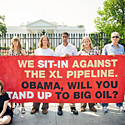
Obama, only two points ahead of Ron Paul in the latest Gallup Poll in the race for 2012, is a beyond-vulnerable candidate. (Somewhere there must be some Democratic pol doing the obvious math and considering a challenge, mustn’t there?) Fortunately, in another area at least as crucial as our wars, demonstrators against a Big Oil tar-sands pipeline from Canada that will help despoil the planet are now out in front of the White House — you can follow them here — and they haven’t been shy about aiming their nonviolent protests directly at Obama. Will he or won’t he act like the climate-change president that, on coming into office, he swore he would be? Time will tell. Meanwhile, let Bill McKibben, TomDispatch regular, an organizer of the protests, and just out of a jail cell, fill you in. Tom
Arrested at the White House
Acting as a Living Tribute to Martin Luther King
By Bill McKibben
I didn’t think it was possible, but my admiration for Martin Luther King, Jr., grew even stronger these past days.
As I headed to jail as part of the first wave of what is turning into the biggest civil disobedience action in the environmental movement for many years, I had the vague idea that I would write something. Not an epic like King’s “Letter from a Birmingham Jail,” but at least, you know, a blog post. Or a tweet.
Heros
But frankly, I wasn’t up to it. The police, surprised by how many people turned out on the first day of two weeks of protests at the White House, decided to teach us a lesson. As they told our legal team, they wanted to deter anyone else from coming — and so with our first crew they were… kind of harsh.
We spent three days in D.C.’s Central Cell Block, which is exactly as much fun as it sounds like it might be. You lie on a metal rack with no mattress or bedding and sweat in the high heat; the din is incessant; there’s one baloney sandwich with a cup of water every 12 hours.
I didn’t have a pencil — they wouldn’t even let me keep my wedding ring — but more important, I didn’t have the peace of mind to write something. It’s only now, out 12 hours and with a good night’s sleep under my belt, that I’m able to think straight. And so, as I said, I’ll go to this weekend’s big celebrations for the openingof the Martin Luther King Jr. National Memorial on the Washington Mall with even more respect for his calm power.
Preacher, speaker, writer under fire, but also tactician. He really understood the power of nonviolence, a power we’ve experienced in the last few days. When the police cracked down on us, the publicity it produced cemented two of the main purposes of our protest:
Eaarth
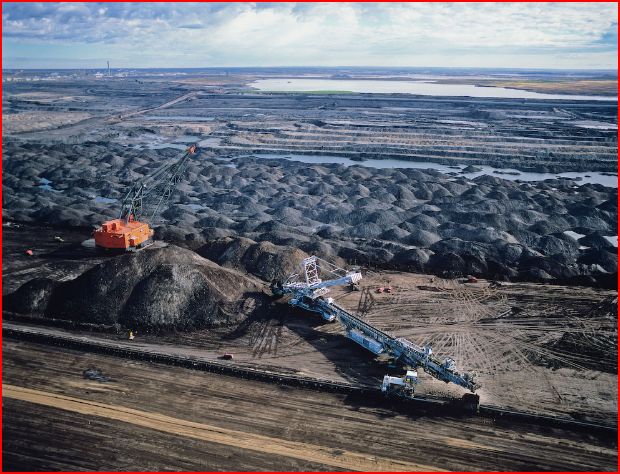
First, it made Keystone XL — the new, 1,700-mile-long pipeline we’re trying to block that will vastly increase the flow of “dirty” tar sands oil from Alberta, Canada, to the Gulf of Mexico — into a national issue. A few months ago, it was mainly people along the route of the prospective pipeline who were organizing against it. (And with good reason: tar sands mining has already wrecked huge swaths of native land in Alberta, and endangers farms, wild areas, and aquifers all along its prospective route.)
Now, however, people are coming to understand — as we hoped our demonstrations would highlight — that it poses a danger to the whole planet as well. After all, it’s the Earth’s second largest pool of carbon, and hence the second-largest potential source of global warming gases after the oil fields of Saudi Arabia. We’ve already plumbed those Saudi deserts. Now the question is: Will we do the same to the boreal forests of Canada. As NASA climatologist James Hansen has made all too clear, if we do so it’s “essentially game over for the climate.” That message is getting through. Witness the incredibly strong New York Times editorial opposing the building of the pipeline that I was handed on our release from jail.
Second, being arrested in front of the White House helped make it clearer that President Obama should be the focus of anti-pipeline activism. For once Congress isn’t in the picture. The situation couldn’t be simpler: the president, and the president alone, has the power either to sign the permit that would take the pipeline through the Midwest and down to Texas (with the usual set of disastrous oil spills to come) or block it.
Barack Obama has the power to stop it and no one in Congress or elsewhere can prevent him from doing so. That means — and again, it couldn’t be simpler — that the Keystone XL decision is the biggest environmental test for him between now and the next election. If he decides to stand up to the power of big oil, it will send a jolt through his political base, reminding the presently discouraged exactly why they were so enthused in 2008.
That’s why many of us were wearing our old campaign buttons when we went into the paddy wagon. We’d like to remember — and like the White House to remember, too — just why we knocked on all those doors.
But as Dr. King might have predicted, the message went deeper. As people gather in Washington for this weekend’s dedication of his monument, most will be talking about him as a great orator, a great moral leader. And of course he was that, but it’s easily forgotten what a great strategist he was as well, because he understood just how powerful a weapon nonviolence can be.
The police, who trust the logic of force, never quite seem to get this. When they arrested our group of 70 or so on the first day of our demonstrations, they decided to teach us a lesson by keeping us locked up extra long — strong treatment for a group of people peacefully standing on a sidewalk.
No surprise, it didn’t work. The next day an even bigger crowd showed up — and now, there are throngs of people who have signed up to be arrested every day until the protests end on September 3rd. Not only that, a judge threw out the charges against our first group, and so the police have backed off. For the moment, anyway, they’re not actually sending more protesters to jail, just booking and fining them.
And so the busload of ranchers coming from Nebraska, and the bio-fueled RV with the giant logo heading in from East Texas, and the flight of grandmothers arriving from Montana, and the tribal chiefs, and union leaders, and everyone else will keep pouring into D.C. We’ll all, I imagine, stop and pay tribute to Dr. King before or after we get arrested; it’s his lead, after all, that we’re following.
Our part in the weekend’s celebration is to act as a kind of living tribute. While people are up on the mall at the monument, we’ll be in the front of the White House, wearing handcuffs, making clear that civil disobedience is not just history in America.
We may not be facing the same dangers Dr. King did, but we’re getting some small sense of the kind of courage he and the rest of the civil rights movement had to display in their day — the courage to put your body where your beliefs are. It feels good.
So perhaps you understand why every American reading this should make sure your voice is heard. And in the last few minutes – 1.30pm MT 25th August – Reuters have just put out this news release,
Nation’s Leading Environmental NGOs Unified Against Tar Sands Pipeline
Update on Day 5 of Tar Sand Pipeline Protest at the White House
See past update and background.
275 people have been arrested so far and many have been released. Today, the largest environmental groups in the US joined to send a letter to President Obama voicing their unified opposition to the Keystone pipeline and asking him to block it.
Why is this important? “For those of us out there in front of the White House, the best thing about this ringing statement is that the administration won’t be able to play one group off against another by making small concessions here and there”; says protest organizer Bill McKibben.
“There’s only one way to demonstrate to the environmental base the rhetoric of Obama’s 2008 campaign is still meaningful – and that’s to veto this pipeline. Since he can do it without even consulting Congress, this is one case where we’ll be able to see exactly how willing he is to match the rhetoric of his 2008 campaign.”
The letter says:
Dear President Obama,
Many of the organizations we head do not engage in civil disobedience; some do. Regardless, speaking as individuals, we want to let you know that there is not an inch of daylight between our policy position on the Keystone Pipeline and those of the very civil protesters being arrested daily outside the White House.
This is a terrible project – many of the country’s leading climate scientists have explained why in their letter last month to you. It risks many of our national treasures to leaks and spills. And it reduces incentives to make the transition to job-creating clean fuels.
You have a clear shot to deny the permit, without any interference from Congress. It’s perhaps the biggest climate test you face between now and the election.
If you block it, you will trigger a surge of enthusiasm from the green base that supported you so strongly in the last election. We expect nothing less.
Sincerely,
Fred Krupp, Environmental Defense Fund
Michael Brune, Sierra Club
Frances Beinecke, Natural Resources Defense Council
Phil Radford, Greenpeace
Larry Schweiger, National Wildlife Federation Erich Pica, Friends of the Earth
Rebecca Tarbotton, Rainforest Action Network
May Boeve, 350.org
Gene Karpinski, League of Conservation Voters
Margie Alt, Environment America
New York Times Also Opposes Pipeline
In an August 21 editorial, the NY Times took a opposition against the pipeline, citing two main concerns: the risk of oil spills along the pipeline, which would traverse highly sensitive terrain, and the fact that the extraction of petroleum from tar sands creates far more greenhouse emissions than conventional production does.
Building the pipeline would clear the way for Canada to double tar sands production over the next decade to more than 1.8 million barrels a day. To do that, some 740,000 acres of boreal forest – a natural carbon reservoir – would be destroyed.
In addition to the emissions produced by tar sands extraction, would be emissions from the loss of this vast, crucial carbon sink, [editor’s note: not to mention the biodiversity it harbors.] Read the editorial:
Website: here with permission from Sustainable Business
[Note: Part Two of The Trap is available to watch in my post of the 7th where one can also link back to Part One. Ed.]
This is another brilliant Adam Curtis documentary originally produced for the BBC. It talks about the modern political realities, where the policies came from and the massive failures of those ideals and how they have ended up exactly where they did not want to be. What is discussed in this episode is the alternative idea to freedom that currently exists and traps the western societies in which we live.
Part One of The Trap is available to watch in my Post of the 4th, US Independence Day. It also provides some background thoughts. It really is a most powerful set of programmes so, if you haven’t already done so, best to watch Part One first.
This is Part 2 of the brilliant Adam Curtis documentary originally produced for the BBC. It talks about the modern political realities, where the policies came from and the massive failures of those ideals and how they have ended up exactly where they did not want to be. This episode focuses on the 1990’s and how the politicians decided to apply the model of a free market economy to the rest of society and consequences of these actions being felt all over the world in western democracies.
Forgive me for making this a much shorter contribution but the efforts of the previous two posts took rather a long time!
This is about the debt situation in the United States of America and, as always, Learning from Dogs trying to get to the underlying truth.
It’s from the BBC and it’s a radio programme that is included in this Post.
But why the headline referring to Churchill? Well in the programme Justin Webb, of the BBC, reminds the world of a characteristic of the American Nation noted by Sir Winston Churchill, “Americans can always be counted on to do the right thing…after they have exhausted all other possibilities.” (But caution about the precise wording of that quote – see here!)
Here’s the article that accompanied the BBC broadcast, the radio programme is after this article,
Is the US in denial over its $14tn debt?
Is America in denial about the extent of its financial problems, and therefore incapable of dealing with the gravest crisis the country has ever faced?
This is a story of debt, delusion and – potentially – disaster. For America and, if you happen to think that American influence is broadly a good thing, for the world.
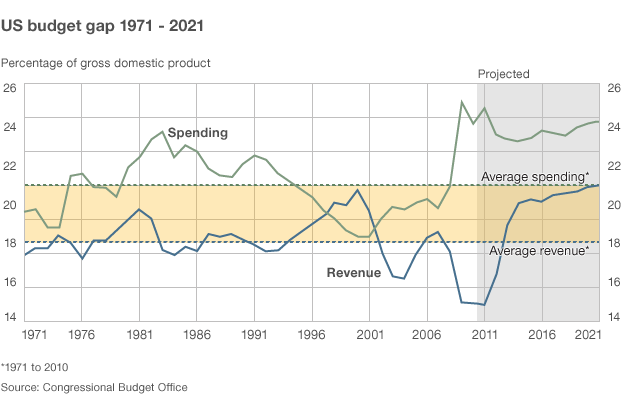
The debt and the delusion are both all-American: $14 trillion (£8.75tn) of debt has been amassed and there is no cogent plan to reduce it.
The figure is impossible to comprehend: easier to focus on the fact that it grows at $40,000 (£25,000) a second. Getting out of Afghanistan will help but actually only at the margins. The problem is much bigger than any one area of expenditure.
The economist Jeffrey Sachs, director of Columbia University’s Earth Institute, is no rabid fiscal conservative but on the debt he is a hawk: “I’m worried. The debt is large. It should be brought under control. The longer we wait, the longer we suffer this kind of paralysis; the more America boxes itself into a corner and the more America’s constructive leadership in the world diminishes.”
The author and economist Diane Coyle agrees. And she makes the rather alarming point that the acknowledged deficit is not the whole story.
The current $14tn debt is bad enough, she argues, but the future commitments to the baby boomers, commitments for health care and for pensions, suggest that the debt burden is part of the fabric of society:
“You have promises implicit in the structure of welfare states and aging populations that mean there is an unacknowledged debt that will have to be paid for by future taxpayers, and that could double the published figures.”
Richard Haass of the Council on Foreign Relations acknowledges that this structural commitment to future debt is not unique to the United States. All advanced democracies have more or less the same problem, he says, “but in the case of the States the figures are absolutely enormous”.
Mr Haass, a former senior US diplomat, is leading an academic push for America’s debt to be taken seriously by Americans and noticed as well by the rest of the world.
He uses the analogy of Suez and the pressure that was put on the UK by the US to withdraw from that adventure. The pressure was not, of course, military. It was economic.
Britain needed US economic help. In the future, if China chooses to flex its muscles abroad, it may not be Chinese admirals who pose the real threat, Mr Haass tells us. “Chinese bankers could do the job.”
Because of course Chinese bankers, if they withdrew their support for the US economy and their willingness to finance America’s spending, could have an almost overnight impact on every American life, forcing interest rates to sky high levels and torpedoing the world’s largest economy.
Not everyone accepts the debt-as-disaster thesis.
David Frum is a Republican intellectual and a former speech writer to President George W Bush.
He told me the problem, and the solution, were actually rather simple: “If I tell you you have a disease that will absolutely prostrate you and it could be prevented by taking a couple of aspirin and going for a walk, well I guess the situation isn’t apocalyptic is it?
“The things that America has to do to put its fiscal house in order are not anywhere near as extreme as what Europe has to do. The debt is not a financial problem, it is a political problem.”
Mr Frum believes that a future agreement to cut spending – he thinks America spends much too big a proportion of its GDP on health – and raise taxes, could very quickly bring the debt problem down to the level of quotidian normality.
‘Organised hypocrisy’
I am not so sure. What is the root cause of America’s failure to get to grips with its debt? It can be argued that the problem is not really economic or even political; it is a cultural inability to face up to hard choices, even to acknowledge that the choices are there.
I should make it clear that my reporting of the United States, in the years I was based there for the BBC, was governed by a sense that too much foreign media coverage of America is negative and jaundiced.
The nation is staggeringly successful and gloriously attractive. But it is also deeply dysfunctional in some respects.
Take Alaska. The author and serious student of America, Anne Applebaum makes the point that, as she puts it, “Alaska is a myth!”
People who live in Alaska – and people who aspire to live in Alaska – imagine it is the last frontier, she says, “the place where rugged individuals go out and dig for oil and shoot caribou, and make money the way people did 100 years ago”.
But in reality, Alaska is the most heavily subsidised state in the union. There is more social spending in Alaska than anywhere else.
To make it a place where decent lives can be lived, there is a huge transfer of money to Alaska from the US federal government which means of course from taxpayers in New York and Los Angeles and other places where less rugged folk live. Alaska is an organised hypocrisy.
Too many Americans behave like the Alaskans: they think of themselves as rugged individualists in no need of state help, but they take the money anyway in health care and pensions and all the other areas of American life where the federal government spends its cash.
The Tea Party movement talks of cuts in spending but when it comes to it, Americans always seem to be talking about cuts in spending that affect someone else, not them – and taxes that are levied on others too.
And nobody talks about raising taxes. Jeffrey Sachs has a theory about why this is.
America’s two main political parties are so desperate to raise money for the nation’s constant elections – remember the House of Representatives is elected every two years – that they can do nothing that upsets wealthy people and wealthy companies.
So they cannot touch taxes.
In all honesty, I am torn about the conclusions to be drawn. I find it difficult to believe that a nation historically so nimble and clever and open could succumb to disaster in this way.
But America, as well as being a place of hard work and ingenuity, is also no stranger to eating competitions in which gluttony is celebrated, and wilful ignorance, for instance regarding (as many Americans do) evolution as controversial.
The debt crisis is a fascinating crisis because it is about so much more than money. It is a test of a culture.
It is about waking up, as the Americans say, and smelling the coffee. And – I am thinking Texas here – saddling up too, and riding out with purpose.
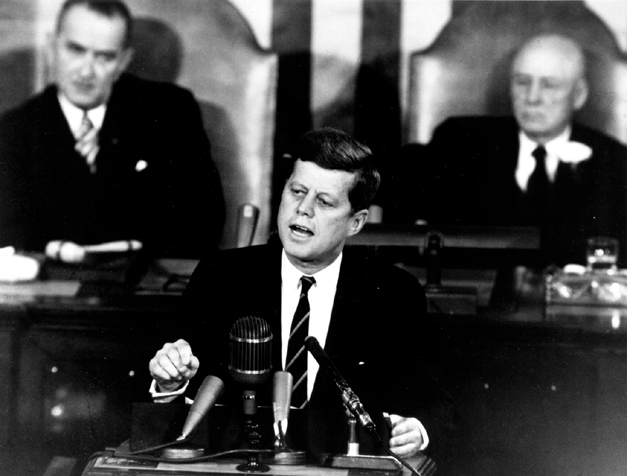
President John F. Kennedy's May 25, 1961 Speech before a Joint Session of Congress
On the 25th May, 1961, President John Kennedy summoned a joint session of Congress and asked America to commit itself to a goal – that of landing a man on the moon and returning him safely to Earth before the decade was out.
There’s a good link on the NASA site to the speech.
MY print column this week notes that it is half a century next week since John Kennedy called for sending a man to the moon and returning him safely to Earth. The bottom line, I think:
If we can send a man to the moon, people ask, why can’t we [fill in the blank]? Lyndon Johnson tried to build a “great society”, but America is better at aeronautical engineering than social engineering. Mr Obama, pointing to competition from China, invokes a new “Sputnik moment” to justify bigger public investment in technology and infrastructure. It should not be a surprise that his appeals have gone unheeded. Putting a man on the moon was a brilliant achievement. But in some ways it was peculiarly un-American—almost, you might say, an aberration born out of the unique circumstances of the cold war. It is a reason to look back with pride, but not a pointer to the future.







 Learning from Dogs