Nothing at all to do with dogs, or with integrity if it comes to that!
Regular followers of this place know that I am a tremendous fan of George Monbiot, the Englishman who so regularly exposes stuff that needs to be aired and discussed. As his About page explains:
Here are some of the things I love: my family and friends, salt marshes, arguments, chalk streams, Russian literature, kayaking among dolphins, diversity of all kinds, rockpools, heritage apples, woods, fishing, swimming in the sea, gazpacho, ponds and ditches, growing vegetables, insects, pruning, forgotten corners, fossils, goldfinches, etymology, Bill Hicks, ruins, Shakespeare, landscape history, palaeoecology, Gavin and Stacey and Father Ted.
Here are some of the things I try to fight: undemocratic power, corruption, deception of the public, environmental destruction, injustice, inequality and the misallocation of resources, waste, denial, the libertarianism which grants freedom to the powerful at the expense of the powerless, undisclosed interests, complacency.
Here is what I fear: other people’s cowardice.
I still see my life as a slightly unhinged adventure whose perpetuation is something of a mystery. I have no idea where it will take me, and no ambitions other than to keep doing what I do. So far it’s been gripping.
Way back in the early days of Learning from Dogs, the blog that is, not the book, George was very gracious in giving me blanket permission to republish his posts, and many of them have appeared in this place.
So now read George Monbiot’s latest Rigging the Market. It is yet another example of what is going wrong in these times.
ooOOoo
Rigging the Market
3rd February 2016
Oil, the industry that threatens us with destruction, is being bailed out with public money
By George Monbiot, published in the Guardian 3rd February 2016
Those of us who predicted, during the first years of this century, an imminent peak in global oil supplies could not have been more wrong. People like the energy consultant Daniel Yergin, with whom I disputed the topic, appear to have been right: growth, he said, would continue for many years, unless governments intervened.
Oil appeared to peak in the United States in 1970, after which production fell for 40 years. That, we assumed, was the end of the story. But through fracking and horizontal drilling, production last year returned to the level it reached in 1969. Twelve years ago, the Texas oil tycoon T. Boone Pickens announced that “never again will we pump more than 82 million barrels”. By the end of 2015, daily world production reached 97 million.
Instead of a collapse in the supply of oil, we confront the opposite crisis: we’re drowning in the stuff. The reasons for the price crash – an astonishing slide from $115 a barrel to $30 over the past 20 months – are complex: among them are weaker demand in China and a strong dollar. But an analysis by the World Bank finds that changes in supply have been a much greater factor than changes in demand. Oil production has almost doubled in Iraq, as well as in the US. Saudi Arabia has opened its taps, to try to destroy the competition and sustain its market share: a strategy that some peak oil advocates once argued was impossible.
The outcomes are mixed. Cheaper oil means that more will be burnt, accelerating climate breakdown. But it also means less investment in future production. Already, $380 billion that was to have been ploughed into oil and gas fields has been held back. The first places to be spared are those in which extraction is most difficult or hazardous. Fragile ecosystems in the Arctic, in rainforests, in remote and stormy seas, have been granted a stay of execution.
BP reported a massive loss on Tuesday, partly because of low prices. A falling oil price drags down the price of gas, exposing coal mining companies to the risk of bankruptcy: good riddance to them. But some renewables firms are being tanked by the same forces: just as natural gas prices plunge, governments like the UK’s are stripping them of their subsidies. One day they will compete unaided, but not yet.
To cheer or lament these vicissitudes is pointless. They are chance events that counteract each other, and will at some point be reversed. The oil age, that threatens the conditions sustaining life on Earth, will come to an end through political, not economic, change. But the politics, for now, are against us.
Already, according to the IMF, more money is spent, directly and indirectly, on subsidising fossil fuels than on funding health services. The G20 countries alone spend over three times as much public money on oil, gas and coal than the whole world does on renewable energy. In 2014, subsidies for fossil fuel production in the UK reached £5 billion. Enough? Oh no. While essential public services are being massacred through want of funds, last year the government announced a further £1.3 billion in tax breaks for oil companies in the North Sea. Much of this money went to companies based overseas. They must think we’re mad.
Last week, David Cameron flew to Aberdeen, where he announced another £250 million of funding for, er, free enterprise, much (though not all) of which will be used to prop up oil and gas. A further £20 million of public money will be spent on seismic testing. Expect more whale strandings, and ask yourself why the industry that threatens our prosperity shouldn’t cover its own bloody costs.
The energy secretary, Amber Rudd, says she stands “100% behind” this “fantastic industry”. She will “build a bridge to the future for UK oil and gas”. Had she been born 300 years ago, I expect she would have said the same about the slave trade. In a few years’ time, her observations will look about as pertinent and about as ethical.
Oil companies have already been granted “ministerial buddies” to “improve access to government” – as if they didn’t have enough already. Now they get an “oil and gas ambassador”, and a new ministerial group, to “reiterate the UK Government’s commitment to supporting the oil and gas industry”. A leaked letter shows that Amber Rudd and other ministers want to silence local people, by transferring the power to decide whether fracking happens from elected councils to an unelected commission. Let’s sack the electorate and appoint a new one.
Compare all this to the government’s treatment of renewables. Local people have been given special new powers to stop onshore windfarms from being built. To the renewables companies Amber Rudd says this, “We need to work towards a market where success is driven by your ability to compete in a market, not by your ability to lobby government”. Strangely, the same rules do not apply to the oil companies. Your friends get protection. The free market is reserved for enemies.
Yes, I do mean enemies. An energy transition threatens the kind of people who attend the Conservative party’s fundraising balls. It corrodes the income of old school friends and weekend guests. For all the talk of enterprise, old money still nurtures its lively hatred of new money, and those who control the public purse use it to protect the incumbents from the parvenus. As they did for the bankers, our political leaders ensure that everyone must pay the costs imposed by the fossil fuel companies – except the fossil fuel companies.
So they lock us into the 20th Century, into industrial decline and air pollution, stranded assets and – through climate change – systemic collapse. Governments of this country cannot resist the future forever. Eventually they will succumb to the inexorable logic, and recognise that most of the vast accretions of fossil plant life in the Earth’s crust must be left where they are. And those massive expenditures of public money will prove to be worthless.
Crises expose corruption: that is one of the basic lessons of politics. The oil price crisis finds politicians with their free-market trousers round their ankles. When your friends are in trouble, the rigours imposed religiously upon the poor and public services suddenly turn out to be negotiable. Throw money at them, trash their competitors, rig the outcome: those who deserve the least receive the most.
I don’t know about you but I take the view that this essay from Monbiot is to be embraced. Simply because the more that stuff like this is aired, discussed and shared then the more likely that we ordinary folk can make a social and a political difference.
Icebergs calved from Jakobshavn Glacier float to sea near Illulissat. This glacier dumps more ice into the global ocean than any other glacier in the Northern Hemisphere, and is thus Greenland’s single biggest contributor to the global sea level rise of one-eight inch per year. Photograph: James Balog/Extreme Ice Survey
When researching material for that article, I came across the official trailer for the film Chasing Ice. The fact that this film is being shown in cinemas and movie theaters across the world is highly relevant.
Because it demonstrates that there is a public appetite for such a film otherwise it would never had made it as a film project.
But not only that, read some of the reviews mentioned on the Chasing Ice website.
Jeff Orlowski’s documentary begins as a straightforward biographical profile, before shifting up into something more urgent, impassioned and compelling. Its subject, James Balog, is a photographer who goes to extremes to prove the existence of global warming: his latest expedition involves descending Arctic cliff faces to fit time-lapse cameras with which to monitor glacial erosion.
The review concludes, thus:
If any film can convert the climate-change sceptics, Chasing Ice would be it: here, seeing really is believing.
Jeff Orlowski’s first-rate documentary begins with complacently smug anti-global-warming clips from Fox News and from the owner of America’s weather channel. It then introduces the persuasive environmentalist James Balog, a celebrated photographer working for National Geographic, who became fascinated with what glaciers can teach us about our changing planet.
In 2007 he set up the Extreme Ice Survey (EIS), a well-funded project to monitor glaciers in Greenland, Iceland, Montana, the Alps, Canada and Bolivia, and the results – photographed using state-of-the-art time-lapse cameras – are sensational in their beauty, terror and the irrefutable evidence they provide of the rapidity with which age-old ice packs are melting away. It’s like watching our world disappear.
“Chasing Ice” aims to accomplish, with pictures, what all the hot air that has been generated on the subject of global warming hasn’t been able to do: make a difference.
The documentary by Jeff Orlowski follows nature photographer James Balog as he documents melting glaciers, beginning in 2007, in Alaska, Iceland, Greenland and Montana. Called the Extreme Ice Survey, the project works like this: Balog sets up still cameras that have been programmed to take a picture, once every hour, for three years, of the same glacier from a fixed spot.
Concluding:
“Chasing Ice” will make an impact, that’s for sure. Whether it can be said to have been effective remains to be seen. This portrait of a man on a mission moves us, not by showing us what we’ve already lost, but what’s still at stake.
My final dip into the review pot is from America Magazine – The National Catholic Review.
Anyone with a desire to preserve our planet has no choice but to see Chasing Ice, the gorgeous, inventive documentary released last month. As of this writing it has been shown to selected audiences but has yet to reach the popularity of a film like “An Inconvenient Truth.” Give it time, however, and hopefully further promotion, because it is truly revelatory. Produced by Paula DuPré Pesmen and Jerry Aronson and directed by Jeff Orlowski, the film is a unique pictorial about global warming, which left me impressed, thoughtful and sad.
Wil Lepkowski closes with these words,
Take the time to see “Chasing Ice,” even if it is not the type of film you would typically see. These are not typical times. We must begin to act. In the wake of a devastating hurricane on the East Coast of the United States, the United States may finally be taking steps to address climate change. Ordinary citizens must take on a greater role too. We cannot dwell on our sadness, but work to provide hope for our children, who will suffer the most if we continue to ignore the disaster on the horizon.
So you get the message!
Here’s that film trailer. And make a note to go to the website of the Extreme Ice Survey and ponder on what you can do to make a difference. That’s the broad ‘you’ by the way. The one that includes you and me and all those on this planet that want to make a difference.
Science may just be starting to make some sense of this cruelest of diseases.
It used be to the dreaded ‘C’ word; cancer. But now that ‘C’ word has a companion, the dreaded ‘A’ word. The incidence of Alzheimer’s disease seems to be on a terrible rise. Indeed, my wife, Jean, lost her late husband to Alzheimer’s disease. My half-sister back in England is now very ill with the disease. Just chatting to some people here in Payson a few days ago revealed many who had friends or relations suffering.
So a recent item first seen on the website of The Permaculture Research Institute of Australia really jumped off the ‘page’! It was an article by George Monbiot entitled The Mind Thieves. I dropped Mr. Monbiot a quick email requesting permission to republish the article and very promptly received a positive answer. Thank you, Sir.
So before moving to the article, first a little background on George M. From his website, one quickly reads,
George Monbiot
I had an unhappy time at university, and I now regret having gone to Oxford, even though the zoology course I took – taught, among others, by Richard Dawkins, Bill Hamilton and John Krebs – was excellent. The culture did not suit me, and when I tried to join in I fell flat on my face, sometimes in a drunken stupor. I enjoyed the holidays more: I worked on farms and as a waterkeeper on the River Kennet. I spent much of the last two years planning my escape. There was only one job I wanted, and it did not yet exist: to make investigative environmental programmes for the BBC.
I’m not going to copy the full ‘About George‘ description but do urge you to pop across to here and read it yourself; George has had, trust me, a fascinating life journey that I suspect is far from over. This is how that About description closes,
Here are some of the things I love: my family and friends, salt marshes, arguments, chalk streams, Russian literature, kayaking among dolphins, diversity of all kinds, rockpools, heritage apples, woods, fishing, swimming in the sea, gazpacho, sprinting up the pitch in ultimate frisbee, ponds and ditches, growing vegetables, insects, pruning, forgotten corners, fossils, goldfinches, etymology, Bill Hicks, ruins, Shakespeare, landscape history, palaeoecology and Father Ted.
Here are some of the things I try to fight: undemocratic power, corruption, deception of the public, environmental destruction, injustice, inequality and the misallocation of resources, waste, denial, the libertarianism which grants freedom to the powerful at the expense of the powerless, undisclosed interests, complacency.
Here is what I fear: other people’s cowardice.
I still see my life as a slightly unhinged adventure whose perpetuation is something of a mystery. I have no idea where it will take me, and no ambitions other than to keep doing what I do. So far it’s been gripping.
The article was first published in the British Guardian newspaper (there’s an online link to it here) as the article mentions below. But I am republishing, in full thanks to George, the copy that appeared on George’s website on the 10th September last, including the references.
oooOOOooo
The Mind Thieves
September 10th, 2012
The evidence linking Alzheimer’s disease to the food industry is strong and growing.
By George Monbiot, published in the Guardian, 11th September 2012
When you raise the subject of over-eating and obesity, you often see people at their worst. The comment threads discussing these issues reveal a legion of bullies, who appear to delight in other people’s problems.
When alcoholism and drug addiction are discussed, the tone tends to be sympathetic. When obesity is discussed, the conversation is dominated by mockery and blame, though the evidence suggests that it can be driven by similar forms of addiction(1,2,3,4). I suspect that much of this mockery is a coded form of snobbery: the strong association between poor diets and poverty allows people to use this issue as a cipher for something else they want to say, which is less socially acceptable.
But this problem belongs to all of us. Even if you can detach yourself from the suffering caused by diseases arising from bad diets, you will carry the cost, as a growing proportion of the health budget will be used to address them. The cost – measured in both human suffering and money – could be far greater than we imagined. A large body of evidence now suggests that Alzheimer’s is primarily a metabolic disease. Some scientists have gone so far as to rename it. They call it diabetes type 3.
New Scientist carried this story on its cover last week(5): since then I’ve been sitting in the library trying to discover whether it stands up. I’ve now read dozens of papers on the subject, testing my cognitive powers to the limit as I’ve tried to get to grips with brain chemistry. While the story is by no means complete, the evidence so far is compelling.
Around 35 million people suffer from Alzheimer’s disease worldwide(6); current projections, based on the rate at which the population ages, suggest that this will rise to 100 million by 2050(7). But if, as many scientists now believe, it is caused largely by the brain’s impaired response to insulin, the numbers could rise much further. In the US, the percentage of the population with diabetes type 2, which is strongly linked to obesity, has almost trebled in 30 years(8). If Alzheimer’s, or “diabetes type 3”, goes the same way, the potential for human suffering is incalculable.
Insulin is the hormone which prompts the liver, muscles and fat to absorb sugar from the blood. Diabetes 2 is caused by excessive blood glucose, resulting either from a deficiency of insulin produced by the pancreas, or resistance to its signals by the organs which would usually take up the glucose.
The association between Alzheimer’s and diabetes 2 is long-established: type 2 sufferers are two to three times more likely to be struck by this dementia than the general population(9). There are also associations between Alzheimer’s and obesity(10) and Alzheimer’s and metabolic syndrome (a complex of diet-related pathologies)(11).
Researchers first proposed that Alzheimer’s was another form of diabetes in 2005. The authors of the original paper investigated the brains of 54 corpses, 28 of which belonged to people who had died of the disease(12). They found that the levels of both insulin and insulin-like growth factors in the brains of Alzheimer’s patients were sharply reduced by comparison to those in the brains of people who had died of other causes. Levels were lowest in the parts of the brain most affected by the disease.
Their work led them to conclude that insulin and insulin-like growth factor are produced not only in the pancreas but also in the brain. Insulin in the brain has a host of functions: as well as glucose metabolism, it helps to regulate the transmission of signals from one nerve cell to another, and affects their growth, plasticity and survival(13,14).
Experiments conducted since then appear to support the link between diet and dementia(15,16,17,18), and researchers have begun to propose potential mechanisms. In common with all brain chemistry, these tend to be fantastically complex, involving, among other impacts, inflammation, stress caused by oxidation, the accumulation of one kind of brain protein and the transformation of another(19,20,21,22). I would need the next six pages of this paper even to begin to explain them, and would doubtless get it wrong (if you’re interested, please follow the links on my website).
Plenty of research still needs to be done. But if the current indications are correct, Alzheimer’s disease could be another catastrophic impact of the junk food industry, and the worst discovered so far. Our governments, as they are in the face of all our major crises, appear to be incapable of responding.
In this country as in many others, the government’s answer to the multiple disasters caused by the consumption of too much sugar and fat is to call on both companies and consumers to regulate themselves. Before he was replaced by someone even worse, the former health secretary, Andrew Lansley, handed much of the responsibility for improving the nation’s diet to food and drinks companies: a strategy that would work only if they volunteered to abandon much of their business(23,24).
A scarcely-regulated food industry can engineer its products – loading them with fat, salt, sugar and high fructose corn syrup – to bypass the neurological signals which would otherwise prompt people to stop eating(25). It can bombard both adults and children with advertising. It can (as we discovered yesterday) use the freedoms granted to academy schools to sell the chocolate, sweets and fizzy drinks now banned from sale in maintained schools(26). It can kill the only effective system (the traffic light label) for informing people how much fat, sugar and salt their food contains. Then it can turn to the government and blame consumers for eating the products it sells. This is class war: a war against the poor fought by the executive class in government and industry.
We cannot yet state unequivocally that poor diet is a leading cause of Alzheimer’s disease, though we can say that the evidence is strong and growing. But if ever there was a case for the precautionary principle, here it is. It’s not as if we lose anything by eating less rubbish. Averting a possible epidemic of this devastating disease means taking on the bullies: those who mock people for their pathologies and those who spread the pathologies by peddling a lethal diet.
References:
1. Caroline Davis et al, 2011. Evidence that ‘food addiction’ is a valid phenotype of obesity. Appetite Vol. 57, pp711–717. doi:10.1016/j.appet.2011.08.017
2. Paul J. Kenny, November 2011. Common cellular and molecular mechanisms in obesity and drug addiction. Nature Neuroscience, Vol. 12, pp 638-651. doi:10.1038/nrn3105
3. Joseph Frascella et al, 2010. Shared brain vulnerabilities open the way for nonsubstance addictions: Carving addiction
at a new joint? Annals of the New York Academy of Sciences, Vol. 1187, pp294–315. doi: 10.1111/j.1749-6632.2009.05420.x
4. Ashley N. Gearhardt et al, 2010. Can food be addictive? Public health and policy implications. Addiction, 106, 1208–1212. ad. d_3301 1208..1212 doi:10.1111/j.1360-0443.2010.03301.x
5. Bijal Trivedi, 1st September 2012. Eat Your Way to Dementia. New Scientist.
6. Sónia C. Correia et al, 2011. Insulin-resistant brain state: The culprit in sporadic Alzheimer’s disease? Ageing Research Reviews Vol. 10, 264–273. doi:10.1016/j.arr.2011.01.001
7. Fabio Copped`e et al, 2012. Nutrition and Dementia. Current Gerontology and Geriatrics Research, Vol. 2012, pp1-3. doi:10.1155/2012/926082
8. See the graph in Bijal Trivedi, 1st September 2012. Eat Your Way to Dementia. New Scientist.
9. Johanna Zemva and Markus Schubert, September 2011. Central Insulin and Insulin-Like Growth Factor-1 Signaling – Implications for Diabetes Associated Dementia. Current Diabetes Reviews, Vol.7, No.5, pp356-366. doi.org/10.2174/157339911797415594
10. Eg Weili Xu et al, 2011. Midlife overweight and obesity increase late life dementia risk: a population-based twin study. Neurology, Vol. 76, no. 18, pp.1568–1574.
11. M. Vanhanen et al, 2006. Association of metabolic syndrome with Alzheimer disease: A population-based study. Neurology, vol. 67, pp.843–847.
12. Eric Steen et al, 2005. Impaired insulin and insulin-like growth factor expression and signaling mechanisms in Alzheimer’s disease – is this type 3 diabetes?. Journal of Alzheimer’s Disease, Vol. 7, pp.63–80.
13. Konrad Talbot et al, 2012. Demonstrated brain insulin resistance in Alzheimer’s disease patients is associated with IGF-1 resistance, IRS-1 dysregulation, and cognitive decline. The Journal of Clinical Investigation, Vol.122, No.4, pp.1316–1338. doi:10.1172/JCI59903.
14. Naoki Yamamoto et al, 2012. Brain insulin resistance accelerates Aβ fibrillogenesis by inducing GM1 ganglioside clustering in the presynaptic membranes. Journal of Neurochemistry, Vol. 121, 619–628. doi: 10.1111/j.1471-4159.2012.07668.x
15. Eg:
Wei-Qin Zhao and Matthew Townsend, 2009. Insulin resistance and amyloidogenesis as common molecular foundation for type 2 diabetes and Alzheimer’s disease.
Biochimica et Biophysica Acta, Vol.1792, pp.482–496. doi.org/10.1016/j.bbadis.2008.10.014,
16. Sónia C. Correia et al, 2011. Insulin-resistant brain state: The culprit in sporadic Alzheimer’s disease? Ageing Research Reviews Vol. 10, 264–273. doi:10.1016/j.arr.2011.01.001
17. T. Ohara et al, 2011. Glucose tolerance status and risk of dementia in the community, the Hisayama study. Neurology, Vol. 77, pp.1126–1134.
18. Karen Neumann et al, 2008. Insulin resistance and Alzheimer’s disease: molecular links & clinical implications. Current Alzheimer Research, Vol.5, no.5, pp438–447.
19. Eg: Lap Ho et al, 2012. Insulin Receptor Expression and Activity in the Brains of Nondiabetic Sporadic Alzheimer’s Disease Cases. International Journal of Alzheimer’s Disease, Volume 2012. doi:10.1155/2012/321280
20. Suzanne M. de la Monte, 2012. Contributions of Brain Insulin Resistance and Deficiency in Amyloid-Related Neurodegeneration in Alzheimer’s Disease. Drugs, Vol. 72, no.1, pp. 49-66. doi: 10.2165/11597760
21. Ying Liu et al, 2011. Deficient brain insulin signalling pathway in Alzheimer’s disease and diabetes. Journal of Pathology, Vol. 225, pp.54–62. doi: 0.1002/path.2912
22. Konrad Talbot et al, 2012. Demonstrated brain insulin resistance in Alzheimer’s disease patients is associated with IGF-1 resistance, IRS-1 dysregulation, and cognitive decline. The Journal of Clinical Investigation, Vol.122, No.4, pp.1316–1338. doi:10.1172/JCI59903.
Don’t know about you but the above is a fine example of investigative reporting. It deserves the widest circulation because if it is proved that there is a link between diet and Alzheimer’s disease then, once again, it shows how taking personal responsibility for our health has huge implications for us, our families and for society at large.
Heavier rainfall, fiercer storms and intensifying droughts are likely to strike the world in the coming decades as climate change takes effect, the world’s leading climate scientists said on Friday.
Rising sea levels will increase the vulnerability of coastal areas, and the increase in “extreme weather events” will wipe billions off national economies and destroy lives, according to the Intergovernmental Panel on Climate Change (IPCC), the body of the world’s leading climate scientists convened by the United Nations.
Later on the article includes this,
Simon Brown, climate extremes research manager at theHadley Centre, the climate research unit of the UK’s Met Office, said: “This focus of the IPCC on extremes is very welcome as less emphasis has traditionally been given to these phenomena which are very likely to be the means by which ordinary people first experience climate change. Human susceptibility to weather mainly arises through extreme weather events so it is appropriate that we focus on these which, should they change for the worse, would have wide-ranging and significant consequences. This review will be very helpful in progressing the science by bringing together a wide range of studies – not just on the physical weather aspects of climate extremes but also on how we might adapt and respond to their changes in the future.”
The latest UN climate summit says much about why the world is failing to tackle global warming
Dec 3rd 2011 | from the print edition
IN HARD times governments are consumed by short-term problems. But this does not mean the archetypal long-term problem, climate change, has gone away. Science continues to support the case for curbing greenhouse-gas emissions so as to minimise the risks of catastrophe. Meanwhile it is clear how wretchedly the world is failing to do so. Even if countries honour their promises, the UN reckons that by 2020 emissions will exceed the trajectory for keeping warming under 2°C by up to 11 gigatonnes. That is equivalent to more than double the emissions of every car, bus and truck in 2005.
The concluding paragraph reads,
No one should imagine such a deal would turn the tide on climate change. That tide will rise, and countries will need to adapt to a lot of warming. But by acknowledging that everybody has a responsibility to act, it would represent progress.
‘Countries will need to adapt to a lot of warming.’ Tomorrow, I will publish a recent essay on TomDispatch. As a taster the opening paragraph is,
The good news? While 2010 tied for the warmest year on record, 2011 — according to the U.N.’s World Meteorological Organization (WMO) — is likely to come in 10th once November and December temperatures are tallied. In part, this is evidently due to an especially strong La Niña cooling event in the Pacific. On the other hand, with 2011 in the top ten despite La Niña, 13 of the warmest years since such record-keeping began have occurred in the last 15 years. Think of that as an uncomfortably hot cluster.
A fascinating and beautiful insight into wild turkeys!
Yesterday, I published a couple of stories that demonstrated that close, loving bonds can form between different species, including an orang-utan and a dog, and a duck and a man.
By chance, Jean and I came across another example of cross-species bonding. This time between Joe Hutto, an American living in Florida, and a brood (is that the right description?) of newly-born wild turkeys. The first thing these tiny birds saw when they opened their eyes after breaking clear of their egg was Joe, and they immediately imprinted him as their ‘mother’.
Joe spent a complete year and more being ‘mother’ to these birds right up to the point where they naturally flew the nest, so to speak. Joe’s experiences led to a book, Illumination in the Flatwoods, and from that to a BBC Natural World special My Life as a Turkey, regrettably not available to viewers outside the UK.
But speaking to someone who did watch the BBC film, it was clear that it was a most beautiful and touching account of how young wild turkeys can bond to a human. Here’s part of the programme review in the British Guardian newspaper,
Joe Hutto’s life changed when a local farmer in the Florida flatlands where he lives left a stainless steel dog bowl full of wild turkey eggs on the porch of his cabin. Joe put them in an incubator, and waited. Some weeks later, cracks began to appear. This is the crucial time: “imprinting” only occurs in the first few moments after hatching. So Joe put his face down to the level of the opening eggs and the first poult emerged, wet and confused. Joe made a chirping, clucky noise, the poult looked him square in the eye, “and something very unambiguous happened in that moment”.
The little turkey stumbled and crawled across to Joe, and huddled up against his face. It recognised Joe as its mother. In the next few hours, Joe became mother to 15 more baby turkeys and remained so for the next 18 months. My Life as a Turkey: Natural World Special (BBC2) tells that story.
Across to the programme details from the BBC2 website (may not be available 26 days after the date of this article),
Biologist Joe Hutto was mother to the strangest family in the world, thirteen endangered wild turkeys that he raised from egg to the day they left home.
For a whole year his turkey children were his only companions as he walked them deep through the Florida Everglades. Suffering all the heartache and joy of any other parent as he tried to bring up his new family, he even learnt to speak their language and began to see the world through turkey eyes. Told as a drama documentary with an actor recreating the remarkable scenes of Joe’s life as a turkey mum.
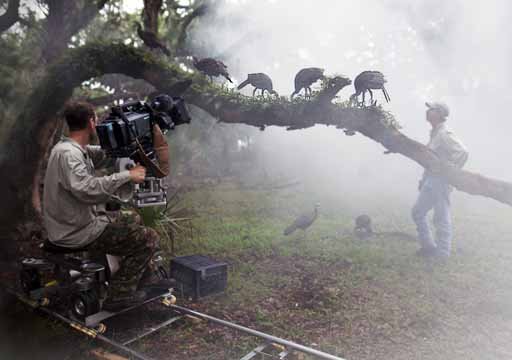
Behind the scenes image of turkeys and Jeff Palmer (actor) in misty forest in Florida. Cameraman (Mark Smith) on track & dolly shows how some of the beautiful sweeping shots were filmed.
Sam Wollaston of the Guardian continues,
It’s not hard to see how the little birds were taken in. Joe’s moustache does look a bit like feathers, he has a long scraggy neck, an understanding of the forest, and a tentative, birdlike walk. He takes them out, to catch their first grasshoppers; he teaches them how to roost. For Joe, as for any mother, parenthood is an emotional rollercoaster ride. There is the joy of seeing his babies grow, but almost constant worry. Grief too, when one is taken by a rat snake, and another by a hawk, and two more get sick (bird flu?) and die.
Adolescence arrives with all its associated problems. The males start fighting; only the toughest will get to mate. “I had no way of knowing how I was going to be part of this rite of passage,” says Joe. Steady now, Joe, let’s not take this too far, you’re not supposed to mate with any of them. For one, they’re your children. They’re also turkeys. That would be doubly wrong. Sometimes I think Joe spends too much time alone in the forest.
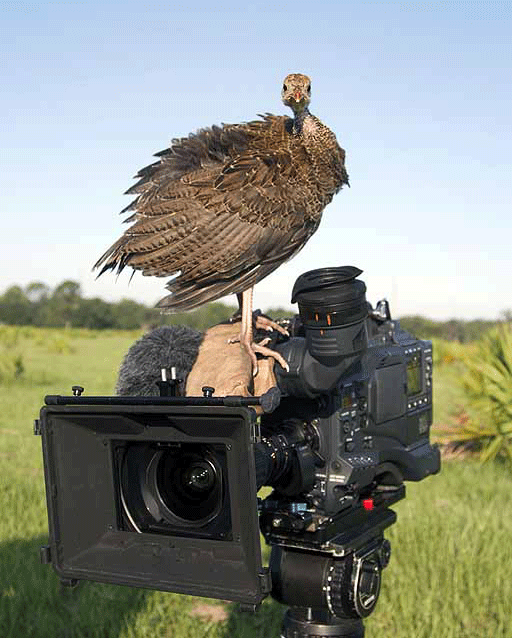
Quite so! However, the film was so beautifully shot that it was very, very easy to forget that this was a re-enactment of Joe’s original experience. That love is all about how you make someone, or in these cases, some other creature, feel. Another couple of pictures from the BBC website,
Lights, camera, action!Jeff Palmer (actor) sat on large felled tree on his cell phone with a dozen wild turkeys.
One final extract from the Sam Wollaston article in The Guardian newspaper,
My Life as a Turkey isn’t simply a wildlife film though. It’s not just about wild animals, it’s about one man’s relationship with wild animals, and that’s what makes it so fabulous. Serious animal behaviourists may not agree, but if you throw a human being in there, it all suddenly becomes a lot more interesting. I’m thinking Ring of Bright Water, Gorillas in the Mist, I’m definitely thinking Werner Herzog’s brilliant Grizzly Man about a man named Tim whose friendship with bears went wrong and he ended up inside one. My Life as a Turkey has something of Grizzly Man about it – a man obsessed, alone in a beautiful place, living with wild animals. But, although Joe was attacked, he didn’t end up inside one of his turkeys thankfully. There would have been a certain irony to that, especially if it had happened at Thanksgiving.
Anyway, it’s a lovely film – beautiful, charming, funny, sad, thought-provoking even. What thoughts did it provoke in me? That I need to go and see my mum.
Unfortunately, as mentioned above if you are outside the UK you are not able to watch the film via the BBC iPlayer system. But you can buy the book.
Joe Hutto's book of his life with wild turkeys.
Available from Amazon, here’s just one of the reviews,
My review is not unbiased because Joe Hutto, author of “Illumination in the Flatwoods,” and I have been friends for almost 25 years.
Joe is the most humble man I’ve ever known. I am honored that he brought me the original manuscript to read. It was so beautiful I could have cried.
With the same graceful writing skills used by conservationists Aldo Leopold (“Sand County Almanac”) and Herbert Stoddard (“Memoirs of a Naturalist”), Joe gives a masterful mix of documentary-style nature reporting and heartfelt thoughts on the meaning of life. As dramatic as that sounds, I think most readers will agree that “Illumination in the Flatwoods” is a life-changing book.
You will never regret the dollars you spend to buy this book nor the time it takes you to read it. . .
Just a few recent items to underline what a strange species we are!
This is being written on the 8th, not too many hours after the successful launch of the very last Shuttle space flight. Forget the [valid] question of cost, this launch sufficiently inspired nearly a million people to travel to the Kennedy Space Center to watch this historic flight. That adventuring drive is a wonderful aspect of mankind.
Now to another view of mankind.
Washington’s Blog of the 3rd July, 2011 has an in-depth review of how “the Japanese government, other governments and nuclear companies have covered up the extent of the Fukushima crisis.” In that excellent piece, there is a reference to material in the British Guardian newspaper (I’m taking the liberty of re-publishing quite a long extract from Washington’s Blog).
British Shenanigans
It’s not just the Japanese. As the Guardian notes:
British government officials approached nuclear companies to draw up a co-ordinated public relations strategy to play down the Fukushima nuclear accident just two days after the earthquake and tsunami in Japan and before the extent of the radiation leak was known.
Internal emails seen by the Guardian show how the business and energy departments worked closely behind the scenes with the multinational companies EDF Energy, Areva and Westinghouse…
Officials stressed the importance of preventing the incident from undermining public support for nuclear power.
***
The Conservative MP Zac Goldsmith, who sits on the Commons environmental audit committee, condemned the extent of co-ordination between the government and nuclear companies that the emails appear to reveal.
***
The official suggested that if companies sent in their comments, they could be incorporated into briefs to ministers and government statements. “We need to all be working from the same material to get the message through to the media and the public.
***
The office for nuclear development invited companies to attend a meeting at the NIA’s headquarters in London. The aim was “to discuss a joint communications and engagement strategy aimed at ensuring we maintain confidence among the British public on the safety of nuclear power stations and nuclear new-build policy in light of recent events at the Fukushima nuclear power plant”.
Other documents released by the government’s safety watchdog, the office for nuclear regulation, reveal that the text of an announcement on 5 April about the impact of Fukushima on the new nuclear programme was privately cleared with nuclear industry representatives at a meeting the previous week. According to one former regulator, who preferred not to be named, the degree of collusion was “truly shocking”.
The release of 80 emails showing that in the days after the Fukushima accident not one but two government departments were working with nuclear companies to spin one of the biggest industrial catastrophes of the last 50 years, even as people were dying and a vast area was being made uninhabitable, is shocking.
***
What the emails shows is a weak government, captured by a powerful industry colluding to at least misinform and very probably lie to the public and the media.
***
To argue that the radiation was being released deliberately and was “all part of the safety systems to control and manage a situation” is Orwellian.
And – as the Guardian notes in a third article – the collusion between the British government and nuclear companies is leading to political fallout:
“This deliberate and (sadly) very effective attempt to ‘calm’ the reporting of the true story of Fukushima is a terrible betrayal of liberal values. In my view it is not acceptable that a Liberal Democrat cabinet minister presides over a department deeply involved in a blatant conspiracy designed to manipulate the truth in order to protect corporate interests”. -Andy Myles, Liberal Democrat party’s former chief executive in Scotland
“These emails corroborate my own impression that there has been a strange silence in the UK following the Fukushima disaster … in the UK, new nuclear sites have been announced before the results of the Europe-wide review of nuclear safety has been completed. Today’s news strengthens the case for the government to halt new nuclear plans until an independent and transparent review has been conducted.” -Fiona Hall, leader of the Liberal Democrats in the European parliament
It’s us, all of us, that create the systems, the political and government systems that are at the heart of this approach to life.
But it’s also us, all of us, that ‘write’ such beautiful stories as this one from NPR Music.
Paul Simon has brought joy to so many for so long, but on this night he made Rayna Ford’s dream come true. During a show in Toronto on May 7, Rayna Ford, a fan from Newfoundland, called out for Simon to play “Duncan,” and said something to the effect that she learned to play guitar on the song. In a moment of astonishment and disbelief, Paul Simon invited her on stage, handed her a guitar and asked her to play it for the crowd. When she strapped on the guitar, the audience went crazy. In a few strums, the band played along, tears ran down Rayna Ford’s cheeks and Simon stood by her side in smiles.
It was an absolute moment of sobbing joy for Ford and for the crowd. It was a moment so beautiful, so human, it could almost be a story in a Paul Simon song. Excuse me while I wipe my own tears. Go Rayna and all the Raynas out there with dreams. As the song says:
Oh, oh, what a night
Oh, what a garden of delight
Even now that sweet memory lingers
I was playing my guitar
Lying underneath the stars
Just thanking the Lord
For my fingers,
For my fingers




 Learning from Dogs