Tag: The Conversation

Wildfire prevention

This is a precarious time of the year!

We live just outside Merlin in Southern Oregon. We have 13 acres of which roughly half is wooded. With the year-on-year warming wildfires are never far from our minds during our Summer. Here’s a part of a message from OPB.

What’s happening

High temperatures are in the forecast along the Interstate 5 corridor, the Willamette Valley and in Central and Eastern Oregon. More than a quarter million acres across multiple counties in Eastern Oregon are ablaze with wildfires, and that could mean smoke and haze, especially in Central and northeastern Oregon.

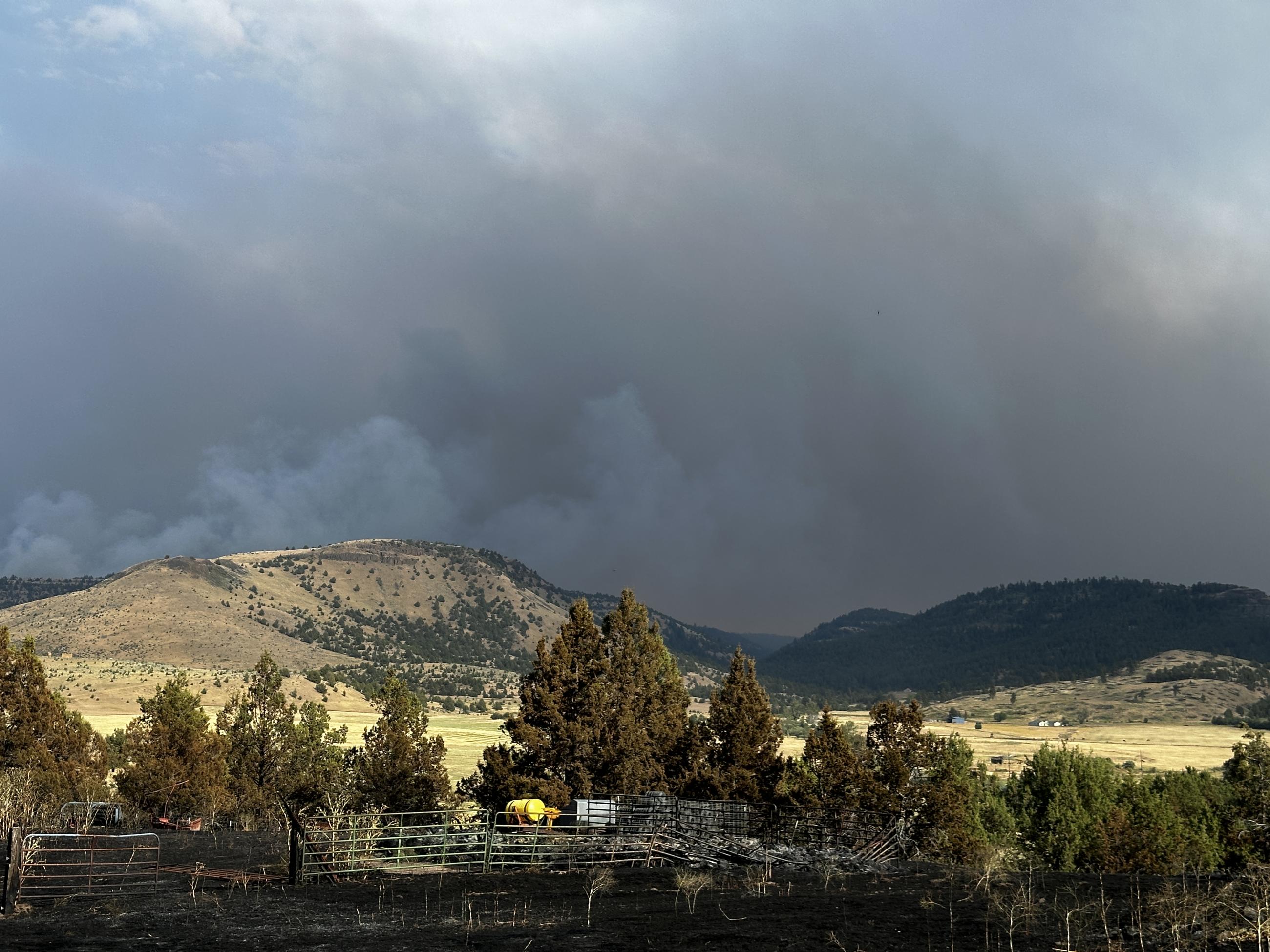
A view of the southern portion of the Lone Rock Fire in north-central Oregon on Wednesday, July 17, 2024.
A view of the southern portion of the Lone Rock Fire in north-central Oregon on Wednesday, July 17, 2024.Courtesy InciWeb 

Hot weather persists

The National Weather Service is anticipating a hot weekend across much of Oregon and Southwest Washington. The agency on Friday issued a heat advisory along the Interstate 5 corridor from Battle Ground, Washington to Cottage Grove, Oregon from 11 a.m. to 11 p.m. Saturday. Temperatures could reach the mid-90s.

From central Oregon east towards Burns a heat advisory is in place from 11 a.m. Saturday to 11 p.m. Monday. Harney County could see temperatures over 100 degrees over the weekend.

Which neatly serves as an introduction to an article from The Conversation about protecting one’s home.

ooOOoo

How to protect your home from wildfires – here’s what fire prevention experts say is most important

Bryce Young, University of Montana and Chris Moran, University of Montana

Extreme heat has already made 2024 a busy wildfire year. More acres had burned by mid-July than in all of 2023, and several communities had lost homes to wildfires.

As fire season intensifies across the West, there are steps homeowners can take to make their homes less vulnerable to burning and increase the likelihood that firefighters can protect their property in the event of a wildfire.

We research wildfire risk to homes and communities. Here’s what decades of research suggest homeowners in high-fire-risk areas can do to protect their properties.

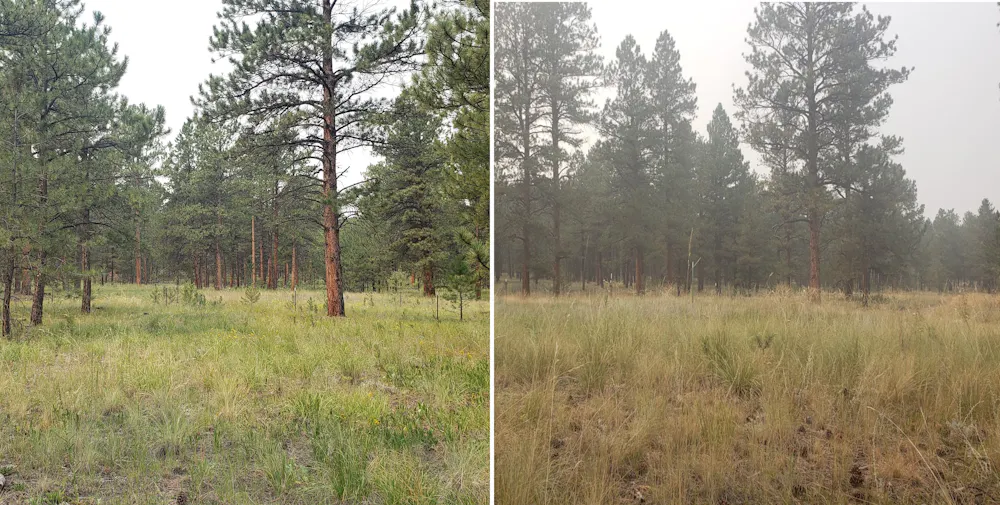
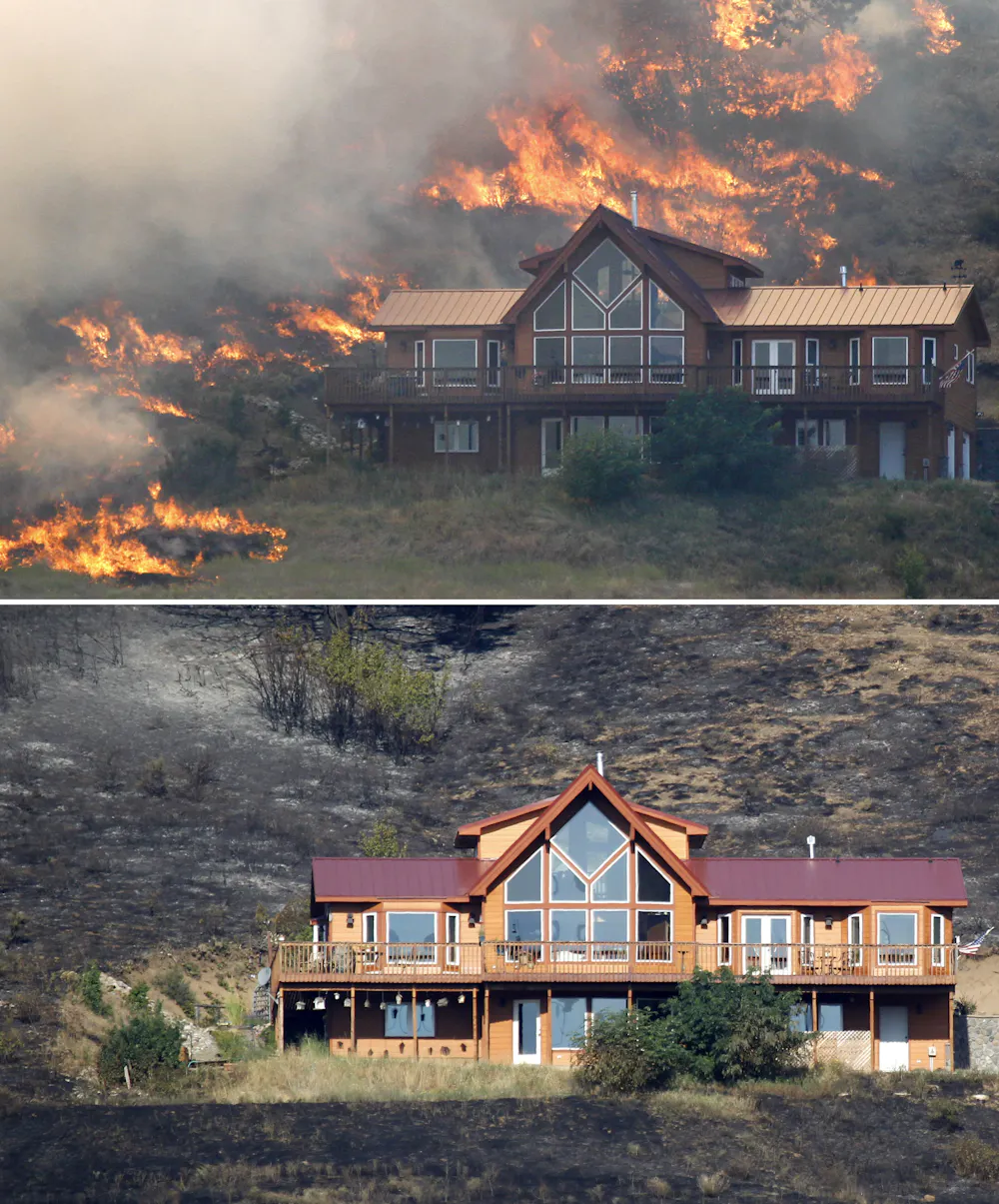
Two photos show the house with the fire behind it and after the fire, with burned land around it but the house untouched.
This house near Cle Elum, Wash., survived a 2012 wildfire because of the defensible space around the structure, including a lack of trees and brush close to the house, according to state officials. AP Photo/Elaine Thompson

Small improvements make big differences

A structure’s flammability depends on both the materials that were used to build it and the design of the building. In general, the vulnerability of a house is determined by its weakest point.

The roof, windows, siding and vents are all vulnerable points to pay attention to.

Roof: The roof provides a landing pad where airborne embers can accumulate like snowflakes. Roofs with lots of valleys can collect pine needles and leaves, which can be ignited by flying embers. This is why it’s important for the roof itself to be made of Class A non-flammable material like clay tiles or asphalt shingles, and why roof maintenance, including cleaning gutters, is important. Embers can easily find their way under peeling shingles, through gaps of clay tiles, or into gutters where pine needles and leaves can accumulate.

Windows: If windows are exposed to heat, they can shatter and allow fire inside the home, where curtains can easily ignite. Even double-paned windows can be shattered by the heat of a burning shed 30 feet away, unless the window glass is tempered, making it stronger. Fire-resistant shutters made of metal, if closed before a fire arrives, can offer additional protection. https://www.youtube.com/embed/HjA9yLP1icg?wmode=transparent&start=0 A life-size test with blowing embers at IBHS’s fire lab shows ways homes are at risk form a nearby fire.

Siding: Materials like stucco are non-flammable, while cedar shake siding will burn. Your exterior siding should be non-flammable, but the siding is only as strong as its weakest point. If there are holes in the siding, plug them with caulk to prevent embers from reaching the wooden frame in your walls. Ideally, there will be a 6- to 12-inch concrete foundation between the ground and the bottom of your siding material.

Vents: Reducing risk from vents is easy and affordable and can drastically reduce the flammability of your home. Make sure that one-eighth inch or finer metal mesh is installed over all vents to keep embers out of your attic and your home’s interior.

Controlling your home ignition zone

A home’s vulnerability also depends on the area around it, referred to as the home ignition zone.

The risk in your home ignition zone depends on things such as the slope of your land and the ecosystem surrounding your home. Here are a few guidelines the National Fire Protection Association recommends, both to reduce the chance of flames reaching your home and make it easier for firefighters to defend it.

Zone 1 – Within 5 feet

From the home’s exterior to 5 feet away, you want to prevent flames from coming in contact with windows, siding, vents and eaves. The gold standard is to have only non-flammable material in Zone 1.

The most common risks are having flammable mulch, plants, firewood, lawn furniture, decks and fences. These items have been a primary reason homes burned in many wildfires, including the 2018 Camp Fire that destroyed much of Paradise, California, and the 2012 Waldo Canyon Fire near Colorado Springs, Colorado.

An illustration of a house with rings at different distances around it and advice for each ring.
Fire protection guidelines take into consideration the surrounding ecosystem. Here some examples based on the National Fire Protection Association’s guidelines. Bryce Young, CC BY

Replacing mulch with gravel or pavers and having only short, sparse plants that don’t touch the house can help reduce the risk.

Wooden decks and fences can burn even if they are well-maintained. Replacing them with non-flammable materials or installing a thin sheet of metal on the house where the siding touches a wooden deck or fence can help protect the home. Mesh screens can prevent the accumulation of debris and embers under the deck.

Zone 2 – 5 to 30 feet away

In the next ring, between 5 and 30 feet from the home, the lawn should be green and short. This is Zone 2.

Be sure to rake up pine needles and leaves and take care to prune the lowest tree branches at least 6 feet high.

There should be about 18 feet of space between trees on a flat slope, and the spacing should increase with slope because steeper terrain drives faster, more intense fires. Walks, pathways, patios, decks and firewood can be kept in this zone.

Zone 3 – 30 to 100 feet away

Beyond Zone 2 and out to about 100 feet from the home is Zone 3. In this area, be sure to give sheds and propane tanks their own defensible space, just like around the house, and prune all low branches to 6 feet.

You can contact your local emergency management office or community wildfire nonprofit to learn more about grant funding that can offset the costs of pruning and removing trees on a forested property.

Beyond 100 feet may extend past your property boundary, but the adjacent house can still be fuel for a wildfire. That’s why it’s smart to plan with your neighbors as you’re reinforcing your own home. Once one house catches fire, house-to-house fire spread is facilitated by closer distances between buildings.

Be prepared

While most U.S. government spending aims to mitigate wildfire hazard on national forests, it is up to residents and communities themselves to reduce their vulnerability to a wildfire disaster.

Following the guidelines required by your community or state and those outlined above can help. Communities can also take steps to reduce fire risk and make fires easier to control by developing a community wildfire protection plan, exploring their wildfire risk, and adopting wildfire-specific building codes.

As the nation rolls into fire season, make sure your property is prepared. And when the call to evacuate comes, know where to go and get the heck out.

Bryce Young, Graduate Student Researcher, Fire Center, University of Montana and Chris Moran, Post-doctoral Researcher, Fire Center, University of Montana

This article is republished from The Conversation under a Creative Commons license. Read the original article.

ooOOoo

Where we live is beautiful and earlier this year we had a great deal of rain. But the summers are dry; that is a function of the climate in this part of the world. So for July so far we have had no rain and that is normal. Also no rain in July in 2023.

The three zones, as described earlier in this post, are very helpful.

An article on ageing

Musings on getting older and older!

I shall be 80 in November; I was born in London some six months before the end of World War II in Europe. I was the result of an affair between my father, Frederick, and my mother, Elizabeth. My father died in December, 1956 when I had recently become twelve years old.

I think that age spans have their own characteristics. So, for example, a person in their 20’s or their 40’s cannot sense what it is like to be in their 70’s or 80’s. Just a theory of mine and I have no evidence that this is a fact.

But as an introduction to today’s post it serves the task perfectly. And today’s post comes from The Conversation.

(And when I was writing this on the 11th July Biden was still the US President. My hunch is that he will not be by the 16th!)

ooOOoo

‘The immortal Gods alone have neither age nor death’

President Joe Biden, left, and first lady Jill Biden depart following a presidential debate with Donald Trump on June 27, 2024, in Atlanta. AP Photo/Gerald Herbert

Rachel Hadas, Rutgers University – Newark

President Joe Biden’s current fraught situation, showcasing both his weakness and his determination, is dramatic because it touches upon more than the political moment and more than one man’s character.

After his disastrous debate performance sparked calls for him to step aside as the Democratic presidential candidate, Biden’s position is not only inextricably entangled with issues of temperament and family dynamics. There’s also the challenge of making a crucial decision swiftly, at a moment when no decision is easy or clearly right.

And that’s not all. Biden has come to symbolize both the biological challenges and the existential poignancy of aging – of aging in power, certainly, but also just the unrelenting wear and tear of growing old.

The pressure of all these factors makes Biden a tragic figure.

Others reluctant to step down

To see this clamorous moment in the light of the past doesn’t make living in the present easier, but it does widen the perspective. Biden is far from the first person in a position of power who has been reluctant to step down – even when common sense or sheer weariness might dictate otherwise. In recent history, Supreme Court Justice Ruth Bader Ginsburg is often cited as an unfortunate example, and there are many other figures historians can cite.

Literature has always been concerned not only with people in power but also with the life cycle and the complexities of family relationships. Myths stay fresh and timeless; as we age, our understanding of a myth may change.

As the poet Eavan Boland writes in “The Pomegranate:”

“And the best thing about the legend is I can enter it anywhere. And have.”

The immense cohort of aging baby boomers, of whom I am one, is likely to sympathize with Biden because he has come to symbolize the vulnerability of aging – vulnerability to humiliation and, more subtly, to isolation.

A woman sitting in a room puts her face in her hands, covering her eyes.
Tonya Morris reacts at Tillie’s Lounge in Cincinnati during the presidential debate between President Joe Biden and the Republican candidate, former President Donald Trump, on June 27, 2024. AP Photo/Carolyn Kaster

Age ‘is not protection against suffering’

Greek poets like Homer and Sophocles present old age realistically.

In Homer’s “Iliad,” the elderly Nestor endlessly reminisces. Although listened to respectfully, he is a figure from an earlier generation whose role in war has dwindled to that of counselor.

Priam, the old king of Troy, heartbroken after the death of his son Hector, still finds the energy to berate his surviving sons as they clumsily hitch the mules that will draw the cart loaded with ransom so Priam can redeem his dead son’s body from the warrior who killed him, Achilles.

The subsequent moment of recognition between Priam and Achilles is one of the most poignant in literature, not least because the sight of old Priam reminds Achilles of his own aged father. Achilles might be expected to be enraged, but seeing Priam turns his anger to grief. Achilles knows he won’t see his father, Peleus, again. Being old is no protection against suffering; the aged Priam, mourning his son Hector, is assailed by the same desolate grief as Achilles.

In Shakespeare’s “Henry IV,” the once jovial and resilient Falstaff, publicly rejected and insulted by Prince Hal, is old, vulnerable – and alone. Macbeth, widowed and isolated, seems to have aged decades in the course of the play; he thinks forlornly of the comforts old age might be expected to provide: “honor, love, obedience, troops of friends.”

King Lear opens the tragedy named for him by ostensibly retiring. He announces his “intent/To shake all cares and business from our age,/Committing them to younger strengths, while we/Unburdened crawl toward death.”

But Lear refuses to cede control. Finally, as he sinks into confusion, he discovers humility and compassion – too late. Lear is reunited in prison with his loyal daughter Cordelia, who hasn’t been afraid to speak truth to power but who also has never ceased to love him – but she is summarily executed, and Lear, heartbroken, dies.

Decision requires ‘rare detachment’

Political commentator Bill Maher has called ageism the last respectable prejudice. It’s as if age and its accompanying disabilities create a force field keeping others at a distance. Or perhaps age bestows a universally recognized vulnerability on people who seemed powerful.

Either way, old people can seem somehow separated from the rest of us.

It’s hard even to imagine President Biden alone; on the contrary, he is apparently surrounded by loyal family and advisers. But the vulnerability of old age was on full display in the first presidential debate. News reports convey how hard it has become for anyone outside Biden’s tight circle to really see or know him.

One of the countless contrasts between Biden and Donald Trump is Biden’s almost sphinxlike unknowability, especially now. With Trump, as has frequently been noted, what you see is what you get. For better or for worse, his qualities are consistently on full display.

Age has been traditionally associated with wisdom, yet the wisdom old age can bestow seems out of reach for a figure still in the thick of politics. Lear’s “all-licensed” Fool rebukes the king: “Thou shouldst not have been old till thou had been wise.”

Only withdrawing from the fray might bestow some tranquility. But the vision to make the difficult decision to withdraw requires a kind of detachment that seems to be very rare in history, and not common in literature either.

An old man being comforted by two women, with a soldier in front of him.
The aged and blind Oedipus at Colonus, in an 1800 drawing by Bertel Thorvaldsen, says, ‘The immortal Gods alone have neither age nor death! All other things almighty Time disquiets.’ Sepia Times/Universal Images Group via Getty Images

‘Almighty time disquiets’

Greek tragedy does offer an eloquent example of just such wisdom.

Sophocles’s “Oedipus at Colonus” is a play about an old man written by an old man – Sophocles was in his 90s when the drama was presented.

The aged, self-blinded and self-exiled former king Oedipus, guided by his loyal daughter, finds himself in Colonus, a holy district outside Athens. When Theseus, the ruler of Athens, arrives on the scene, Oedipus’s words to him transcend both the immediate situation and Oedipus’s dire backstory.

“The immortal
Gods alone have neither age nor death!
All other things almighty Time disquiets.
Earth wastes away; the body wastes away;
Faith dies, distrust is born.
And imperceptibly the spirit changes
Between a man and his friend, or between two cities ….
… but time goes on,
Unmeasured Time, fathering numberless
Nights, unnumbered days ….”

By touching upon the shared human condition of mortality, as well as another universal, the inevitability of change, this speech bestows a stark tranquility on the situation.

Oedipus knows that he has come to Colonus to die, and his words convey a vision that seems to issue from beyond the grave. His detachment has an authority that now seems almost out of the reach of any of us, let alone a politician. But it’s good to remember that such qualities exist.

Of course this is a different moment. The looming juggernaut that Trump represents makes it hard for Biden’s supporters, or any Democrats, to be calm. Nevertheless, it’s useful to think about the potential strengths, as well as the vulnerabilities, of age.

The widespread anxiety now rampant among Biden’s supporters is sometimes mocked as unjustified panic. Time, as Oedipus might remind us, will tell. I personally find this anxiety touching and heartening for its humanity; there’s widespread compassion for Biden’s vulnerability.

In the ugly spectacle of American politics, it’s hard to keep humanity in sight. Literature can remind us of what we already know about growing old, about change, and about mortality.

Rachel Hadas, Professor of English, Rutgers University – Newark

This article is republished from The Conversation under a Creative Commons license. Read the original article.

ooOOoo

I cannot add anything to this first-class post!

A post on Heat

Not the first and I’m sure it won’t be the last on this topic!

We are experiencing the first week of Summer’s heat.

Where it is going, temperature-wise, who knows but the consensus is that it is becoming warmer year on year.

So this seemed like a great post to republish. It was on The Conversation.

ooOOoo

Heat index warnings can save lives on dangerously hot days − if people understand what they mean

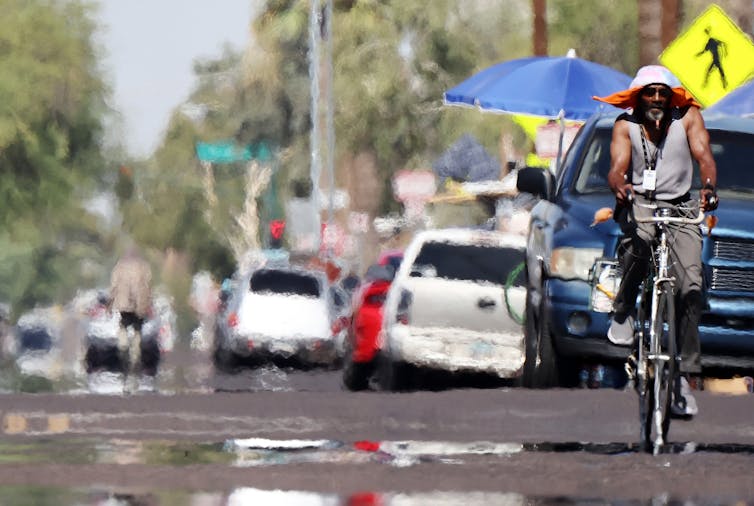
The sticky combination of heat and high humidity can be more than uncomfortable – it can be deadly. Mario Tama/Getty Images

Micki Olson, University at Albany, State University of New York

You’ve probably heard people say, “It’s not the heat, it’s the humidity.” There’s a lot of truth to that phrase, and it’s important to understand it as summer temperatures rise.

Humidity doesn’t just make you feel sticky and uncomfortable – it also creates extra dangerous conditions on hot days. Together, too much heat and humidity can make you sick. And in severe cases, it can cause your body to shut down.

Meteorologists talk about the risk of heat and humidity using the heat index, but it can be confusing.

I’m a risk communication researcher. Here’s what you need to know about the heat index and some better ways meteorologists can talk about the risks of extreme heat.

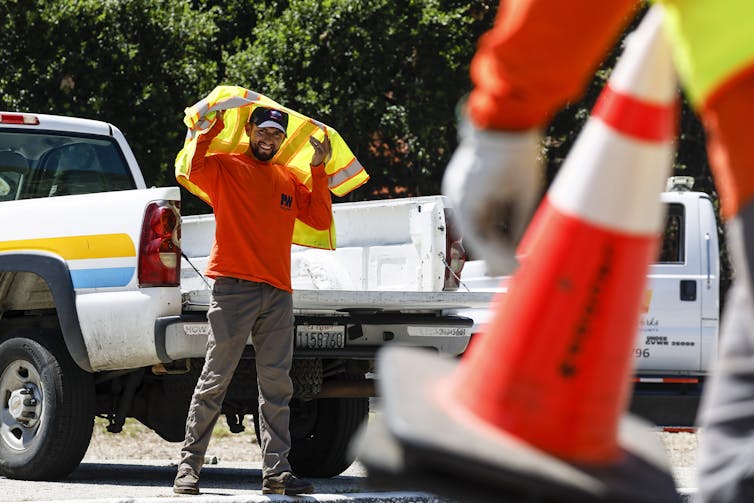
A construction worker in reflective gear holds a jacket over his head against the sun.
Outdoor workers can be at high risk of heat illnesses. Robert Gauthier/Los Angeles Times via Getty Images

What is the heat index, and how is it measured?

Heat index is the combination of the actual air temperature and relative humidity:

  • Air temperature is how hot or cold the air is, which depends on factors such as the time of day, season of the year and local weather conditions. It is what your thermometer reads in degrees Celsius or Fahrenheit.
  • Relative humidity compares how much water vapor is in the air with how much water vapor the air could hold at that temperature. It’s expressed as a percentage.

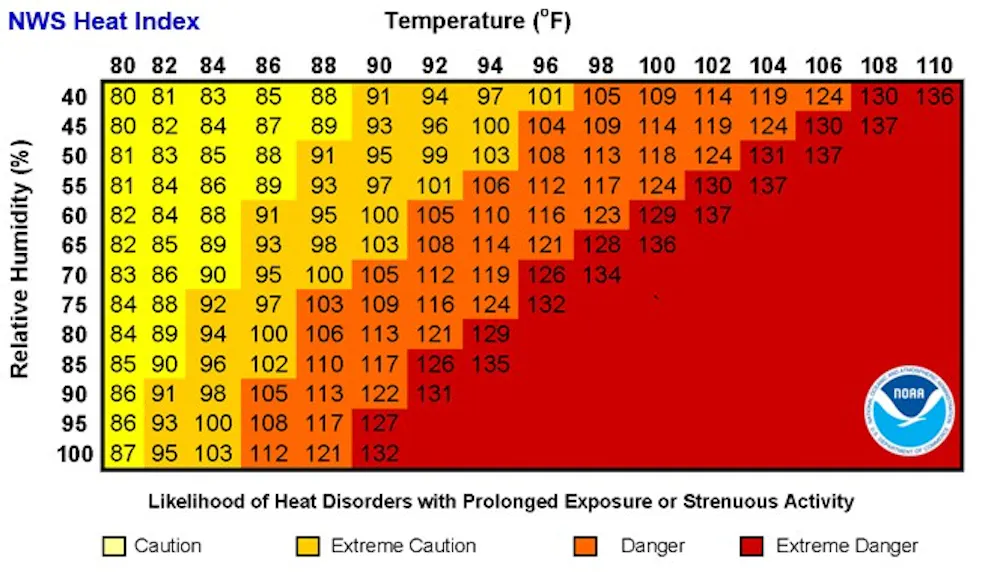
The heat index tells you what it “feels like” outside when you factor in the humidity. For example, if it’s 98 degrees Fahrenheit (36.7 Celsius) with 55% relative humidity, it might feel more like a scorching 117 F (47.2 C).

A chart with a grid showing heat and humidity risks.
NOAA’s heat index chart shows how heat and humidity combine for dangerous temperatures. NOAA

But there’s a catch: Heat index is measured in shady conditions to prevent the sun’s angle from affecting its calculation. This means if you’re in direct sunlight, it will feel even hotter.

Apparent temperature, alerts and wet bulb

“Apparent temperature” is another term you might hear this summer.

Apparent temperature is the “feels like” temperature. It considers not only temperature and humidity but also wind speed. This means it can tell us both the heat index and wind chill – or the combination of the temperature and wind speed. When conditions are humid, it feels hotter, and when it’s windy, it feels colder.

We found that apparent temperature is even less well understood than the heat index, possibly due to the word apparent having various interpretations.

There are a few other ways you may hear meteorologists talk about heat.

Wet bulb globe temperature considers temperature, humidity, wind and sunlight. It’s especially useful for those who spend time outdoors, such as workers and athletes, because it reflects conditions in direct sunlight.

HeatRisk is a new tool developed by the National Weather Service that uses colors and numbers to indicate heat risks for various groups. More research is needed, however, to know whether this type of information helps people make decisions.

In many places, the National Weather Service also issues alerts such as excessive heat watches, warnings and advisories.

The risk is getting lost in translation

Knowing about heat and humidity is important, but my colleagues and I have found that the term heat index is not well understood.

We recently conducted 16 focus groups across the United States, including areas with dry heat, like Phoenix, and more humid areas, like Houston. Many of the people involved didn’t know what the heat index was. Some confused it with the actual air temperature. Most also didn’t understand what the alerts meant, how serious they were or when they should protect themselves.

In our discussions with these groups, we found that meteorologists could get across the risk more clearly if, instead of using terms like heat index, they focus on explaining what it feels like outside and why those conditions are dangerous.

Watches, warnings and advisories could be improved by telling people what temperatures to expect, when and steps they can take to stay safe.

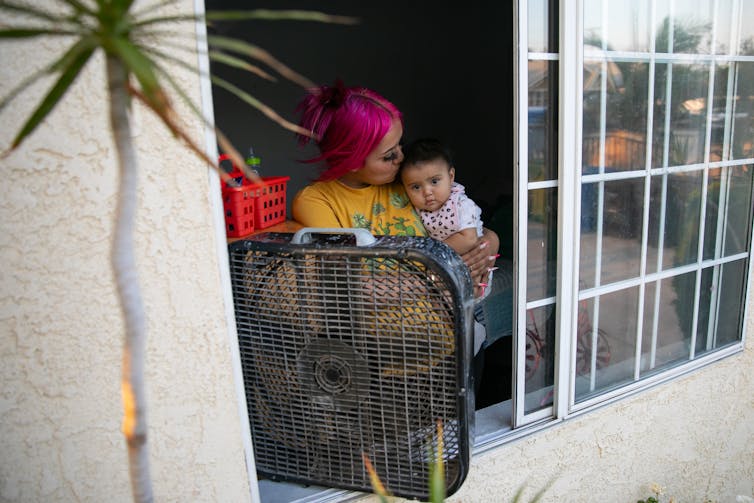
A woman holds a baby at an open window with a fan blowing in.
Clear warnings can help residents understand their risk and protect themselves, which is especially important for small children and older adults, who are at greater risk of heat illness. Jason Armond/Los Angeles Times via Getty Images

Climate change is exacerbating heat risks by making extreme heat more common, intense and long-lasting. This means clear communication is necessary to help people understand their risk and how they can protect themselves.

What you can do to protect yourself

With both hot and humid conditions, extra precautions are necessary to protect your health. When you get hot, you sweat. When sweat evaporates, this helps the body cool down. But humidity prevents the sweat from evaporating. If sweat cannot evaporate, the body has trouble lowering or regulating its temperature.

Although everyone is at risk of health issues in high heat, people over 65, pregnant women, infants and young children can have trouble cooling their bodies down or may run a higher risk of becoming dehydrated. Certain health conditions or medications can also increase a person’s risk of heat-related illness, so it’s important to talk to your doctor about your risk.

Heat illnesses, such as heat exhaustion and heat stroke, are preventable if you take the right steps. The U.S. Centers for Disease Control and Prevention focuses on staying cool, hydrated and informed.

  • Stay cool: Use air conditioning in your home, or spend time in air-conditioned spaces, such as a shopping mall or public library. Limit or reschedule your exercise and other outdoor plans that occur in the middle of the day when it is hottest.
  • Stay hydrated: Drink more water than you might otherwise, even if you don’t feel thirsty, so your body can regulate its temperature by sweating. But avoid sugary drinks, caffeine or drinks with alcohol, because these can cause you to become dehydrated.
  • Stay informed: Know the signs of heat illness and symptoms that can occur, such as dizziness, weakness, thirst, heavy sweating and nausea. Know what to do and when to get help, because heat illnesses can be deadly.
Heat exaustion includes dizziness, thirst, heavy sweating, nausea and weakness. Move to cooler area, loosen clothing, sip cool water and get medical help if no improvement. If heat stroke, including confusion, dizziness and unconsciousness, also call 911.
The difference between heat exhaustion and heat stroke and the CDC’s advice on how to respond. NOAA, CDC

Micki Olson, Senior Researcher in Emergency and Risk Communication, University at Albany, State University of New York

This article is republished from The Conversation under a Creative Commons license. Read the original article.

ooOOoo

That last diagram on staying cool, staying hydrated, and staying informed is one element in me choosing this article for publication. Further, if one looks up the website for the Centers for Disease Control and Prevention then immediately one comes across:

Stay cool indoors.Stay in an air-conditioned place as much as possible. If your home does not have air conditioning, go to the shopping mall or public library—even a few hours spent in air conditioning can help your body stay cooler when you go back into the heat.

Please take care!

The Same Language, but …

We are so close yet in some ways so separate!

George Bernard Shaw once quoted that: “England and America are two countries separated by the same language.”

It seems a most apt way of introducing an article published by The Conversation.

ooOOoo

UK and US elections: 2 very different systems united by a common political language

Long, drawn-out campaigns just aren’t Rishi Sunak’s cup of tea. Chris J Ratcliffe/WPA Pool/Getty Images.

Garret Martin, American University School of International Service

Voters in the United Kingdom on May 22 learned the date they would be joining the many, many people casting ballots around the world in 2024.

In a surprise move, Prime Minister Rishi Sunak announced a snap election to be held on July 4 – six months earlier than many had expected. An early election is certainly a major gamble for the prime minister but one he felt was worth taking. With the ruling Conservative Party more than 20 percentage points behind opposition Labour in the latest polls, Sunak faces an uphill battle to stay in office.

The Labour Party, led by Keir Starmer, is heavily favored to return to power for the first time since 2010.

To a U.S. audience, many of the top issues in the election campaign will sound familiar: the economy, immigration, health care, Ukraine and Gaza. The choice of date, too, may ring a bell – and political soothsayers are already trying to read into what it means for the U.K. election to fall on Independence Day.

A person with a trash bin head gestures with his thumbs down to a person with a bucket as a head.
U.K. elections can be an odd affair in which mainstream politicians can rub shoulders with the likes of rival candidates Count Binface and Lord Buckethead. Oli Scarff/AFP via Getty Images

But as to the campaign itself – well, they do things a bit different on the other side of the pond. While Americans may be used to set terms and lengthy campaigns filled with endless advertising, in the U.K. such things are, to use a Britishism, “just not cricket.” Here are three main ways in which the British conduct their elections.

1. Election timeline

U.S. elections follow a predictable schedule. In 1845, Congress passed a law establishing a single day for federal elections to take place on “the Tuesday next after the first Monday in November.” Further, presidents are elected for a fixed four-year term, making the dates for upcoming votes knowable for the foreseeable future.

That isn’t the case in the United Kingdom. By convention, elections have been held on a Thursday since 1935. But the month of the vote has varied considerably. For the most part, they take place in late spring or early summer – but fall and winter elections are not unheard of.

The U.K. Parliament does have a fixed term of five years, with elections automatically scheduled once that time has lapsed. In practice, however, parliaments have rarely gone the full five years.

Indeed, prime ministers in the United Kingdom have the authority to request the dissolution of Parliament at any time. They can do so without the approval of the cabinet, and so prime ministers have taken liberal advantage of their ability to control the timing of the election to try and gain an advantage.

Many thought that Sunak may have been eyeing an election later in the year, but a number of factors, including economic forecasts and not wanting the distraction of a U.S. election, may have factored in to him calling an earlier-than-expected vote.

2. Campaign rules

Besides the shifting timing, the nature and rules of the campaign are also very different in the United Kingdom. This starts with the sheer brevity of the campaign. Once Parliament is dissolved, the election must take place 25 working days later. This means the parties have a mere six weeks to make their case to the public.

And unlike in a presidential system, voters in the United Kingdom do not cast a ballot for the person they want to see lead the country. Instead, the U.K. is divided into 650 distinct constituencies; voters pick their preferred candidate to represent their local constituency in Parliament. The party with the most seats typically wins the election, and the leader of that party has the opportunity to become prime minister and govern as a single-party government or as part of a coalition.

U.K. election campaigns are also subject to strict rules to maintain neutrality. Once the campaign starts, the period of “purdah” kicks in, which imposes certain restrictions on government activities. This involves, for instance, strict prohibitions on government ministers announcing new initiatives to affect the election or using public funds for political purposes.

In the same manner, civil servants – employees of the crown who work for the government but are not political appointees – are required to maintain strict impartiality and not become involved in partisan debates.

Moreover, the Office of Communications, the United Kingdom’s independent media regulatory authority, also enforces strict rules for broadcast media, including television and radio. The 2003 Communications Act requires that all broadcast media must cover the elections in an impartial manner, providing coverage of all parties, even if they do not assign equal time.

A man in a white shirt chats to a man in a blazer. Bith hold cups.
Opposition leader Keir Starmer, left, poses on the campaign trail with what the photographer says is a cup of coffee … but which I strongly suspect is actually tea. Leon Neal/Getty Images

Broadcast media is also not allowed, on polling day, to suggest the outcome of the vote before polls are closed.

In a huge departure from the U.S., U.K. political parties are banned from buying television ads, but this rule does not apply to streaming television.

3. The role of money

The limited role of money is another distinct feature in U.K. elections. Even factoring in the different population sizes, U.K. elections are significantly cheaper than their counterparts in the United States.

Indeed, total campaign spending in the 2020 U.S. elections, covering presidential and congressional races, hit more than US$14 billion. That scale completely dwarfs how much parties and candidates will be able to spend in the 2024 United Kingdom election.

Through regulations established by the Electoral Commission, an independent government agency, a British party that competes in all constituencies in the United Kingdom will be allowed to spend just over £34 million (around $43 million) in total to support all candidates.

That figure in itself marks an 80% increase from the allowance at the last election in 2019, so to factor for inflation since limits were set in 2000.

Individual candidates can spend funds to support their campaign. But the amount, defined partly by the size of the constituency, is low and in the scale of tens of thousands of pounds. This is again a far cry from some of the more expensive congressional races in the United States, where even primary elections could attract close to $30 million in spending.

Challenging times ahead

As a result, both Sunak and Starmer will have only a short time – and limited funds – to make their case to voters. Whoever wins will face a very challenging situation at home and abroad, with little to no respite. According to the think tank Institute for Fiscal Studies, the state of public finances is “a dark cloud that hangs over the election.” And then there is the delicate matter of maintaining a special relationship with the U.S. – a country that may itself have a very different political landscape after it goes to the polls later in the year.

Garret Martin, Senior Professorial Lecturer, Co-Director Transatlantic Policy Center, American University School of International Service

This article is republished from The Conversation under a Creative Commons license. Read the original article.

ooOOoo

As I have frequently said, I feel English and love the fact that I speak with an English accent. Yet I adore, along with Jean, where we live just outside Merlin in Southern Oregon. I wouldn’t want to live anywhere else in the world.

Politically we are in very strange times, as was said right at the end of this article.

Having pets!

But primarily for companionship.

I chose this article from The Conversation simply because it is the truth about having a pet animal.

ooOOoo

Pets give companionship, cuddles and joy – and also unavoidable stresses

Pets can bring joy and companionship, as well as financial worries, loss and logistical challenges. Dann Tardif/Stone via Getty Images

Emily Hemendinger, University of Colorado Anschutz Medical Campus

Owning a pet can be a roller coaster. There are the highs, like when your dog greets you with a full-body wiggle when you return home, or when your cat purrs loudly as you cuddle next to one another. Then there are the lows, like stressful trips to urgent care, waking up to that unpleasant vomiting noise, or making the difficult choice to say goodbye because of medical problems or even intractable behavioral issues.

For those pet-owners who are struggling, it’s beneficial to their mental health to acknowledge that pets can create stress and that some animals are more work than others.

Research has shown that both cats and dogs can have equally positive impacts on mental health.

Pets may be helpful at reducing stress, anxiety and feelings of being overwhelmed, including in children. Pet ownership has also been shown to improve well-being by instilling people with a sense of purpose and responsibility.

As a licensed clinical social worker, animal lover and proud dog mom, I have both professionally and personally seen the mental health impacts of having animal companions.

Media stories commonly cover the positives of pet ownership. But the hardships and downsides of owning a pet are not discussed as often. For instance, while there are many positive aspects to pet ownership, some research is showing that pets may lead to exacerbated mental health concerns or even sleep issues.

Whether you’re adopting or shopping, pets can bring a full range of emotions into our lives. Research has even shown that pets may benefit non-pet owners around them as well.

How pets can enrich our lives

A pet owner may easily be able to tick off an infinite number of positive effects their fuzzy companion has had on their life. Research backs them up.

Pets can provide constant companionship for individuals and families. This is particularly true for older adults. There was an uptick in adoptions of pets during the early days of the COVID-19 pandemic. Many people benefited from pets during periods of stay-at-home mandates and quarantines.

Pet adoptions soared during the early days of the COVID-19 pandemic. But many owners then found themselves struggling with the rising costs of care.

Research shows that dogs can reduce loneliness in their owners. In fact, being accompanied by a dog may even make you seem more approachable.

Pets, especially dogs, may help improve one’s ability to socialize and feel connected with others, as well as increasing the prospects for social interactions. People may bond over the experience of having pets, socialize at the dog park, or even meet up at the local cat café.

Animals and pets have also been used to assist in detecting the onset symptoms of medical episodes, including seizures. Animal-assisted therapy and pet therapy have shown promise in improving symptom management and overall quality of life in a number of conditions, including trauma and stressor-related disorders, anxiety disorders, eating disorders, autism, traumatic brain injuries, neurological disorders and more.

There are ample benefits to pet ownership.

The inherent stressors

Despite the many positive impacts of pet ownership, it also can have negative impacts. For example, one survey found that 47% of Americans felt separation anxiety when leaving their dogs at home.

The survey also found that 41% of pet owners declined social invitations because they did not want to leave their dog at home, and that 70% of pet owners would prefer to work remotely so they could stay at home with their pet. Pet owners have also identified feeling anxious about their pet getting sick or running away, or the risk that they might harm the animal unintentionally.

Stress from pet ownership is common. There’s the stress of house-training and making sure the pet is getting enough enrichment – both physically and mentally. Then there are the challenges associated with vet appointments and navigating illness, as well as financial stressors and finding pet sitters.

Another element of pet ownership that people often don’t talk about is the stress, and often shame, that owners with reactive dogs experience from walking their dog, having people over to the house or having their dog around children.

Finally, there’s the reality that our pet companions live shorter lives than we do, leading to end-of-life planning, expensive treatments for older-age ailments, and, of course, the grief that will be felt from the loss of a pet. For some people, the loss of a pet may feel worse than human loss.

People may judge or criticize pet owners for an “overblown” grief reaction. The common experience of invalidation and lack of acknowledgment related to grief around pet loss – similar to the grief felt from divorce and miscarriage – is categorized as disenfranchised grief. This term refers to grief that is not acknowledged, validated or accepted socially.

Young man sits in front of his laptop and puts his nose up to the nose of his cat.
Society often fails to recognize the significance of pets in people’s lives. Thomas Northcut/DigitalVision via Getty Images

Strings attached

Pet owners, especially post-pandemic, have reported high levels of guilt related to leaving their pets at home while at work or social events. Some of this guilt may be related to concerns about providing insufficient attention to the pet or about the pet’s health. This guilt has even been shown to be similar to the feeling human parents have concerning their human children.

As someone who adores their dog, I can relate to the guilt of leaving him alone. To complicate things, my dog has joint issues, anxiety and discoid lupus, a type of lupus that affects the skin on his nose. He can also be reactive. All of these aspects require me to provide extra care. When friends invalidate my worries and guilt, it can feel isolating and shaming.

And I’m not alone in these feelings. Overall, when there is a lack of consideration for the complex feelings pet owners experience, the invalidation and disenfranchised feelings can lead to depression, anxiety, feelings of being isolated and worsened quality of life.

Woman sits on a dock with her arm around her dog, which looks backward over her shoulder into the camera.
Many pet owners report feeling unsupported and invalidated when it comes to the grief around illness, loss and other complicated issues that come with pet ownership. LWA/DigitalVision via Getty Images

Finding support

The human-animal bond is unique, with humans receiving unconditional love and full acceptance from their animal companion. When society can honor and respect this bond through validation, patience and compassion, it not only helps pet owners but also the clinicians who treat the animals.

Employers can be supportive by continuing to provide remote and hybrid work options, flexibility in scheduling and opportunities for employees to feel validated and receive support. If a loved one is experiencing guilt around leaving their dog at home or a friend is having anxiety about their cat’s health, instead of minimizing their experience, try talking to them and asking how best to support them through their distress.

Another support tool is encouraging pet owners to practice self-compassion and mindfulness, being present and focusing on the time they do have with their pet.

Pets can bring infinite joy and companionship to our lives, whether that’s through pet ownership, fostering, volunteering or engaging in animal-assisted therapy.

It remains important, however, to acknowledge the stressors and difficulties pet owners face. After all, the ups and downs of pet ownership, just like the ups and downs of the human experience, are what make life and relationships that much more meaningful.

Emily Hemendinger, Assistant Professor of Psychiatry, University of Colorado Anschutz Medical Campus

This article is republished from The Conversation under a Creative Commons license. Read the original article.

ooOOoo

This is such a good article both for the general readership and for Jeannie and me specifically. For when I met Jean in December, 2007 Jean had 23 dogs and 7 cats. Jean’s passionate interest was in rescuing the many street dogs that roamed San Carlos in Mexico.

My great love of dogs came from the loving companionship that the animals offered me, including my Pharaoh that I brought with me from England. Now we are down to just two dogs: Oliver and Cleopatra.

This was a very lucky moment

A hiker in Arizona saw a dog hiding, and scared!

This is such a lovely tale and one that defies all the odds.

ooOOoo

Hiker Stops In His Tracks When He Sees ‘Amber Eyes’ Peeking Out From Crevice

No one has any idea how she got up there ⛰️

By Caitlin Jill Anders, Published on May 3, 2024

A Good Samaritan was hiking a narrow, slippery trail on Lookout Mountain in Phoenix, Arizona, and was very focused on his hike until something caught his eye. He was about half a mile up the mountain and a little off the beaten path when he caught a glimpse of light reflecting off of something — and was shocked to realize it was a pair of amber eyes.

The eyes belonged to a very scared dog huddled up in a tiny hole in the side of the mountain. She was completely blending in with her surroundings, and if she hadn’t had such piercing eyes, the hiker may not have noticed her. He had no idea how she’d managed to get up there, but it was clear that she’d been stuck for a while and might not be able to last much longer.

The Good Samaritan quickly contacted the Arizona Humane Society (AHS), who sent two emergency animal medical technicians, Tracey Miiller and Ruthie Jesus, out to help while he waited with the pup until they arrived. The dog was definitely scared but seemed open to getting help.

“This Good Samaritan waited probably almost two hours, and then we found this incredible dog, who incidentally is literally the same color as the dirt,” Jesus said in a press release. “She blends in so much, the complainant told us that he wanted to call her Bright Eyes because when he hiked past her, that was literally the only thing he saw was her amber bright eyes staring back at him.”

After a quick and careful assessment on the side of the mountain, the technicians determined that Bright Eyes was dangerously dehydrated with cut-up paws and a wound on her rear end.

“She was really sweet and letting me pet her head, but she absolutely did not want to come out of that den, so I kind of had to just sort of pull her out,” Jesus said.

She was definitely too weak to walk with her rescuers down the mountain, so the technicians took turns carrying her until they reached the ambulance. Bright Eyes was calm the whole time, so grateful to finally be safe.

“She actually really just relaxed and seemed to enjoy being carried down the mountain,” Jesus said. “But it was a very teeny-tiny rocky trail that was pretty slick, and so Tracey and I took turns carrying her down the mountain, and she was just an absolute angel. She knew we were getting her to safety.”

It’s still a mystery as to how or why Bright Eyes ended up on the mountain in the first place, but the important thing is someone found her and now she’s getting the care she needs.

“We were so elated to be able to get her,” Jesus said. “She was just so dehydrated. I think she’d probably been up there several days and that was probably her last day, and this Good Samaritan really just saved her life.”

ooOOoo

Frankly, there’s nothing more to add to this account. For it captured all that so many people do for dogs.

P.S. All the above photographs were supplied by the Arizona Humane Society. Please take a look at their website.

Our teeth

A recent post from The Conversation reveals all!

I have no excuse for not being better at looking after my teeth, for one of my elder sisters, Corinne, was a dental assistant and when I was in my mid-fifties I moved down to South-West England and bought a home just a few miles from Corinne’s home. Thereafter she looked after my teeth at the dental practice in Totnes.

But I was careless in following Corinne’s advice and it wasn’t until in my seventies, and living in Merlin, Oregon, that I saw the light; so to speak!

Read this!

ooOOoo

Healthy teeth are wondrous and priceless – a dentist explains why and how best to protect them

Healthy teeth are truly priceless. Moncherie/E+ via Getty Images

Samer Zaky, University of Pittsburgh

At an auction in England in 2011, one of John Lennon’s teeth sold for just over US$31,000.

How much are your teeth worth?

Teeth are amazing little miracles. They light up our smiles, we use them to speak and we chew with them more than 600 times at every meal.

Yet, in a society where 1 out of 5 Americans ages 75 and up live without their teeth, many people may not realize that teeth are designed to stay with us for a lifetime.

I’m a dentist and an assistant professor spanning clinical dentistry and craniofacial regeneration research. Researchers like me are still deepening our understanding of tooth development, with the ultimate goal of serving patients with on-demand regrown ones.

In the process, I have developed reverence for natural teeth and for the complex beauty of these biological and mechanical masterpieces.

Designed for lifelong function

The secret of teeth longevity lies in their durability as well as in how they are anchored to the jaw – picture a hammer and its hand grip. For each tooth, durability and anchorage are functions of the complex interface between six different tissues; each alone is a biological marvel.

For anchorage, the cementum, ligament and bone grip the tooth at its root portion that is buried under the gum. The ligament, a soft tissue that is about 0.2 millimeters wide (about the diameter of four hairs), attaches the cementum of the root on one end to the bone of the jaw on the other end. It serves to anchor the tooth as well as to cushion its movement during chewing.

For durability, however, the secret lies in the enamel, dentin and pulp – our focus in this discussion.

An illustration of tooth anatomy
Dentin and pulp are the body and heart of the tooth. Anna Koroleva/iStock via Getty Images

Enamel – the shield

The enamel is the protective shell that covers the visible part of the tooth above the gum. Thanks to its high mineral content, enamel is the hardest tissue in the body. It needs to be, since it acts as a shield against the constant impact of chewing.

Enamel does not contain cells, blood vessels or nerves, so it is nonliving and nonsensitive. Enamel is also non-regenerating. Once destroyed by decay or broken by misuse such as ice chewing, nail biting or bottle opening – or touched by the dental drill – that part of our priceless enamel is gone for good.

Because it interfaces with a germ-laden world, the enamel is also where decay starts. When acid-generating bacteria accumulate on unbrushed or poorly brushed teeth, they readily dissolve the minerals in the enamel.

How bacteria invade the teeth and cause cavities.

Like hair or fingernails, the non-innervated enamel is not sensitive. The decay advances through the 2.5-millimeter thick (tenth of an inch) layer of enamel painlessly. When caught at that phase during a dental checkup visit, the dentist can treat the decay with a relatively conservative filling that hardly compromises the tooth’s structural integrity.

Because of its high mineral content, enamel is stiff. Its lifelong support is provided by the more resilient infrastructure – the dentin.

Dentin and pulp – body and heart

With less mineral content than enamel, dentin is the resilient body of the tooth. It is a living tissue formed of parallel tiny tubes housing fluid and cellular extensions. Both originate from the pulp.

The pulp is the tooth’s soft tissue core. Vastly rich in cells, blood vessels and nerves, it is the life source of the tooth – its heart – and the key to its longevity.

Like smoke detectors communicating with a remote fire station, the cellular extensions within the dentin sense decay as soon as it breaks through the nonsensitive layer of enamel into dentin. Once the extensions communicate the danger signal to the pulp, our tooth sensitivity alarm goes off: The tooth heart is in flames.

The inflamed pulp initiates two protective actions. The first is to secrete an additional layer of dentin to delay the approaching attack. The second is toothache, a call to visit the dentist.

The earlier the visit, the less the drilling and the smaller the filling. If caught in time, most of the tooth’s natural tissues will be preserved and the pulp will likely regain its healthy state. If caught too late, the pulp slowly dies out.

Without its heart, a nonliving tooth has no defense against further decay invasion. Without a hydration source, a dried-out dentin will sooner or later break under the forces of constant chewing. Besides, a tooth that has already lost a significant portion of its natural structure to decay, cavity preparation or root canal instrumentation becomes weak, with limited longevity.

In other words, the tooth is never the same without its heart. Pulpless, the tooth loses its womb-to-tomb endurance and mother nature’s lifelong warranty.

The tooth coming together

More complex – and more precious – than a pearl within an oyster, the formation of a tooth within our jawbone involves layered mineral deposition. As tooth development progresses in a process of ultimate cellular engineering, the cells of the six aforementioned tissues – enamel, dentin, pulp, cementum, ligament and bone – multiply, specialize and mineralize synchronously with each other to form uniquely interlocking interfaces: enamel to dentin, dentin to pulp, cementum to dentin and cementum to ligament to bone.

https://www.youtube.com/embed/xrebAYBnKw0?wmode=transparent&start=0 Tooth development – the ultimate process of cellular engineering.

In a progress akin to 3D printing, the tooth crown grows vertically to full formation. Simultaneously, the root continues its elongation to eventually launch off the crown from within the bone across the gum to appear in the mouth – the event known as teething. It is about that time, around 12 years of age, that our set of adult teeth is complete. These pearls are set to endure a lifetime and are undoubtedly worth preserving.

Save your teeth, visit the dentist

Tooth decay, the most prevalent disease in humans, is both predictable and preventable. The earlier it is caught, the more the tooth integrity can be preserved. Since the process starts painlessly, it is imperative to visit the dentist regularly to keep those insidious germs in check.

During your checkup visit, the dental professional will clean your teeth and check for early decay. If you are diligent with your daily preventive measures, the good news for you will be no news – enough to make anyone smile.

Samer Zaky, Research Assistant Professor in Oral and Craniofacial Sciences, University of Pittsburgh

This article is republished from The Conversation under a Creative Commons license. Read the original article.

ooOOoo

There’s that saying: “No news is good news.”

A good night’s sleep?

This article has some deeper implications.

As 99% of you know, Jean, my wife, has Parkinson’s Disease. One of the characteristics of the disease is the effect it has on sleeping; Jean frequently has a bad night. Plus, our two dogs, Cleopatra and Oliver sleep in the bedroom on dog beds.

But if I was on my own I would find it difficult not to encourage our dogs to sleep on our double bed. That’s my assessment, at least! Over to The Conversation on the topic.

ooOOoo

Could sharing a bedroom with your pets be keeping you from getting a good night’s sleep?

Your dog may not be the best sleep partner. gollykim/E+ via Getty Images

Brian N. Chin, Trinity College

Sleeping with your dog in the same room could be negatively affecting your sleep quality, according to my team’s recently published research in Scientific Reports.

We recruited a nationally representative sample of more than 1,500 American adults who completed questionnaires assessing their sleep habits. Overall, about half of the participants reported co-sleeping with pets – defined in our study as sleeping in the same room with your pet for at least part of the night.

Next, our research team compared the sleep habits of people who did and didn’t co-sleep with pets. Our analyses revealed that participants who co-slept with pets had poorer sleep quality and more insomnia symptoms than those who did not. These findings persisted even after accounting for demographic differences between these groups. When considering pet type, we found evidence for a negative effect on sleep when co-sleeping with dogs but no evidence for a negative effect on sleep when co-sleeping with cats.

Orange and white cat sleeping against the covered legs of their owner sleeping in bed
Cats may have less of a negative effect on sleep than dogs when sharing the same room with their owners. Lewis Tse Pui Lung/iStock via Getty Images Plus

Surprisingly, 93% of people in our study who co-slept with their pets believed that their pets had either a positive or neutral overall effect on their sleep. Although more research is needed, these findings could suggest that most people are unaware of the potential negative effects their pets may have on their sleep.

Why it matters

Most pet owners report that their pets have a generally positive effect on their mental health. Pets can improve their owners’ health in numerous ways during the day, such as by encouraging physical activity, promoting a daily routine and providing love and companionship.

However, our study fills an important knowledge gap by indicating that co-sleeping with pets can affect sleep quality. Good sleep is a pillar of health and wellness. Even though pets may have an overall positive effect on mental health, it is possible that some of this benefit may be undermined if they are also causing you to lose sleep at night.

Although some people report that co-sleeping with their pets can provide them with a sense of comfort or intimacy, it is important for people sharing a bedroom with their pets to be aware of their potential to serve as a source of nighttime noise, heat or movement that can disrupt your ability to fall or stay asleep.

What still isn’t known

Survey-based studies like ours are unable to prove that co-sleeping with pets causes disrupted sleep, although there is some evidence suggesting that this could be the case.

One important factor that our study did not assess was whether participants were also co-sleeping with other people like a spouse or child. Previous research suggests that sharing a bed with other people can also affect our sleep and that the mental health benefits of pet ownership could be stronger for people with a romantic partner.

Chocolate Labrador dog sleeping on owner's bed, sunlight streaming in through window
Pets provide many health benefits during the day, but consider keeping them out of your bed at night. Justin Paget/DigitalVision via Getty Images

What’s next

It probably isn’t realistic for most people to just stop co-sleeping with their pets. So, what should someone do to improve their sleep if they already share a bed with their pets?

Some expert tips include choosing a mattress that is large enough for you and your pets, washing and changing your bedding regularly, and establishing and maintaining a consistent bedtime routine with your pets. Further research is needed to identify more specific habits and routines that pet owners can adopt to ensure a good night’s sleep when sharing the bedroom with their pets.

The Research Brief is a short take about interesting academic work.

Brian N. Chin, Assistant Professor of Psychology, Trinity College

This article is republished from The Conversation under a Creative Commons license. Read the original article.

ooOOoo

Coming back to Jean and me at least we have a pretty regular routine with us going to our bedroom around 7pm to 8pm. In the morning over our daily coffees I always ask Jean what sort of night she had. Yesterday morning Jean replied that she had had a poor night. My judgement is that Jean has roughly one in two poor nights.

To state the obvious, it’s in the numbers!

A wonderful, and educational, item on The Conversation.

I was listening to an item on the BBC yesterday morning and counting came up. The need for counting was incredibly early on in our history. Here is a copy of the part of the introduction to The Universal History of Numbers: From Prehistory to the Invention of the Computer.

A riveting history of counting and calculating from the time of the cave dwellers to the late twentieth century, The Universal History of Numbers is the first complete account of the invention and evolution of numbers the world over. As different cultures around the globe struggled with problems of harvests, constructing buildings, educating their citizens, and exploring the wonders of science, each civilization created its own unique and wonderful mathematical system. 

Dubbed the “Indiana Jones of numbers,” Georges Ifrah traveled all over the world for ten years to uncover the little-known details of this amazing story. From India to China, and from Egypt to Chile, Ifrah talked to mathematicians, historians, archaeologists, and philosophers. He deciphered ancient writing on crumbling walls; scrutinized stones, tools, cylinders, and cones; and examined carved bones, elaborately knotted counting strings, and X-rays of the contents of never-opened ancient clay accounting balls. Conveying all the excitement and joy of the process of discovery, Ifrah writes in a delightful storytelling style, recounting a plethora of intriguing and amusing anecdotes along the way.

Now to that article on The Conversation.

ooOOoo

From thousands to millions to billions to trillions to quadrillions and beyond: Do numbers ever end?

The number zero was a relatively recent and crucial addition − it allows numbers to extend in both directions forever. pixel_dreams/iStock via Getty Images Plus

Manil Suri, University of Maryland, Baltimore County

Curious Kids is a series for children of all ages. If you have a question you’d like an expert to answer, send it to curiouskidsus@theconversation.com.


Why don’t numbers end? – Reyhane, age 7, Tehran, Iran


Here’s a game: Ask a friend to give you any number and you’ll return one that’s bigger. Just add “1” to whatever number they come up with and you’re sure to win.

The reason is that numbers go on forever. There is no highest number. But why? As a professor of mathematics, I can help you find an answer.

First, you need to understand what numbers are and where they come from. You learned about numbers because they enabled you to count. Early humans had similar needs – whether to count animals killed in a hunt or keep track of how many days had passed. That’s why they invented numbers.

But back then, numbers were quite limited and had a very simple form. Often, the “numbers” were just notches on a bone, going up to a couple hundred at most.

How numbers evolved throughout the centuries.

When numbers got bigger

As time went on, people’s needs grew. Herds of livestock had to be counted, goods and services traded, and measurements made for buildings and navigation. This led to the invention of larger numbers and better ways of representing them.

About 5,000 years ago, the Egyptians began using symbols for various numbers, with a final symbol for one million. Since they didn’t usually encounter bigger quantities, they also used this same final symbol to depict “many.”

The Greeks, starting with Pythagoras, were the first to study numbers for their own sake, rather than viewing them as just counting tools. As someone who’s written a book on the importance of numbers, I can’t emphasize enough how crucial this step was for humanity.

By 500 BCE, Pythagoras and his disciples had not only realized that the counting numbers – 1, 2, 3 and so on – were endless, but also that they could be used to explain cool stuff like the sounds made when you pluck a taut string.

Zero is a critical number

But there was a problem. Although the Greeks could mentally think of very large numbers, they had difficulty writing them down. This was because they did not know about the number 0.

Think of how important zero is in expressing big numbers. You can start with 1, then add more and more zeroes at the end to quickly get numbers like a million – 1,000,000, or 1 followed by six zeros – or a billion, with nine zeros, or a trillion, 12 zeros.

It was only around 1200 CE that zero, invented centuries earlier in India, came to Europe. This led to the way we write numbers today.

This brief history makes clear that numbers were developed over thousands of years. And though the Egyptians didn’t have much use for a million, we certainly do. Economists will tell you that government expenditures are commonly measured in millions of dollars.

Also, science has taken us to a point where we need even larger numbers. For instance, there are about 100 billion stars in our galaxy – or 100,000,000,000 – and the number of atoms in our universe may be as high as 1 followed by 82 zeros.

Don’t worry if you find it hard to picture such big numbers. It’s fine to just think of them as “many,” much like the Egyptians treated numbers over a million. These examples point to one reason why numbers must continue endlessly. If we had a maximum, some new use or discovery would surely make us exceed it.

The symbols of math include +, -, x and =.

Exceptions to the rule

But under certain circumstances, sometimes numbers do have a maximum because people design them that way for a practical purpose.

A good example is a clock – or clock arithmetic, where we use only the numbers 1 through 12. There is no 13 o’clock, because after 12 o’clock we just go back to 1 o’clock again. If you played the “bigger number” game with a friend in clock arithmetic, you’d lose if they chose the number 12.

Since numbers are a human invention, how do we construct them so they continue without end? Mathematicians started looking at this question starting in the early 1900s. What they came up with was based on two assumptions: that 0 is the starting number, and when you add 1 to any number you always get a new number.

These assumptions immediately give us the list of counting numbers: 0 + 1 = 1, 1 + 1 = 2, 2 + 1 = 3, and so on, a progression that continues without end.

You might wonder why these two rules are assumptions. The reason for the first one is that we don’t really know how to define the number 0. For example: Is “0” the same as “nothing,” and if so, what exactly is meant by “nothing”?

The second might seem even more strange. After all, we can easily show that adding 1 to 2 gives us the new number 3, just like adding 1 to 2002 gives us the new number 2003.

But notice that we’re saying this has to hold for any number. We can’t very well verify this for every single case, since there are going to be an endless number of cases. As humans who can perform only a limited number of steps, we have to be careful anytime we make claims about an endless process. And mathematicians, in particular, refuse to take anything for granted.

Here, then, is the answer to why numbers don’t end: It’s because of the way in which we define them.

Now, the negative numbers

How do the negative numbers -1, -2, -3 and more fit into all this? Historically, people were very suspicious about such numbers, since it’s hard to picture a “minus one” apple or orange. As late as 1796, math textbooks warned against using negatives.

The negatives were created to address a calculation issue. The positive numbers are fine when you’re adding them together. But when you get to subtraction, they can’t handle differences like 1 minus 2, or 2 minus 4. If you want to be able to subtract numbers at will, you need negative numbers too.

A simple way to create negatives is to imagine all the numbers – 0, 1, 2, 3 and the rest – drawn equally spaced on a straight line. Now imagine a mirror placed at 0. Then define -1 to be the reflection of +1 on the line, -2 to be the reflection of +2, and so on. You’ll end up with all the negative numbers this way.

As a bonus, you’ll also know that since there are just as many negatives as there are positives, the negative numbers must also go on without end!


Hello, curious kids! Do you have a question you’d like an expert to answer? Ask an adult to send your question to CuriousKidsUS@theconversation.com. Please tell us your name, age and the city where you live.

And since curiosity has no age limit – adults, let us know what you’re wondering, too. We won’t be able to answer every question, but we will do our best.

Manil Suri, Professor of Mathematics and Statistics, University of Maryland, Baltimore County

This article is republished from The Conversation under a Creative Commons license. Read the original article.

ooOOoo

This article was written for those a great deal younger than I am. But, to be honest, it is a fascinating account of something so utterly basic to humans and human cognition.

Enjoy!

An article on loneliness

A surprising find!

I shall be 80 in November and I find myself thinking about death more often than I did a few years ago. As an example of how my mind has changed, yesterday I was contemplating renewing my subscription to the Free Inquiry magazine and wondering if I should renew it for two or three years? In other words will I still be alive in three years time? Silly but it is the truth. And that is not taking into account that I go to the Club Northwest two days a week and try and bike ride another two or three times a week.

Then let us not get into the topic of whether I will die before Jean or the reverse. That is an enormous subject and, thank goodness, where we live in Oregon one has the choice to die: “Two states, Oregon and Washington, currently have statutes providing a procedure for a terminally ill patient to request medication to end his or her life. These laws are sometimes referred to as “death with dignity” or “physician-assisted suicide” laws.

All of which is an introduction to a recent article published in The Conversation that I republish below:

ooOOoo

Loneliness can kill, and new research shows middle-aged Americans are particularly vulnerable

The desire to belong is a fundamental human need. Oliver Rossi/Stone via Getty Images

Frank J. Infurna, Arizona State University

Middle-aged Americans are lonelier than their European counterparts. That’s the key finding of my team’s recent study, published in American Psychologist.

Our study identified a trend that has been evolving for multiple generations, and affects both baby boomers and Gen Xers. Middle-aged adults in England and Mediterranean Europe are not that far behind the U.S. In contrast, middle-aged adults in continental and Nordic Europe reported the lowest levels of loneliness and stability over time.

We used survey data drawn from over 53,000 middle-aged adults from the U.S. and 13 European nations from 2002 to 2020. We tracked their reported changes in loneliness every two years across the midlife years of 45 to 65. This span provided us data from the so-called silent generation of people born between 1937 and 1945; baby boomers, born between 1946 and 1964; and members of Generation X, born between 1965 and 1974.

Our study makes clear that middle-aged Americans today are experiencing more loneliness than their peers in European nations. This coincides with existing evidence that mortality rates are rising for working-age adults in the U.S.

We focused on middle-aged adults for several reasons. Middle-aged adults form the backbone of society by constituting a majority of the workforce. But they also face increasing challenges today, notably greater demands for support from both their aging parents and their children.

Following the Great Recession from late 2007 to 2009, middle-aged adults in the U.S. reported poorer mental and physical health compared to same-aged peers in the 1990s. Compared to several European nations, U.S. middle-aged adults currently report more depressive symptoms and higher rates of chronic illness, pain and disability.

Why it matters

The desire to belong is an innate and fundamental need. When this is lacking, it can have downstream consequences.

Loneliness is bad for your health. Researchers have found that loneliness is as dangerous as smoking. Loneliness increases one’s vulnerability to sickness, depression, chronic illness and premature death.

Loneliness is considered a global public health issue. The U.S. surgeon general released an advisory report in 2023 documenting an epidemic of loneliness and a pressing need to increase social connection. Other nations, such as the U.K. and Japan, have appointed ministers of loneliness to ensure relationships and loneliness are considered in policymaking.

You can be lonely even when surrounded by people.

What still isn’t known

Why are middle-aged Americans exceptional when it comes to loneliness and poorer overall mental and physical health?

We did not directly test this in our study, but in the future we hope to zero in on the factors driving these trends. We think that the loneliness Americans are reporting compared to peer nations comes down to limited social safety nets and to cultural norms that prioritize individualism over community.

Individualization carries psychological costs, such as reductions in social connections and support structures, which are correlates of loneliness. Relative to the other nations in our study, Americans have a higher tendency to relocate, which is associated with weak social and community ties.

One of the reasons why we chose countries from across Europe is that they differ dramatically from the U.S. when it comes to social and economic opportunities and social safety nets. Social and economic inequalities likely increase one’s loneliness through undermining one’s ability to meet basic needs. Generous family and work policies likely lessen midlife loneliness through reducing financial pressures and work-family conflict, as well as addressing health and gender inequities.

Our findings on loneliness in conjunction with previous studies on life expectancy, health, well-being and cognition suggest that being middle-aged in America is a risk factor for poor mental and physical health outcomes.

The Research Brief is a short take on interesting academic work.

Frank J. Infurna, Associate Professor of Psychology, Arizona State University

This article is republished from The Conversation under a Creative Commons license. Read the original article.

ooOOoo

And on yesterday afternoon, the Sunday, I went for a bike ride of 22 miles. I loved the ride especially as I listened to music all the way; I have a portable speaker that clips near the front handlebars and plays tracks from my iPhone.

Then there was an article in March from the University of Bristol: “Happiness can be learnt, but we have to work at it – study finds.

It reads:

Press release issued: 11 March 2024

We can learn to be happy, but only get lasting benefits if we keep practising, a first-of-its-kind study has revealed.

The team behind the University of Bristol’s ‘Science of Happiness’ course had already discovered that teaching students the latest scientific studies on happiness created a marked improvement in their wellbeing.

But their latest study found that these wellbeing boosts are short-lived unless the evidence-informed habits learnt on the course – such as gratitude, exercise, meditation or journaling – are kept up over the long-term.

Senior author Professor Bruce Hood said: “It’s like going to the gym – we can’t expect to do one class and be fit forever. Just as with physical health, we have to continuously work on our mental health, otherwise the improvements are temporary.”

Launched in 2018, the University of Bristol’s Science of Happiness course was the first of its kind in the UK. It involves no exams or coursework, and teaches students what the latest peer-reviewed studies in psychology and neuroscience say really makes us happy.

Students who took the course reported a 10 to 15% improvement in wellbeing. But only those who continued implementing the course learnings maintained that improved wellbeing when they were surveyed again two years on.

Published in the journal Higher Education, it is the first to track wellbeing of students on a happiness course long after they have left the course.

Professor Hood said: “This study shows that just doing a course – be that at the gym, a meditation retreat or on an evidence-based happiness course like ours – is just the start: you must commit to using what you learn on a regular basis.

“Much of what we teach revolves around positive psychology interventions that divert your attention away from yourself, by helping others, being with friends, gratitude or meditating.

“This is the opposite of the current ‘selfcare’ doctrine, but countless studies have shown that getting out of our own heads helps gets us away from negative ruminations which can be the basis of so many mental health problems.”

Professor Hood has distilled the Science of Happiness course into a new book, out on March 10. ‘The Science of Happiness: Seven Lessons for Living Well’ reveals an evidence-informed roadmap to better wellbeing.

The other paper authors are fellow University of Bristol academics Catherine Hobbs and Sarah Jelbert, and Laurie R Santos, a Yale academic whose course inspired Bristol’s Science of Happiness course.

Paper

Long‑term analysis of a psychoeducational course on university students’ mental well‑being‘ by Catherine Hobbs, Sarah Jelbert, Laurie R. Santos and Bruce Hood in Higher Education

Further information
  • Surprising take aways from the Science of Happiness course include:
    • Talking to strangers makes us happier, despite a majority of us shying away from such encounters.
    • Social media is not bad for everyone, but it can be bad for those who focus on their reputation.
    • Loneliness impacts on our health by impairing our immune systems.
    • Optimism increases life expectancy.
    • Giving gifts to others activates the reward centres in our brain – often providing more of a happiness boost than spending money on oneself.
    • Sleep deprivation impacts on how well we are liked by others.
    • Walking in nature deactivates part of the brain related to negative ruminations, which are associated with depression.
    • Kindness and happiness are correlated.

I sincerely hope you find today’s post, a long post, of interest.