Tag: Technology

Amazing accuracy

Better navigational accuracy in the air may be approaching its limits.

For passengers travelling with scheduled airlines, times have changed, sadly, and no longer can you visit the flight deck, and see from there the views that pilots get.

New meaning to the term 'on track'.

It was not so long ago, that aircraft navigation was carried out using beacons on the ground, either on VHF, or Medium wavebands.

For longer trips with no ground aids a Navigator would plot your route using Astro (sun or the stars) navigation, until companies like Decca produced other radio systems to give you a position, but these from my memory had their problems.

Today in the modern aircraft we have Inertial Navigation Systems using laser gyros together with radio VHF back up, taking cross cuts from beacons, coupled with Distance measuring equipment to pinpoint your position, and now the magic Global Positioning System (GPS) with it`s startling accuracy.

Often with only 1000 feet between, you can see aircraft either above, or below you, often on the same track. This picture of an Emirates airline Airbus A380 was taken northbound over Turkey. The trails left behind are ice crystals which are left by the water vapour that passes through the engine, and freezes immediately at temperatures of some minus 60 degrees C.

The vortex from the wings causes the rotating trail from each engine to be disturbed, and if you pass through such disturbed air following the wake of another aircraft you often get a bump as your aircraft will be travelling at 500 MPH, some 7 miles per minute, a closing speed of 1000MPH if heading towards each other.

As the accuracy is so good these days, airlines have taken to introducing an offset of one or two miles to the left or right of track, just in case there is an error of timing, or in severe turbulence an aircraft could lose or gain the amount of separation which is between machines.

I think we get the best seats in the house!

By Bob Derham

[Bob is a Captain on a privately operated Airbus A319. Ed.]
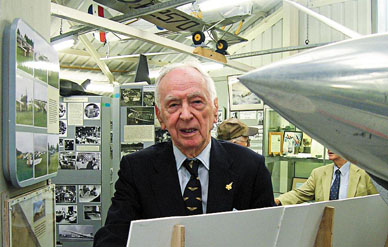
Captain Eric Brown. MBE, OBE, CBE, DSC, AFC.

Now Think Sound Barrier!

I was excited to see details of a lecture held recently in Glasgow, recounting the Struggle to Break the Sound Barrier.  [Nice history on WikiPedia, Ed]

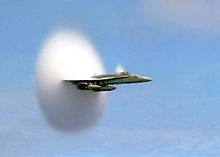
FA-18 breaking sound barrier

How easy it is today to jump into an aircraft, and expect to fly safely round the world in the luxury of an arm chair 7 miles or more above the surface of the earth, or know that the modern aircraft of our Air Forces can fly on every limit known, in the knowledge that all the aerodynamic tests and trials have been carried out.

Eric Brown is now 92. He gave up his wings at 70, but still 22 years later is lecturing on a subject which was at the time uncharted territory, a race to fly faster than Mach1, the Speed of Sound. Chuck Yeager got there first, but now ponder the following.

Captain “Winkle” Brown was with the Royal Navy for 31 years, much of it as an outstanding test pilot.

He flew 487 different types, (not variants) and made 2407 Aircraft Carrier landings, both World records.

At University he studied German, so at the end of the war as a linguist he interrogated many leading German aviation personalities such as Willy Messerschmitt, Ernst Heinkel, and Hanna Reitsch..

Capt. Eric Brown

What an interesting life, and still with stories to tell, and knowledge to pass on. There’s a lovely interview with Capt. Brown here.

By Bob Derham

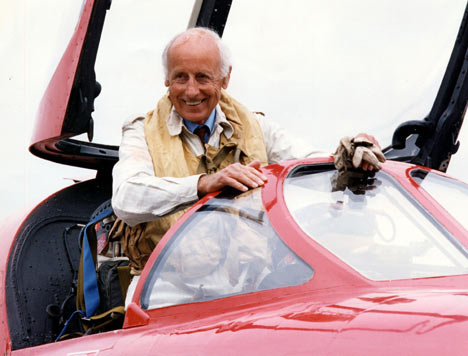
The Hawker Hunter aircraft

What a beautiful aircraft!

On April 2nd, I published an account of a flight in a Hawker Hunter that my dear cousin, Richard, experienced in 2003, the 50th anniversary of Neville Duke’s breaking of the existing world speed record on September 7th, 1953.  Neville Duke died in 2007 at the age of 85.

Squadron Leader Neville Duke, 85, flew 485 operational sorties during the war

It seemed fitting to add a little more information about this marvellous aircraft from an era when Britain built some of the best aircraft in the world.

As always, WikiPedia has an excellent account of the history of the aircraft.  So this Post will just present a few images for readers to ooh, aah over!

Thunder and Lightnings has some excellent images of all the different types including WB188 that Duke broke the speed record in.

Copyright 2009 Damien Burke

F.3 WB188, Hawker Aircraft, RAF Tangmere, 1953; author
As at 7th September 1953, when World Absolute Speed Record of 722.2 mph gained by Neville Duke; pointed nose, reheated engine, additional curved/raked windscreen
Later scheme of Scarlet Red

There is also a distant connection with our erstwhile editor, Paul.  Paul used to fly a TB2o from Exeter Airfield in SW England which is where the Hunter Club is based.  Jonathan Whaley, who commanded the Hunter that Richard flew in, has his own personal Hunter – Miss Demeanour – registration G-PSST so during the summer months it was not uncommon to see Hunters in the sky above Exeter.

Hawker Hunter 'Miss Demeanour'

Finally, a couple of videos to drool over.

and a lovely display at RAF Waddington in rather unpleasant weather conditions

Wonderfully nostalgic!

By Bob Derham

20 years of the WWW

And a neat idea from the BBC

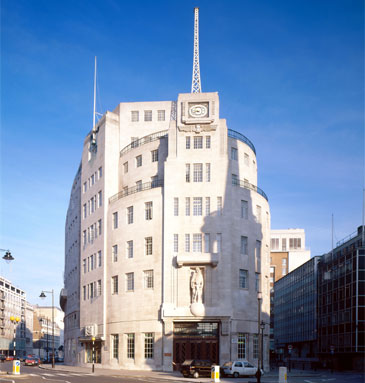
BBC Broadcasting House, Portland Place, London

For those living outside the UK (well so far as our IP address is concerned) watching BBC television via the Web has always been a bit of a challenge.  Presumably because of the way that the BBC is funded, a Licence Fee (aka tax!) on those UK householders that wish to watch public broadcasted television, it is deemed ‘unfair’ if those outside the UK, who do not pay this Fee, have unfettered access to the Beeb’s programming.  Thus if one attempts to access the BBC online from outside the UK you are met with the following message:

Currently BBC iPlayer TV programmes are available to play in the UK only, but all BBC iPlayer Radio programmes are available to you. Why?

However, the BBC have made a wonderful exception with regard to a series of programmes under the title of The Virtual Revolution. All about 20 years of the World Wide Web.

Most of, if not all, the key players of this last 20 years have been interviewed and the uncut footage of these interviews is here.  Fascinating viewing.

And if you fancy making your own documentary using this material, under a unique BBC permissive licence, then here’s where to start.

Well done, the Beeb!

By Paul Handover

Even more Tim Berners-Lee

The powerful spread of open data.

Sir 'Tim' Berners-Lee

Tim Berners-Lee was, or is, the father of the Internet, that remarkable network that has done to connect millions together.  Indeed, my personal view is that the Internet may be the only real tool that people have to protect and defend democracy.

I’m sure thousands know the background of Sir Timothy John “Tim” Berners-Lee, to give him his full name, an Englishman living in the USA.

There was an introduction to the the way that Sir Tim wants to see the web move in yesterday’s Post.

But Tim recently (February 2010) gave a talk in Long Beach, California, entitled The year open data went worldwide. This takes the concept much further.

It’s a fascinating presentation.

By Paul Handover

More Tim Berners-Lee

Not content with ‘inventing’ the world wide web, Sir Tim is still at it.

This Post doesn’t really require any introduction.

If you see Sir Tim as the hero that he is then you will want to watch this presentation given to a TED audience in 2009.

Enough said!

By Paul Handover

Man on the moon

How many remember this?

Very early on in the life of this Blog, indeed on the second day, I wrote a short article about the NASA mission to the moon, some 40 years after the event.  You see, for me that has been the historic event of my lifetime.

I believe that this nation should commit itself to achieving the goal, before this decade is out, of landing a man on the Moon and returning him safely to the Earth. No single space project in this period will be more impressive to mankind, or more important in the long-range exploration of space; and none will be so difficult or expensive to accomplish.
Apollo 11 badge

That speech before Congress by President Kennedy was on the 25th May, 1961.  I was 16 and was enthralled by the idea of being alive when man first set foot on another planetary body.  That came about on July 20th, 1969 at which time I was living and working in Sydney, Australia.  I took three days off work, rented a TV and watched every minute of the event.

Exploration is a core need of man.  By pushing out the boundaries of our knowledge we continue to offer hope to mankind.

So it is with great disappointment that it has been announced by President Obama that the manned mission programs to the moon are to be severely curtailed – that sounds terribly like political speak for cancelled!

As Eugene Cernan (last astronaut to set foot on the moon) said:

I’m quite disappointed that I’m still the last man on the Moon. I thought we’d have gone back long before now.
I think America has a responsibility to maintain its leadership in technology and its moral leadership… to seek knowledge. Curiosity’s the essence of human existence.

Curiosity is indeed the essence of human existence.

That curiosity and the investment in space exploration by NASA on behalf of the whole world has shown us some remarkable findings about Saturn and it’s majestic rings.  Just watch the video segments in this piece from the BBC.

The one-time cost of Cassini-Huygens mission was $3.26 billion. Just 0.3% of the cost of one year’s expenditure on U.S. defense spending.

Science missions like Cassini enhance cooperation between nations, and greatly contribute to scientific progress which benefits everyone.

Perhaps the big Banks would like to pick up the cost of further manned missions to the Moon?

By Paul Handover

Humour is alive and well!

The Toyota Prius recall gets a few laughs.

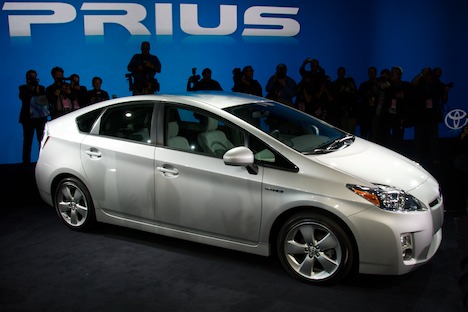
2010 model Prius

Most of the readers of Learning from Dogs will be aware of the global embarrassment that Toyota is facing as a result of the recall of the Toyota Prius model.  As described partly on the UK website of Toyota:

Toyota have announced a recall on the latest, third-generation Prius built before 27 January 2010. This will involve 8,500 cars in the UK.

To date, there have been no accidents linked to this issue reported in Europe. No other Toyota or Lexus models are affected by this latest recall action in Europe.

Toyota GB would like to apologise to its customers for any concern this issue has caused.

The recall is being taken in response to reports of inconsistent brake feel during slow and steady braking on bumpy or slick road surfaces when the anti-lock braking system (ABS) is actuated.

Well a few days ago, a friend of mine sent me a text message on my cell phone.  It read, “Just driving my new Toyota Prius. Chat later, Can’t stop.

And I see the Jeremy Clarkson/James May team from BBC’s Top Gear programme are also having a little poke at Toyota.  James May was reported to have said:

‘You have to laugh a bit don’t you,’

‘Maybe if you’re going to try to save the world through your car you have to accept that some sacrifices have to be made and one of them is stopping.’

James May

How Earth Made Us …

... and the way we treat it!

Once again the British Broadcasting Company, BBC, has put together a spectacular television production; the epic story of how geology, geography and climate have influenced mankind.  It is remarkable and fabulous viewing as you can sample in these opening minutes from the first episode on Deep Earth.

The four programmes, Deep Earth; Water; Wind; Fire, are testament to both the incredible symbiosis between mankind and the elements and how that relationship is critically balanced in a way that allows us to survive.  Some of the images are truly outstanding, for example, the section on Prof. Iain Stewart exploring the Naica Cave system in Mexico.

Naica Cave system, Mexico

This theme of the balance of geological circumstances that allows, just, mankind to survive comes across time and time again in these films.  For example, our relationship with fresh water which we all take completely for granted.

Have any of us really pondered how long we would survive if there was insufficient clean, safe drinking water to go around?

The programmes also reveal something of the technological prowess that mankind has achieved to allow the way these films have been produced.

So why, oh why, are we also such a stupid, stupid species – so stupid that we foul our own nest to an incredible degree.

Continue reading “How Earth Made Us …”

Are you really sure about your cell phone?

Society may be cooking up one hell of an issue.

Like most people if most western nations, for many years I had a cell phone, or a mobile phone as they are known in the UK.

I can recall a few years ago there being a scare in the UK about the microwave radiation hazard involved in using a cell phone but it certainly passed me by in terms of not really worrying about it.

Now a recent report in GQ Magazine seems to be gathering some momentum: once again, it’s about how your cell phone may be hazardous to your health.  It would be too easy just to dismiss this as just another poke at a very successful technology but something about this article caused me to write this Post – make of it what you will.

Here’s an extract:

Earlier this winter, I met an investment banker who was diagnosed with a brain tumor five years ago. He’s a managing director at a top Wall Street firm, and I was put in touch with him through a colleague who knew I was writing a story about the potential dangers of cell-phone radiation. He agreed to talk with me only if his name wasn’t used, so I’ll call him Jim. He explained that the tumor was located just behind his right ear and was not immediately fatal—the five-year survival rate is about 70 percent. He was 35 years old at the time of his diagnosis and immediately suspected it was the result of his intense cell-phone usage. “Not for nothing,” he said, “but in investment banking we’ve been using cell phones since 1992, back when they were the Gordon-Gekko-on-the-beach kind of phone.” When Jim asked his neurosurgeon, who was on the staff of a major medical center in Manhattan, about the possibility of a cell-phone-induced tumor, the doctor responded that in fact he was seeing more and more of such cases—young, relatively healthy businessmen who had long used their phones obsessively. He said he believed the industry had discredited studies showing there is a risk from cell phones. “I got a sense that he was pissed off,” Jim told me. A handful of Jim’s colleagues had already died from brain cancer; the more reports he encountered of young finance guys developing tumors, the more certain he felt that it wasn’t a coincidence. “I knew four or five people just at my firm who got tumors,” Jim says. “Each time, people ask the question. I hear it in the hallways.”

Continue reading “Are you really sure about your cell phone?”