Tag: taxation

Government Taxation Departments, don’t you just love them!

Sent in by John Lewis, an old (English) friend of this Blog.

Apparently this is a real reply from the (UK) Inland Revenue. The Guardian newspaper had to ask for special permission to print it.

Dear Mr Addison,

I am writing to you to express our thanks for your more than prompt reply to our latest communication, and also to answer some of the points you raise.   I will address them, as ever, in order.

Firstly, I must take issue with your description of our last as a “begging letter”.    It might perhaps more properly be referred to as a “tax demand”.    This is how we at the Inland Revenue have always,  for reasons of accuracy,  traditionally referred to such documents.

Secondly, your frustration at our adding to the “endless stream of crapulent whining and panhandling vomited daily through the letterbox on to the doormat” has been noted.    However, whilst I have naturally not seen the other letters to which you refer I would cautiously suggest that their being from “pauper councils, Lombardy pirate banking houses and pissant gas-mongerers”  might indicate that your decision to  “file them next to the toilet in case of emergencies”  is at best a little ill-advised.    In common with my own organisation,  it is unlikely that the senders of these letters do see you as a “lackwit bumpkin” or, come to that, a “sodding charity”.    More likely they see you as a citizen of Great Britain , with a responsibility to contribute to the upkeep of the nation as a whole.

Which brings me to my next point.   Whilst there may be some spirit of truth in your assertion that the taxes you pay  “go to shore up the canker-blighted, toppling folly that is the Public Services”,  a moment’s rudimentary calculation ought to disabuse you of the notion that the government in any way expects you to “stump up for the whole damned party”  yourself.    The estimates you provide for the Chancellor’s disbursement of the funds levied by taxation,  whilst colourful,  are,  in fairness,  a little off the mark.     Less than you seem to imagine is spent on “junkets for Bunterish lickspittles”  and  “dancing whores”  whilst far more than you have accounted for is allocated to,  for example,  “that box-ticking facade of a university system.”

A couple of technical points arising from direct queries:

1. The reason we don’t simply write  “Muggins” on the envelope has to do with the vagaries of the postal system;

2. You can rest assured that  “sucking the very marrow of those with nothing else to give”  has never been considered as a practice because even if the Personal Allowance didn’t render it irrelevant,  the sheer medical logistics involved would make it financially unviable.

I trust this has helped.   In the meantime,  whilst I would not in any way wish to influence your decision one way or the other,  I ought to point out that even if you did choose to  “give the whole foul jamboree up and go and live in India ”  you would still owe us the money.

Please send it to us by Friday.

Yours sincerely,
H J Lee
Customer Relations
Inland Revenue
The Age of Pledge and Spin

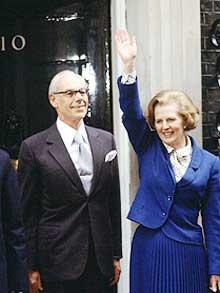
Mrs Thatcher and hubby

A dream that, perhaps, one day politicians will be truthful.

British General Elections are always fascinating occasions. On the one hand they are deadly serious. Mrs Thatcher’s win in 1979 set up the country for 18 years of Tory rule with massive changes and frequent social conflict whose effects are still felt today.

It was either a total social and economic disaster or a great leap forward into modernity depending on your point of view. Her victory of course also consigned Labour to 18 years of impotent pfaffing about in the political wilderness.

But on the other hand they always cause a great deal of hilarity to the student of human behaviour, as day after day nonsensical, fatuous, spinladen pronouncements are made by those desperate to get their hands on power.

And these pronouncements of future intentions (often delivered with the word “pledge” attached – as if that were somehow more weighty than “promise”) are often based not on reason or good planning but on how they will go down with the public!

And amazingly, they often seem to be made without any great thought about the consequences. Brown has got some stick only today because he promised (or if you like “pledged”) that there would be no VAT imposed on the Simon Cowell charity record for Haiti, yet EU rules prohibit such gestures and so the Treasury is having after all to charge VAT and is now promising to pay this back with increased aid as a workaround.

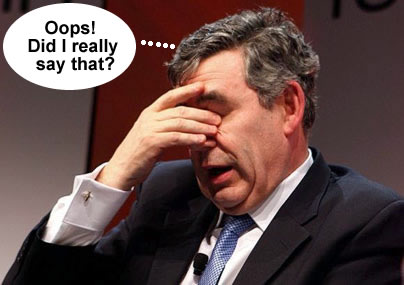
Foot in mouth - again!

The increased aid could have been given in the first place without his headline-grabbing “pledge” to make it VAT-free.

As ex Chancellor, Brown should have KNOWN that removing VAT from individual items on a whim is not allowed, but he clearly spoke without thinking, the headline-potential of declaring the record VAT-free being irresistible.

Gordon Brown has also got himself into “another fine mess” by trying out a variation of  his trick of the 1994 election.

During the pre-election campaign then he solemnly pledged NOT to raise income tax. No,  not he. He was not the man to steal the public’s hard-earned cash by raising income tax; that would be most unsporting.

Meanwhile the poor old honest and hopelessly-naive spinfree Lib-Dems promised to put one measly pence onto income tax to pay for more education. Naturally, in the election they got slaughtered as wild spenders. You couldn’t make it up!

As for Gordon Brown, he kept his word. Income Tax remained as untouched as the virgin snow. But he had a cunning plan; as soon as he got his hands on our money, he vastly raised National Insurance (NI) instead. It actually comes down to the same thing, but of course the SPIN was different. That was how Brown’s management of our finances began, and so it has gone ever since.

Well, it’s hard not to repeat a winning formula, as many crooks have found out to their cost.  Putting up National Insurance of course (even if this time you TELL the people you’re going to do it) can be sold as much more  socially responsible than simply putting up income tax. The former can be spun as essential to pay for hospitals, pensions and the like whereas the latter seems more often like Robin Hood in reverse. The silly thing is that it’s ALL MONEY TAKEN FROM OUR PAYPACKETS, so what difference does it make?

Well, to the wage-earner, none at all, but to the employer quite a lot, and this is where Brown is batting on a sticky wicket. Increasing National Insurance certainly IS a “tax on jobs”. Let’s look across the English Channel ……

They have a VERY high level of NI (French = “charges”) in France. The result is that:

  • Employers bend over backwards NOT to employ anyone; it is so expensive.
  • Productivity in France is very high (higher than in the US – fewer workers than in many other countries do the same amount of work).
  • Unemployment is also consistently very high.

In Denmark it is much cheaper and easier to hire and fire people than in France. Oh Dear! Horrible, nasty, capitalist,  Denmark and wonderful, caring, socialist France!!

Errmmm … No, actually; unemployment in Denmark is usually around 4% (I just checked; it is TODAY despite all the economic chaos just 4.1%) and in France endemically nearer 10%.

Rocket science it ain’t. Sad for the otherwise-could-be-employed it certainly is.

Well, even the plebs are not quite as gullible as 25 years ago. The negative effects on employment are blindingly-obvious to employers but as it is such an easy thing to understand (though not apparently for the entire French government or for Mr Brown) ordinary people are beginning to understand it, too. Brown’s statement that he will raise NI isn’t doing his election campaign any good at all.

However, as it is currently business leaders in particular who are bleating about this, perhaps it will be spun as: “Don’t worry chaps – it’s just those capitalist business-chief bastards whinging again”. That’s one thing you can rely on in an election; there will be endless spinning, quoting of statistics and rubbishing of the enemy ….

By Chris Snuggs