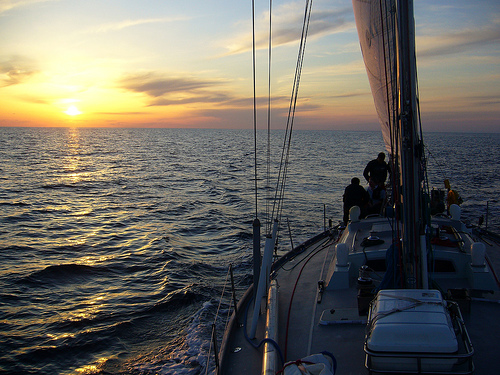
Tag: Songbird of Kent

More sharing the thoughts of others.

Unexplored waters ahead!

My sub-title comes from personal knowledge of what it feels like to set out on an ocean voyage into waters that one has not sailed before. In my case, leaving Gibraltar bound for The Azores on my yacht Songbird of Kent in the Autumn of 1969.
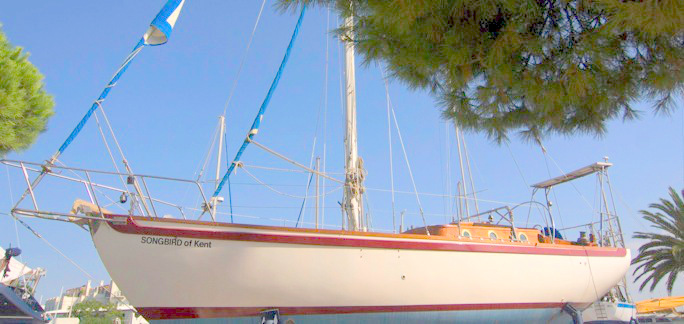
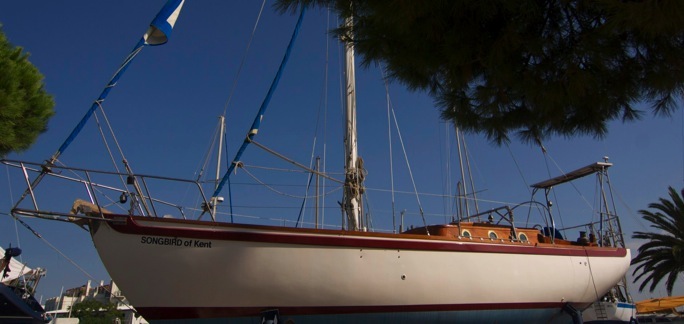
Tradewind 33 - Songbird of Kent.
My home for five years – Tradewind 33: Songbird of Kent.

Despite me being very familiar with my boat, and with sailing in general, there was nonetheless a sense of trepidation as I headed out into a vast unfamiliar ocean.

Coming to matters closer to hand, there is a sense of trepidation felt by me and countless others as to what world we are heading into if we don’t take seriously the risks that are ‘tapping on our door’.

So hold that in your mind as you read a recent essay published by Patrice Ayme’; an essay that highlights very uncertain times ahead if we, as a global society, don’t get our act together pretty damn quick. Republished here on Learning from Dogs with Patrice’s kind permission.

ooOOoo

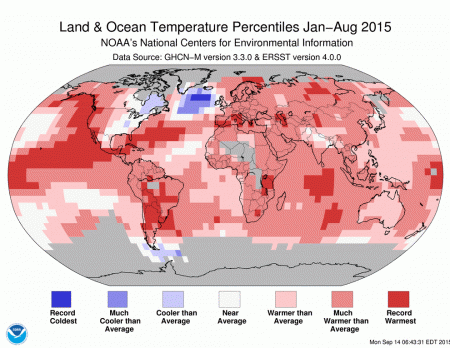
Record Heat 2015, Obama Cool

2014 was the warmest year ever recorded. 2015 was even warmer, and by far, by .16 degrees centigrade. The UK (Great Britain) meteorological office announced that the temperature rise is now a full degree C above the pre-industrial average. At this annual rate of increase, we will get to two degrees within six years (as I have predicted was a strong possibility).

What’s going on? Exponentiation. Just as wealth grows faster, the greater the wealth, mechanisms causing more heat are released, the greater the heat. Yes, it could go all the way to tsunamis caused by methane hydrates explosions. This happened in the North Atlantic during the Neolithic, leaving debris of enormous tsunamis all over Scotland.

heat-2015
2015: Not Only Record Heat, But Record Acceleration Of Heat

The Neolithic settlements over what is now the bottom of the North Sea and the Franco-English Channel (then a kind of garden of Eden), probably perished the hard way, under giant waves.

Explosions of methane hydrates have started on the land, in Siberia. No tsunami, so far. But it can, and will happen, any time. The recent North Easter on the East Coast of the USA was an example of the sort of events we will see ever more of: a huge warm, moist Atlantic born air mass, lifted up by a cold front.

Notice that, at the COP 21 in Paris all parties, 195 nations, agreed to try their best to limit warming to 1.5 degree Centigrade. At the present instantaneous rate, that’s less than 4 years away. Even with maximum switching out of fossil fuels, we are, at the minimum, on a three degrees centigrade target, pretty soon.

By the way, if all nations agree, how come the “climate deniers” are still heard of so loudly? Well, plutocrats control Main Stream Media. It’s not just that they want to burn more fossil fuels (as it brings them profit, they are the most established wealth). It’s also that they want to create debates about nothing significant, thus avoiding debates about significant things, such as how much the world is controlled by Dark Pools of money.

Meanwhile, dear Paul Krugman insists in “Bernie, Hillary, Barack, and Change“, that it would be pure evil to see him as a “corrupt crook“, because he believes everything Obama says about change and all that. Says Krugman: “President Obama, in his interview with Glenn Thrush of Politico, essentially supports the Hillary Clinton theory of change over the Bernie Sanders theory:

[Says Obama]: ‘I think that what Hillary presents is a recognition that translating values into governance and delivering the goods is ultimately the job of politics, making a real-life difference to people in their day-to-day lives.’”

This is all hogwash. We are not just in a civilization crisis. We are in a biosphere crisis, unequalled in 65 million years. “Real-life differences“, under Obama, have been going down in roughly all ways. His much vaunted “Obamacare” is a big nothing. All people in the know appraise that next year, it will turn to a much worse disaster than it already is (in spite of a few improvements, “co-pays” and other enormous “deductibles” make the ironically named, Affordable Care Act, ACA, unaffordable).

The climate crisis show that there is no more day-to-day routine. At Paris, the only administration which caused problem, at the last-minute, was Obama’s. How is that, for “change”? The USA is not just “leading from behind”, but pulling in the wrong direction. Really, sit down, and think about it: under France’s admirable guidance (!), 194 countries had agreed on a legally enforceable document. Saudi Arabia agreed. The Emirates agreed. Venezuela agreed. Nigeria agreed. Russia agreed. Byelorussia agreed. China, having just made a treaty with France about climate change, actually helped France pass the treaty. Brazil agreed. Zimbabwe agreed. Mongolia agreed. And so on. But, lo and behold, on the last day, Obama did not.

I know Obama’s excuses well; they are just that, excuses. Bill Clinton used exactly the exact same excuses, 20 years ago. Obama is all for Clinton, because, thanks to Clinton, he can just repeat like a parrot what Clinton said, twenty years ago. Who need thinkers, when we have parrots, and they screech?

I sent this (and, admirably, Krugman published it!):

“No doubt Obama wants to follow the Clintons in making a great fortune, 12 months from now. What is there, not to like?

Obama’s rather insignificant activities will just be viewed, in the future, as G. W. Bush third and fourth terms. A janitor cleaning the master’s mess. Complete with colored (“bronze”) apartheid health plan.

What Sanders’ supporters are asking is to break that spiral into ever greater plutocracy (as plutocrat Bloomberg just recognized).”

Several readers approved my sobering message, yet some troll made a comment, accusing me of “racist “slander”. Racist? Yes the “bronze” plan phraseology is racist. I did not make it up. And it is also racist to make a healthcare system which is explicitly dependent upon how much one can afford. Krugman is all for it, but he is not on a “bronze” plan. Introducing apartheid in healthcare? Obama’s signature achievement. So why should we consider Obama as the greatest authority on “progressive change”? Because we are gullible? Because we cannot learn, and we cannot see? Is not that similar to accepting that Hitler was a socialist, simply because he claimed to be one, it had got to be true, and that was proven because a few million deluded characters voted for him?

We are in extreme circumstances, unheard of in 65 million years, they require extreme solutions. They do not require, nor could they stand, Bill Clinton’s Third Term (or would that be G. W. Bush’s fifth term? The mind reels through the possibilities).

“Change we can believe in”: the new boss, same as the old boss, the same exponentiation towards inequality, global warming and catastrophe, the same warm rhetoric of feel-good lies.

As it is, there is a vicious circle of disinformation between the Main Stream Media, and no change in the trajectory towards Armageddon. Yes, Obama was no change. Yes, Obama was the mountain of rhetoric, who gave birth to a mouse. Yes, we need real change, and it requires to start somewhere. And that means, not by revisiting the past.

Patrice Ayme’

ooOOoo

Yes, we do need real change, and every day that we think that this change is the responsibility of someone else then that is another day lost forever. Or in the more proasic words of Mahatma Gandi, “You must be the change you wish to see in the world.”
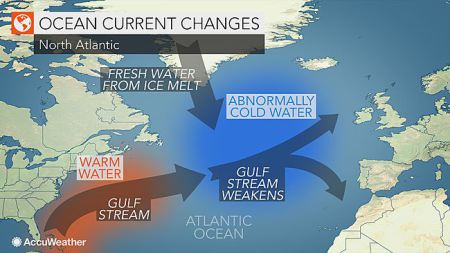
The changing North Atlantic.

The vastness of the seas and the immensity of their influence over all of us.

This is an introduction, a rather long one I’m warning, to a republication of a recent post by Patrice Ayme. An introduction that offers a deeply personal memory of the Atlantic ocean.

Many years ago, I spent 5 years living on a boat; a wonderful heavy-displacement ocean-going yacht of a type known as a Tradewind 33.

Tradewind 33 - Songbird of Kent.
My home for five years – Tradewind 33:  Songbird of Kent.

There is a place in my mind to which I can so easily travel; a memory of a dark night out in the Atlantic ocean one time in the Autumn of 1969. But first let me set the scene from almost fifty years ago.

The call of the open ocean

Those first few hours were utterly absorbing as I went through the whole business of clearing the yacht harbour at Gibraltar and heading out to the South-West hugging this unfamiliar coastline of Southern Spain. It was tempting to move out to deeper waters but the almost constant flow of large ships through the Straights of Gibraltar soon quashed that idea. Thankfully, the coastal winds were favourable for me and my single-masted sailing yacht.

After such a long time sailing in the relatively confined waters of the Mediterranean, it was difficult for me to imagine that in a few hours time the southern-most point of Spain would pass me by and the vastness of the Atlantic ocean would be my home for the next few weeks.

Soon the city of Tarifa was past my starboard beam and the Spanish coastline was rapidly disappearing away to the North-West. The horizon ahead of me was already approaching 180 degrees of raw, open ocean.  There was just a flicker of a thought that whispered across my mind: “Oh Paul, what have you gone and done” as slowly but persistently the coastlines of Spain to the North and of Africa to the South became more and more distant and fuzzy.  It was at 15:30 that I made an entry in my yacht’s log: “No land in sight in any direction!

Now was the time to make sure that my bunk was made up, flashlights to hand, and my alarm clock ready and set. Alarm clock? Set to go off every twenty minutes during the night! For this was the only way to protect me and my yacht from being hit by one of those gigantic container ships that seemed to be everywhere. It took at least twenty minutes from the moment a ship’s steaming lights appeared above the horizon to crossing one’s path!

It was in the early hours of my first morning alone at sea, when once again the alarm clock had woken me and I was looking around an ocean without a single ship’s light to be seen that more of Les’ words (see footnote) came to me. I remembered asking Les: “What’s the ­appeal of sailing?” Les replied without a moment’s hesitation: “It’s the solitude. When you’re out at sea on your own, there’s no government or bankers to worry about. You’re not ­responsible to anyone but yourself.

Yes, I could sense the solitude that was all around me but it was an intellectual sense not an emotional one. That would come later. Inside, I was still afraid of what I had let myself in for.

Remarkably quickly however, the pattern of solo life aboard a thirty-three-foot yacht became my world. Frankly, it staggered me as to how busy were my days. Feeding myself, navigating, trying to forecast the winds, staying in touch with other yachties via the short-wave radio, keeping the boat tidy and a zillion other tasks meant the first few days and nights just slipped by.

But it was a sight on my fourth night at sea that created the memory that would turn out to remain with me for all my life. The memory that I can go to anytime in my mind.

That fourth night I was already well into the routine of waking to the alarm clock, clipping on my harness as I climbed up the three steps that took me from my cabin into the cockpit, scanning the horizon with my eyes, checking that the self-steering had the boat at the correct angle to the wind and then, if no ships’ lights had been seen, slipping back down into my bunk and sleeping for another twenty minutes. Remarkably, I was not suffering from any long-term tiredness during the day.

It was a little after 3am that fourth night when the alarm clock had me back up in the cockpit once again. Then it struck me.

Songbird was sailing beautifully. There was a steady wind of around ten knots from the south-east, almost a swell-free ocean, and everything set perfectly.  Not a sign of any ship in any direction.

Then I lifted my eyes upwards. There was not a cloud in the night sky, not a single wisp of mist to dim a single one of the million or more stars that were above my head. For on this dark, moonless night, so far removed from any shore-based light pollution, the vastness, yet closeness of the heavens above was simply breath-taking. I was transfixed. Utterly unable to make any rational sense of this night splendour that glittered in every direction in which I gazed. This dome that represented a vastness beyond any meaning other than a reminder of the magic of the universe.

This magic of the heavens above me that came down to touch the horizon in all directions. Such a rare sight to see the twinkling of stars almost touching the starkness of the ocean’s horizon at night. A total marriage of this one planet with the vastness of outer space.

I heard the alarm clock go off again and again next to my bunk down below. But I remained transfixed until there was a very soft lightening of the skyline to the east that announced that another dawn was on its way.

I would never again look up at the stars in a night sky without being transported back to that wonderful night and the memory of a lonely sea and sky.

I did warn you it would be a long introduction!

ooOOoo

Non-Linear Cold Blob Rising Over North Atlantic

The reason life survived on Earth for so long, and blossomed into animals, and now mind, is that the planet is equipped with homeostatic mechanisms (homeo means similar in Greek, and stasis, standing still). However, those mechanisms tend to be geological.

Human civilization is now having an impact on the biosphere of a violence probably never seen before. The changes are faster than what geology, or even life, can accommodate.

Some will brandish the impact of the Yucatan asteroid, and claim that was worse; however that’s just a theory: the biosphere was clearly under stress at the time from the Deccan Traps eruptions, and had been under that stress for hundreds of thousands of years, if not millions. At its worst, the Asteroid was just the straw which broke the Camel’s back.

2015 will be the warmest year since the end of the Eemian, 115,000 years ago. So why are record low temperatures appearing just south of Iceland? Yes, record lows, lower than ever recorded.

While The Rest Of Planet Is At Record Warmth, Off Iceland, Record Colds Are Achieved!

That was fully expected, and a demonstration of Non-Linearity of the incipient global warming. A phenomenon is linear when it looks like a line. Global warming is not going up like a line, as some places are warming at a rate ten times higher than the average, and some regions are cooling (and some are cooling spectacularly, off Iceland and some seas around Antarctica, for reasons related to warming).

The Dryas events were extremely fast and pronounced cooling events which happened several times during the period 10,000 years to 15,000 Before Present. Some lasted around a millennium, others, just a century. They vanished as fast as they came. They are named after a tundra flower, the Dryas. In Scandinavia forests were replaced by tundra graced with Dryas (hence the name). In Britain, average temperature collapsed to minus 5 degree Celsius, and glaciers formed at elevation.

These spastic events of drastic cooling, while, overall, de-glaciation was going on, long remained a mystery. Overall, the great glaciation which had brought glaciers down to New York, was on its way out, the planet was globally, irresistibly warming. So why would temperatures collapse in some places around Greenland by 15 degrees Celsius? The solution to the Dryas events’ spastic glaciation riddle? The same as always! Warming is non-linear.

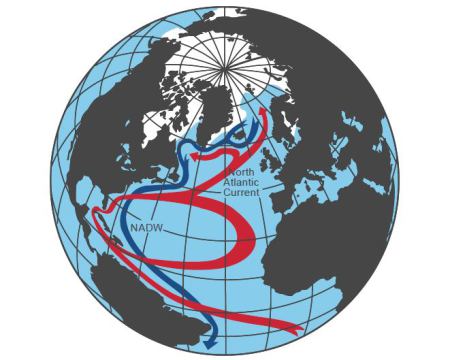
What’s the theory? The details are uncertain, but we know that the Gulf Stream (aka the North Atlantic “Conveyor”) shorted, literally: analyses of deep sea sediments have shown this. The conveyor sends an enormous current of warm tropical waters northward.

When the warm tropical waters become very cold between Iceland and Spitzbergen, they sink to the bottom of the sea, and head south. This sinking, plus the pushing by trade winds in the tropics, is what provides the energy of the Gulf Stream.

However, if the warm tropical waters are capped by a very cold, but light sweet(er) water lid, they will get cold early, and sink before Iceland. This is what happened in the Dryas events.

And It Is Happening Again, Albeit On A Smaller Scale.

Was it in response to a sudden influx of fresh water from Lake Agassiz and deglaciation in North America, and Greenland? Sudden freezing there would have removed the freshwater lid, hence the brutal switchback to warming after the brutal cooling. By the way, the sea level rising speed responded quickly, by a factor of three. After the typical Dryas cooling, oceanic rise rebounded to 18 millimeter per year right away (this shows that those who expect a slow rise of sea level rise are deluding themselves, or, more to the point, are trying to delude us!)

Nowadays a Dryas-like mechanism would have to rest on the melting of Greenland alone (that’s the only place with significant ice). This is, of course, insufficient, but summer 2015, cool and rainy over the northern North Atlantic is evidence that the effect is on. Scientific analysis confirms it. See: “Exceptional Twentieth Century Slow Down of Atlantic Ocean Overturning Circulation” (Nature, 23 March, 2015).

The exact nature of what is going on at this point is a matter of debate among experts. What is sure is that something is going on.

The Atlantic Conveyor Is A Subtle Thing, Yet Dominates Glaciation In The Arctic.

A similar situation beckons in Antarctica, where ice shield melting creates a freshwater lid all around which in turn freeze, extending the ice cap in the Austral winter.

When considering nonlinearity, subtlety and surprises are of the essence. This is true in physics, as it is in psychology, history, or politics.

And the morality in all this? The USA has played god. The European Union made a honest to goodness effort to reduce CO2 emission, while the USA, paying lip service to the opposite of what it was doing went right ahead, with its factory, the Plutocratic Republic of China, to use and abuse fossil fuels as never before.

So now what? Is god still American, as usual? At first it seems so: the USA started to frack massively and massive amounts of fossil fuels were extracted from the USA’s generous soil. When American companies tried the same in Poland, it failed: the underground god (Pluto?) did not cooperate: Polish soil is adverse to fracking.

Here comes the punchline: sea level has been rising fast along the Eastern seashore of the USA. Actually, three to four times faster than the world average. That’s more than one centimeter per year.

Why? Imagine a traffic jam. Or rather a crash ahead: things come to a halt, cars, water piles up behind. Maybe the Washington politicians will soon have to learn to swim, and not just against the tide of world public opinion.

The USA is going to be punished with its own instruments. Meanwhile 20 countries formed the V20, a group of twenty countries whose existence is immediately threatened by global warming, although they caused it not.

A Two Degree Celsius rise of temperature is indeed way too much: nonlinearity is upon us. Evil is always nonlinear.

Patrice Ayme’

ooOOoo

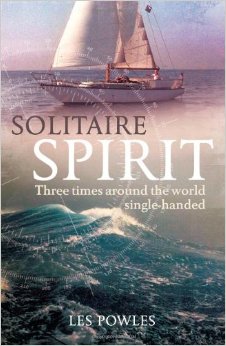
Footnote: The Les referred to is Les Powells, the yachtsman who sailed solo three times around the world. He and I became good friends when we met up at Larnaca Marina in Cyprus.


Les Powells book


Writing 101 Day Two

A room with a view.

Here’s what WordPress sent out:

Today’s Prompt: If you could zoom through space in the speed of light, what place would you go to right now?

The spaces we inhabit have an influence on our mood, our behavior, and even the way we move and interact with others. Enter a busy train station, and you immediately quicken your step. Step into a majestic cathedral, and you lower your voice and automatically look up. Return to your own room, and your body relaxes.

A place belongs forever to whoever claims it hardest, remembers it most obsessively, wrenches it from itself, shapes it, renders it, loves it so radically that he remakes it in his own image. – Joan Didion

Today, choose a place to which you’d like to be transported if you could — and tell us the backstory. How does this specific location affect you? Is it somewhere you’ve been, luring you with the power of nostalgia, or a place you’re aching to explore for the first time?

Today’s twist: organize your post around the description of a setting.

Giving your readers a clear sense of the space where your story unfolds will help them plunge deeper into your writing. Whether it’s a room, a house, a town, or something entirely different (a cave? a spaceship?), provide concrete details to set this place apart — and to create a more immersive reading experience.

You can go the hyperrealist route (think the opening four paragraphs of Gustave Flaubert’s A Simple Soul, a masterclass of telling detail). Or focus on how a specific space makes the people in it feel and behave, like blogger Julie Riso did in this visceral recounting of her hike through an Estonian bog.

So here we go!

 The lonely sea and the sky.

The title of my story is taken from that famous poem Sea Fever by John Masefield. Here’s that first stanza of Masefield’s poem:

I must go down to the seas again, to the lonely sea and the sky,
And all I ask is a tall ship and a star to steer her by;
And the wheel’s kick and the wind’s song and the white sail’s shaking,
And a grey mist on the sea’s face, and a grey dawn breaking.

There is a place in my mind to which I can so easily travel that resonates perfectly with my chosen title. A memory of a dark night out in the Atlantic ocean one time in the Autumn of 1969.

First let me set the scene of this place in my mind, a scene almost fifty years ago, written from that time.

The call of the open ocean

Those first few hours were utterly absorbing as I went through the whole business of clearing the yacht harbour at Gibraltar and heading out to the South-West hugging this unfamiliar coastline of Southern Spain. It was tempting to move out to deeper waters but the almost constant flow of large ships through the Straights of Gibraltar soon quashed that idea. Thankfully, the coastal winds were favourable for me and my single-masted sailing yacht.

After such a long time sailing in the relatively confined waters of the Mediterranean, it was difficult for me to imagine that in a few hours time the southern-most point of Spain would pass me by and the vastness of the Atlantic ocean would be my home for the next few weeks.

Soon the city of Tarifa was past my starboard beam and the Spanish coastline was rapidly disappearing away to the North-West. The horizon ahead of me was already approaching 180 degrees of raw, open ocean.  There was just a flicker of a thought that whispered across my mind: Oh Paul, what have you gone and done!

Where this crazy adventure had been born.

In 1986 I had the opportunity to take a few years off. Off from a working life, that is. I had started my own company in 1978 after eight years of being a salesman for the Office Products Division of IBM UK. In 1986, the successful sale of my company meant that for a while I could go and play. By chance, that summer I went on a vacation to Larnaca on the Island of Cyprus; Larnaca being on the Greek side of what was a divided island (and still is!) between Greece and Turkey.

Larnaca struck me as a lovely place on a lovely island in the Eastern part of the Mediterranean Sea. Again, quite by chance, one day during my vacation, when strolling around Larnaca Marina, I noticed a yacht with a For Sale notice on the yacht’s pulpit. The yacht, named Songbird of Kent, was a Tradewind 33, a type that I had heard about previously from reading yachting magazines. I vaguely recalled that the type had been designed in the UK by John Rock, himself an experienced deep-water yachtsman, for the purpose of serious ocean sailing and that many Tradewinds had completed vast ocean crossings.

I was still looking at the yacht, lost in some dream about sailing the seas, when a call brought me back to ground, so to speak. It was a call from a man who had just come on deck from the cabin and had spotted me looking at Songbird.

Hi, my name is Ken and I’m the owner of Songbird. Did you want to come onboard and have a look around?” I couldn’t resist!

It transpired that Ken, and Betty his wife, an English couple, had been living on Songbird for some years, cruising the Mediterranean each Summer, and now wanted to return to England.

It was obvious that the yacht, a single-masted vessel with double head-sails known in the trade as a cutter rig, had been cared for in every possible way and that the yacht was offered for sale in a manner that meant she could become my permanent new home with little or no effort on my behalf. Thus so it was that three hours later Ken and Betty and yours truly had agreed terms for the sale of Songbird of Kent. One of those spur of the moment things that we do in our lives that, so often, make being alive such a reward.

I should explain that as a younger man (I was 42 when I agreed to buy Songbird) I had devoured the books written by such round-the-world solo sailors as Francis Chichester and Joshua Slocum and many others and harboured this silly, naive dream of one day doing a solo transatlantic crossing. Later on in life, when living in Wivenhoe in Essex, I bought my first yacht but never achieved anything more than local coastal sailing and a couple of overnight sailings to Holland; all with others I should hasten to add, never solo! However, I knew for sure that if there was one yacht that was perfect for open ocean sailing it was the Tradewind.

So it wasn’t long before my home in Great Horkesley, near Colchester, had been sold and I was adjusting to a new life as a ‘live aboard yachtie’ out in Cyprus.

I loved living in Larnaca for a whole bundle of reasons that I won’t go into here. Except one! That was that in my years of living and working near Colchester, which was where my business had been based, I had been introduced to gliding and eventually had ended up becoming a gliding instructor. So imagine my delight at finding that there was an active gliding club on a British ex-military airfield thirty minutes away from Larnaca. It was not long before I was fully back to gliding.

One day, I was doing gliding experience flights for some visitors. Early in the afternoon, up came a quietly spoken Englishman who wanted to get an idea of what it was like to fly in a glider. Les, for that was his name, settled himself in. I checked his straps were secure, pointed out the canopy release and jumped into the seat behind him, and within moments we were airborne.

Later on, when back on the ground and sitting to one side of the old runway, Les and I started chatting about our backgrounds and what had brought each of us to Larnaca. I learned that Les was not only Les Powles, the famous solo sailor, but that he was living on board his yacht, Solitaire, right here in Larnaca Marina.

Over the following days, often with a beer or two in hand, I heard Les’ tales about him having been in his 50s when he built Solitaire, with little prior knowledge of boatbuilding. That he had just eight hours of sailing experience when he decided to sail solo around the world. That remarkably, he had made it across the Atlantic, albeit discovering that his navigation skills didn’t quite match up to his boatbuilding abilities. This translating to his first landfall being the coast of Brazil, a 100 miles south of, and a different hemisphere, to the Barbados he had been aiming for!

I listened for hours, in utter rapture of what Les had achieved. This quiet, unpretentious man that had achieved so much. Including how after solo circumnavigation number one, Les ended up completing a further three solo circumnavigations, all of them full of incidents. Particularly, the last one, with Les being given up for dead when he hadn’t been heard of for over four months. When eventually he sailed up the Lymington River in Hampshire, in a skeletal state, his arrival caused a media frenzy. Lymington Marina subsequently gave him a free berth for life. Les’ boat had been damaged in a storm, he had lost all communications and had virtually run out of food by the time he made it back to England. Oh, and Les was 70 at the time!

At one point in me listening to Les he asked me about my own sailing ambitions. I remarked that I had this tired old idea of a solo sailing across the Atlantic.

Have you done any solo sailing before?”, Les asked me.

I replied, “At the start of most Summers, I sail alone from Larnaca across to the Turkish coast to meet up with family and friends who want to cruise along with me.

Continuing, “Generally I head for Alanya or a little further along the Turkish coast; to Antalya. It takes me two or three days to get there non-stop, most often with me going west-about Cyprus, and then straight up to Turkey. But I am embarrassed to admit that I hate both that trip, and the return solo trip at the end of the Summer. Detest would be a better word than hate.

Pausing before adding a moment later, “If I can’t stomach solo sailing for three days then there’s no chance, no chance at all, that I could sail solo across the Atlantic ocean.

It was then that Les said something both profound and deeply inspiring.

Paul, guess what! The first three days of being alone at sea are just as terrible for me, too. Indeed, I have never met a solo sailor who doesn’t say the same. Those early days of adjusting to your new world, your new world of being alone out on the ocean, are the worst. But never lose hope that from some point around the third or fourth day, you will have worked through that transition and found an unbelievable state of mind; a freedom of mind that has no equal.

Back to reality.

So here I was, Les’ words still ringing in my ears, as slowly but persistently the coastlines of Spain to the North and of Africa to the South became more and more distant and fuzzy.  It was at 15:30 that I made an entry in my yacht’s log: “No land in sight in any direction!

Now was the time to make sure that my bunk was made up, flashlights to hand, and my alarm clock ready and set. Alarm clock? Set to go off every twenty minutes; day and night! For this was the only way to protect me and my yacht from being hit by one of those gigantic container ships that seemed to be everywhere. It took at least twenty minutes from the moment a ship’s steaming lights appearing above the horizon to crossing one’s path!

It was in the early hours of my first morning alone at sea, when once again the alarm clock had woken me and I was looking around an ocean without a single ship’s light to be seen that more of Les’ words came to me. I remembered asking Les: “What’s the ­appeal of sailing?” Les replied without a moment’s hesitation: “It’s the solitude. When you’re out at sea on your own, there’s no government or bankers to worry about. You’re not ­responsible to anyone but yourself.

Yes, I could sense the solitude that was all around me but it was an intellectual sense not an emotional one. That would come later. Inside I was still afraid of what I had let myself in for.

Remarkably quickly however, the pattern of solo life aboard a thirty-three-foot yacht became my world. Frankly, it staggered me as to how busy were my days. Feeding myself, navigating, trying to forecast the winds, staying in touch with other yachties via the short-wave radio, keeping the boat tidy and a zillion other tasks meant the first few days and nights just slipped by.

But it was a sight on my fourth night at sea that created the memory that would turn out to remain with me for all my life. The memory that I can go to anytime in my mind.

That fourth night I was already well into the routine of waking to the alarm clock, clipping on my harness as I climbed up the three steps that took me from my cabin into the cockpit, scanning the horizon with my eyes, checking that the self-steering had the boat at the correct angle to the wind and then, if no ships’ lights had been seen slipping back down into my bunk and sleeping for another twenty minutes. Remarkably, I was not suffering from any long-term tiredness during the day.

It was a little after 3am that fourth night when the alarm clock had me back up in the cockpit once again. Then it struck me.

Songbird was sailing beautifully. There was a steady wind of around ten knots from the south-east, almost a swell-free ocean, and everything set perfectly.  Not a sign of any ship in any direction.

Then I lifted my eyes upwards. There was not a cloud in the night sky, not a single wisp of mist to dim a single one of the million or more stars that were above my head. For on this dark, moonless night, so far removed from any shore-based light pollution, the vastness, yet closeness of the heavens above was simply breath-taking. I was transfixed. Utterly unable to make any rational sense of this night splendour that glittered in every direction in which I gazed. This dome that represented a vastness beyond any meaning other than a reminder of the magic of the universe.

This magic of the heavens above me that came down to touch the horizon in all directions. Such a rare sight to see the twinkling of stars almost touching the starkness of the ocean’s horizon at night. A total marriage of this one planet with the vastness of outer space.

I heard the alarm clock go off again and again next to my bunk down below. But I remained transfixed until there was a very soft lightening of the skyline to the east that announced that another dawn was on its way.

I would never again look up at the stars in a night sky without being transported back to that wonderful night and the memory of a lonely sea and sky.

ooOOoo

As dear Les said, “… a freedom of mind that has no equal.

That place in my mind, that dark, stupendous night out in the Atlantic, still has the power to remind me of that freedom!

I know it will be one of my last thoughts when my time is up.

The book! Part Four: The importance of hope.

The night is always darkest before the dawn.

That very well-know saying rings in my ears the word: hope. Hope! What a short, little word that carries on its back, so to speak, so much promise, so many reasons for staying with it, whatever ‘it’ might mean at any particular moment.

For countless times for countless numbers of people, the importance of hope has been incalculable! But first let’s dip into the dictionary as a way of clearly understanding the word.

Hope: as a noun, in part: “the feeling that what is wanted can be had or that events will turn out for the best”; as a verb, in part: “to look forward to with desire and reasonable confidence”.

Yes, there are other definitions of the word ‘hope’; both as a noun and an adjective. But I selected the two above because they resonated with me and past experiences. Or more accurately, a past experience. My prelude to another story from my past that seemed an appropriate way of opening this chapter; this chapter on hope.

In 1986 I had the opportunity to take a few years off. Off from the working life, that is. I had started my own company in 1978 after eight years of being a salesman for the Office Products Division of IBM UK. In 1986, the successful sale of my company meant that for a while I could go and play. By chance, I went on a vacation to Larnaca on the Island of Cyprus; Larnaca being on the Greek side of what was a divided island(and still is!) between Greece and Turkey.

Larnaca struck me as a lovely place on a lovely island in the Eastern part of the Mediterranean Sea. Again, quite by chance, one day during my vacation, when strolling around Larnaca Marina, I noticed a yacht with a For Sale notice on the yacht’s pulpit. The yacht, named Songbird of Kent, was a Tradewind 33, a type that I had heard about previously from reading yachting magazines. I vaguely recalled that the type had been designed in the UK by John Rock, himself an experienced deep-water yachtsman, for the purpose of serious ocean sailing and that many Tradewinds had completed vast ocean crossings.

I was still looking at the yacht, lost in some dream about sailing the seas, when a call from a man who had just come up from the cabin caught my attention. He had spotted me looking at the yacht.

Hi, my name is Ken and I’m the owner of Songbird. Did you want to come onboard and have a look around?” I couldn’t resist!

It transpired that Ken, and Betty his wife, an English couple, had been living on Songbird for some years, cruising the Mediterranean each Summer, and now wanted to return to England.
It was obvious that Songbird had been cared for in every possible way and that the yacht was offered for sale in a manner that meant she could become my permanent new home with little or no effort on my behalf.
Three hours later Ken and Betty and yours truly had agreed terms for the sale of Songbird of Kent. One of those spur of the moment things that we do in our lives that, so often, make being alive such a reward.

I should explain that as a younger man (I was 42 when I agreed to buy Songbird) I had devoured the books written by such round-the-world solo sailors as Francis Chichester and Joshua Slocum and others and harboured this silly, naive dream of one day doing a solo transatlantic crossing. Later on in life, when living in Wivenhoe in Essex, I bought my first yacht but never achieved anything more than local coastal sailing and a couple of overnight sailings to Holland; all with others I should hasten to add – never solo! However, I knew for sure that if there was one yacht that was perfect for open ocean sailing it was the Tradewind.

Thus it wasn’t long before my home in Great Horkesley, near Colchester, had been sold and I was adjusting to a new life as a ‘live aboard yachtie’ out in Cyprus.

I loved living in Larnaca for a whole bundle of reasons that I won’t go into here. Except one! That was that in my years of living and working near Colchester, which was where my business was based, I had been introduced to gliding and eventually had ended up becoming a gliding instructor. So imagine my delight at finding that there was an active gliding club on a British ex-military airfield thirty minutes away from Larnaca. It was not long before I was fully back to gliding.

One day, I was doing gliding experience flights for some visitors. Early in the afternoon, up came a quietly spoken Englishman who wanted to get an idea of what it was like to fly in a glider. Les, for that was his name, settled himself in, I checked his straps were secure, pointed out the canopy release and jumped into the seat behind him, and within moments we were airborne.

Later on, when back on the ground and sitting to one side of the old runway, Les and I started chatting about our backgrounds and what had brought each of us to Larnaca. I learned that Les was not only Les Powles, the famous solo sailor, but that he was living on board his yacht, Solitaire, right here in Larnaca Marina.

Over the following days, often with a beer or two in our hands, I heard Les’ tales about him having been in his 50s when he built Solitaire, with little prior knowledge of boatbuilding. That he had just eight hours of sailing experience when he decided to sail solo around the world. That remarkably, he had made it across the Atlantic, albeit discovering that his navigation skills didn’t quite match up to his boatbuilding abilities. This translating to his first landfall being the coast of Brazil, a 100 miles south of (and a different hemisphere) the Barbados he had been aiming for!

I listened for hours, in utter rapture of what Les had achieved. This quiet, unpretentious man that had achieved so much. Including how after solo circumnavigation number one, Les ended up completing three solo circumnavigations, all of them full of incidents. Particularly, the last one, with Les being given up for dead when he hadn’t been heard from for over four months. When eventually he sailed up the Lymington River in Hampshire, in a skeletal state, his arrival caused a media frenzy. Lymington Marina subsequently gave him a free berth for life. Les’ boat had been damaged in a storm, he had lost all communications and had virtually run out of food by the time he made it back to England.Oh, and Les was 70 at the time!

It’s OK readers, I haven’t forgotten I was promising you an anecdote on the subject of hope! Stay with me a little longer; it’s coming!

At one point, Les asked me about my own sailing ambitions. I remarked that I had this tired old idea of a solo sailing across the Atlantic.

Have you done any solo sailing?”, Les asked.

I replied, “At the start of most Summers, I sail alone from Larnaca across to the Turkish coast to meet up with family and friends who want to cruise along with me.

Continuing, “Generally I head for Alanya or a little further along the Turkish coast; to Antalya. It takes me two or three days to get there non-stop, most often with me going west-about Cyprus, and then straight up to Turkey. But I am embarrassed to admit that I hate both that trip, and the return solo trip at the end of the Summer. Detest would be a better word than hate.

Pausing before adding a moment later, “If I can’t stomach solo sailing for three days then there’s no chance, no chance at all, that I could sail solo across the Atlantic ocean.

It was then that Les said something both profound and deeply inspiring.

Paul, guess what! The first three days of being alone are just as terrible for me, too. Indeed, I have never met a solo sailor who doesn’t say the same. Those early days of adjusting to your new world, your new world of being alone out on the ocean, are the worst. But never lose hope that from some point around the third or fourth day, you will have worked through that transition and found an unbelievable state of mind; a freedom of mind that has no equal.

Years later, with Les’ words still ringing in my ears, I set out from Gibraltar for the Westward crossing of the Atlantic and lived the truth of Les’ prediction.

Sorry if that turned into a longer trip down memory lane than you were anticipating. However, I knew of no better way of telling you about how I learned the real meaning of hope, courtesy of dear Les.

Now a purely anecdotal tale on gaining the meaning of hope would be no way to end this chapter. We need to seek a professional view as well.

Scott Barry Kaufman is the Scientific Director of The Imagination Institute in the Positive Psychology Center at the University of Pennsylvania. (See footnote)

Back in December of 2011 he was the author of an essay published in the journal Psychology Today. The essay was called: The Will and Ways of Hope, with the subheading: Hope involves the will to get there, and different ways to get there.

It opened:

Talent, skill, ability — whatever you want to call it — will not get you there. Sure, it helps. But a wealth of psychological research over the past few decades shows loud and clear that it’s the psychological vehicles that really get you there. You can have the best engine in the world, but if you can’t be bothered to drive it, you won’t get anywhere.

Psychologists have proposed lots of different vehicles over the years. Grit, Conscientiousness, self-efficacy, optimism, passion, inspiration, etc. They are all important. One vehicle, however, is particularly undervalued and underappreciated in psychology and society. That’s hope.

Professor Kaufman went on to say that, “Put simply: hope involves the will to get there, and different ways to get there.” It struck me that those words seemed to resonate strongly with the multi-stage process of change that was covered in the previous chapter: The process of change.

The good Professor then adding:

Why is hope important? Well, life is difficult. There are many obstacles. Having goals is not enough. One has to keep getting closer to those goals, amidst all the inevitable twists and turns of life. Hope allows people to approach problems with a mindset and strategy-set suitable to success, thereby increasing the chances they will actually accomplish their goals.

Thus what Professor Kaufman seemed to be saying, well to my ears anyway, was that hope was not some wishy-washy emotion, some vaguely defined way of giving oneself a good talking to but “a dynamic cognitive motivational system” to use his words. That people who have clear goals in their lives, especially goals that demand learning, that in themselves are related positively to success, whatever success means specifically to an individual, that those goals are critically dependent on hope.

More from Kaufman:

Under this conceptualization of hope, emotions follow cognitions, not the other way round. Hope-related cognitions are important. Hope leads to learning goals, which are conducive to growth and improvement. People with learning goals are actively engaged in their learning, constantly planning strategies to meet their goals, and monitoring their progress to stay on track.

While reading Professor Kaufman’s essay, I found myself quietly wondering about where hope fitted in with other psychological attitudes, such as optimism and self-confidence. I didn’t have to wonder for much longer because, towards the end of the Professor’s essay, he specifically addresses my wonderings:

Hope can be distinguished from other psychological vehicles, such as self-efficacy and optimism. Self-efficacy refers to your belief that you can master a domain. Optimism refers to a general expectation that it’ll all just ‘be alright’. Hope, self-efficacy, and optimism are all incredibly important expectancies and contribute to the attainment of goals. Even though they all involve expectations about the future, they are subtly, and importantly, different from each other. People with self-efficacy expect that they will master a domain. Optimism involves a positive expectancy for future outcomes without regard for one’s personal control over the outcome. In contrast to both self-efficacy and optimism, people with hope have both the will and the pathways and strategies necessary to achieve their goals.

For the first time in many decades of reflection and introspection into aspects of success, motivation and achievement, I saw the sense of seeing hope in a two-dimensional manner: the will and the ways! Fascinating!

Reinforced so clearly in Professor Kaufman’s closing words:

We like to think that current ability is the best predictor of future success. We’ve built up the importance of existing ability because the testing and gating mechanisms are so well established to suit this belief. Important psychological studies show that ability is important, but it’s the vehicles that actually get people where they want to go. Oftentimes, the vehicles even help you build up that ability you never thought you had. And hope — with its will and ways — is one of the most important vehicles of them all.

Is there a connection between learning the “first three days are the worst’ from dear Les Powles and the academic eminence of Professor Scott Barry Kaufman?

I think so. For one could interpret Les’ advice about working through that initial three days at sea as containing both the Will – I am determined to keep going through those transitional days – and the Way – one can only achieve the peace of mind of being alone at sea by sailing onwards for three or four days.

I cannot close this better than by quoting Aristotle, “Hope is a waking dream.”

2,361 words Copyright © 2014 Paul Handover

—–

Footnote: Scott Barry Kaufman is Scientific Director of The Imagination Institute in the Positive Psychology Center at the University of Pennsylvania. Kaufman investigates the development and measurement of imagination, and the many paths to greatness. He has six books, including Ungifted: Intelligence Redefined and The Philosophy of Creativity(with Elliot Samuel Paul). Kaufman is also co-founder of The Creativity Post. Kaufman completed his doctorate in cognitive psychology from Yale University in 2009 and received his masters degree in experimental psychology from Cambridge University in 2005, where he was a Gates Cambridge Scholar.

Not seeing the wood for the trees!

A postscript to the last two days.

This week is taking on a life of it’s own, so far as Learning from Dogs is concerned!

For when I penned Monday’s post, Running on Empty, I had not yet read George Monbiot’s essay Are We Bothered?. When I did so, it struck me as the perfect sequel to Monday’s post and formed the crux of yesterday’s post The nature of delusions.  That second post also included a personal account of my delusion with regard to ocean sailing and seemed sufficiently wordy not to be extended by my further reflections.

Thus the decision to run over to a third day!

Let me offer, first of all, my own reflections to George Monbiot’s concerns. That I distill, using his words, to: “The more we consume, the less we care about the living planet.” Expanded in his concluding paragraph:

So the perennially low level of concern, which flickers upwards momentarily when disaster strikes, then slumps back into the customary stupor, is an almost inevitable result of a society that has become restructured around shopping, fashion, celebrity and an obsession with money. How we break the circle and wake people out of this dreamworld is the question that all those who love the living planet should address. There will be no easy answers.

When I first read Mr. Monbiot’s essay, I found myself nodding in agreement. Yet, upon further reflection, I became less sure that “a society that has become restructured around shopping, fashion, celebrity and an obsession with money.” was the core of the issue.  I think it is a symptom.

Stay with me awhile I take a small deviation. To dogs, and other animals.

Many creatures have a powerful and instinctive means of assessing danger.  One only needs to observe the wild black-tailed deer that frequent our property to know that the slightest hint of danger or the unknown has them dashing away to safety.

A young black-tailed deer seen at home last September.

Dogs are the same in that they will run early on from a danger.

Humans also have the propensity to be cautious about a clear and present danger.  However, it’s my proposition that when the danger is unclear and when that danger threatens the very essence of who we are and the world that we have constructed around us, we can be blind to the point of madness. I can think of many examples in support of that thesis and I’m sure you can too.

Yes, we have “a society that has become restructured around shopping, fashion, celebrity and an obsession with money.” But I contend only because of the power of capitalism, of the power of modern marketing and advertising and the allure of being ‘one of the crowd’.

So back to my proposition.  It is this.

That when our lives are threatened by something unclear, complex and, ultimately, of devastating impact, we are very reluctant to embrace it and even more reluctant to both embrace it and escape to safety; whatever the latter implies.

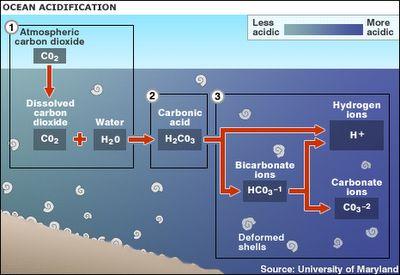
Mankind’s effect on the environment, the rising CO2 levels in the atmosphere, the increasing acidification of the oceans, the growing concerns about global weather, and on and on, are the most unclear, the most complex and the most devastating of futures to embrace.

(Thanks to Patrice for using this recently.)
(Thanks to Patrice for referring to this recently.)

So it really is no surprise to see mankind in general behaving as though this is a bit of a hangover, and an aspirin and a good night’s sleep will sort it! Especially when there is so much money and control invested in selling the same message; the message that there really is nothing to worry about.

There will be a so-called ‘tipping point’. A point in our awareness where the urgency to prevent the destruction of the biosphere will be paramount. And it will be a miracle if when that point arrives it isn’t far too late to save us.

I truly hope that I am wrong.

oooo

Remember what I wrote in yesterday’s post? About experiencing an Atlantic gale?

Fewer than 48-hours before my estimate of coming into Horta Marina on the Azores island of Faial, Songbird of Kent was struck by an early, fierce Winter gale. I seem to recall it was touching Force 10 Beaufort Scale (54 – 63 mph or 48 – 55 knots).

Anyway, it just about finished me off: literally as well as psychologically! I was so frightened, so utterly scared that I could think of nothing else other than getting to Horta and never going sailing again.

It revealed my delusion!

That was my ‘tipping point’ when it came to ocean sailing.

The gale subsided and I motor-sailed the 150-odd miles to Horta without any break for sleep or rest. Came into the harbour early in the morning after the second night since the gale. As soon as I was securely berthed, I closed the boat up and found a local hotel where a hot shower and a clean bed could restore a part of me.

Within a week, I had engaged a crew to sail the boat to Plymouth in South-West England and I flew back to England on a commercial airline.

Once Songbird of Kent arrived at Plymouth, she was put up for sale at a price that wouldn’t delay matters and that was that!

Oh, and I have never read any more books about single-handed ocean sailing. (But see my P.S.!)

oooo

P.S.

In yesterday’s post, I referred to Les Powells. Remember when I was in Larnaca, Cyprus? This is what I wrote:

Living on a boat close to me was Les Powles. Many will not have heard of Les but this quiet, softly-spoken man knows a thing or two about solo ocean sailing. As an article in The Guardian newspaper explained (in part):

In the 1980s and 90s a British man called Les Powles sailed three times round the world – always single-handedly, once non-stop. He couldn’t afford a radio transmitter, and on his greatest adventure he didn’t speak to anyone for 329 days. At 84, his ­circumnavigating days are now behind him, but he still lives on his boat, the Solitaire. What’s the ­appeal of sailing, I asked him. “It’s the solitude. When you’re out at sea on your own, there’s no government or bankers to worry about. You’re not ­responsible to anyone but yourself.”

Three times around the world – solo!

Thus getting to know Les was a great inspiration in getting me over the hurdle of can I really do this! (Les once said to me “the first three days are the worst!”)

Anyway, I have discovered that Les is living happily on his boat in Lymington, England and has written a book about his sailing life.

Les Powells book

It has been ordered and arrives today. This one will be read – from the comfort and safety of our rural home in Oregon!

The nature of delusions.

Sometimes the truth isn’t so obvious!

Yesterday, I wrote a post under the title of Running on empty!  I listed just a few recent items that had left me feeling very dispirited.  Trust me, not a familiar place!

I also raised the question ……

All of this is sending out a message. The message that if we are not very, very careful this could be the end-game for human civilisation on this Planet.

But do you know what really puzzles me?

It’s that this message is increasingly one that meets with nods of approval and words of agreement from more and more people that one sees going about one’s normal life.

…… then didn’t expand on what was puzzling me!

Let me come at this again; in full!

But do you know what really puzzles me?  It is the terrible lethargy across so many societies. The lack of any substantial social and political force for change. Especially, when so many scientists involved in climate research are warning we are leaving it dangerously late.

I’m no psychologist; far from it. But I want to recount a true story that gave me an insight into one of my own delusions.  Please stay with me because it does have a message at the end of it! 😉

oooo

Many years ago, I spent 5 years living on a boat in Larnaca in Cyprus.  My boat was a wonderful heavy-displacement ocean-going yacht.  A type known as a Tradewind 33.  Here is a picture of my boat.

Tradewind 33 - Songbird of Kent.
Tradewind 33 – Songbird of Kent.

For years I had devoured all the books written by the great yacht sailors who had sailed the oceans, many of them completing solo circumnavigations of the world.  Part of me wanted to sail the oceans.

Living on a boat close to me was Les Powles.  Many will not have heard of Les but this quiet, softly-spoken man knows a thing or two about solo ocean sailing. As an article in The Guardian newspaper explained (in part):

In the 1980s and 90s a British man called Les Powles sailed three times round the world – always single-handedly, once non-stop. He couldn’t afford a radio transmitter, and on his greatest adventure he didn’t speak to anyone for 329 days. At 84, his ­circumnavigating days are now behind him, but he still lives on his boat, the Solitaire. What’s the ­appeal of sailing, I asked him. “It’s the solitude. When you’re out at sea on your own, there’s no government or bankers to worry about. You’re not ­responsible to anyone but yourself.”

Three times around the world – solo!

Thus getting to know Les was a great inspiration in getting me over the hurdle of can I really do this!  (Les once said to me “the first three days are the worst!”)

Thus it came about that I departed Larnaca and worked my way Westwards along the Mediterranean, eventually arriving in Gibraltar.  After a few days getting ‘Songbird’ ready for my first ocean leg, Gibraltar to the Azores, I took a deep breath and headed West out into the Atlantic Ocean. Frankly, I was a tad too late to be starting out but the thought of spending a Winter in and around Gibraltar was too much to contemplate and, anyway, it was only 8 or 9 days sailing to the Azores; a distance of 1,125 land miles or 980 nautical miles.

Fewer than 48-hours before my estimate of coming into Horta Marina on the Azores island of Faial, Songbird of Kent was struck by an early, fierce Winter gale.  I seem to recall it was touching Force 10 Beaufort Scale (54 – 63 mph or 48 – 55 knots).

Anyway, it just about finished me off: literally as well as psychologically! I was so frightened, so utterly scared that I could think of nothing else other than getting to Horta and never going sailing again.

It revealed my delusion!

It proved that I had been in love with the courageousness of those many ocean sailors that I had read about. In love with the idea of a solo Atlantic crossing and being seen as a courageous hero. But, in truth, utterly in denial about what ocean sailing was really about!

So with the theme of delusion in your head, have a read of a recent post by George Monbiot. The post is called Are We Bothered? It is republished with the kind permission of George.

ooOOoo

Are We Bothered?

May 16, 2014

The more we consume, the less we care about the living planet.

By George Monbiot, published on the Guardian’s website, 9th May 2014

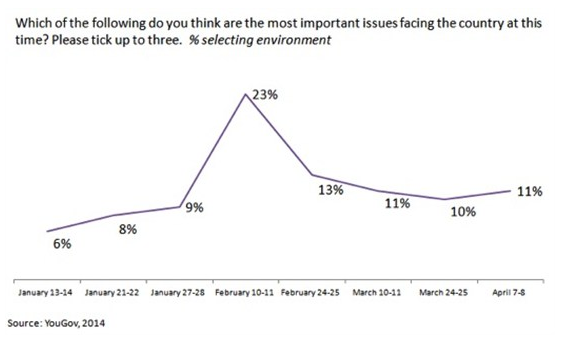
That didn’t take long. The public interest in the state of the natural world stimulated by the winter floods receded almost as quickly as the waters did. A YouGov poll showed that the number of respondents placing the environment among their top three issues of concern rose from 6% in mid-January to 23% in mid-February. By early April – though the Intergovernmental Panel on Climate Change had just published two massive and horrifying reports – the proportion had fallen back to 11%.

CarbonBrief has plotted the results on this graph:

GM1

Sustaining interest in this great but slow-burning crisis is a challenge no one seems to have mastered. Only when the crisis causes or exacerbates an acute disaster – such as the floods – is there a flicker of anxiety, but that quickly dies away.

Why is it so difficult to persuade people to care about our wonderful planet, the world that gave rise to us and upon which we wholly depend? And why do you encounter a barrage of hostility and denial whenever you attempt it (and not only from the professional liars who are paid by coal and oil and timber companies to sow confusion and channel hatred)?

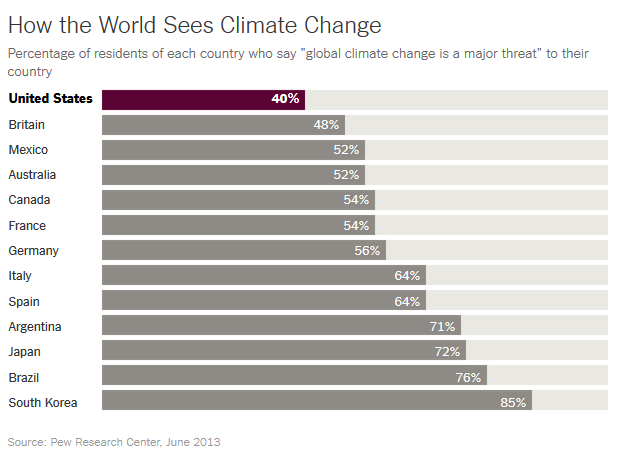
The first thing to note, in trying to answer this question, is that the rich anglophone countries are anomalous. In this bar chart (copied from the website of the New York Times) you can see how atypical the attitudes of people in the US and the UK are. Because almost everything we read in this country is published in rich, English-speaking nations, we might get the false impression that the world doesn’t care very much.

GM2

This belief is likely to be reinforced by the cherished notion that we lead the world in knowledge, sophistication and compassion. The bar chart puts me in mind of the famous quote perhaps mistakenly attributed to Gandhi. When asked by a journalist during a visit to Britain, “What do you think of Western civilization?”, he’s reputed to have replied, “I think it would be a good idea.”

Our erroneous belief that we are more concerned about manmade climate change than the people of other nations informs the sentiment, often voiced by the press and politicians, that there’s no point in acting if the rest of the world won’t play its part. For example, last year the Chancellor, George Osborne, remarked:

“I don’t want us to be the only people out there in front of the rest of the world. I certainly think we shouldn’t be further ahead of our partners in Europe.”

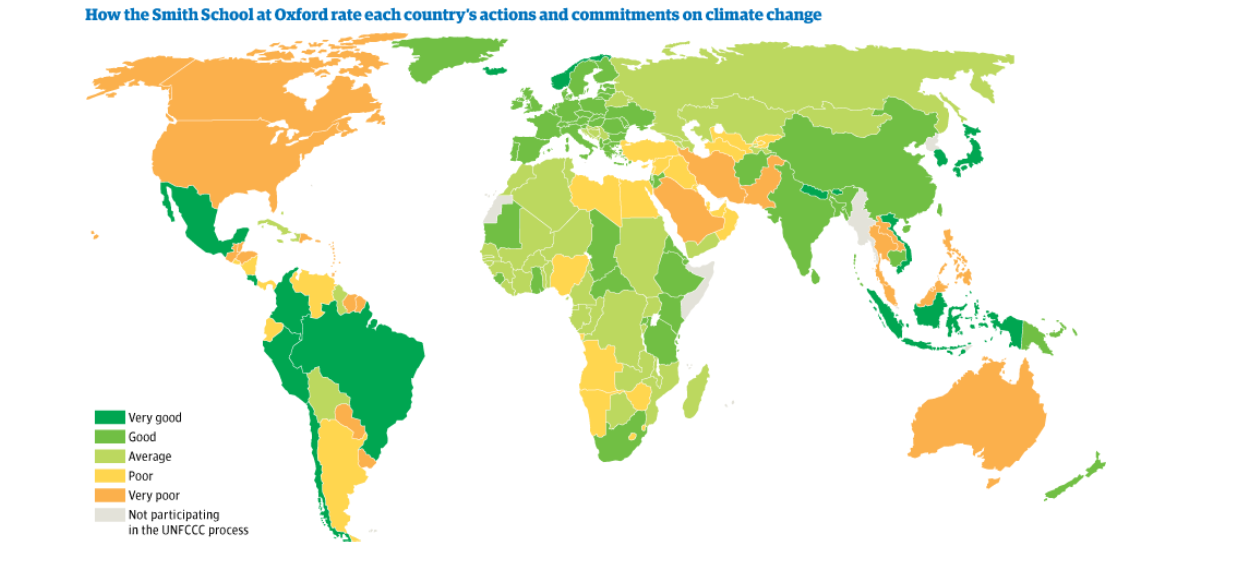
But we’re not “the only people out there in front of the rest of the world.” In fact we’re not in front at all. As this map produced by Oxford University’s Smith School suggests, we are some way behind not only some other rich nations but also a number of countries much poorer than ours.

GM3

As for the US, Australia and Canada, they are ranked among the worst of all: comprehensively failing to limit their massive contribution to a global problem. We justify our foot-dragging with a mistaken premise. Our refusal to stop pumping so much carbon dioxide into the atmosphere is pure selfishness.

Both the map and the bar chart overlap to some degree with the fascinating results of the Greendex survey of consumer attitudes.

For years we’ve been told that people cannot afford to care about the natural world until they become rich; that only economic growth can save the biosphere, that civilisation marches towards enlightenment about our impacts on the living planet. The results suggest the opposite.

As you can see from the following graph, the people consulted in poorer countries feel, on average, much guiltier about their impacts on the natural world than people in rich countries, even though those impacts tend to be smaller. Of the nations surveyed, the people of Germany, the US, Australia and Britain feel the least consumer guilt; the people of India, China, Mexico and Brazil the most.

GM4

The more we consume, the less we feel. And maybe that doesn’t just apply to guilt.

Perhaps that’s the point of our otherwise-pointless hyperconsumption: it smothers feeling. It might also be the effect of the constant bombardment of advertising and marketing. They seek to replace our attachments to people and place with attachments to objects: attachments which the next round of advertising then breaks in the hope of attaching us to a different set of objects.

The richer we are and the more we consume, the more self-centred and careless of the lives of others we appear to become. Even if you somehow put aside the direct, physical impacts of rising consumption, it’s hard to understand how anyone could imagine that economic growth is a formula for protecting the planet.

So what we seem to see here is the turning of a vicious circle. The more harm we do, the less concerned about it we become. And the more hyperconsumerism destroys relationships, communities and the physical fabric of the Earth, the more we try to fill the void in our lives by buying more stuff.

All this is accompanied in the rich anglophone nations with the extreme neoliberalism promoted by both press and politicians, and a great concentration of power in the hands of the financial and fossil fuel sectors, which lobby hard, in the public sphere and in private, to prevent change.

So the perennially low level of concern, which flickers upwards momentarily when disaster strikes, then slumps back into the customary stupor, is an almost inevitable result of a society that has become restructured around shopping, fashion, celebrity and an obsession with money. How we break the circle and wake people out of this dreamworld is the question that all those who love the living planet should address. There will be no easy answers.

http://www.monbiot.com

ooOOoo

Tomorrow I will offer my own reflection on all of this – and finish off the story of me and ocean sailing!

Being at sea!

A discovery of some writing from the past triggers memories.

Way back on the 15th November, 2009, I wrote a post about single-handed sailing and how it caused me much disquiet.  Rather than just leave you with a link to that reflection, I’m going to include the post again, below.  The reason is that a few days ago, in looking through some of my earlier writings in conjunction with a writing group that Jean and I belong to, I came across a piece that I wrote following a solo voyage from Larnaca in Cyprus, west along the Mediterranean Sea and then out over the Atlantic from Gibraltar to Horta on the  island of Faial in the Azores.  That last leg was a little over 1,100 nautical miles (1,300 land miles) and took me eight days.

So first here’s that earlier post from 2009.

A personal reflection on this rather strange way of travelling!

The recent Post about young Jessica Watson sailing alone around the world raised a few comments but also reminded me of my own experiences of solo sailing.

Some years ago, having successfully sold my own IT company, I warmed to the idea of being a full-time yachtie! A second-hand Tradewind 33 was discovered on the Island of Corfu.  (Now here’s a surprise!  I was just browsing the web looking for a picture of a Tradewind and came across my old yacht currently up for sale.  Her name is Songbird of Kent! Picture below.)

Songbird of Kent
Tradewind 33 - Songbird of Kent

Anyway, the deal was done and having sold my house in England I flew out to Corfu to collect Songbird of Kent. Inevitably it was a number of months before the boat was ready to head out into the Mediterranean but in early Spring 1988 it was time to explore the long coastlines of Greece and Turkey.

After a fantastic summer cruising from one idyllic anchorage to another mostly with friends or family on board, it was time to find a winter haven.  Many recommended Larnaca Marina in Cyprus.  Thus it was late in the summer of 1988 that I said goodbye to friends and set out on my own to cross from Antalya in Turkey to Cyprus and along the South coast of Cyprus to Larnaca, on the SE side of the island.

That sea crossing, a little over 200 nautical miles, was to become a regular solo experience at the start and end of each summer season. Impossible to do in a single day thus it always included a night at sea and rarely, if things didn’t go well with the weather, a couple of nights. I hated it! Maybe it was the sudden transition from coastal sailing to a deep water crossing, often going from having friends on board to being alone, but whatever it was I never enjoyed my time on my own and knew that long-distance solo sailing was never going to be my scene.

Anyway, I ended up spending several very happy winters in Larnaca.

One time, there was news of a Frenchman who had come into Larnaca on his way home to France having nearly completed a circumnavigation of the world. He was on his own!

I was astounded to hear how someone could do this and made a point of calling round to his berth. The boat was a beautiful, solid steel yacht, the very epitome of a craft that could challenge the oceans. The owner’s name was Pierre (it would be!). Pierre invited me aboard and we went down to his saloon to drink a hot coffee – real French coffee!

Inevitably the conversation turned to the challenges of sailing alone. Pierre said that the big cargo ships at sea moved quickly relative to the speed of a yacht so at night he set an alarm for every 15 minutes. That was the time that a ship could go from being hull down over the horizon to being close enough to be a hazard. Thus while at sea Pierre got up briefly every 15 minutes during the night to avoid being run down! It sounded totally exhausting.

Then Pierre asked me about the sailing I had done and whether I had sailed on my own. I declared my trivial journeys back and forth from Cyprus to Turkey and revealed that being on my own made me very, very unhappy. Pierre was surprised to hear that as he admitted that being at sea alone was one of the most tranquil and peaceful experiences ever. Pierre asked how long these solo journeys took. I replied, two or three days.

Ah!”, he said, “That is the problem.” “I, too, hate the three days. It is always a period where you adjust and it is terrible.

My friend, you must find a way to be alone for more than three days. You will see that it is very different.

It was some years before that opportunity came about but, in the end, I did undertake a solo journey of 8 days. Pierre was right. The first three days were hell, the rest were heaven!

Thank you, Songbird of Kent, you gave me some fabulous memories!

at sea

By Paul Handover

Now on to my writings about being out at sea alone on a small yacht.

Being at Sea

Going to sea in a small vessel is a profound experience.

In harbour we build up a reliance on things external. We have no need to worry if there is insufficient food on board, we can plug into the dockside power supply, sleep through the night undisturbed and we can wander off and enjoy the company of others if the boat feels a little claustrophobic.

Then slowly, imperceptibly, but with huge force, arrives the need to move on.  The realisation that our cosy life connected to the busy, bustling and self-obsessed world of shoreside is not fulfilling our search for adventure and for the truths that lay over the horizon.  It is time to leave.

The act of casting off is always exciting as it heralds a new adventure. But it also carries feelings of loss and apprehension as one lets go of the bonds of a previous certainty.  The first few hours are filled with the workload of getting one’s craft shipshape and battened down for the unknown seas. Then gradually comes the realisation that the land is now less the dominating visual feature than the vastness of the seascape that is ahead.  But with the land in sight, albeit a distant horizon behind one, you can still sense the life you are leaving.

Now all that surrounds you is the sea.  You are now truly disconnected from the land.  It is often at this point that despondency and uncertainty play with your mind; after all this new life is still very unfamiliar compared to the warmth of that island home that still resonates in your heart. Time to remind yourself of why you wanted to take this voyage.

A small boat is very fragile.  Just a centimetre of hull separating you from the unimaginable depths of the ocean beneath your keel. Not until the end of your voyage, when you draw your boat up, metaphorically on to that beach, will you ever stop feeling how close fate is, how it rides on your shoulder night and day. That, of course, is why we go to sea. It is the place where we taste life, where we savour each moment of the present because the future seems too bound up in the mystery, the uncertainty of the ocean. You are in charge of your tiny craft. Your survival depends on how you manage your small ship, how you navigate these seas, how you read the weather ahead and avoid the storms.

Soon your life on the ocean becomes everything to you. You have time to reflect on so much that is left behind. The distance seems to dissolve all the nuisances, bring into focus all the things that are important to you. There is no certainty with the ocean apart from the knowledge that you are very small and very, very vulnerable and yet, in a sense, also so strong.

In the end, we have to break away from our insecurities and our emotional dependencies on external people and situations because, without that, we are never able to command our own life and the destiny that flows from that captaincy.  There is a real strength in knowing ourselves as we would know our own boat.  If we really know every spar, sail, rope and fitting, if we have real understanding of the strengths and weaknesses of our small vessel then we are able to know when to breast the waves or when to turn and run before the storm.  We are secure that our small craft will protect us day and night.

Thus self-knowledge gives us the same freedom to manage our lives, to know when to fight and when to turn away.  And just as after every long voyage the boat will need hours of careful maintenance so our own souls need regular love and caring from our spiritual keeper.

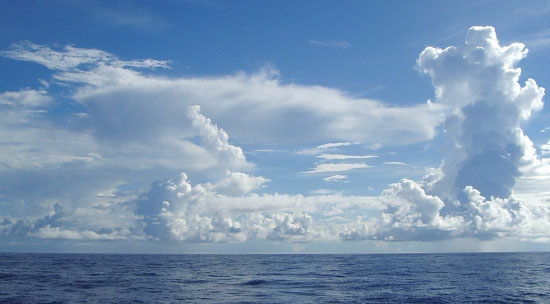
The setting sun ahead of a night on the ocean.

Copyright © 2008 Paul Handover