Tag: Reflections

Welcome Ranger – and Ben!

Our new boys- the story of two horses!

Regular readers of Learning from Dogs will remember a post just over a month ago The lone Ranger.  Essentially, that explained that we had visited Strawberry Mountain Mustangs in Roseburg, Oregon and, subject to their approval, had decided to adopt Ranger, a 15-year-old gelding.

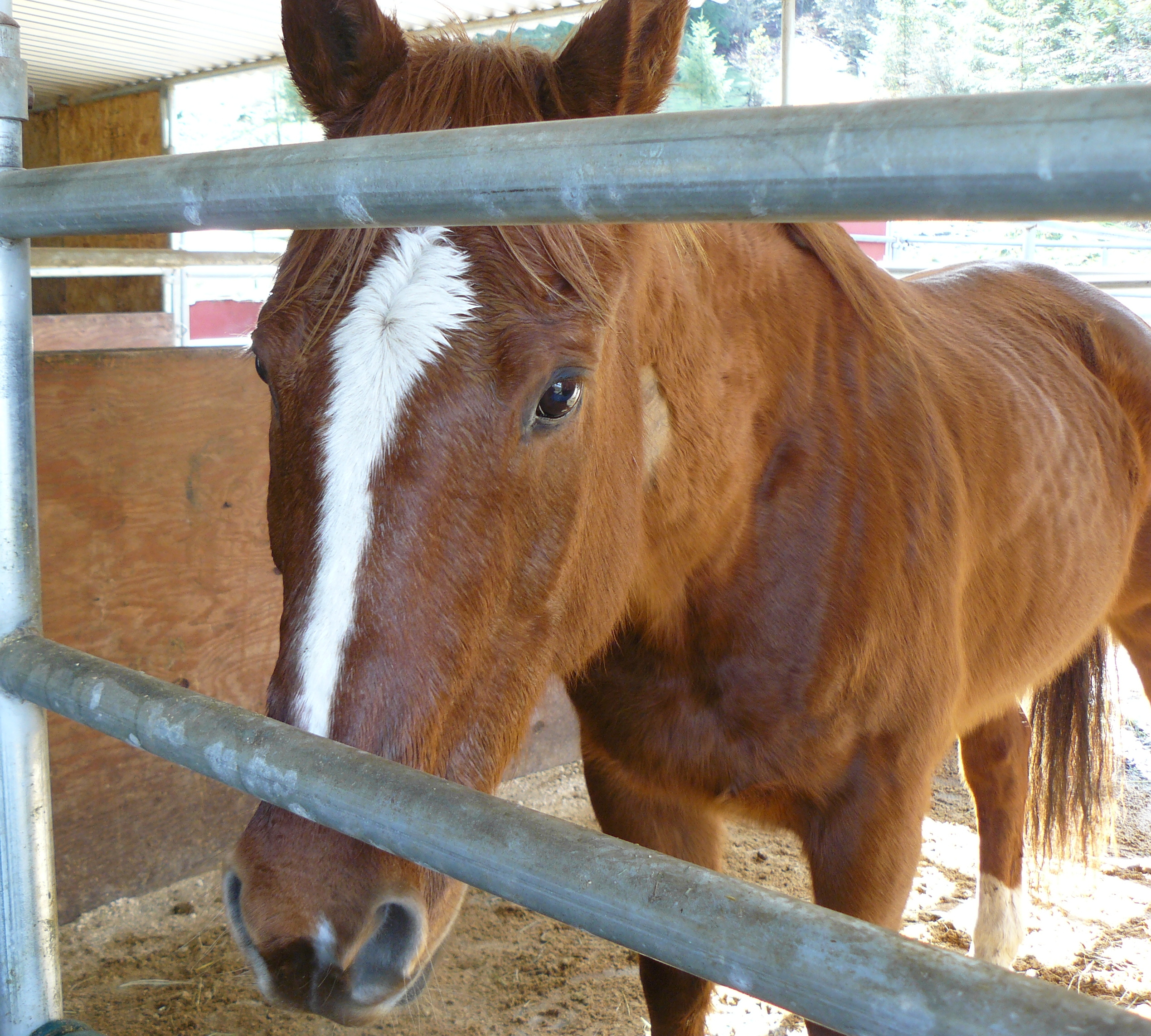
Ranger, when first seen in February.

Thus it proceeded to the point where two-days ago Darla, of Strawberry Mountain, ably assisted by Cody, brought Ranger and Ben to us here in Merlin.  It’s been a wonderful twenty-four hours (at the time of writing this). Why Ben?  Please read on.

Destination!
Destination!

Darla and Cody making a safe and timely arrival a little before 10am last Tuesday.

Ben, our new foster.
Ben, our new foster, being coaxed out by Darla on the lead-line and Cody behind him.

Why did we take the two?  Last October, Ben had been found starved and showing the signs of a great lack of confidence.   He was ‘rescued’ on orders of Darla’s local sheriff because of Ben’s condition despite being in private ownership.  Darla was certain that Ben had been physically beaten in recent times, hence him being very wary of strangers.  Thus his relationship with Ranger was part of his journey of returning to a healthy, confident horse. Darla offered us the opportunity of fostering Ben because Ranger had become a good companion for him. Darla explained that Ben was a very wary horse, especially of sudden movements from men.

Jean leading Ranger; Darla leading Ben.

Another 100 yards and the start of a new life for these two gorgeous animals.

Hey Ranger, is this for real!!

In the those first few minutes after Jean and Darla led the horses to the grass paddock, Ben seemed to have an expression on his face that suggested it was all too difficult to believe!  Ranger just got stuck into munching!  But not to the extent of not enjoying a back-rub!

"I think I'm going to like this, Ben!"
“I think I’m going to like this, Ben!”

In the afternoon, it was time to bring Ben and Ranger for an overnight in the top area where the stables, food and water were.  Ben was very nervous at coming through the open gate and for a while there seemed to be a complication in that Ranger kept thrusting at Ben as if to keep him away from the fence line separating the horses from Allegra and Dancer, our miniature horses.

But in the morning, yesterday, things seemed much more relaxed. To the point that when Ben and Ranger went back out to the grass, Ben was much more relaxed towards Jean and me, as the following pictures reveal.

Jean offering Ben some treats.

oooo

Yours truly doing likewise.

OK, want to turn back to Darla.

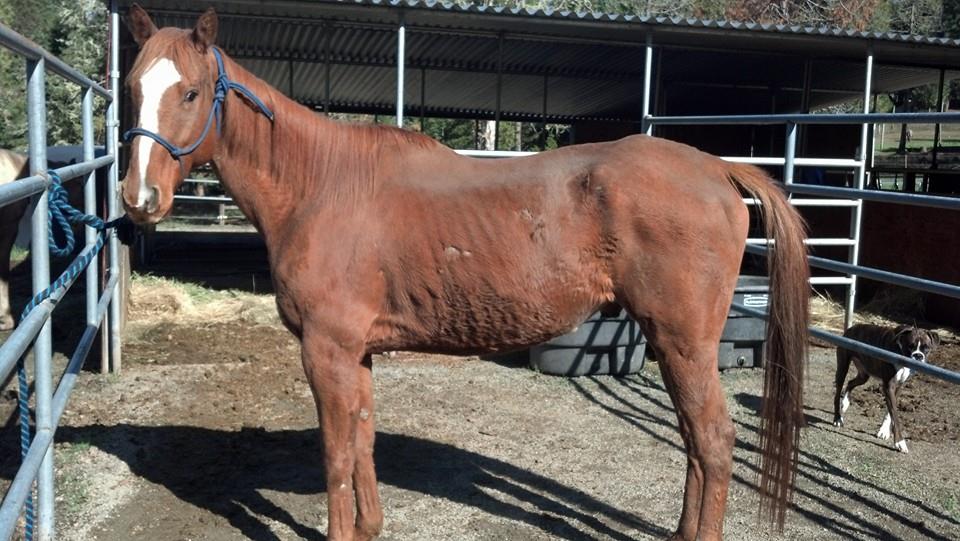
To give an insight into the awe-inspiring work of Darla and her team (and many others across the Nation) and to recognise the need of the authorities to have such outlets as Strawberry Mountain, here are two photographs of Ben shortly after he was removed from the people who had stopped loving and caring for him.

Ben2 when found
Ben as seen last October.

oooo

Ben as seen last October.
Ben close to starving.

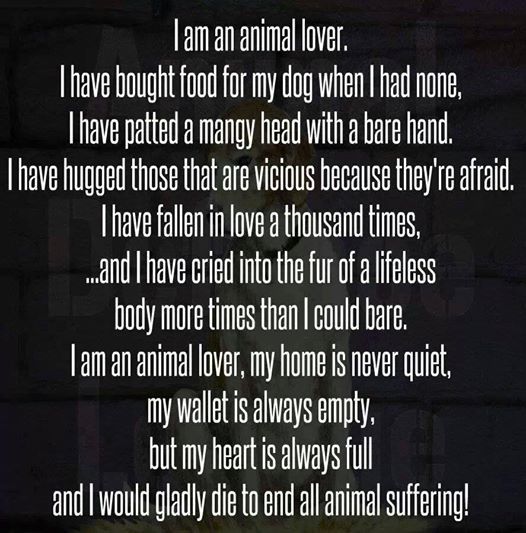
Strikes me as only one way to end this post is with the following as seen on Darla’s Facebook page.

asasa
Author unknown.

Thus this post is offered in dedication to the good people all over the world who know the value of the unconditional love we receive from animals and do not hesitate to return the same.

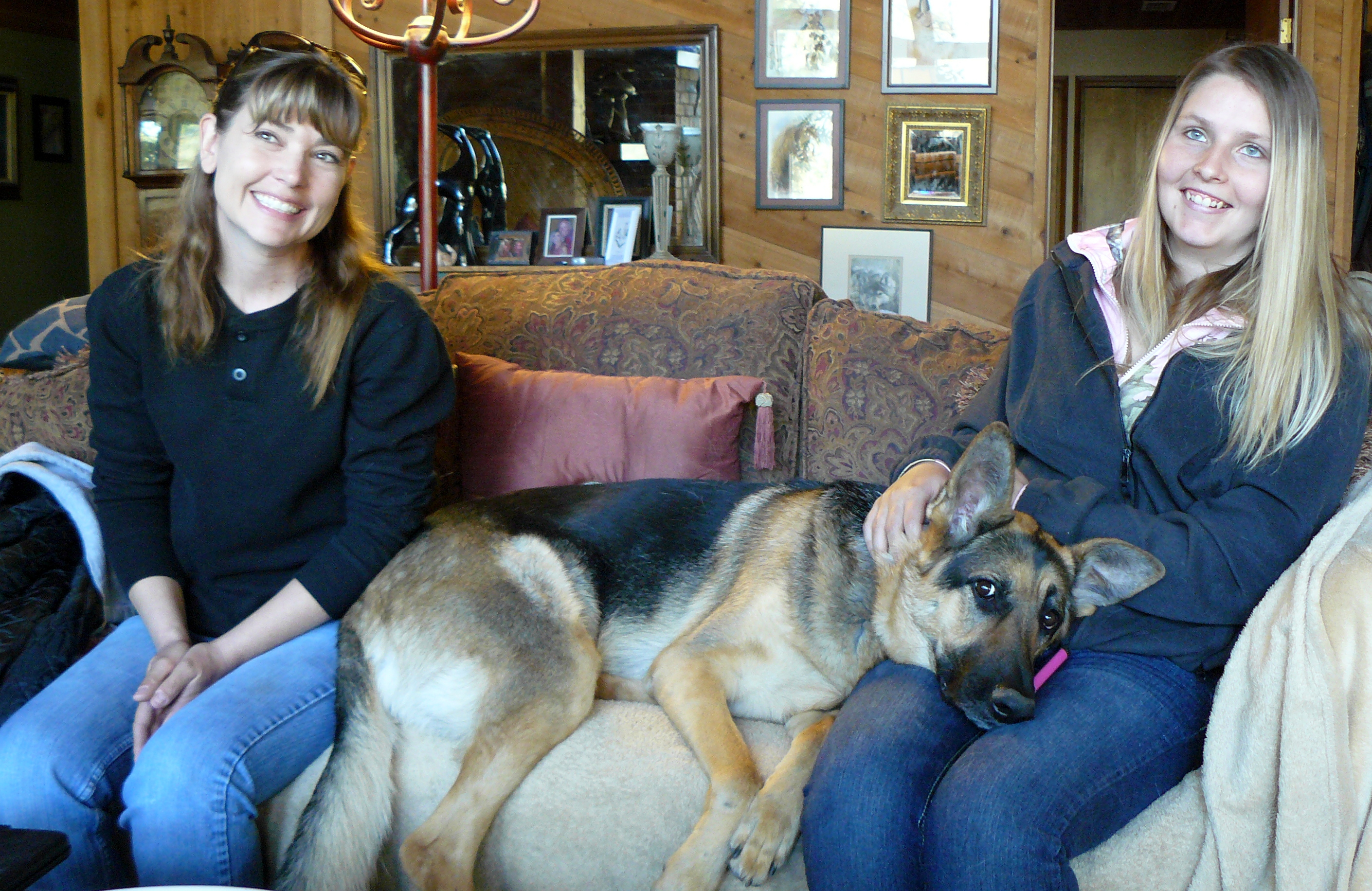
Darla, Cleo and Cody setting a wonderful example of unconditional love.

How about giving the nearest animal, or human, a big hug telling them at the same time how much you love them!

Just words!

Odds are you have already seen this!

Reason I state that is, as of yesterday morning, some 19,070,066 viewings of the following video had taken place.

But so what!

That number shows that despite the advertising insertions, despite the video promoting a commercial concern at the close, there are plenty of us who want to be reminded of the power of words.

Whatever words we utter should be chosen with care

for people will hear them and be influenced by them

for good or ill.

Buddha.

Footnote:

Jean and I were pottering around yesterday afternoon getting everything ready for Ranger’s arrival planned for Tuesday.  In the back of my mind was some self-criticism for just sticking today’s post up in front of you, in the sense that it was just too easy.  Not that the message isn’t powerful but does it relate to the essence of this blog – exploring what we can learn from dogs?

Then it struck me as blindingly obvious! Of all the things that dogs offer us humans, the one key aspect of their integrity is their unconditional love.   The way that dogs love us acknowledges our existence at a ‘being-to-being’ level.

That’s the power of that short video. That the passing lady stopped and acknowledged the existence of the blind beggar-man.

We all need to be reminded of that all the time!

Picture parade thirty-five.

The second instalment of pieces of wisdom.

If you missed the first set from Bob Derham they were last week.

RD8

oooo

RD9

oooo

RD10

oooo

RD11

oooo

RD12

oooo

RD13

oooo

RD14

oooo

Come back in a week’s time for the third and final set.

In the interim, have a peaceful week.

Mid-week story

Too good to wait until the week-end!

(And a big thanks to Dan Gomez for sending it my way.)

ooOOoo

Went Fishing, Caught 4 Deer

A once in the history of mankind kind of thing. The Best Day Of Fishing Ever!

Some fishing stories are a little hard to believe but this guy has pictures to prove his story. Like me, you will heard of salmon jumping into boats, but never anything quite like this…

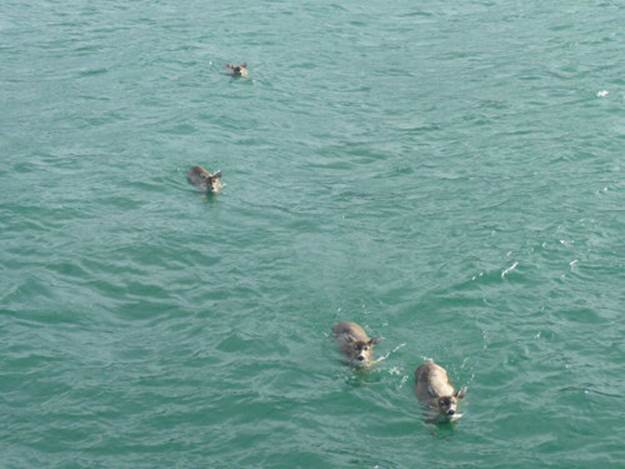
Tom Satre told the Sitka Gazette that he was out with a charter group on his 62-foot fishing vessel when four juvenile black-tailed deer swam directly toward his boat.

a_00t4

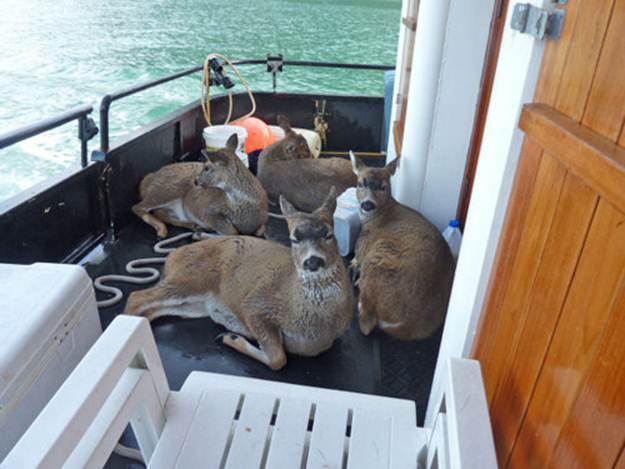
Once the deer reached the boat, the four began to circle the boat, looking directly at us. We could tell right away that the young bucks were distressed. I opened up my back gate and we helped the typically skittish and absolutely wild animals onto the boat. In all my years fishing, I’ve never seen anything quite like it! Once on board, they collapsed with exhaustion, shivering.

ass

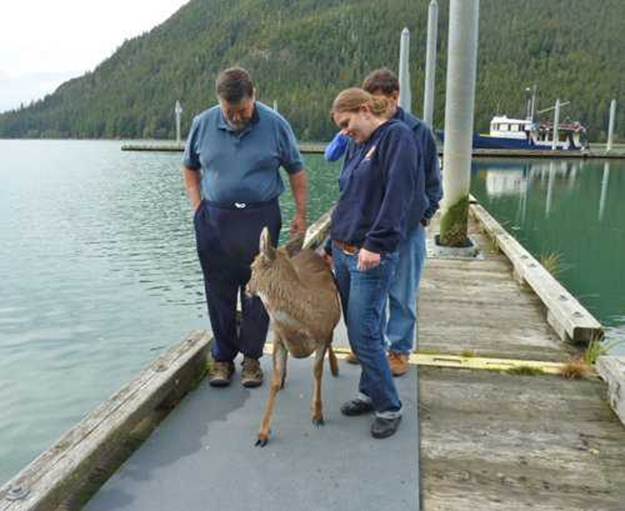
This is a picture I took of the rescued bucks on the back of my boat, the Alaska Quest. We headed for Taku Harbour.  Once we reached the dock, the first buck that we had pulled from the water hopped onto the dock, looked back as if to say ‘thank you’ and disappeared into the forest. After a bit of prodding and assistance, two more followed, but the smallest deer needed a little more help.

a_sf003
This is me carrying the little guy.

oooo

a_00ff2

My daughter, Anna, and son, Tim, helped the last buck to its feet. We didn’t know how long they had been in the icy waters or if there had been others who did not survive.  My daughter later told me that the experience was something that she would never forget, and I suspect the deer felt the same way as well!”

Kindness is the language the blind can see and the deaf can hear.” – Mark Twain

Story dated October, 2010

ooOOoo

I have no idea if it is a true story, although the photographs suggest it is, but so what!  Any reminder of how precious our wild life is will always be welcomed on Learning from Dogs!

Nostalgic times.

Flying the Piper Super Cub

Last Saturday, I posted an item that included a great video about the Air-Cam sports aircraft.  I succumbed to a bout of nostalgia in that I dipped into both my old gliding and flying log-books.  As I wrote:

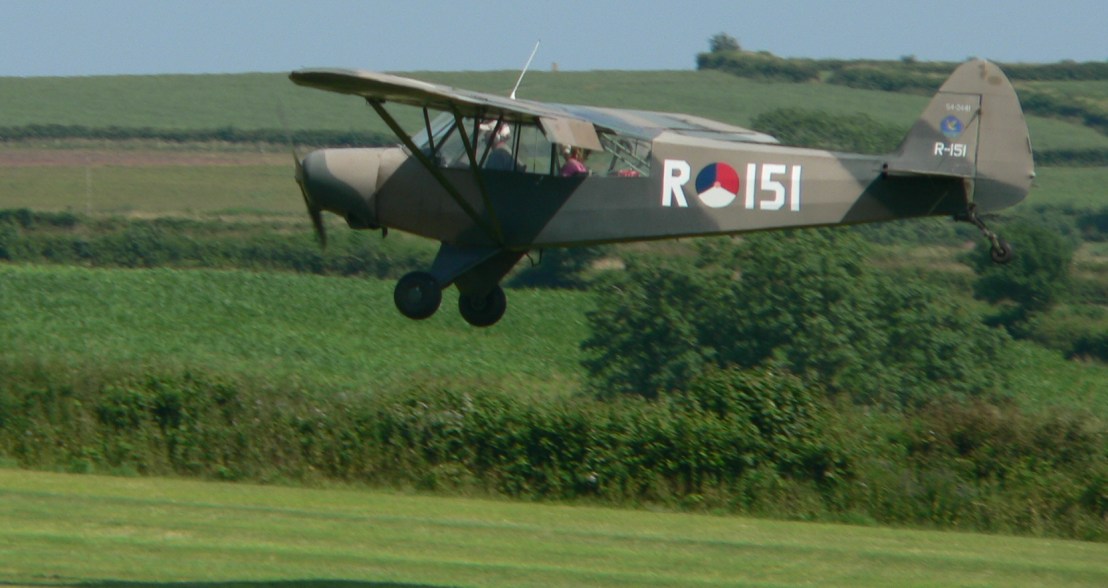
 My last (powered) flight was in a Piper Super Cub, registration R-151, a flight of 1 hr 40 mins from Kemble returning to Watchford Farm, where the Cub was based.

I ‘warned’ readers that today’s post would offer some more about that wonderful aircraft; Piper Super Cub R-151.

ooOOoo

Approaching home in South Devon, England
Approaching home airfield in South Devon, England

Piper Super Cub, L-21B, R-151

A/C Construction No. 18-3841, Frame No. 18-3843

Original Engine, Lycoming 135 Type 0-290-D2, 54/2441

R-151 was one of a batch of 298 L-21’s delivered in 1954. There were 584 L-21B’s produced by Piper for military use, the ‘L’ standing for Liaison. The L-21B’s were PA-18-135’s with civil Lycoming 0-290-D2 engines, glasswork as most L-21A’s and L-18’s and a gross weight of 1760 lbs.

This aircraft was delivered to Koninklijke Luchtmacht, Dutch Air Force, on the 1st July, 1954 and registered R-151. After various homes, R-151 transferred to the Dutch civil register as PH-GER, on the 1st April 1976 with 4,458 hours. Shortly thereafter the aircraft was registered to Vliegclub Hoogeveen, Certificate Number 2380.  Amazingly, the club is still in existence as their website shows.

On the 27th March, 1981 the aircraft was delivered to the UK with a total time of 5,043 hours and in September, 1981 became G-BIYR. In April, 1983 G-BIYR was the first of type to be given a Public Transport CofA (Certificate of Airworthiness) and was used for training at Tollerton; Nottingham. G-BIYR reverted to a Private CofA in January, 1984 when purchased by Mike and Barbara Fairclough from Devon at 5,120 hours.

In 1992, the aircraft was re-engined with a Lycoming 150HP, 0320-A2B No. L49809-27A (zero hours). Finally on the 2nd June, 1995 the aircraft was repainted in original Dutch insignia and given CAA (UK Civil Aviation Authority) permission to use the original call-sign, Romeo 151.

The aircraft is based in South Devon, England and owned by the five members of the Delta Foxtrot Flying Group.

More pictures.

Flying in the French Alps, Mt Blanc in sight

oooo

9,300 ft up in the French Alps

oooo

This last photograph was taken shortly after Pharaoh decided to jump into the passenger’s seat.  The year was 2006 when Pharaoh was 3 years old.  As much as I was tempted, I resisted the urge of taxying him around the airfield!

P1000357.s
Rather like the view from here, Dad!

Picture parade thirty-four

Pieces of wisdom.

After the run of eye-wateringly beautiful pictures of dogs and small children, the third and final set being a week ago, I was gently panicking as to how to follow that up.  Then dear friend, Bob Derham, came to the rescue, the first seven of which are offered today.

RD1

oooo

RD2

oooo

RD3

oooo

RD4

oooo

RD5

oooo

RD6

oooo

RD7

oooo

More from Capt. Bob next week.

Now for something completely different!

Echoes of a past life.

A few days ago, dear friend Suzann, sent me an item about a wonderful new light aircraft.  (It was Su and Don who invited me to Mexico in December, 2007 that resulted in me and Jeannie meeting!)

Before I explain what Su sent me, allow me a few moments of nostalgia.

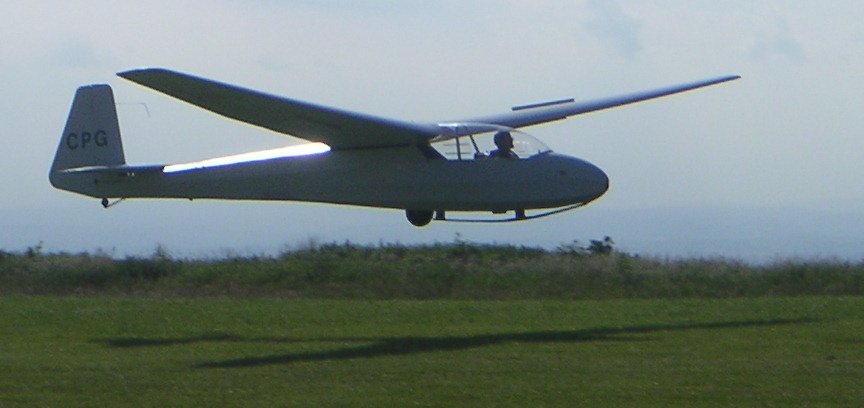
'K7' glider.
‘K7’ glider.

I have a gliding (sailplaning in US speak) log book that has the following entry at the top of page 1:

Flights 1 & 2. June 7th 1981. K7 dual seat glider. Rattlesden Gliding Club, Suffolk. Winch launch. Total flight time 12 minutes.

Those flights started a love affair with flying.

I have a powered-flight log book that has the following entry at the top of page 1.

March 3rd, 1984. Cessna 150. Reg: G-BGAF. Capt: Martin Lowe. Ipswich Airport – local flight 1325 – 1355. Exercises 4,5.

I continued glider flying, becoming an instructor along the way, until my last flight, flight number 1,424, on the 19th December, 1992; again from Rattlesden.

I continued power flying until the 4th August, 2008, a short time before I left the UK to be with Jean in Mexico.  My last flight was in a Piper Super Cub, registration R-151, a flight of 1 hr 40 mins from Kemble returning to Watchford Farm, where the Cub was based.

My son, Alex, shared my love of flying as a young man and is now a Senior Captain with a British airline.

G-EWFN, a Socata TB20.

Anyway, all of which is a rather long preamble to this.

What a fabulous aircraft!  The relevant website is, unsurprisingly, the Air-Cam site.

(Come back on Monday for some more recollections about flying the Piper Super Cub!)

What we really have to learn from dogs!

And many more of Nature’s creatures besides.

The answer? Unconditional love. (11 words.)

OK, that’s it for today’s post! 😉

oooo

Those that know this blog know that posts of just eleven words coming from yours truly are as rare as hen’s teeth.  So stay with me!

The number of LfD followers has just passed 900.  To say that I am amazed, grateful and humbled still feels like an inadequate response.  Thank you: to everyone of you.

One of those new followers left a recent comment that said, ” I love this blog, dedicated to dogs ..”  It struck me that as the number of new followers has increased significantly in recent times that it wouldn’t do any harm to return to the principles behind Learning from Dogs.

For it’s not a blog about dogs per se but about the qualities that we, as in mankind, have to learn from dogs.

The starting point is truth; as in what is truth?  Such a straightforward question of just three words requires many more words, indeed a book, to answer. A little over two years ago, I published a post called The evolution of the domestic dog, that included the following:

Way back in 2007 I was working with a good friend of mine, Jon, who lives in SW England. Anyway, Jon spoke of the philosophies of Dr. David Hawkins.  David Hawkins has written a number of books including Truth vs Falsehood: How to Tell the Difference which I read a few years ago and found very convincing.

Dr David Hawkins of Veritas Publishing, Sedona, Arizona.

Here’s how Amazon describes the book,

The exploration into the truth of man’s activities is unique, intriguing, and provocative. From a new perspective, one quickly grasps the levels of truth expressed by the media, the arts, writers, painters, architecture, movies, TV, politics, and war, as well as academia and the greatest thinkers and philosophies through the ages and up to present-day science and advanced theories of the nature of the universe. Most importantly, the ego and its structure are revealed to facilitate the understanding of religious and spiritual truths expressed by the mystics and enlightened sages over the centuries. It becomes apparent why the human mind, unaided, has been intrinsically incapable of discerning truth from falsehood. A simple test is described that, in seconds, can solve riddles that have been irresolvable by mankind for centuries. This book delivers far more than it promises.

Here’s the description of the book on David Hawkin’s website,

Reveals a breakthrough in documenting a new era of human knowledge. Only in the last decade has a science of Truth emerged that, for the first time in human history, enables the discernment of truth from falsehood. Presented are discoveries of an enormous amount of crucial and significant information of great importance to mankind, along with calibrations of historical events, cultures, spiritual leaders, media, and more.

A science of consciousness developed which revealed that degrees of truth reflect concordant calibratable levels of consciousness on a scale of 1 to 1,000. When this verifiable test of truth was applied to multiple aspects of society (movies, art, politics, music, sociology, religion, scientific theories, spirituality, philosophy, everyday Americana, and all the countries of the world), the results were startling.

Trust me, I am (slowly) getting to the point!

Dr. Hawkins created a ‘map’ of those calibrated levels of consciousness, see details of that map here.  Also, it wasn’t too difficult to find a plain B&W version on the Web, reproduced below.

Map of Consciousness, copyright Dr. David Hawkins

As you can see when you study the map, the boundary between ‘truth’ and ‘falsehood’ is the calibrated level of 200, the blue line in the above described as ‘The beginning of integrity’.

Anyway, back to Jon.  When I used to visit him, I always had Pharaoh with me and he would settle down behind my chair and let the human talk just flow over him, happy at some dog level to be included.

One day Jon was talking about the different levels of consciousness and looked over at Pharaoh asleep on the floor and said, “Do you that dogs are integrous!”  I responded that I didn’t know that, please tell me more.

Jon continued, “Yes, dogs have been calibrated as having a level of consciousness in the zone of 205 to 210.”

So dogs, horses, cats and many other warm-blooded species of animals are fundamentally integrous creatures.  Creatures that display the qualities of unconditional love, trust, courage, integrity and forgiveness.  Just see where those emotions appear on David Hawkin’s ‘map’ above.  However of all those animals, dogs have been man’s longest companion by far, perhaps all the way back to neolithic times.

So what gets written about Learning from Dogs is what we, as in society, have to learn from dogs. Because the time for mankind to place integrity, as in integrity of thought, word and deed, at the highest pinnacle of our domain is fast running out.

Going to close with a photograph taken yesterday afternoon here at home in Oregon, showing a pair of geese that are giving every indication of using our ‘island’ in our so-called pond as their base for having their goslings!

The integrity of Nature!

Some content on this page was disabled on August 23, 2017 as a result of a DMCA takedown notice from Susan Hawkins. You can learn more about the DMCA here:

https://wordpress.com/support/copyright-and-the-dmca/

Picture parade thirty-three.

The concluding photographs on the theme of why we have pets.

The first set may be seen here; the second set are here.

AS17

oooo

AS18

oooo

AS19

oooo

AS20

oooo

AS21

oooo

AS22

oooo

AS23

oooo

AS24

oooo

AS25

oooo

As I mentioned in Picture parade thirty-one, all twenty-five photographs were sent to me by friend and follower in Australia, Amanda Smith.

Amanda will be delighted that her photographs have caused so much pleasure to so many, including Jean and me, of course.

Blast from the past: IBM

A powerful reminder of ethical business practices.

First the background to today’s post. (You may want to settle down with a glass of something; it’s a bit of a ramble!)

In 1968, I emigrated to Sydney, Australia.  In those days, one could get a sponsored one-way flight ticket to Australia for 10 GBP if one intended to make Australia your new home.  Once there, I obtained a sales clerking job with the Australian division of the famous British company, ICI (Imperial Chemical Industries).  I had previously been working for a UK part of ICI Plastics, British Visqueen Ltd, in Stevenage, Hertfordshire.

Going to Australia came about because in the UK, I had been dating a Finnish woman who, together with her parents and sisters, was living in Sydney.  So when Britta returned to Sydney I thought ‘what the hell’ for a ‘tenner’ I can follow her out there.  (We subsequently married and Britta is the mother of my son, Alex, and daughter, Maija.)

Via very circuitous circumstances, I ended up as a freelance journalist working for a Finnish magazine KotiPosti.  Britta and I spent many months in 1969-1970 driving 30,000 miles all around around Australia finding Finns in the most amazing places doing the most incredible things, and me writing about them.  Then I was invited to travel to Helsinki and in 1970, Britta and I decided to go to Finland via the Trans-Siberian Railway, all the way from Nakhodka in Eastern Russia, on the Sea of Japan, to Moscow, thence on to Helsinki. The route being via Vladivostok, Irkutsk (where we took 24 hours out to visit Lake Baikal), Novosibirsk, Moscow, St. Petersburg (Leningrad) and the short hop to Helsinki.
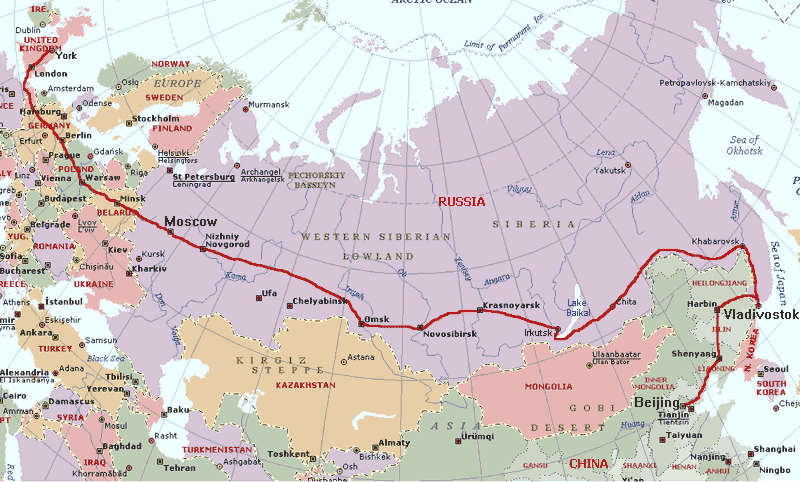
transib3

What on earth does this have to do with IBM?  Hang on in there! 😉

We initially travelled from Australia to Japan because in 1970, Expo 70 was being held in Japan, and KotiPosti had asked me to write about the event.  One of the most impressive stands at Expo 70 was the IBM stand.  Frankly, it blew me away.

So now fast-forward to Britta and me having completed our stuff in Helsinki and on our way home to Sydney, via London of course, because I still had family in England.  A couple of evenings after we had arrived at Preston Road, Wembley, where my mother’s house was, I read an advertisement in the daily evening newspaper, The London Evening Standard, (still going strong) that IBM UK Ltd, their office products division, were looking for salesmen.  I had been so impressed with IBM at Expo 70 that I seemed unable to resist applying for the job.  To my amazement, I won a place in IBM’s sales team and was with IBM for 8 years – we never returned to Australia.

Fast forward all the way to present times.

A while ago, I signed up to the Current and Ex-IBM Employee Group (Unofficial) on Linked-In.  Yesterday, a member of that group published, The Original IBM Basic Beliefs for those that have never seen them.  They really are worth sharing because how much better would our corporate world be if all businesses subscribed to these beliefs.  Here they are:

ooOOoo

The Original IBM Basic Beliefs for those that have never seen them.

Respect for the Individual
===================
Our basic belief is respect for the individual, for his rights and dignity. It follows from this principle that IBM should:
1. Help each employee to develop his potential and make the best use of his abilities
2. Pay and promote on merit
3. Maintain two-way communications between manager and employee, with opportunity for a fair hearing and equitable settlement of disagreements.

Service to the Customer
===================
We are dedicated to giving our customers the best possible service. Our products and services bring profits only to the degree that they serve the customer and satisfy his needs. This demands that we:
1. Know our customers’ needs, and help them anticipate future needs
2. Help customers use our products and services in the best possible way.
3. Provide superior equipment maintenance and supporting services

Excellence Must Be a Way of Life
==========================
We want IBM to be known for its excellence. Therefore, we believe that every task, in every part of the business, should be performed in a superior manner and to the best of our ability. Nothing should be left to chance in our pursuit of excellence. For example, we must:
1. Lead in new developments
2. Be aware of advanced made by others, better them where we can, or be willing to adopt them whenever they fit our needs.
3. Produce quality products of the most advanced design and at the lowest possible cost

Managers Must Lead Effectively
=========================
Our success depends on intelligent and aggressive management which is sensitive to the need for making an enthusiastic partner of every individual in the organization. This requires that managers:
1. Provide the kind of leadership that will motivate employees to do their jobs in a superior way.
2. Meet frequently with all their people.
3. Have the courage to question decisions and policies; have the vision to see the needs of the Company as well as the division and department
4. Plan for the future by keeping an open mind to new ideas, whatever the source

Obligations to stockholders
=====================
IBM has obligations to its stockholders whose capital has created our jobs. These require us to:
1. Take care of the property our stockholders have entrusted to us.
2. Provide an attractive return on invested capital
3. Exploit opportunities for continuing profitable growth

Fair Deal for the Supplier
====================
We want to deal fairly and impartially with suppliers of goods and services. We should:
Select suppliers and according to the quality of their products or services, their general reliability and competitiveness of price.
1. Recognize the legitimate interests of both supplier and IBM when negotiating a contract; administer such contracts in good faith
2. Avoid suppliers becoming unduly dependent on IBM

IBM should be a Good Corporate Citizen
================================
We accept our responsibilities as a corporate citizen in community, national and world affairs; we serve our interest best when we serve the public interest. We believe that the immediate and long-term public interest is best served by a system of competing enterprises. Therefore, we believe we should compete vigorously, but in a spirit of fair play, with respect for our competitors, and with respect for the law. In communities where IBM facilities are located, we do our utmost to help create an environment in which people want to work and live. We acknowledge our obligation as a business institution to help improve the quality of the society we are part of. We want to be in the forefront of those companies which are working to make our world a better place.

Thomas J. Watson, Jr.
April 1969

ooOOoo

1969! Coming up to 45-years ago.  Sometimes one wonders if society has learnt anything in the last five decades!