Tag: Reflections

Do animals fall in love?

Opening our minds to a beautiful concept!

One of the better things about my old home country, the United Kingdom, is The Open University.  As Wikipedia explains:

The OU was established in 1969 and the first students enrolled in January 1971. The University administration is based at Walton Hall, Milton Keynes in Buckinghamshire, but has regional centres in each of its thirteen regions around the United Kingdom. It also has offices and regional examination centres in most other European countries. The university awards undergraduate and postgraduate degrees, as well as non-degree qualifications such as diplomas and certificates or continuing education units.

With more than 250,000 students enrolled, including around 32,000 aged under 25 and more than 50,000 overseas students, it is the largest academic institution in the United Kingdom (and one of the largest in Europe) by student number, and qualifies as one of the world’s largest universities.

For reasons that I am unclear about, I subscribe to the OU’s newsletter.  Thus it was that a few weeks ago, this dropped into my ‘in-box’.

Do animals fall in love?

Do romantic relationships exist in the animal kingdom?

Throughout his lifetime, evolutionist and biologist Charles Darwin researched and wrote about how he felt that love can exist within the animal world. Particularly in his papers ‘The Expression of Emotions in Man and Animals’ and ‘Comparison of the Mental Powers of Man and the Lower Animals’, he explored how animals can display supposed ‘human emotions’ like pleasure, pain, happiness and misery. He investigated how animals could seemingly appear to feel ‘down’ when separated from their companions, and seemed to jump for joy and touch one another in a way similar to a human hug when reunited.

Although monogamy and lifelong pair bonds are generally rare in the animal kingdom, some animals seem to thrive on it. Recent research has shown that Gibbons, who were thought to mate for life, have more complicated relationships, with mates occasionally philandering, and even sometimes dumping a mate, suggesting some similarity to human relationships. Swans also form monogamous pair bonds that last for many years, and occassionally for life. Loyalty to their mates has made them a virtually universal symbol of love. But some researchers believe it isn’t as romantic as it first appears, and that they stay together because spending extra time attracting a new mate has the potential to impact on the otherwise reproductive time.

Darwin’s theories have paved the way for further studies. In this free article, Tim Halliday explores natural selection and evolution in the animal world.

Here is that article.

ooOOoo

Natural Selection and Evolution

Tim Halliday explores natural selection and evolution in the animal world

By: Professor Tim Halliday (Department of Life Sciences, The Open University)*

In the Rules of Life series, and its accompanying CD, Aubrey Manning looks at the behaviour of animals and describes many new discoveries about the way that this is beautifully adapted to meet the challenges which animals face in their daily lives. The scientific study of animal behaviour, or ethology, was founded some 50 years ago by Niko Tinbergen and Konrad Lorenz. Their most significant contribution was to bring together the study of natural history with an understanding of evolution by natural selection. Since then, the numerous studies that have been made of animal behaviour have revealed that animals do many things that challenge many of the ideas that people had about natural selection 50 years ago. Natural selection theory has developed enormously since that time, largely as the result of animal behaviour studies, and a number of popular misconceptions about evolution have been revealed to be false as a result.

One such misconception is embodied in the phrase ‘survival of the fittest’, first coined by Herbert Spencer, and often used to encapsulate the way natural selection works. It is misleading, because ‘survival’ is only part of the story. Evolutionary change comes about because some individuals are more successful in reproduction and so pass on their genes to succeeding generations. As a result, the characteristics that make individuals successful in reproduction become more common in the population. It is thus reproduction that is important in evolution, and survival becomes simply a means to that end.

The importance of this point becomes apparent when we appreciate that, for most animals, reproduction is a very costly and sometimes dangerous activity, as illustrated many times in the series. To engage effectively in reproductive activity requires a great deal of energy and other resources that could otherwise be put towards survival. This is apparent in the common observation that animals show a greatly reduced growth rate, or stop growing altogether, when they reach sexual maturity. The resources that they derive from feeding are diverted from growth to reproduction.

A second common misconception is that natural selection acts ‘for the good of the species’. There are numerous examples of animal behaviour that show that this cannot be the case. For example, African lions live in prides, consisting of several females and their cubs, controlled by a group of two or three males. Other mature males are excluded from living in a pride. From time to time, a coalition of excluded males is formed and they attempt to take over a pride, by attacking and driving away the current pride-holders. If they succeed in doing this, their first act is to kill any cubs in the pride that are still being suckled by their mothers. To kill the young of one’s own species cannot benefit the species. The adaptive value of this behaviour for males is that, deprived of the cubs they have been suckling, the females very quickly come on heat and can conceive cubs fathered by the new pride-holders.

This example illustrates another common misconception about evolution, that, when mating, males and females are acting cooperatively. While it is in the interests of both parents that reproduction is successful, the way that that success comes about is not necessarily the same for the two sexes. For male lions, it is of no reproductive benefit to them to guard females that give birth to cubs fathered by other males. Infanticide is of benefit to them because it ensures that cubs born in the pride are their offspring. Infanticide is costly for females because the considerable time and resources that they have put into producing cubs is wasted. There is thus a conflict between the sexes, even though they have to behave cooperatively if either is to reproduce at all.

The interplay of cooperation and conflict is also apparent in the relationship between parents and offspring. For animals that produce more than one young at a time, it is usually to the advantage of the parent to share food more or less equally among its progeny. For each individual progeny, however, it is to its advantage if it receives more food than its siblings. There is thus a great deal of competition among progeny. This takes a bizarre form in the European Fire Salamander, and in a species of shark described in one of the programmes. In these animals, the young develop within the mother and, as they grow, they eat one another until only one, very large young is left. It may be that producing one offspring at a time is a good strategy from the mother’s point of view, or it could be that she would have higher reproductive success if she produced more; it may be, however that she has no choice in the matter.

The key to understanding evolution by natural selection is to think of it, not in terms of an individual’s survival, but in terms of its effectiveness in passing on its genes, what in the series is referred to as ‘genetic accounting’. Natural selection favours those individuals that pass on the most copies of their genes. This enables us to explain many aspects of animal behaviour that are difficult to explain purely in terms of survival. For example, in many species, particularly among birds, certain adult individuals do not breed themselves, but help other adults to do so, for example by feeding their young. In almost all cases, helpers turn out to be close relatives of the parents they are helping and so they are, in an indirect way, helping to spread those genes that they share with their relatives.

* Tim Halliday is professor of biology at The Open University, where he has worked on newts, toads and frogs since 1977.

ooOOoo

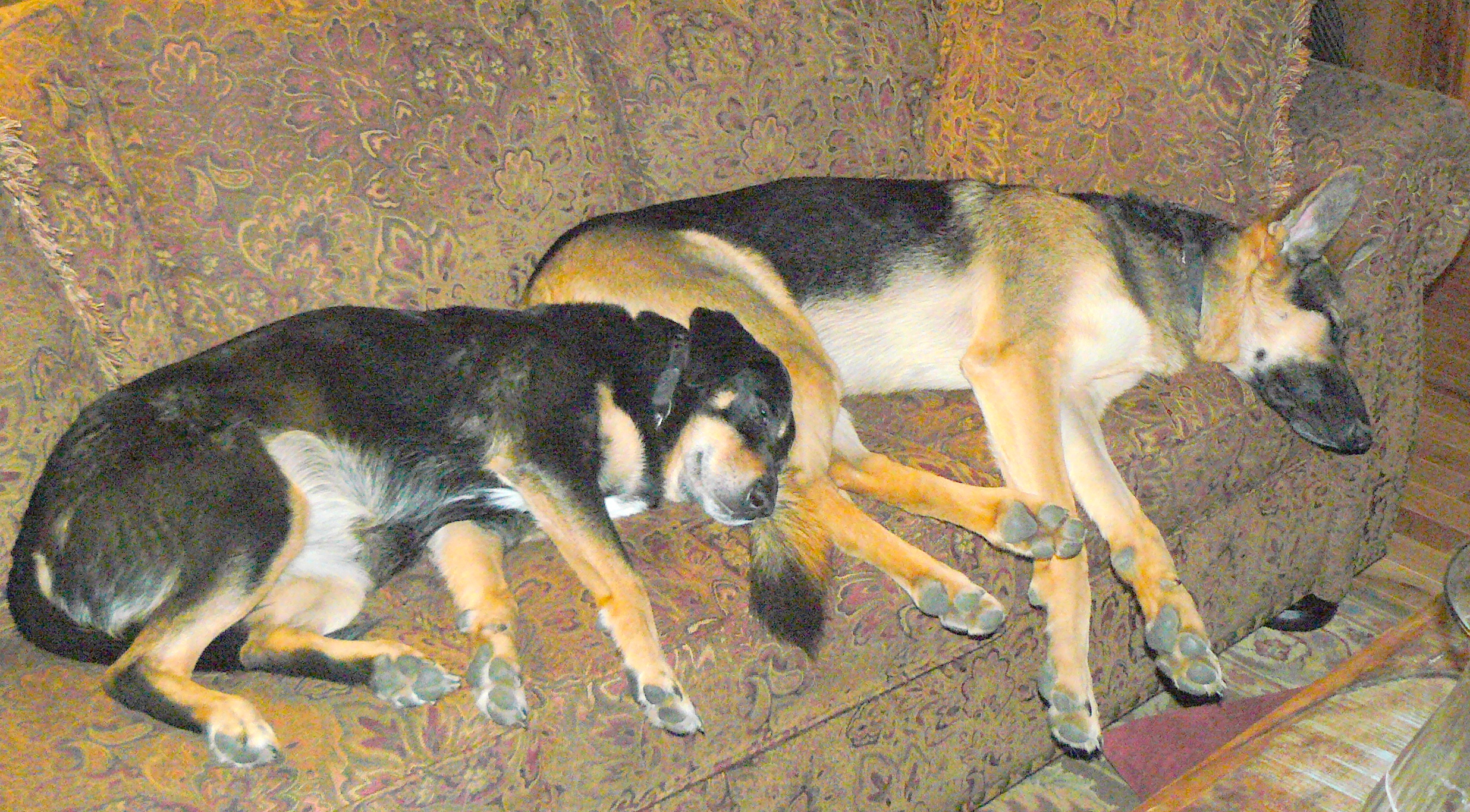
Two photographs that offer my answer to the question: Do animals fall in love?
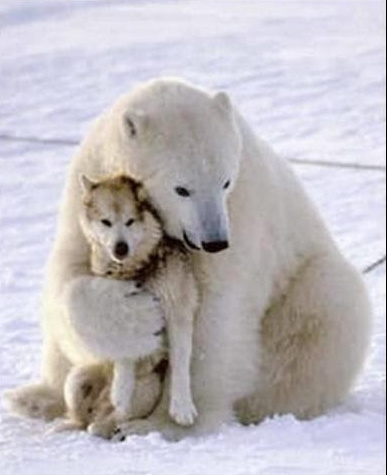
animallove

oooo

Hazel asleep with her dear friend Cleo. (Hazel to the left.)

Progressing Wisdom – the preamble.

A reflection on intelligence, learning and knowledge.

Today’s essay has been prompted by a fascinating exchange of views and comments on a post recently published by Patrice Ayme.  More of that tomorrow.

Before getting to the heart of things, I feel compelled to offer a little background on my own educational journey. It is presented today as a preamble to tomorrow’s main essay.

By rights, I should have enjoyed a stunning academic journey as a young man.  My mother holds a double degree in French and German from Cambridge University.  My father was both a Chartered Architect and Chartered Surveyor and worked for Barclay Perkins & Co at their Anchor Brewery in Southwark, London all his working life.  My uncle, Christian Schiller, took up a mathematics scholarship at Sidney Sussex college at Cambridge University and ended up HM Inspector of Schools in the United Kingdom. Notably, he was a promoter of progressive ideas in primary education.

But it was not to be so.

My father died suddenly and with very little warning five days before Christmas in 1956.  I had turned 12-years-old some six weeks previously and just completed my first term at Preston Manor County Grammar School.  My secure, comfortable young life was thrown into emotional turmoil with one of the consequences being that instead of passing a clutch of GCE ‘O-Level’ exams, I barely managed to pass two subjects and was unable to continue on with a higher level of studying and the consequent sitting of GCE ‘A-Level’ exams, a pre-requisit for university.

Somehow, I then managed to win a place as a student at the Faraday House of Electrical Engineering, in those days based at Southampton Row, London.  It was to study for a Diploma in Electrical Engineering.  The requirement was that by the end of my first year at Faraday House I should pass two A-level examinations.

I was very happy as a college student.  That first year was spent entirely learning about engineering with much time ‘hands-on’ in the engineering workshop. Then came time for me to sit those two A-level exams. I failed both of them! There was no choice but for me to leave the college.

faradayhouseplaque
So that’s enough to demonstrate that academic prowess was not my speciality.

However, being unable to jump through the hoops needed for a degree or equivalent didn’t mean that I was a poor learner; far from it.

After my father’s death, my mother remarried and my ‘new’ Dad was very supportive.  He had a background in communications and quickly encouraged me to become a radio amateur.  I joined the nearby Radio Society of Harrow (still in existence!) and their encouragement enabled me to pass the full set of exams necessary to become a licensed radio amateur and a full member of the Radio Society of Great Britain.  My amateur call sign was (and still is) G3PUK. I was 17.


G3PUK0001
I can still whistle the alphabet in morse code, from A to Z, and the numbers 0 to 9!

Later on, when I was an apprentice at the British Aircraft Corporation’s site in Stevenage, Hertfordshire, one of the commercial staff, Jim Jenner, spent many hours preparing me for the Institute of Advanced Motorists examination. I passed that exam and became a full member of the IAM in May, 1966.

So there’s my background that, hopefully, will set the scene to a wonderful exchange of views and ideas that flowed from Patrice’s blog. Ideas that will be explored tomorrow.

For the reason, the powerful reason, that the intelligence and wisdom of humanity has always been important.  But now, in this time of the affairs of man, our collective intelligence and wisdom has never been more important.

Thank you – a thousand times!

This blog passes an unbelievable milestone.

Over the week-end Learning from Dogs registered a 1,000 followers. Now I may be tempting fate by writing this but whatever the figure, on a day-to-day basis, the trend is one of a steadily increasing number of subscribers.

Yes, in the grand scheme of things, this is a tiny achievement compared to many of the great blogs out there. But, nonetheless, I feel compelled to write this.

That it is impossible for me to convey the degree of gratitude to all of you followers and the many additional readers who pass this way. Please just know the depth of my feelings in this regard.

Just also know that the community feeling that has grown up around this writing adventure is fabulous. Something of which I had no expectation when I published my first post on July 15th, 2009. Just for fun, here is that first post.

ooOOoo

Parenting lessons from Dogs!

Much too late to make me realise the inadequacies of my own parenting skills, I learnt an important lesson when training my GSD (who is called Pharaoh, by the way).  That is that putting more emphasis into praise and reward for getting it right ‘trains’ the dog much quicker than telling it off.  The classic example is scolding a dog for running off when it should be lots of hugs and praise for returning home.  The scolding simply teaches the dog that returning home isn’t pleasant whereas praise reinforces that home is the place to be.  Like so many things in life, very obvious once understood!

Absolutely certain that it works with youngsters just the same way.

Despite being a very dominant dog, Pharaoh showed his teaching ability when working with other dogs.  In the UK there is an amazing woman, Angela Stockdale, who has proved that dogs (and horses) learn most effectively when being taught by other dogs (and horses).  Pharaoh was revealed to be a Beta Dog, (i.e. second in status below the Alpha Dog) and, therefore, was able to use his natural pack instinct to teach puppy dogs their social skills and to break up squabbles within a pack.

When you think about it, don’t kids learn much more (often to our chagrin!) from other kids than they do from their parents.  Still focusing on giving more praise than punishment seems like a much more effective strategy.

As was read somewhere, Catch them in the act of doing Right!

By Paul Handover.

ooOOoo

So here we are! Within a couple of months of me writing Learning from Dogs for five years!

For those who love numbers and statistics, try these:  2,062 published posts with 8,815 comments approved.

But those numbers mean nothing compared to the joy of having you follow Learning from Dogs.

Thank you!

Pharaoh appreciates the milestone, as well!
Pharaoh appreciates the milestone, as well!  Thanks all you wonderful supporters of this place!

This photograph of Pharaoh was taken yesterday morning. Like his ‘owner’ starting to show his age! (Pharaoh is eleven on June 3rd.)

Here’s another photograph taken same time yesterday morning.

A very, very special friend!

The loss of democracy, Concluding Part.

Part Two of what is probably just now the most important lesson to be learnt from dogs!

(Part One was published last Friday.)

Last Friday I part-used a recent chilling essay on TomDispatch by Peter Van Buren to illustrate the madness and the associated dangers of how we humans are behaving at present.  Here’s the balance of that essay.

ooOOoo

This Land Isn’t Your Land, This Land Is Their Land

An Empire in Decline (City by City, Town by Town)
By Peter Van Buren

The Most Exclusive Gated Community: U.S. Marine Corps Base, Camp Lejeune, North Carolina

I grew up in a fairly small Ohio town that, in the 1970s, was just crossing the sociological divide between a traditional kind of place and a proper bedroom suburb. Not everyone knew each other, but certain principles were agreed upon. A steak should be one inch thick or more. A good potluck solved most problems. Vegetables were boiled, faith rewarded. Things looked better in the morning. Kids drank chocolate milk instead of Coke. We had parades every Memorial Day and every Fourth of July, but Labor Day was just for barbecues because school began the next day and dad had to get up for work. In fact, that line — “I’ve got to get up for work” — was the way most social events broke up. This isn’t nostalgia, it’s history.

In 2014, you could travel significant parts of the decaying Midwest and not imagine that such a place had ever existed. But turn south on Interstate 95 and look for the signs that say “Welcome to U.S. Marine Corps Base Camp Lejeune,” in Jacksonville, North Carolina. Actually, welcome to almost any U.S. military base outside of actual war zones, where a homogeneous military population and generous government spending (re)creates the America of the glory days as accurately as a Hollywood movie. For a first-time visitor, a military base can feel like its own living museum, the modern equivalent of Colonial Williamsburg.

Streets are well maintained, shaded by tall trees planted there (and regularly pruned) for just that purpose. Road, water, and sewer crews are always working. There are no potholes. There is a single school with a prominent football field, and a single shopping area. The restaurants are long-time Department of Defense franchise partners and there’s always a pizza place with a fake-sounding Italian name. Those creature comforts on such bases in the U.S. and around the world come at a cost to taxpayers of billions of dollars a year.

Some of the places employ locals, some military spouses, some high school kids earning pocket money after school. The kids bag groceries. Everybody tips them; they’re neighbors.

The centerpieces of any base like Camp Lejeune are the Base Exchange and the Commissary. The former is a mini-Walmart; the latter, a large grocery store. Both are required by law not to make a profit and so sell products at near wholesale prices. Because everyone operates on federal property, no sales tax is charged. When a member of a Pentagon advisory board proposed shutting down some of the commissaries across the U.S., a step that would have saved taxpayers about $1.4 billion a year, World War III erupted in Congress and halted the idea.

Over in officers’ housing areas, everyone cuts their lawns, has a garage full of sports equipment and a backyard with a grill. Don’t keep up your assigned housing unit and you’ll hear from a senior officer. People get along — they’re ordered to do so.

The base is the whole point of Jacksonville, the town that surrounds it. The usual bars and strip clubs service the Marines, and Camp Lejeune is close to being the town’s sole employer like that old steel mill in Weirton or the gambling palaces in Atlantic City. The base shares another connection to places like Weirton: as men lost their health in the mills thanks to asbestos and other poisons, so Camp Lejeune’s drinking water was contaminated with trichloroethylene, a known carcinogen, between 1953 and 1987.

There, however, the similarities end.

Unlike the archipelago of American towns and cities abandoned to shrivel and die, the “city” inside Camp Lejeune continues to thrive, since its good times are fully covered by taxpayer money. The 23% of the national budget spent on defense assures places like Camp Lejeune of their prosperity.

The Department of Defense, with 3.2 million employees (albeit not all in uniform) is the world’s largest employer. It makes up more than two percent of the American labor force.

And the military pays well; no scrambling for a minimum wage at Camp LeJeune. With combat pay more or less standard since 9/11 (the whole world being a battlefield, of course), the Congressional Budget Office estimates that the average active duty service member receives a benefits and pay compensation package worth $99,000. This includes a livable pension after 20 years of service, free medical and dental care, free housing, a clothing allowance, and more. In most cases, dependents of service members continue to live on a base in the United States while their husbands or wives, fathers or mothers serve abroad. Unlike in the minimum-wage jobs many other Americans now depend on, service members can expect regular training and skills enhancement and a clear path to promotion. Nearly every year, Congress votes for pay increases. The arguments for military benefits may be clear — many service members lead difficult and dangerous lives. The point is, however, that the benefits exist, unlike in so many corporate workplaces today. The government pays for all of them, while Atlantic City and Weirton struggle to stay above water.

Small Town America in the Big Apple: Spanish Harlem

The number of Americans who have visited Harlem, even for a quick stop at a now-trendy restaurant or music club, is unknown but has to be relatively small. Even many lifetime New Yorkers riding the uptown subway under the wealthy upper east side are careful to hop off before reaching the 116th Street stop. Still, get off there, walk a few blocks, and you find yourself in a micro-economy that, in its own way, has more in common with America of the 1950s than 2014.

There are, of course, no shaded areas along the block I was visiting in what has traditionally been known as Spanish Harlem, no boyish Little League games. But what you do find are locally owned stores with hardly a franchised or corporately owned place in sight. The stores are stocked with a wondrous hodge-podge of what people in the area need, including South American root vegetables, pay-as-you-go cell phones, and cheap school supplies.

These stores could not exist in many other places. They are perfectly adapted to the neighborhood they are in. While the quality of goods varies, prices are wondrously below what similar things cost a half-dozen subway stops away in midtown Manhattan. In the stores, the employees of these family businesses speak the same languages as their mostly Dominican immigrant customers, and those who work there are eager to make suggestions and help you find things.

People actually chat with each other. Customer loyalty is important, so prices are often negotiable. When he discovered that his customer was also his neighbor, one shop owner helped carry purchases upstairs. Another store informally accepted and held package deliveries for neighbors.

The guy selling frozen ices on the sidewalk nearby did not work for a conglomerate and doled out healthy-sized servings to his regulars. He told me that he bought his raw materials in the very grocery store we were camped in front of.

Even at night, the sidewalks here are full of people. I never felt unsafe, even though I obviously wasn’t from the neighborhood. People seemed eternally ready to give me directions or suggest a local eatery I shouldn’t miss. The one established mega-corporate store in the area, a Rent-a-Center charging usurious prices for junk, had no customers inside on the day I visited. The shop next to it, with an impressive array of used TVs and small appliances from unknown Chinese manufacturers, seemed to be doing gangbuster business. The owner shifted among English, Spanish, and some sort of Dominican creole based on the needs of his customers.

Few things here are shiny or new. There are vacant lots, an uncomfortable sight at night. Homeless people, some near naked despite the weather and muttering to themselves, are more prevalent than in Midtown. The streets have more trash. I saw drug deals going on against graffiti-scarred walls. There is a busy methadone clinic on a busy street. Not everyone is the salt of the earth, but local businesses do cater to the community and keep prices in line with what people could pay. Money spent in the neighborhood mostly seems to stay there and, if not, is likely sent home to the Dominican Republic to pay for the next family member’s arrival in town — what economist John Maynard Keynes called the “local multiplier effect.” One study found that each $100 spent at local independents generated $45 of secondary local spending, compared to $14 at a big-box chain. Business decisions — whether to open or close, staff up or lay off — were made by people in the area face-to-face with those they affected. The businesses were accountable, the owners at the cash registers.

The stretch of Spanish Harlem I passed through is a galaxy away from perfect, but unlike Weirton, which had long ago given up, Atlantic City, which was in the process of doing so, or Camp Lejeune, which had opted out of the system entirely, people are still trying. It shows that an accountable micro-economy with ties to the community can still work in this country — at least in the short run. But don’t hold your breath. Target recently opened its first superstore not far away and may ultimately do to this neighborhood what cheap foreign steel imports did to Weirton.

Looking Ahead

I grew up in the Midwest at a time when the country still prided itself on having something of a conscience, when it was a place still built on hope and a widespread belief that a better future was anybody’s potential birthright. Inequity was always there, and there were always rich people and poor people, but not in the ratios we see now in America. What I found in my travels was place after place being hollowed out as wealth went elsewhere and people came to realize that, odds on, life was likely to get worse, not better. For most people, what passed for hope for the future meant clinging to the same flat-lined life they now had.

What’s happening is both easy enough for a traveler to see and for an economist to measure. Median household income in 2012 was no higher than it had been a quarter-century earlier. Meanwhile, expenses had outpaced inflation. U.S. Census Bureau figures show that the income gap between rich and poor had widened to a more than four-decade record since the 1970s. The 46.2 million people in poverty remained the highest number since the Census Bureau began collecting that data 53 years ago. The gap between how much total wealth America’s 1% of earners control and what the rest of us have is even wider than even in the years preceding the Great Depression of 1929. Argue over numbers, debate which statistics are most accurate, or just drive around America: the trend lines and broad patterns, the shadows of our world of regime change, are sharply, sadly clear.

After John Steinbeck wrote The Grapes of Wrath, he said he was filled with “certain angers at people who were doing injustices to other people.” I, too, felt anger, though it’s an emotion that I’m unsure how to turn against the problems we face.

As I drove away from Atlantic City, I passed Lucy the Elephant still at her post, unblinking and silent. She looks out over the Boardwalk, maybe America itself, and if she could, she undoubtedly would wonder where the road ahead will take us.

Peter Van Buren blew the whistle on State Department waste and mismanagement during Iraqi reconstruction in his first book, We Meant Well: How I Helped Lose the Battle for the Hearts and Minds of the Iraqi People. A TomDispatch regular, he writes about current events at his blog, We Meant Well. His book Ghosts of Tom Joad: A Story of the #99Percent has just been published.

Follow TomDispatch on Twitter and join us on Facebook and Tumblr. Check out the newest Dispatch Book, Ann Jones’s They Were Soldiers: How the Wounded Return From America’s Wars — The Untold Story.

Copyright 2014 Peter Van Buren

ooOOoo

Let me pick up a sentence that Peter wrote in his penultimate paragraph.  This one; “I, too, felt anger, though it’s an emotion that I’m unsure how to turn against the problems we face.

Those feelings of anger are easy to feel and, of course, anger is a legitimate response to the terrible levels of inequity in many societies.   But the answer is clear.  We need to promote the role of integrity, honesty, love and trust in our affairs, from the top to the bottom of the peoples who make up a nation.  As is explained in my sidebar Dogs and integrity,

Dogs:

  • are integrous ( a score of 210) according to Dr David Hawkins
  • don’t cheat or lie
  • don’t have hidden agendas
  • are loyal and faithful
  • forgive
  • love unconditionally
  • value and cherish the ‘present’ in a way that humans can only dream of achieving
  • are, by eons of time, a more successful species than man.

Not a bad model for the future!

The history of man and dog.

Revising my understanding.

Regular visitors to this blog probably now don’t notice my home page where I state, in part:

Dogs live in the present – they just are! Dogs make the best of each moment uncluttered by the sorts of complex fears and feelings that we humans have. They don’t judge, they simply take the world around them at face value. Yet they have been part of man’s world for an unimaginable time, at least 30,000 years.

Just as likely, I expect, readers do not go across to my sideline Dogs and integrity that includes, in part:

Dogs are part of the Canidae, a family including wolves, coyotes and foxes, thought to have evolved 60 million years ago.  There is no hard evidence about when dogs and man came together but dogs were certainly around when man developed speech and set out from Africa, about 50,000 years ago.  See an interesting article by Dr. George Johnson.

Recently Patrice Ayme published a post under the title of Neanderthal Superiority.  In that post he set out very convincing arguments about the origins of the Neanderthals and I do recommend you read it in full.

However, what I would like to republish is the part of Patrice’s essay that explains the origins of the domesticated dog, as it is very different to what I have been presenting on Learning from Dogs.  Here it is:

Previously unknown Neanderthal technologies are found every year. Neanderthals invented needle and thread, way back (80,000 years ago, at least; probably much older). Necessity was the mother of invention: Europeans (aka Neanderthals) needed clothing more than Africans did, as the latter wore none. Moreover, appropriate fibers are more easily found in the temperate zone (everything rots quickly in the very warm, wet tropics, including DNA).

NEANDERTHALS INVENTED DOGS, COAL BURNING, SHELL FISH DINING:

Some of the arguments against Neanderthals have been outright ridiculous: not only we were told, without any evidence, that they could not talk, but that the superiority of Africans came from eating shell fish, about 70,000 years ago (along the East Coast of Africa).

However, it has since been discovered that Neanderthal cavemen supped on shellfish on the Costa del Sol 150,000 years ago, punching another torpedo hole in the theory that only Africans ate (supposedly) brain-boosting seafood.

Neanderthals also used coal, as long ago as 73,000 years. Once again, making a fire in present day France, then suffering from a pretty bad glaciation, made more sense than trying to stay warm in the Congo.

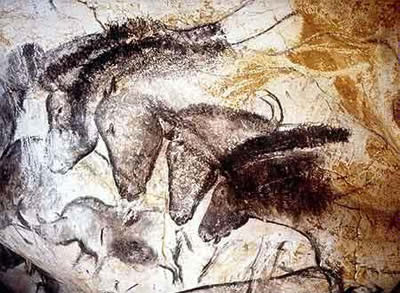
Earlier and earlier prehistoric art has been found. It’s getting ever harder to claim that Neanderthals had nothing to do with it. This is from the enormous Chauvet cave in France, at least 32,000 years old:

If Not Neanderthal, Probably Mostly Neanderthal

(42,000 year old art was also found in Spain.)

Neanderthals also domesticated, and genetically engineered dogs, from European wolves. That’s very clear.

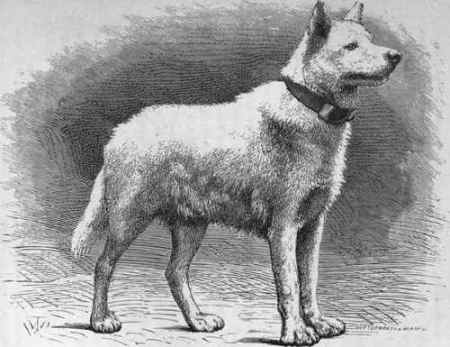
How do I know this? Simple. The Goyet dog, pictured below was dated around 32,000 years. In 2010, an even older dog was found in the Altai mountains. Both dogs were derived from Canis Lupus Familiaris, the European wolf, but were quite distant from it, genetically, they had been evolved probably on a time scale of more than 10,000 years, thus well before any arrival of Sapiens Sapiens from Africa.

Those dogs were completely compatible with people, just as contemporary dogs are. Proof? Ancient, 26,000-year-old footprints made by a child and a dog deep in the Chauvet Cave, France. (OK, by then Neanderthals had been deemed “extinct” by some… However, these are still the same dogs Neanderthals invented.)

It Took Many Thousands Years To Breed Such Large Dogs From European Wolves.

It is perplexing that other human groups did not domesticate the local canids. There are (still!) wolves in Africa and India. And also Lycaons (“African Wild Dogs”). Those are supremely intelligent, and sort of domesticate readily in the wild (I tried this myself as a child).

The argument that Africans would have moved to Europe to domesticate European wolves, when they had a similar fauna, including wolves, to domesticate in Africa, is simply extravagant.

In the next few days I will amend those static pages to incorporate this fascinating update to my knowledge.  I shall also seek permission to republish the articles linked to by Patrice as they are full of detailed knowledge about the oldest man-animal relationship; by far!

I just want to throw up!

Apologies for feeling very dispirited!

Normally, there’s always a selection of bits and pieces in my LfD Blog folder from which to construct a new post.

But yesterday afternoon as I trawled a number of articles and blog sites I ended up feeling sick to the back teeth. Disgusted about the inequalities and injustices that seem to be in the news just now. (I use the word ‘news’ liberally!)

It started with me reading, even before I was out of bed, the latest essay from George Monbiot entitled The Shooting Party.

As the food queues lengthen, the government is giving our money to the super-rich.

Then I went back to re-read an essay from Patrice Ayme that came out on the 22nd called USA: Rich Plutos, Poor People.  Here’s a snippet from there:

Plutocracy is a redistribution of wealth, power, income, from We The People to a small minority of controlling parasites. Plutocracy paralyzes the minds with a warped case of inverted decency. Plutocracy is neither optimal for the society, nor the economy.

Plutocracy affects the USA more than Europe, and the minds, even more than the stomachs. The fact that average Americans feel that they are much better off than in the rest of the world reinforces the plutocratization of the USA. Including astounding tolerance for the amazingly corrupt so called Supreme Court (Supremely plutocratic!).

On to another of Patrice’s essays.  Or more specifically to a comment left by Eugen to a post from Patrice published yesterday.

I would like to share with you my thought about the major defaults of the economic system called “Market economy” or “Capitalism”, or in the language of this blog, the moral deficiency of the system run by Plutocracy.

The major problem of the contemporary economic system on the macro level is that it enabled on one hand to pour into the economy too much financial liquidity at times of boom and overheated economy, by investing too much money in wrong and too expensive assets, and on the other hand at times of bust, when the economy needs liquidity to sustain employment, the system is rather greedy with helping investments in the same assets for even very reduced price. This system a-priory has to cause bust and boom, situations.

The economist since the great depression of 1929-1933 which had disastrous consequences learned from the lesson, and since then the governments and the central banks took as their major task in economy (and be the price whatever it takes), to act as anti bust and boom instrument. This is why they made the economic stimulus of trillions that saved the banks and financial system from total collapse (luckily the collapse came during the time of republican presidency and they couldn’t resist this decision), and the quantitative easing that poured liquidity of government money into the economy as alternative to the private money from banks who stopped to borrow.

So if it is so easy to solve the economic crisis situations, what is the problem? Let the economy run on the waves of bust and boom, and whenever the bust comes the government interferes, and at the times of booms let the boys play and enjoy themselves. If economics would be only about mathematical formulas, probably it could work, but the truth is all the economic decisions have their moral-political aspects. [Ed. My emphasis] And here lies the problem.

Because it is morally and politically very hard to neglect the principle of punish those who do wrong and give tribute to those who has done good. And this is actually what happens when the government comes to rescue the “credit boomers”, the bankers who created a distorted financial system, that channeled the financial and material resources to wrong places to invest in wrong assets, and when the D day came, they did not have to pay the price for their wrong doings. The same happened to those who took the loans, without to ask themselves if and when are they going to pay them back.

These Financiers and their creditors, who get loans of other peoples’ money enjoy free lunch twice. Once when they give and get these loans with knowledge that it will never be repaid, and second time when they enjoy the debt reduction, when the governments come to rescue them.

On the other hand those who use the wealth generated at times of boom to accumulate reserves for the bad times have to pay twice. First time when they restrain their activities during the times of prosperity and reduce by it their profits, second time at times of bust, when still they have to fulfill all their obligations, and get no praise for their responsible behavior in the times of boom.

Of course this system of Boom and Bust causes with each wave a major shift of wealth from one sector to the other, and generally from the decent and responsible entrepreneurs to the irresponsible gamblers, who happen to make bid on other people’s money.

This is one of the reasons why the pension systems are all in deficit, the wages stagnate while the profits and mainly the rewards of corporate managers of publicly traded companies surge.

Isn’t this just unfair?

Then I forget how I ended up on the Animal Spirits blogsite.  But I did.  To read a short essay Sanctions salami tactics.

Sanctions salami tactics

Plutocrats have a certain grudging respect for one another. Naturally, they would like to put each other out of business unless it impacted their own business adversely. So I conclude that Obama’s sanctions are an attempt to isolate Putin from his plutocratic supporters (although perhaps supporters is too strong a word; Putin keeps his plutocrats on a pretty tight leash, just ask Mikhail Khodorkovsky).

But what if under the table the West is inviting Putin’s plutocrats to join them, where the grass is greener and you don’t have old Vlad busting your chops. We’re not going to mention that we’re going to give you a haircut on the way, but are you really ready for the rebirth of the Soviet Union? The London bankers must certainly be for it.

On the other hand, you have the Chinese promising big business… but China’s biggest real estate investor is unloading everything as China replicates the Western real estate bubble and collapse….

It’s tough being a Russian plutocrat these days. It’s tough being a plutocrat anywhere, really, with all this talk that plutocrats are *too* wealthy (and are actually mass murdering their fellow humans with their insatiable greed by hording wealth and depriving others of health care, education and jobs).

Come to America! Come to the UK! Plutocrats rule! This is the subtext of what the Russian plutocrats are hearing.

Finally, an essay published on Naked Capitalism had me reaching for the bowl. It was by Rob Johnson on the Breakdown of Democracy.  Read it.  It included this video.

Published on Apr 26, 2014
Rob Johnson: The influx of additional campaign finance dollars and central bank policies have contributed to the destruction of democratic institutions

That was enough for me.

Couldn’t take any more. Certainly wasn’t feeling inspired and creative.  Just wanted to go out and find a horse to kiss.

Sanity is a warm, loving horse!

Sorry! Hopefully back to being more positively creative tomorrow!

The Natural order – life and death.

Nature imposes herself on us humans in absolute terms.

I do not believe in any form of life after death.  Jean is uncertain.  Many good people do believe in some form of spiritual afterlife.

However, one thing is sure. Our living mind and body will die.

These few words are an introduction to the first essay under the broad title of The Natural order. On the 23rd April I introduced the idea of writing a regular essay “about the past, present and future of man’s relationship with Nature.

Thus it did seem entirely appropriate to ‘kick off’ the essays with reflections about life and death.

Alex Jones of The Liberated Way blog recently wrote a post under the title of ‘The circle of life and death‘.  I am republishing it in full with Alex’s kind permission.

ooOOoo

The circle of life and death

Posted on April 27, 2014 |
Nature reminds me life and death is a circle.

The circle of life and death.

I visit a house, the noise of hungry little birds emanating from a nest hidden in the roof, busy parents flying in and out feeding their brood. Less than a week before summer (1st May) I encounter life all about me, like a vast fountain of creativity, as plant and animal erupt into growth and creation. I feel a sense of joy at the life all about me, like dipping my feet in crystal clear spring waters.

Amongst this carnival of life a reminder that with life there is also death. Helix our cat is an effective hunter, a blue tit is found dead upon the ground. I feel no sadness for the death, it is a natural part of the cycle of nature, my animistic viewpoint is of a small spirit returning to the source, and from then renewing. No anger for Helix, since this is the nature of cats, despite being fed, a cat must follow the primal instinct of its nature to hunt. I carry the dead blue tit to an overgrown spot of trees and grass, here I place the blue tit to decay and thus become part of the life of plant and animal of that place, such is the circle of life and death.

ooOOoo

There can’t be a single person on this planet who does not understand that our human life is finite.

Life span of early man: Until fairly recently, little information existed about how long prehistoric people lived. Too few fossilized human remains made it tough for historians to estimate the demographics of any population. Anthropology professors Rachel Caspari and Sang-Hee Lee chose instead to analyze the relative ages of skeletons found in archeological digs in eastern and southern Africa, Europe, and elsewhere. Comparing the proportion of those who died young, with those who died at an older age, the team concluded that longevity only began to significantly increase (that is, past the age of 30 or so) about 30,000 years ago – quite late in the span of human evolution.

In an article published in 2011 in Scientific American, Caspari calls the shift the “evolution of grandparents”, as it marks the first time in human history that three generations might have co-existed. ( Source: Longevity Throughout History.)

Thus given that living much past the age of thirty years is a relatively recent experience, it baffles me beyond comprehension that we, as in mankind, have become so short-sighted about reinvesting in the one and only natural planet that sustains us.

Beautifully expressed in another wonderful essay from John Hurlburt.

ooOOoo

 Notes on the Human Dilemma

The metanexus of Faith, Nature and Science form an integral vision of the reality in which we exist. We are components of Creation living in an emerging universe. As consciously aware life forms we are each and all responsible to the Nature of God in a steadily emerging universe. Change is both constant and inevitable. Species that don’t adapt, do not survive.

Our human problems are obvious.

The essential growth of human conscious awareness remains questionable.

There is a blatant disregard for Nature. The rate of Natural disasters is increasing everywhere on Earth

Civil unrest is bordering on a second Civil War and is already in that state in many other nations of the world.

Imminent economic collapse remains probable as long our world economy is based on a foundation that has been leveraged at least twenty-five times above any realistic material foundation on Earth.

Are we a moral species?

A steady increase in natural disasters worldwide is inevitable until we change in response to Nature’s warnings or become extinct. The collapse of morality threatens the existence of global civilization.

The virtual extinction of the human race in its present state is all but assured within the next century unless we adapt to the Reality we presently blithely ignore or chose to vilify.

We still have a choice.

Our alternative to what has been euphemistically referred to as “new reality” is the process of education, reformation and transformation on a personal level. The objectives are an obvious need to adapt to constant natural change and create a species renaissance in harmony with the reality of God, Nature and Science.

There is clearly a need for a global economy that is based on our primal need for clean air, clean water, clean food and clean energy. We need to maintain our balance through gratitude for the blessings of the life we share and equal justice for all. We need to remember that we are not in charge of anything except our responsibilities to God, Nature and each other.

Under these simple guidelines, a healthy, growing future remains possible as we prepare to migrate from our home planet and relieve the consumptive consequences of an exponentially growing and ravenous demographic ruled by the artificial symbol of Money.

Sound impossible? Au contraire…

The world is being forced to re-evaluate its economic premises. Here are a few proven solutions to help create a naturally invigorated economy.

We can cut air pollution dramatically overnight by converting commercial diesel engines to far more cost-effective bio-fuels without a single change to the diesel mechanisms.

Bio-diesel distillation plants can filter and recycle the clean water we need to live.

We are capable of growing our own food with recycled organic fertilizers.

We have begun the process of harnessing the limitless clean renewable energy provided by the sun, the wind and hydraulic power.

Electric cars that may be fueled by solar energy are winning world class races.

The list of what we are capable of doing is only limited by our imaginations.

The questions to ask ourselves are:


Are we at the beginning of a new world or at the end of an old world?


Are we a part of the problem or part of a realistic solution?”


What will be the harvest of our lives?”


an old lamplighter


ooOOoo

Having yourself as your best friend.

The power of having a great friendship – with yourself!

Today’s post came as a result of some poems published by Kimberley over at Words4jp’s Blog.  She and I follow each other’s blog and each often stirs the other’s emotions.  There was a sad post published by her on the 23rd April called within.  Part of the comment that I wrote to that post read as follows:

Oh, it pains me to read your post. You are such an open, honest person; well that’s what comes across through your writings. Knowing and loving ourself is the only worthwhile journey of our life. For without being at peace with who we are, we will struggle to be at peace with others.

Kimberley published another post the following day, friend and foe, that again struck me as being sad.  Read it and see if you agree with me.

it is said

to keep one’s friends close

but

to keep one’s enemies closer

SO

could this explain

WHY

when i look in the mirror

i find

i am becoming less of a friend

and

more of an enemy –

to myself

?

After reading both those poems I ‘threatened’ Kimberley that I would write a post on becoming friends with oneself.

Here it is.  Adding immediately that I’m drawing heavily on a conversation that Jon Lavin and I had a few months ago; Jon’s background can be looked up over at The People Workshop. Jon is the professional psychotherapist – I am not!

ooOOoo

Knowing who we are.

On the 24th January last, I published a post under the title of 20:20 self-awareness.  Included in that post was this:

What we hear and what we say are both modified, frequently unconsciously, by past events, experiences and trauma. That being the case, then it is key, critically so, that we achieve the best possible self-awareness. Because it is only through an understanding of our past that we come to learn of our sensitivities and our associated ‘tender spots’ and their potential for ‘pulling our strings’. Here’s a personal story.

In 1956, when I was 12, I experienced a trauma that was interpreted by my consciousness as emotional rejection. By the age of 14 that sensitivity to rejection had descended into my subconscious. For fifty years, that sensitivity remained hidden yet continued to influence my life in many unseen ways, not all of them negatively by a long measure. In 2007 a period of counselling revealed that hidden emotional rejection; brought it to the surface. It changed beyond imagination how I felt, how I behaved, how I was. Nonetheless, that sensitivity to rejection is still there, albeit now visible. Thus when I hear or experience something that tickles that sensitivity I still react. But because I can now see and feel myself reacting, I can sidestep the emotional strings.

OK, but what does better self-awareness not achieve?  Knowing better who we are delivers no cleansing of our past, no removal of the capacity of that past to cause pain.  Those psychological hooks and impulses are still alive and well!

So what’s the point of knowing better who we are if that greater self-awareness doesn’t remove those hooks and impulses that have the capacity to cause us pain?

The answer to that last question is this.

Greater self-awareness brings about control by the self of the self! We are able to start the slow process of gaining trust in ourselves.  Trust; as in emotional trust. Being able to emotionally trust ourself is a central theme in psychotherapy solutions.

When we trust the emotional person that we are then we have achieved a liking for the person that we are.  Bringing to mind the truism that you cannot like another if you do not like yourself. Like = Love, of course.

So two things to offer to close the post.

WakingTiger

The first is that if you have any suspicion, or know for certain, that you have experienced trauma in your past life, especially in your formative years then the book Waking The Tiger by Peter A. Levine is a valuable resource.  You can learn more about the book including reading the first chapter on the Somatic Experiencing website.

The second is to repeat the short film that was included in the 20:20 self-awareness post.  This is how it was introduced:

The following is a short, twenty-minute, documentary film about fear. Do watch it. The message that we are so profoundly a product of our past is beautifully presented.

Take good care of yourself!

The Natural order.

Back to the basics of life.

Regular readers of Learning from Dogs will recall that just under a week ago I published an essay under the title of A bedtime story for mankind.  The post centred around an essay from Patrice Ayme.  Patrice’s essay could be summarised as follows: “At the present rate of greenhouse gases emissions, within nine years, massively lethal climate and oceanic changes are guaranteed.

Then just last Sunday, Patrice published a second essay reinforcing that first one.  The subsequent essay was called Ten Years to Catastrophe.  I was minded to republish that but upon reflection thought that there was a better option.  That was to explore the deep, core questions that both of Patrice’s essays raised in my mind and, presumably, must be raised in the minds of countless thousands of others.  Questions along the lines of a comment I submitted to that subsequent post from Patrice.

Do you have an idea, even a sense, of when global leaders, elected Governments, the ‘movers and shakers’ in societies, will truly embrace the global catastrophe that is heading our way?

And a supplementary question: What would be the indicators that Governments were acknowledging the task ahead?

Frankly, they weren’t especially good questions but they were an attempt by me to open up a debate on whether or not this is the “beginning of the end” of life for us humans.  Central to what was going through my mind was the core question of how did it all go wrong?

Welcome to Payson, AZ

On Monday evening, I rang John Hurlburt, a close friend of Jean and me from our Payson, Arizona days and kicked around those questions .  It was a most enlightening conversation.  John is an active founder member of Transition Town Payson and Payson recently welcomed the Great March for Climate Action in their walk from Los Angeles to Washington D.C. (An essay on that event coming soon.)

Anyway, from out of that conversation with John came the idea of a series of essays here on Learning from Dogs about the past, present and future of man’s relationship with Nature.  The aim is to offer an essay on a weekly basis but we’ll see how it goes.  Wherever possible, I will use the essays and posts from other bloggers that reinforce the vision. As always, your feedback in the form of ‘Likes’ or comments will reflect on the value of the essays to you.

After John and I finished the call, he sent me an email with what could be best described as his vision for these essays.  Here is that email [my emphasis].

Integral Vision

Everything fits together. Otherwise, we’d simply be disassociated atoms.

Human beings are a consciously aware component of Nature. We have a DNA-level directive to survive as a species and as individual members of a species …. in that order!

We are consciously aware components of the conscious interaction between energy and matter in a predominently smoothly emerging cyclic universe with departures from time to time into pockets of chaos.

We disconnect from reality when we become self-centered, often during the various stages of our lives. When we are blessed we continue to live and learn.

Issues of ideology, rational thought, economics, politics, religion, history and science become insignificant in comparison to the whelming power of Nature.

Such is life. It comes with the territory. Spirituality, Nature and Science describe the metanexus in which we live.

Maintain an even strain,

an old lamplighter

Ref: Episcopal “Catechism of Creation”

Ideas, feedback and comments, as always, hugely welcomed.

Picture parade forty.

A very suitable set of pictures for today; Easter Sunday.

Thanks to Bob Derham for sending them to me.

ES1

oooo
ES2

oooo

ES3

oooo

ES4

oooo

ES5

oooo
ES6

oooo

ES7

oooo

ES8

oooo

ES9

oooo

ES10

oooo

ES11

oooo

ES12

oooo

ES13

oooo

ES16

oooo

ES17

oooo

ES18

oooo

ES19

oooo

ES20

oooo

ES21

oooo

ES22

oooo

ES23

oooo

ES24

oooo

ES25

oooo

ES26

oooo

ES27

oooo

ES28

oooo

ES29

oooo

ES30

oooo

ES31

oooo

ES32

oooo

ES33

oooo

ES34

oooo

ES35

From Jean and me and all our animals, our Easter wishes for peace to you all.