Tag: Reflections

How big bankers became outlaws

[This is another Guest Post from Patrice Ayme which appeared on his Blog on the 28th April.  It has been slightly modified by me. Ed]


Celebrating Goldman Sachs, while acknowledging that it is far from being all their fault.

Point One: We are living in a state of law. Supposedly.

Point Two: That State is democracy, the rule of the demos, the people. It is not the rule of the bankers. Supposedly.

Point Three: Political leaders have recently given PRIVATE unelected individuals, the bankers, the means and the right to create money, the money everybody uses, through debt, ex nihilo, starting from PUBLIC funds  (Called, somewhat misleadingly, the fractional reserve banking system.)

Point Three contradicts the union of Point One and Point Two. Power is supposed to be exerted by the people, but money is power. Big bankers create money at will, with the complicity of the political leadership. So they create power at will.

Thus, the present system incites (big) MONEY CREATING BANKERS TO BECOME GANGSTERS, and then OUTLAWS.

It is as simple as that!

Thus one needs to get rid of the private fractional reserve PUBLICLY funded money creating system.  The situation has been rendered worse in the last decade by the blossoming of synthetic derivatives which are out-of-this-world bets which could not possibly be paid back.

Synthetic derivatives of derivatives transformed a 300 billion dollars loss in real mortgages into a potential exposure of 24,000 billion dollars, thanks to the leverage of the derivatives squared.

Then political leaders, accomplices with the bankers, offered to pay the 24,000 billion dollars, on behalf of taxpayers, leaving the economy in tatters.

Not all is lost: Goldman Sachs got its entire 2008 profit, 13 billion dollars, from taxpayers, through AIG, thanks to US politicians, and the USA loves a winner. Love and dove, there are still many a feather to pluck.

By Patrice Ayme

P.S. Synthetic derivatives are, mathematically and philosophically, a generalization of the license of the privately managed, publicly funded, fractional reserve system, thus proving further, if need be, how erroneous the latter can be.

P.P.S. The fractional reserve system ought to be kept, to provide the capital needed, simply it ought not to be anymore the province of a small private oligarchy gaming it.

Freedom starts at home

Freedom as something one must endeavor to gain and maintain!

The power of a cup of tea!

There is a quiet self-contradiction developing in the Tea Party movement that needs addressing, for it is a contradiction that, if left uncorrected, could turn a force with truly revolutionary potential into one more element of an oligarchic political stasis.

This movement, which as a culture attempts in many ways to be an imitation of the founders, is steering away from its origins and failing to take hold of perhaps the single most important insight of the entire American Revolution – that national change is the result of local change, not its cause.

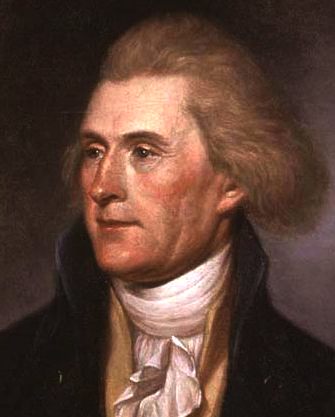
It was not homesickness that led Thomas Jefferson to return to his home state of Virginia and decline a re-election to

Thomas Jeffersen

Congress after penning the Declaration of Independence. At the forefront in Jefferson’s mind on July 5, 1776, was not the welfare of the new nation as a whole, but rather the welfare of his home state of Virginia.

For Jefferson, Virginia was not simply one part of the ultimate goal of the United States, but in fact an ultimate goal in itself. It was at the local level that Jefferson knew provisions for the future freedom of his fellow Virginians had to be made.

Voltairine de Cleyre, an anarchist who lived in the late 19th and early 20th centuries, greatly admired the founding generation and Jefferson in particular.

In her essay “Anarchism and American Traditions,” she wrote that one of the greatest traits of the American revolutionaries was their recognition “that the little must precede the great; that the local must be the basis of the general; that there can be a free federation only when there are free communities to federate; that the spirit of the latter is carried into the councils of the former.”

“Anarchism” today is often employed as a pejorative term rather than as a description of the political and economic philosophy taken seriously by such great minds as J.R.R. Tolkien, Henry David Thoreau, Thomas Jefferson and William Lloyd Garrison. In fact, de Cleyre’s political philosophy had many similarities with modern libertarianism and traditional conservatism.

Continue reading “Freedom starts at home”

Giving Up!

[With this Post, Jon introduces a series of forthcoming articles looking at the inner person and exploring ways in which each of us can enhance our feelings of contentment and happiness. Ed.]

Stop the world, I want to get off!

Starting again requires giving up

Whichever way we look, there appear to be huge problems. Not insurmountable but, metaphorically speaking, sheer vertical cliffs without any easy way up.

One might ponder if the last 50 years, that post-war period of growth and prosperity, have, in reality given society real, sustainable, core improvements or whether all the ‘gains’ have come at such a cost that the net benefit is questionable?

This could be seen as pessimism gone mad. Undoubtedly, there have been some huge gains from a scientific point of view and we now enjoy lives that are greatly enhanced and longer. But not to ask such a fundamental question is to assume the alternative, that everything in the garden is rosy.

Now this may seem a strange introduction to a topic that is going to be deeply personal and private.

But both the private, individual world of the ‘self’ and the great, interconnected world of the planet are indivisible. Every aspect of our lives, our livelihoods, our environment and the future of our children depends on how well, and how sustainably, we manage our personal, local, national and international interests.

For example, if Prof. Lovelock’s theory on the planet being a self-regulating organism is correct, his Gaia theory,  then possibly in the lifetimes of our children, and certainly in the lifetimes of our grandchildren, worrying about a job or repaying the mortgage will be irrelevant. Our descendants will be worrying about their very survival!

I called this piece Giving Up. Why?

Because the only way forward is to give up on the present. I will expand on this theme in future Posts.

The future depends on each of us being happy and contented with ourselves and avoiding looking out there for the magic cure to all our troubles. Being, as far as we are able, at peace with our circumstances and able to do the best, individually, as well as the best for our families, our friends and the larger world in which we work and play.

I have heard people ask the question before, “How can I best help the world?” The only truthful answer is to develop ourselves as individuals. In doing this, the field of consciousness that we are all connected to is also lifted or elevated to a higher level.

At this stage of history, either…the general population will take control of its own destiny and will

Noam Chomsky

concern itself with community interests guided by values of solidarity and sympathy and concern for others or alternately there will be no destiny for anyone to control.

-Noam Chomsky

By Jon Lavin

[Anyone who has been affected by this article and wishes to contact Jon may find his contact details here. Ed.]

It’s an ill wind that blows nobody any good!

Iceland’s ash casts an enigmatic spell over Japan

It seems that there has been nothing else on the news following the eruption of Mount Eyjafjallajokull
in Iceland, which was of particular interest to me  because on the 10th April I was flying from New York across the southern area of Iceland on my way to Rome, since which time I have passed through the UAE and Singapore on my way to Japan.

My work replacement was due to arrive on the 18th April after a holiday in the Mediterranean, but the flight which he was on was diverted into Paris because UK airspace was suddenly closed. He managed to continue his journey by train, ferry, car, taxi and bus but was then stuck in England. My duty had to continue but there seemed little point in propping up a hotel bar with other crews, so I decided to turn the situation into something positive.

After an exploratory trip into Tokyo, it was Paul, our Editor in Chief who put me in contact with his sister and her husband in the city, and another friend who suggested I should jump on a train and go to Hiroshima to see his son, who I know, so my travels started.

The transport system in Japan is extremely well organised with instructions and information well displayed in English along side Japanese. Everything is clean and modern, and runs to the second! At short notice I decided to make the journey to Hiroshima in this once in a life time opportunity, and there was the famous bullet train a monster of modern technology, which runs on banked rails at steady speeds of 400 kph.

Mount Fuji - Japan

We sped along through ever changing countryside. Initially the skyline was of mainly high rise buildings which changed to two story properties once we were out of town. The new leaves of spring and the famous blossom of the plum and cherry trees, and the quick glimpse of a Japanese water garden. Industry is mixed with small allotments, and tiny houses, roads and rail lines raised from ground level to make everything fit, and above that cables and wires, because of the threat of earthquakes, and past the stunning Mount Fuji, white with snow against a blue sky.

I never met such polite people, and on the train the guards and girls who pass through the carriage with drinks and food bow when they enter and leave. They are so well dressed and smart. No graffiti here!

Familiar Japanese trading names on local buildings, and strangely a huge Union Jack flag. I wonder how there can be so many buildings and parking areas full of cars ,but seemingly no people in view, but many large span bridges arching across hill sides to join places together.

Through Kyoto where there seemed to be a lot of energy being used, for purposes that were not immediately clear. College students in smart suits with white shirts and blue ties, passed quietly through the train. I noticed each time they had left the train at a station they took their rubbish with them, and put the seat back in the upright position!

The A-Bomb Dome

At last after four hours we arrived at Hiroshima, which today it is a lovely modern city of which to be proud. There is just one damaged building standing in a stark fashion at the waters edge which is all that it takes to remind us of such devastation and the Garden of Peace, there to allow some quiet reflection.

I took a 45 minute boat ride to Mijajima, now a World Heritage site. This beautiful island is probably 15 miles from Hiroshima, and there amongst the beauty of the trees and a 500 year old shrine wander the deer, quite happy to sit as people pass by.

My thought as I came away from Hiroshima was that all leaders of any country with any connection to Nuclear weapons or power should be made to attend the A-Bomb Dome and reflect. As all the plaques say this must never be allowed to happen again.

By Bob Derham

Letter from Payson – the language barrier!

America and England are two Nations divided by a common language

The other day I was in Payson’s local Home Depot looking for what I call a torch.  As usual, if one has an air of not knowing where to look, it is only a matter of moments before a sales assistant asks if he or she may help.

The Home Depot - Payson, Az

Me: Excuse me but do you sell rechargeable torches?

Sales Assistant: I don’t think so, Sir, you would be best advised to ask at the Information Desk.

A few moments later, at said Information Desk … Do you stock rechargeable torches?

The young girl types on a keyboard, looks up at the screen and replies … I’m sorry Sir, we don’t stock those.

Surprised, I get on looking for the other items that I need.

About 10 minutes later, halfway down an aisle I notice – guess what – a decent selection of rechargeable torches! Pleased, I make my selection and on the way out to the tills pass by the original sales assistant who came to help me.

Me: You see you do sell rechargeable torches!

Sales Assistant:  Ah, we call them flashlights!

The point of this rather mundane story is to point out that the differences in language between American English and UK English are much more involved than the famous ones such as rubber and condom!

In fact there are so many different terms in the D-I-Y arena that I have stopped asking for items in what, to me, is the

Ace Hardware

obvious name and now tend to describe the problem that I am trying to fix.

Thank goodness, most of the assistants in Home Depot, and the equally efficient Ace Hardware, now see me coming and know that I’m still learning to speak American!

Is there a deeper element to this language difference?

I believe so.  Because the assumption is that you are going to be understood straight off.  If one was in a country where the natural language was other than English then, without doubt, you would know that verbal communication was going to be strained, to say the least.

In America we just take the language for granted. In practice, I suspect that verbal communications are much less effective than one assumes.

Finally, it’s interesting to note that Jean, who was married to an American for 30 years, effortlessly switches to both an American accent and vocabulary as soon as she is talking to the locals.  Will I, too, make the switch over time?

(If you are in need of a rechargeable torch yourself, here is a Home Depot coupon. Good luck!)

By Paul Handover

P.S. The quote that started this article appears to have been originated by George Barnard Shaw and not Winston Churchill as I previously thought.

A Teen’s Reflections

This is the second Guest post from AJ Easton, a 13-year-old girl from North Carolina, USA. AJ first wrote about Learning from Horses on January 17th this year. This is a more reflective essay that would have been a credit to someone with many, many more years.

Trust is a complicated thing…

You have to learn to trust, but it is not something that can be taught in schools. You also have to earn trust, by keeping secrets and not spreading rumors.

With the people you trust, you do things you wouldn’t do with other people . Your true self comes out with the people you trust. You don’t worry about being judged; you don’t worry about people disliking you for who you are.

AJ Easton

But, in our modern-day world, it seems as if everyone judges.

People seem to hate for reasons as stupid as one’s appearance. People don’t trust people anymore because it seems that we are constantly warned to avoid strangers because they might hurt you, murder you, or completely mess up your life in some way, shape, or form.

And in school, if you trust someone enough to tell them a secret, they don’t keep it. And then, in your point of view, the world has ended.

All because of some secret that got out about who you like, or what you did with the person you were dating, or something else that, in the end, isn’t all that important.

Then everyone will judge you based on that rumor until you leave the school or graduate. They do this to make themselves feel “cool” and “important.”  And you learn not to trust.

Social status has become such a big factor in everything we do these days. Everyone feels as though they have to be highly ranked socially to mean anything to the world.

But, truly, all you have to do is love what you do and respect yourself, to follow your dream and be determined. We should make decisions that help us move forward, not dwelling on the past.  Every second is different; everything is unique. Nothing is the same. Not a single person, or tree, or moment.  Each moment represents a new opportunity.

Don’t have regrets. What has happened has already happened and you can’t change it. Time travel is fictitious, not a reality. You can’t rewind your life to change what you have already done. There is a reason behind everything: remember this when you are having doubts about what you have done.  Learn from your past but don’t let it eat at you.

Live your own life. And learn to trust yourself, and those who love you.

By AJ Easton

Alistair Cooke

A tribute to Alistair Cooke of Letter from America

Many, many people of a certain age will remember with very fond affection the weekly BBC Radio broadcasts of Alistair Cooke under the title of Letter from America.

Alistair’s broadcast title, Letter from America, came to mind because I have been thinking for a couple of weeks about what to call my impressions about moving to Payson in Arizona.

Payson Perceptions? Pictures of Payson? Payson Profile?  No!  They all seemed naff!

But would it be too presumptuous to echo Cooke’s hugely famous programme title?  Hopefully not.

(And regular readers will know that yesterday, the first Letter from Payson was published.)

I did a Google search on Alistair Cooke and immediately found the BBC web page devoted to him.  For those that don’t know Cooke here are a few details from WikiPedia.

Born in 1908 in Salford, Lancashire, England, Cooke first started broadcasting for the BBC in 1946 and continued until the 20th February, 2004, a total of 58 years and making Letter from America the longest-running speech radio show in the world.

I hope the BBC will forgive me in reproducing here on Learning from Dogs the obituary that is on the Alistair Cooke website.  He was a wonderfully interesting man and his weekly Letter from America seems to have been part of my complete life (in a sense it was).

——————-

Reading Letter from America in the 1950s

He read his Letter from America for 58 years

Esteemed writer and BBC broadcaster Alistair Cooke, famed for his programme Letter From America, has died aged 95. BBC News Online looks back at his long and respected career.

For more than half a century, Alistair Cooke’s weekly broadcasts of Letter from America for BBC radio monitored the pulse of life in the United States and relayed its strengths and weaknesses to 50 countries.

His retirement from the show earlier this month after 58 years, due to ill health, brought a flood of tributes for his huge contributing to broadcasting.

Born in Salford, near Manchester, northern England, Alistair Cooke’s father was an iron-fitter and Methodist lay-preacher.

Alistair Cooke

Alistair Cooke: Consummate broadcaster

Winning a scholarship to Jesus College, Cambridge he read English, edited the undergraduate magazine, Granta, and founded the Cambridge University Mummers.

Alistair Cooke made his first visit to the United States in 1932, on a Commonwealth Fund Fellowship which took him to both Yale and Harvard universities.

Following his return to Britain, he became the BBC’s film critic and, in 1935, London correspondent for America’s National Broadcasting Corporation.

He returned to the United States in 1937 to work as a commentator on American affairs for the BBC. He made his home there and, in 1941, became an American citizen.

Alistair Cooke

A passion for jazz

March 1946 saw the first edition of American Letter, which became Letter from America in 1949.

The series was the longest-running series in history to be presented by a single person.

Alistair Cooke never decided what he was going to talk about until he wrote the script, made no notes during the preceding week and preferred to rely on his memory.

In an interview given at the time of the 3,000th edition of Letter from America, he appeared to have mixed feelings about the future of the United States.

“In America,” he said, “the race is on between its decadence and its vitality, and it has lots of both.”

Addressing Congress in 1973

He addressed Congress in 1973

Cooke led his listeners through the American vicissitudes of Korea, Kennedy, Vietnam, Watergate, Nixon’s resignation and Clinton’s scandals.

In all of this, Cooke pulled no punches. The lyricism of his broadcasting and the urbanity of his voice did not disguise his fears for America which he saw becoming a more violent society.

A liberal by nature, he reserved particular dislike for what he saw as the shallow flag-waving of the Reagan presidency.

Alongside working for the BBC and The Guardian, for which he wrote from 1945 to 1972, he developed a passion for jazz and golf and, as a film critic, he mixed with Hollywood stars.

As a commentator on history, Cooke was sometimes an eyewitness too. He was just yards away from Senator Bobby Kennedy when the latter was assassinated in 1968.

He was never as comfortable on television as radio but, by the 1970s, his hugely successful television series America recounted his personal history of his adopted homeland and won international acclaim, two Emmy Awards and spawned a million-selling book.

British or American?

The Queen awarded him an honorary knighthood in 1973 and the following year, for a journalist, he received the ultimate recognition – he was asked to address the United States Congress on its 200th anniversary.

He told his audience he felt as if he was in a dream, standing naked before them and there was only one thing he could find to say.

Teasing, he exclaimed to the assembled legislators, “I gratefully accept your nomination for President of the United States!”

Naturally, he brought the house down.

Many Britons thought he was American, but to the Americans he was the quintessential Brit, the man who brought them the best of British television as presenter of Masterpiece Theatre. For his part, he explained, “I feel totally at home in both countries.”

He impressed both audiences with his high quality work. With his unquenchable curiosity, Alistair Cooke remained for decades the consummate broadcaster, an elegant writer and a man of enormous wit and charm who made sense of the American Century.

By Paul Handover (still missing Letter from America on the radio.)

Letter from Payson – first impressions

Ma’am, it’s only a small cow town!

On February 26th Jean and I, and a caravan of dogs and cats, arrived at our new home in Payson, Arizona.

We chose Payson simply because we wanted seasons.  Payson is about an hour NE of Phoenix up at 5,000 feet and has very distinct seasons!

Snow in the garden - late March!

Both of us for different reasons thought we knew America pretty well.  Jean was married to an American for nearly 30 years and I had been doing business in the US for a long time, even having my own (small) US company based in New Jersey.

But what neither of us anticipated was the wonderful warmth and friendliness of the Payson inhabitants.  Despite the fact that Payson is hurting big time as a result of the economic situation, the majority of people that we met were happy, smiling and wonderfully accepting of a couple of Brits turning up in their town.

Indeed, Jean spoke to this stranger in the local supermarket, a tall guy complete with the boots and Stetson hat, and asked simply, “Why are so many people in Payson smiling?

His reply was simply, “Ma’am, it’s only a small cow town!

Well here’s a couple of newcomers to this small cow town who like it!

Payson and the Mogollon Rim in the background.

By Paul Handover

The Flirting Pilot

A departure from economics!

I have hit a man only once in my adult life. Only once, but this was a full-out, closed-fist, knock-you-off-your-feet slug that dared him to come back for more. And he didn’t. One slug did it! How empowering!

Bob (name changed) took me and George (my then-fiancé and now ex-husband) for a ride in a four-seat plane above the skyline in downtown Dallas, Texas late one summer night when the skies were dark and the stars were bright.

Private Plane

Bob was a friend of Allen, who was a very good friend of mine and an accomplished private pilot who had introduced me to the joys of flying. Allen trusted Bob and I trusted Allen, so I was not unusually concerned about Bob’s ability to get us back down safely. But I hadn’t factored in Bob’s judgment, or lack thereof.

I think, in hindsight, that Bob had hoped I would show up for the ride alone despite the  fact that I had arranged it as a surprise for George. The plan was for George to sit up front and play co-pilot.  Upon arrival at the hanger, however, Bob promptly stuck George in the back seat of the plane and then turned his full attention to me.  I’m usually fairly dense to these things, but it was apparent even to me that Bob considered this to be a  “date.”  He was charming, animated and very friendly, while virtually ignoring George’s very existence.  We reviewed the safety measures, checked out the plane, and away we went.

Bob was showing me a series of maneuvers, swooping and banking and it was all lovely and exciting until…..a sudden plunge…..and everything instantly blacked out.  It was very disorienting — even though my eyes were  wide open and I was totally conscious, I could not see a thing.

The sirens started blaring; a recorded voice shouted “Stall! Stall! Stall!”  I called to George but he didn’t answer. Either he was unconscious or couldn’t hear me over the noise, but I wasn’t sure which.  I reached out to Bob, but he was unresponsive and felt limp.  Now I was really worried.  Momentarily terrified, actually, with that cold feeling of raw fear in the pit of my stomach.  I thought to myself, “If I am blacked out and cannot see, then HE, the, um, PILOT,  might be blacked out as well!”

I had what seemed like a very long time to ponder what I could do to survive this emergency, and keep George alive, who was there because of me!  I tried to feel my way along the control panel to find the radio to call out “May Day,” but that wasn’t going too well. Somehow — I don’t know how because I still could not see! — Bob got us out of the descent, pulling the nose up and righting the plane.   The sirens and warnings stopped.  After a few more moments, my vision came back, and my stomach returned to its rightful place.  We landed in one piece.

But when ole’ Bob got out of the pilot’s seat and walked around the plane to help me exit, I had a little surprise for him. Actually, it was a surprise for me, too, because I didn’t plan it and didn’t “see” or “feel” it coming. The next thing I knew I had drawn my right arm back, made a fist, and threw it into his left shoulder with everything I had. POW!

He stumbled, grabbed his arm, and said “Ow! What did you do THAT for?”  Well, I didn’t think I had to explain how I thought he had just put my life and that of a friend in danger just to show off.  I didn’t think he would see it the way I did, that he had flown that plane beyond his ability to control it. And even if he was in control the entire time, which I doubted, he scared the bajeebees out of me which was reason enough for me to sock him one!

I don’t recommend physical violence, even if the assailant is half the size of the perpetrator, but I have to tell you that to my knowledge, Bob never took another unsuspecting victim up for a little spin around the tops of buildings in downtown Dallas.   And I know that if I ever really need to wind it up and let her go, I do have it in me.

By Sherry Jarrell

Let’s stop messing with the clocks!

Crazy, outdated concept – adjusting clocks twice a year!

The whole concept of adjusting the clocks with the seasons, “Daylight Saving” as the Americans call it, seems increasingly ludicrous the more that one thinks about it. In the UK, it is called British Summer Time and is abbreviated to BST; I call it British Silly Time.

The expensive consequences for computer systems, airlines, railways and many other systems and organisations having to mess about with times and schedules are completely unnecessary. And I have lost count of the number of times I have heard of people missing calls or online meetings due to misinterpretations of time zones and distortions in the name of “daylight saving”.

One would have thought that people who spend the most time involved with nature would find it the most ludicrous and that among those would be farmers. However, it seems that this is not the case as there is a discussion about introducing permanent BST or even “double BST” on the UK National Farmers Union (NFU) website.

The news article is titled “Should we change the clocks?”. My answer is a simple “no”. In case the answer is unclear, I mean “no”! That is “do not change the clocks”! That is “leave the clocks alone”! That is “stop messing with the clocks”! In the UK that means “leave the clocks on GMT, the correct time”!

Does no one else understand this? Well, thankfully, many people do. For example, the whole of the aviation industry uses Zulu time (UTC) worldwide. Let’s be clear what that means. When pilots get a weather reports from any airport in the world (whether it is Heathrow or Los Angeles airport), the times are in Zulu time which is UTC/GMT. Yes everyone uses UTC.

The really funny part is that the NFU news article even states “analysts have claimed an extra hour’s daylight could be worth £3.5 billion a year to the economy”. This is the ultimate fallacy.

Let us be clear about something, in case you had not noticed: THERE IS NO EXTRA DAYLIGHT!! Where, on earth, did farmers get the idea that there is?!

Chris Madden cartoon

By John Lewis