Tag: Prof Stanley Coren

Sharing our emotions

Good people, ran out of time yesterday but wanted to republish the following.

It first appeared in October, 2015. The pictures are no longer available online.

Exploring the range of emotions felt and displayed by our dogs.

Like so many bloggers, I subscribe to the writings of many others. Indeed, it’s a rare day when I don’t read something that touches me, stirring up emotions across the whole range of feelings that we funny humans are capable of.

Such was the case with a recent essay published on Mother Nature Network. It was about dogs and whether they are capable of complex emotions. Better than that, MNN allow their essays to be republished elsewhere so long as they are fully and properly credited.

Thus, with great pleasure I republished the following essay written by Jaymi Heimbuch.

ooOOoo

Are dogs capable of complex emotions?

Joy, fear, surprise, disgust, sadness. These are the basic emotions dogs feel that are also easy enough for humans to identify. But what about more complex emotions?

Many dog owners are convinced their dogs feel guilty when they’re caught misbehaving. In the same way, many owners are sure their dogs feel pride at having a new toy or bone. But it gets tricky when you assign these sorts of emotions to a dog. These are definitely emotions felt by humans, but are they also felt by dogs?

(see footnote)

Why we question the presence of complex emotions is wrapped up in the way we get to those emotions. The American Psychological Association explains, “Embarrassment is what’s known as a self-conscious emotion. While basic emotions such as anger, surprise or fear tend to happen automatically, without much cognitive processing, the self-conscious emotions, including shame, guilt and pride, are more complex. They require self-reflection and self-evaluation.”

Essentially we’re comparing our behavior or situation to a social expectation. For instance, guilt comes when we reflect on the fact that we’ve violated a social rule. We need to be aware of the rule and what it means to break it. So, can dogs feel guilt? Well, exactly how self-reflective and self-evaluative are dogs?

Among humans, children begin to experience empathy and what are called secondary emotions when they are around 2 years old. Researchers estimate that the mental ability of a dog is roughly equal to that of an 18-month-old human. “This conclusion holds for most mental abilities as well as emotions,” says Stanley Coren in an article in Modern Dog Magazine. “Thus, we can look to the human research to see what we might expect of our dogs. Just like a two-year-old child, our dogs clearly have emotions, but many fewer kinds of emotions than found in adult humans.”

In other words, if 18-month-old children can’t yet experience these emotions, and dogs are roughly equal to them in cognitive and emotional ability, then dogs can’t feel these self-reflective emotions either. At least, that’s what researchers have concluded so far.

Is that guilt or fear?

The evidence for primary emotions like love and happiness in dogs abounds, but empirical evidence for secondary emotions like jealousy and guilt is sparse. And this is partially because it’s difficult to create tests that provide clear-cut answers. When it comes to guilt, does a dog act guilty because she knows she did something wrong, or because she’s expecting a scolding? The same expression can come across as guilt or fear. How do we know which it is?

Scientific American explains it further:

“In wolves, it is thought that guilt-related behaviors serve to reinforce social bonds, as in primates, by reducing conflict and eliciting tolerance from other members of the social group. The same could be true of dogs, though their social groups would primarily include humans. The problem is that the display of the associated behaviors of guilt are not, themselves, evidence of the capacity to emotionally experience guilt… It may still be some time before we can know for certain whether dogs can experience guilt, or whether people can determine if a dog has violated a rule prior to finding concrete evidence of it.”

Guilt, and other secondary emotions, are complicated. That’s exactly why cognitive awareness and emotional capacity in dogs is still a topic under study. In fact, it’s an area that has grown significantly in recent years. We may discover that dogs have a more complex range of emotions than we’re aware of today.

Dogs are highly social animals, and social animals are required to navigate a range of emotions in themselves and those around them to maintain social bonds. It wasn’t so long ago that scientists thought that dogs (and other non-human animals) didn’t have any feelings at all. Perhaps our understanding of dog emotions is simply limited by the types of tests we’ve devised to understand their emotions. After all, we’re trying to detect a sophisticated emotional state in a species that doesn’t speak the same language.

There’s a lot we don’t know

Marc Bekoff makes the argument for leaving the possibility open. In an article in Psychology Today he writes, “[B]ecause it’s been claimed that other mammals with whom dogs share the same neural bases for emotions do experience guilt, pride, and shame and other complex emotions, there’s no reason why dogs cannot.”

Keeping the possibility open is more than just an emotional animal rights issue. There is a scientific basis for continuing the research. A recent study showed that the brains of dogs and humans function in a more similar way than we previously thought.

Scientific American reports that “dog brains have voice-sensitive regions and that these neurological areas resemble those of humans. Sharing similar locations in both species, they process voices and emotions of other individuals similarly. Both groups respond with greater neural activity when they listen to voices reflecting positive emotions such as laughing than to negative sounds that include crying or whining. Dogs and people, however, respond more strongly to the sounds made by their own species.”

Until recently, we had no idea of the similar ways human and dog brains process social information.

So do dogs feel shame, guilt and pride? Maybe. Possibly. It’s still controversial, but for now, there seems to be no harm in assuming they do unless proven otherwise.

ooOOoo

Footnote: At this point in the MNN article there was a link to a series of gorgeous photographs of dogs. If you dear readers can wait, then I will publish them this coming Sunday. If you can’t wait, then go here!
One man’s love for a dog.

Millions will share these sentiments.

I can’t recall how I came across the story but it doesn’t matter.  A story that was presented on the MNN website back in May, 2013.  That had it’s origin in an episode of the Johnny Carson Show back in the year 1981.  An episode where the late Jimmy Stewart read a poem about his dog, Beau.

Here’s the clip of that 1981 show.

Impossible not to be deeply moved by that clip.

oooo

A further web-search came across this item on WikiPedia:

Background

James Stewart owned a “willful but beloved” golden retriever named Beau, of whom he was extremely fond. Beau slept in the corner of Stewart’s bedroom, but would often crawl onto the bed between Stewart and his wife Gloria. Stewart recalled, “he was up there because he wanted me to pat his head, so that’s what I would do. Somehow, my touching his hair made him happier, and just the feeling of him laying against me helped me sleep better.”

While shooting a movie in Arizona, Stewart received a phone call from Dr. Keagy, his veterinarian, who informed him that Beau was terminally ill, and that Gloria sought his permission to perform euthanasia.  Stewart declined to give a reply over the phone, and told Keagy to “keep him alive and I’ll be there.” Stewart requested several days’ leave, which allowed him to spend some time with Beau before granting the doctor permission to euthanize the sick dog. Following the procedure, Stewart sat in his car for ten minutes to clear his eyes of tears.  Stewart later remembered:

After [Beau] died there were a lot of nights when I was certain that I could feel him get into bed beside me and I would reach out and pat his head. The feeling was so real that I wrote a poem about it and how much it hurt to realize that he wasn’t going to be there any more.

You can understand why I sub-titled this post ‘Millions will share these sentiments.’ because there are millions of dog-owners right across the world who have their dogs sleep with them in the bedroom.  We have five do just that: Pharaoh, Sweeny, Cleo, Dhalia and Hazel.  Hazel and Dhalia sleep in line pressed up against me and Sweeny sleeps in the crook of Jean’s legs.  Yes, it can be a pain turning at night.  Yes, it can be a pain going to the bathroom in the night.  But would we miss them sleeping on the bed: YES!

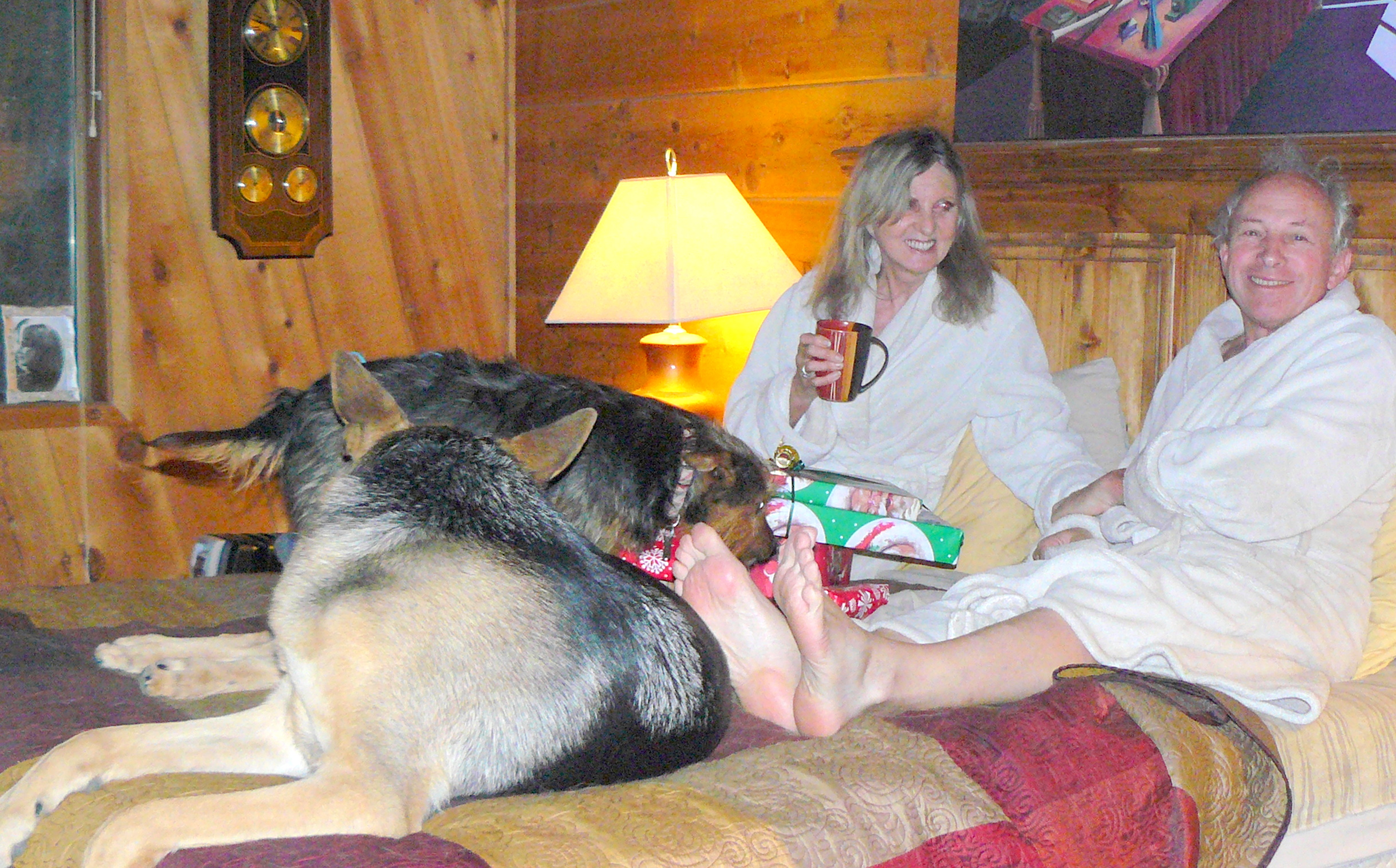
To reinforce that last point, here are two photographs of me and Jean on Christmas Day morning.

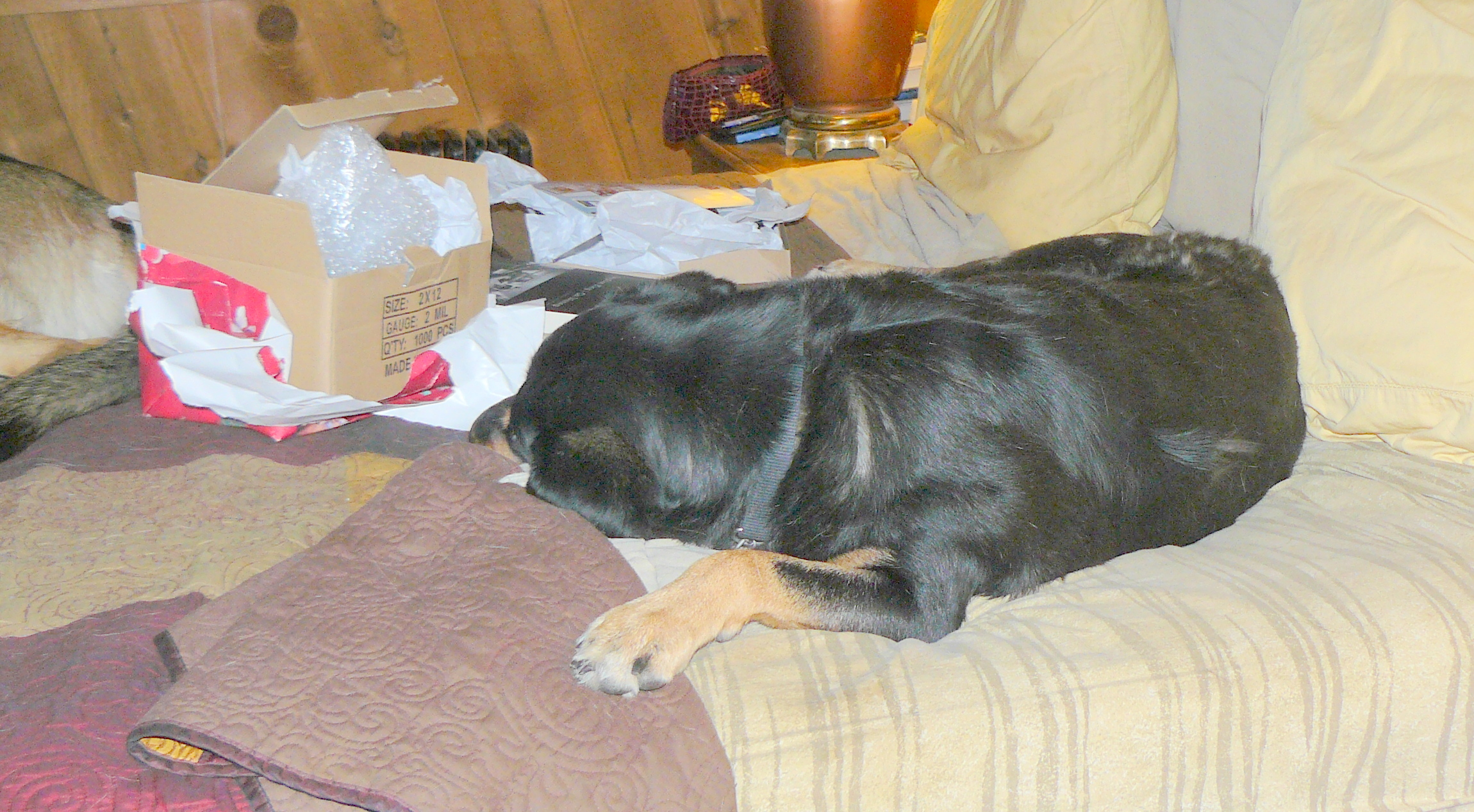
Hazel being very slow to get off the bed!

oooo

Cleo, foreground, and Sweeny helping open presents!
Cleo, foreground, and Sweeny helping open presents for Jean and me!

That web-search that found the WikiPedia item also found an excerpt from Professor Stanley Coren’s fabulous book Why We Love the Dogs We Do.  I say fabulous because it’s a book that I have read and is on the book-shelf not four feet from where I am sitting.  With Stanley Coren’s written permission, for which I say thanks, that excerpt is now republished:

While I was on a book tour a few years ago, I had the opportunity to meet with Jimmy Stewart. He was no longer the young Charles Linbergh character that I remembered from the film The Spirit of St. Louis, or the easy moving character that became a hero in The Man Who Shot Liberty Valance. His age had begun to show on him, and he appeared to be almost fragile. He was slow moving and even slower talking than I remember him being in the movies. However, when he started to speak about his dogs his face broke into a smile and the pace of his talking picked up. He told me:

“When I married Gloria she already had a German Shepherd named Bello. He loved her a lot and, after a while, he and I got along. Gloria really loves German Shepherds best of all, but sometime after we lost our second one, she decided that they weren’t the breed of dogs that I needed. Anyway, she went out and got me this Golden Retriever named Simba, and its been Goldens ever since for me. “We actually have three dogs now. Kelly and Judy, are Golden Retrievers, and then there is Princess who is some kind of a mixed breed that my daughter found and we sort of rescued. Princess had some behavior problems and I think that Kelly and Judy picked up some of her bad habits–figured that if Princess could get away with it so could they. We had met Matthew Margolis [who co- authored of a number of fine dog training books, such as When Good Dogs Do Bad Things, with Mordecai Siegal] and Gloria liked him. He runs the National Institute of Dog Training. Kelly and Judy were not behaving. They didn’t listen to anything we said, and they were always jumping up and barking and pulling on the leash–both were just imitating Princess, I think. Well, anyway, Matthew told us that he would have to take the dogs to his training kennel for six weeks to get them to behave. The reason that he wanted them at the kennel had something to do with ‘socialization’ and other dog things like that. It was supposed to help their shyness and excitability. Gloria and I didn’t like it, but she felt that we had to do something. Well that lasted just one day. You know I love my house, but without any dogs around it feels like some kind of mausoleum. I told Gloria ‘Get those dogs back home because I can’t put up with them not being here.’ Anyway, Matthew tried to set up a training program at the house, but it really didn’t work so well. In the end we compromised. We broke the three dogs up into squads, so we could send one or two of them to school for short sessions, and still have one or two at home for company. I still didn’t like it, even though we got to visit their school on weekends. Gloria made a lot of phone calls to make sure they were OK–to reassure me I guess. “I suppose the truth is that I’d rather have a happy dog than a trained one. My dogs have never been good at things like ‘sit’, ‘stay’ or even ‘come’. I think that we’ve given the tourists a few laughs, especially when the dogs hit the end of their leashes hard enough to drag Gloria down the street. I don’t even mind it when the dogs jump up. Matthew showed us how to jerk the leash to correct that kind of thing. I suppose that it does have to be done–you know to keep them from knocking someone down or messing their clothes–but it seems kind of cruel to me. If my dog jumps up on me I figure that he wants to kiss my face and tell me that he thinks that I’m a really nice person. I don’t believe that you should punish a dog for saying ‘I love you.’ When your dog’s face is up looking at yours like that I think that you should tell him just how nice you think that he is too. Gloria told me that Matthew says that we mother the dogs too much and that they’ll never really be well trained. Well, they’re a lot better now than what they were before, so some of the training must be working. The difference between ‘trained OK’ and ‘trained perfectly’ doesn’t really matter all that much to me. I once did a film with Lassie. When that dog got excited it jumped all over Rudd Weatherwax [Lassie’s trainer]. Now that’s the smartest dog in the world. If the world’s best trained dog can jump around to show he’s happy then my dogs should be allowed to do the same. “The truth is that it’s just really hard for me to get to sleep without a dog in my bedroom. It’s funny about that. I once had a dog named Beau. He used to sleep in a corner of the bedroom. Some nights, though, he would sneak onto the bed and lie right in between Gloria and me. I know that I should have pushed him off the bed, but I didn’t. He was up there because he wanted me to pat his head, so that’s what I would do. Somehow, my touching his hair made him happier, and just the feeling of him laying against me helped me sleep better. After he died there were a lot of nights when I was certain that I could feel him get into bed beside me and I would reach out and pat his head. The feeling was so real that I wrote a poem about it and about how much it hurt to realize that he wasn’t going to there any more.”

I later learned just how intense his feelings were for his dog Beau. At the time, Stewart was making a picture which was shooting on location in Arizona. One evening he got a phone call from his veterinarian, a Dr. Keagy. The call was about Beau. Keagy told him that Beau was very sick. He was having trouble breathing and was in considerable pain. The disease had progressed to the point that it was obvious to Keagy that the dog couldn’t be saved. He was calling for permission to end Beau’s life quickly. Stewart’s wife Gloria said that she couldn’t make that decision since Beau was Jimmy’s dog. “I can’t just tell you to put him to sleep like this,” Stewart said, “Not over the phone–not without seeing him. You keep him alive and I’ll be there.” Stewart was always known as an easy actor to work with, who never made excessive demands. So, the director was taken aback when he went to him to ask for a few days off to fly home to see to his dog. The leave was granted and Stewart got to sit with Beau for a long while before making the decision. He later admitted that when he left the veterinarian’s office he had to sit in his car for around 10 minutes, just to clear his eyes of tears, so that it would be safe to drive home.

NB: Please note that Professor Stanley Coren is the author of the above excerpt, the material is copyrighted by SC Psychological Enterprises Ltd and has been republished with permission.  I would thoroughly recommend visiting the blog-site of Psychology Today, Canine Corner.