Tag: Politics

Copenhagen – the unspoken issue

It’s getting crowded down here!

For those readers who are not regular BBC television viewers, the Beeb has for many years run an excellent factual/science & nature series under the name of Horizon.  Just recently there was a programme with the title of How Many People Can Live on Planet Earth?
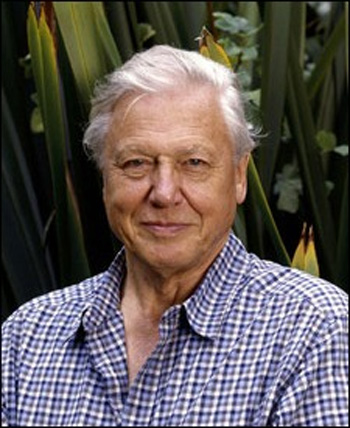
Sir David Attenborough

It was presented by that familiar face on the BBC in terms of the natural world, Sir David Attenborough.  It was an appropriate and worthy person to present the information.

But before getting into some of the details underpinning the programme, there seems to been an enormous and unspoken omission at Copenhagen – why no debate about global population trends?

Luckily the media noticed the rather obvious exclusion.  Here’s the UK Daily Telegraph newspaper (online version) of the 8th December, 2009. An extract:

Population growth is the one issue accused of causing driving climate change that no one at the Copenhagen climate summit dares to talk about.

The argument is that more people consume more resources, therefore producing more greenhouse gases that cause global warming.

The global population is currently at 6 billion and could rise to 11 billion by 2050 if fertility rates continue, not only threatening the climate, but food shortages and conflict as well.

Organisations like the Optimum Population Trust, that is backed by Sir Jonathan Porritt, Dame Jane Goodall and Sir David Attenborough, advocate birth control as a way of slowing climate change.

As Sir David has said: “I’ve never seen a problem that wouldn’t be easier to solve with fewer people, or harder, and ultimately impossible, with more.”

A study by the London School of Economics found contraception is almost five times cheaper as a means of preventing climate change than conventional green solutions such as investing in green technology.
Read more of this Post

Greg Craven and the power of social media

There’s a new power on the streets and it may make politicians feel very uncomfortable!

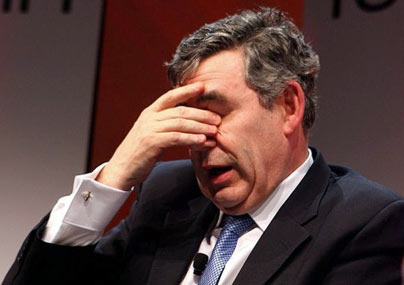
The Rt Hon Gordon Brown

Like me, you probably haven’t heard of Greg Craven.  I hadn’t until about 24 hours before starting to write this Post (that would be Friday afternoon, Mountain Time, on the 11th December).

I was doing some research for an earlier Post about Copenhagen and came across a YouTube video created by Greg.  More details and links later after making a more fundamental point.

This video of Greg’s has had 2,704,000 viewings! The information on that YouTube ‘page’ has had over 7,500,000 viewings. Greg has now written a book and so on, and so on.

In other words, the personal message that Greg is conveying has reached an unbelievable number of people.  That would have been impossible without the power and reach of modern social media software systems: YouTube, Facebook, Linked-In, Twitter, MySpace, Digg, at al.

In the past, information has flowed outwards in a much more ‘top down’ way.  Hierarchical, as it is called.   That has suited those that wish, in some way, to control the message.  While individuals would always chatter and gossip with their peers, there was a finite limit to that before “Send reinforcements, we are going to advance” morphed into “Send three and fourpence, we are going to a dance”!

The example of Greg Craven shows only too well how information can now flow.  Out of anyone’s control, spreading virally.

Having made my point, I want to return to the subject matter that Greg is championing – but will include that in a separate Post.

Politicians!  Be very careful what you say.  We are all listening now, in one way or another, and ready to pounce if we don’t trust your words!

By Paul Handover

Let’s Introduce Obama’s Left Hand to his Right

To post or … what to post?

As I was perusing the business press this morning, an article caught my eye:  “That would make a great post!” I thought to myself.  I continued reading through the rest of the articles, intending to go back to the one that piqued my interest to compose a comment.  Of course, when I went back, I could not find it!

Trouble internally

But in the process of looking for that particular paragraph, I noticed something troubling. Something that, should my students’ papers include the same, would bring their score down by a full letter grade, if not more.

Read more of this Post

Paul Krugman’s Endless Ego

A small challenge to a Nobel prize winner in Economics!

In a recent New York Times op-ed, Paul Krugman continues his boundless quest to become the “it” guy in the world of economics.  I have taken issue with his command of basic economic facts in the past — a gutsy, if not insane thing to do given the man was awarded a Nobel Prize in Economics.

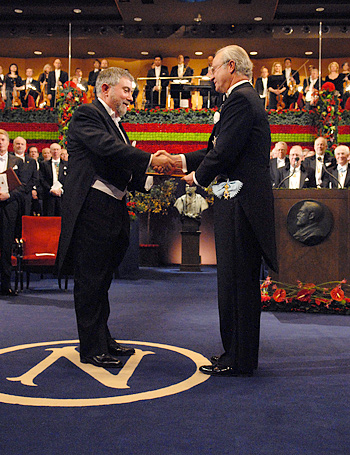
Krugman accepting the Nobel Prize

This post is more about ego than economics, however.

In this op-ed, Mr. Krugman says (and I kid you not),

But after the debacle of the past two years, there’s broad agreement — I’m tempted to say, agreement on the part of almost everyone not on the financial industry’s payroll — with Mr. Turner’s assertion that a lot of what Wall Street and the City do is “socially useless.” And a transactions tax could generate substantial revenue, helping alleviate fears about government deficits. What’s not to like?

Well, I disagree with the idea that what Wall Street does is socially useless.  And I am not on the financial industry’s payroll.

Nope, I’m just a simple economist, using my head, training, and experience to consider this idea, map out the pros and cons, and analyze the logical end-game of such a tax.  I conclude that it is a really bad idea.

Why?  There are lots of reasons, but I will mention only two.

  • One, raising taxes reduces private economic activity, which will curtail growth, reduce tax revenues and increase the deficit.
  • Two, taxes distort the price signal between suppliers and demanders of goods and services, including financial capital, reducing economic efficiency.

His reasons?  Other than citing one academic study (while ignoring the many others that reach a different conclusion), he gives no economic reasons for his views.  Instead, he make claims. He claims, for example, that “socially damaging behavior … caused our current crisis.”  He says that the financial services industry is “bloated” and needs to be cut down to size.   He says that the new tax is okay because it raises revenues for the government which, he claims, should make us all feel better about the deficit and, apparently, the size and nature of government spending under Obama. And, the lamest of all, for no other reason than to hide behind their skirt, he claims the existence of some phantom majority, apparently to create the impression that anyone with a different view is clearly in the minority.   A tactic that should be beneath a Noble Prize winner, but one that runs through his work with increasing frequency over time.

But, Mr. Krugman, I so disagree with you.  And even in an op-ed piece — perhaps especially in an op-ed piece – I believe that one needs to reign in an ego that would parade claims as facts, especially when each of those claims is disputed by your fellow economists, none of whom stooped so low as to imply that you were paid for your views.

By Sherry Jarrell

Clarkson on Mandelson … and more!

“Get me a rope before Mandelson wipes us all out”

Whether you live in the UK or not is an issue, because it might well affect somewhat your reaction to a recent diatribe which is characteristic of a journalist who is well known in the UK, but probably not outside. (That sentence was too long; I was trying to emulate his style!)

Jeremy Clarkson

That journalist is Jeremy Clarkson, who is known as an arrogant, irresponsible motoring journalist.

Over the years, he has done only a moderately good job of using that persona to hide his intelligence, his common sense, his sentimentality and, even, his wit!

Fortunately, for the rest of us, his failures to hide them completely have been known to result in some valuable contributions; whether this is one of them, you will have to judge for yourself.

If you are live in the UK, or are from the UK and living elsewhere, you will probably “get” his recently written article in the Times Online.  Here’s a flavour of the article:

He [Peter Mandelson] announced last week that middle-class children will simply not be allowed into the country’s top universities even if they have 4,000 A-levels, because all the places will be taken by Albanians and guillemots and whatever other stupid bandwagon the conniving idiot has leapt onto in the meantime.

I hate Peter Mandelson. I hate his fondness for extremely pale blue jeans and I hate that preposterous moustache he used to sport in the days when he didn’t bother trying to cover up his left-wing fanaticism. I hate the way he quite literally lords it over us even though he’s resigned in disgrace twice, and now holds an important decision-making job for which he was not elected. Mostly, though, I hate him because his one-man war on the bright and the witty and the successful means that half my friends now seem to be taking leave of their senses.

My guess is that you will either sympathise with it, or not; there is unlikely to be any middle position!

If you have no UK connections, then the whole thing might appear to be complete nonsense. In that case, you might be interested, at least, to know that more and more people in the UK feel like this!

My hand is up, “include me in”, as they say! … and my guess is that Chris Snuggs, of this blog, has both hands up!

Read it here!

By John Lewis

[P.S. more of Clarkson’s superb writing here.  P.P.S. Mandelson background for non Brits. Ed.]

Save the planet – eat a carrot!

Another political masterpiece!

British Health Minister Andy Burnham is urging us to give up meat; this will apparently help to save the planet.

Andy Burnham! (Seriously)

Now, it is very noble of the Minister to try to help save the planet. However, his efforts do raise some questions.

  • The thing is, if it is essential to stop eating meat then shouldn’t the government put its money where its mouth is and DO something about it? Such as tax it? (usually the first instinct!) Or do they only do things that are electorally favourable? (this is a rhetorical question, by the way – feel free not to answer it …)
  • Or is this perhaps a long process of “educating the electorate”? Well, there are plenty who leave school hardly literate already, so he’s being a bit optimistic, isn’t he? And why start with poor, little Britain? There are tens if not hundreds of millions of our American buddies to convince ….

And at the same time as we are being sermonised about our meat-eating the the USA is edging towards the opening-up to oil-exploration of previously off-limit areas.

In our quaint British lingo this is known as “not singing from the same song-sheet”.  And as for oil, I wish they would make up their minds once and for all; either we have to reduce its use or we don’t.

At the moment, all they seem to be doing is organising conferences (at vast carbon footprint) where they promise to reduce emissions. This is schizophrenia, isn’t it?

Re the British sermon, one wonders whether the noble minister is himself a vegetarian, and of course whether he is among the vast government contingent attending the international climate conference. And does he drive the car 50 metres to the baker’s on Sunday mornings?

Personally, I’d be prepared to give up meat if: A) I were convinced it would do any good and B) I thought that the great and good (and rich) would make a similar sacrifice.

These are two VERY big “ifs” ………

Must go – got some burgers in the pan …..

By Chris Snuggs

Why the Anger over U.S. Executive Compensation?

Pay and the Free Market

It came up again in conversation today:  someone was offended and upset over the level of compensation of some senior executives in the U.S. economy.   I have to admit I just do not understand the anger. And I have a fundamental lack of respect for the arguments that have been served up thus far in support of the position.

I have tried to resist drawing the conclusion that the anger is born of envy, but I am very close to throwing in the towel on that one.  Why should we begrudge anyone who earns a healthy salary, especially in an economy that provides each of us the opportunity to aspire to the same?

Even if there were reasonable ways around the practical issues and costs associated with legislative caps on salaries — how to set them, who sets them, using what measures, what value judgements — it simply makes no sense.  It is the antithesis of a competitive market economy where individuals have the incentive to learn, grow, work hard, and succeed.  It ignores the role played by capitalism in creating a strong and vibrant private economy that provides endless opportunities for all who want to put in the hours and the effort to succeed.

U.S. corporate governance rules provide the framework for determining the compensation for senior executives, and it works remarkably well.  Each shareholder, or owner of the company, gets one vote on material issues such as reorganization. The Board of Directors is responsible for hiring and firing senior management on behalf of the shareholders.  If the shareholders do not like the decisions of the board, including those that set the level and form of compensation for senior management, they have at least two, very effective choices. They can either sell their shares in the company or they can vote to replace the board members.  The board can take several steps if, after negotiating the compensation package for senior management, the executive fails to perform. The board can withhold the bonus, renegotiate the terms of the contract, or fire the executive.  Then the long, mostly objective arm of the competitive labor market will determine the market-clearing value for the skills and experience of the recently fired executive.

One thing I’ve never quite understood is why the market doesn’t seem to exact more punishment on senior executives who run their companies into the ground.  Maybe there is an old boys network that looks out for ex-executives; maybe my observations are biased; maybe I notice only those cases where failed executives rise again.  But it’s an empirical question, in any case; we can gather data on the issue and study it objectively.

Regardless of the conclusions of such an analysis, however, decisions about executive compensation must remain in the labor market where your ability to produce economic value still reigns supreme over your ability to curry votes and political favor.

By Sherry Jarrell

Consequences and probabilities

How Peter L Bernstein’s work helps us make the safest decision with regard to global warming.

Probably like me you hadn’t heard of Peter Bernstein. He was instrumental in understanding risk and that alone makes him worth knowing about.  Here’s the entry from Wikipedia:

Peter Lewyn Bernstein (January 22, 1919 – June 5, 2009) was a financial historian, economist and educator whose development and refinement of the efficient market theory made him one of the country’s [USA] best known authorities in popularizing and presenting investment economics to the general public.

Watch the YouTube video before reading on:

You could not have missed a fundamental message in the interview – if the consequence of something is critically harmful then don’t take ANY risks. Bernstein’s book on risk is Against the Gods.

Continue reading “Consequences and probabilities”

Government Spending and jobs! Uh? What jobs?

Government spending isn’t what it is made out to be.

The headlines are full of claims about the number of jobs created or saved by the stimulus package, the impact of the Cash for Clunkers program on U.S. output and, the latest, the reduction in the deficit from the proposed U.S. health care reform legislation.

What total rubbish!

Government spending is just that — SPENDING.  It does not, can not, never has, and never will CREATE any output, economic wealth, or job.  The only way — and I mean the ONLY way — that profits or wealth or a new job is created is through a business.  Businesses are the only entity that can hire labor and capital and combine them in such a way as to create a product or a service that society may decide is worth more than it costs.

And that spread between the cost of production and what society is willing to pay is economic value; it is the generation of profits that then enables the taxes that the government collects to spend on the goods and services it thinks America ought to consume.

Private industry is the job creator.  Not the government.   And this is not wishful thinking, or a political point of view, or a theoretical model.  It is an unmitigated, irrefutable fact.

By Sherry Jarrell

Economics and Semantics

Governments borrow – why?

This post is a plea for help from someone clever …. what I would like to understand concerns “the borrowing requirement”. All my adult life I have listened year after year to the British Chancellor’s presentation of his budget and each time there is reference to “the borrowing requirement”.

What I would like to know is WHY there is a borrowing “requirement” in the first place. Exactly WHY do governments spend more than they “earn”? And more to the point, why do – and can – they keep doing this year after year, decade after decade? Layman that I am, it seems to me that continually borrowing, living beyond one’s means, spending more than one receives is BOUND to lead to problems in the long run. Is it simply that in most western democracies the “long run” is not foremost in the minds of our leaders? Or does this continual borrowing not matter?

I was interested in the last French presidential election to see that  centrist candidate François Bayrou proposed making it illegal for the government to spend more than it received. I found this courageous and innovative. Naturally,

Bayrou

he came nowhere in the election! Silly chap! He should have promised to spend, spend, spend like the rest of them! Then he may have had a chance.

No, we are paying vast amounts of interest every year merely to service our debt. The basic questions are: Why can and do states do this? Is it necessary and is it wise? And if the answer to the last two questions is “No”, then why do we let them get away with it?

It seems to me that the “borrowing requirement” is simply a fairly crude means that governments use to bribe us with our own money. Please correct me if I am wrong!

By Chris Snuggs