Tag: Plato

Afraid of the light!

Back to learning from our wonderful dogs.

Last week, on the 9th to be exact, I published a post under the title of What a funny lot we all are! The thrust of that post was the republication of a recent Tom Dispatch essay by Michael Klare: Tipping Points and the Question of Civilizational Survival. Professor Michael T. Klare is professor of peace and world security studies at Hampshire College and the author, most recently, of The Race for What’s Left. Those who read his essay will have found it a gloomy report on the future of mankind on this planet.

Back to my sub-title.

One of the golden pieces of advice for all of us who succumb to a fear of the future is to live in the present. Living in the now, in the present, is what our dogs do so very well, and it is a fabulous example for us humans. Because there is such a volume of news about so many things going wrong in our world, that it is easy to become overly negative, possibly to the point of causing us ill health, for there is strong link between mind and body.

When circumstances actually do change then dogs are incredibly quick to adapt to those changed times. Dogs, however, do not worry about the future.

All of which is my preamble to an essay that was published under The Conversation header on Sunday. It was an essay by Melanie Randle, and the link goes to a page that offers:

Melanie is an Associate Professor of Marketing in the School of Management, Operations and Marketing in the Faculty of Business at the University of Wollongong. Her primary research areas are social and non-profit marketing, particularly in the areas of volunteering and foster care. Other research interests include marketing to children, obesity and gambling.

That profile doesn’t give much of a heads-up to the theme of her essay. That theme, to my way of thinking, is that right now change is underway. A change in the awareness of people that change has to take place.

Which is why I chose part of a saying attributed to Plato for the title to this post. The full saying being:

We can easily forgive a child who is afraid of the dark; the real tragedy of life is when men are afraid of the light.

So to Melanie’s essay.

ooOOoo

Many fear the worst for humanity, so how do we avoid surrendering to an apocalyptic fate?

Melanie Randle, October 11, 2015

A new, four-nation study has found people rate the risks of global threats to humanity surprisingly high. These perceptions are likely to be important, socially and politically, in shaping how humanity responds to the threats.

The study, of more than 2000 people in the US, UK, Canada and Australia, found:

  • 54% of people surveyed rated the risk of our way of life ending within the next 100 years at 50% or greater;
  • almost one in four (24%) rated the risk of humans being wiped out within a century at 50% or greater;
  • almost three in four (73%) believe there is a 30% or greater risk of our way of life ending (30% said that the risk is 70% or more); and
  • almost four in ten (39%) believe there is a 30% or greater danger of humanity being wiped out (10% said the risk is 70% or more).

Perceptions of risks to way of life and humanity by country

Percentage support for propositions that existing way of life and humanity have a 50% or more chance of ending in a century. University of Wollongong, Author provided

The study also asked people about different responses to the threats. These responses were categorised as nihilism (the loss of belief in a social or moral order; decadence rules), fundamentalism (the retreat to certain belief; dogma rules), or activism (the transformation of belief; hope rules). It found:

  • a large majority (78%) agreed “we need to transform our worldview and way of life if we are to create a better future for the world” (activism);
  • about one in two (48%) agreed that “the world’s future looks grim so we have to focus on looking after ourselves and those we love” (nihilism); and
  • more than one in three (36%) said “we are facing a final conflict between good and evil in the world” (fundamentalism).

Findings were similar across countries, age, sex and other demographic groups, although some interesting differences emerged. For example, more Americans (30%) believed the risk of humans being wiped out was high and that humanity faces a final conflict between good and evil (47%). This presumably reflects the strength in the US of Christian fundamentalism and its belief in the “end time”, a coming Apocalypse.

Perceptions of risk to way of life and humanity by generation

Percentage support for propositions that existing way of life and humanity have a 50% or more chance of ending in a century. University of Wollongong, Author provided

A world of threats coming to a head

There is mounting scientific evidence and concern that humanity faces a defining moment in history – a time when it must address growing adversities or suffer grave consequences. Reputable journals are canvassing the possibilities; the new study will be published in a special issue of Futures on “Confronting catastrophic threats to humanity”.

Most focus today is on climate change and its many, potentially catastrophic, impacts. Other threats include depletion and degradation of natural resources and ecosystems; continuing world population growth; disease pandemics; global economic collapse; nuclear and biological war and terrorism; and runaway technological change.

Many of these threats are not new. Scientists and other experts have warned of the dangers for decades. Nevertheless, the evidence is growing stronger, especially about climate change, and never before have actual events, including natural disasters and calamities, and their sustained and graphic media coverage so powerfully reinforced the possible impacts.

Not surprisingly, then, surveys reveal widespread public pessimism about the future of the world, at least in Western countries. This includes a common perception of declining quality of life, or that future generations will be worse off.

However, there appears to have been little research into people’s perceptions of how dire humanity’s predicament is, including the risk of collapse of civilisation or human extinction. These perceptions have a significant bearing on how societies, and humanity as a whole, deal with potentially catastrophic futures.

How does loss of faith in the future affect us?

People’s responses in our study do not necessarily represent considered assessments of the specific risks. Rather, they are likely to be an expression of a more general uncertainty and fear, a loss of faith in a future constructed around notions of material progress, economic growth and scientific and technological fixes to the challenges we face.

This loss of faith is important, yet hardly registers in current debate and discussion. We have yet to understand its full implications.

At best, the high perception of risk and the strong endorsement of an activist response could drive a much greater effort to confront global threats. At worst, with a loss of hope, fear of a catastrophic future erodes people’s faith in society, affecting their roles and responsibilities, and their relationship to social institutions, especially government.

It can deny us a social ideal to believe in – something to convince us to subordinate our own individual interests to a higher social purpose.

There is a deeply mythic dimension to this situation. Humans have always been susceptible to apocalyptic visions, especially in times of rapid change; we need utopian ideals to inspire us.

Our visions of the future are woven into the stories we create to make sense and meaning of our lives, to link us to a broader social or collective narrative. Historians and futurists have emphasised the importance of confidence and optimism to the health of civilisations and, conversely, the dangers of cynicism and disillusion.

Despite increasing political action on specific issues like climate change, globally the scale of our response falls far short of matching the magnitude of the threats. Closing this gap requires a deeper understanding of how people perceive the risks and how they might respond.

This article was co-authored by Richard Eckersley, founding director of Australia21.

ooOOoo

Now there’s nothing in the essay from Randle and Eckersley to say that these are not critically important times for all of humanity. Yet, I detect that among the many people one meets on a day-to-day basis there is a growing understanding that we can’t just lie down and let the future ride on over us. That living in the present and responding to the world around us here and now is the healthiest way to be, and the most effective. No more powerfully expressed than by Thich Nhat Hanh

“Fear keeps us focused on the past or worried about the future. If we can acknowledge our fear, we can realize that right now we are okay. Right now, today, we are still alive, and our bodies are working marvelously. Our eyes can still see the beautiful sky. Our ears can still hear the voices of our loved ones.”

Harvest moon

There’s always much more to people than meets the eye!

I can’t recall at what point in the life of Learning from Dogs that Per Kurowski popped up over the parapet but it was pretty early on.  Per has been a great supporter of my varied efforts to promote the way that dogs are a wonderful example of integrity, trust and openness.

Anyway, Per comes from a background that one might not associate with the rest of this article.  Per used to be a director at the World Bank.  One of his Blogs includes this:

I warned many about the coming crisis, long before it happened, on many occasions and in many places, even at the World Bank. They did not want to listen and that´s ok, it usually happens, but what is not ok, is that they still do not seem to want to hear it. “We can easily forgive a child who is afraid of the dark; the real tragedy of life is when men are afraid of the light.” (Plato: 427 BC – 347 BC)

Just a couple of days ago, I posted about the moon that passed closer to the Earth on the 19th than for the last 20 years.  Per added a comment to that Post, “And this is a homemade version of the beautiful Harvest Moon song by Neil Young” With this link.  At that link you can watch and listen to Per singing ‘Harvest Moon’ recorded by Neil Young.  Enjoy.

Here was that moon, as seen from Payson in Arizona with some cloud in the sky!


That moon!


Finally, for those interested in the lyrics, here they are.

Come a little bit closer
Hear what I have to say
Just like children sleepin’
We could dream this night away.

But there’s a full moon risin’
Let’s go dancin’ in the light
We know where the music’s playin’
Let’s go out and feel the night.

Because I’m still in love with you
I want to see you dance again
Because I’m still in love with you
On this harvest moon.

When we were strangers
I watched you from afar
When we were lovers
I loved you with all my heart.

But now it’s gettin’ late
And the moon is climbin’ high
I want to celebrate
See it shinin’ in your eye.

Because I’m still in love with you
I want to see you dance again
Because I’m still in love with you
On this harvest moon.
Come a little bit closer
Hear what I have to say
Just like children sleepin’
We could dream this night away

But there’s a full moon risin’
Let’s go dancin’ in the light
We know where the music’s playin’
Let’s go out and feel the night

Because I’m still in love with you
I want to see you dance again
Because I’m still in love with you
On this harvest moon

When we were strangers
I watched you from afar
When we were lovers
I loved you with all my heart

But now it’s gettin’ late
And the moon is climbin’ high
I want to celebrate
See it shinin’ in your eye

Because I’m still in love with you
I want to see you dance again
Because I’m still in love with you
On this harvest moon

Thoughts on Humanitarianism

“An ethic of kindness, benevolence and sympathy extended universally and impartially to all human beings.” WikiPedia

Introduction

Friedrich Nietzsche

I do not in any of this mean to say that humanitarianism is a negative thing, I am merely attempting to describe why humanitarianism exists in the world today in much larger proportion than it has in the past.

I hope also in some of this to disagree, hopefully intelligently, with Nietzsche’s claim that humanitarianism decreases the overall strength of the human race, or at least its higher echelons.

Self-interest

Human beings are either entirely or nearly entirely driven by self-interest, this much has been made clear by both ancient and modern philosophy.

Different philosophers have realized this point in different ways.

  • Mises said that all people are rational maximizers.
  • Nietzsche said that the natural human being attempts to exert his force upon the world surrounding him.
  • Plato said that all men desire good things, but each man has his own subjective opinion of the “good” which he came to via his own experiences (both during and before “life”.)

I highly doubt that human nature has changed a great deal in 100 years.

However, 100 years ago it was very common for European nations to do just about whatever they wanted to the rest of the world.  In fact, human nature is in all likelihood not very different now than it was in the days of the early church, when Christians were wrapped in lambskin, covered in oil, and burned alive in order to serve as torches.

Humanitarianism goes mainstream

Read more of Elliot’s essay

Elliot’s schooling – the positives

Elliot Engstrom – Guest Author

On April 1st I set the scene for the essays that I wanted to write for Learning from Dogs as follows:

I often ask myself just how effective the modern US schooling system is as a tool of education, and whether or not its costs outweigh its benefits. I hope to have at least a rough answer to this question in the

Elliot Engstrom

final post of this series.

In the following posts, I will examine three topics:

In what ways does the modern schooling system function as a positive tool for education?

What costs involved in modern schooling hinder its ability as an educative tool, and even make it a negative influence on students?

Considering the analyses put forth in the first two posts, do the costs or benefits or this system outweigh the other? On the whole, are school and education complements or antagonists?

Here is the first one looking at the positive aspects of the American educational system.

Intellectual exploration

My kindergarten teacher told me to always start with something positive, so I’ll be beginning my analysis of American schooling by looking at how it is a positive tool for education.

One facet of the American education system that I once disapproved of but now find extremely useful and educative is the long period of time that students have before they must commit to a career choice.

I used to view this lag as a waste of resources. However, living in France and being a student at a French university changed my mind. The French system begins to lock children into a career path as early as the closing years of middle school. If a student in France wants to be a doctor, for example, they enter into medical school immediately upon leaving high school. The same is true for professions like pharmacology and law. There is very little opportunity for intellectual exploration in the country’s schools. Rather, one simply must make the best of wherever one ends up.

While the American system is more long-winded, it is a better tool for education in that it allows for a more dynamic range of studies. A liberal arts education forces students to delve into a wide range of subjects, giving students the chance to explore their interests and abilities.

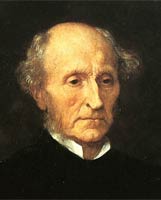
Socrates (or Plato, depending on your interpretation of Plato’s dialogues), believed that a liberal arts education also encouraged the development of critical thinking skills. However, it should be noted that many of the greatest critical

John Stewart Mill, (1806–1873)

thinkers in history did not go through formal schooling. (Socrates himself and John Stewart Mill come to mind.)

This system also allows students to change their mind, pursuing those fields of study that truly interest them the most. It is amazing how many students in the American university system change majors during their tenure as students. This often is because they find that the career path they thought was for them is in fact not their liking – the number of students who abandon the premed track during college is a perfect example of this.

Education also entails socializing with other human beings. The American education system also facilitates this form of education quite well, as a liberal arts form of study at both the high school and university levels mixes together students of different interests.

Whereas in the French model a student studying medicine is constantly surrounded by other students of the same mindset, a premed student in the United States will have classes with students in other fields of study, expanding their social horizons and forcing them to relate to people with whom they may have little in common.

In my next post, I will examine the American schooling system as an antagonist to education, and will then close this series by attempting to weigh the system’s costs and benefits against each other.

By Elliot Engstrom