Young Australian, Jessica Watson, is home safe and sound.
(Circumstances required that I had to prepare this Post well ahead of the confirmation that Jessica is back and as it happens, the chances are that when Jessica made it past the Sydney Heads finish line I was onboard a flight from Los Angeles to London.)
05-May-2010
The youngest person to sail around the world solo, non-stop and unassisted, 16 year old Australian Jessica Watson, is expected to complete her historic voyage, arriving back in Sydney to a hero’s welcome on Saturday 15 May.
Jessica left Sydney on 18 October 2009 and has so far overcome every challenge that Mother Nature has thrown at her to achieve her goal.
Jessica needs to cross the finish line at Sydney Heads to officially complete her voyage. She will then cruise down Sydney Harbour before disembarking at Sydney Opera House.
It is anticipated that Jessica will cross the finish line at approximately 11:30am and arrive at the Sydney Opera House around 12.30pm, the first time she will have set foot on land in almost seven months.
Readers of Learning from Dogs will know that we recognised Jessica’s brave and courageous voyage in a Post published on November 12th, 2009.
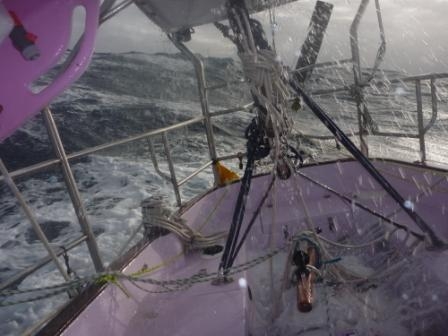
Soon memories such as this:
With the drogue trailing behind Ella's Pink Lady shaking off one wave with the next 10m monster coming up behind!
A week or so ago, the BBC under their Beautiful Minds series, screened a programme about James Ephraim Lovelock, more popularly known as Professor Jim Lovelock.
Prof. James Lovelock
(Picture taken from this article – in itself well worth reading.)
The programme demonstrated that Lovelock’s mind is more than beautiful, it is still capable, at 90 years of age, of thinking in ways that are very rare in today’s societies where conformity is such a powerful force.
As always, WikiPedia has an excellent reference on Prof. Lovelock and I encourage you to read it plus Lovelock’s own website which makes up in content what it may lack for presentation!
Luckily there is an extract from the BBC programme on YouTube – please watch this and reflect on exactly what Lovelock is saying.
And if you are up for more, then settle down for thirteen minutes and watch this next video.
James Lovelock is the Darwin of our times.
Now to put this into some context (this is me speaking as a layman!).
It seems that there has been nothing else on the news following the eruption of Mount Eyjafjallajokull
in Iceland, which was of particular interest to me because on the 10th April I was flying from New York across the southern area of Iceland on my way to Rome, since which time I have passed through the UAE and Singapore on my way to Japan.
My work replacement was due to arrive on the 18th April after a holiday in the Mediterranean, but the flight which he was on was diverted into Paris because UK airspace was suddenly closed. He managed to continue his journey by train, ferry, car, taxi and bus but was then stuck in England. My duty had to continue but there seemed little point in propping up a hotel bar with other crews, so I decided to turn the situation into something positive.
After an exploratory trip into Tokyo, it was Paul, our Editor in Chief who put me in contact with his sister and her husband in the city, and another friend who suggested I should jump on a train and go to Hiroshima to see his son, who I know, so my travels started.
The transport system in Japan is extremely well organised with instructions and information well displayed in English along side Japanese. Everything is clean and modern, and runs to the second! At short notice I decided to make the journey to Hiroshima in this once in a life time opportunity, and there was the famous bullet train a monster of modern technology, which runs on banked rails at steady speeds of 400 kph.
Mount Fuji - Japan
We sped along through ever changing countryside. Initially the skyline was of mainly high rise buildings which changed to two story properties once we were out of town. The new leaves of spring and the famous blossom of the plum and cherry trees, and the quick glimpse of a Japanese water garden. Industry is mixed with small allotments, and tiny houses, roads and rail lines raised from ground level to make everything fit, and above that cables and wires, because of the threat of earthquakes, and past the stunning Mount Fuji, white with snow against a blue sky.
I never met such polite people, and on the train the guards and girls who pass through the carriage with drinks and food bow when they enter and leave. They are so well dressed and smart. No graffiti here!
Familiar Japanese trading names on local buildings, and strangely a huge Union Jack flag. I wonder how there can be so many buildings and parking areas full of cars ,but seemingly no people in view, but many large span bridges arching across hill sides to join places together.
Through Kyoto where there seemed to be a lot of energy being used, for purposes that were not immediately clear. College students in smart suits with white shirts and blue ties, passed quietly through the train. I noticed each time they had left the train at a station they took their rubbish with them, and put the seat back in the upright position!
The A-Bomb Dome
At last after four hours we arrived at Hiroshima, which today it is a lovely modern city of which to be proud. There is just one damaged building standing in a stark fashion at the waters edge which is all that it takes to remind us of such devastation and the Garden of Peace, there to allow some quiet reflection.
I took a 45 minute boat ride to Mijajima, now a World Heritage site. This beautiful island is probably 15 miles from Hiroshima, and there amongst the beauty of the trees and a 500 year old shrine wander the deer, quite happy to sit as people pass by.
My thought as I came away from Hiroshima was that all leaders of any country with any connection to Nuclear weapons or power should be made to attend the A-Bomb Dome and reflect. As all the plaques say this must never be allowed to happen again.
This is being written at 15:00 UTC on Tuesday, 20th April. It’s still anyone’s guess as to when the airspace that commercial aircraft fly in will be free from volcanic fallout.
Nature disposing
Based in Arizona but planning to fly to the UK in about three weeks, it’s also very frustrating finding really good, accurate information to help one think through plans and back-up plans.
But here’s a web site for UK glider (sailplane) pilots that goes a very long way to providing really solid information. Check it out. (And, once again, thanks to Yves Smith of Naked Capitalism for finding the site.)
On February 26th Jean and I, and a caravan of dogs and cats, arrived at our new home in Payson, Arizona.
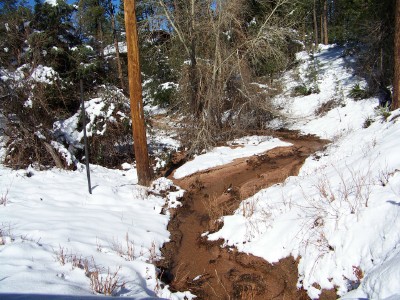
We chose Payson simply because we wanted seasons. Payson is about an hour NE of Phoenix up at 5,000 feet and has very distinct seasons!
Snow in the garden - late March!
Both of us for different reasons thought we knew America pretty well. Jean was married to an American for nearly 30 years and I had been doing business in the US for a long time, even having my own (small) US company based in New Jersey.
But what neither of us anticipated was the wonderful warmth and friendliness of the Payson inhabitants. Despite the fact that Payson is hurting big time as a result of the economic situation, the majority of people that we met were happy, smiling and wonderfully accepting of a couple of Brits turning up in their town.
Indeed, Jean spoke to this stranger in the local supermarket, a tall guy complete with the boots and Stetson hat, and asked simply, “Why are so many people in Payson smiling?”
His reply was simply, “Ma’am, it’s only a small cow town!”
Well here’s a couple of newcomers to this small cow town who like it!
The winter can seems very long when the temperature remains extremely cold and the news headlines show dramatic pictures of villages completely cut off by drifting snow. And the old debate about cold weather payments for pensioners comes around once again.
We are often still able to enjoy time in our garden well into October, but the weeks that follow up to March can be very long and drawn out. Then comes my favourite flower, The Snowdrop.
Snowdrops
There are several different types of this beautiful little plant, and in the county of Hampshire in England [where Bob and his family live, Ed.], in particular there seem to be clumps of this special white flower everywhere.
Heale House
However the other day I was able to see a complete field of them in the grounds of Heale House, a private residence owned by Patrick Hickman,an ex Lancaster pilot, now 89, who is still very active and keeping his yew bushes well trimmed in the art of topiary.
Heale House is open at this time of year for people to visit the lovely gardens and again enjoy the snowdrops.
Spring has arrived, but it is the first flower that is my favourite!
A relaxing contrast to high profile events in the UK
During March I was working in the UAE, and there in the hotel where I was staying in Sharjah were the Pakistan cricket first team, and the English Lions representing England and Wales.
Pakistani cricket team
The weather was lovely with temperatures in the mid 70`s during the day. It was interesting to watch the players of each team, relaxing, but really using this time to prepare for the season, running round the lagoon, and getting fit. There were no raised voices, or bad behaviour, in fact quite the opposite, and each team came into the eating area well dressed, quietly enjoying the week.
There were several matches starting in Sharjah at the old cricket ground. No posters, no large crowds, just a few people like myself who had heard about the games and who had wandered along to find a bench and sit and watch a 20/20 match without the big coverage and hullabaloo which will come later in the year.
One lovely six went flying over the stands and later a young boy came proudly back with the ball which he had found the other side of a main road, stuck in the sand.
The teams later moved on to Abu Dhabi some 70 miles along the coast to play in the new stadium and ground. This, like the new world-class Formula 1 racing circuit is brand new, and full of bright lights and modern style.
Venus Williams
Dubai in between Sharjah and Abu Dhabi likes to host sport during this time of the year, and just as with the cricket, tennis has a big following, with all the big names appearing in the small stadium near the airport in Dubai.
One evening I was watching Venus Williams play, and in the quiet of the late evening, and the general quiet of the match it was interesting to hear the chanting from the minaret as prayer time came.
If you want a winter break, and enjoy cricket motor racing, tennis, or golf you could do worse than stop off in the UAE to relax and enjoy your time.
Don’t know what time it is? Hardly surprising in Spring and Autumn.
Today is exactly one month before the United Kingdom ‘moves’ its clocks forward and enters British Summer Time; 1am (UTC) on Sunday 28th March 2010. Is that date the same across the world? One would think so because it makes life, especially international air transport, so much easier.
But no! In fact the way that time zones are applied and changed for Daylight Saving is a complete hotch-potch.
In the United States of America, daylight saving starts at 2am on March 14th, 2010. And just three years ago that start time would have been the first Sunday in April. Changes were made in the US Energy Policy Act of 2005.
Other parts of the world observe Daylight Saving Time as well. While European nations have been taking advantage of the time change for decades, in 1996 the European Union (EU) standardized an EU-wide “summertime period.” The EU version of Daylight Saving Time runs from the last Sunday in March through the last Sunday in October. During the summer, Russia’s clocks are two hours ahead of standard time. During the winter, all 11 of the Russian time zones are an hour ahead of standard time. During the summer months, Russian clocks are advanced another hour ahead. With their high latitude, the two hours of Daylight Saving Time really helps to save daylight. In the southern hemisphere where summer comes in December, Daylight Saving Time is observed from October to March. Equatorial and tropical countries (lower latitudes) don’t observe Daylight Saving Time since the daylight hours are similar during every season, so there’s no advantage to moving clocks forward during the summer.
Of course, someone had to create a web-site to track all these various time zones and changes. Here it is.
Last year, the BBC News website published an interesting article about the Greenwich Meridian aka The Prime Meridian. The setting of the Prime Meridian was done just over 125 years ago, in October 1884. When one thinks of the importance in having a standard meridian, both for time keeping and navigation, I would have guessed that it went back much further in time.
The other aspect that was news to me was that the conference had been convened at the request of the American President Chester Arthur.
From that BBC article:
Until the 19th Century, many countries and even individual towns kept their own local time based on the sun’s passage across the sky and there were no international rules governing when the day would start or finish.
However, with the rapid expansion of the railways and communications networks during the 1850s and 1860s, setting a standard global time soon became essential.
“The world was in a very big mix-up,” explains Dr Avraham Ariel, author of Plotting the Globe. “People had lots of prime meridians. Earlier in Europe there were 20 prime meridians. The Russians had two or three, the Spanish had their own and so on.”
Thus that famous line in the grounds of the National Maritime Museum at Greenwich, London is not as old as many might have thought.
The American magazine Popular Mechanics had an interesting piece on some of the more bizarre airports around the world. As the article says,
Engineers tasked with building an airport are faced with countless challenges: The ideal location needs ample space, endless flat ground, favorable winds and great visibility. But spots in the real world are rarely ideal, and engineers are forced to work with what they have, making sure that the end product is the safest possible structure for pilots. A survey of airports around the world turns up a mixed bag, ranging from dangerous and rugged landing strips to mega-size facilities that operate like small cities.
Apart from the general interest in these airports, there is also a personal resonance as three of them are in my aviation log-book: Barra; Gibralter; Courchevel. Indeed my experiences of flying into Barra were the subject of a Post on this Blog a few months ago.
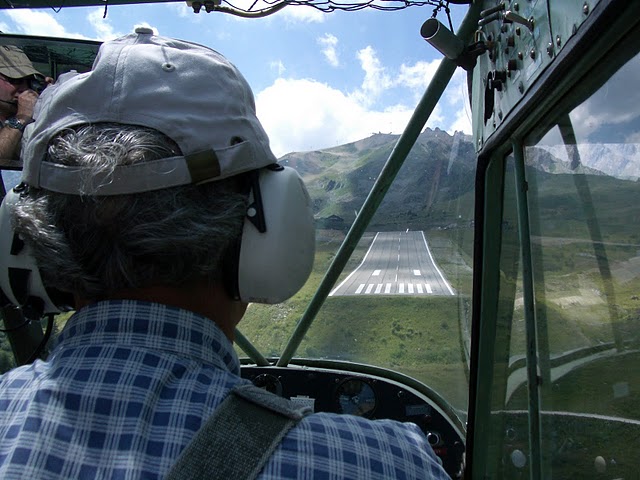
Courchevel in the French Alps is, for all pilots, one of the most amazing, butt-clenching arrivals one could ever imagine.
Courchevel’s airport also has a certain degree of infamy in the aviation industry as home to one of the shortest runways in the world, with a length of 525 metres and a gradient of 18.5% in order to help slow landing aircraft. The airport has a dangerous approach through deep valleys which can only be performed by specially certified pilots. On landing there is no go-around procedure, as most of the worlds airports have – there is merely a very steep hill which has seen a few accidents since the airport first opened.
Quite so!
Here’s an interesting video from YouTube
and a few personal memories:
Start of the approach into Courchevel'short final' CourchevelAuthor & aircraft on the apron - Courchevel
Maybe not the strangest thing to collect, but close!
I doubt if very many people have heard of an American by the name of Eric Sakowski and, to be honest, neither had I until I opened a copy of The Arizona Republic newspaper on a recent visit to Payson, Az. There on the front page was an article about Eric and his passion for bridges! Yes, bridges. As the article starts:
Eric Sakowski’s fixation with bridges began as it has for many.
As a kid, he bought the “Guinness Book of World Records” every year and read it cover to cover. He began to ponder: What is the world’s second-highest bridge? Or the 100th.
In 2004, Sakowski took his interest to the next level. He embarked on a five-year quest that would take him halfway around the world three times and cost him thousands of dollars. He became an amateur sleuth, digging out what he says are the real heights of mammoth bridges and snapping pictures.
Sakowski’s endeavor culminated last month in a tidy room of his parents’ home in Sun City West, where at age 44, he completed his project by launching a Web site, highestbridges.com, that catalogs the 500-highest bridges in the world. His findings challenge some long-held claims.
In fact, the website is really quite interesting and some of the photos are stunning. Here’s one of the Hegigio Gorge Pipeline Bridge in Papua New Guinea.
Hegigio Gorge Pipeline Bridge
It’s 1,289 feet high (393 m) and until 2009 was the world’s highest bridge.
Sakowski has also found some interesting errors in the statistics concerning some bridges.
Using a laser range-finder, he has measured about 100 bridges in the U.S. and about a dozen in China. He found some interesting discrepancies. For example, he determined that the highest bridge in the United States, the Royal Gorge Bridge in Colorado, is 98 feet lower than officially reported. In western China, he said, he first identified the latest bridge to become the world’s highest. He is trying to get “Guinness World Records” to publish the claim next year.
Eric is a professional film-maker but I sense that the day may not be too far off when someone is going to make a film about Eric the Bridge Man!




 Enlarge Image



 Learning from Dogs