Tag: Passion

Fire lighting

The answer to whom we turn to when the times are tough.

Light your own fire!

Regular readers of Learning from Dogs will know that a few days ago, Sherry wrote a piece entitled Light My Fire? It expressed her view that lately she was finding it a problem to be inspired, finding the passion as Sherry put it.

I have been thinking about Sherry’s article for the last few days and a couple of peripheral things come to mind.

We tend to get more of what we notice and orient towards. By allowing ourselves to become absorbed in the negative, that is what we tend to notice.  The fact is that the media thrive and make vast sums of money focusing on the negative. Just compare the amount of negative with the positive in any news cast.

That is not to say that we should not be aware of the negative or hide our heads in the sand. We can however change the way we view things and that has to come from within.

In fact, the answer rarely lies “out there”.

Change in how we view things, i.e. our attitude, needs to start coming from “within” ourselves.

The one thing that characterises these times is uncertainty.

A lot of us don’t even know where the next bit of money to pay the bills is coming from. In spite of the tendency to look ‘out there’ for strong direction, I still feel that the inner resolve has got to come for inside.

Another thing, I don’t believe it’s possible to think ourselves out of this one.

Although it’s a subject I go on a lot about, the sense of direction and well being has to come from us, or rather the feeling of interconnectedness that we share with everything. At a level, we are all connected.

We are all connected.

The one thing that gets us all through is a faith in some higher consciousness, that we can all tap into when we remember and ask for that miracle of clarity.

This is not thinking. The opposite in fact. This is a process of trust and ‘allowing’.

Allowing requires a power that few can sustain for long as we’re all geared to doing.  ‘Allowing’ requires us to turn off the noise machine that is in our head and creating a quietness and space for awareness to surface.

Paul recently wrote an article on Living in the Present that describes this way of letting go rather well.  I know for a fact that Paul is new to these ideas but already he is finding a peace and clarity emerging that shows that there’s always a good time to start – NOW!

Back to my thoughts. I am not advocating lying down and letting the world roll over us – the opposite in fact. By bringing awareness into this whole mess, we are more likely to take the right action.

I have honestly noticed that the more effort and circular thinking I have put into my present financial difficulties, and I’m a real expert in worry and circular thinking, the worse things have got.

I notice that by returning to silence and simply observing, a background is created that allows solutions and options to rise.

By asking to be shown the way forward and then letting go of the need for an instant solution, subtle options and ways forward present themselves.
Then right action follows.

An acceptance that in any moment we are all operating at our maximum level of consciousness. We are all doing the best we can. If we knew better, we would do better.

Therefore, what is going on in the world is a reflection of ourselves and is absolutely perfect for where the sum total of all of us are. (“Perfect”, does not mean we have to like it but it is, never the less, inevitable)

It follows, therefore, that the best way to help the world is to work on ourselves by striving to be the best we can, in every way. And the only way to do that is with awareness.

I think it was Abraham Maslow who coined the phrase, “Self Actualising”, meaning, being the best we can in every way, mentally and physically.

During these undoubtedly troubled times in the earth’s history, we all tend to turn to someone or something to provide a sense of direction.  That someone you need to turn to is yourself.

By Jon Lavin

Light My Fire?

Any firelighters out there?

I am not sure what the problem is, but I’ve had a difficult time of late finding the passion.

Maybe it’s the continuous stream of bad news that greets us every morning on everything from war and oil spills to lawsuits and unemployment.

Maybe it’s the finger pointing: no one standing up to take responsibility, everyone passing the blame (except for General McChrystal, who likely took the blame for his staff).

Maybe it’s the lack of leadership: we don’t really know where we are headed, and we have no plan for figuring out how we are going to get there, wherever that is.

So what do you do to find your passion?  Write in and let us know!   Inspire us!  We would love to hear what you do to “light your fire!”

Light my Fire?

by Sherry Jarrell

Living in the present

What do you think of it so far?

The above is a popular catchphrase.  It suggests that how we view something now is the product of all our experiences to date.  It might apply to a book, play, TV programme or life itself.

But the truth may be very different, how we view the present moment may be more to do with shutting off all those previous experiences and just accepting the present as if we have been blind, dumb and deaf until this perfect moment of now.

That’s why what we have to learn from dogs is so important even though that ‘lesson’ may be just this single, very, very important aspect.  Living in the now!

Here’s what is written on our Home Page post:

Dogs have so much to teach us. To an extent that’s difficult for humans to contemplate, they live in the present. Dogs just are!

They make the best of each moment uncluttered by the sorts of complex fears and feelings that we humans have.

Living in the present is not easy.  Trust me, I’m only starting to practice this myself and maintaining a few seconds is a challenge!

But try it.  Just let everything in your mind be replaced, just for a few moments, by NOW.  That’s the sound of your breath woven into the sound of everything going on around you.  Let all of those sounds just be a part of your awareness.

Be aware of touch.  Feel what you are sitting on standing on. Feel the messages your fingers and hands are sending to your nervous system.  Feel the bench, chair, ground or whatever is connecting your body in a physical sense to the world around you.

Hold a rock, a plant, a branch, anything real and be totally aware of the texture and feel of that object.

Smell the aromas entering your nose – just be aware of them.

And see with your eyes.  Really see.   See through your eyes with the innocence of eyes first opened.

Just hold this place of divine grace for a few moments.

You have just experienced true peace and your world will never be quite the same again.

A Spring flower

Oh, how I envy dogs!

By Paul Handover

More on the SR-71, Part 2

The second part of the guest post by Captain Dave Jones. Ed.

Part One was yesterday which I introduced as follows:

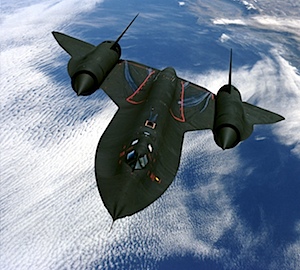
The SR-71, a truly great aircraft

John’s couple of articles about the SR-71 here and here reminded me of the time that I was given an article by my instructor at Mojave. He was a military test pilot and ended up with NASA and he was one of a select few to fly the Blackbird as a civilian….a great chap to talk to…  I continue with Part 2

     The SR-71 was an expensive aircraft to operate. The most significant
cost was tanker support, and in 1990, confronted with budget cutbacks, the
Air Force retired the SR-71. The Blackbird had outrun nearly 4,000 missiles,
not once taking a scratch from enemy fire. On her final flight, the
Blackbird, destined for the Smithsonian National Air and Space Museum, sped
from Los Angeles to Washington in 64 minutes, averaging 2,145 mph and
setting four speed records. 

        The SR-71 served six presidents, protecting America for a quarter of
a century. Unbeknownst to most of the country, the plane flew over North
Vietnam, Red China, North Korea, the Middle East, South Africa, Cuba,
Nicaragua, Iran, Libya, and the Falkland Islands. On a weekly basis, the
SR-71 kept watch over every Soviet nuclear submarine and mobile missile
site, and all of their troop movements. It was a key factor in winning the
Cold War. 

 Read the final part of this great story

More on the SR-71, Part 1

This is a guest post from Captain Dave Jones.  Dave and I go back many years to the time when I was studying for my Instrument Rating, a flying rating that allows one to fly in the same airspace as commercial aircraft.  He is what I call a Total Aviation Person!  Dave read the posts from John Lewis about the SR-71 and mentioned that he had once had a instructor at Mojave Airport, California who had been a civilian SR-71 pilot.  Ed.

The SR-71

The SR-71, a truly great aircraft

John’s couple of articles about the SR-71 here and here reminded me of the time that I was given an article by my instructor at Mojave. He was a military test pilot and ended up with NASA and he was one of a select few to fly the Blackbird as a civilian….a great chap to talk to…

This is his article [broken into two posts because of its length. Ed.] with an intro from my instructor.

Awesome story about a truly great aircraft. I only let it go as high as Mach 3.27 once (the design speed was 3.2) but it could do all that is in this story, Cheers, Rogers

In April 1986, following an attack on American soldiers in a Berlin
disco, President Reagan ordered the bombing of Muammar Qaddafi's terrorist
camps in Libya. My duty was to fly over Libya and take photos recording the
damage our F-111s had inflicted. Qaddafi had established a "line of death,"
a territorial marking across the Gulf of Sidra, swearing to shoot down any
intruder that crossed the boundary. On the morning of April 15, I rocketed
past the line at 2,125 mph. 

        I was piloting the SR-71 spy plane, the world's fastest jet,
accompanied by Maj. Walter Watson, the aircraft's reconnaissance systems
officer (RSO). We had crossed into Libya and were approaching our final turn
over the bleak desert landscape when Walter informed me that he was
receiving missile launch signals. I quickly increased our speed, calculating
the time it would take for the weapons-most likely SA-2 and SA-4
surface-to-air missiles capable of Mach 5 - to reach our altitude. I
estimated that we could beat the rocket-powered missiles to the turn and
stayed our course, betting our lives on the plane's performance. 

 Read more about this amazing story

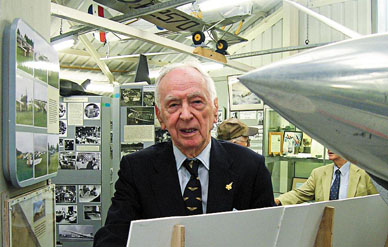
Captain Eric Brown. MBE, OBE, CBE, DSC, AFC.

Now Think Sound Barrier!

I was excited to see details of a lecture held recently in Glasgow, recounting the Struggle to Break the Sound Barrier.  [Nice history on WikiPedia, Ed]

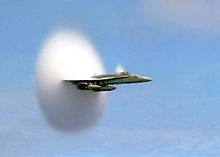
FA-18 breaking sound barrier

How easy it is today to jump into an aircraft, and expect to fly safely round the world in the luxury of an arm chair 7 miles or more above the surface of the earth, or know that the modern aircraft of our Air Forces can fly on every limit known, in the knowledge that all the aerodynamic tests and trials have been carried out.

Eric Brown is now 92. He gave up his wings at 70, but still 22 years later is lecturing on a subject which was at the time uncharted territory, a race to fly faster than Mach1, the Speed of Sound. Chuck Yeager got there first, but now ponder the following.

Captain “Winkle” Brown was with the Royal Navy for 31 years, much of it as an outstanding test pilot.

He flew 487 different types, (not variants) and made 2407 Aircraft Carrier landings, both World records.

At University he studied German, so at the end of the war as a linguist he interrogated many leading German aviation personalities such as Willy Messerschmitt, Ernst Heinkel, and Hanna Reitsch..

Capt. Eric Brown

What an interesting life, and still with stories to tell, and knowledge to pass on. There’s a lovely interview with Capt. Brown here.

By Bob Derham

Captain Thomas Murray – RIP

Regular readers of Learning from Dogs will know that we usually only post a single article on week-end days.  But yesterday I received news that a business friend of many years standing had lost his battle against ill-health and died peacefully in the afternoon.  His name was Tom Murray and it’s my wish to celebrate his life by reproducing in full the email that was sent to me. It’s serendipitous that the planned posts by John Lewis for this week-end are aviation related.

Capt. Tom Murray

On Thursday afternoon the world lost a respected, influential, and creative aviator, one of the “Great Ones”.

Captain Thomas Murray was a pilot, artist, inventor, musician, and father.

A noted jet pilot, he explored the far corners of the globe, mapping out the Canadian Arctic, flying thousands of hours in Africa, Europe, the Himalayas, and the Americas.

Whether flying Gulf streams, Falcon, Hawkers, Learjets or old DC3s, Tom was a pilot’s pilot, the friendly, knowledgeable kind of guy who knew his craft so thoroughly that airmen the world over would “just call Tom”, whenever they needed answers.

He thrilled everyone he met with exciting stories of his travels…

…such as the time he found himself lost while flying over what should have been a large African lake, only to realize the lake had dried up. The only hope of finding civilization was to dead-reckon his way in a straight line and hope he hit the tiny “dot of a town” that was his final destination.

…Or the time his oxygen system failed in the Himalayas at 20,000 feet forcing him to dive the airplane into an 8000-foot valley to find out he was the only conscious crewmember.

…Or the time the entire front panel of his Hawker 800 fell onto his lap during takeoff because someone had forgotten to screw it in.

An adventurer to the max, he was also an inventor and visionary.

Tom took an ordinary problem such as converting hard-to-read aircraft performance charts into easy-to-read tables, and then turned that process into a successful business.

Tom created one of the first electronic documents to find its way into a cockpit – tables of aircraft performance data that minimized the chance of pilot error due to miscalculation that he called “EPADS”.

Constantly working to organize the cockpit, provide higher levels of safety and better information to the pilots, he invented one of the world’s first electronic flight bags, and established the process of managing aircraft electronic checklists, a process that the FAA later modeled their ECL guidelines after.

He joked that the entire cockpit should have a mode that turned it into a simulator during flight to alleviate boredom amongst pilots and give them a chance to train in truly challenging simulations during long flights.

He invented games for children, played flute, and wrote a storybook.

An accomplished artist, he relaxed by attending artist workshops and amazing all with his skill and precision. Just last summer, Tom held his first art exhibition.

His greatest creation with wife Daisy was his son, Thomas Alexander Murray, who was born with the charismatic smile and sense of mischief that characterized Tom at his best.

Tom’s inventions were his “other child”.  He would latch onto a design problem like a pit bull.

He cherished the fact that he would uncompromisingly focus on a design and refuse to leave it go it until it was “perfect”, even to his own financial detriment when those around him insisted he was losing sight of the “big picture”.

To this effect, during his last year, he asked me to form a foundation in his name, to offer an annual award (which I’ll see if it’s possible to do)…

“To the individual who focuses on solving difficult problems; who is clearly addicted to finding the solution; who is unrelenting in the face of opposition – which may seem to be (or genuinely be) to their own personal detriment”

Perhaps he wanted an award, he knew he’d win!

Tom was well known for acting as “pilot in command” in his daily life, often forcing people to act “my way or the highway” and insisting that his way was the “right way”.

While this trait was annoying and frustrating to colleagues and friends, what was possibly more frustrating was the number of times one was forced to humble oneself when he was indeed “right”.

In the last year of his life, Tom worked relentlessly to teach others his design philosophy and prepare several of us to run the company he’d created, the vessel that would carry his vision and concern for the safety of his fellow pilots into the future.

Tom loved life and spent his days on a personal mission to make the world a better place, a more interesting place, a more ordered place, a more beautiful place, a more fun place to live…

Tom wasn’t always too clear with his emotions, and though he often maintained a “business” exterior, at heart he was the artist, and his appreciation and depth of love for his family, fellow pilots, and the people who worked for him and with him, his friends — was endless.

You always knew when he respected you, he’d give you a big pilot’s “Thumbs up!”

We will miss him dearly.

Today, we salute a great airman, Captain Thomas Murray.

On behalf of Tom, I know he would wish you a warm, “Thumbs up!”

Charles Guerin President
On-Board Data Systems (OBDS)

The Love of a Dog

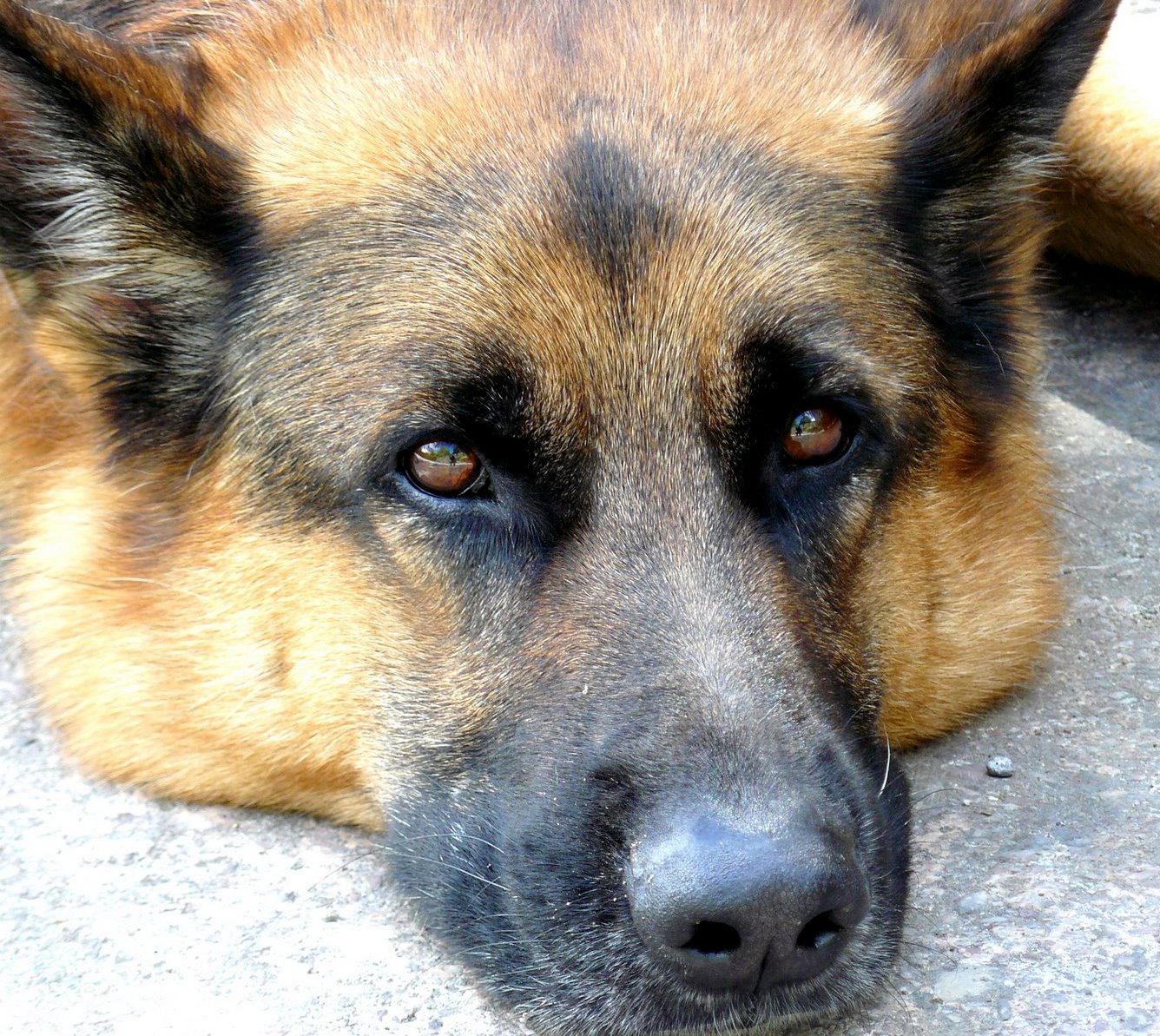
Pharaoh – from whom I have learnt so much.

German Shepherd, Pharaoh, born June 3rd, 2003

I am your dog and have something I would love to whisper in your ear.

I know that you humans lead very busy lives.  Some have to work, some have children to raise, some have to do this alone.  It always seems like you are running here and there, often too fast, never noticing the truly grand things in life.

Look down at me now.  Stop looking at your computer and look at me.  See the way my dark, brown eyes look at yours.

You smile at me.  I see love in your eyes.

What do you see in mine?  Do you see a spirit?  A soul inside who loves you as no other could in the world? A spirit that would forgive all trespasses of prior wrong doing for just a single moment of your time?  That is all I ask. To slow down, if even for a few minutes, to be with me.

So many times you are saddened by others of my kind passing on.  Sometimes we die young and, oh, so quickly, so suddenly that it wrenches your heart out of your throat.

Sometimes, we age slowly before your eyes that you may not even seem to know until the very end, when we look at you with grizzled muzzles and cataract-clouded eyes.  Still the love is always there even when we must take that last, long sleep dreaming of running free in a distant, open land.

I may not be here tomorrow.  I may not be here next week.  Someday you will shed the water from your eyes, that humans have when grief fills their souls, and you will mourn the loss of just ‘one more day’ with me.

Because I love you so, this future sorrow even now touches my spirit and grieves me.  I read you in so many ways that you cannot even start to contemplate.

We have now together.  So come and sit next to me here on the floor and look deep into my eyes.  What do you see?  Do you see how if you look deeply at me we can talk, you and I, heart to heart.  Come not to me as my owner but as a living soul.  Stroke my fur and let us look deep into the other’s eyes and talk with our hearts.

I may tell you something about the fun of working the scents in the woods where you and I go.  Or I may tell you something profound about myself or how we dogs see life in general.

I know you decided to have me in your life because you wanted a soul to share things with. I know how much you have cared for me and always stood up for me even when others have been against me.  I know how hard you have worked to help me be the teacher that I was born to be.  That gift from you has been very precious to me.  I know too that you have been through troubled times and I have been there to guard you, to protect you and to be there always for you.  I am very different to you but here I am.  I am a dog but just as alive as you.

I feel emotion.  I feel physical senses.  I can revel in the differences of our spirits and souls.  I do not think of you as a dog on two feet; I know what you are.  You are human, in all your quirkiness, and I love you still.

So, come and sit with me.  Enter my world and let time slow down if only for a few minutes.  Look deep into my eyes and whisper in my ears.  Speak with your heart and I will know your true self.  We may not have tomorrow but we do have now.

(Based on an article sent to me, unfortunately from an unknown author, and modified to reflect the special relationship that I have with my 6 year old German Shepherd, Pharaoh.)

By Paul Handover

Alan Peters

What is it about wood?

The smell of wood shavings!

When I was a very young boy at Grammar School (aka High School) in Wembley, North West London, one of the subjects taught was wood-working.  I loved the feel of wood, still do, and the smell of a wood shaving fresh off the wood plane is still remembered.  But, for whatever reason, wood and I never got on.

Later on, my first yacht was a pretty little East Coast gaff cutter, built in 1898, with a hull of pitch pine laid on grown oak frames.  Her original name was Mimms but this had been changed to Esterel by the time she was purchased by me. Despite needing a lot of remedial work, the over-riding memory was how the hull ‘spoke’ when she was being sailed.

It’s almost as though wood doesn’t die when the tree is felled, it just passes into another phase depending on the use made of it.

So where’s this all leading?

Alan Peters who died October 11th, 2009

In the issue of The Economist dated November 7th, 2009, there was an obituary about Alan Peters, furniture maker, who died on October 11th, 2009, aged 76.  Like all obits. that appear in The Economist this was well published but something about this particular obituary really stuck in my mind.  I tore out the page so it could be re-read over the coming weeks.

It’s still on my desk even 6 months later and it prompted me to write about Alan Peters on Learning from Dogs.

Here’s an extract of the obituary of Alan Peters as published in the The Times.

In contrast to many of today’s school-leavers, who look for instant success and celebrity, the furniture designer Alan Peters served seven years’ apprenticeship in the workshop of Edward Barnsley, which then operated without power tools. When interviewed last year Peters was still proud that he swept the workshop floor quicker and better than anyone else. His eagerness to share his passion and knowledge of furniture design and furniture making was a theme of his life.

And here’s another reflection from David Savage who studied under Alan Peters:

Damn, Damn, Damn, I am getting fed up writing obituries on dead furniture makers. Why can’t they just go on for ever.

I knew Alan quite well. He was a role model and a mentor when I really needed one. This would be way back in the late 1970s when there were very few people making modern furniture in a barn in Devon which is what I wanted to do. Even fewer making a living doing it. I had all the questions and Alan as far as I could see had all the answers. I spent a short time working with him. I was first in the workshop in the morning and last out in the evening. I’m sure he got fed up with my questions but he patiently answered. He gave and gave and gave. When I was set up he helped me get into the Devon Guild of Craftsmen and much later he would come to my workshop in Bideford to give Saturday seminars showing slides of his work and trips to Japan and Korea. He was an inspiration I know not just to me but to a generation of makers. I miss him.

Question: How many furniture makers does it take to change a light bulb?

Answer: Ten, one to change the bulb and nine to discuss at length how Alan would do it.

By Paul Handover

Sport – UAE style

A relaxing contrast to high profile events in the UK

During March I was working in the UAE, and there in the hotel where I was staying in Sharjah were the Pakistan cricket first team, and the English Lions representing England and Wales.

Pakistani cricket team

The weather was lovely with temperatures in the mid 70`s during the day. It was interesting to watch the players of each team, relaxing, but really using this time to prepare for the season, running round the lagoon, and getting fit. There were no raised voices, or bad behaviour, in fact quite the opposite, and each team came into the eating area well dressed, quietly enjoying the week.

There were several matches starting in Sharjah at the old cricket ground. No posters, no large crowds, just a few people like myself who had heard about the games and who had wandered along to find a bench  and sit and watch a 20/20 match without the big coverage and hullabaloo which will come later in the year.

One lovely six went flying over the stands and later a young boy came proudly back with the ball which he had found the other side of a main road, stuck in the sand.

The teams later moved on to Abu Dhabi some 70 miles along the coast to play in the new stadium and ground. This, like the new world-class Formula 1 racing circuit is brand new, and full of bright lights and modern style.

Venus Williams

Dubai in between Sharjah and Abu Dhabi likes to host sport during this time of the year, and just as with the cricket, tennis has a big following, with all the big names appearing in the small stadium near the airport in Dubai.

One evening I was watching Venus Williams play, and in the quiet of the late evening, and the general quiet of the match it was interesting to hear the chanting from the minaret as prayer time came.

If you want a winter break, and enjoy cricket motor racing, tennis, or golf you could do worse than stop off in the UAE to relax and enjoy your time.

By Bob Derham