Tag: Oregon State University

Hedgerows

That’s right – planting hedgerows!

For many years I lived in South Devon, England. I never thought twice about hedgerows because they were so common.

Then today I read an article in The Economist about Brexit and the one thing that was favourable was this “Brexit delivers a win for British wildlife.

Here’s a small extract from the magazine:

No other country matches the rich heritage of hedgerows that weave across the damp (ideal for hedges) British Isles. Since the Bronze Age, Britons have reared sheep and cattle and have used hedges to mark the boundaries of fields and keep livestock in place. Some of these ancient bushes still stand. In West Penwith, one such prehistoric hedge, a gurgoe, might be over 4,000 years old. Most, though, were planted in the 18th century, when landowners enclosed the commons, an event that turned the country into a chequerboard of small, irregular fields. America, by contrast, passed a law prohibiting private landowners from enclosing public land in 1885, protecting its open ranges.

Here in Oregon hedges are not so common. But I did some research as to the cause and came upon this article by Oregon State University.

I trust it may be shared with you.

ooOOoo

A Guide to Hedgerows: Plantings That Enhance Biodiversity, Sustainability and Functionality

Pami Monnette and Jude Hobbs

EM 8721 | Revised June 2020, Reviewed 2023

An aerial photo taken above Forest Grove shows hedgerows bordering the urban growth boundary and used as buffers between fields. 
Photo: Justin Smith, © Oregon State University
This young hedgerow bordering a field features native plants that provide habitat for beneficial insects and pollinators.
Photo: Janet Donnelly, © Oregon State University

We see them at the edges of farm fields or along roads: long rows of trees, shrubs, flowers and grasses known as hedgerows. They are living fences with the ability to grow food, shelter wildlife, save water, manage weeds and look beautiful all year round.

Hedgerows are sometimes called shelter belts, windbreaks or conservation buffers. These layers of plant life enhance the beauty, productivity and biodiversity of a landscape. 

Hedgerows originated in medieval Europe and are enjoying a modern resurgence. People in England planted hawthorn cuttings and allowed them to grow about 6 feet. They were bent and trained to fill gaps in the trees, yielding a living fence. They called these fences “hagas” or hedges, form the word “hawthorn.” As the birds settled in the hawthorns and dropped seeds. more plants sprung up. Today, many farms in England are surrounded by ancient hedgerows that shelter beneficial organisms and conserve soil and water. 

Hedgerow plantings were uncommon in the early United States. In the 1930s, the U.S. Department of Agriculture’s Shelterbelt Program briefly supported planting trees for windbreaks to prevent soil erosion in the Midwest. Today, as interest surges in sustainable farming methods, more people are turning to this age-old practice.

Hedgerows can serve several ecological functions. Among their many benefits, hedgerows:

  • Enhance ecological biodiversity.
  • Offer food for livestock, humans and wildlife.
  • Provide habitat for beneficial insects and pollinators.
  • Facilitate water conservation.
  • Provide windbreaks.
  • Help manage invasive weeds.
  • Provide erosion control and improve soil health.
  • Support the health of aquatic habitats.
  • Enhance carbon sequestration.
  • Create borders and privacy screens.
  • Reduce noise, dust, chemical drift and other types of pollution.
  • Diversify farm income.
  • Generate year-round beauty.

Let’s look at these benefits in detail.

Benefits of hedgerows

Enhance ecological biodiversity

Biodiversity describes the variety of life forms within a specific ecosystem and the relationship of these organisms to one another and the broader environment. Hedgerows can be designed to attract a wide variety of mammals, birds, reptiles, amphibians, insects and plants, many of which offer beneficial relationships to each other. They also create more edges, or “ecotones,” between different habitats, which increases species diversity. Trees and shrubs provide shelter for larger mammals, and nesting sites and perches for raptors, which are important predators of rodents. Dense or thorny shrub thickets can offer songbirds a refuge to escape predators as well as a place to nest. The diverse composition and structure of a hedgerow creates a functional habitat where species experience vital interconnections with one another and the environment.

Offer food for livestock, humans and wildlife

Hedgerows provide undisturbed refuge for species of all kinds, creating wildlife corridors, travel lanes or habitat islands. Hedgerows help protect wildlife from predators and provide sheltered access to riparian zones or other water sources. These corridors are especially important in fragmented landscapes, such as fields where only a single crop is grown. Hedgerows provide shade to reduce heat stress and help to block wind currents. These measures support a healthier wildlife population. Berry-producing plants encourage insectivores, such as birds, that also prey upon common crop pests. The hedgerow habitat creates cover for wildlife so they can feed, nest and care for their young.

Provide habitat for beneficial insects and pollinators

Planting a variety of flowering trees, shrubs, forbs and perennial plants provides insect habitat, and nectar and pollen sources throughout the year for beneficial insects and pollinators. Plants in the family Umbelliferae attract parasitic wasps; predator flies such as hover flies, lacewings and ladybeetles; and true bugs, like ambush or minute pirate bugs. Flowering plants in this family include coriander, dill, fennel, parsnip, parsley and carrots. These plants are useful in the kitchen and are also very attractive to pollinators. Over 75% of successful production of food requires pollination. Increasing plant habitat for pollinator species improves fruit set, size and quality, as well as general biodiversity. Pollinator habitat also attracts beneficial insects, which prey on many crop pests. Increasing the numbers of beneficial insects can help farmers manage crop pests and cut down on insecticide use.

Facilitate water conservation

Hedgerows retain water and reduce evaporation by reducing wind speed and providing cover over the ground surface. Plants also catch and store water in their root systems, leaves and branches, slowing the rate of excess rainwater entering waterways and reducing the risk of flooding. Decaying matter from the roots, stems and branches of hedgerow plants increase the organic matter in the soil over time. This increases the soil’s ability to absorb and retain water. Planting hedgerows on hillsides helps conserve water and soil by reducing erosion. If planting near adjacent cropland, periodic root pruning can reduce competition for nutrients and water.

Provide windbreaks

Properly designed hedgerows can reduce wind speed by as much as 75% and improve crop performance. This is especially effective when plantings reach a density of 40%–50% and are planted perpendicular to the prevailing wind. Wind-resistant trees usually have flexible, wide-spreading, strong branches and low centers of gravity. Wind-tolerant shrubs often have small, thick or waxy leaves or very narrow leaves or needles, to help control moisture loss. Wind can disturb pollination and damage fruit and flowers when plant parts thrash against each other. During times when soil is exposed, a windbreak can protect topsoil from erosion. Crops under wind stress also put energy into growing stronger roots and stems, resulting in smaller yields and delayed maturity. Strong winds also cause lodging of grain and grass crops, bending the stems and making harvest more difficult. Winds dry out crops on the field edges, increasing pests such as two-spotted spider mites.

Help manage invasive weeds

Hedgerows planted along roads or between crop fields may prevent weed seeds from blowing into the field. The weed seed pods collect on hedgerow plants, where a farmer could remove and burn them. Hedges can prevent millions of weed seeds from entering the crop field. As hedgerows mature, these plantings displace invasive weeds. If well maintained, this weed management lasts the lifetime of the hedgerow.

Provide erosion control and improve soil health

Rain, irrigation, clean cultivation and vacant field borders can all increase erosion potential in an agricultural system.

Hedgerow plantings can significantly reduce the amount of soil erosion on a landscape. They can also provide a barrier to filter out pollutants, such as pesticides, and slow down sediments and organic material that can flow from farm fields into waterways. This is accomplished by increasing the surface water infiltration rate and improving soil structure around the root zone. This, in turn, decreases fertilizer runoff from farm fields. The biomass that plants shed acts as a soil conditioner and can enhance plant growth. In urban or suburban environments, hedges similarly reduce pollutants from neighboring sites.

Support aquatic habitat

Hedgerows can provide shade to riparian areas. Shade reduces water temperatures, prevents water evaporation and improves watershed quality. Though many factors influence watershed temperatures, studies have proven that lowland streams bordered by trees and tall shrubs exhibit cooler temperatures. The hedgerow’s latitude, stream aspect, leaf density and the height of its vegetation from the water surface all affect water temperature.

Enhance carbon sequestration

During photosynthesis, trees, shrubs and grasses absorb carbon dioxide from the atmosphere, allowing the carbon to become part of the plant’s tissue. As plants die or shed tissue — either through natural processes or pruning — the carbon that was stored in the plant breaks down and enters the soil. Plants store relatively large amounts of carbon in their biomass, helping to offset some of the effects of climate change. A tree can absorb as much as
48 pounds of carbon dioxide per year and can sequester, or store, 1 ton of carbon dioxide by the time it reaches 40 years old.

Create borders and privacy screens along roads and between properties

Hedgerows are attractive borders and can block undesirable views. Evergreens offer year-round screening. When selecting plants, consider the height at maturity for optimum screening. Evergreens can be pruned to control height and density. Plant a diverse mix of species to help protect against damage from a single pest or disease.

Reduce noise, dust, chemical drift and other types of pollution

As hedgerows mature and become dense, they can create barriers to reduce noise, dust, chemical drift and other pollutants. Open canopy trees are effective barriers to dust and pesticides; air and particles slowly filter through them instead of depositing clouds of pollutants on the other side of the hedge.

Plant hedges as close as possible to any areas where pollutants are a concern. This can help alleviate neighborhood conflicts where agriculture intersects with urban areas.

Hedgerows can act to contain contaminants from urban or suburban environments and keep them from entering agricultural areas.

Diversify farm income

Trees, shrubs and herbaceous plants in a hedgerow can also serve as sources of income. Potential products include nuts, fruits, berries, leaves, flowers, seeds, bark and medicinal herbs. You can grow plants to be propagated as seeds, rootstock, cuttings and transplants. Other potential crops are nursery stock and floral materials, including ferns, broadleaf evergreens, flowers and willows grown for craft material and furniture. You can grow fruits, berries and nuts for food. Hedgerows can shelter bees and encourage a higher pollination rate. Consider planting trees for secondary wood products such as lumber, veneer, firewood, chips for bedding and mulch. Game birds such as quail, pheasant and sage grouse are attracted to hedgerows. Managed hunting can provide a potential source of food and off-season revenue for landowners.

Generate year-round beauty

Hedgerows in the landscape add continuous beauty. You can design a hedge for year-round interest, considering the color and texture of leaves and bark, bloom color and timing, and the general growth habit or form of plants.
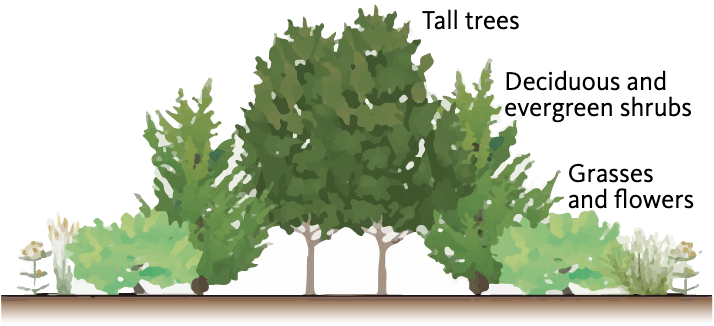
Hedgerow design
Graphic: Kerry Wixted with graphics from Tracey Saxby, IAN Image Library, courtesy of the Integration and Application Network, University of Maryland Center for Environmental Science
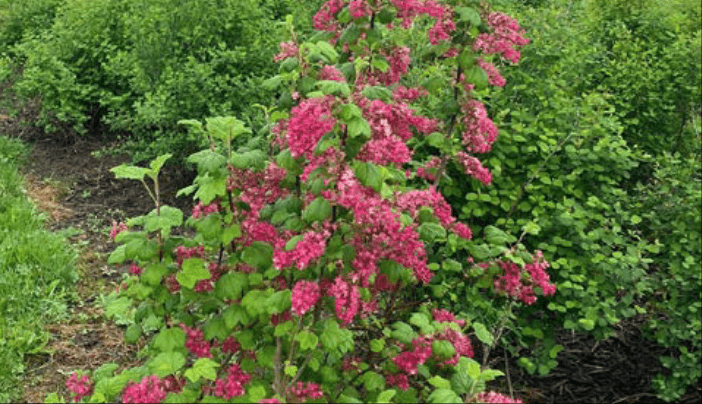
Native red-flowering currant adds beauty to a hedgerow.
Photo: Janet Donnelly, © Oregon State University

Establishing and maintaining hedgerows

Whether in rural or urban settings, the principles of planning a hedgerow are the same: Evaluate the site, determine what you would like to accomplish with the plantings, match the right plant with the right place, and properly prepare the site.

Design

There are many essential components to consider when designing a multifunctional hedgerow. The first step is to observe the site where the hedge is to be planted and take into consideration the ecological and environmental conditions listed below. These elements influence the design, plant selection, location and the size of the area to be planted. Although a single line of trees will provide some benefits, four or more rows of plants are optimal for windbreaks, water and soil conservation, wildlife habitat and general biodiversity. When it works for the situation, place plants tallest at maturity in the center row, with shorter ones inter-planted between and along the edges. A diverse selection of plant sizes and characteristics is most beneficial. When possible, orient rows perpendicular to prevailing winds.

Hedgerows following land contours create meandering lines on the landscape, producing a natural appearance and larger buffer for wildlife habitat. If the goal is to attract pollinator species, reserve approximately one half-acre for every 40 acres planted in crops.

Plant selection

Plant a wide variety of multi-tiered plants for maximum habitat. Avoid varieties that are susceptible to common pests and diseases and choose plants that are non-invasive. Some perennial species such as blackberry can provide excellent wildlife habitat and food crops but are highly invasive and require frequent maintenance. See the plant lists on page 7 for plantings suited to the Pacific Northwest.

When selecting plants, consider the conditions plants need to survive in specific habitats:

  • Range: place of origin (indigenous, native/non-native).
  • Hardiness zones: frost dates.
  • Light requirements: sun or shade.
  • Size of plants at maturity, growth.
  • Soil type (pH, fertility, erosion concerns).
  • Drainage.
  • Water movement and moisture needs.
  • Planting time.
  • Bloom time: seasonal interest.
  • Day length.
  • Productivity.
  • Tolerance to heat, cold, salt, drought, pollution, wind and wild or domestic animals.
  • Evergreen or deciduous.
  • Plant structure: form or shape, texture, leaf and bark type.
  • Edible or poisonous: what parts.
  • Insect and disease resistance.
  • Plant size, costs and availability.
  • Maintenance needed.
  • Allellopathy: a chemical inhibitor of one plant to another which can impact germination or plant growth.

Ultimately, place plants together that have similar soil, water, sun and drainage needs.

General planting recommendations:

  • Plant trees and shrubs about 6 to 8 feet apart in rows 8 to 10 feet apart.
  • Plant one or two rows of tall trees flanked by a row or two of shrubs. A 20-foot wide hedgerow can have two rows of shrubs flanking a row of trees.
  • Hedgerows work best for wildlife when they are wider than 20 feet.
  • Depending on the site’s prevailing winds, a winter windbreak could have at least two rows of evergreen trees and a row of deciduous trees or shrubs. A summer windbreak could have at least one row of tall deciduous trees and a row of deciduous shrubs.
  • Make sure the planting holes are deep and wide enough to accept and cover the roots of each plant. Be sure to water in each new planting.
  • In a small area, place a 3-inch layer of straw mulch or cardboard around each tree and shrub after planting to discourage weeds and encourage plant survival.

Soil preparation

Soil preparation is one of the keys to plant survival. On a smaller site, an easy way to establish planting areas in existing grass or pasture is to apply a thin layer of compost or manure, followed by several layers of cardboard, and mulch such as straw or leaves. Worms are attracted to the manure and will work over the winter to decompose grasses and fertilize the soil. However, this method may not be practical on a large scale. In this instance, prepare the area for planting by tilling the ground in spring and planting an early cover crop such as crimson clover, followed by buckwheat. In late summer, till or disc in the cover crop and replant an overwintering cover crop such as crimson clover, field peas or vetch. Cover crops improve soil fertility, reduce weeds, stabilize the soil and attract beneficial insects. Till again the following spring and install the first set of plantings for the hedgerow.

Another option for sites with high weed pressure is solarization. Closely mow the ground and put down UV-stabilized anti-condensation greenhouse plastic in midsummer for several weeks to kill the weeds. After solarization, remove the plastic and follow with a fall planting.

Planting time

In more temperate environments, fall planting allows roots to become established before foliage emerges and gives plants the benefit of winter rains. In extreme cold climates, early spring may be the ideal time for planting. At the time of planting, apply amendments such as compost or manure as a top dressing.

Irrigation

To increase the success rate of your hedgerow planting, provide supplemental water for the first two or three years. Irrigate once a week during the heat of the summer during the first year. For the second year, water every two weeks. In the third year, irrigate once a month. Irrigation needs depend on the location and the plants selected. Be sure to water deeply to encourage deep root growth. Most hedgerow plantings may not survive if they do not get supplemental water in the first few years. Water can be supplied by swales, furrows, flood, drip irrigation or hand watering. If the hedgerow is next to cropland, overhead irrigation from the crop can be extended to water the hedge.

Keeping out weedy plants and destructive wildlife

One of the biggest challenges in establishing a hedgerow is keeping unwanted plants from taking over the new plantings. There are a variety of techniques to inhibit these weedy plants. The simplest method is to leave alleys between plant rows for mowing, cultivation or mulching until plants are well established. Ideally, an area 6 to 8 feet wide around the hedgerow should be mowed, flailed or tilled for weed management, fire protection and rodent control. It is also important to mulch heavily with a minimum of 3 inches of leaves, straw, sawdust or cardboard around each plant. As plants mature, they will eventually shade out most annual weeds. This is the ideal time to infill with low-growing, shade-tolerant plants.

If needed, protect plants from beaver and nutria with hardware cloth, and use partially buried plastic-coated cardboard or tubing around tree trunks to protect from voles and mice. If applying pesticides, follow the label in order to protect riparian zones along rivers, creeks and ponds from contamination.

Managing a hedgerow in the first few years is similar to managing a crop. Good weed management during establishment results in less labor to control weeds in seasons to come.

Cost of establishment

Planting hedgerows does not have to be expensive. Seedling plants are available at low cost, and you can propagate new plants from existing plantings. The larger the plant, the sooner it will reach maturity, which is especially important in creating a fast-growing privacy screen. This can be achieved by purchasing dormant bareroot plants and 1-gallon potted plants or larger. Remember, these larger plants will most likely require summer irrigation. Government programs are available to assist landowners with hedgerow development. Many counties have tax exemption programs for riparian lands, along with wildlife habitat conservation and management programs. See “Incentive programs to help with hedgerow establishment” and Estimated Costs To Establish Pollinator Hedgerows, in “Resources,” pages 9–10.

Conclusion

A hedgerow is a long-term commitment. With proper planning and care, it will take approximately four to eight years to establish a hedgerow and 30 or more years for it to reach maturity. To encourage success, draft a plan with planting installments for each year, depending on your goals and budget.

Hedgerows in rural agricultural or urban settings provide many benefits that increase over time, including the opportunity for supplemental income. With benefits for wildlife, humans and the planet, hedgerows are a practice that has stood the test of time.

Hedgerow plants

Hedgerows can contain native and non-native plants, although plants should not be invasive. The following trees, shrubs, groundcovers and perennial plants are appropriate for hedgerows in the Pacific Northwest. Remember to consider proper site selection and plant requirements. Plants that tolerate wet soil are indicated by an asterisk (*).

Sun-tolerant plants under 25 feet

  • Arbutus unedo Strawberry tree
  • Aronia Chokeberry Schubert
  • Baccharis pilularis consanguinea Coyote brush
  • Ceanothus velutinus Tobacco brush
  • Cornus stolonifera Red twig dogwood
  • Diospyros kaki Japanese persimmon
  • Diospyros virginiana American persimmon
  • Elaeagnus multiflora Goumi
  • Elaeagnus umbellata Autumn olive
  • Ficus carica Fig
  • Fuchsia magellanica Hardy fuschia
  • Lonicera caerulea Blue honeyberry
  • Lonicera involucrata Twinberry
  • Malus fusca West Coast crabapple
  • Malus sp. Apple
  • Morus Mulberry
  • Myrica pensylvanica Bayberry
  • Oemleria cerasiformis Osoberry
  • Philadelphus lewisii Mock orange
  • Prunus avium Cherry
  • Prunus domestica Plum
  • Pyrus pyrifolia Asian pear
  • Ribes sanguineum Red-flowering currant
  • Ribes divaricatum Black gooseberry*
  • Ribes nigrum Black currant*
  • Rosa nutkana Nootka rose
  • Salix fluviatilis Columbia River willow*
  • Salix hookeriana Hooker’s willow*
  • Sambucus cerulea Blue elderberry*
  • Spiraea douglasii Western spiraea*
  • Vaccinium corymbosum Blueberry*
  • Vaccinium ovatum Evergreen huckleberry
  • Viburnum opulus Highbush cranberry

Sun-tolerant plants 25+ feet tall

  • Abies grandis Grand fir
  • Acer macrophyllum Bigleaf maple
  • Alnus rubra Red alder*
  • Arbutus menziesii Madrone
  • Asimina Pawpaw
  • Calocedrus decurrens Incense-cedar
  • Castanea Chestnut
  • Chrysolepis chrysophylla Golden chinkapin
  • Diospyros virginiana Persimmon
  • Fraxinus latifolia Oregon ash*
  • Juglans regia English walnut
  • Picea species Spruce
  • Pinus ponderosa Ponderosa pine
  • Populus trichocarpa Black cottonwood
  • Prunus subcordata Klamath plum*
  • Pseudotsuga menziesii Douglas-fir
  • Quercus garryana Oregon white oak
  • Robinia pseudoacacia Black locust
  • Thuja plicata Western redcedar

Groundcovers

  • Fragaria chiloensis Strawberry
  • Gaultheria shallon Salal
  • Mahonia nervosa Oregon grape
  • Polystichum munitum Sword fern
  • Vaccinium vitis idaea Lingonberry

Vines

  • Lonicera Honeysuckle
  • Akebia Five-fingered akebia*

Plants for pond edges

  • Typha latifolia Cattail*
  • Ledum glandulosum Labrador tea

Plants that tolerate shade

  • Chrysolepis chrysophylla Golden chinkapin
  • Cornus nuttallii Western flowering dogwood*
  • Corylus cornuta Hazel*
  • Physocarpus capitatus Ninebark
  • Polystichum munitum Sword fern
  • Sambucus racemosa Red elderberry*
  • Prunus virginiana Chokecherry

Plants for partial shade to shade

  • Acer circinatum Vine maple *
  • Amelanchier alnifolia Serviceberry
  • Berberis aquifolium Oregon grape
  • Gaultheria shallon Salal
  • Cornus stolonifera Red-osier dogwood
  • Holodiscus discolor Oceanspray
  • Lonicera involucrata Twinberry
  • Oemleria cerasiformis Indian plum
  • Philadelphus lewisii Mock orange
  • Rhamnus purshiana Cascara sagrada
  • Taxus brevifolia Western yew*
  • Vaccinium ovatum Evergreen huckleberry

Edge plantings

  • Achillea millefolium Yarrow
  • Arctostaphylos uva-ursi Kinnikinnick
  • Berberis nervosa Cascade Oregon grape
  • Calendula officinalis Calendula
  • Cichorium intybus Chicory
  • Foeniculum vulgare Fennel
  • Fragaria chiloensis Wild strawberry
  • Gaultheria shallon Salal
  • Lavandula angustifolia English lavender
  • Medicago sativa Alfalfa

Nuts

  • Carya illinoinensis Northern pecans
  • Carya ovata Shagbark hickory
  • Castanea Chestnuts
  • Ginkgo biloba Gingko
  • Juglans ailantifolia Heartnut
  • Juglans regia English Walnut
  • Xanthoceras sorbifolium Yellowhorn

Plants for arid environments

Plantings around vineyards

Some flowering plants attract specific kinds of beneficials, for example, carnivorous flies (Oregon sunshine), predatory bugs (stinging nettle) and Anagrus wasps (sagebrush). Research shows trends of reduced pest abundance and increased beneficial insect diversity and abundance in vineyards with a diversity of native flowering plants compared to vineyards lacking native plants.

  • Artemisia spp. Sagebrush
  • Chrysothamnus, Ericameria Rabbitbrush
  • Eriogonum compositum Northern buckwheat
  • Eriogonum niveum Snow buckwheat
  • Eriogonum elatum Tall buckwheat
  • Clematis ligusticifolia Western clematis
  • Eriophyllum lanatum Oregon sunshine
  • Crepis atribarba Slender hawksbeard
  • Asclepias speciosa Showy milkweed
  • Achillea millefolium Yarrow

Arid trees

  • Juniperus occidentalis Western juniper
  • Larix occidentalis Western larch
  • Picea pungens Blue spruce
  • Pinus flexilis Limber pine
  • Pinus edulis Pinyon pine
  • Pinus ponderosa Ponderosa pine
  • Pinus nigra Austrian pine
  • Populus trichocarpa Black cottonwood

Shrubs

  • Artemisia tridentata Big sagebrush
  • Atriplex canescens Four-wing saltbush
  • Cercocarpus montanus Mountain mahogany
  • Chamaebatiaria Desert sweet millefolium
  • Ericameria nauseosa Rubber rabbitbrush
  • Cornus stolonifera Red-osier dogwood
  • Mahonia repens Creeping Oregon grape
  • Potentilla fruticosa Shrubby cinquefoil
  • Prunus emarginata Bitter cherry
  • Prunus virginiana Chokecherry ‘Schubert’
  • Purshia tridentata Antelope bitterbush
  • Rosa woodsii Woods’ rose
  • Shepherdia argentea Silver buffaloberry
  • Shepherdia canadensis Russet buffaloberry

Herbaceous perennials

  • Antennaria species Cat’s ears
  • Anaphalis margaritacea Pearly everlasting
  • Aster alpinus Dwarf alpine aster
  • Aurinia saxatilis Basket of gold
  • Delosperma species Ice plant
  • Echinacea purpurea Purple coneflower
  • Ericameria nauseosa Rubber rabbitbrush
  • Erigeron annuus Fleabane daisy
  • Eriogonum umbellatum Sulfur buckwheat
  • Eriophyllum lanatum Oregon sunshine
  • Kniphofia uvaria Torch lily
  • Lavandula angustifolia English lavender
  • Linum lewisii Flax
  • Penstemon pinifolius Pineleaf penstemon
  • Rudbeckia species Black-eyed Susan
  • Salvia dorii Purple sage
  • Sedum spurium and album Stonecrops
  • Sphaeralcea munroana Globemallow
  • Rosa woodsii Woods’ rose
  • Yucca glauca Narrow leaf yucca

Groundcovers

  • Juniperus Savin juniper
  • Arctostaphylos uva-ursi Kinnikinnick
  • Sedum Stonecrop
  • Sempervivum Hens and chicks
  • Thymus pseudolanuginosus Wooly thyme
Jason Lueker, a horticulture student, helps maintain the hedgerow at the Oak Creek Center for Urban Horticulture at Oregon State University in Corvallis.
Photo: Hannah O’Leary, © Oregon State University
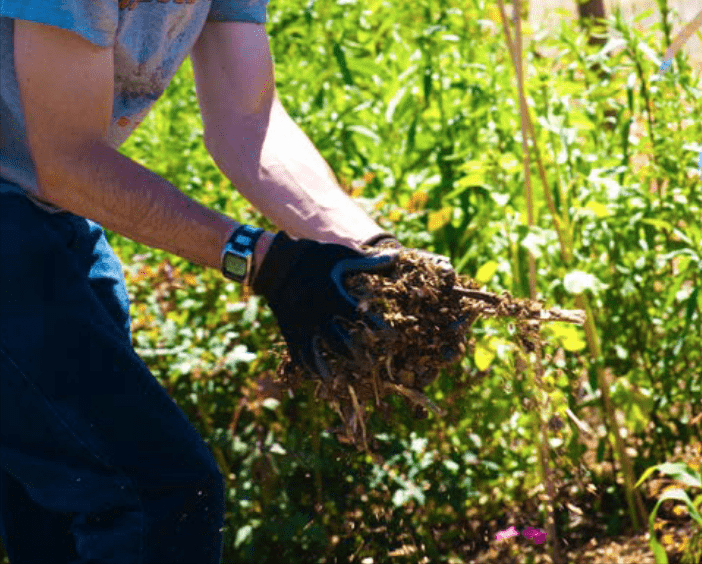
Mulching in a hedgerow’s early years controls weeds, which helps the plants become established.
Photo: Hannah O’Leary, © Oregon State University
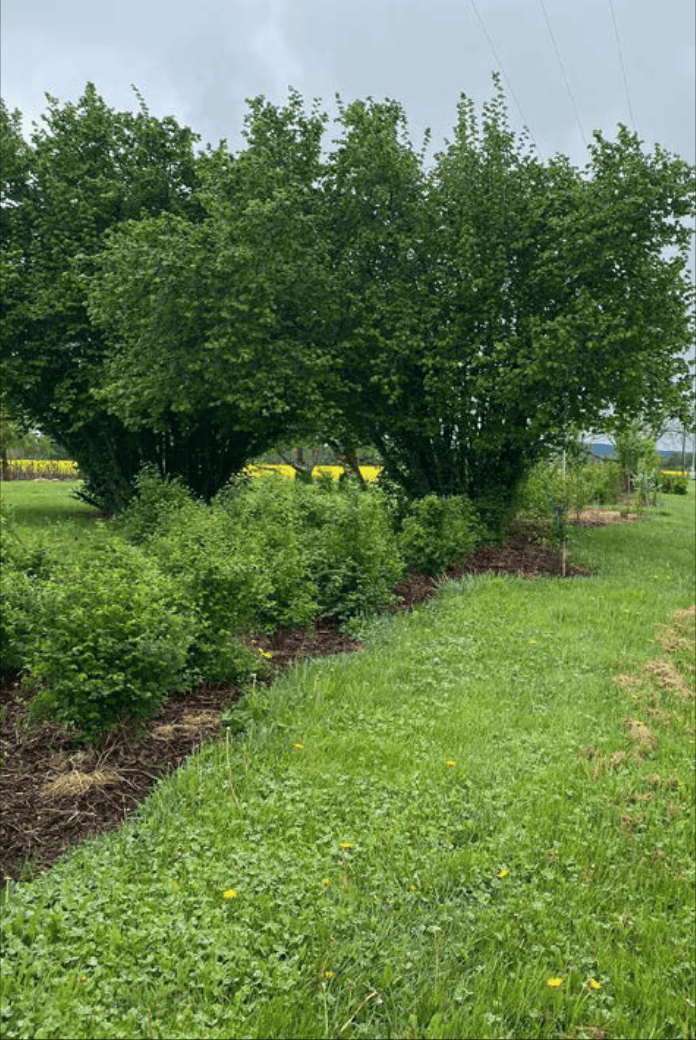
A hedgerow at a Willamette Valley farm combines tall trees with shrubs and flowering plants.
Photo: Janet Donnelly, © Oregon State University

Incentive programs to help with hedgerow establishment

Conservation Reserve Enhancement Program

In exchange for removing environmentally sensitive land from production and establishing permanent resource-conserving plant species, farmers and ranchers are paid an annual rental rate along with other federal and state incentives. This program is administered through the USDA Farm Service Agency and local Soil and Water Conservation districts.

Environmental Quality Incentives Program

This program provides financial and technical assistance to agricultural producers in order to address natural resource concerns and deliver environmental benefits such as improved water and air quality, conserved ground and surface water, reduced soil erosion and sedimentation or improved or created wildlife habitat. The program is administered through the USDA Natural Resources Conservation Service via local field offices.

Resources

Agencies

Books and publications

  • Earnshaw, S. Community Alliance with Family Farmers. Hedgerows and Farmscaping for California Agriculture: A Resource Guide For Farmers.
  • Guard, J.B. Wetland Plants of Oregon and Washington. 2010. Lone Pine Publishing.
  • Imhoff, D. and R. Carra. Farming With The Wild: Enhancing Biodiversity on Farms and Ranches. 2011. Sierra Club Books.
  • Kruckenberg, A. Gardening With Natives of the Pacific Northwest. 1982. University of Washington Press.
  • Lee-Mäder, E., J. Hopwood, M. Vaughan, S. Hoffman Black and L. Morandin. Farming with Native Beneficial Insects: Ecological Pest Control Solutions. 2014. Storey Publishing.
  • Link, R. Landscaping for Wildlife in the Pacific Northwest. 1999. University of Washington Press,
  • Mader, E., M. Shepherd, M. Vaughan, S. Black, G. LeBuhn, Attracting Native Pollinators. 2011. The Xerces Society for Invertebrate Conservation.
  • Martin, A., H.S. Zim, A.L. Nelson. American Wildlife and Plants: A Guide To Wildlife Food Habits. 1951. Dover Publications.
  • National Center for Appropriate Technology, Oregon Tilth and The Xerces Society for Invertebrate Conservation. Conservation Buffers in Organic System: Western States Implementation Guide. March 2014.
  • Pojar, J. and A. MacKinnon. Plants of the Pacific Northwest Coast. 2016. Lone Pine Publishing.
  • Rodriguez, O. and R. Dufour. A Pictorial Guide to Hedgerow Plants for Beneficial Insects, ATTRA — Sustainable Agriculture Program.
  • Rose, R., C.E.C. Chachulski, D.L. Haase. Propagation of Pacific Northwest Native Plants. 1998. Oregon State University Press.
  • The Xerces Society. Estimated Costs To Establish Pollinator Hedgerows.

Pollinator guides and publications

ooOOoo

This is a fantastic resource and my hope is that it will be read far and wide. We find it very inspiring here in Southern Oregon.

A Tilt of the Head

Head-tilting in dogs.

There have been two recent articles on head-tilting in dogs. One was published by Springer Link and was a scientific report; the Abstract as follows:

Little is known about head-tilts in dogs. Based on previous investigations on the head turning and the lateralised brain pattern of human speech processing in dogs, we hypothesised that head-tilts may be related to increased attention and could be explained by lateralised mental functions. We observed 40 dogs during object-label knowledge tests and analysed head-tilts occurring while listening to humans requesting verbally to fetch a familiar toy. Our results indicate that only dogs that had learned the name of the objects tilted their heads frequently. Besides, the side of the tilt was stable across several months and tests. Thus, we suggest a relationship between head-tilting and processing relevant, meaningful stimuli.

The other report was a more easy read, so to speak, and is from Treehugger and that is the one that I shall share with you.

ooOOoo

Why Brilliant Dogs Tilt Their Heads.

They’re processing relevant information.

By Mary Jo DiLonardo

Mary Jo DiLonardo

Published November 12, 2021

Tetra Images – Jessica Peterson / Getty Images

Ask your dog a question, and there’s a good chance he’ll tilt his head as he ponders his response.

The head tilt is a cute canine maneuver that gives the impression your pup is paying attention to you. But there’s been little scientific research analyzing the behavior.

In a new study of “gifted” dogs, researchers found that dogs that can easily learn the names of their toys tilt their heads when their owners ask them to fetch a specific toy. And they typically tilt their heads consistently to the same side.1

Data was collected during the Genius Dog Challenge, a series of experiments that were broadcast on social media, showing dogs retrieving their toys by name. The information was also collected during an earlier study that researched how some dogs are able to learn the names of many of their toys.2

These dogs were dubbed “gifted word learners” by researchers.

“We started studying this phenomenon after we realised that all of us observed this behaviour very often when we were testing the gifted word learner (GWL) dogs,” lead researcher Andrea Sommese, from the Family Dog Project at the Eötvös Loránd University in Budapest, tells Treehugger. 

“It’s such a cute, common behaviour but we didn’t know why our dogs were doing it and most of all, why so often!”

Gifted Learners 

For their work, researchers searched globally for two years, looking for dogs that had the ability to quickly memorize the names of their toys. They also created the Genius Dog Challenge, a research project and social media campaign, to find even more brilliant pups.3

They found six border collies that live in different countries, who all learned toy names just while playing with their owners. For the challenge, these gifted word learners had a week to learn the names of six toys. During the second stage, they had a week to try to learn the names of a dozen toys.4

“In all our experiments we found that the GWL dogs were tilting the head very often. It wasn’t just during the challenge but also when we were testing them every month,” Sommese says.

“We believe that there is a relationship between head tilting and processing relevant, and meaningful stimuli as our GWL dogs only showed this behaviour during the test when their owners were saying the name of a toy.”

In one experiment, researchers observed 40 dogs for three months as they attempted to learn the names of two new toys. The dogs sat or stood in front of their owners when they were asked to fetch one of the toys by pronouncing its name. (For example, “bring rope!”) The dogs would then go to another room and attempt to retrieve the correct toy.1

The researchers found that the gifted word learner dogs tilted their heads 43% of the time versus the typical dogs that only tilted in 2% of trials.1

The results were published in the journal Animal Cognition.

Choosing Sides

Dogs, horses, and other animals—including humans—show asymmetry in the way they perceive the world around them. They prefer one ear, eye, hand (or paw) over the other when interacting with the environment.5

“A typical way to show asymmetry, especially in humans, is handedness. Most of us are right-handed but there are still left-handed people around. The same can happen to animals,” Sommese says.

“Of course, it doesn’t always have to be a ‘hand’ or a paw in their case, it can be an eye or an ear. For instance, in dogs, even the inclination their tails have when they’re wagging is a sign of asymmetrical behaviour.”

In the study, researchers found that the dogs also showed asymmetry, nearly always tilting their heads to the same side.1

What About Typical Dogs?

Researchers say the findings suggest there’s a connection between head tilting and processing relevant and meaningful stimuli.5

But their results are limited because they only studied these brilliant pups who have learned toy names.

“Even if typical dogs are not able to learn the names of many toys as we showed with our previous study, typical dogs still tilt their head,” Sommese says. “It seems that even in them this might be in response to meaningful stimuli—but we don’t know what meaningful means for a typical dog just yet.”

Article Sources

  1. Sommese, Andrea, et al. “An Exploratory Analysis of Head-Tilting in Dogs.” Animal Cognition, 2021, doi:10.1007/s10071-021-01571-8
  2. Talk-To-Tilt: Head Tilting In Dogs.” ELTE Institute of Biology, 2021.
  3. Shany Dror, from the Family Dog Project, Eötvös Loránd University in Budapest
  4. The Challenge.” Genius Dog Challenge.
  5. lead researcher Andrea Sommese, from the Family Dog Project at the Eötvös Loránd University in Budapest

ooOOoo

Now I see The Smithsonian magazine has jumped on the bandwagon. Here is a small piece from their article:

“The next step is asking more questions to get at what the head tilt really means,” says Monique Udell, a human-animal interaction researcher at Oregon State University who wasn’t involved in the work, to Rachel Fritts of Science. “Can we use head tilting to predict word-learning aptitude, or attention, or memory?”

But The Smithsonian has to be thanked for mentioning Monique Udell because one can quickly find her details:

Monique Udell

Dr. Udell is the Director of the Human-Animal Interaction Laboratory and teaches courses on Animal Behavior & Cognition, Applied Animal Behavior, Animal Learning, Behavior Modification and Enrichment within the Department of Animal & Rangeland Sciences at OSU.

Her research interests include:

  • Human-animal interactions & bonding, including animal training and animal assisted intervention programs aimed at improving the lives of humans and animals through mutually beneficial interactions.
  • Lifetime and evolutionary factors influencing the social development and wellbeing of canines (dogs and wolves), domestic cats, and other captive and domesticated species.
  • Evaluating and improving the welfare of animals living as companion, working, or production animals.

More details can be found at the Human-Animal Interaction lab website: TheHumanAnimalBond.com

If anyone wants to contact her then her email address is: monique.udell@oregonstate.edu

I think I will simply because I would like to know more about her work!

Fire-wising call.

Normal service is being interrupted!

I have been reluctant to tackle the fire preparations. One of the issues is that daily temperatures have been excessive and that makes working outside difficult.

But we have to and it is going to take some planning and preparation to be ready to evacuate should we get the call.

So for a short while there is going to be a break in me offering posts to you all on Learning from Dogs. I don’t know how long and it could be just a quick break.

For information to any others who want to know more. the Oregon State University provide a fantastic Fire Program website.

Frankly it would be so much easier to ignore it all because what with our dogs and horses and our parakeets and preparing the home and so much more it is a great deal of work.

But I know that is not the answer.

Being prepared is!

Meat is Heat!

A counter-intuitive approach to stopping global warning.

About three weeks ago, the 22nd November to be precise, I published a post under the title of Our Beautiful Planet. It included the reply to an email that I had sent to Prof. Bill Ripple or, to give him his full nomenclature, William J. Ripple, Distinguished Professor of Ecology, Department of Forest Ecosystems and Society, Oregon State University, Corvallis, Oregon.

I reached out to the good Professor because I wanted to share with you what he thought were the top priorities in terms of how each and every one of us should change our lifestyle. You may well recall his reply (my emphasis):

Paul, Consider suggesting that if people want to help, they could have fewer children, reduce energy consumption such as driving autos and flying, avoid meat and eat mostly plant-based foods and avoid wasting food. Below are quotes from our paper. Bill

“It is also time to re-examine and change our individual behaviors, including limiting our own reproduction (ideally to replacement level at most) and drastically diminishing our per capita consumption of fossil fuels, meat, and other resources ….

… reducing food waste through education and better infrastructure; promoting dietary shifts towards mostly plant-based foods

Last Tuesday week, on the 5th December, there was an item published by NutritionFacts.org. It was called Meat is Heat: The Effects of Diet on Global Warming.

I am keeping my fingers crossed that Dr. Michael Greger is happy for me to republish this article in full. For it so underlines what Professor Ripple is promoting. (Indeed, further browsing on the NutritionFacts website showed that articles are published under the Creative Commons License arrangement.)

ooOOoo

Image Credit: Andrew Walton / Unsplash. This image has been modified.

Meat is Heat: The Effects of Diet on Global Warming

One of the most prestigious medical journals in the world editorialized that climate change represents “the biggest global health threat of the 21st century.” Currently, chronic diseases are by far the leading cause of death. Might there be a way to combat both at the same time? For example, riding our bikes instead of driving is a win-win-win for the people, planet, and pocketbook. Are there similar win-win situations when it comes to diet?

As I discuss in my video Diet and Climate Change: Cooking Up a Storm, the foods that createthe most greenhouse gases appear to be the same foods that are contributing to many of our chronic diseases. Researchers found that meat (including fish), eggs, and dairy had the greatest negative environmental impact, whereas grains, beans, fruits, and vegetables had the least impact. And not only did the foods with the heaviest environmental impact tend to have lower nutritional quality, but they also had a higher price per pound. So, avoiding them gives us that triple win scenario.

The European Commission, the governing body of the European Union, commissioned a study on what individuals can do to help the climate. For example, if Europeans started driving electric cars, it could prevent as much as 174 million tonnes of carbon from getting released. We could also turn down the thermostat a bit and put on a sweater. But the most powerful action people could take is shift to a meat-free diet.

What we eat may have more of an impact on global warming than what we drive.

Just cutting out animal protein intake one day of the week could have a powerful effect. Meatless Mondays alone could beat out a whole week of working from home and not commuting.

A strictly plant-based diet may be better still: It’s responsible for only about half the greenhouse gas emissions. Studies have suggested that “moderate diet changes are not enough to reduce impacts from food consumption drastically.” Without significant reduction in meat and dairy, changes to healthier diets may only result in rather minor reductions of environmental impacts. This is because studies have shown that the average fossil energy input for animal protein production systems is 25 calories of fossil energy input for every 1 calorie produced—more than 11 times greater than that for grain protein production, for example, which is around 2 to 1.

Researchers in Italy compared seven different diets to see which one was environmentally friendliest. They compared a conventional omnivorous diet adhering to dietary guidelines; an organic omnivorous diet; a conventional vegetarian diet; an organic vegetarian diet; a conventional vegan diet; an organic vegan diet; and a diet the average person actually eats. For each dietary pattern, the researchers looked at carcinogens, air pollution, climate change, effects on the ozone layer, the ecosystem, acid rain, and land, mineral, and fossil fuel use. You can see in the video how many resources it took to feed people on their current diets, all the negative effects the diet is having on the ecosystem, and the adverse effects on human health. If people were eating a healthier diet by conforming to the dietary recommendations, the environmental impact would be significantly less. An organic omnivorous diet would be better still, similar to a vegetarian diet of conventional foods. Those are topped by an organic vegetarian diet, followed by a conventional vegan diet. The best, however, was an organic vegan diet.

The Commission report described that the barriers to animal product reduction are largely lack of knowledge, ingrained habits, and culinary cultures. Proposed policy measures include meat or animal protein taxes, educational campaigns, and putting the greenhouse gas emissions information right on food labels.

Climate change mitigation is expensive. A global transition to even just a low-meat diet, as recommended for health reasons, could reduce these mitigation costs. A study determined that a healthier, low-meat diet would cut the cost of mitigating climate change from about 1% of GDP by more than half, a no-meat diet could cut two-thirds of the cost, and a diet free of animal products could cut 80% of the cost.

Many people aren’t aware of the “cow in the room.” It seems that very few people are aware that the livestock sector is one of the largest contributors to greenhouse gas emissions. But that’s changing.

The UK’s National Health Service is taking a leading role in reducing carbon emissions. Patients, visitors, and staff can look forward to healthy, low-carbon menus with much less meat, dairy, and eggs. “Evidence shows that as far as the climate is concerned, meat is heat.”

The Swedish government recently amended their dietary recommendations to encourage citizens to eat less meat. “If we seek only to achieve the conservative objective of avoiding further long-term increases in [greenhouse gas] emissions from livestock, we are still led to rather radical recommendations” such as cutting current consumption levels in half in affluent countries—“an unlikely outcome if there were no direct rewards to citizens for doing so. Fortunately, there are such rewards: important health benefits…” By helping the planet, we can help ourselves.

There are tons of articles on diet and sustainability. It’s such an important topic that I may review the new science once every year or two. When the U.S. Department of Agriculture entered these waters, the meat industry appeared to freak out, and the Dietary Guidelines debate continues.

ooOOoo

Just reflect on the key message from this article (my emphasis):

“A study determined that a healthier, low-meat diet would cut the cost of mitigating climate change from about 1% of GDP by more than half, a no-meat diet could cut two-thirds of the cost, and a diet free of animal products could cut 80% of the cost.”

In other words, the most cost-effective way of mitigating climate change is to change to a diet free of animal products. Plus, it’s a damn sight healthier for you and me!


Our beautiful planet.

It is the only lovely planet that we all have.

That ‘we’ being all the animals, plants, insects and humans there are.

I’m not saying anything new and not making this plea for the first time in this place.

But just take a few minutes out of your busy day to reflect that for you, for me, for everyone wherever they are in the world, physically and culturally, doing nothing is not an option.

More of that in a minute.

First I want to share with you a few autumnal photographs of our home here in Oregon.

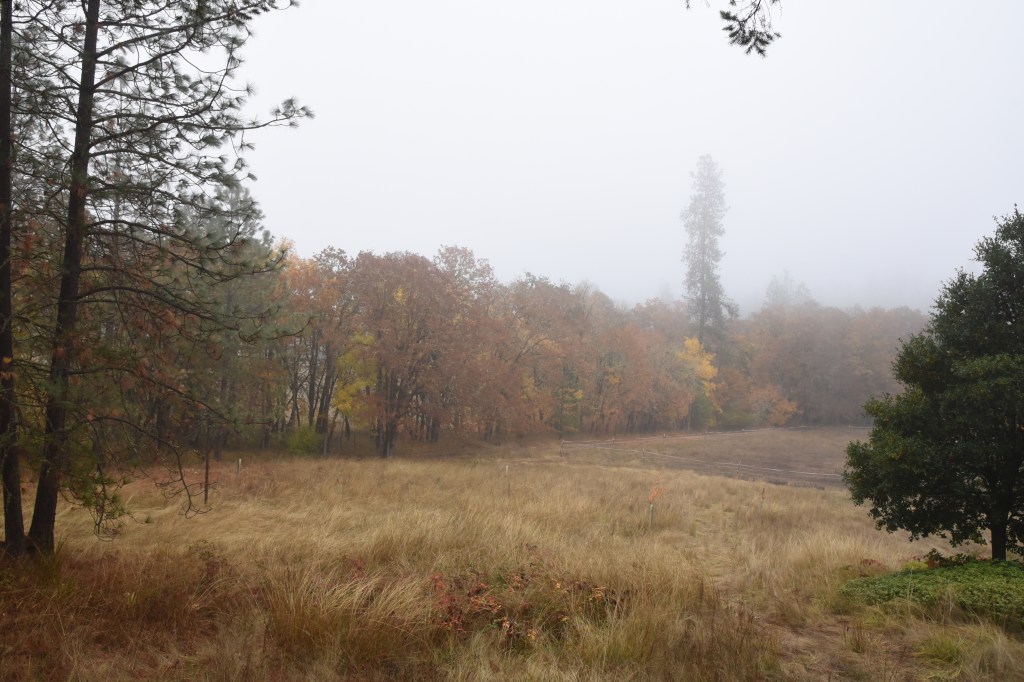
Below was taken at 9am on October 24th showing the  mountain mist right down to the tops of our trees that mark the edge of our driveway from the house to our Hugo Road entrance.

Next, a sunrise photograph with the camera pointing to the East. The tree line follows the ridge of some hills the other side of Hugo Road. The picture taken on the 19th October at 07:20.
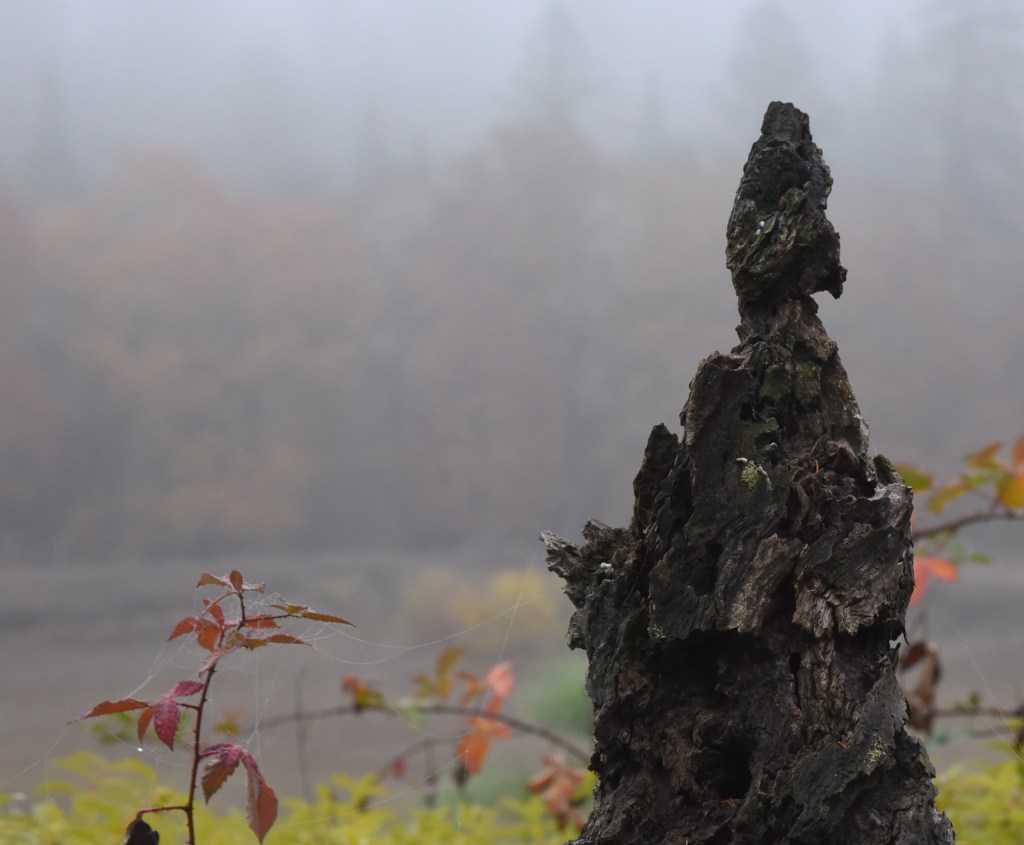
Now a close-up of the remains of a very old tree trunk with the trees that border Bummer Creek, that runs through our land, just showing through the morning mist. Taken on the 24th October at 09:05.
Final photograph I wanted to share with you is this beautiful sight of the moon taken from our property at 16:05 on the 25th. October.

Regular readers will know that Jean and I are not believers in any religion; we are atheists. But to my way of thinking that puts even more pressure on me and Jean to try to make a difference. We do all that we can but there’s no doubt that we can do more.
Yesterday, I referred to Bill Ripple, or to give him his full signature: William J. Ripple, Distinguished Professor of Ecology, Department of Forest Ecosystems and Society, Oregon State University, Corvallis, Oregon.

I sent Bill an email:

Dear Bill (and forgive the over familiarity if that offends),
I am a Brit, just turned 73, living with my beautiful wife, Jean, London-born as I was, down in Merlin, Oregon.

We live on 13 wonderful acres of rural property with 6 dogs (down from 12 when we moved here 5 years ago) and 4 horses, the majority of whom are ex-rescues.

I am the author of the blog Learning from Dogs and want to publish a post highlighting that viewpoint article. Because I believe with every neuron left in my ageing brain that the political changes that this world so urgently needs can only come when 99.9% of the public are screaming out “enough is enough”!

But there’s another saying that comes to mind, the one about being the change you want to see or something like that.

Is there information anywhere online that spells out, almost in words of one syllable, what lifestyle changes each of us can and need to commit to today? Changes that are as appropriate for elderly authors living in the country as young people seeking their first job or those up to their necks in working and raising families?

For that is what I want to publish on my blog!

If it would be easier for me to make an appointment to call you and take notes over the phone then I am just as happy to do that.

Sincerely,

Paul Handover
Hugo Road, Merlin,

Bill promptly replied:

Hi Paul, how long of a list of lifestyle changes do you want to make? Would three or four be enough? Bill

then followed that up with another email:

Paul, Consider suggesting that if people want to help, they could have fewer children, reduce energy consumption such as driving autos and flying, avoid meat and eat mostly plant-based foods and avoid wasting food. Below are quotes from our paper. Bill

“It is also time to re-examine and change our individual behaviors, including limiting our own reproduction (ideally to replacement level at most) and drastically diminishing our per capita consumption of fossil fuels, meat, and other resources ….

… reducing food waste through education and better infrastructure; promoting dietary shifts towards mostly plant-based foods

Now watch this video

I will close this post by listing out all the things that you and I can do now!

  • Set a target for reducing your car mileage next year compared to 2017,
  • If you are a regular aircraft passenger, then set a target for flying fewer hours in 2018 compared to 2017,
  • reduce or stop eating meat,
  • do not waste food,
  • reduce the use of heating and cooling in your home/s for next year,
  • commit to a dietary change away from meats and processed foods to a plant-based diet.

Then for younger couples who want a family around them, limit the number of children to a “replacement level” at most. Adopt??

A plea for this planet!

I feel compelled to ‘bang the drum’!

The recent news that many scientists have signed an open letter warning about how soon it will be too late to “save Earth” has been widely broadcast; not that this stops me from republishing the version of the news story that I read on the EarthSky blog site.

Here it is.

oooooh

Scientists warn: Soon it will be too late to save Earth

By Eleanor Imster in EARTH | HUMAN WORLD | November 16, 2017
More than 15,000 scientists in 184 countries have signed a letter urging the world to address major environmental concerns. “Soon it will be too late to shift course away from our failing trajectory, and time is running out.”

A letter to all of us, signed by more than 15,000 scientists (and counting) in 184 countries, warns that human well-being will be severely jeopardized by continuing trends in environmental harm, including our changing climate, deforestation, loss of access to fresh water, species extinctions and human population growth.

Entitled World Scientists’ Warning to Humanity: A Second Notice, it was published in the international journal Bioscience on November 13, 2017.

In 1992, more than 1,700 scientists signed a World Scientists’ Warning to Humanity published by the Union of Concerned Scientists. But global trends have worsened since 1992, the authors wrote in the new letter. In the last 25 years, trends in nine environmental issues suggest that humanity is continuing to risk its future.

Read the letter here.

The scientists wrote:

Soon it will be too late to shift course away from our failing trajectory, and time is running out. We must recognize, in our day-to-day lives and in our governing institutions, that Earth with all its life is our only home.

The letter also says …

By failing to adequately limit population growth, reassess the role of an economy rooted in growth, reduce greenhouse gases, incentivize renewable energy, protect habitat, restore ecosystems, curb pollution, halt defaunation, and constrain invasive alien species, humanity is not taking the urgent steps needed to safeguard our imperiled biosphere.

The article was written by an international team led by William Ripple of Oregon State University led the international team of scientists who created the letter. Ripple said in a statement:

Some people might be tempted to dismiss this evidence and think we are just being alarmist. Scientists are in the business of analyzing data and looking at the long-term consequences. Those who signed this second warning aren’t just raising a false alarm. They are acknowledging the obvious signs that we are heading down an unsustainable path. We are hoping that our paper will ignite a wide-spread public debate about the global environment and climate.

Progress in some areas — such as a reduction in ozone-depleting chemicals and an increase in energy generated from renewable sources — shows that positive changes can be made, the authors wrote. There has been a rapid decline in fertility rates in some regions, which can be attributed to investments in education for women, they added. The rate of deforestation in some regions has also slowed.

The warning came with steps that can be taken to reverse negative trends, but the authors suggested that it may take a groundswell of public pressure to convince political leaders to take the right corrective actions. Such activities could include establishing more terrestrial and marine reserves, strengthening enforcement of anti-poaching laws and restraints on wildlife trade, expanding family planning and educational programs for women, promoting a dietary shift toward plant-based foods and massively adopting renewable energy and other “green” technologies.

Scientists who did not sign the warning prior to publication can endorse the published warning here.

Bottom line: A letter entitled World Scientists’ Warning to Humanity: A Second Notice, urging the world to address major environmental concerns. was signed by more than 15,000 scientists in 184 countries.

Read more from Oregon State University

ooOOoo

As is the way with this modern inter-connected world it was but a moment to track down said William Ripple, find his email address and ask him what he recommended as the top things that you and I should be doing now.

Not just for you and me but for all the animals as well on this very beautiful planet.

Bill’s reply is part of tomorrow’ post. See you then!

Return to Predators!

The critical value of predators.

Not so long ago there was some discussion about how important it was for the natural way of things to include predators. I mentioned how this had been the topic of a post published some time ago in this place.

It was back in February, 2014 and I have republished it today.

oooo

The critical value of predators in our wild lands.

February 24th, 2014

The consequences of the reintroduction of wolves to Yellowstone National Park.

I have two people to offer my thanks to for today’s post: Suzann and Ginger. Both of them within hours of each other sent me an email recommending the following video. So, without further ado, here is that video. (Oh, would you believe this. The video was released on February 13th, 2014 and, at the time of me writing this post, has been viewed 1,453,345 times! Wow!)

Published on Feb 13, 2014

Visit http://sustainableman.org/ to explore the world of sustainability.

For more from George Monbiot, visit http://www.monbiot.com/ and for more on “rewilding” visit http://bit.ly/1hKGemK and/or check out George Monbiot’s book Feral: rewilding the land, the sea and human life: http://amzn.to/1dgdLi9

“When we try to pick out anything by itself, we find it hitched to everything else in the Universe.” – John Muir

When wolves were reintroduced to Yellowstone National Park in the United States after being absent nearly 70 years, the most remarkable “trophic cascade” occurred. What is a trophic cascade and how exactly do wolves change rivers? George Monbiot explains in this movie remix.

Narration from TED: “For more wonder, rewild the world” by George Monbiot. Watch the full talk, here: http://bit.ly/N3m62h

B-Roll Credits:
“Greater Yellowstone Coalition – Wolves” (http://bit.ly/1lK4LaT)
“Wolf Mountain” (http://bit.ly/1hgi6JE)
“Primodial – Yellowstone” (https://vimeo.com/77097538)
“Timelapse: Yellowstone National Park” (http://bit.ly/1kF5axc)
“Yellowstone” (http://bit.ly/1bPI6DM)
“Howling Wolves – Heulende Wölfe” (http://bit.ly/1c2Oidv)
“Fooled by Nature: Beaver Dams” (http://bit.ly/NGgQSU)

Music Credits:
“Unfoldment, Revealment, Evolution, Exposition, Integration, Arson” by Chris Zabriskie (http://bit.ly/1c2uckW)

FAIR USE NOTICE: This video may contain copyrighted material. Such material is made available for educational purposes only. This constitutes a ‘fair use’ of any such copyrighted material as provided for in Title 17 U.S.C. section 106A-117 of the US Copyright Law.

For any concerns or questions, you may contact us athttp://sustainableman.org/contact/

If you want to read more on a general level, then my post on the 11th January, 2014, An echo in the hills! may be worthwhile. It included this from William Ripple, of Oregon State University:

ooOOoo

Top dogs keep ecosystems in order

Many of these large carnivore species are endangered and some are at risk of extinction, either in specific regions or entirely. Ironically, they are vanishing just as we are learning about their important ecological effects, which is what led us to write a new paper in the journal Science to document their role.

From a review of published reports, we singled out seven species that have been studied for their important ecological role and widespread effects, known as trophic cascades. These are the African lion, leopard, Eurasian lynx, cougar, gray wolf, sea otter and dingo.

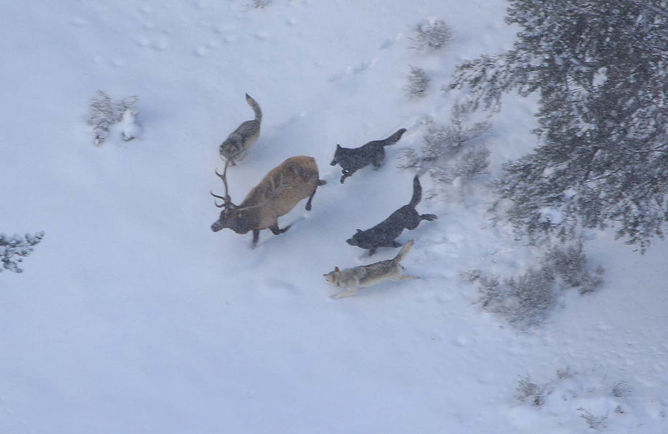
Based on field research, my Oregon State University co-author Robert Beschta and I documented the impact of cougars and wolves on the regeneration of forest tree stands and riverside vegetation in Yellowstone and other national parks in western North America. Fewer predators, we found, lead to an increase in browsing animals such as deer and elk. More browsing disrupts vegetation, reduces birds and some mammals and changes other parts of the ecosystem. From the actions of the top predator, widespread impacts cascade down the food chain.

Similar effects were found in studies of Eurasian lynx, dingoes, lions and sea otters. For example in Europe, absence of lynx has been closely tied to the abundance of roe deer, red fox and hare. In Australia, the construction of a 3,400-mile dingo-proof fence has enabled scientists to study ecosystems with and without dingoes which are closely related to gray wolves. They found that dingoes control populations of herbivores and exotic red foxes. The suppression of these species by dingoes reduces predation pressure, benefiting plants and smaller native prey.

In some parts of Africa, the decrease of lions and leopards has coincided with a dramatic increase in olive baboons, which threaten crops and livestock. In the waters off southeast Alaska, a decline in sea otters through killer whale predation has led to a rise in sea urchins and loss of kelp beds.

Predators are integral, not expendable

We are now obtaining a deeper appreciation of the impact of large carnivores on ecosystems, a view that can be traced back to the work of landmark ecologist Aldo Leopold. The perception that predators are harmful and deplete fish and wildlife is outdated. Many scientists and wildlife managers now recognise the growing evidence of carnivores’ complex role in ecosystems, and their social and economic benefits. Leopold recognised these relationships, but his observations were ignored for decades after his death in 1948.

op carnivores, at work keeping things in check. Doug Smith
Top carnivores, at work keeping things in check. Doug Smith

Human tolerance of these species is the major issue. Most would agree these animals have an intrinsic right to exist, but additionally they provide economic and ecological services that people value. Among the services documented in other studies are carbon sequestration, restoration of riverside ecosystems, biodiversity and disease control. For example, wolves may limit large herbivore populations, thus decreasing browsing on young trees that sequester carbon when they escape browsing and grow taller. Where large carnivore populations have been restored – such as wolves in Yellowstone or Eurasian lynx in Finland – ecosystems appear to be bouncing back.

I am impressed with how resilient the Yellowstone ecosystem is, and while ecosystem restoration isn’t happening quickly everywhere in this park, it has started. In some cases where vegetation loss has led to soil erosion, for example, full restoration may not be possible in the near term. What is certain is that ecosystems and the elements of them are highly interconnected. The work at Yellowstone and other places shows how species affect each another through different pathways. It’s humbling as a scientist to witness this interconnectedness of nature.

My co-authors and I have called for an international initiative to conserve large carnivores in co-existence with people. This effort could be modelled after a couple of other successful efforts including the Large Carnivore Initiative for Europe, a non-profit scientific group affiliated with the International Union for the Conservation of Nature, and the Global Tiger Initiative which involves all 13 of the tiger-range countries. With more tolerance by humans, we might be able to avoid extinctions. The world would be a scary place without these predators.

William Ripple does not work for, consult to, own shares in or receive funding from any company or organisation that would benefit from this article, and has no relevant affiliations.

ooOOoo

The ConversationMan! We are a strange species at times!
Hazel’s postscript.

Decisions!

In my post informing all you lovely people that Hazel had died in the early hours of Wednesday morning I included:

There has been so much interest and concern over her from you all that I wanted to post this without delay. We will be arranging to have the exact cause of death determined so that, too, may be shared with you all.

The background is that our vet, Dr. Jim Goodbrod, had been in touch with the appropriate health authority with regard to the risk of Coccidioidomycosis, the medical term for the fungal infection of Hazel’s lungs that was the first diagnosis of what was ailing Hazel. Reason why is that Coccidioidomycosis can be a danger to humans if the spores in a body are released following the corpse being open up.

The next step was that Oregon State University (OSU) expressed an interest in doing further research on Hazel’s body because Coccidioidomycosis was so rarely seen in Oregon. That would have entailed shipping Hazel’s body up to Corvallis in Oregon and then having her cremated up there.

In the end, we thought that the most dignified way of treating Hazel was to have her cremated by Stephens locally in Grants Pass. They have been very kind in keeping Hazel’s body chilled while we worked out the if’s and how’s of working with OSU.

We expect that by the end of today, Friday, our lovely dog will have been cremated.

On Saturday, I will be publishing a eulogy to Hazel and Sunday’s Picture Parade will be devoted to remembering the beautiful dog that she was.

The critical value of predators in our wild lands.

The consequences of the reintroduction of wolves to Yellowstone National Park.

I have two people to offer my thanks to for today’s post: Suzann and Ginger.   Both of them within hours of each other sent me an email recommending the following video.  So, without further ado, here is that video.  (Oh, would you believe this.  The video was released on February 13th, 2014 and, at the time of me writing this post, has been viewed 1,453,345 times! Wow!)

Published on Feb 13, 2014

Visit http://sustainableman.org/ to explore the world of sustainability.

For more from George Monbiot, visit http://www.monbiot.com/ and for more on “rewilding” visit http://bit.ly/1hKGemK and/or check out George Monbiot’s book Feral: rewilding the land, the sea and human life: http://amzn.to/1dgdLi9

“When we try to pick out anything by itself, we find it hitched to everything else in the Universe.” – John Muir

When wolves were reintroduced to Yellowstone National Park in the United States after being absent nearly 70 years, the most remarkable “trophic cascade” occurred. What is a trophic cascade and how exactly do wolves change rivers? George Monbiot explains in this movie remix.

Narration from TED: “For more wonder, rewild the world” by George Monbiot. Watch the full talk, here: http://bit.ly/N3m62h

B-Roll Credits:
“Greater Yellowstone Coalition – Wolves” (http://bit.ly/1lK4LaT)
“Wolf Mountain” (http://bit.ly/1hgi6JE)
“Primodial – Yellowstone” (https://vimeo.com/77097538)
“Timelapse: Yellowstone National Park” (http://bit.ly/1kF5axc)
“Yellowstone” (http://bit.ly/1bPI6DM)
“Howling Wolves – Heulende Wölfe” (http://bit.ly/1c2Oidv)
“Fooled by Nature: Beaver Dams” (http://bit.ly/NGgQSU)

Music Credits:
“Unfoldment, Revealment, Evolution, Exposition, Integration, Arson” by Chris Zabriskie (http://bit.ly/1c2uckW)

FAIR USE NOTICE: This video may contain copyrighted material. Such material is made available for educational purposes only. This constitutes a ‘fair use’ of any such copyrighted material as provided for in Title 17 U.S.C. section 106A-117 of the US Copyright Law.

For any concerns or questions, you may contact us athttp://sustainableman.org/contact/

If you want to read more on a general level, then my post on the 11th January, 2014, An echo in the hills! may be worthwhile. It included this from William Ripple, of Oregon State University:

ooOOoo

Top dogs keep ecosystems in order

Many of these large carnivore species are endangered and some are at risk of extinction, either in specific regions or entirely. Ironically, they are vanishing just as we are learning about their important ecological effects, which is what led us to write a new paper in the journal Science to document their role.

From a review of published reports, we singled out seven species that have been studied for their important ecological role and widespread effects, known as trophic cascades. These are the African lion, leopard, Eurasian lynx, cougar, gray wolf, sea otter and dingo.

Based on field research, my Oregon State University co-author Robert Beschta and I documented the impact of cougars and wolves on the regeneration of forest tree stands and riverside vegetation in Yellowstone and other national parks in western North America. Fewer predators, we found, lead to an increase in browsing animals such as deer and elk. More browsing disrupts vegetation, reduces birds and some mammals and changes other parts of the ecosystem. From the actions of the top predator, widespread impacts cascade down the food chain.

Similar effects were found in studies of Eurasian lynx, dingoes, lions and sea otters. For example in Europe, absence of lynx has been closely tied to the abundance of roe deer, red fox and hare. In Australia, the construction of a 3,400-mile dingo-proof fence has enabled scientists to study ecosystems with and without dingoes which are closely related to gray wolves. They found that dingoes control populations of herbivores and exotic red foxes. The suppression of these species by dingoes reduces predation pressure, benefiting plants and smaller native prey.

In some parts of Africa, the decrease of lions and leopards has coincided with a dramatic increase in olive baboons, which threaten crops and livestock. In the waters off southeast Alaska, a decline in sea otters through killer whale predation has led to a rise in sea urchins and loss of kelp beds.

Predators are integral, not expendable

We are now obtaining a deeper appreciation of the impact of large carnivores on ecosystems, a view that can be traced back to the work of landmark ecologist Aldo Leopold. The perception that predators are harmful and deplete fish and wildlife is outdated. Many scientists and wildlife managers now recognise the growing evidence of carnivores’ complex role in ecosystems, and their social and economic benefits. Leopold recognised these relationships, but his observations were ignored for decades after his death in 1948.

op carnivores, at work keeping things in check. Doug Smith
Top carnivores, at work keeping things in check. Doug Smith

Human tolerance of these species is the major issue. Most would agree these animals have an intrinsic right to exist, but additionally they provide economic and ecological services that people value. Among the services documented in other studies are carbon sequestration, restoration of riverside ecosystems, biodiversity and disease control. For example, wolves may limit large herbivore populations, thus decreasing browsing on young trees that sequester carbon when they escape browsing and grow taller. Where large carnivore populations have been restored – such as wolves in Yellowstone or Eurasian lynx in Finland – ecosystems appear to be bouncing back.

I am impressed with how resilient the Yellowstone ecosystem is, and while ecosystem restoration isn’t happening quickly everywhere in this park, it has started. In some cases where vegetation loss has led to soil erosion, for example, full restoration may not be possible in the near term. What is certain is that ecosystems and the elements of them are highly interconnected. The work at Yellowstone and other places shows how species affect each another through different pathways. It’s humbling as a scientist to witness this interconnectedness of nature.

My co-authors and I have called for an international initiative to conserve large carnivores in co-existence with people. This effort could be modelled after a couple of other successful efforts including the Large Carnivore Initiative for Europe, a non-profit scientific group affiliated with the International Union for the Conservation of Nature, and the Global Tiger Initiative which involves all 13 of the tiger-range countries. With more tolerance by humans, we might be able to avoid extinctions. The world would be a scary place without these predators.

William Ripple does not work for, consult to, own shares in or receive funding from any company or organisation that would benefit from this article, and has no relevant affiliations.

ooOOoo

The ConversationMan! We are a strange species at times!

Taking a pause today!

Life has conspired with too many distractions.

It’s 11am Thursday at the time of writing this.

We have a visit to our property in a little over 2 hours time from the other students, Rhianna, our teacher, and mentors from the Land Stewardship course that Jean and I undertook at Oregon State University in the Spring.

I seemed to have picked up a Summer head cold that is making me more grumpy than usual!

Plus I have to focus on an interesting ‘project’ that I will write about early next week.

So there!

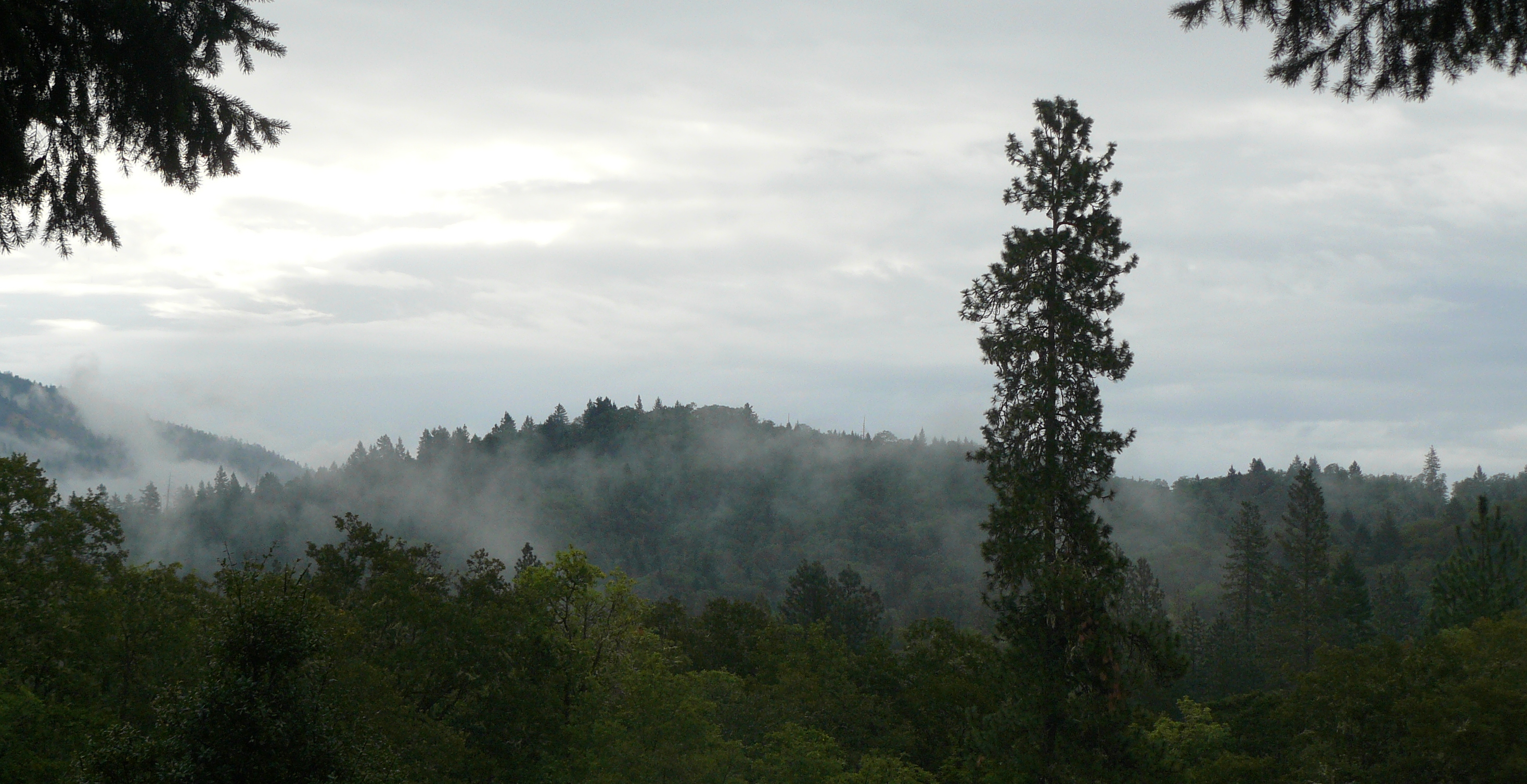
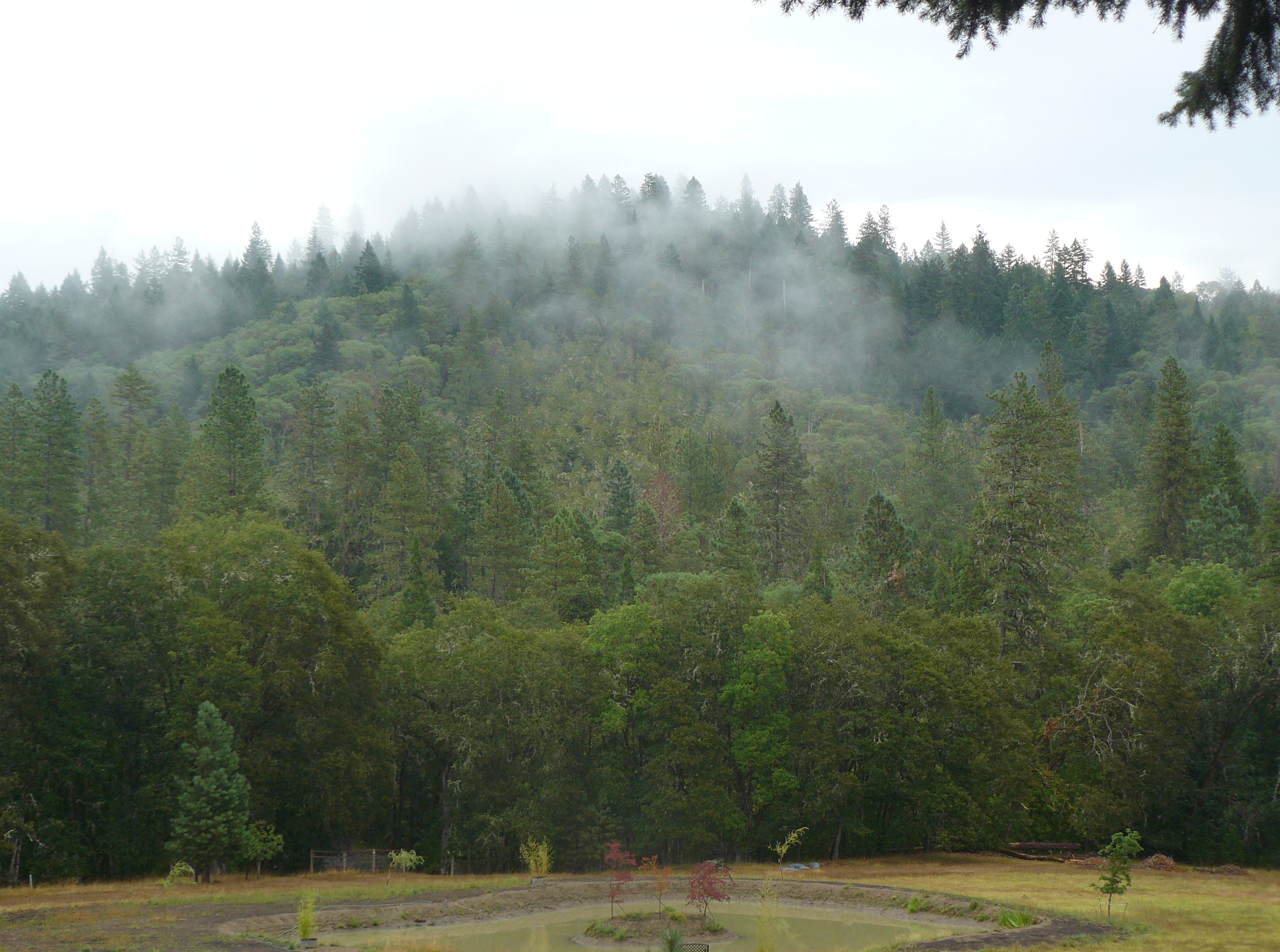
Let me leave you with these two pictures of the softness of cloud and low mist that brought some much-needed rain to us a few days ago.

asas
Looking out to the North-East with Sexton Mountain, some 5 miles away, just off picture to the left.

oooo

asasa
Looking East across our fields to the forest beyond.

If anyone wants to put these pictures into context, there was a property map published in the LfD post of the 22nd, Sing for the trees.