Tag: Neolithic dogs

That relationship!

Dogs and humans go back a long, long way!

We like to think of our relationship with dogs as a moderately recent affair. Not the time since dogs and humans have mixed together, that was a very long time ago, but having a dog as a pet.

But even that view needs to be updated.

Try 4,000 years ago!

ooOOoo

New Study Looks at Why Neolithic Humans Buried Their Dogs With Them 4,000 Years Ago

Analysis of the remains of 26 dogs found near Barcelona suggest the dogs had a close relationship with ancient humans

Specimen of a dog skull ( Wagner Souza e Silva / Museum of Veterinary Anatomy FMVZ USP via Wikicommons under Creative Commons Attribution-Share Alike 4.0 International )

By Marissa Fessenden

SMITHSONIAN.COM
FEBRUARY 14, 2019

Humans have enjoyed a long history of canine companions. Even if it’s unclear exactly when dogs were first domesticated (and it may have happened more than once), archaeology offers some clues as to the nature of their relationship with humans.

The latest clue suggests that humans living in Southern Europe between 3,600 to 4,200 years ago cared for dogs enough to regularly share their gravesites with them. Barcelona-based researchers studied the remains of 26 dogs from four different archaeological sites on the northeastern Iberian Peninsula.

The dogs ranged in age from one month to six years old. Nearly all were buried in graves with or nearby humans. “The fact that these were buried near humans suggests there was an intention and a direct relation with death and the funerary ritual”, says lead author Silvia Albizuri, a zooarchaeologist with the University of Barcelona, in a press release.

To better understand the dogs’ relationship with the humans they joined in the grave, Albizuri and her colleagues analyzed isotopes in the bones. Studying isotopes—variants of the same chemical element with different numbers of neutrons, one of the building blocks of atoms—can reveal clues about diet because molecules from plants and animals come with different ratios of various isotopes. The analysis showed that very few of the dogs ate primarily meat-based diets. Most enjoyed a diet similar to humans, consuming grains like wheat as well as animal protein. Only in two puppies and two adult dogs did the samples suggest the diet was mainly vegetarian.

This indicates that the dogs lived on food fed to them by humans, the team reports in the Journal of Archaeological Science. “These data show a close coexistence between dogs and humans, and probably, a specific preparation of their nutrition, which is clear in the cases of a diet based on vegetables,” says study co-author Eulàlia Subirà, a biological anthropologist at the Autonomous University of Barcelona.
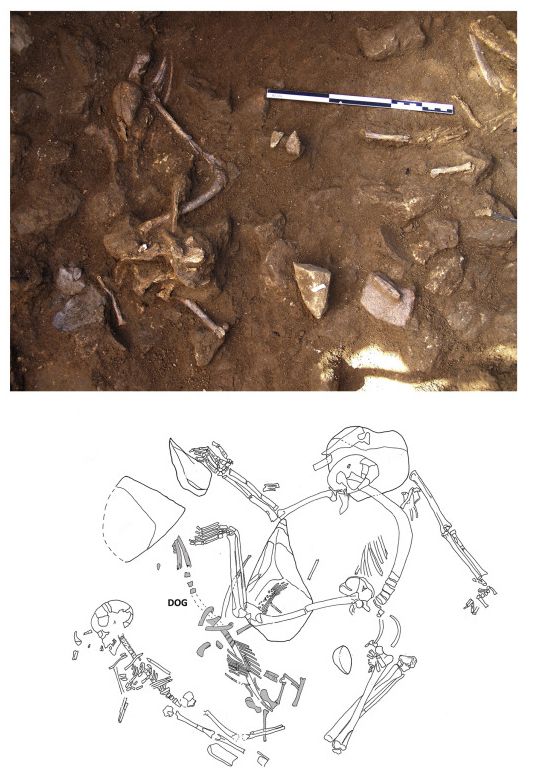
Top: remains of a dog found at the archeological site called La Serreta. Bottom: drawing of dog skeleton found between human skeletons in the necropolis Bòbila Madurell. (UB-UAB)


The archaeological sites all belong to people of the Yamnaya Culture, or Pit Grave Culture. These nomadic people swept into Europe from the steppes north of the Black and Caspian Seas. They kept cattle for milk production and sheep and spoke a language that linguists suspect gave rise to most of the languages spoken today in Europe and Asia as far as northern India.

The buried dogs aren’t the oldest found in a human grave. That distinction belongs to a puppy found in a 14,000-year-old grave in modern-day Germany. The care given to that puppy to nurse it through illness was particularly intriguing to the researchers who discovered it. “At least some Paleolithic humans regarded some of their dogs not merely materialistically, in terms of their utilitarian value, but already had a strong emotional bond with these animals,” Liane Giemsch, co-author on a paper about the discovery and curator at the Archäologisches Museum Frankfurt, told Mary Bates at National Geographic in 2018.

The fact that the researchers in the new study found so many dogs in the region they studied indicates that the practice of burying dogs with humans was common at the time, the late Copper Age through the early Bronze Age. Perhaps the canine companions helped herd or guard livestock. What is certain is that ancient humans found the animals to be important enough to stay close to even in death.

ooOOoo

That last sentence is precious. “What is certain is that ancient humans found the animals to be important enough to stay close to even in death.

As far back as 14,000 years!

We go back a very long time

The ancient history of man and dog!

And when I say ‘man’ I am of course referring to the species.

For a couple of weeks ago Meilan Solly of The Smithsonian wrote about the relationship 4,500 years ago of man and dog.

In Neolithic times there was an important relationship, as there is today. Maybe our dogs have become more of the ‘pet’ rather than the working dog that they are assumed to be then.

But here’s the article.

ooOOoo

Thanks to Facial Reconstruction, You Can Now Look Into the Eyes of a Neolithic Dog

The collie-sized canine was buried in a cavernous tomb on Scotland’s Orkney Islands around 2,500 B.C.

Experts believe the Neolithic dog is the first canine to undergo forensic facial reconstruction (Santiago Arribas/Historic Environment Scotland)
By Meilan Solly
SMITHSONIAN.COM, 

Some 4,500 years ago, a collie-sized dog with pointed ears and a long snout comparable to that of the European grey wolf roamed Scotland’s Orkney Islands. A valued member of the local Neolithic community, the canine was eventually buried alongside 23 other dogs and at least eight humans in a cavernous tomb known as the Cuween Hill Chambered Cairn.

Now, 118 years after archaeologists first chanced upon its resting place, the prized pup’s image is being reimagined. As Esther Addley reports for the Guardian, experts believe the dog is the first canine to undergo forensic facial reconstruction. Its likeness, commissioned by Historic Environment Scotland (HES) and the National Museum of Scotland, is set to go on view in Orkney later this year.

“Just as they’re treasured pets today, dogs clearly had an important place in Neolithic Orkney, as they were kept and trained as pets and guards and perhaps used by farmers to help tend sheep,” Steve Farrar, interpretation manager at HES, explains in a statement. “But the remains discovered at Cuween Hill suggest that dogs had a particularly special significance for the farmers who lived around and used the tomb about 4,500 years ago.”

It’s possible, Farrar adds, that the Neolithic group viewed dogs as their “symbol or totem,” perhaps even dubbing themselves the “dog people.”

Cuween Hill dates to around 3,000 B.C., Sky News reports, but radiocarbon dating places the dog’s actual interment some 500 years later. It remains unclear why the animal was buried so many centuries after the tomb’s creation, but archaeologists posit the timing may point toward the ceremony’s ritual value within the community. As HES observes, the fact that the Orkney residents placed canine remains alongside those of humans could also speak to their belief in an afterlife for both parties.

According to the Scotsman, forensic artist Amy Thornton drew on a CT scan to create a 3-D print of the animal’s skull. After layering clay approximations of muscle, skin and hair onto this base, she cast the model in silicone and added a fur coat designed to mimic that of the European grey wolf. Interestingly, Thornton notes, the process played out much as it would for a human facial reconstruction, although “there is much less existing data” detailing average tissue depth in canine versus human skulls.

The model is the latest in a series of technologically focused initiatives centered on Orkney’s Neolithic residents. Last year, HES published 3-D digital renderings of the chambered cairn on Sketchfab, enabling users to explore the tomb’s four side cells, tall central chamber and entrance passage. First discovered in 1888 but only fully excavated in 1901, the impressive stone structure held 24 canine skulls and the remains of at least eight humans.

In an interview with the Guardian’s Addley, Farrar explains that the reconstruction aims “to bring us closer to who [the dog’s owners] were and perhaps give a little hint of what they believed.”

“When you look at a Neolithic dog, it somehow communicates human relationships,” Farrar concludes. “… I can empathise with the people whose ingenuity made Orkney such an enormously important place. When this dog was around, north-west Europe looked to Orkney.”

ooOOoo

“When you look at a Neolithic dog, it somehow communicates human relationships,” Farrar concludes.

That’s a powerful statement.

Now if one goes across to the website for Cuween Hill Chambered Cairn one reads this:

History

An ancient site for burials

Built between 3000 and 2400 BC, this is an excellent example of a Neolithic chambered tomb. It has four cells opening off a central chamber, which is accessed down a passage. Entrance into the tomb today is through the original passage.

Secondary burials at the Cuween Hill could reflect a continued reverence for the site. A recently discovered settlement nearby is probably contemporary with the cairn, and would likely have been connected.

Tomb of the dogs

Exploration at the tomb in 1901 found:

  • Remains of at least eight humans – five skulls on the floor of the chamber, one at the entrance and two in side cells
  • The skulls of 24 dogs on the chamber floor

The dog remains suggest the local tribe or family perhaps had a dog as their symbol or totem, or there may have been a belief in an afterlife for animals.

The tomb is completely unlit, which serves to both add to the atmosphere and discourage vandalism and graffiti. It also means the tomb is largely free of green algal growth.

The stonework at Cuween Hill is of particularly high quality. The roof of one of the cells is likely to be original, elsewhere the walls and corbelled roofs have survived to a considerable height.

As I said, we go back a very long time!